[Spanish New World Commerce]:Biblio.com
6 325 résultats
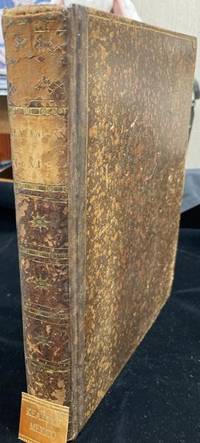
1778réf. 37240Madrid: Pedro Marin 1778. Commercial Policy in Spanish America Detailed rules and regulations governing Spain's late 18th-century commercial policy in Latin America with a preliminary section of nineteen pages providing a summary of the articles and tariffs documented in the main portion of the text. With this REGLAMENTO. the Crown terminated Cadiz and Seville's monopoly of trade with Spanish America allowing other cities of the realm to participate. In addition to much information on commerce and numerous tariffs on a large variety of Spanish and American goods several sections discuss shipping ports and other maritime activities directly related to commercial activity. The work also includes the text of concessions granted to Louisiana. Quarto. Contemporary mottled calf spine gilt extra. Light shelf wear corners rubbed. Contemporary ownership inscription on titlepage modern bookplate on front pastedown clipped booksellers' descriptions pasted to front free endpaper. Text quite clean. Very good plus. PALAU 255843. SABIN 68890. MEDINA BHA 4845. unknown
1778réf. 37240Madrid: Pedro Marin 1778. Commercial Policy in Spanish America Detailed rules and regulations governing Spain's late 18th-century commercial policy in Latin America with a preliminary section of nineteen pages providing a summary of the articles and tariffs documented in the main portion of the text. With this REGLAMENTO. the Crown terminated Cadiz and Seville's monopoly of trade with Spanish America allowing other cities of the realm to participate. In addition to much information on commerce and numerous tariffs on a large variety of Spanish and American goods several sections discuss shipping ports and other maritime activities directly related to commercial activity. The work also includes the text of concessions granted to Louisiana. Quarto. Contemporary mottled calf spine gilt extra. Light shelf wear corners rubbed. Contemporary ownership inscription on titlepage modern bookplate on front pastedown clipped booksellers' descriptions pasted to front free endpaper. Text quite clean. Very good plus. PALAU 255843. SABIN 68890. MEDINA BHA 4845. unknown books
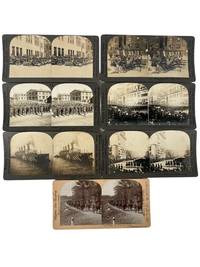
1918réf. 205021918. Buffalo Soldier regiments depicted in stereoview photographs from the World War I era document African American cavalrymen and infantry units serving in segregated formations of the United States Army during the early twentieth century. These images record soldiers from several historically significant Black military units including the 9th U.S. Cavalry the 10th Cavalry and the 369th Infantry Regiment. African American soldiers served in large numbers during World War I despite segregation in the armed forces and the war marked a turning point in public recognition of Black military service. The photographs capture cavalry movement machine gun training and celebratory returns from the European front preserving visual evidence of the military presence and public visibility of Buffalo Soldiers during the conflict. Archive consists of seven stereoview photographs published by the Keystone View Company during the World War I period. The views depict soldiers from the 9th U.S. Cavalry the 8th Regiment of Colored Troops the 10th Cavalry the Chicago Regiment of Colored Troops and the 15th Regiment of the 369th Infantry. Two stereoviews show Black machine gun companies operating Lewis guns one of the principal light machine guns used on the Western Front during the war. Another view shows Troop K of the 10th Cavalry moving on horseback at Camp Chickamauga in Georgia. Additional stereoviews depict African American soldiers returning from European service and marching in public celebrations including scenes of troops parading along major boulevards such as Fifth Avenue in New York. The Buffalo Soldier regiments had already established a long military record before the First World War. Units such as the 10th Cavalry formed part of the segregated Regular Army created after the Civil War and served in campaigns across the western United States during the Indian Wars later participating in the Spanish American War the Philippine American War and operations during the Mexican Revolution. World War I marked one of the final periods in which cavalry units remained visible in American military organization as mechanized armor and motorized vehicles soon replaced mounted troops. At the same time Black soldiers who returned from service were celebrated in wartime parades yet continued to face segregation and racial discrimination within American society. Stereoview cards remain well preserved with light age wear typical of early twentieth century photographic prints. Very good condition overall and a visually compelling record of Buffalo Soldiers during the World War I era. unknown
1918réf. 205021918. Buffalo Soldier regiments depicted in stereoview photographs from the World War I era document African American cavalrymen and infantry units serving in segregated formations of the United States Army during the early twentieth century. These images record soldiers from several historically significant Black military units including the 9th U.S. Cavalry the 10th Cavalry and the 369th Infantry Regiment. African American soldiers served in large numbers during World War I despite segregation in the armed forces and the war marked a turning point in public recognition of Black military service. The photographs capture cavalry movement machine gun training and celebratory returns from the European front preserving visual evidence of the military presence and public visibility of Buffalo Soldiers during the conflict. Archive consists of seven stereoview photographs published by the Keystone View Company during the World War I period. The views depict soldiers from the 9th U.S. Cavalry the 8th Regiment of Colored Troops the 10th Cavalry the Chicago Regiment of Colored Troops and the 15th Regiment of the 369th Infantry. Two stereoviews show Black machine gun companies operating Lewis guns one of the principal light machine guns used on the Western Front during the war. Another view shows Troop K of the 10th Cavalry moving on horseback at Camp Chickamauga in Georgia. Additional stereoviews depict African American soldiers returning from European service and marching in public celebrations including scenes of troops parading along major boulevards such as Fifth Avenue in New York. The Buffalo Soldier regiments had already established a long military record before the First World War. Units such as the 10th Cavalry formed part of the segregated Regular Army created after the Civil War and served in campaigns across the western United States during the Indian Wars later participating in the Spanish American War the Philippine American War and operations during the Mexican Revolution. World War I marked one of the final periods in which cavalry units remained visible in American military organization as mechanized armor and motorized vehicles soon replaced mounted troops. At the same time Black soldiers who returned from service were celebrated in wartime parades yet continued to face segregation and racial discrimination within American society. Stereoview cards remain well preserved with light age wear typical of early twentieth century photographic prints. Very good condition overall and a visually compelling record of Buffalo Soldiers during the World War I era. unknown books
Un disegno originale dell'Autore in copertina (ogni volume reca un disegno diverso). Stampato in occasione del sessantesimo compleanno del poeta Stampato dall'Arte Grafica Bartolomé U. Chiesino S.A. di Buenos Aires. 8vo. pp. 14. . Ottimo (Fine). . Prima ed. di 29 es. numerati e firmati dall'A.. . Empujan, en fin, vientos de libertad marina a la poesía de Rafael Alberti llevándola a explorar todos los espacios de la historia, de la mitología o de la experiencia humana: ''Yo te miraba, oh Cádiz, bahía de los mitos / ... / Canas de antigüedad, tus estelares fábulas, / tus solares historias, / oh gaditano mar de los perdidos / Atlantes, vesperales jardines de la espuma, / islas desvanecidas del Ocaso!'' Los pobres pescadores que salen del Guadalete hacia el mar son los mismos que arribaban a Tarsis en busca de oro y plata y estaño. El mar resume la historia y el mar compendia el sueño. ¿Qué escenario mejor podría soñarse para el encuentro amoroso de Venus y Príapo que el escenario del mar de Cádiz? Uno de los más formidables poemas amorosos de la literatura universal, de ese Diálogo entre Venus y Príapo, acontece en esa bahía: "Amor! La noche se desvae. / Nos baña el mar. (Oh luz!. El mundo canta. / Cae la luna... El viento...)"
1971réf. 51506As New. Hardcover. FREE UPGRADE to Courier/Priority Shipping Upon Request – – IN STOCK AND IMMEDIATELY AVAILABLE FOR SHIPMENT - TEXT PRISTINE COMPLETE FOUR 4 VOLUME SET -Corresponds to ASIN: B0000DW6Q9 -- with a bonus offer--; Guidol Jose; Translated from the Spanish By Lyons Kenneth Goya 1746 - 1828 : Biography Analytical Study and Catalogue of His Paintings - With 1295 Plates Presented in Volumes II III and IV . 1971. hardcover
1957réf. 33570Meridian Books Inc. As New. FREE UPGRADE to Courier/Priority Shipping Upon Request - IN STOCK AND IMMEDIATELY AVAILABLE FOR SHIPMENT - Rebound in library gray-green hardcover binding; else Very Good condition Tight to the spine. This edition marked: "GREENWICH EDITIONS Original first published September 1957 by Meridian Books Inc. " and then "First Printing August 1957". -- Three pages with improperly shaped corners from the original printer paper cut. -several pages have small brown discolored spots on fore-edge or in page margins near fore-edge -- with a bonus offer--; 520-orteg; Ex-Library . 1957. Meridian Books, Inc hardcover
1957réf. 57006Meridian Books Inc. As New. Paperback. FREE UPGRADE to Courier/Priority Shipping Upon Request – – IN STOCK AND IMMEDIATELY AVAILABLE FOR SHIPMENT - Tight to the spine - 190 pages. -- with a bonus offer--; Ex-Library . 1957. Meridian Books, Inc paperback
1987réf. 74409Museum. New. Paperback. FREE UPGRADE to Courier/Priority Shipping Upon Request - IN STOCK AND IMMEDIATELY AVAILABLE FOR SHIPMENT - Flawless copy brand new pristine never opened -- Text in English. 48 pp. With 15 ills. 3 col. . 26 x 18 cm. -- with a bonus offer-- . 1987. Museum paperback
1983réf. 66181Luis Gonzalez-Robles and Jose M. Losada. As New. Paperback. FREE UPGRADE to Courier/Priority Shipping Upon Request – – IN STOCK AND IMMEDIATELY AVAILABLE FOR SHIPMENT - AS NEW THE TEXT BLOCK IS PRISTINE CLEAN UNMARKED AND IN EXCELLENT CONDITION - - Text in English. 72 pp. With 98 ills. 16 col. . 29 x 23 cm. -- with a bonus offer-- . 1983. Luis Gonzalez-Robles and Jose M. Losada paperback
1937réf. SPANISHC002314Left Review London. 1937. First edition. Royal octavo. 24 pages. Wrappers. A publication arising from a letter signed by twelve European writers prominent in Europe including Aragon W.H. Auden Nancy Cunard Heinrich Mann Pablo Neruda Ramon Sender Tristan Tzara etc. The letter was addressed to the writers of England Scotland Ireland and Wales and asked whether they were for or against the government of Republican Spain. Somehow Ezra Pound got involved he was neutral in a combative kind of way: ''Spain is an emotional luxury to a gang of sap-headed dilettantes''. The majority of responses were in favour and these include messages from Samuel Beckett ''�Up the Republic!'' - almost the shortest contribution Kay Boyle Thomas Burke Cyril Connolly Aleister Crowley C. Day Lewis Liam O'Flaherty Ford Madox Ford David Gascoyne Victor Gollancz Laurence Housman Aldous Huxley C.L.R. James Arthur Koestler John Lehmann Rose Macaulay ''AGAINST FRANCO'' - the shortest contribution Hugh Macdiarmid Louis MacNeice John Middleton Murry Sylvia Pankhurst V.S. Pritchett Herbert Read Olaf Stapledon Sylvia Townsend Warner Clough Williams-Ellis etc etc. In the neutral camp were Vera Brittain Robert Byron T.S. Eliot H.G. Wells V. Sackville-West etc. Only five messages are in the ''Against'' section including ones from Edmund Blunden Arthur Machen and Evelyn Waugh. The following year a similar exercise was carried out in America where 418 writers gave their opinions. This pamphlet has also been the inspiration for questionnaires on the Vietnam War and even the Falklands War.Foxing mostly light on almost every page. Covers lightly stained. Spine starting to split. Good. Left Review, London. unknown
1869In -folio, 2 voll., pp. (4), VIII, 1-224, (2), 223-244, 70 tavv. a colori; (4), XLIX, 464, tela con tassello e titolo al dorso. Sontuosa edizione completa di 70 litografie che riproducono, a colori, il cosiddetto “Codice Troano”, uno dei pochi manoscritti superstiti della lingua maya. Si tratta di uno dei primi cospicui tentativi di decodificare la scrittura della civiltà precolombiana: Brasseur (1814-1874) vi si dedicò per oltre cinque anni con passione, diligenza e competenza ma, purtroppo, partendo dallo sbagliato presupposto che i codici riproducessero un alfabeto fonetico, convinzione che derivava da un metodo cinquecentesco messo a punto da Diego de Landa, monaco spagnolo che sarebbe diventato vescovo dello Yucatàn. La tavola comparativa tra alfabeto latino e caratteri maya era inaffidabile. In base alla decrittazione di questo codice, fra l’altro, si ipotizzò la suggestiva descrizione del continente perduto di Mu, mitica terra collocata nel Pacifico. Il lavoro di Brasseur avrebbe avuto un corso scientifico molto limitato, e la sua teoria fu smentita entro la fine del secolo, ma una serie di miti costruiti sulle sue presunte scoperte, fra tutti proprio quello della terra di Mu, hanno avuto corso fino a oggi in ambito parascientifico e in numerose suggestioni letterarie. La pubblicazione fa parte di una serie di opere commissionate da Napoleone III (“Mission scientifique au Méxique”) intese allo studio del Sud America. A luxury edition, complete of 70 lythographies reproducing, in colors, the so said “Troano codex”, one of the few manuscripts survived to Maya civilization’s destruction. This is one of the first attempts to decipher their writing: Brasseur (1814-1874) studied the matter for five years but he was wrongly convinced that the codex was reproducing a phonetic alphabet. The myth of “Mu” land results from this erroneus interpretation. The publication is part of a collection of works about South America commissioned by Napoleon the III.
réf. a-now-infamous-photo-afteHarman B/W Digital Fibre. Limitation of only 20 of each size. First ever printing. Hand numbered. Spanish Tony Media estate stamp to verso. Spanish Tony Sanchez facsimile signature to bottom right recto. Taken 1972 printed 2024. All prices are unframed. If you would like your print to be framed do get in touch. unknown
19334 vols., 8vo., First Edition (one volume a Second Impression), with 4 portrait frontispieces, and numerous plates, facsimiles, maps and plans, neat contemporary inscription on front free endpaper of first volume; original maroon buckram, upper boards blocked in gilt, gilt backs, gilt tops, a very good, bright, crisp, clean set in unclipped, mildly age-soiled dustwrapper. Volume I is a second impression published in the same month as the first edition. SCARCE IN THIS CONDITION. Cohen A97.2(I-IV).a, Woods/ICS A40(aa).
1637réf. ABC_50143Madrid: Juan Sanchez 1637. Disbound. Folio 21 x 29.2 cm. With a woodcut decorated initial. Interesting account in Spanish of two captures and defeats that the Lord Marquis of Floresdavila of His Majesty's Council of War and his Governor and Captain General in those parts had in different Berber villages on the borders of Oran.The "Marquis of Floresdavila" is Antonio Zúñiga y de la Cueva ca. 1590-1652 who was the second Marquis of Flores DAvila General of the Galleys of Naples and Sicily Governor of Oran and Mersw-el-Kébir and of the County od Rousillon and member of the War Council of King Philip IV. Antonio Zúñiga was accompanied during the execution of these very bloody battles by Father Juan Ponce de Léon a 17th-century Spanish presbyter who served as an official "qualifer" calificador of the Holy Office the Spanish Inquisition. The first battle was on 17 November 1636 and following days the other on 5 February 1637 both were bloody and many Muslims and enslaved people were killed. The result was the definitive subjugation of these regions around Oran to the throne of Spain which had not seen a Spaniard before.The pamphlet was printed by Juan Sánchez Frexeneda also known as Juan Sánchez de la Frexeneda a prominent 17th-century Spanish printer and typographer based in Madrid. He operated one of the active printing workshops in Madrid during the Spanish Golden Age active from roughly 1613 until his death in 1639. His press distributed current event broadsheets "Vendese en casa de Esperança Franciscea frontero del Colegio de Atocha" is printed on p. 1.With near- contemporary manuscript foliation in the upper outer corners of the leaves "148-151". Somewhat foxed the edges of the leaves are frayed. Juan Sanchez, unknown
1990The best monograph on the work of this modern Catalan artist (1912-1999), profusely illustrated in color. WITH A SIGNED COLOR SELF-PORTRAIT IN PROFILE BY THE ARTIST ON THE TITLE-PAGE. Large 4to. Original wraps. FINE AND BRIGHT, LIKE NEW.
1966Three volumes, complete. ALL THREE VOLUMES ARE SIGNED FIRST EDITIONS. GOYTISOLO RARELY SIGNS BOOKS, AND THIS SET MAY BE THE ONLY COMPLETE SIGNED SET EVER OFFERED FOR SALE. This trilogy established Goytisolo as a major modern writer and remains his greatest accomplishment. SeÒas de identidad was published in Mexico City in 1966 in an edition of 4100 numbered copies. Don Julian was published in 1970, also in Mexico City, in an edition of 5000 numbered copies. Juan sin tierra was published in 1975 in Goytisolo's native Barcelona. 8vo. First two volumes near fine in publisher's cloth, with very good djs. Third volume very good in publisher's wraps. SeÒas de identidad signed by Goytisolo on half-title, with prior owner's signature on front free endpaper. ReivindicaciÛn signed and inscribed by Goytisolo on front free endpaper. Juan sin tierra signed by Goytisolo on title-page, with prior owner's signature underneath. ALL THREE VOLUMES WERE SIGNED IN TANGIER IN AUGUST, 2013. Included with this set: a great digital photograph of Goytisolo signing the the books.
1793réf. 000703Paris Defer de Maisonneuve 1793
1970réf. 022883New York: Harper & Row Publishers 1970 Stated first edition American first printing without the number line on bottom back page in the second issue dust jacket lacking the exclamation mark at the end of the first paragraph on the front flap. A tiny bump to bottom back corner and light rubbing to spine ends and corners else book in fine condition; dust jacket with a short closed tear/crease to bottom back edge near the flap-fold a short closed tear/crease to foot of back spine fold a tiny closed tear to upper front flap and minor rubbing to extremities. Harper & Row, Publishers hardcover
1800réf. 54439London:: Printed For J. Wright Piccadilly By John Dean 1800. 1800. First edition in English. 4to. Translated from the original Spanish by Maurice Keatinge. Leather and boards viii 514 1 pp. frontispiece map preface. One of the most important firsthand accounts of the Spanish conquest of Mexico. Written by Bernardo Diaz del Castillo a foot soldier who served under Hernan Cortes during the expedition that led to the fall of the Aztec Empire. The book covers the expedition from Cuba to Mexico in 1519; first encounters with Indigenous peoples along the Gulf Coast; the alliance with the Tlaxcalans; the march to Tenochtitlan; meetings between Cortes and Moctezuma II; the uprising in Tenochtitlan and the retreat known as the La Noche Triste; the siege and fall of Tenochtitlan in 1521; etc. The book provides detailed descriptions of Indigenous cities markets and customs; military operations and logistics; relationships among Spanish commanders; daily life of common soldiers; the cultural shock experienced by Europeans encountering Mesoamerican civilization; etc. Encyclopedia Britannica: "Bernal Diaz del Castillo 1495 – 1584 was a Spanish soldier and author who took part in the conquest of the Aztec nation. Diaz's account is written in an unassuming colloquial style and has both historical and artistic value." A.S.W. Rosenstock 19 #193: "All the later histories of America have acknowledged their debt to Bernal Diaz and his work has been acclaimed one of the most valuable source books of the period." The author was an original member of Cortez’s expedition to conquer the Aztec nation. He was involved in the initial planning stages all the way to its culmination. One of the most important sources on the conquest of the Aztec Empire and Mexico. The original leather spine label is missing but a new leather label approximating the original has been placed inside this copy. Retains the original leather boards which exhibit perimeter wear. Internally there are repairs to the hinges with some toning of the text but remarkably free of foxing. In all a very good copy. Printed For J. Wright, Piccadilly, By John Dean, 1800. hardcover
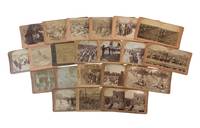
1898réf. 231301898. Spanish-American War stereoview archive circa 1898-1899 documenting how the war was pictured through mass-produced photographic views that followed U.S. mobilization battlefield action occupation and military life across both Cuba and the Philippines. These stereoviews preserves the visual system by which the war was circulated to American audiences showcasing camp organization troop movement burial hospital care naval power and overseas deployment. Particularly notable is the archive's coverage of the Rough Riders the Santiago campaign in Cuba and U.S. presence in Manila and Malate showing how stereoview photography helped normalize the war's expansion from anti-Spanish conflict into a broader American imperial presence. Archive of 21 stereoviews Various publishers. Spanish-American War stereoview archive. Cuba the Philippines and the United States circa 1898-1899. each measuring 3" x 7". The views are drawn from multiple phases and theaters of the war including camp and drill scenes in the United States embarkation and troop arrivals at Tampa battlefield and occupation imagery from Cuba and extensive and some grisly scenes from Manila and surrounding areas in the Philippines. Captions and images show soldiers in formation cavalry drill military reviews naval artillery hospital interiors encampments burial grounds and troops in active position. Cuban views include Morro Castle after bombardment dead and wounded on the battlefield of Santiago U.S. soldiers preparing to invade Cuba and troops dining near Cabañas Fortress. Philippine views include a departure for Manila American pickets routing a Filipino reconnoitering party the 18th Infantry engaged by Filipino outposts volunteers awaiting orders under the tropical sun Army Hospital Manila and "Our Boys in Camp at Malate P.I." One stereoview identifies Roosevelt's Rough Riders in the mobilization phase linking the archive to one of the war's most publicly mythologized units. As a group the stereoviews demonstrate the process by which the Spanish-American War was framed not simply as a short military victory over Spain but as a sustained structure of U.S. troop deployment and occupation extending from Cuba into the Philippines. The Manila and Malate scenes are especially important in this regard since they place American soldiers within the opening phase of the Philippine conflict where U.S. military presence quickly moved beyond liberation rhetoric into imperial control. The archive's mixture of battlefield casualties camp routine naval spectacle and celebratory review scenes shows how stereoscopic publishing converted war into a domestic viewing experience while reinforcing the legitimacy of American expansion abroad. Wear to mounts some toning; overall very good condition. A strong cross-theater visual archive of the Spanish-American War and the emergence of U.S. imperial power in Cuba and the Philippines. unknown
1898réf. 231301898. Spanish-American War stereoview archive circa 1898-1899 documenting how the war was pictured through mass-produced photographic views that followed U.S. mobilization battlefield action occupation and military life across both Cuba and the Philippines. These stereoviews preserves the visual system by which the war was circulated to American audiences showcasing camp organization troop movement burial hospital care naval power and overseas deployment. Particularly notable is the archive's coverage of the Rough Riders the Santiago campaign in Cuba and U.S. presence in Manila and Malate showing how stereoview photography helped normalize the war's expansion from anti-Spanish conflict into a broader American imperial presence. Archive of 21 stereoviews Various publishers. Spanish-American War stereoview archive. Cuba the Philippines and the United States circa 1898-1899. each measuring 3" x 7". The views are drawn from multiple phases and theaters of the war including camp and drill scenes in the United States embarkation and troop arrivals at Tampa battlefield and occupation imagery from Cuba and extensive and some grisly scenes from Manila and surrounding areas in the Philippines. Captions and images show soldiers in formation cavalry drill military reviews naval artillery hospital interiors encampments burial grounds and troops in active position. Cuban views include Morro Castle after bombardment dead and wounded on the battlefield of Santiago U.S. soldiers preparing to invade Cuba and troops dining near Cabañas Fortress. Philippine views include a departure for Manila American pickets routing a Filipino reconnoitering party the 18th Infantry engaged by Filipino outposts volunteers awaiting orders under the tropical sun Army Hospital Manila and "Our Boys in Camp at Malate P.I." One stereoview identifies Roosevelt's Rough Riders in the mobilization phase linking the archive to one of the war's most publicly mythologized units. As a group the stereoviews demonstrate the process by which the Spanish-American War was framed not simply as a short military victory over Spain but as a sustained structure of U.S. troop deployment and occupation extending from Cuba into the Philippines. The Manila and Malate scenes are especially important in this regard since they place American soldiers within the opening phase of the Philippine conflict where U.S. military presence quickly moved beyond liberation rhetoric into imperial control. The archive's mixture of battlefield casualties camp routine naval spectacle and celebratory review scenes shows how stereoscopic publishing converted war into a domestic viewing experience while reinforcing the legitimacy of American expansion abroad. Wear to mounts some toning; overall very good condition. A strong cross-theater visual archive of the Spanish-American War and the emergence of U.S. imperial power in Cuba and the Philippines. unknown books
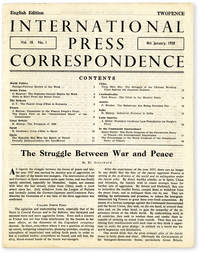
1934réf. 52881London: H.R.G. Jefferson et al 1934-1939. NOTE: Other identified publishers all London include: Unthanks Bookshop; R. Bishop; William Massey. Beginning in July 1938 title changes to "World News and Views." Collection of two hundred forty-nine quarto issues in original staple-bound self-wrappers. Each issue 27cm x 21cm; most issues ca 20pp numbered sequentially. General wear occasional creasing or small losses; some copies marked as "File Copies;" some with red pencil annotations presumably for publication; a few issues with ink pressure stamp of the Los Angeles Workers Library. With the exception of a few issues in 1934 the journal was printed on high-quality newsprint; the run is well-preserved Very Good overall and fully readable. The periodical was issued irregularly from one to as many as three issues per week; our run collates as follows: Vol. 14 1934: 28-14161719-232629-3234-3638-4043-455760-63 32 issues Vol. 15 1935: 1-58-3136383944474850555658596163646668-72 49 issues Vol. 16 1936: 1246-3032-384042-58 53 issues Vol. 17 1937: 248-242642444547-5355-57 47 issues Vol. 18 1938: 1-35-81012-2325273031333436-4044-47525456-60 38 issues Vol. 19 1939: 2-91415181920-2628-3235-4155 30 issues. Beginning in 1918 immediately following the Russian Revolution International Press Correspondence usually called by its acronym INPRECOR became the Communist International's principal international organ for distributing "official" news of the global spread of Marxist ideology. The paper was issued in four languages English French Spanish and German and at its height no fewer than one and as many as three issues per week appeared. The chief audience was the editorial staffs of COMINTERN-aligned newspapers where many of INPRECOR's articles would be republished verbatim. Thus INPRECOR served as a de facto press service for the left-wing media in Europe North and Latin America. In our experience cohesive runs of INPRECOR in any size are unusual; this collection represents a veritable treasure-trove of official COMINTERN policy during the Popular Front period especially valuable for its day-by-day coverage and interpretation of events in Spain before during and after the Civil War and for documenting the rise of fascism across the European continent. Our run ends in August 1939 on the eve of Germany's invasion of Poland and the outbreak of the Second World War. Between that date and 1934 despite occasional lacunae the issues offered here provide a clear and compelling narrative of the sweep of world events leading to the World War and an intimate view of the communist left's response to those events. Even individual issues are somewhat scarce in commerce. Earlier issues of INPRECOR have been digitized by the Marxist Internet Archive ending in 1934. Much of the run is available in microfiche produced by the Communist Party of Great Britain but the imaging is of legendarily poor quality basically illegible in many places. Holdings for physical issues are spotty per WorldCat with many institutions holding small samples or partial runs. H.R.G. Jefferson [et al] unknown
1934réf. 52881London: H.R.G. Jefferson et al 1934-1939. NOTE: Other identified publishers all London include: Unthanks Bookshop; R. Bishop; William Massey. Beginning in July 1938 title changes to "World News and Views." Collection of two hundred forty-nine quarto issues in original staple-bound self-wrappers. Each issue 27cm x 21cm; most issues ca 20pp numbered sequentially. General wear occasional creasing or small losses; some copies marked as "File Copies;" some with red pencil annotations presumably for publication; a few issues with ink pressure stamp of the Los Angeles Workers Library. With the exception of a few issues in 1934 the journal was printed on high-quality newsprint; the run is well-preserved Very Good overall and fully readable. The periodical was issued irregularly from one to as many as three issues per week; our run collates as follows: Vol. 14 1934: 28-14161719-232629-3234-3638-4043-455760-63 32 issues Vol. 15 1935: 1-58-3136383944474850555658596163646668-72 49 issues Vol. 16 1936: 1246-3032-384042-58 53 issues Vol. 17 1937: 248-242642444547-5355-57 47 issues Vol. 18 1938: 1-35-81012-2325273031333436-4044-47525456-60 38 issues Vol. 19 1939: 2-91415181920-2628-3235-4155 30 issues. Beginning in 1918 immediately following the Russian Revolution International Press Correspondence usually called by its acronym INPRECOR became the Communist International's principal international organ for distributing "official" news of the global spread of Marxist ideology. The paper was issued in four languages English French Spanish and German and at its height no fewer than one and as many as three issues per week appeared. The chief audience was the editorial staffs of COMINTERN-aligned newspapers where many of INPRECOR's articles would be republished verbatim. Thus INPRECOR served as a de facto press service for the left-wing media in Europe North and Latin America. In our experience cohesive runs of INPRECOR in any size are unusual; this collection represents a veritable treasure-trove of official COMINTERN policy during the Popular Front period especially valuable for its day-by-day coverage and interpretation of events in Spain before during and after the Civil War and for documenting the rise of fascism across the European continent. Our run ends in August 1939 on the eve of Germany's invasion of Poland and the outbreak of the Second World War. Between that date and 1934 despite occasional lacunae the issues offered here provide a clear and compelling narrative of the sweep of world events leading to the World War and an intimate view of the communist left's response to those events. Even individual issues are somewhat scarce in commerce. Earlier issues of INPRECOR have been digitized by the Marxist Internet Archive ending in 1934. Much of the run is available in microfiche produced by the Communist Party of Great Britain but the imaging is of legendarily poor quality basically illegible in many places. Holdings for physical issues are spotty per WorldCat with many institutions holding small samples or partial runs. H.R.G. Jefferson [et al] unknown books
1758réf. 37969Madrid. 1758. A rare proclamation by Ferdinand VI King of Spain demanding that earlier laws regarding the appointment of judges in the Spanish Indies be observed. The decree states that disregard of these laws and guidelines in the past has been a great injustice causing injury to royal interests and to the general population. This proclamation was to be sent to the viceroys and audiencias throughout the Spanish Indies. This copy accomplished in manuscript at Aranjuez Spain on August 20 1758 is signed by Juan Emanuel Crespo with the inscription "Yo El Rey" and the annotation "Por mandado del Reyno exo. señor." A manuscript inscription on the blank verso of the final printed page dated December 4 1759 confirms that the decree had been reviewed by the President the fiscal and other high-ranking officials in Santiago de Chile. Not in OCLC Medina BHA or Palau. Folio. Dbd. Maltese cross at head of title. Contemporary and later manuscript annotations in ink and later pencil annotation on first page. Accomplished in manuscript with additional manuscript annotations. Manuscript inscription on blank verso of final printed page. Extremely light dampstaining in margins occasional minor soiling and ink stains the latter touching a few letters. Very good. unknown