Francisco de Goya (1746-1828)Livre Rare Book
8 244 résultats
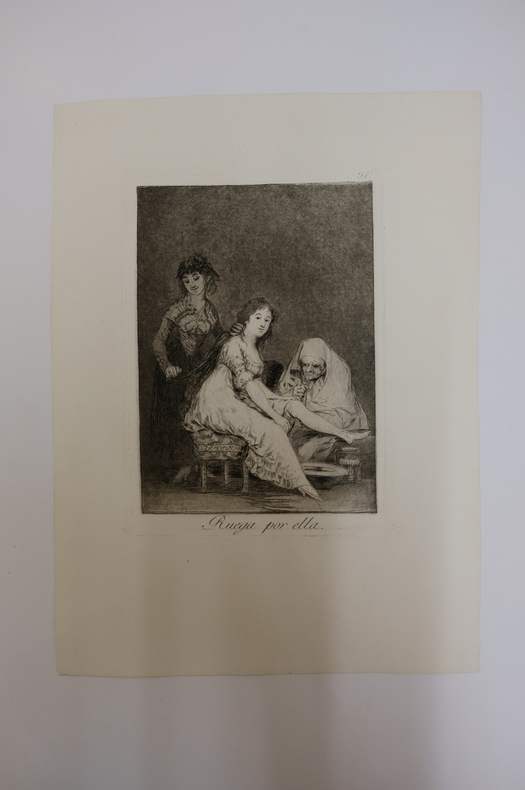
1799réf. est147b2Dimension extérieur 33 x 24,2, cuvette 20,5 x 15 cm. Magnifique eau-forte réalisée par le très célèbre Francisco de Goya en 1799. Elle est en parfait état. Dimensión externa 33 x 24,2, cuenco 20,5 x 15 cm. Hermoso grabado del famosísimo Francisco de Goya en 1799. Está en perfecto estado.
1799réf. est151b2Dimension extérieur 34,5 x 26 cm, cuvette 21,5 x 15 cm. Magnifique eau-forte réalisée par le très célèbre Francisco de Goya en 1799. Elle est en parfait état. Dimensión externa 34,5 x 2- cm, cuenco 21,5 x 15 cm. Hermoso grabado del famosísimo Francisco de Goya en 1799. Está en perfecto estado.
réf. 180321Lima, J. M. Monterola, 1847 in-8, [4]-229 pp., [2] ff. n. ch. (table et errata), demi-chevrette violine, dos lisse orné de filets et guirlandes dorés, tranches mouchetées de rouge, gardes de papier azur (reliure de l'époque). Bon exemplaire.
1972réf. 82762Ediciones Poligrafa S. A 1972-01-01. Hardcover. Very Good. Large format hardcover in jacket with text in Spanish light chip to head of spine of the jacket. All 11 original lithographs are intact. Tight binding no marks. oversized and overweight. Please email for photos. Ediciones Poligrafa, S. A hardcover
réf. DADAX0415152666New unknown
réf. SONG0838460712Used: Good unknown
réf. DADAX071487325XNew unknown
réf. SONG1558851798Used: Good unknown
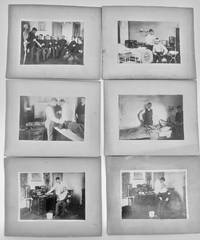
1899réf. 66627Washington D.C. 1899. A collection of photos several showing the medical training or treatment of service men. Ten of the images 5 x 7 in. are mounted on stiff card stock the other five 4 3/4 x 6 1/2 in. are not mounted. All the photos are very good clear. In twelve of the images the same Army medical doctor Frank G. Atwood is shown: using a skeleton to teach anatomy to a group of privates 1; bandaging the head of an injured soldier who sits beside a bed with a blanket belonging to the "U.S.A. Med. Dept. 1887" 1; attending a bed-ridden patient 3 or a patient in his office 1; examining the teeth of other service men 3; listening to the heart of another soldier using his ear 1; preparing medicines 1; and with his horse and medical bag presumably on the grounds of a post hospital 1. The remaining photos show another man bandaging the ankle of an officer 1; an examination table on a swivel base 1; and a troop of soldiers standing at attention with their rifles on a parade ground 1. These photos are likely all from Atwood's time at the U.S. Army medical department in Washington D.C. Dr. Frank G. Atwood was born in Woodbury Connecticut in 1875. He studied veterinary science at the University of Toronto graduating in 1896. He also took post-graduate courses at Yale Medical School and at Johns Hopkins University studying general medicine and surgery. At the outbreak of the Spanish American War he served with the Medical Department of the U.S. Army in Cuba caring for the sick and injured soldiers there. Following the conflict he returned to Washington D.C. "where he was stationed at the General Hospital in the medical department of the United States army caring for the sick and wounded in the capital city for ten months when he returned to New Haven and resumed the practice of the veterinary science." see: "Modern History of New Haven and Eastern New Haven County" by Everett G. Hill NY: 1918 Vol. II pp. 704-5 . Dr. Frank G. Atwood advertised his services as a veterinarian in a W.C.T.U. community cookbook publication "Proved Receipts" from Clinton Madison and Guilford Connecticut 1904 and included his photograph which helped to identify him as the physician in these photos. His obituary published in the New York Times on Sept. 15 1936 states that as a "pioneer research student under Dr. Osler he was active in the Spanish War in the work to stamp out yellow fever." He also operated a large veterinary hospital in New Haven Connecticut for a quarter century. unknown
1899réf. 66627Washington D.C. 1899. A collection of photos several showing the medical training or treatment of service men. Ten of the images 5 x 7 in. are mounted on stiff card stock the other five 4 3/4 x 6 1/2 in. are not mounted. All the photos are very good clear. In twelve of the images the same Army medical doctor Frank G. Atwood is shown: using a skeleton to teach anatomy to a group of privates 1; bandaging the head of an injured soldier who sits beside a bed with a blanket belonging to the "U.S.A. Med. Dept. 1887" 1; attending a bed-ridden patient 3 or a patient in his office 1; examining the teeth of other service men 3; listening to the heart of another soldier using his ear 1; preparing medicines 1; and with his horse and medical bag presumably on the grounds of a post hospital 1. The remaining photos show another man bandaging the ankle of an officer 1; an examination table on a swivel base 1; and a troop of soldiers standing at attention with their rifles on a parade ground 1. These photos are likely all from Atwood's time at the U.S. Army medical department in Washington D.C. Dr. Frank G. Atwood was born in Woodbury Connecticut in 1875. He studied veterinary science at the University of Toronto graduating in 1896. He also took post-graduate courses at Yale Medical School and at Johns Hopkins University studying general medicine and surgery. At the outbreak of the Spanish American War he served with the Medical Department of the U.S. Army in Cuba caring for the sick and injured soldiers there. Following the conflict he returned to Washington D.C. "where he was stationed at the General Hospital in the medical department of the United States army caring for the sick and wounded in the capital city for ten months when he returned to New Haven and resumed the practice of the veterinary science." see: "Modern History of New Haven and Eastern New Haven County" by Everett G. Hill NY: 1918 Vol. II pp. 704-5 . Dr. Frank G. Atwood advertised his services as a veterinarian in a W.C.T.U. community cookbook publication "Proved Receipts" from Clinton Madison and Guilford Connecticut 1904 and included his photograph which helped to identify him as the physician in these photos. His obituary published in the New York Times on Sept. 15 1936 states that as a "pioneer research student under Dr. Osler he was active in the Spanish War in the work to stamp out yellow fever." He also operated a large veterinary hospital in New Haven Connecticut for a quarter century. unknown books
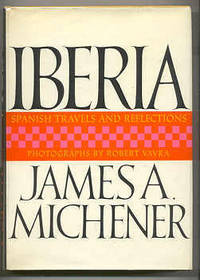
1968réf. 100334NY: Random House 1968. First edition first prnt. Photographs by Robert Vavra. Inscribed by Michener on the front free endpage to Random House editior Bert Krantz. "Random House 1968 To Bert Kranz Who helped so much to put this beautiful book together even though she was damn near dead at the time. Affectionately Jim Michener." Tiny tear at spine top edge very light shelfwear; dustjacket with minimal edgewear mostly at the spine top edge. Near Fine condition in a Near Fine dustjacket with an archival cover. A bright association copy and unique with Michener's sentiments to editor Krantz. Inscribed by Author. First Edition. Hardcovers. Near Fine/Near Fine. 8vo - over 7¾" - 9¾" tall. Association Copy. Random House Hardcover
1968réf. 100334NY: Random House 1968. First edition first prnt. Photographs by Robert Vavra. Inscribed by Michener on the front free endpage to Random House editior Bert Krantz. "Random House 1968 To Bert Kranz Who helped so much to put this beautiful book together even though she was damn near dead at the time. Affectionately Jim Michener." Tiny tear at spine top edge very light shelfwear; dustjacket with minimal edgewear mostly at the spine top edge. Near Fine condition in a Near Fine dustjacket with an archival cover. A bright association copy and unique with Michener's sentiments to editor Krantz. Inscribed by Author. First Edition. Hardcovers. Near Fine/Near Fine. 8vo - over 7¾" - 9¾" tall. Association Copy. Random House Hardcover books
1743Prima edizione rara. In-4°; pp. (32) 328, testatine e capilettera nel testo incise su legno; da p. 249 al termine, musica per la Missa Pro defunctis, Feria quinta in coena domini, Feria sexta in Pasceve, Sabbato sancto, e nel testo numerose parti di musica.Il theatro ecclesiastico è dedicato alle rappresentazioni canore che avevano luogo in chiesa, per le quali si offre un trattato di canto e di coro, con spiegazioni relative alla tecnica canora vera e propria, e di come per le diverse festività ecclesiastiche e a seconda del luogo si dovevano allestire i cori. Legatura in piena pella con tassello, titolo e fregi in oro al dorso. Alcuni foro di tarlo al dorso.
réf. SONG0978715365Used: Good unknown
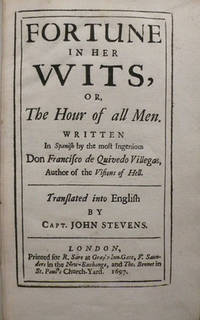
1697réf. 19796London: Printed for R. Sare F. Saunders and Tho. Bennet 1697 1697. First edition in English. ESTC R5377; Wing Q188. Binding particularly the spine rubbed; text fine; very good copy. 8vo contemporary mottled calf gilt decorated and lettered spine. The first English translation of Francisco de Quevedo's La Hora de Todos y la Fortuna con Seso a biting satire of Spanish politics and the follies of the times written under the guise of a prose fantasy. Ouevedo 1580-1645 a contemporary and friend of Cervantes was one of the greatest writers of his era in Spanish literature. The translator Capt. John Stevens was a prolific translator of Spanish literature and author on Spanish subjects. London: Printed for R. Sare, F. Saunders and Tho. Bennet, 1697 unknown
réf. SONG0060253282Used: Good unknown
1898réf. 238901898. Spanish American War glass lantern slide set circa 1898 to 1905 depicting the conflict through a numbered sequence of military portraits United States warships naval engagements troop movements artillery and fighting on land. Produced during the period when the war became a major subject of projected entertainment and illustrated lectures the set belongs to an early visual culture in which distant warfare was reconstructed for audiences through photographs reproduced illustrations portraits and views of military technology. Contemporary dealers marketed Spanish American War lantern programs almost immediately after the 1898 conflict including sets organized around President William McKinley the destruction of the Maine American and Spanish commanders the campaigns in Cuba and the naval war. Photo archive of 36 black and white photographic and reproduced illustrative images on nine numbered glass lantern sheets each approximately 7 1/8 x 2 1/8 inches United States and Cuba circa 1898 to 1905. Each sheet contains four circular images with the surviving sequence numbered 1 through 36. The naval material is particularly extensive with multiple American warships appearing broadside or at anchor and underway accompanied by portraits of uniformed naval officers and scenes of vessels under fire or in rough water. Other images depict sailors or troops gathered around artillery a landing or embarkation crowded with men field guns and their crews soldiers advancing across open ground men fighting from improvised positions mounted troops and battle scenes reproduced from contemporary illustrations. The later numbers shift between portraits of civilian or military figures and active campaign imagery including armed men in tropical vegetation an artillery crew maneuvering a field piece troops moving across broken terrain and mounted soldiers in the field. The Spanish American War lasted only from April to August 1898 but it's cultural impact allowed for photo studios to market the conflict to the American public. The conflict was the first American war in which motion picture cameras played a substantial role and contemporary exhibitors combined films and lantern slides to construct extended accounts from actualities portraits drawings reenactments and views of military sites. The present sheets show minor scratches rubbing and edge wear; no chips or cracks the images remain substantially legible. Overall in very good condition. A compact numbered visual narrative of the Spanish American War showing how commanders modern naval power battlefield action and American military participation were translated into projected history at the turn of the twentieth century. unknown
1898réf. 238901898. Spanish American War glass lantern slide set circa 1898 to 1905 depicting the conflict through a numbered sequence of military portraits United States warships naval engagements troop movements artillery and fighting on land. Produced during the period when the war became a major subject of projected entertainment and illustrated lectures the set belongs to an early visual culture in which distant warfare was reconstructed for audiences through photographs reproduced illustrations portraits and views of military technology. Contemporary dealers marketed Spanish American War lantern programs almost immediately after the 1898 conflict including sets organized around President William McKinley the destruction of the Maine American and Spanish commanders the campaigns in Cuba and the naval war. Photo archive of 36 black and white photographic and reproduced illustrative images on nine numbered glass lantern sheets each approximately 7 1/8 x 2 1/8 inches United States and Cuba circa 1898 to 1905. Each sheet contains four circular images with the surviving sequence numbered 1 through 36. The naval material is particularly extensive with multiple American warships appearing broadside or at anchor and underway accompanied by portraits of uniformed naval officers and scenes of vessels under fire or in rough water. Other images depict sailors or troops gathered around artillery a landing or embarkation crowded with men field guns and their crews soldiers advancing across open ground men fighting from improvised positions mounted troops and battle scenes reproduced from contemporary illustrations. The later numbers shift between portraits of civilian or military figures and active campaign imagery including armed men in tropical vegetation an artillery crew maneuvering a field piece troops moving across broken terrain and mounted soldiers in the field. The Spanish American War lasted only from April to August 1898 but it's cultural impact allowed for photo studios to market the conflict to the American public. The conflict was the first American war in which motion picture cameras played a substantial role and contemporary exhibitors combined films and lantern slides to construct extended accounts from actualities portraits drawings reenactments and views of military sites. The present sheets show minor scratches rubbing and edge wear; no chips or cracks the images remain substantially legible. Overall in very good condition. A compact numbered visual narrative of the Spanish American War showing how commanders modern naval power battlefield action and American military participation were translated into projected history at the turn of the twentieth century. unknown books
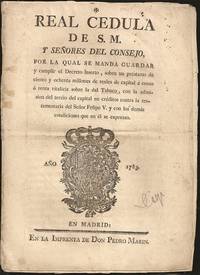
1783réf. CA114212 pages with crest to title page. Quarto 11 1/4" x 8" single folded sheet housed in a custom made enclosure. First edition. Cedula Latin means in general an order or authorization; in earlier times such a document on the authority of the king or a royal decree which for Spain and Spanish America was a decree issued directly by the monarch. During the second half of the eighteenth century the Spanish Crown monopolized the tobacco industry in its American colonies creating vertically integrated organisations which included factories for the production of cigars and cigarettes. Few economic activities were more vital to the development of the Spanish American economies that the cultivation manufacture and commercialization of tobacco. Tobacco was the second most important export industry in Spanish America at the time. The decision of the Bourbon monarchs to monopolize the industry was a critical component of their plan to increase government revenues through a renewed contract with the colonists. This Spanish royal decree issued at the end of the War of American Independence to take effect January 1 1784 alters the basis for the tobacco trade set up as a monopoly under Phillip V and establishing new regulations for the business. This decree mainly affected the American colonies including Louisiana. Condition: Some soiling on front and back; last page has columns of numbers and damp-stain along edge one inner page heavily soiled near head else a very good copy in a fine enclosure. En la Imprenta de Don Pedro Marinan
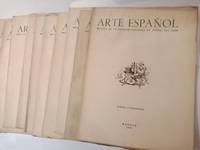
1949réf. 28545Madrid: Sociedad Española de Amigos del Arte1949-1967.- 36 fascículos de unas 45 p. cada uno ilustraciones; 4º 26 cm.- SE OFRECEN los siguientes Nos.: 1949 3er. cuatrimestre 1950 1er. cuatrimestre 1951 completo los tres cuatrimestres 1952 1er. cuatrimestre 1953 a 1962 completos los tres cuatrimestres de cada año además de los tres fascículos que se publicaron para los años 1963-1967 conjuntamente. Es decir faltan el 2º y el 3er. cuatrimestres de los años 1950 y 1952 4 números salvo esto la revista SE OFRECE SEGUIDA desde 1949 3er. cuatrimestre hasta 1967 final por lo que se vende como conjunto. ARTE ESPAÑOL EN GENERAL E HISTORIA DEL ARTE ESPAÑOL Libro en español [Sociedad Española de Amigos del Arte] paperback
réf. 46726Madrid Don Antonio de Sancha 1784 in 8 (19,5x13) 2 volumes reliures pleine basane fauve racinée de l'époque, dos lisses ornés de beaux fleurons dorés, pièces de titre de cuir rouge, pièces de tomaison de cuir vert, guirlande dorée d'encadrement sur les plats, roulette dorée sur les coupes, avec 12 figures gravées hors-texte (12 grabados calcográficos de Moreno Tejada,Brieva, Vázquez y Fabregat, según dibujos de J. Ximeno), petit cachet ex-libris ancien. Tomo 1: XVI et 304 pages, con 6 láminas grabadas (6 figures gravées hors texte). Tomo 2: 364 pages, con 6 láminas grabadas (6 figures gravées hors texte). Imprimés sur beau papier vergé filigrané (exempt de rousseurs). Très bel exemplaire, reliures très fraiches ( Photographies sur demande / We can send pictures of this book on simple request )
réf. 27941Paris 1945 in 4 (26,5x19) 1 volume broché en faux-feuillets sous couverture rempliée, 77 pages [1, coloophon, colofón], chemise et étui bordé. Ouvrage illustré de 6 eaux-fortes originales hors-texte (la dernière signée au crayon dans la marge inférieure par Carles Fontseré), et de bois gravés (lettrines, bandeaux et frontispices) par Carles Fontseré (11 ilustraciones entre texto en la xilografia, formando encabezados, iniciales e inicials de capítulo, más 6 grabados entre texto a pá). Les 6 eaux-fortes originales furent exécutées directement par Carles Fontseré, le tirage fut assuré par le maitre imprimeur Roger Lacourière. Odes de Jacint Verdaguer, Joan Maragall, J. M. Lopez-Pico, Pere Guilanya, dans leur texte catalan et la traduction française en regard, avec une introduction par Rafael Tasis. Tirage limité à 85 exemplaires, celui-ci un des 75 numérotés sur papier velin (N°1-75). Très rare. Bel exemplaire ( Photographies sur demande / We can send pictures of this book on simple request )
réf. DADAX1567183492New unknown
1951réf. 230726k006xbvkI. Paris, Editions André Bonne, 1950. / II. Paris, Editions André Bonne, 1951. I. 375 (1) pages on untrimmed fine paper. / II. 357 (1) pages on untrimmed fine paper; BOTH BOOKS PRINTED BY 'FIRMIN-DIDOT ET CIE. au Mesnil-sur-L'Estrée (Eure)'. --- I. Publisher's titled creme-colour cardboard-cover, hand-bound in brown 3/4-morocco binding with matching vertical 3-cm morocco-strips towards the foreedge, 'tricolour' marbled panels and gilt-titled spine, shiny gilt topedge and blue-marbled endpapers. / II. Publisher's titled creme-colour cardboard-cover, bound in turquoise-blue 3/4-morocco binding with matching large leather-corners, 'tricolour' marbled panels and gilt-titled spine, shiny gilt topedge and tricolour-marbled endpapers. - BOTH SPINES WITH dissimilarly designed slim- resp. broad BLUE-WHITE-RED LEATHER-INLAYS DEPICTING THE FRENCH FLAG ('Tricolore') HOLDING THE PETAINIST EMBLEM - a doubleside 'battle-axe' - also varyingly executed; BOTH BINDINGS STAMP-SIGNED 'M. LANDRÉ' at front endpaper vs. top-left; each 8vo.(ca. 20,5 x 13,5 x 3 cm.).
A very attractive copy of the first edition of one of the most important 17th-century French novels. Complete with the final blank Ee2. 12mo. Contemporary calf, spine gilt. Wear to extremities of binding and gilding on spine somewhat abraded, but structurally solid and still attractive. Large margins. Internally bright and fine except for a couple minor spots. Barbier I, 691c; Brunet V, 59; Graesse VI (1), 226; Rothschild III, 2451. Very rare, especially in a contemporary binding.