[BREVET DE NOBLESSE ESPAGNOL].Livre Rare Book

9532 risultati
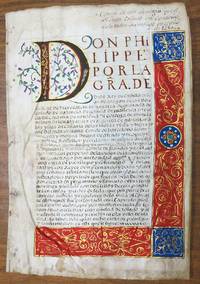
rif. LCS-18309Somptueux manuscrit sur peau de vélin, soigneusement calligraphié à l'encre brune, ligné en rouge, et orné de 21 superbes lettrines enluminées et peintes, dorées ou argentées. Grenade, août 1602. Manuscrit enluminé sur peau de vélin. Petit in-folio de 56 ff.n.ch., le dernier blanc, complet. 34 lignes écrites à l’encre noire sur des lignes rouges horizontales. Justification : 260 x 160 mm. 4 peintures à pleine page, 4 grandes initiales historiées et enluminées en tête de chapitres, 17 initiales ornées et enluminées, 1 portrait du roi. Chaque page est encadrée d’un large filet doré. Relié en velours rouge sur ais de bois, dos à nerfs muet, gardes de peau de vélin. Reliure du XVIIIe siècle. 310 x 208 mm.
1572rif. RF 1076Royal Provision of Phillip II Confirming and Ratifying the Privileges Granted by the Masters of the Order of Santiago to the Village of Corral de Almaguer Toledo 1572 Manuscript. Small folio. 12 1/4 x 8 1/4". 8 double-sided vellum manuscript leaves originally bound together now unbound hand painted and decorated in blue red and gilt at various points throughout the text. The first page is hand-painted and decorated along the edge and includes a large decorative initial in multiple colors. Manuscript text in gothic style. Signed "Yo el Rey" on the back of the final leaf by King Phillip II of Spain in 1572. ATTRACTIVELY ILLUMINATED EARLY MANUSCRIPT. JUDAICA INTEREST. Our manuscript contains the 4 confirmed provisions originally drafted by Infante Henry Duke of Aragon 1421 and 1440 Alonso de Cárdenas here listed as "Alfoso" sic in 1480 and then "The Catholic Kings" in 1494 all of whom at various times served as "Grand Masters of the Order of Santiago". The provisions were instigated against the Jewish communities of the villages of Corral de Almaguer and Ocana in Toledo province. Residents of the towns affiliated with the Order of Santiago repeately complained throughout the 15th and 16th centuries to the the authorities of that order of that the Jews and later conversos had bought land from Christians and had not paid any taxes on their purchases. Ultimately the Jews of Corral de Almaguer were ordered to pay comparable taxes to the Christians for said property but the Jews of Ocana were excepted because of their previous payments of other taxes. Given the fact that this manuscript copy dates from 1572 and was signed and reconfirmed by King Phillip II so long after the expulsion of 1492 shows there were still clearly tensions and persecution of local conversos even long after the communities had converted to Catholicism. The top left margin on the front of the first leaf contains a handwritten note in ink stating in Spanish "It consists of this-privilege that Juan Collado was a secretary of the Order of Santiago in the year 1480". There are a few additional scant marginal notes in ink throughout and additional handwritten notes and signatures some indecipherable on the verso of the final leaf under the King's signature. This document provide a fascinating and invaluable resource to those studying the history of Jews in Spain during the 15th and 16th centuries. Text in Spanish. hardcover
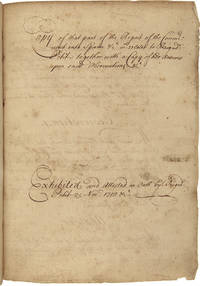
1708rif. 53351Minorca Spain. 1708–1713. Important Documents of the War of the Spanish Succession A lengthy and highly detailed manuscript volume containing documents related to the British takeover of Minorca after its capture from Spain during the War of Spanish Succession and an investigation into the governance of the island. In September 1708 British forces occupied the Mediterranean island with little opposition the inhabitants and nobles having mostly supported the Anglo-Dutch designs for the Spanish throne. The inherent importance of the island as a military outpost and trading way point in the Mediterranean led the British to occupy it for the rest of the war and to receive it as a possession in the Treaty of Utrecht which ended the conflict in 1713. The documents collected here relate to the English Brigadier Lewis Petit who served as Lieutenant Governor and Chief Engineer of the island during its occupation. As Chief Engineer Petit was in charge of improving the fortifications and defenses of Minorca and although a Spanish ally was named as titular Governor Petit exercised the true authority over the island. Although his improvement plans may have been sound his management of the island's public moneys was suspect. "Petit somehow found time to enter into commercial speculations on his own account. In partnership with two Spaniards and Stanhope's secretary Arent Furley Petit purchased a French prize at Mahón for 7800 dollars with which to trade between Minorca Majorca Sardinia and the Spanish and Barbary coasts. He advised Furley that he had found it necessary to use funds supplied for the fortifications to complete the purchase and urgently requested capital from his partners to repay this misappropriation. Petit's participation was valuable to the enterprise owing to his ability to land cargoes at Mahón without paying duty an activity much objected to by the local town government. "Petit was soon to find himself under the scrutiny of the inspectors sent from London to investigate irregularities in the expenditure of the army in Spain as an attempt to disgrace the previous ministry.The accusations against him concerned imperfections in his accounts including allegations of missing vouchers irregularities and overcharging in the numbers of workmen and mules and alleged differences between prices contracted and prices paid among other charges" - DNB. The documents compiled here therefore relate principally to the investigation of those actions by a specially convened Board of Commissioners and contain Petit's written responses to specific inquiries about his expenditures. In transmitting these answers the reports provide a detailed perspective regarding the management of Minorca's finances defenses and engineering improvements under Petit's charge. Moreover in order to buttress or to undermine those claims voluminous correspondence financial figures construction reports testimonies affidavits and other material are reproduced that span the length of the British occupation of the island before it officially became a possession. As a result the manuscript documents contained here provide a thorough encapsulation of the economic and military situation on Minorca and the growth of its importance as a British outpost in the Mediterranean. A highly valuable set of manuscript documents that meticulously details the development and management of a British possession gained through the War of Spanish Succession worthy of much deeper research. Thick quarto. Later three-quarter calf and marbled boards. Moderate wear to edges and spine extremities boards rubbed corners bumped. Small later ownership inscription on front pastedown. Light foxing and tanning marginal dust soiling. Composed in a neat legible hand. Very good. Untrimmed. DNB online. hardcover
1708rif. 53351Minorca Spain. 1708–1713. Important Documents of the War of the Spanish Succession A lengthy and highly detailed manuscript volume containing documents related to the British takeover of Minorca after its capture from Spain during the War of Spanish Succession and an investigation into the governance of the island. In September 1708 British forces occupied the Mediterranean island with little opposition the inhabitants and nobles having mostly supported the Anglo-Dutch designs for the Spanish throne. The inherent importance of the island as a military outpost and trading way point in the Mediterranean led the British to occupy it for the rest of the war and to receive it as a possession in the Treaty of Utrecht which ended the conflict in 1713. The documents collected here relate to the English Brigadier Lewis Petit who served as Lieutenant Governor and Chief Engineer of the island during its occupation. As Chief Engineer Petit was in charge of improving the fortifications and defenses of Minorca and although a Spanish ally was named as titular Governor Petit exercised the true authority over the island. Although his improvement plans may have been sound his management of the island's public moneys was suspect. "Petit somehow found time to enter into commercial speculations on his own account. In partnership with two Spaniards and Stanhope's secretary Arent Furley Petit purchased a French prize at Mahón for 7800 dollars with which to trade between Minorca Majorca Sardinia and the Spanish and Barbary coasts. He advised Furley that he had found it necessary to use funds supplied for the fortifications to complete the purchase and urgently requested capital from his partners to repay this misappropriation. Petit's participation was valuable to the enterprise owing to his ability to land cargoes at Mahón without paying duty an activity much objected to by the local town government. "Petit was soon to find himself under the scrutiny of the inspectors sent from London to investigate irregularities in the expenditure of the army in Spain as an attempt to disgrace the previous ministry.The accusations against him concerned imperfections in his accounts including allegations of missing vouchers irregularities and overcharging in the numbers of workmen and mules and alleged differences between prices contracted and prices paid among other charges" - DNB. The documents compiled here therefore relate principally to the investigation of those actions by a specially convened Board of Commissioners and contain Petit's written responses to specific inquiries about his expenditures. In transmitting these answers the reports provide a detailed perspective regarding the management of Minorca's finances defenses and engineering improvements under Petit's charge. Moreover in order to buttress or to undermine those claims voluminous correspondence financial figures construction reports testimonies affidavits and other material are reproduced that span the length of the British occupation of the island before it officially became a possession. As a result the manuscript documents contained here provide a thorough encapsulation of the economic and military situation on Minorca and the growth of its importance as a British outpost in the Mediterranean. A highly valuable set of manuscript documents that meticulously details the development and management of a British possession gained through the War of Spanish Succession worthy of much deeper research. Thick quarto. Later three-quarter calf and marbled boards. Moderate wear to edges and spine extremities boards rubbed corners bumped. Small later ownership inscription on front pastedown. Light foxing and tanning marginal dust soiling. Composed in a neat legible hand. Very good. Untrimmed. DNB online. hardcover books
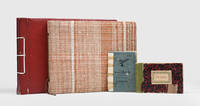
1936rif. 142062Spain & northern Europe: 1936-44. Auf-zum! so ging es tagtäglich" "Off we go! That's how it went every day" An exceptional and unusually complete archive documenting the career of Leutnant Konrad Ellermann a decorated airman who served with the Condor Legion in Spain and later in flying-boat operations on the Eismeer Front. Centred on two meticulously compiled photograph albums and augmented by scarce supporting documents it offers a rare coherent visual record of theatres where comprehensive personal archives seldom survive. The first album charts his Condor Legion service beginning with 43 tourist views of Spain and 25 informal images of squadron life followed by sequences showing Heinkel 59 flying boats in preparation and in flight with aerial views of enemy positions and bomb damage. Ellermann dedicates a page to comrades killed in March 1938 almost certainly the crew of the HE 59 downed near Cambrils and records their funerals and repatriation. Additional images include Condor Legion fighters He 51 He 112 Bf 109 long-range raids from Portbou to Oropesa and bombed railway lines. A section headed "Einiges von den Taten!" depicts two merchant vessels sunk by his unit - the British SS Jean Weems and the Danish SS Edith - alongside further action shots. The album closes with off-duty scenes and high-quality aerial photographs of Pollença Tangier and Portbou. The second album covers northern service. It opens with trials of the Dornier Do 26 flying boat in late 1938 with fine airborne views images of the second prototype and photographs of Dornier staff at work. Other aircraft represented include the Blohm & Voss Ha 139 the Latécoère 521 and the Dornier Do 18. Around 20 aerial views of Norway follow including encounters with He 111s and Ellermann's aircraft moored in Rombaken fjord culminating in a medal ceremony featuring Oberleutnant Karl Otto Max Barth. A final section documents his posting with Flussklärungsfliegerstaffel 1/125 in Finland with portraits of his Heinkel HD 114 scenes in Helsinki and Turku maintenance shots and a concluding portrait of Ellermann. Born in Geisingen in 1915 Ellermann began as a funkmeister before becoming an observer in 1938. He received the Iron Cross First and Second Class the Narvikschild the Frontflugspange für Kampfflieger in gold and silver the Luftwaffe Honour Cup and the Deutsches Kreuz in Gold. His service included AS-88 in Spain 1937-38 Sonderstaffel Tr. O 1939-41 Küstenflieger-Staffel 1/406 in Norway 1942-43 and Seeaufklärungsgruppe 131 1943-45. His surviving logbook records 484 flights between October 1937 and March 1944 378 of them operational including 62 Condor Legion sorties on ships and towns such as Barcelona Sagunto and Alicante. Later missions encompassed reconnaissance and anti-submarine patrols over the North Sea and Norwegian coast one section countersigned by Captain Martin Harlinghausen later the Luftwaffe's leading ship-killer of the Second World War. 4 items. Album 1: 245 x 320 mm original pale red and white rough-weave cloth punch holes at spine golden brown fastening cord bookseller's ticket of Otto Memmert Kiel; 222 original photographs on 24 black card leaves mainly deckle-edged snapshot images most 60 x 90 mm some larger up to 110 x 170 mm manuscript "title page" in coloured chalks with crossed Spanish and Nazi flags. Album 2: 250 x 330 mm original dark red faux leather punch holes to spine white coated-wire fastening tape bookseller's ticket of Bohrer & Co Kiel; 171 original photographs 50 x 60 mm to 240 x 180 mm on 24 tan card leaves glassine guards; manuscript "title page" with illustration of Nazi eagle above legend; 2 divisional pages first with watercolour drawing of unit insignia ram's skull above title; second with watercolour drawing of unit insignia penguin wearing clogs and flying over sea above title. Soldbuch: 28 pp 145 x 100 mm original blue card printed wrappers Ellermann's photograph mounted on inside front cover punch holes with metal eyelets to front cover. Log book: 100 x 155 mm pp. 114. Original marbled sides green cloth spine paper label on front cover. Album 1 in very good condition; Album 2 with a little wear to binding shallow indentations to covers leaf loose; Soldbuch: general signs of handling paper sometime taped around spine; Log book with some loss of marbled paper from front cover a little finger soiling. A well-preserved group. Sebastian Cox & Peter Gray eds Air Power History: Turning Points from Kitty Hawk to Kosovo 2002. hardcover
1770rif. est142t5Dimension extérieur (carton) 43,8 x 59 cm, intérieur 25,5 x 41,2 cm. Gravure dans son jus, scotché sur cadre carton. Image en bon état, très jolie travail de la fin du 18 ème siècle. Dimensiones exteriores (cartón) 43,8 x 59 cm, interiores 25,5 x 41,2 cm. Grabado en su estado original, pegado en un marco de cartón. Imagen en buen estado, obra muy bonita de finales del siglo XVIII.
1979rif. est146t7Dimension extérieur 34,8 x 52,5 cm, cuvette 23,4 x 27,9 cm. Très belle eau-forte moderne, réalisée par Josep Vives Campomar, peintre et graveur espagnol du 20 et 21 ème siècle. Elle fut probablement réalisée en 1979. Tirage 97/100. En excellent état. Dimensiones exteriores 34,8 x 52,5 cm, cuenco 23,4 x 27,9 cm. Bellísimo grabado moderno de Josep Vives Campomar, pintor y grabador español del siglo XX y XXI. Probablemente se hizo en 1979. Tirada 97/100. En excelente estado.