9.162 resultados
ref. DADAX1857090640New unknown
1937ref. 26237Valencia: CNT 1937. 49 tabloid issues ca.48cm with publication seqence as follows: Año II Nos. 219 224-225 227-228 233-234 241-243 245 327-329 331-332 334-340 342 347-349 351-352 356 358-363 365-378. Printed offset on newsprint ca.8pp per issue; illus. Issues show light overall wear and toning creases and small tears with underlining and marginalia in red and blue colored-pencil to most issues; overall Very Good. Substantial run of this Spanish Civil War newspaper the official organ of the anarcho-syndicalist group Confederación Nacional del Trabajo. Published in Valencia between 1936-1939 the paper provided daily coverage of the Republican struggle with articles by Jesus Muro Felix Paredes Enrique Lopez Alarcon Gaston Leval and Juan Lopez et al. Illustrated with political cartoons and caricatures throughout. Large runs extremely uncommon in the trade; OCLC shows just 5 American institutions holding any issues. [CNT] unknown
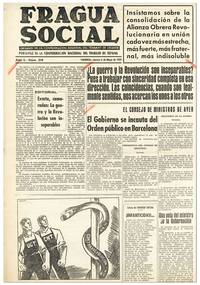
1937ref. 26237Valencia: CNT 1937. 49 tabloid issues ca.48cm with publication seqence as follows: Año II Nos. 219 224-225 227-228 233-234 241-243 245 327-329 331-332 334-340 342 347-349 351-352 356 358-363 365-378. Printed offset on newsprint ca.8pp per issue; illus. Issues show light overall wear and toning creases and small tears with underlining and marginalia in red and blue colored-pencil to most issues; overall Very Good. Substantial run of this Spanish Civil War newspaper the official organ of the anarcho-syndicalist group Confederación Nacional del Trabajo. Published in Valencia between 1936-1939 the paper provided daily coverage of the Republican struggle with articles by Jesus Muro Felix Paredes Enrique Lopez Alarcon Gaston Leval and Juan Lopez et al. Illustrated with political cartoons and caricatures throughout. Large runs extremely uncommon in the trade; OCLC shows just 5 American institutions holding any issues. [CNT] unknown books
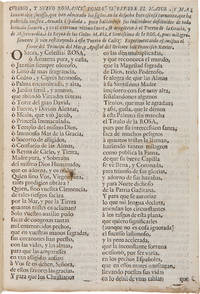
1719ref. 35378Seville: Francisco Garay 1719. A Massive Storm at Sea Versified A four-page ballad describing the enormous storm experienced by the Spanish fleet in 1719 and of the miraculous preservation of the ships which eventually arrived safely in Cadiz. It was this same great fleet which Spain had gathered at Cadiz and Corunna for the invasion of the west of England directed by James Butler the attainted Duke of Ormonde. A rare possibly unique piece of early 18th-century Spanish verse. Not recorded in Palau NUC or on OCLC. 4pp. Small quarto. Modern three-quarter morocco over linen boards spine gilt. Occasional stains holes at bottom of both leaves not effecting text last page of text closely trimmed. A good copy. hardcover
1719ref. 35378Seville: Francisco Garay 1719. A Massive Storm at Sea Versified A four-page ballad describing the enormous storm experienced by the Spanish fleet in 1719 and of the miraculous preservation of the ships which eventually arrived safely in Cadiz. It was this same great fleet which Spain had gathered at Cadiz and Corunna for the invasion of the west of England directed by James Butler the attainted Duke of Ormonde. A rare possibly unique piece of early 18th-century Spanish verse. Not recorded in Palau NUC or on OCLC. 4pp. Small quarto. Modern three-quarter morocco over linen boards spine gilt. Occasional stains holes at bottom of both leaves not effecting text last page of text closely trimmed. A good copy. hardcover books
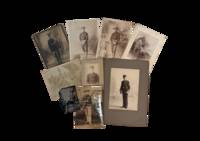
1898ref. 239381898. Spanish American War soldier photo archive depicting American servicemen in uniform campaign clothing armed field equipment and camp settings circa 1898 to 1900 recording the appearance and conditions of service during the rapid wartime expansion of the United States Army. The men appear at different points between enlistment and active service: formally uniformed for studio portraits dressed in campaign hats and leggings armed with a rifle and cartridge belt and seated amid the temporary furnishings of military encampment. In 1898 the United States mobilized a large volunteer force alongside its Regular Army funneling state volunteer regiments through camps before deployment to Cuba Puerto Rico and the Philippines; the Army's Cuba expedition alone embarked approximately 17000 men from the congested staging area around Tampa. Army Historical Program These photographs preserve the individual scale of that mobilization showing soldiers not as distant formations or published battle scenes but as men equipped clothed and housed for wartime service. Photo archive of 9 silver gelatin photographs including one tintype Various sizes ranging from approximately 3.25 x 2.5 to 6.25 x 9 inches circa 1898 to 1900. Several are full length portraits of soldiers wearing the broad brimmed campaign hat dark pullover shirt trousers tucked or fastened into leggings and waist belts associated with field service. One soldier stands before a thatched structure holding a long rifle across his body with a loaded cartridge belt around his waist; another sits outside a tent in campaign clothing his boots and leggings visible. A camp photograph shows a uniformed soldier seated among folding chairs with other servicemen behind him recording the improvised domestic environment in which mobilized troops spent much of their service. The tintype portrays a seated soldier in campaign clothing and hat. Other photographs show men in more formal military dress including a large Brenner Studios Chicago portrait of a soldier standing in a dark buttoned uniform with chevrons visible on his sleeve and another full length portrait of a serviceman in a dark dress coat with contrasting piping and cords. Handwritten versos preserve partial evidence of identity and unit affiliation. One appears to identify a soldier with "Co. K 2nd . Vol. Reg."; another is inscribed to "Mrs. Alice . at Bat Cave N.C."; and another carries a presentation inscription from "Ed. A. Schlesinger." The photographs belong to a military mobilization whose daily realities were often defined less by battlefield action than by mustering training waiting for transportation camp routine illness and preparation for service overseas. Volunteer regiments arrived at large temporary encampments in 1898 with uneven levels of training and equipment while the Army struggled to absorb and transport the sudden influx of personnel. At the Presidio of San Francisco for example volunteers from across the country trained before embarkation for the Philippines and approximately 80000 men passed through the post between the beginning of the Spanish American War and 1900; temporary camps became crowded and sickness repeatedly spread among the troops. The conflict with Spain ended in 1898 but American soldiers remained abroad as occupation duties in former Spanish possessions developed into a prolonged war against the Philippine Republic extending the experience of mobilization and overseas service well beyond the original campaign. The shifts visible here between dress uniforms field clothing weapons tents and camp surroundings record the practical transition from civilian volunteer to wartime soldier at the level of individual servicemen. Some toning fading staining surface wear and edge and corner wear to mounts; several mounts with creasing or small losses with handwritten inscriptions remaining partially legible. Overall in very good condition. A personal photographic record of the uniforms equipment encampment and individual experience of American military service during the mobilization of 1898 and its overseas aftermath. unknown
1898ref. 239381898. Spanish American War soldier photo archive depicting American servicemen in uniform campaign clothing armed field equipment and camp settings circa 1898 to 1900 recording the appearance and conditions of service during the rapid wartime expansion of the United States Army. The men appear at different points between enlistment and active service: formally uniformed for studio portraits dressed in campaign hats and leggings armed with a rifle and cartridge belt and seated amid the temporary furnishings of military encampment. In 1898 the United States mobilized a large volunteer force alongside its Regular Army funneling state volunteer regiments through camps before deployment to Cuba Puerto Rico and the Philippines; the Army's Cuba expedition alone embarked approximately 17000 men from the congested staging area around Tampa. Army Historical Program These photographs preserve the individual scale of that mobilization showing soldiers not as distant formations or published battle scenes but as men equipped clothed and housed for wartime service. Photo archive of 9 silver gelatin photographs including one tintype Various sizes ranging from approximately 3.25 x 2.5 to 6.25 x 9 inches circa 1898 to 1900. Several are full length portraits of soldiers wearing the broad brimmed campaign hat dark pullover shirt trousers tucked or fastened into leggings and waist belts associated with field service. One soldier stands before a thatched structure holding a long rifle across his body with a loaded cartridge belt around his waist; another sits outside a tent in campaign clothing his boots and leggings visible. A camp photograph shows a uniformed soldier seated among folding chairs with other servicemen behind him recording the improvised domestic environment in which mobilized troops spent much of their service. The tintype portrays a seated soldier in campaign clothing and hat. Other photographs show men in more formal military dress including a large Brenner Studios Chicago portrait of a soldier standing in a dark buttoned uniform with chevrons visible on his sleeve and another full length portrait of a serviceman in a dark dress coat with contrasting piping and cords. Handwritten versos preserve partial evidence of identity and unit affiliation. One appears to identify a soldier with "Co. K 2nd . Vol. Reg."; another is inscribed to "Mrs. Alice . at Bat Cave N.C."; and another carries a presentation inscription from "Ed. A. Schlesinger." The photographs belong to a military mobilization whose daily realities were often defined less by battlefield action than by mustering training waiting for transportation camp routine illness and preparation for service overseas. Volunteer regiments arrived at large temporary encampments in 1898 with uneven levels of training and equipment while the Army struggled to absorb and transport the sudden influx of personnel. At the Presidio of San Francisco for example volunteers from across the country trained before embarkation for the Philippines and approximately 80000 men passed through the post between the beginning of the Spanish American War and 1900; temporary camps became crowded and sickness repeatedly spread among the troops. The conflict with Spain ended in 1898 but American soldiers remained abroad as occupation duties in former Spanish possessions developed into a prolonged war against the Philippine Republic extending the experience of mobilization and overseas service well beyond the original campaign. The shifts visible here between dress uniforms field clothing weapons tents and camp surroundings record the practical transition from civilian volunteer to wartime soldier at the level of individual servicemen. Some toning fading staining surface wear and edge and corner wear to mounts; several mounts with creasing or small losses with handwritten inscriptions remaining partially legible. Overall in very good condition. A personal photographic record of the uniforms equipment encampment and individual experience of American military service during the mobilization of 1898 and its overseas aftermath. unknown books
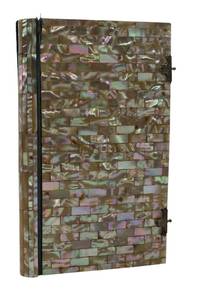
1895ref. AQ31138París: Librería A. Aimond 1895. 4 180pp. Contemporary tessellated mother-of-pearl two metal clasps incorporating a cruciform design. Housed in custom dark green cloth clamshell case. Green cloth joints starting. Leaves lightly browned modern book-label of Robin de Beaumont to verso of FFEP. A late nineteenth-century Parisian edition of the Catholic Liturgy of Hours in Spanish housed in an exceedingly elaborate and frustratingly unsigned contemporary nacre binding. . 12mo. Librería A. Aimond hardcover
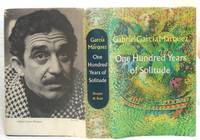
ref. 133132Harper & Row Publishers 1970. Book. Very Good. Hard Cover with Dustjacket. First American Edition First Printing. 8vo - over 7¾ - 9¾" tall. Hardcover with dustjacket: very good / very good minus. Book: very slight bow to binding; binding is clean and bright; very slight softness to spine tips; very slight bump to top outer corner of binding; very slight soiling to outer edges of text block; straight; hinges strong; light rippling to bottom inch or so of text block; pages are clean unmarked; no tears; First Edition stated on copyright page with no additional printings listed on last page. Jacket in new mylar protector; slight soiling on back panel; 1/2" closed tear to bottom back; mild edge wear mostly at spine tips and corners; light rippling to bottom two inches; tiny hole in front; spine might be very slightly faded otherwise bright; $7.95 price 0270 on front flap with exclamation point after America so it is a first state jacket. Not perfect but definitely collectible condition. Harper & Row, Publishers Hardcover
ref. DADAX0071499032New unknown
1703ref. 139168London: Printed and sold by John Nutt 1703. Planting colonies in the Spanish Americas First edition preceding the second edition of that year with an added postscript. Published in the third year of the War of the Spanish Succession 1701-1714 the anonymous author proposes that in return for the support of Britain and the Netherlands for the claim of the Emperor of Austria to the Spanish crown Spain's territories in America should be ceded to the two mercantile powers. They propose a confederation which will share the treasure from the Spanish mines keeping it out of the hands of a single monarch and in so doing preserve the balance of power in Europe. They moreover support extending the war to the Spanish West-Indies at that stage untouched by the conflict and offer proposals to plant colonies there. They respond to critics who would argue that such attempts at joint control of the American mines and territories would engender war between Britain and the Netherlands as trade brings peace and also reject the arguments that American wealth flowing into the mercantile nations would weaken the nation as was believed to be the case in Spain. The polemic nonetheless offers a stark realpolitik view of world politics and of the war treating as irrelevant the moral questions of stripping the territories of their nominal ally Habsburg Spain rather than the official war aims of taking French territories and stemming the growth of Bourbon power. A scarce treatise with ESTC locating six copies for this issue and a further two copies of the second edition Library Hub and Worldcat adding several more yet still absent from many prominent institutional collections and untraced in auction records. Small quarto 205 x 162 mm. Disbound pamphlet with remnants of original spine the pages numbered in an 18th-century hand 589-654 from its original place in the sammelband vol. Lightly browned and foxed top two cords mostly gone but bottom two holding light worming at foot not affecting text tiny hole affecting one letter to pp. 25/26. A very good copy without chipping or repairs. Alden 703153; European Americana 703/53; ESTC T193661; Kress S2261. Not in Sabin. unknown
1932ref. 016152Paris Galerie Georges Petit 1932 In-4 Broché, couverture rempliée
1799Opera tratta dai "Los Caprichos", per la prima volta pubblicati nel 1799. Prova della quinta edizione di dodici, stampata dalla calcografia di Madrid, circa 1883. Acquaforte, acquatinta brunita e puntasecca, in perfetto stato di conservazione. La serie chiamata Los Caprichos è composta da ottanta incisioni, la cui prima edizione [l’unica a non essere pubblicata postuma] venne alla luce nel 1799. Curata in fase d’edizione dallo stesso artista, la serie fu commercializzata e dopo poco tempo ritirata dal mercato. Infatti, a causa dei numerosi soggetti che ironizzavano sulla società spagnola di fine secolo, il Goya subì una censura. L’interpretazione dei soggetti rappresentati su queste lastre, sempre enigmatiche, è spesso controversa Plate 1: portrait of the artist wearing hat, bust-length to left; Fifth Edition c.1883 impression. 1799 Etching, aquatint, drypoint and burinFrom the fifth edition of twelve of the so-called "Los Caprichos" series, edited by the Madrid Calcografia [circa 1883].A very good impression, with good contrast, printed on contemporary paper, customary margins, in very good conditions. The series called Los Caprichos, consists of eighty etchings. This first edition of 1799, the only one not to be published posthumously, is imprinted on soft laid pape. Cured in phase edition by the same artist, the series was marketed and before long withdrawn from the market. In fact, because of the many subjects that mocked the Spanish society of the century, Goya suffered censorship. The interpretation of the subjects represented on these plates, always enigmatic, is often controversial. Harris 36, Delteil 38.
1961Variazioni su di un tema di Romano BILENCHI. Versione di Mario LUZI. Con tre illustrazioni di Gian Luigi Giovanola. Testo a fronte. Alle ultime pagine un componimento autografo scritto a penna dall'Autore dedicato a Picasso, datato Roma, XII 1960, intitolato ''Picasso. Tauromaquia (La pique cassée)''. (With a hand-written poem by Guillen written in blue ink on 3 pages, dedicated to Picasso, dated Rome XII-1960) Volume n. 3 della collana "Poeti stranieri tradotti da poeti italiani". Libro a cura di Vanni Scheiwiller e impresso a Milano dalla Tipografia U. Allegretti di Campi il 9 febbraio 1961. 16mo. pp. 28. Dedica e firma autografe dell'Autore, datata Roma 27/II/1961 (Inscribed and signed by the Author, dated Rome 27/II/1961). Ottimo (Fine). . Prima edizione di 1000 es. numerati. .
1678In -4°, pp. (40), 146, (6), pergamena coeva, difetti al dorso. Prima edizione. Nato a Saragozza, l’autore insegnò a Napoli e Roma prima di partire per Cuba, dove avrebbe passato la vecchiaia. Il libro, interessante e curioso, si occupa di prostituzione e della sua accettabilità dottrinaria, argomento rispetto al quale l’autore è fortemente contrario. Lo scritto replica a un manoscritto (poi stampato a Catania, “Resolutio theologica moralis in qua occasione cuiusdam casus occurrentis afferitur et propugnatur, licite permitti posse Meretrices”, 1677) del francescano Giovanni dell’Olmo, che difendeva il diritto delle prostitute a entrare nelle dimore nobiliari napoletane. La polemica svela molto sui costumi del sesso a pagamento all’epoca. Born in Saragoza, the author was a professor in Naples and Rome before leaving to Cuba. This curious book deals with prostitution and its doctrinaire acceptability (that the author is strongly against to). This work replies to a manuscript (then printed in Catania, “Resolutio theologica moralis in qua occasione… licite permitti posse meretrices”, 1677) of a franciscan preacher, Giovanni dell’Olmo, who supports permission to prostitutes to enter in neapolitan noble palaces. This controversy reveals many facts about prostitution at time.
1914ref. T91037Barcelona, Institut d'Estudis Catalana 1914-1937 Colletion of 22 volumes (in total 24 volumes have been published ever, this collection lacks only vol.3 & 19), together more than 3700pp. with some illustrations in text and some folding maps and plates out-of-text, 24cm., most texts are in Catalan, uniform hardcover bindings with spine in green leather and title in gilt (except for vols.23-24: brown leather), few stamps (at blanco front endpaper and on titlepage), some traces of humidity on volumes 1 and 5 and 9 and 18 (mainly on cloth boards), good condition, rare and almost complete set, [contains a.o. Volume XII (1924): AMADES J. & ROIG E.: Vocabulari de l'Art de la navigacio i la pesca (116pp. with illustrations), vol.XIV (1926): ROIG E. & AMADES J.: Vocabulari de la pesca (83pp. with ills.), Vol.XV (1927): AMADES J.: Essers fantastics (80pp. with some ills.), vol.20 (1932): GRIERA A.: La casa catalana (pp.13-332 with ills. & plates out of text), vol.21 (1935): Indexs generals dels vint primeirs volums (xii + 356pp.), vol.22 (1934): AMADES J.: Vocabulari dels vells oficis de transport i llurs derivats (pp.59-239 with ills.), etc.], total weight is 15kg., T91037
1914Colletion of 22 volumes (in total 24 volumes have been published ever, this collection lacks only vol.3 & 19), together more than 3700pp. with some illustrations in text and some folding maps and plates out-of-text, 24cm., most texts are in Catalan, uniform hardcover bindings with spine in green leather and title in gilt (except for vols.23-24: brown leather), few stamps (at blanco front endpaper and on titlepage), some traces of humidity on volumes 1 and 5 and 9 and 18 (mainly on cloth boards), good condition, rare and almost complete set, [contains a.o. Volume XII (1924): AMADES J. & ROIG E.: Vocabulari de l'Art de la navigacio i la pesca (116pp. with illustrations), vol.XIV (1926): ROIG E. & AMADES J.: Vocabulari de la pesca (83pp. with ills.), Vol.XV (1927): AMADES J.: Essers fantastics (80pp. with some ills.), vol.20 (1932): GRIERA A.: La casa catalana (pp.13-332 with ills. & plates out of text), vol.21 (1935): Indexs generals dels vint primeirs volums (xii + 356pp.), vol.22 (1934): AMADES J.: Vocabulari dels vells oficis de transport i llurs derivats (pp.59-239 with ills.), etc.], total weight is 15kg., T91037
ref. DADAX1601378793New unknown
A bibliophile edition of selections from Berceo's masterpiece, ILLUSTRATED WITH 9 FULL-PAGE HORS-TEXTE MIXED ETCHINGS BY ASCENSION BIOSCA AFTER SANDRA ESCOHOTADO AND FERNANDO CANO. Each etching is SIGNED AND JUSTIFIED BY BIOSCA IN PENCIL. From a total edition of 89 numbered copies, all printed on fine, thick wove paper, this is ONE OF ONLY 40 COPIES WITH THE ETCHINGS PRINTED IN BLACK. Large folio. Loose as issued in wraps. Housed in publisher's attractive silk folding case. Prospectuses laid in. FINE AND BRIGHT. New.
ref. SONG1400001501Used: Good unknown
1899ref. 237631899. American Imperialism and the Colonization of the Philippines: Admiral Dewey Spanish-American War Military Victory Celebration Parade and New Rochelle Life Photo Album 1899-1900. An important photographic record of the public celebration of American imperial expansion following the Spanish-American War highlighted by approximately 38 photographs of the September 30 1899 New York parade honoring Admiral George Dewey and the American victory at Manila Bay. The celebration occurred as the United States was imposing colonial rule over the Philippines and fighting Filipino forces seeking independence giving the photographs particular significance as a visual record of American overseas conquest presented at home through patriotic pageantry military power and mass public celebration. Photo album of approximately 153 photographs including approximately 117 silver gelatin prints and 36 albumen photographs most 3.5 x 2.5 inches New York principally 1899 and 1900. The photographs are held in gray window mounts in a string-bound album and can be removed as they are not adhered to the leaves; handwritten captions and dates occur throughout. Approximately 38 photographs document the military parade celebration showing ranks of West Point cadets mounted cavalry identified as "Troop A" and "Troop C" artillery and horse-drawn equipment military bands American flags and enormous crowds lining the parade route. The official procession included 350 West Point cadets sailors and Marines from Dewey's fleet regular Army troops New York National Guard regiments Spanish-American War veterans and Governor Theodore Roosevelt and his staff. One view is captioned "Only woman in parade" while another photograph depicts the first American flag "hoisted over Morro Castle at Santiago." Dewey's May 1 1898 destruction of the Spanish fleet at Manila Bay helped open the Philippines to American occupation and transformed him into a national symbol of the country's new overseas power. Spain subsequently ceded the Philippines to the United States while Filipinos who had fought for independence resisted American rule resulting in the Philippine-American War beginning in 1899. The New York celebration therefore documented more than Dewey's military homecoming: its flags troops artillery bands political leaders and immense crowds embodied the popular celebration of America's emergence as an imperial power at the very moment it was establishing colonial control over the Philippines. The remainder of the album documents New Rochelle and Long Island Sound life including boating hunting fishing families dogs horses carriages substantial houses residential construction and waterfront recreation. Identified subjects include the launch of "Kathleen" Horseshoe Harbor Glen Island the Columbia Library and the Atlantic City Boardwalk. Bound album with severely worn spine; photographs generally clean and in very good condition with occasional corner wear creasing and small tears. Overall in good condition. unknown
1899ref. 237631899. American Imperialism and the Colonization of the Philippines: Admiral Dewey Spanish-American War Military Victory Celebration Parade and New Rochelle Life Photo Album 1899-1900. An important photographic record of the public celebration of American imperial expansion following the Spanish-American War highlighted by approximately 38 photographs of the September 30 1899 New York parade honoring Admiral George Dewey and the American victory at Manila Bay. The celebration occurred as the United States was imposing colonial rule over the Philippines and fighting Filipino forces seeking independence giving the photographs particular significance as a visual record of American overseas conquest presented at home through patriotic pageantry military power and mass public celebration. Photo album of approximately 153 photographs including approximately 117 silver gelatin prints and 36 albumen photographs most 3.5 x 2.5 inches New York principally 1899 and 1900. The photographs are held in gray window mounts in a string-bound album and can be removed as they are not adhered to the leaves; handwritten captions and dates occur throughout. Approximately 38 photographs document the military parade celebration showing ranks of West Point cadets mounted cavalry identified as "Troop A" and "Troop C" artillery and horse-drawn equipment military bands American flags and enormous crowds lining the parade route. The official procession included 350 West Point cadets sailors and Marines from Dewey's fleet regular Army troops New York National Guard regiments Spanish-American War veterans and Governor Theodore Roosevelt and his staff. One view is captioned "Only woman in parade" while another photograph depicts the first American flag "hoisted over Morro Castle at Santiago." Dewey's May 1 1898 destruction of the Spanish fleet at Manila Bay helped open the Philippines to American occupation and transformed him into a national symbol of the country's new overseas power. Spain subsequently ceded the Philippines to the United States while Filipinos who had fought for independence resisted American rule resulting in the Philippine-American War beginning in 1899. The New York celebration therefore documented more than Dewey's military homecoming: its flags troops artillery bands political leaders and immense crowds embodied the popular celebration of America's emergence as an imperial power at the very moment it was establishing colonial control over the Philippines. The remainder of the album documents New Rochelle and Long Island Sound life including boating hunting fishing families dogs horses carriages substantial houses residential construction and waterfront recreation. Identified subjects include the launch of "Kathleen" Horseshoe Harbor Glen Island the Columbia Library and the Atlantic City Boardwalk. Bound album with severely worn spine; photographs generally clean and in very good condition with occasional corner wear creasing and small tears. Overall in good condition. unknown books
ref. 20757Paris A l'Emblème du Secrétaire 1938 in 4 (26,5x19,5) 4 volumes brochés sous couvertures rempliées, [4], 315 pages; [1] 330 pages; [2] 347 pages; [4] 371 pages. Avec 288 dessins dont 48 hors texte, coloriés au pochoir par Beaufumé, Jon et Raynal. Avec 288 dessins de Dubout, dont 48 hors-texte, coloriés au pochoir par Beaufumé, Jon et Raynal. Tirage limité à 2144 exemplaires, celui-ci un des 56 exemplaires de collaborateurs, celui-ci nominatif imprimé sur royal Vidalon avec une suite en noir des 48 hors-texte. Notre exemplaire est enrichi d'un envoi autographe signé de Dubout et d'un petit dessin en couleurs. Très bel exemplaire ( Photographies sur demande / We can send pictures of this book on simple request )
1738In -4°, pp. (108), 216, 196-199, (8), 229-326, capilettera, testatine e finali; pergamena coeva con lacci e titolo manoscritto al dorso. Qualche foro di tarlo che non incide sul testo. Vari errori di segnatura e numerazione delle pagine. Prima edizione di quest’opera del maggiore poligrafo e scienziato del Perù in epoca colonialista. Il libro si distingue per una vasta incoerenza delle segnature, per l’uso esteso dei capilettera di tipo “factotum”, caratteristiche entrambe dell’editore, Antonio José Gutierrez de Cevallos che possedeva la tipografia “extra muros de Santa Cathalina e fu attivo in città fino al 1750. Pedro Peralta Barnuevo (1663-1743) era rettore della Università di San Marcos e con evidenza scrisse questi dieci sermoni sulla Passione di Cristo per presentarli a una platea universitaria: si distinguono infatti per il ritmo narrativo del testo. Il lavoro è preceduto da un saggio di genealogia sulla famiglia Moscoso, una delle più influenti famiglie del Nuovo mondo, ed è ricco di informazioni storiche e politiche circa questa e altre importanti famiglie messicane, peruviane e spagnole. Vari errori di numerazione e segnatura ma libro completo. The first edition of this work by the major writer and scientist of Peru, at time. The book is interesting under a typographic point of view, because of the extended use of “factotum” initials and a wide incoherence in signatures, both typical of its publisher, Antonio José Gutierrez de Cevallos. The author was dean of San Marcos university and he wrote these ten speeches about Christ passion towards an academic audience. The work is introduced by a genealogic essay about Moscoso family, one of the most important in the New World, rich of historic and politic information about Peru and spanish colonies. Many page number and signature mistakes, but the book is complete.
ref. SONG8484438589Used: Good unknown