3283 risultati
rif. 99104Oxford Clarendon Press 1750. . First edition; two volumes in one; 4to 24 x 19.5 cm; text in Hebrew; contemporary calf boards with gilt borders spine with raised bands leather label joints and spine cracked. A non-vocalised edition of the Pentateuch based on E. van der Hooght's text Darlow & Moule 5141. It is the earliest edition of the Hebrew Bible apart from the London Polyglot to be printed in England. The editor Nathaniel Forster D. D. 17181757 was an English cleric and biblical scholar. Son of a minister he was educated at Eton and at the Corpus Christi College in Oxford. In 1750 he became domestic chaplain to Bishop Joseph Butler who died in his arms two years later in Bath Somerset. ESTC T147721; Darlow & Moule 5151. Oxford, Clarendon Press, 1750. hardcover
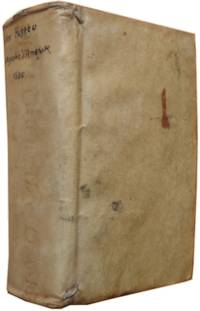
rif. 1502JC008Contenant les grands & hauts poincts desquels elle traite tant pour les choses Morales & Naturelles que pour les diuines & supernatureles. Traduite dItalien en François par le Seigneur du Parc Champenois. A LYON PAR BENOIST RIGAUD. M. D. XCV. 1595. In 8º. 12x8 cm. 816 47 págs. Encadernação em pergaminho flexível do século XVIII com título 2 vezes manuscrito na lombada uma vez ao alto e desvanecido e outra vez na coifa superior. Ilustrado com uma vinheta tipográfica com o retrato do autor no centro da folha de rosto. Reedição da versão original em francês traduzida por Denis Sauvage Sieur du Parc e impressa inicialmente por Guillaume Rouillé em 1551. Exemplar com leves picos de traça marginais sem afectar a leitura do texto. Principal obra deste autor Diálogos de Amor é um diálogo entre dois amantes: Fílon - o amor - e Sofia - a sabedoria. Aí expõe a sua doutrina segundo a qual o amor é o fundamento ontológico do real concebido não apenas como sentimental mas também como intelectual. Deste modo pretende unificar fé e razão embora deixando clara a prevalência da primeira. Pelo amor Deus criou e pelo amor a criatura regressa a Deus. É então o amor que a tudo anima e a tudo harmoniza. Neste sentido Leão Hebreu defende uma conceção cosmológica que à maneira neoplatónica estabelece uma hierarquia de seres que vai do puro espírito - Deus - à matéria. O mundo é visto como um ser vivo composto de superior e inferior respetivamente alma e corpo. O regresso do homem a Deus realiza-se pelo amor na medida em que este é um amor intelectual. Esta visão idealizada e mística do amor exerceu um impacto profundo na literatura ocidental servindo de base direta para a poesia lírica de Luís de Camões e influenciando profundamente autores como Miguel de Cervantes e Baruch Espinoza. A expressão Leão Hebreu refere-se a Judá Abravanel Lisboa c. 1460 Nápoles c. 1530 um influente filósofo médico e poeta judeu sefardita português. O termo também pode estar relacionado à tradução da palavra leão para o hebraico Aryeh ou ao símbolo bíblico do "Leão da Tribo de Judá. Filho do célebre estadista teólogo e financeiro Isaac Abravanel Judá recebeu uma educação excecional que aliou a tradição talmúdica e a Cabala aos estudos de medicina astrologia e filosofia clássica. A sua vida foi profundamente marcada pela instabilidade geopolítica da época: em 1483 a sua família foi forçada a fugir para o Reino de Castela devido a tensões políticas com o rei D. João II de Portugal. Anos mais tarde em 1492 o Decreto de Alhambra promulgado pelos Reis Católicos obrigou-os a um novo exílio desta vez para a península itálica onde Judá enfrentou a dolorosa perda do seu filho primogénito raptado e batizado à força por ordem real. Estabelecido em Itália Judá Abravanel viveu em cidades como Nápoles Génova e Veneza onde exerceu a medicina com grande prestígio chegando a servir como médico pessoal do capitão espanhol Gonzalo Fernández de Córdoba. Foi neste ambiente vibrante do humanismo italiano que conviveu com importantes intelectuais da época e redigiu por volta de 1502 a sua obra-prima os Diálogos de Amor publicados postumamente em 1535. O filósofo faleceu em Nápoles por volta de 1530 deixando um legado intelectual duradouro que fundiu a mística judaica com o neoplatonismo cristão quebrando barreiras religiosas e moldando o pensamento de grandes vultos da cultura ocidental. EN In octavo. 12 × 8 cm. 816 47 pp. 18th-century flexible parchment binding with the title handwritten twice on the spine once at the top where it has faded and once on the upper cap. Illustrated with a typographic vignette featuring the authors portrait in the centre of the title page. A reprint of the original French version translated by Denis Sauvage Sieur du Parc and first printed by Guillaume Rouillé in 1551. Copy with slight marginal moth work that does not affect the readability of the text. This authors main work Diálogos de Amor Dialogues on Love is a dialogue between two lovers: Philo love and Sophia wisdom. In it he sets out his doctrine according to which love is the ontological foundation of reality conceived not only as emotional but also as intellectual. In this way he seeks to unify faith and reason whilst making clear the primacy of the former. Through love God created and through love the creature returns to God. It is therefore love that animates and harmonises all things. Leo the Hebrew advocates a cosmological conception which in the Neoplatonic manner establishes a hierarchy of beings ranging from pure spirit God to matter. The world is viewed as a living being composed of a higher and a lower part namely the soul and the body. Mans return to God is achieved through love insofar as this is an intellectual love. This idealised and mystical vision of love had a profound impact on Western literature serving as a direct basis for the lyric poetry of Luís de Camões and profoundly influencing authors such as Miguel de Cervantes and Baruch Spinoza. The term Hebrew Lion refers to Judah Abravanel Lisbon c. 1460 Naples c. 1530 an influential Portuguese Sephardic Jewish philosopher physician and poet. The term may also be related to the Hebrew translation of the word lion Aryeh or to the biblical symbol of the Lion of the Tribe of Judah. The son of the celebrated statesman theologian and financier Isaac Abravanel Judah received an exceptional education that combined Talmudic tradition and Kabbalah with studies in medicine astrology and classical philosophy. His life was profoundly shaped by the geopolitical instability of the time: in 1483 his family was forced to flee to the Kingdom of Castile due to political tensions with King John II of Portugal. Years later in 1492 the Decree of the Alhambra issued by the Catholic Monarchs forced them into a new exile this time to the Italian peninsula where Judah faced the painful loss of his eldest son who was abducted and forcibly baptised by royal decree. Having settled in Italy Judah Abravanel lived in cities such as Naples Genoa and Venice where he practised medicine with great distinction even serving as personal physician to the Spanish captain Gonzalo Fernández de Córdoba. It was within this vibrant milieu of Italian humanism that he rubbed shoulders with leading intellectuals of the time and around 1502 penned his masterpiece the Dialogues on Love published posthumously in 1535. The philosopher died in Naples around 1530 leaving behind an enduring intellectual legacy that fused Jewish mysticism with Christian Neoplatonism breaking down religious barriers and shaping the thinking of major figures in Western culture. Ref:. Baudrier Bibliogr. lyon. III p. 441. SACO NMANNO1-01 unknown
1701In-folio, (25cc), 2-1155 col, (80cc); legatura in piena pergamena coeva con nervi e titolo al dorso. Sui piatti anteriore e posteriore sigillo di Minerva Dordracena. Seconda edizione 1. Dedicato a Urbano VIII Barberini, con occhiello, antiporta frontespizio , stampato in rosso e nero. Nel testo numerose incisioni su rame raffiguranti svariate tipologie di lumi e lucerne ad olio di varie epoche, oltre a strumenti tipo piccoli imbuti per il riempimento di questi, a candelabri ebraici e a monete. 2. Dedicato al Cardinale Francesco Barberini, numerose illustrazioni su legno nel testo che rappresentano oggetti cultuali ebraici, cristiani e pagani. 3. Dedicato al Cardinale Antonio Barberini, in cui si tratta diffusamente delle cerimonie pubbliche israelitiche, le adorazioni e le acclamazioni. Fortunato Scacchi, dotto filologo e antiquario, nacque intorno al 1573 a Fano, dove morì nel 1643. La sua opera più importante è proprio la presente, un trattato di profonda erudizione, in cui l’autore raccoglie le notizie e i dati storici sugli aromi impiegati dagli ebrei antichi negli unguenti e nei profumi e sulla loro composizione e utilizzo nelle cerimonie sacre. Il testo è ricco di riferimenti ai libri dell’Antico Testamento e a quelli degli autori del mondo greco e romano antico, ma anche all’Arca Santa e alla ‘menorah’ e alle suppellettili per il culto divino. Scacchi parla di ogni sorta di unzione menzionata nelle Sacre Scritture, dalle lampade degli antichi, all’imbalsamazione, ai bagni. Dal cap. XXX al XXXIV del libro I si tratta diffusamente dei Balnea, delle tipologie degli edifici, distinti tra quelli pubblici e quelli privati, degli effetti benefici sul corpo, dei tipi di acque consigliate per i diversi scopi; il bagno preludeva in particolare, per gli atleti, al rituale dell’unzione del corpo, prima della lotta nella sabbia delle arene, ma in genere era anche praticato dopo ogni tipo di attività fisica, sia il gioco della palla che la corsa, per defatigare il corpo ed eliminare il sudore. Nel libro si trova anche ampio spazio dato ai tipi di essenze e alle fasi della composizione vera e propria di questi olii ed unguenti utilizzati dagli atleti. L’autore riporta a proposito l’abitudine di uomini e giovani di stare nudi nelle palestre e nei ginnasi, alcuni passi in cui si sosteneva che questo fosse un incitamento all’amore omosessuale e un preludio al lupanare. Brunet 662 In-folio, (25cc), 2-1155 col, (80cc); coeval full vellum binding with bands and title on the spine. On the upper and back covers seal of Minerva Dordracena. Second edition. 1. Dedicated to Urban VIII Barberini, with half-title, title page with elegant allegorical border engraved in copper, printed in red and black. In the text, numerous copper engravings depicting various types of lamps and oil lamps of various eras, as well as instruments such as small funnels for filling these, with Jewish candlesticks and coins. 2. Dedicated to Cardinal Francesco Barberini, numerous illustrations on wood in the text representing Jewish, Christian and pagan cult objects. 3. Dedicated to Cardinal Antonio Barberini, in which it deals widely with Jewish public ceremonies, adorations and cheers. Fortunato Scacchi, a expert philologist and antiquarian, was born around 1573 in Fano, where he died in 1643. His most important work is the present one, a treatise of profound erudition, in which the author collects news and historical data on the aromas used by ancient Jews in ointments and perfumes and on their composition and use in sacred ceremonies. The text is full of references to the books of the Old Testament and to those of the authors of the ancient Greek and Roman world, but also to the Holy Ark and the 'menorah' and furnishings for divine worship. Scacchi speaks of all sorts of anointments mentioned in the Holy Scriptures, from the lamps of the ancients, to embalming, to the baths. From chap. XXX to XXXIV of book I, the author deals widely with the Balneas, the types of buildings, distinguished between public and private ones, the beneficial effects on the body, the types of water recommended for the various purposes; the bath preluded in particular, for the athletes, to the body anointing ritual, before the fight in the sand of the arenas, but in general it was also practiced after any type of physical activity, both the game of the ball and the races, to defatigate the body and eliminate the sweat. In the book there is also ample space given to the types of essences and the phases of the actual composition of these oils and ointments used by athletes. By the way, the author reports the habit of men and young people to be naked in gyms and gymnasiums, which was claimed as an incitement to homosexual relations and a prelude to brothels. Brunet 662
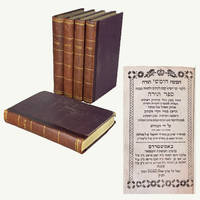
1797rif. T22Octavo approx. 7" x 4.5". 5 vols. Eighteenth century Pentateuch vocalized. Text in Hebrew in single column format. Commentary by Rashi. Title pages within borders. Occasional headpieces and ornaments. Collation: Genesis: 1 title 1-194 1-41 13 1-72 1-32; Exodus: lacks title 1-182 1-52 13 1-72 12 24 1-62; Leviticus: 1 title 1-124 1-42 51 13 1-72 1-54 62 72 84 91; Numbers: 1 title1-154 11-3113 1-72 12 24 32; Deuteronomy: 1 title 1-143 1-32 13 1-72 1-31. Exodus lacks title otherwise complete. Binding: Rebound in quarter calf. Spines lettered in gilt. Marbled endpapers. Accompanied by slipcase. Condition: Clean and bright. The second volume chipped at head and with some staining to lower gutter impacting up to five lines of text. Provenance: "Sara van Gelder Loewenstamm" to front endpaper of first volume. Collection of Tim Lutz. Note: The Proops family were a notable dynasty of Hebrew printers publishers and booksellers in Amsterdam. Solomon ben Yosef d. 1734 likely son of a printer began as a bookseller and in 1704 founded a Hebrew press producing liturgical works as well as texts on halakhah Kabbalah ethics and history. From 1715 his books carried advertisements and in 1730 he issued the first Hebrew sales catalogue. After his death guardians and later his sons continued the press using his name until 1751. In 1785 Joseph Proops sold most stock to Kurzbeck of Vienna; his widow and sons printed on a smaller scale until 1812. Solomon ben Abraham Proops his grandson split in 1797 and worked independently until 1827. Proops family of printers hardcover
1797rif. T22Octavo approx. 7" x 4.5". 5 vols. Eighteenth century Pentateuch vocalized. Text in Hebrew in single column format. Commentary by Rashi. Title pages within borders. Occasional headpieces and ornaments. Collation: Genesis: 1 title 1-194 1-41 13 1-72 1-32; Exodus: lacks title 1-182 1-52 13 1-72 12 24 1-62; Leviticus: 1 title 1-124 1-42 51 13 1-72 1-54 62 72 84 91; Numbers: 1 title1-154 11-3113 1-72 12 24 32; Deuteronomy: 1 title 1-143 1-32 13 1-72 1-31. Exodus lacks title otherwise complete. Binding: Rebound in quarter calf. Spines lettered in gilt. Marbled endpapers. Accompanied by slipcase. Condition: Clean and bright. The second volume chipped at head and with some staining to lower gutter impacting up to five lines of text. Provenance: "Sara van Gelder Loewenstamm" to front endpaper of first volume. Collection of Tim Lutz. Note: The Proops family were a notable dynasty of Hebrew printers publishers and booksellers in Amsterdam. Solomon ben Yosef d. 1734 likely son of a printer began as a bookseller and in 1704 founded a Hebrew press producing liturgical works as well as texts on halakhah Kabbalah ethics and history. From 1715 his books carried advertisements and in 1730 he issued the first Hebrew sales catalogue. After his death guardians and later his sons continued the press using his name until 1751. In 1785 Joseph Proops sold most stock to Kurzbeck of Vienna; his widow and sons printed on a smaller scale until 1812. Solomon ben Abraham Proops his grandson split in 1797 and worked independently until 1827. Proops family of printers hardcover books
1873rif. 140948037Vienna: L. C. Zamarski & C. Dittmarsch 1873. The Babylonian Talmud complete in 24 books bound in 12 volumes. The title page to the first volume is undated but typically dated 1864 in institutional catalogs; the second volume is dated 1866 the last volume is dated 1872 but the last page of the Taharot Vol. XXIV is dated 1873. Tall quarto each volume measuring 14" x 10". Bound in half cloth and paper-covered boards leather spine labels with gilt lettering. Title pages printed in red black yellow and gilt. Very Good overall lots of edge wear with exposed boards chipping toning and wear to spines. Cloth of volume 7 appears to have been inexpertly repaired; binding tape repair to rear hinge. Other than that the bindings are sturdy; contents have a little foxing with age. Occasional marginal notes presumably from either Ernest or Walter Jacob; a few pages of notes in Hebrew laid in as well. This set has a very distinguished provenance: it came from the estate of Walter Jacob a significant leader in Reform Judaism in America author of 43 books and the chief rabbi at Rodef Shalom in Pittsburgh. His father Ernest Israel Jacob 1899-1974 was district rabbi of Augsburg and was deported to Dachau concentration camp for several months after Kristallnacht in 1938; he eventually emigrated to the US. Walter's grandfather Benno Jacob was considered one of the great biblical commentators of liberal Judaism. Ernest Jacob has written a note on the front pastedown of the first volume: "The textual corrections and marginal annotations in this Vienna edition of the Babylonian Talmud are by the late orientalist Samuel Landauer a great Aramaic scholar formally librarian of the University library at Strasbourg Alsace from whose estate I bought this work. Ernest I. Jacob." A lovely 19th century Hebrew edition of the central text of Rabbinic Judaism and the source of Jewish law and theology compiled in the 3rd to 6th centuries in Mesopotamia. International buyers please note: shipping this set outside the United States will require extra charges due to its weight and size. L. C. Zamarski & C. Dittmarsch unknown
1873rif. 140948037Vienna: L. C. Zamarski & C. Dittmarsch 1873. The Babylonian Talmud complete in 24 books bound in 12 volumes. The title page to the first volume is undated but typically dated 1864 in institutional catalogs; the second volume is dated 1866 the last volume is dated 1872 but the last page of the Taharot Vol. XXIV is dated 1873. Tall quarto each volume measuring 14" x 10". Bound in half cloth and paper-covered boards leather spine labels with gilt lettering. Title pages printed in red black yellow and gilt. Very Good overall lots of edge wear with exposed boards chipping toning and wear to spines. Cloth of volume 7 appears to have been inexpertly repaired; binding tape repair to rear hinge. Other than that the bindings are sturdy; contents have a little foxing with age. Occasional marginal notes presumably from either Ernest or Walter Jacob; a few pages of notes in Hebrew laid in as well. This set has a very distinguished provenance: it came from the estate of Walter Jacob a significant leader in Reform Judaism in America author of 43 books and the chief rabbi at Rodef Shalom in Pittsburgh. His father Ernest Israel Jacob 1899-1974 was district rabbi of Augsburg and was deported to Dachau concentration camp for several months after Kristallnacht in 1938; he eventually emigrated to the US. Walter's grandfather Benno Jacob was considered one of the great biblical commentators of liberal Judaism. Ernest Jacob has written a note on the front pastedown of the first volume: "The textual corrections and marginal annotations in this Vienna edition of the Babylonian Talmud are by the late orientalist Samuel Landauer a great Aramaic scholar formally librarian of the University library at Strasbourg Alsace from whose estate I bought this work. Ernest I. Jacob." A lovely 19th century Hebrew edition of the central text of Rabbinic Judaism and the source of Jewish law and theology compiled in the 3rd to 6th centuries in Mesopotamia. International buyers please note: shipping this set outside the United States will require extra charges due to its weight and size. L. C. Zamarski & C. Dittmarsch unknown books
1609rif. 371891Geneva: Pierre de la Rouière 1609. In two columns. 28 184 283 1 84 203 1; 8 186 2 134 2pp. Folio 15 x 9-1/2 inches. Contemporary pigskin covers blocked in gilt and blind remnants of paper label on the spine gauffered edges lacks bosses and hinges and clasps worn at extremities and bottom of spine. Provenance: Johann Georg Feuchter of Jura-Weickersroda inscription on pastedown that the bible was purchased at an August 6 1728 auction for 4 florins and 30 groschen; General Theological Seminary blindstamp. In two columns. 28 184 283 1 84 203 1; 8 186 2 134 2pp. Folio 15 x 9-1/2 inches. Edited with introduction by Benito Arias Montanus 1527-1598 Spanish orientalist and editor of the Antwerp Polyglot a reprint of Plantin's similar edition. Darlow & Moole 5113 OT and 4662 NT Pierre de la Rouière unknown
1609rif. 371891Geneva: Pierre de la Rouière 1609. In two columns. 28 184 283 1 84 203 1; 8 186 2 134 2pp. Folio 15 x 9-1/2 inches. Contemporary pigskin covers blocked in gilt and blind remnants of paper label on the spine gauffered edges lacks bosses and hinges and clasps worn at extremities and bottom of spine. Provenance: Johann Georg Feuchter of Jura-Weickersroda inscription on pastedown that the bible was purchased at an August 6 1728 auction for 4 florins and 30 groschen; General Theological Seminary blindstamp. In two columns. 28 184 283 1 84 203 1; 8 186 2 134 2pp. Folio 15 x 9-1/2 inches. Edited with introduction by Benito Arias Montanus 1527-1598 Spanish orientalist and editor of the Antwerp Polyglot a reprint of Plantin's similar edition. Darlow & Moole 5113 OT and 4662 NT Pierre de la Rouière unknown books
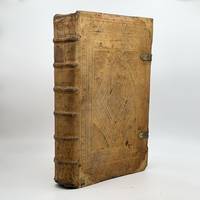
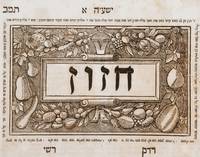
1619rif. 52679Basel: Ludwig König 1619. First edition in part. Hardcover. Good. Eight parts in three volumes folio biblical texts and commentary in four parts continuously foliated; three supplemental sections each with separate foliation; Tiberias 1655 with separate pagination here bound after the Haftarot - Vol. 1: 6 title and prelims 1-228 1 sect. title 234-441 1 blank ff. Vol. 2: 1 sect. title 442-705 3 blank 707 sect. title-837 1 blank ff. Vol. 3: 839 half-title-881 1 blank 883-946; 8 Targum Yerushalmi; last leaf unfoliated; 67 Masorah 1 blank; 1 title 2-36 Haftarot ff.; 8 title and prelims 108pp. Despite the gap in foliation between the first and second parts and numerous errors in foliation throughout the Rabbinic Bible collates complete with all blanks noted in Prijs Die Basler hebräischen Drucke and the Haftarot bound at the end. Largely arranged in two columns of biblical texts in square font surrounded by commentaries in rabbinic Rashi font; biblical texts read from right to left. This copy with collective Hebrew title surrounded by biblical quotations in Hebrew set within elaborate woodcut architectural borders; brief preface in Hebrew by Abraham Braunschweig at the verso. Hebrew sectional titles set within the same woodcut borders for the three other biblical sections and the Haftarot with a plain letterpress half-title for the Five Megillot. Opening word of each biblical book set in large one-third to one-half page cartouche vignettes with elaborate woodcut borders and surrounding letterpress Hebrew text. Main title Jewish date chronogram = 5378 1618-1619. Near-contemporary half calf over speckled boards worn and rubbed; spines with raised bands gilt morocco lettering pieces and old paper labels heavily faded. About two-thirds of the text embrowned ranging from minimal to moderately heavy; worm tracing in a 1- by 2-inch section at leaves 541-553 affecting text. A good complete set notably containing the Ashkenazi Haftarot readings not found in all copies. Sixth Rabbinic Bible in Hebrew: Mikra'ot Gedolot edited by Johann Buxtorf I 1565-1629 professor of Hebrew at the University of Basel and the foremost Christian Hebraist of his era with the assistance of the Jewish scholars Abraham Braunschweig who served as the principal corrector and Mordechai Gumplin of Posen. This was "a truly audacious undertaking for his time" Burnett as no Christian scholar had yet attempted to edit the entire biblical corpus including the Aramaic versions Targumim and masoretic notes. Based mainly on the third Rabbinic Bible published by Daniel Bomberg at Venice in 1546-1548 the editor has carefully incorporated elements from two other Venetian editions. At the verso of the Latin title Buxtorf provides a detailed bibliographical excursus on the earlier Venetian editions and offers a tribute to Bomberg's industry by reprinting the colophon of the second Venetian Rabbinic Bible 1524-1525 at the conclusion of the masoretic appendix with text by the Hebrew grammarian and lexicographer Elijah Levita 1468 or 1469-1549 and a new introduction by Abraham Braunschweig. The design of the sectional titles and separate book title vignettes closely model those of the Venetian editions. "Buxtorf did not plan simply to reprint one of the existing Venice editions but rather to assemble the best features of them all into one work" and "to provide theologians with what he considered the most important tools for interpreting the Old Testament" Burnett. Buxtorf served in an official capacity as Basel's Hebrew censor charged with the oversight of all Jewish printing in the city and insuring that "no 'blasphemies' or slurs against Christians or Christianity appear in any book printed in Basel" Burnett. He carefully edited the Jewish commentaries in the Rabbinic Bible in accordance with this mandate "and removed many words and phrases which had escaped the attention of earlier censors" Burnett. The Rabbinic Bible contains the vocalized Masoretic text of the Hebrew Scriptures with accents and a vocalized Targum an Aramaic paraphrase of the biblical text: Onkelos for the Pentateuch; Jonathan b. Uzziel for the Prophets; and Targum Hagiographa for the Writings. The Hebrew and Aramaic versions are printed in square characters and presented in facing columns at the center of each page. The Jerusalem Targum of the Pentateuch appears as an appendix. In addition to the Aramaic paraphrases the Rabbinic Bible includes a massive scholarly apparatus of biblical commentaries by Rashi Ibn Ezra Baal ha-Turim Jacob b. Asher R. David Kimchi Radak R. Levi b. Gershon Ralbag Saadia Gaon and R. Isaiah along with the Masora a corpus of critical notes on the external form of the Biblical text compiled by Jewish scholars from late antiquity through the medieval era. As frequently occurs a copy of Buxtorf's work on the textual history of the Hebrew Bible Tiberias the 1655 revised edition is bound-in. This work was made possible by the publication in 1538 of Elijah Levita's Masoret ha-Masoret a commentary on the Masora which Buxtorf translated into Latin for his own private use in 1593. While "Buxtorf was concerned with the integrity of the consonantal text and the origin and integrity of the vowel points and accents of the Hebrew Bible from the very beginning of his scholarly career." While he had earlier published a long excursus on the age of the vowel points and accents in his 1609 Thesaurus Grammaticus "Tiberias is Buxtorf's fullest and most impressive work on the history of the biblical text" Burnett. Intended as a reference work for Christian students and scholars interested in studying the Masora Buxtorf was also keen to refute the view advanced by Levita that the Hebrew vowel points were early medieval innovations. Our folio version of Tiberias was intended to accompany the Rabbinic Bible and has the same architectural borders at the title. König also published a quarto edition in the same year but only the folio version includes a critical commentary on the Masora in which Buxtorf proposes various corrections to the Masoretic notes. As noted at the title Buxtorf's faithful study and tireless labor studio fido et labore indefesso yielded notably long-lasting results: "The Basel rabbinical Bible became a standard tool for research among Christian scholars and would remain so. until the end of the nineteenth century" Burnett. A vast array of early modern scholars including Protestants like Johannes Drusius and John Selden as well as Roman Catholics like Robert Bellarmine and Andreas Masius owned a copy or two of the Rabbinic Bible. "Johannes Buxtorf's thoroughly censored "Christian" version of the Rabbinic Bible Basel 1618-19 only made it easier for Hebraists to own copies of their own" Burnett Christian Hebraism in the Reformation Era p.163. A note on the date of publication: "The actual printing began between the mid-August and mid-September of 1618. According to the colophon production ended on the 24 of Ab 379 = August 4 1619 but since this date also appeared on the colophon of the Bomberg Biblia rabbinica edition of 1524-25 reprinted unchanged in the 1546-48 and 1568 editions it is suspect. Prijs suggested that the probable completion date was sometime during Ab of 379 between July 12 and August 10 of 1619" Burnett. References: Biblia Sacra: Burnett 7. Cowley 87. Darlow & Moule 5120 like our copy bound with the 1665 second edition of Tiberias cf. 5093. Davidson Otsar ha-shirah vol.1 p.406 no.8954. Prijs 219. Steinschneider 423 423b. VD17 23:675325G. S. Burnett Christian Hebraism in the Reformation Era Leiden: Brill 2012 p.163. Tiberias: Burnett 114. Prijs 272a. For detailed analyses of both works see: S. Burnett From Christian Hebraism to Jewish Studies Leiden: Brill 1996 pp.169-239 chaps. 6 & 7. Ludwig König hardcover
1619rif. 52679Basel: Ludwig König 1619. First edition in part. Hardcover. Good. Eight parts in three volumes folio biblical texts and commentary in four parts continuously foliated; three supplemental sections each with separate foliation; Tiberias 1655 with separate pagination here bound after the Haftarot - Vol. 1: 6 title and prelims 1-228 1 sect. title 234-441 1 blank ff. Vol. 2: 1 sect. title 442-705 3 blank 707 sect. title-837 1 blank ff. Vol. 3: 839 half-title-881 1 blank 883-946; 8 Targum Yerushalmi; last leaf unfoliated; 67 Masorah 1 blank; 1 title 2-36 Haftarot ff.; 8 title and prelims 108pp. Despite the gap in foliation between the first and second parts and numerous errors in foliation throughout the Rabbinic Bible collates complete with all blanks noted in Prijs Die Basler hebräischen Drucke and the Haftarot bound at the end. Largely arranged in two columns of biblical texts in square font surrounded by commentaries in rabbinic Rashi font; biblical texts read from right to left. This copy with collective Hebrew title surrounded by biblical quotations in Hebrew set within elaborate woodcut architectural borders; brief preface in Hebrew by Abraham Braunschweig at the verso. Hebrew sectional titles set within the same woodcut borders for the three other biblical sections and the Haftarot with a plain letterpress half-title for the Five Megillot. Opening word of each biblical book set in large one-third to one-half page cartouche vignettes with elaborate woodcut borders and surrounding letterpress Hebrew text. Main title Jewish date chronogram = 5378 1618-1619. Near-contemporary half calf over speckled boards worn and rubbed; spines with raised bands gilt morocco lettering pieces and old paper labels heavily faded. About two-thirds of the text embrowned ranging from minimal to moderately heavy; worm tracing in a 1- by 2-inch section at leaves 541-553 affecting text. A good complete set notably containing the Ashkenazi Haftarot readings not found in all copies. Sixth Rabbinic Bible in Hebrew: Mikra'ot Gedolot edited by Johann Buxtorf I 1565-1629 professor of Hebrew at the University of Basel and the foremost Christian Hebraist of his era with the assistance of the Jewish scholars Abraham Braunschweig who served as the principal corrector and Mordechai Gumplin of Posen. This was "a truly audacious undertaking for his time" Burnett as no Christian scholar had yet attempted to edit the entire biblical corpus including the Aramaic versions Targumim and masoretic notes. Based mainly on the third Rabbinic Bible published by Daniel Bomberg at Venice in 1546-1548 the editor has carefully incorporated elements from two other Venetian editions. At the verso of the Latin title Buxtorf provides a detailed bibliographical excursus on the earlier Venetian editions and offers a tribute to Bomberg's industry by reprinting the colophon of the second Venetian Rabbinic Bible 1524-1525 at the conclusion of the masoretic appendix with text by the Hebrew grammarian and lexicographer Elijah Levita 1468 or 1469-1549 and a new introduction by Abraham Braunschweig. The design of the sectional titles and separate book title vignettes closely model those of the Venetian editions. "Buxtorf did not plan simply to reprint one of the existing Venice editions but rather to assemble the best features of them all into one work" and "to provide theologians with what he considered the most important tools for interpreting the Old Testament" Burnett. Buxtorf served in an official capacity as Basel's Hebrew censor charged with the oversight of all Jewish printing in the city and insuring that "no 'blasphemies' or slurs against Christians or Christianity appear in any book printed in Basel" Burnett. He carefully edited the Jewish commentaries in the Rabbinic Bible in accordance with this mandate "and removed many words and phrases which had escaped the attention of earlier censors" Burnett. The Rabbinic Bible contains the vocalized Masoretic text of the Hebrew Scriptures with accents and a vocalized Targum an Aramaic paraphrase of the biblical text: Onkelos for the Pentateuch; Jonathan b. Uzziel for the Prophets; and Targum Hagiographa for the Writings. The Hebrew and Aramaic versions are printed in square characters and presented in facing columns at the center of each page. The Jerusalem Targum of the Pentateuch appears as an appendix. In addition to the Aramaic paraphrases the Rabbinic Bible includes a massive scholarly apparatus of biblical commentaries by Rashi Ibn Ezra Baal ha-Turim Jacob b. Asher R. David Kimchi Radak R. Levi b. Gershon Ralbag Saadia Gaon and R. Isaiah along with the Masora a corpus of critical notes on the external form of the Biblical text compiled by Jewish scholars from late antiquity through the medieval era. As frequently occurs a copy of Buxtorf's work on the textual history of the Hebrew Bible Tiberias the 1655 revised edition is bound-in. This work was made possible by the publication in 1538 of Elijah Levita's Masoret ha-Masoret a commentary on the Masora which Buxtorf translated into Latin for his own private use in 1593. While "Buxtorf was concerned with the integrity of the consonantal text and the origin and integrity of the vowel points and accents of the Hebrew Bible from the very beginning of his scholarly career." While he had earlier published a long excursus on the age of the vowel points and accents in his 1609 Thesaurus Grammaticus "Tiberias is Buxtorf's fullest and most impressive work on the history of the biblical text" Burnett. Intended as a reference work for Christian students and scholars interested in studying the Masora Buxtorf was also keen to refute the view advanced by Levita that the Hebrew vowel points were early medieval innovations. Our folio version of Tiberias was intended to accompany the Rabbinic Bible and has the same architectural borders at the title. König also published a quarto edition in the same year but only the folio version includes a critical commentary on the Masora in which Buxtorf proposes various corrections to the Masoretic notes. As noted at the title Buxtorf's faithful study and tireless labor studio fido et labore indefesso yielded notably long-lasting results: "The Basel rabbinical Bible became a standard tool for research among Christian scholars and would remain so. until the end of the nineteenth century" Burnett. A vast array of early modern scholars including Protestants like Johannes Drusius and John Selden as well as Roman Catholics like Robert Bellarmine and Andreas Masius owned a copy or two of the Rabbinic Bible. "Johannes Buxtorf's thoroughly censored "Christian" version of the Rabbinic Bible Basel 1618-19 only made it easier for Hebraists to own copies of their own" Burnett Christian Hebraism in the Reformation Era p.163. A note on the date of publication: "The actual printing began between the mid-August and mid-September of 1618. According to the colophon production ended on the 24 of Ab 379 = August 4 1619 but since this date also appeared on the colophon of the Bomberg Biblia rabbinica edition of 1524-25 reprinted unchanged in the 1546-48 and 1568 editions it is suspect. Prijs suggested that the probable completion date was sometime during Ab of 379 between July 12 and August 10 of 1619" Burnett. References: Biblia Sacra: Burnett 7. Cowley 87. Darlow & Moule 5120 like our copy bound with the 1665 second edition of Tiberias cf. 5093. Davidson Otsar ha-shirah vol.1 p.406 no.8954. Prijs 219. Steinschneider 423 423b. VD17 23:675325G. S. Burnett Christian Hebraism in the Reformation Era Leiden: Brill 2012 p.163. Tiberias: Burnett 114. Prijs 272a. For detailed analyses of both works see: S. Burnett From Christian Hebraism to Jewish Studies Leiden: Brill 1996 pp.169-239 chaps. 6 & 7. Ludwig König hardcover books
1596rif. 371949Hamburg: Jacob Lucius 1596. Four parts in one each with sectional title with woodcut border. Engraved general title bound following the part one sectional title with a full page woodcut of the seal of the city of Hamburg on verso. 4 423 1 blank; 2 425-772; 773-1135 1 blank; 1139-1572pp. Folio. Contemporary pigskin stamped in blind light soiling and wear. Very minor worming first two leaves with old paper strengthening along the fore-edge. Provenance: Rev. Edwin A. Dalrymple bookplate; Maryland Diocesan Library; General Theological Seminary. Four parts in one each with sectional title with woodcut border. Engraved general title bound following the part one sectional title with a full page woodcut of the seal of the city of Hamburg on verso. 4 423 1 blank; 2 425-772; 773-1135 1 blank; 1139-1572pp. Folio. A re-issue of Elias Hutter's 1587 Hebrew Bible - the earliest production of a Hebrew press in Hamburg - published with an new engraved title as above here bound in following the first sectional title published in conjunction with the Hamburg Polyglot of 1596 "thus making the whole publication appear a tetraglot in two volumes" Darlow & Moole. Printed with the root letters in thick type and the inflectional letters in hollow type. See Darlow & Moole 1425 and 5108 Jacob Lucius unknown
1596rif. 371949Hamburg: Jacob Lucius 1596. Four parts in one each with sectional title with woodcut border. Engraved general title bound following the part one sectional title with a full page woodcut of the seal of the city of Hamburg on verso. 4 423 1 blank; 2 425-772; 773-1135 1 blank; 1139-1572pp. Folio. Contemporary pigskin stamped in blind light soiling and wear. Very minor worming first two leaves with old paper strengthening along the fore-edge. Provenance: Rev. Edwin A. Dalrymple bookplate; Maryland Diocesan Library; General Theological Seminary. Four parts in one each with sectional title with woodcut border. Engraved general title bound following the part one sectional title with a full page woodcut of the seal of the city of Hamburg on verso. 4 423 1 blank; 2 425-772; 773-1135 1 blank; 1139-1572pp. Folio. A re-issue of Elias Hutter's 1587 Hebrew Bible - the earliest production of a Hebrew press in Hamburg - published with an new engraved title as above here bound in following the first sectional title published in conjunction with the Hamburg Polyglot of 1596 "thus making the whole publication appear a tetraglot in two volumes" Darlow & Moole. Printed with the root letters in thick type and the inflectional letters in hollow type. See Darlow & Moole 1425 and 5108 Jacob Lucius unknown books
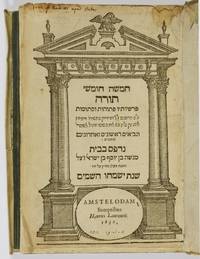
1631rif. 55459Amsterdam: printed by Menasseh ben Israel for Henricus Laurentius 1631. First edition. Hardcover. Very good-. Octavo 16.8 by 11.4 cm. Collation: aleph-lamed-zayin8 = 296 leaves. 612 i.e. 592 pp: p. 464 erroneously numbered 484 465 as 485 and so on throughout. Two column text in unvocalized Hebrew; every fifth verse numbered in the margin. Title within architectural border; half titles with letterpress ornamentation for the Former and Latter Prophets. Contemporary vellumwith exposed thongs edges stained blue; yapp fore-edges; front joint cracked but holding strong. Intermittent light toning to text outmost leaves a bit more darkened; very occasional small stains. Title-page slighltly trimmed 4 mm at bottom edge; expert marginal repairs at bottom corners of 2 leaves; 1 leaf re-margined at fore-edge with no loss of text else a very good copy with crisp clean text. First Hebrew Bible published in Amsterdam printed by the rabbi diplomat publisher and religious thinker Menasseh ben Israel 1604-1657 one of the most distinguished members of the Portuguese Jewish community of Amsterdam and the first Jewish printer in the Northern Netherlands. The Amsterdam printer and publisher Hendrick Laurensz Lauretius provided the financing for this edition along with two other Bible editions and two editions of the Hebrew Psalms printed by Menasseh between 1631 and 1646. "These publications were not only made for the local market but mainly for international trade. Thanks to this financial help Menasseh was able to organize his printing office in a more professional way" Fuks hiring a Jewish compositor Judah Leb ben Mordecai Gimple from Posen and a gentile compositor Bartholomeus Laurensz. The printing activity of Menasseh was especially important in the steadily growing productions of the Hebrew press in the Northern Netherlands. Fulfilling the needs of the Sephardic community for Jewish ritual texts eliminated the need for expensive imports from Venice and Poland. Menasseh undersood that the relatively cheap paper and tools available in Amsterdam made it possible to compete in quality and prices with the Hebrew presses of Poland Italy and Basel. "Gentile publishers and booksellers in Amsterdam such as Jansonius and Laurentius were quick to see the opportunity of the opening Eastern European market and financed several of Menasseh's publications" Fuks. Menasseh was the first to introduce in the Netherlands waybertaytsch types for Yiddish publications along with illustrated Hebrew books. He was also the first Jewish printer to adopt the Dutch pocket-book format made famous by the Elzeviers. Notes on publication date and issue: The title is dated 1630 in Arabic numerals; the colophon notes the date of completion in Hebrew characters as 5 Adar 5391 = 7 February 1631 along with the printer's apology for being unable to provide the index of pericopes promised on the title-page due to lack of printing material. Darlow and Moule describe this issue as Variant A with a Latin imprint appearing in the cartouche beneath the Hebrew title. Provenance and annotations: early entry in brown ink at front paste-down with short Greek inscription Theos. dated 1700; old Latin inscription in black ink at top margin title in reference to Hebrew roots; date of 1812 beside Yiddish entry penned in black ink within imprint cartouche at title; old entry in German penned in black ink at verso title beneath which is an oval cartouche in imitation of the one at the title in which an owner has penned in black ink the Hebrew imprint information regarding Hendrick Laurensz as it would appear in the Varient B issue; old library shelf marks at rear paste-down; recent owner entry in blue ink in Hebrew at front paste-down. References: Darlow and Moule 5123a; Fuks/Fuks-Mansfeld no. 152; pp. 105; 111f.; Steinschneider no. 453; Vinograd Amsterdam 22. Full title and imprint: חמשה חומשי תורה פרשיותיו פתוחות וסתומות ע"פ ×”×¨×ž×‘× ז"ל ומדוייק בחסירו' ויתרות להעתק ס"ת ×¢× לוח בסופו מועיל לסופרי' ×•× ×‘×™××™× ×¨××©×•× ×™× ×•××—×¨×•× ×™× ×•×›×ª×•×‘×™×: נדפס בבית מנשה בן ישר×ל ז׳׳צל והוגה בעיון נמרץ על ידו שנת ישמחו ×”×©×ž×™× Amstelodami sumptibus Henrici Laurentii 1630. printed by Menasseh ben Israel for Henricus Laurentius hardcover
1631rif. 55459Amsterdam: printed by Menasseh ben Israel for Henricus Laurentius 1631. First edition. Hardcover. Very good-. Octavo 16.8 by 11.4 cm. Collation: aleph-lamed-zayin8 = 296 leaves. 612 i.e. 592 pp: p. 464 erroneously numbered 484 465 as 485 and so on throughout. Two column text in unvocalized Hebrew; every fifth verse numbered in the margin. Title within architectural border; half titles with letterpress ornamentation for the Former and Latter Prophets. Contemporary vellumwith exposed thongs edges stained blue; yapp fore-edges; front joint cracked but holding strong. Intermittent light toning to text outmost leaves a bit more darkened; very occasional small stains. Title-page slighltly trimmed 4 mm at bottom edge; expert marginal repairs at bottom corners of 2 leaves; 1 leaf re-margined at fore-edge with no loss of text else a very good copy with crisp clean text. First Hebrew Bible published in Amsterdam printed by the rabbi diplomat publisher and religious thinker Menasseh ben Israel 1604-1657 one of the most distinguished members of the Portuguese Jewish community of Amsterdam and the first Jewish printer in the Northern Netherlands. The Amsterdam printer and publisher Hendrick Laurensz Lauretius provided the financing for this edition along with two other Bible editions and two editions of the Hebrew Psalms printed by Menasseh between 1631 and 1646. "These publications were not only made for the local market but mainly for international trade. Thanks to this financial help Menasseh was able to organize his printing office in a more professional way" Fuks hiring a Jewish compositor Judah Leb ben Mordecai Gimple from Posen and a gentile compositor Bartholomeus Laurensz. The printing activity of Menasseh was especially important in the steadily growing productions of the Hebrew press in the Northern Netherlands. Fulfilling the needs of the Sephardic community for Jewish ritual texts eliminated the need for expensive imports from Venice and Poland. Menasseh undersood that the relatively cheap paper and tools available in Amsterdam made it possible to compete in quality and prices with the Hebrew presses of Poland Italy and Basel. "Gentile publishers and booksellers in Amsterdam such as Jansonius and Laurentius were quick to see the opportunity of the opening Eastern European market and financed several of Menasseh's publications" Fuks. Menasseh was the first to introduce in the Netherlands waybertaytsch types for Yiddish publications along with illustrated Hebrew books. He was also the first Jewish printer to adopt the Dutch pocket-book format made famous by the Elzeviers. Notes on publication date and issue: The title is dated 1630 in Arabic numerals; the colophon notes the date of completion in Hebrew characters as 5 Adar 5391 = 7 February 1631 along with the printer's apology for being unable to provide the index of pericopes promised on the title-page due to lack of printing material. Darlow and Moule describe this issue as Variant A with a Latin imprint appearing in the cartouche beneath the Hebrew title. Provenance and annotations: early entry in brown ink at front paste-down with short Greek inscription Theos. dated 1700; old Latin inscription in black ink at top margin title in reference to Hebrew roots; date of 1812 beside Yiddish entry penned in black ink within imprint cartouche at title; old entry in German penned in black ink at verso title beneath which is an oval cartouche in imitation of the one at the title in which an owner has penned in black ink the Hebrew imprint information regarding Hendrick Laurensz as it would appear in the Varient B issue; old library shelf marks at rear paste-down; recent owner entry in blue ink in Hebrew at front paste-down. References: Darlow and Moule 5123a; Fuks/Fuks-Mansfeld no. 152; pp. 105; 111f.; Steinschneider no. 453; Vinograd Amsterdam 22. Full title and imprint: חמשה חומשי תורה פרשיותיו פתוחות וסתומות ע"פ ×”×¨×ž×‘× ז"ל ומדוייק בחסירו' ויתרות להעתק ס"ת ×¢× לוח בסופו מועיל לסופרי' ×•× ×‘×™××™× ×¨××©×•× ×™× ×•××—×¨×•× ×™× ×•×›×ª×•×‘×™×: נדפס בבית מנשה בן ישר×ל ז׳׳צל והוגה בעיון נמרץ על ידו שנת ישמחו ×”×©×ž×™× Amstelodami sumptibus Henrici Laurentii 1630. printed by Menasseh ben Israel for Henricus Laurentius hardcover books
rif. 117964Mantua Eliezer Shlomo of Italy 1785. . 8vo; contemporary vellum engraved frontispiece depicting the Sacrifice of Isaac slightly stained hinges cracked but holding edges stained red; text in Hebrew; 248 124 iipp. Scarce Hebrew bible from Italy with Five Scrolls Haftarot at the end of the volume and calendars of Holidays and fasts for 120 years at the beginning. The frontispiece engraving depicts The Binding of Isaac with Abraham dressed in contemporary 18th-century Italian dress. Vinograd Mantua 545. Mantua, Eliezer Shlomo of Italy, 1785. hardcover
1928"Whatever place its author may ultimately occupy in future histories of England, one thing is certain, that in the history of the Jewish people the name of Balfour will enjoy unchallenged immortality, evoking comparison with that of Cyrus, for the issue of the Balfour Declaration marked the opening of a new epoch in the annals of Jewry which will be recognised as such even in the remotest centuries to come. In this little book have been gathered together all the utterances of Lord Balfour on the interpretation and implications of his Declaration, on its political aspects and its practical realisation, made during the last ten years." - Preface. [4], 5-128 pp. 7" x 4.75". Original spine label present and intact. Front free endpaper professionaly replaced. Tanning to central portion of half-title. Prior owner's ink stamp upon title page. Duplicate spine label bound at p.128. Average external wear. Binding intact with moderate forward lean. No dust jacket, presumably as issued. Quarter inch notch from top of backstrip. A sound copy of this jewel of Zionist history. EMANUEL p.48. [ASIN B000852UV4] Book
rif. 371476Amsterdam: Joseph Jacob and Abraham the sons of Solomon Proops 5522. Titled printed in red and black. 2 178 2 179-332 10 Introduction etc. 2 160 2 161-350pp. Publisher's introduction and other preliminaries misbound preceding the later Prophets. Folio 15-7/8x10 inches. Nineteenth or early 20th century half morocco and marbled paper boards rear joint splitting worn at joints and head and tail of spine. Foxing principally to the title tear to the final text leaf. Provenance: General Theological Seminary bookplate. Titled printed in red and black. 2 178 2 179-332 10 Introduction etc. 2 160 2 161-350pp. Publisher's introduction and other preliminaries misbound preceding the later Prophets. Folio 15-7/8x10 inches. Besides being the first bi-lingual edition in Hebrew and Spanish this edition is the first Hebrew book whose publication was financed by an American - Abraham Mendes de Castro 1689-1762 of Curaçao - intended for use in the West Indies with the sale proceeds to benefit the Jewish communities of Jerusalem and Hebron. Cowley 102; Darlow & Moule 5156; Zedner 102; not in Steinschneider or Roest Joseph, Jacob and Abraham, the sons of Solomon Proops unknown
rif. 371476Amsterdam: Joseph Jacob and Abraham the sons of Solomon Proops 5522. Titled printed in red and black. 2 178 2 179-332 10 Introduction etc. 2 160 2 161-350pp. Publisher's introduction and other preliminaries misbound preceding the later Prophets. Folio 15-7/8x10 inches. Nineteenth or early 20th century half morocco and marbled paper boards rear joint splitting worn at joints and head and tail of spine. Foxing principally to the title tear to the final text leaf. Provenance: General Theological Seminary bookplate. Titled printed in red and black. 2 178 2 179-332 10 Introduction etc. 2 160 2 161-350pp. Publisher's introduction and other preliminaries misbound preceding the later Prophets. Folio 15-7/8x10 inches. Besides being the first bi-lingual edition in Hebrew and Spanish this edition is the first Hebrew book whose publication was financed by an American - Abraham Mendes de Castro 1689-1762 of Curaçao - intended for use in the West Indies with the sale proceeds to benefit the Jewish communities of Jerusalem and Hebron. Cowley 102; Darlow & Moule 5156; Zedner 102; not in Steinschneider or Roest Joseph, Jacob and Abraham, the sons of Solomon Proops unknown books
1839rif. 52150Philadelphia: Bagster & Marshall 1839. First American edition. Hardcover. Good . Octavo. 6 10 778pp. Pointed Hebrew text in two columns the New Testament with only vocal marks. Continuous pagination in Arabic numerals; but separate Hebrew pagination for the Old and New Testaments. Contemporary three-quarter calf over pebbled cloth boards; spine with raised bands ruled and lettered in gilt. Decorative endleaves. Covers rubbed with wear at spine caps and corners. Library pressure stamp at title bookplate and pocket at paste-downs. A good ex-library copy with very clean fresh text throughout. First American edition of this Hebrew Bible earlier published by Samuel Bagster at London in 1835; it contains the first printing of the New Testament in Hebrew translation to appear in the United States. That translation was prepared by the philologist William Greenfield 1799-1831 the editorial superintendent of the British and Foreign Bible Society and first published by Samuel Bagster at London in 1831 D&M no. 5186. In preparing his revised Hebrew version Greenfield was allowed to utilise the London Jews' Society Hebrew New Testament published at London between 1813 and 1817 D&M no. 5170. Among the earliest publications of the society founded in 1809 this version was itself based upon Elias Hutter's Hebrew translation of the New Testament published at Nuremberg in 1599 D&M no. 5111. Prepared by a group of scholars under the supervision of Thomas Fry and William Bengo Collyer this London Jews' Society edition employed only biblical words and translated Old Testament quotations from the Greek not citing them directly from the Hebrew Scriptures. The editor of the New Testament version in the present work appears to have had a notable gift for languages. William Greenfield began his Hebrew studies as a young man while apprenticed to a bookbinder taking lessons from one of his co-workers a Jew with some learning who had been described as "a reader of the law in the synagogue" ODNB. Greenfield subsequently left the business in 1824 in order to devote himself to languages and biblical criticism. His defence of the Serampore Mahratta version of the New Testament in response to an 1829 article in the Asiatic Journal brought him to the attention of the British and Foreign Bible Society who then hired him to superintend their editiorial department. "During his nineteen months in the society's service Greenfield wrote on twelve European five Asiatic one African and three American languages and acquired considerable knowledge of Peruvian African-English Chippeway and Berber" ODNB. His revision of the Hebrew New Testament earlier published by the London Jews' Society was among the last works he undertook for the British and Foreign Bible Society along with the revision of the Modern Greek Psalter as it went through the press. Provenance: Bookplate and other markings including withdrawal stamp of the Library of the Garrett Theological Seminary Evanston Illinois. Full title in Hebrew: ספר הקדש ×•×”×•× תורה × ×‘×™××™× ×•×›×ª×•×‘×™× ×’× כתבי ברית החדשה נעתק מלשון יונית ×ל לשון עברית Philadelphiae: Sumptibus Bagster et Marshall in via vulgo dicta Chestnut Street ad Repositorium Bibliorum Sacrorum etc. quae in linguis antiquis et hodiernis edita sunt. Anno erae Judaicae I rev. C; rev. C DXCIX. References: Goldman Hebrew Printing in America no. 6: "This was the first New Testament published in Hebrew in America." ODNB: "Greenfield William" Gordon Goodwin revised by H. C. G. Matthew. J. R. Marcus "Jewish Americana a Supplement to A. S. W. Rosenbach An American Jewish Bibliography" in: Monographs of the American Jewish Archives 1954 no. 1 no. 164. Cf. Darlow & Moule nos. 5111; 5170; 5186. Bagster & Marshall hardcover
1839rif. 52150Philadelphia: Bagster & Marshall 1839. First American edition. Hardcover. Good . Octavo. 6 10 778pp. Pointed Hebrew text in two columns the New Testament with only vocal marks. Continuous pagination in Arabic numerals; but separate Hebrew pagination for the Old and New Testaments. Contemporary three-quarter calf over pebbled cloth boards; spine with raised bands ruled and lettered in gilt. Decorative endleaves. Covers rubbed with wear at spine caps and corners. Library pressure stamp at title bookplate and pocket at paste-downs. A good ex-library copy with very clean fresh text throughout. First American edition of this Hebrew Bible earlier published by Samuel Bagster at London in 1835; it contains the first printing of the New Testament in Hebrew translation to appear in the United States. That translation was prepared by the philologist William Greenfield 1799-1831 the editorial superintendent of the British and Foreign Bible Society and first published by Samuel Bagster at London in 1831 D&M no. 5186. In preparing his revised Hebrew version Greenfield was allowed to utilise the London Jews' Society Hebrew New Testament published at London between 1813 and 1817 D&M no. 5170. Among the earliest publications of the society founded in 1809 this version was itself based upon Elias Hutter's Hebrew translation of the New Testament published at Nuremberg in 1599 D&M no. 5111. Prepared by a group of scholars under the supervision of Thomas Fry and William Bengo Collyer this London Jews' Society edition employed only biblical words and translated Old Testament quotations from the Greek not citing them directly from the Hebrew Scriptures. The editor of the New Testament version in the present work appears to have had a notable gift for languages. William Greenfield began his Hebrew studies as a young man while apprenticed to a bookbinder taking lessons from one of his co-workers a Jew with some learning who had been described as "a reader of the law in the synagogue" ODNB. Greenfield subsequently left the business in 1824 in order to devote himself to languages and biblical criticism. His defence of the Serampore Mahratta version of the New Testament in response to an 1829 article in the Asiatic Journal brought him to the attention of the British and Foreign Bible Society who then hired him to superintend their editiorial department. "During his nineteen months in the society's service Greenfield wrote on twelve European five Asiatic one African and three American languages and acquired considerable knowledge of Peruvian African-English Chippeway and Berber" ODNB. His revision of the Hebrew New Testament earlier published by the London Jews' Society was among the last works he undertook for the British and Foreign Bible Society along with the revision of the Modern Greek Psalter as it went through the press. Provenance: Bookplate and other markings including withdrawal stamp of the Library of the Garrett Theological Seminary Evanston Illinois. Full title in Hebrew: ספר הקדש ×•×”×•× תורה × ×‘×™××™× ×•×›×ª×•×‘×™× ×’× כתבי ברית החדשה נעתק מלשון יונית ×ל לשון עברית Philadelphiae: Sumptibus Bagster et Marshall in via vulgo dicta Chestnut Street ad Repositorium Bibliorum Sacrorum etc. quae in linguis antiquis et hodiernis edita sunt. Anno erae Judaicae I rev. C; rev. C DXCIX. References: Goldman Hebrew Printing in America no. 6: "This was the first New Testament published in Hebrew in America." ODNB: "Greenfield William" Gordon Goodwin revised by H. C. G. Matthew. J. R. Marcus "Jewish Americana a Supplement to A. S. W. Rosenbach An American Jewish Bibliography" in: Monographs of the American Jewish Archives 1954 no. 1 no. 164. Cf. Darlow & Moule nos. 5111; 5170; 5186. Bagster & Marshall hardcover books
1610rif. 18174Leiden 1610. 24mo in 8s 11 x 6 cm. Franciscus II Raphelengius Gold-tooled mottled calf ca. 1720 sewn on 4 cords each board with a small central flower ornament and a frame of double fillets the spine with a lozenge ornament in each of the 5 compartments a roll on each raised band and at the head and foot and further double fillets gold-tooled board edges mottled edges. With 4 letterpress title-pages for the Pentateuch early prophets major and minor prophets and Psalms etc. and decorations built up from arabesque typographic ornaments. Set in sephardic meruba Hebrew types unpointed with the imprints in semi-cursive rabbinical but the place of publication in meruba. 4 volumes bound as 1. 264; 227 1 blank; 238 2 blank; 287 1 blank pp. vols. 1-2 with arabic numerals 3-4 with Hebrew. A pocket-sized edition of the Hebrew Old Testament in four volumes volume 1 containing the Pentateuch or Torah volume 2 the early prophets Joshua Judges Samuel Kings volume 3 the later major Isaiah Jeremiah Ezekiel and minor prophets and volume 4 the Psalms Job Song of songs Ruth Lamentations Ecclesiastes Esther Daniel Ezra and Chronicles. It was produced by Franciscus II Raphelengius grandson of Christoffel Plantin and son of one of Europe's first great Hebrew scholars Plantin's son-in-law Franciscus I Raphelengius 1539-1597 who helped prepare Plantin's magnificent 1572 Polyglot Bible succeeded to the Leiden branch of Plantin's printing office and became professor of Hebrew at Leiden University. Plantin himself had produced the Dutch Republic's first Hebrew book there in 1585 and Raphelengius produced many more beginning in 1588.With occasional very minor foxing or faint discolouration but otherwise in very good condition. The spine and joints are worn with superficial cracks a repair at the head and a small tear at the foot and the sewing is slightly loose. A charming little Hebrew Bible from the first Dutch printing office to produce Hebrew books.l aleph.nli.org.il 001366023 4 copies; Darlow & Moule 5114; Fuks 25 2 copies; Steinschneider 386; WorldCat 8 or 9 copies. ABE CAT Bibles Sermons & Psalmbooks unknown
1535rif. 372715Basel: Bebel Isengrin and Petri 1535. Text in two columns in Hebrew and Latin. 2 vols. Folio. Nineteenth century half calf and marbled boards. Old ink notation at top of front pastedowns: Duplum. Very good plus some rubbing. Text in two columns in Hebrew and Latin. 2 vols. Folio. First edition of the new Latin translation by Sebastian Münster. Copinger 243; Darlow & Moule 5087 6115; VD 16 B2881. Provenance: W. A. Copinger bookplate; General Theological Seminary [Bebel, Isengrin, and Petri] unknown
1535rif. 372715Basel: Bebel Isengrin and Petri 1535. Text in two columns in Hebrew and Latin. 2 vols. Folio. Nineteenth century half calf and marbled boards. Old ink notation at top of front pastedowns: Duplum. Very good plus some rubbing. Text in two columns in Hebrew and Latin. 2 vols. Folio. First edition of the new Latin translation by Sebastian Münster. Copinger 243; Darlow & Moule 5087 6115; VD 16 B2881. Provenance: W. A. Copinger bookplate; General Theological Seminary [Bebel, Isengrin, and Petri] unknown books
18535614 [185354]. 1st edition. Original period deluxe tooled leather, 4to, [iv], 1011, [v] pages [1020 pages total]. COPY BELONGING TO JEWISH COMMUNAL LEADER AND DIPLOMAT BENJAMIN FRANKLIN PEIXOTTO (18341890), WITH HIS OWNERSHIP SIGNATURE ON THE FRONT ENDPAPER ("B.F. Peixotto, Cleveland, O. 1865"). Beautiful original period leather binding with tooled leather boards and board edges and raised bands. All Edges Gilt. The first edition of the first translation of the full Hebrew bible (Old Testament) into English by a Jew. Deinard 847; Singerman 1271; Goldman 12. Vinograd, Philadelphia 21. Very important work, Isaac Leesers magnum opus. In the preface, Leeser here writes of a life-long ambition to do for his fellow Hebrews who use the English as their vernacular, what had been done for the Germans by some of the most eminent minds That is, to present an Old Testament Bible in the peoples tongue which was unprejudiced against Jews. This task took Rabbi Leeser more than 15 years to complete. The Twenty-Four Books..., has remained Leeser's literary magnum opus and his most lasting contribution to Judaism in America. Printed in 1854, complete with "short explanatory notes, " his efforts at biblical translation had actually developed in stages, beginning almost two decades earlier. Leeser's first biblical translation was The Law of God, a Pentateuch (Five Books of Moses) in five volumes, published in 1845. According to Leesers biographer Lance Sussman, one factor convincing Leeser of the need for a Jewish-translated bible into English was the opening of Rebecca Gratz's Sunday School in March 1838, in Philadelphia. The school was desperately in need of appropriate study material, with students using the King James Bible for want of a Jewish alternative: religiously objectionable passages in other texts provided by Protestant organizations were either pasted over or torn out by Gratz's staff. Leeser, who supported the Sunday School and was its chief academic resource person, felt compelled to find more suitable texts for the students. Leeser's Bible, as it has come to be known, quickly became the standard Bible for English-speaking Jews, especially in America. The impetus for Leeser throughout was always his desire to provide the Jews of America with an English text of the Bible that was produced by one of their own and was not tainted by conversionist motivations. In his preface to the present volume, Leeser characterizes this culmination of his long years of endeavor as having finally provided for his fellow Jews "a version of the Bible which has not been made by the authority of churches in which they have no confidence." Benjamin Franklin Peixotto (18341890), the owner of this bible, was a lawyer, diplomat, and important Jewish communal leader. His mother, Rachel Seixas, and his paternal grandfather, Moses Levi Maduro Peixotto (Hazzan of New York's Congregation Shearith Israel from 1820-1828) were both members of important early New York Jewish families. Young Benjamin settled in Cleveland during 184766, writing frequent editorials for the daily Cleveland Plain Dealer. In 1855, Peixotto and [George A.] Davis founded the Hebrew Benevolent Society; Peixotto was its secretary. In 1863 Peixotto helped found the first Cleveland lodge of B'nai B'rith. In 1860, he founded the Young Men's Hebrew Literary Society, four years later convincing it to affiliate with B'nai B'rith as Montefiore Lodge (Ency Cleveland History, 2020). In addition, Peixotto was a follower of Democratic Senator Stephen A. Douglas of Illinois [Abraham Lincolns famous sparring partner in the Great Debates of 1858], under whose guidance Peixotto studied law. A trustee and founder of the Sunday School at Congregation Tifereth Israel (now The Temple), he served as Grand Sar (president) of B'nai B'rith during 186364 and was the prime mover for its Jewish Orphan Asylum (now Bellefaire) established in Cleveland in 1869 .Early in 1870, moved by the Romanian persecution of Jews, Peixotto succeeded in becoming the first U.S. consul in Bucharest, appointed by President Grant through the intervention of the Seligmans. His financial needs in the unpaid position, as well as political support, were provided, not always reliably, by a group of wealthy U.S. Jews, along with the B'nai B'rith, the Board of Delegates of American Israelites, and prominent French and English Jews led by Sir Francis Goldsmid. In Bucharest Peixotto pressed vigorously for Jewish emancipation, to which Romanian Jews were legally entitled by the Treaty of Paris of 1856, and also took the initiative in founding Jewish schools, cultural societies, and Romanian B'nai B'rith, as part of his plan to modernize Jewish life in that country .his well-publicized presence inhibited new antisemitic legislation and avoided or mitigated several pogroms .he continued to endorse emigration privately while serving in Bucharest until 1876. From 1877 to 1885 Peixotto was U.S. consul in Lyons .His son was George Da Maduro Peixotto (18591937), a painter .He became a notable portrait painter, executing portraits from life of Cardinal Manning, President McKinley, Chief Justice Waite, and John Hay, among others .Peixotto's portrait of Sir Moses Montefiore at the latter's centenary in 1884 hung in the Corcoran Gallery, and his painting of [Rabbi] Julius Bien hangs in the National Museum, Washington, D.C. (JewishVirtualLibrary). For more on this work, see: Israel Abrahams, Isaac Leesers Bible," By-Paths in Hebraic Bookland (Philadelphia: The Jewish Publication Society of America, 1920), 254-259. Ephraim Deinard, Kohelet america: yakhil reshimat kol ha-sefarim asher nidpesu ba-america mi-shenat [5]495 (1735) ad shenat [5]686 (1926) u-bikkoret ketsarah kimat al kol sefer, vol. 2 (St. Louis: Moinester Printing Company, 1926), 133 (no. 847). Yosef Goldman, Hebrew Printing in America 1735-1926: A History and Annotated Bibliography, vol. 1 (Brooklyn: Yosef Goldman, 2006), 12-13 (no. 12). Jonathan D. Sarna and Nahum M. Sarna, Jewish Bible Scholarship and Translations in the United States," in Ernest S. Frerichs (ed.), The Bible and Bibles in America (Atlanta: Scholars Press, 1988), 83-116, at pp. 84-92. Lance J. Sussman, Another Look at Isaac Leeser and the First Jewish Translation of the Bible in the United States," Modern Judaism 5,2 (1985): 159-190. Lance J. Sussman, Isaac Leeser and the Making of American Judaism (Detroit: Wayne State University Press, 1995), 150-151, 185-193. The most recent sale of any copy of this work at auction (2018) was for over $16,000 (with premium). Original tooled black leather binding expertly repaired, with some light wear and loss of gilt to boards and edges. Rubbing to lemon endpapers and small repairs to outer margins of some leaves. A beautiful copy of this landmark of American Jewish scholarship with important provenance. Very Good Condition (AMR-39-53-BD)