Hebrew Union College PressBiblio.com

3 483 résultats
1985réf. BN219434Hebrew Union College PressU.S. 1985. 1985. Hardcover. Hebrew Union College Annual Volume 56 Hebrew Union College Annual Volume 56 Hebrew Union College Press Hebrew Union College Press,U.S. hardcover
1978réf. BN220150Hebrew Union College PressU.S. 1978. 1978. Hardcover. Hebrew Union College Annual Volume 49 Hebrew Union College Annual Volume 49 Hebrew Union College Press Hebrew Union College Press,U.S. hardcover
1984réf. BN219433Hebrew Union College PressU.S. 1984. 1984. Hardcover. Hebrew Union College Annual Volume 55 Hebrew Union College Annual Volume 55 Hebrew Union College Press Hebrew Union College Press,U.S. hardcover
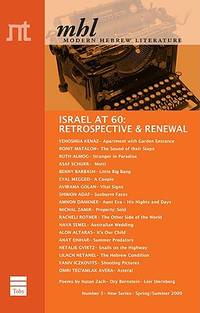
réf. BN420026Toby Pr Llc. Israel at 60: Retrospective & Renewal Modern Hebrew Literature Band 5 Israel at 60: Retrospective & Renewal Modern Hebrew Literature Band 5 Institute for the Translation of Hebrew Toby Pr Llc unknown
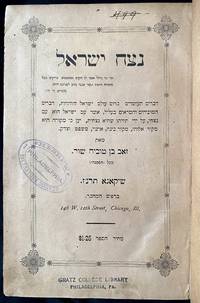
1897réf. 43553Shikago Chicago: Bi-Defus ha-Mahaver 1897. 1st Edition. Original printed paper wrappers bound into period buckram boards 8vo 273 pages misprinted as "173" 1 leaf; 25 cm. In Hebrew. English title from original rear paper wrapper present here. Title translates as "The Eternity of Israel: Things That Stand Above the World of Israel and Judaism." Goldman 1067. Deinard 582. Singerman 5264. Deinard 582. Mishkin Defuse Shikago be-'ivrit ube-yidish 24. "The first Hebrew work in America to react favorably to political Zionism" Eisig Silberschlag in EJ with publication in the same year as the First Zionist Congress in Basle. "Schur wrote Netsah Yisrael in response to the threat to American Jews posed by Christian missionaries particularly William Blackstone Reform rabbis and socialists" Goldman. Not coincidentally the book's publication in 1897 also coincides with the founding in Vilna of the Jewish Labor Bund whose goal was to bring Jewish workers across the Russian Empire into a single socialist party. Netsah Yisrael "compared the Mosaic law with every known ancient or modern religious or political system. in a manner which well demonstrates his broad culture and extensive reading and comes to the conclusion that.Mosaism is immeasurably superior to all othersystems from those of ancient Canaan and Egypt to Christianity" Drachman 81. Zev Wolf Schur aka William; 1884-1910 was a "pioneer Hebrew writer and journalist in the United States. Born in Lithuania he settled in the United States in 1888 and spent most of his life in poverty. A friend of Abraham Mapu Schur devoted himself to Hebrew literature traveled and taught in many countries including the Far East and wrote about his voyages in the periodicals Ha-Meliz Ha-Yom and Ha-Shahar. He was an ardent pioneer of the Hebrew press in America and later of political Zionism participating in the Fourth Zionist Congress. Under his editorship the periodical Ha-Pisgah 1889-99 in which Tchernichowsky made his literary debut attracted the best Hebrew writers in America and some Hebrew writers from abroad. After it ceased publication it was continued as Ha-Tehiyyah 1899-1900. Schur wrote several novels in Hebrew. His most important book is Nezah Yisrael 1897 a defense of Judaism against Christian attacks against Reform Judaism against socialism and anarchism. It affirms the twin axiom: the eternal existence of Jewry and the eternality of the Torah. Supporting nationalism it was the first Hebrew work in America to react favorably to political Zionism" Eisig Silberschlag in EJ. Goldman notes additionally that Schur "lived in New York Baltimore Boston St. Louis and Chicago." His "Hebrew journal Ha-Pisgah Hapisgoh" was "at times was the only Hebrew periodical publication in America and he operated a Hebrew printing press." In Orthodox Judaism the phrase Netzach Yisrael the Eternity of Israel proclaims the metaphysical belief that the Jewish people are immortal and destined to eternally endure regardless of the historical physical or spiritual challenges they face. Rooted in the verse Netzach Yisrael lo yeshaker 1 Samuel 15:29 this foundational concept addresses the most vital questions regarding Jewish destiny faith and survival. An English translation was proposed but it never appeared Kabakoff. OCLC: 19150692. YIVO keeps their copy in their Rare Book Collection. Card pocket removed. Modern Jewish Library bookplate as well as turn of the 20th Century stamps & labels of the "Hebrew Literature Society Philadelphia." Donation inscription to the Society in year of publication on title page. Spine label small stamp to margin of title page. Good Condition. Important work from an important leader of the turn of the century American Hebrew press. BER-1 AMR-72-11A-GGBBBDRLKKF. Shikago [Chicago]: Bi-Defus ha-Mahaver unknown
réf. 54353598like new. unknown
réf. 54353598-nnew. unknown
réf. 21728347-nnew. unknown
réf. 21728347like new. unknown
réf. SONG1929496001Used: Good unknown
réf. 51789045-nnew. unknown
réf. 51789045like new. unknown
réf. DADAX9653015915New unknown
réf. 42835353-nnew. unknown
réf. DADAX1907534032New unknown
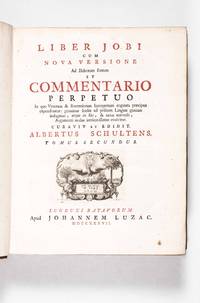
1737réf. 49261Leiden: Jean Luzac 1737. First edition. Two volumes large quarto. 52 544; 2 545-1232 63 indices 1 corrigendapp. Text in two columns with Hebrew text and facing Latin translation interspersed with commentary. Titles in red and black with engraved vignettes. Contemporary speckled calf; gilt-tooled spine with raised bands and morocco lettering pieces; gilt dentelles; edges daubed in red and green. Light scuffing to boards and fading to spines. A very good set with crisp clean text throughout. First edition of this comprehensive commentary to the biblical Book of Job by the Dutch scholar of Semitic languages Albert Schultens 1686-1750 who maintained "that the true nature of the Hebrew language and the meaning of many of its words and idioms are to be found chiefly in the Arabic" Orme. Fifty-five pages of the indices constitute a brief lexicon and provide Latin as well as Arabic equivalents for more than 1000 Hebrew words. Schultens studied theology and eastern languages at Groningen where he received his degree in theology in 1709. After a brief career as a preacher in Wassenaar he was nominated professor of Hebrew and Jewish antiquities at Franeker in 1713. In 1729 he decamped for Leiden were he was first appointed reader in eastern languages and finally full professor in 1732. At this time a chief concern of Calvinist theologians was to liberate Old Testament exegesis from the Jewish Rabbinic as well as Catholic traditions. Schultens' influential and controversial solution was revealed as early as 1706 in his first public thesis Disputatio theologico philologica de utilitate linguae Arabicae in interpretanda S. Scriptura A Theologico-Philosophical Dissertation on the Utility of the Arabic Language for the Interpretation of the Holy Scriptures "a forceful attack" Brugman & Schröder on the Protestant sola scriptura methodology of Biblical exegesis. "With the help of Jacobus Golius' Arabic dictionary he perused with zeal and fervour the Old Testament and wrote prolifically. The lexical superiority of Arabic had led him to a reconsideration of the position of Hebrew: at first he had called Arabic 'the most splendid daughter of mother Hebrew' but in his oration of 1729 he proclaimed Hebrew and Arabic cognate twin sisters. This shocked conservative theologians as an outright profanation of God's Word" Brugman & Schröder. "In 1737 he applied his theories in his bilingual edition of the book of the prophet Job whom he regarded as an Arab. The Hebrew text and the Latin translation are all but totally submerged by the extensive commentary in which Schultens draws abundantly on Arabic texts such as the Hamasa an anthology of early Arabic poetry by the ninth-century poet Abu Tammam" Vrolijk & van Leeuwen. Schultens was not without his critics and by 1824 William Orme notes a turning of the tide: "Different opinions are entertained of the correctness of his views and also of his success in applying them; but it is now generally admitted that he carries his notions of the advantage of Arabic learning to the interpretation of the Scriptures too far." Jean Luzac 1728-1777 was a member of a well-known Huguenot family of printers; he published many works for the University of Leiden including three Hebrew books of Albert Schultens. Isaac van der Mijn is noted as the printer at the colophon of the second volume. Provenance: printed label of the Bibliotheca Seminarii Warmondani at the front endleaf of the first volume. Full title: Liber Jobi cum nova versione ad Hebraeum fontem et commentario perpetuo in quo Veterum et Recentiorum Interpretum cogitata præcipua expenduntur: genuinus sensus ad priscum Linguae genium indagatur atque ex filo et nexu universo Argumenti nodus intricatissimus evolvitur. Curavit et editit. Albertus Schultens. Tomus Primus. -Tomus Secundus References: J. Brugman & F. Schröder Arabic Studies in the Netherlands Leiden: E.J. Brill 1979 p.26f. Fuks/Fuks-Mansfeld 78. Orme Bibl. Biblica p. 390. A. Vrolijk & R. van Leeuwen Arabic Studies in the Netherlands a Short History in Portraits 1580-1950 Leiden: E.J. Brill 2014 pp. 73-79. Jean Luzac unknown
réf. SONG0567687066Used: Good unknown
réf. SONG1451469233Used: Good unknown
réf. DADAX0300222645New unknown
réf. DADAX0801099595New unknown
réf. DADAX0802876935New unknown
réf. DADAX1646020626New unknown
réf. DADAX0801435862New unknown
réf. SONG019939475XUsed: Good unknown