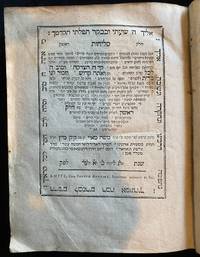
02 [One of the First Hebrew Imprints from Metz, France] [Selihot, in Hebrew and Judeo-German]Biblio.com
3 134 résultats
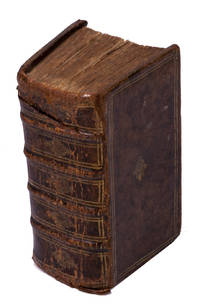
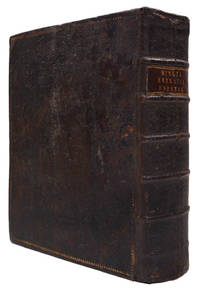
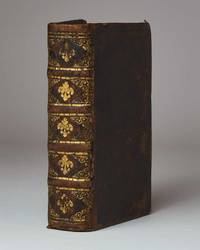
1765réf. 42165Mets Metz Bi-defus Mosheh Mai 1765. Hardcover. 8vo; Hebrew Date 525. Period full leather with raised bands and interspersed gilt floral design and leather spine label 4to large 18 leaves i.e. 36 pages 152 leaves i.e. 304 pages 69 leaves i.e. 138 pages i.e. 478 pages total. 27 cm. In Hebrew and Judeo-German German in Hebrew script. Includes indexes. Vinograd Metz 10. "In France Hebrew presses were established in Metz c. 1760 Strasbourg 1770 and later in Paris 1806" Jewish virtual library this being an early example of Hebrew printing in Metz. SUBJECTS: Judaism -- Liturgy -- Texts. Repentance -- Prayers and devotions. Judai¨sme -- Liturgie -- Textes. OCLC: 265896805. OCLC lists 6 copies worldwide British Library Loyola NYPL YIVO Stanford HUC. The British library holding lists an engraved frontis; however no other holdings nor auction records which we have seen ever list an engraved frontis so we assume that to either be a mistake or added later or a variant. Some wear to leather boards as expected especially at corners but paper and binding remain clean and strong. About Very Good- Condition. A beautiful copy with attractive leather binding. BK5 Rab-66-33-'belccm. Mets [Metz] Bi-defus Mosheh Mai hardcover
réf. SONG1498285465Used: Good unknown
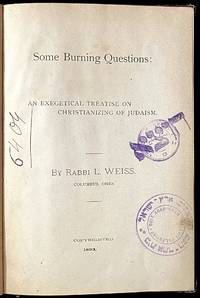
1893réf. 42957Columbus Ohio: No Publisher The Author 1893. 1st edition. 8vo 87 pages 22 cm. Henry Marcus Leipziger's copy inscribed to him by the author. Singerman 4615. Errata slip tipped in. Henry Marcus Leipziger 1854-1917 was an adult-education pioneer who "traveled to Europe and throughout the western United States examining educational systems. Upon his return to New York City Leipziger established the Hebrew Technical Institute. The Institute's objective was to educate Jewish boys in both intellectual and manual skills. Leipziger acted as director of the school from 1884 to 1891. His papers are held in the NYPL archives. From 1891-2896 he worked for the New York City Board of Education as Supervisor of Lecturers from 1890-1917. As such he organized an extremely popular series of free public lectures. Other positions he held were Assistant Superintendent of New York City Public Schools 1891-1896 Chairman of the Library Committee of Aguilar Free Library now part of the New York Public Library and vice president of the American Scenic and Historical Society.The National Institute of Social Science awarded Leipziger a gold medal for service to the community 1916" NYPL. "Louis Weiss rabbi and scholar was born on February 17 1848 in Kotay Hungary. He received his rabbinical diploma from a school in Grosswardein Hungary. Weiss immigrated to the United States and in Chicago in 1876 he became a naturalized U.S. citizen. He served as rabbi for several congregations in the South and in Columbus Ohio 1894; Hamilton Ontario; Palestine Texas 1903-1905 and Braddock Pennsylvania 1905-1909" americanjewisharchives.org. SUBJECTS: Judaism. OCLC: 2082891. Some wear to cover and spine some notes on second leaf and title page ex library with usual marks. Clean pages. Good condition. SBK AMR-68-4-B-'d. Columbus, Ohio: No Publisher [The Author] unknown
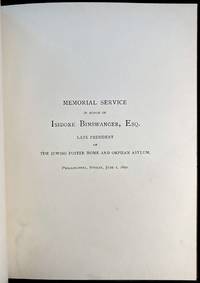
1890réf. 42371New York: Press of Lehmaier & Bro 1890. paperback. 1st edition. Original publisher's boards 8vo 39 unnumbered pages 1 photo plate portrait of Rabbi Binswanger. 22 cm. Prefatory poem signed in the print: F. B.i.e. Frances Binswanger. Singerman 4075. Includes excerpts from obituaries that appeared in various periodicals. Isidore Binswanger 1820-1890 was a "U.S. businessman and communal leader. Binswanger was born in Wallerstein Bavaria. He immigrated to the United States in 1841 living first in Baltimore then in Philadelphia and finally in Richmond Virginia. In 1869 he became president of the Richmond Granite Company a position he held until shortly before his death. Binswanger was chairman of the board and later president of the Hebrew Education Society in Philadelphia and president of the board of trustees of Maimonides College Hebrew Education Society. He was also active in various aid societies and helped organize relief measures in the early 1880s for Jewish immigrants from Russia. His three brothers Lewis Samuel and Harry S. settled in Richmond too where they also went into business and were active in local Jewish life" EJ. SUBJECTS: Memorial service. Obituaries. Jews -- Pennsylvania -- Philadelphia -- Biography. Jewish businesspeople -- Service comme´moratif. Ne´crologies. Juifs -- Pennsylvanie -- Philadelphie -- Biographies. Gens d'affaires juifs -- Death and burial. OCLC: 40128020. OCLC and Singerman together list 8 copies worldwide YU Wesleyan HUC HUC-LA Free Lib Phila Temple Penn AJHS only one at any Ivy League institution. Jewish Institutional bookplate on front pastedown bookplate removed from rear pastedown edgewear to blank front endpaper no other marks inside some light wear to boards Very Good Condition B AMR-67-31-RBD!. New York: Press of Lehmaier & Bro unknown
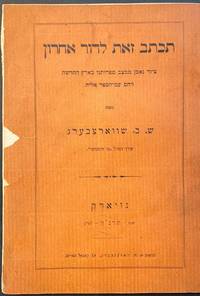
1898réf. 42441Nuyork New York: Rozenberg 1898. paperback. 1st edition. Original orange printed wrappers 8vo 33 pages. 23 cm. In Hebrew. Title translates as: “Write This For The Last Generation: A Faithful Picture of the State of Our Literature in the New Land and the Attitude of the People of the Book To It.” Extremely critical observations on the state of Hebrew literature and its readership in America by Schwarzberg 1865-1929 a Hebrew publisher and editor in Poland and the U.S. Singerman 5473. Goldman 1110. "Schwartzberg published this pamphlet following the failure of Ner Hamerabi Goldman #908 a Hebrew periodical he edited." In it he “poured forth a bitter complaint against 'the people of the book' for their indifference to Hebrew and its literature . He draws a dark picture of the state of Hebrew culture and literature in this country" Waxman. Goldman notes that the work remains an important source on Ner Hamerabi. “Schwarzberg who was born in Lipno Poland published Hebrew books at the close of the 19th century in Warsaw among them I. L. Peretz' Hebrew poems Ha-Ugav 1894. Arriving in the United States in 1897 he became editor of the Hebrew monthly Ner ha-Ma'aravi which appeared from 1895 to 1897. In 1898 he published a 33-page pamphlet Tikkatev Zot le-Dor Aharon "This Shall be Written for the Final Generation" a scathing attack on the attitude of the Jews toward the new Hebrew literature. He fought Yiddishism and its standard-bearer Chaim Zhitlowsky. He also published a bibliography of the works of Senior Sachs” Eisig Silberschlag in EJ. Deinard 886; AJYB 1930-31 155; Not in Bibliography of the Hebrew Book 1470-1960. SUBJECTS: Hebrew literature Modern -- United States -- History and criticism. Litte´rature he´brai¨que moderne -- E´tats-Unis -- Histoire et critique. OCLC: 649820031. OCLC: 649820031. OCLC lists 5 copies outside of Israel YIVO Am Jewish U Yale HUC YU. Spine rebacked touch of edgewear to orange wrapper which remains bright. About Very Good- Condition. Important. B AMR-67-38-DL-'b. Nuyork [New York]: Rozenberg unknown
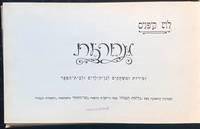
1923réf. 43438Frankfurt am Main: Verlag "Omonuth" Omonut Omanut Omanuth 1923. 1st German-printed Edition. Original boards horizontal 8vo 1 score xv 177 pages. 13 x 21 cm. In Hebrew. Title translates as "Rhyme: Songs and Games for Kindergarten and School." Book of songs for children written by Levin Kipnis. Includes musical settings unaccompanied for the poems by various composers. Hebrew text of each entire poem printed on page corresponding to strophic melody. Originally issued in Jerusalem and republished in this edition in Germany by the publishing house Omonuth. "Kipnis was born in Ushomyr Volhynia.In 1913 he moved to Palestine to study at the Bezalel Academy of Art and Design. He later studied pedagogy for two years in Germany and thereafter became a teacher in Levinsky's Teacher's College in Tel Aviv 1923-1952. He debuted in print in 1911 with a poem in the children's magazine Heperaim The flowers and from that point published over one hundred Hebrew books for children and edited children's newspapers textbooks and the like. He is considered the founder of Hebrew-language children's literature in Israel. Leksikon fun der Nayer Yidisher Literatur "A year after opening and before a single book had even been published Omanut closed its doors in Moscow and moved to Odessa a bustling port on the Black Sea located in the Ukraine and as yet untouched by the Revolution. Odessa was already a flourishing center of Jewish culture home to such luminaries of Modern Hebrew literature as Mendele Mocher Sforim and Chaim Nachman Bialik. But the events of 1917 sent even more Jewish writers and artists pouring in. With such a stable of local talent from which to draw Odessa was to prove fertile ground indeed for Omanut. As the Bolsheviks advanced on the Ukraine Olamenu's female founder Shoshana Persitz relocated again this time to Frankfurt-am-Main in Germany. There she republished the beautiful picture books illustrated by the young art students in Odessa and also began publishing the polished Hebrew translations of world literature for children by which the press was to become famous. In 1925 Omanut left Europe altogether establishing itself once and for all in Tel-Aviv." LOC SUBJECTS: Children's songs Hebrew. Singing games. Children's songs Hebrew. Singing games. OCLC: 18897325. "Printed in Germany" stamp on title page. Some wear to spine and discoloration of cloth binding. Good Condition. GER-61-5-XX-'elggxcc. Frankfurt am Main: Verlag "Omonuth" [Omonut, Omanut, Omanuth] unknown
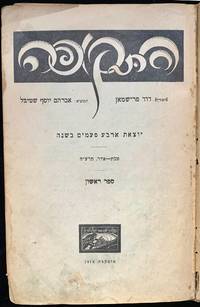
1918réf. 43090Moskvah Moscow : A.Y. Shtibel 1918. First edition. Original boards 8vo 678 pages. 26 cm. In Hebrew. Title translates as “The Season.” Rare volume 1 published in the USSR of the quarterly literary magazine Ha-Tekufah. Includes essays by Simon Dubnow poetry short stories translations and articles. Ha-Tekufah was a “Hebrew periodical devoted to literary scientific and social subjects which appeared first as a quarterly then as an annual intermittently between 1918 and 1950. Ha-Tekufah received the financial backing of Abraham Joseph Stybel a philanthropist who had placed David Frischmann in charge of launching Hebrew literary projects on an unprecedented large scale. Accordingly Frischmann established both the Stybel publishing house and launched Ha-Tekufah serving as the editor of both projects. The first volume of Ha-Tekufah appeared in Moscow early in 1918 before the Bolshevik regime had decided to suppress Hebrew literature. Frischmann published the works of the world's best authors and scholars. The literary standards of the periodical were high. Frischmann encouraged young authors for example Eliezer Steinman. In all respects and not least for its beautiful graphic work Ha-Tekufah was a rare phenomenon in Hebrew literature.” Jewish Virtual Library. SUBJECTS: Hebrew literature Modern -- Periodicals. Hebrew literature Modern. OCLC: 25586768 Boards separated and pages edgeworn. Lacks backtrip spine covering. Good Condition internally. YID-46-7-’. Moskvah [Moscow] : A.Y. Shtibel unknown
réf. 17686'No. 2. Bon-Accord Rhymes and Ballads. Aberdeen: George Middleton Skene Square. 1878. Smith's entry in the Oxford DNB explains the background to this pamphlet explaining that he was 'commissioned to write some articles on biblical subjects for the ninth edition of the Encyclopaedia Britannica and the first two of these appeared in 1875—‘Angel’ in volume 2 and ‘Bible’ in volume 3. These articles marked a turning point in his career. The Bible was regarded by the Free Church of Scotland as ‘the supreme rule of faith and life’ and so anything that might seem to undermine its authority was bound to arouse opposition. An investigation by the college committee of the Free Church found that Smith's opinions as expressed in the article ‘Bible’ were hardly compatible with his position as a teacher of candidates for the ministry of the church but provided insufficient grounds to support a process for heresy. Smith maintained that he accepted that the Bible was the one sufficient and authoritative record of divine revelation and that his critical views were the fruit of studies carried out under the guidance of his teachers at New College Edinburgh. He therefore demanded that he be given a formal trial by libel indictment for his alleged heresies and errors. In the subsequent protracted proceedings in the various church courts Smith by sheer dialectical skill was able to beat back the attack on all points except the authorship and purpose of Deuteronomy. The libel proceedings were eventually terminated but a vote of no confidence in Smith was passed by the general assembly of 1881 and was followed by his summary removal from his chair.' 8pp. 12mo. Disbound without covers. In fair condition on aged paper with first and last leaf separated. Comprises a poem 'To the Publisher' dated by 'THE AUTHOR' to 15 April 1878; a poem titled 'The Heresy Hunters'; and another titled 'The Heretic Hunter's Song'. All three are written in lowland Scots. 'The Heresy Hunters' features references to 'The College' and 'SELBIE' as well as the stanza: 'Let dabbler DAVIES spit their spite And CRAVENS croak and BINNIES bite And slippery SLOANS and all unite They've neither pith Nor can nor calibre to fight Professor Smith.' 'The Heretic Hunter's Song' features references to 'Professor Smith' 'a wily loon' and 'Lawyer Davie' as well as 'Doctor Broon'. Pencil comment on line of poem in margin of p.7: 'But faith <he's roastin>'. Scarce: the only two copies found on COPAC at the National Library of Scotland and British Library. 'No. 2. Bon-Accord Rhymes and Ballads. ] Aberdeen: George Middleton, Skene Square. 1878. unknown
réf. 68870Jerusalem, Haifa, Academy, 1968, in 12 relié pleine toile de l'éditeur, 114 pages.
2012réf. PEINTUR696661224Tel Aviv, Museum of Art, 2012, 24,5 x 28,5, 240 pages sous cartonnage éditeu illustré. Iconographie couleurs. Catalogue publié à l'occasion de l'exposition présentée du 28 décembre 2012 au 2 avril 2013. BILINGUE hébreu-anglais.
1610réf. 18174Leiden 1610. 24mo in 8s 11 x 6 cm. Franciscus II Raphelengius Gold-tooled mottled calf ca. 1720 sewn on 4 cords each board with a small central flower ornament and a frame of double fillets the spine with a lozenge ornament in each of the 5 compartments a roll on each raised band and at the head and foot and further double fillets gold-tooled board edges mottled edges. With 4 letterpress title-pages for the Pentateuch early prophets major and minor prophets and Psalms etc. and decorations built up from arabesque typographic ornaments. Set in sephardic meruba Hebrew types unpointed with the imprints in semi-cursive rabbinical but the place of publication in meruba. 4 volumes bound as 1. 264; 227 1 blank; 238 2 blank; 287 1 blank pp. vols. 1-2 with arabic numerals 3-4 with Hebrew. A pocket-sized edition of the Hebrew Old Testament in four volumes volume 1 containing the Pentateuch or Torah volume 2 the early prophets Joshua Judges Samuel Kings volume 3 the later major Isaiah Jeremiah Ezekiel and minor prophets and volume 4 the Psalms Job Song of songs Ruth Lamentations Ecclesiastes Esther Daniel Ezra and Chronicles. It was produced by Franciscus II Raphelengius grandson of Christoffel Plantin and son of one of Europe's first great Hebrew scholars Plantin's son-in-law Franciscus I Raphelengius 1539-1597 who helped prepare Plantin's magnificent 1572 Polyglot Bible succeeded to the Leiden branch of Plantin's printing office and became professor of Hebrew at Leiden University. Plantin himself had produced the Dutch Republic's first Hebrew book there in 1585 and Raphelengius produced many more beginning in 1588.With occasional very minor foxing or faint discolouration but otherwise in very good condition. The spine and joints are worn with superficial cracks a repair at the head and a small tear at the foot and the sewing is slightly loose. A charming little Hebrew Bible from the first Dutch printing office to produce Hebrew books.l aleph.nli.org.il 001366023 4 copies; Darlow & Moule 5114; Fuks 25 2 copies; Steinschneider 386; WorldCat 8 or 9 copies. ABE CAT Bibles Sermons & Psalmbooks unknown
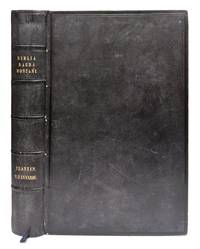
1584réf. 665155Ex officina Christophori Plantini / Christopher Plantin 1584. Leather Binding. Near Fine. A near fine copy austerely but attractively bound in full 19th-century dark aubergine morocco spine with raised bands and gilt titling inner dentelles tooled win gilt with a repeating floral scroll all edges gilt covers bordered in blind minor wear corners show some wear; an old inscription on the New Testament title page has been removed with slight loss and paper restoration; some minor occasional marginal stains. An attractive intact copy of this 16th-century Plantin polyglot Bible. N.T. first in volume. O.T. starts at back of volume Title page of Greek N.T. reads:'Novum Testamentum Græcum cum Vulgata interpretatione Latina Græci contextus lineis inserta: quæ quidem interpretatio cùm à Græcarum dictionum proprietate discedit sensum videlicet magis quàm verba exprimens in margine libri est collocata: atque alia Ben. Ariæ Montani Hispalensis operâ è verbo reddita ac diuerso characterum genere distincta in eius est substituta locum. Accesserunt & huic editioni libri Græcè scripti quos Ecclesia Orthodoxa Hebræorum Canonum secuta inter Apocryphos recenset; cum interlineari interpretatione Latina ex Bibliis Complutensibus deprompta.' The Greek N.T. Novum testamentum graecum cum vulgata interpretatione Latina Graeci contextus lineis inserta is at the beginning of the vol. with the Hebrew O.T. at the end with the Greek Apocrypha 128 p. between. Each Testament has its own title page and the mention of the Apocrypha on both suggests that it was intended to form an appendix to either of the Testaments if they were issued separately Reprinted from the 1569-72 Antwerp Polyglot. PROVENANCE: With the ownership inscription of auhtor Archibald Douglas Fox on verso of front endpaper: 'Archibald Douglas Fox 1901 / belonged to my father and grandfather.'. Ex officina Christophori Plantini / Christopher Plantin unknown
1952réf. LFA-126723808Revue trimestrielle de 83 pages, format 135 x 210 mm, brochée, bon état, rare
1904First edition. Original boards. 8vo. 224 pages. 21 cm. In Hebrew, English, and Yiddish. Goldman 319. Title translates as A Hebrew Grammar: An Instructive Guide to the Holy Language for Jewish Schools and Homes. Hertz was born in Rebrin, Czechoslovakia, (or Lastomir, Hungary) in 5617 [1847] and he studied for three years under Rabbi Azriel Hildesheimer in Eisenstadt (or Berlin ) . He immigrated to America in 1884 and devoted the rest of his life to Jewish education. Hertz published poetry and linguistics and Biblical studies. He died in the Bronx in 1913. His son was Joseph H. Hertz, the chief rabbi of the British Empire and the editor of the "Hertz Chumash. " "An instructive guide to the Holy Language for Jewish Schools and Homes. Written in a most interesting and attractive style, with ample rules and explanations concerning Rashi script and the reading of unpunctuated Hebrew in English and Jewish-German. The English and Yiddish texts appear on facing pages (Goldman) . Grammatical rules are formulated in verse. SUBJECTS: Hebrew language -- Grammar. OCLC lists 7 copies worldwide. Minor shelf wear to boards. Internally Very Good. Overall Good+ Condition. (AMR-47-39)
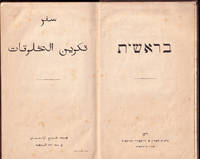
1872réf. 056106Vienna Wien: A.Riechert = A. Rikhard ve-Shutafot Beç 1872. 1st Edition . Hardcover. Very Good. 8vo - over 7¾ - 9¾" tall. Original cloth binding with a bilingual title in Hebrew and Ottoman Turkish in Arabic script on the front board and blind-tooled decorations on both boards. Demy 8vo 22 x 14 cm. Text in Ottoman Turkish and Hebrew. 4 176 pp. Cloth slightly faded; foxing to the first and last blank leaves and pastedowns as well as to some margins; hinges slightly split. Overall a good copy. Extremely rare early Viennese edition of this bilingual "Genesis" in Hebrew and Ottoman Turkish one of only three produced by the Adolf Holzhausen Printing House in Vienna a major centre for Hebrew book production in its time. According to the Özege catalogue it represents one of the few bilingual Holzhausen editions. Adolf Holzhausen 1868-1931 was an influential Austrian-Jewish publisher and bookseller notable for his contributions to the world of printing and publishing in Vienna. He was the son of Adolf Holzhausen the Elder 1827-1892 who led the Viennese court and the university's book printing company. Growing up in a family deeply rooted in the book trade Holzhausen received thorough training in the family business; his father had owned the prestigious Manzsche Buchdruckerei Manzsche Book Printing Company since 1858. Holzhausen developed specialized expertise in typesetting and printing of oriental scripts and he supplied his company with carefully crafted oriental typefaces which were highly valued in scholarly and literary circles. Building on this expertise he eventually established his own university book printing company as well as a private publishing house focusing primarily on art books historical works and scholarly publications. Following the upheavals of the First World War Holzhausen was appointed head of the Austrian Military Geography Institute reflecting both his organizational abilities and his intellectual reputation. Beyond his publishing and military contributions he was a strong advocate for collaboration among Austrian educational book publishers promoting greater unity and standards in the production of educational materials. Through his dual roles as a printer and publisher Holzhausen left a lasting impact on Viennese cultural and academic life bridging traditional craftsmanship with modern publishing practices and fostering scholarship in art and history. TBTK 12907. For later edition see Özege 19925. As of March 2026 OCLC lists no copies in a Western library see 236007780 but for the earlier edition 1860 it can be traced only in the Stanford University Cecil H. Green Library see 71019424. A.Riechert = A. Rikhard ve-Shutafot, Beç hardcover
1980IN HEBREW. 28X21.5 cm. 191 Pages. Hardcover. Ex Library with usual marks. Cover slightly stained and yellowing. Spine slightly stained and yellowing. Spine edges slightly bumped. Few pages age-stained. Pages slightly yellowing. Else in good condition. PLEASE NOTE: This item is overweight. We may ask for extra shipping costs.
198412mo; 117 pages; In German. 2 long handwritten letters from the author laid in. A nicely done history. (GER-39-4)
réf. 48202Lille, Desclée de Brouwer, 1903, brochure petit in 12, 33 pages.
réf. 99104Oxford Clarendon Press 1750. . First edition; two volumes in one; 4to 24 x 19.5 cm; text in Hebrew; contemporary calf boards with gilt borders spine with raised bands leather label joints and spine cracked. A non-vocalised edition of the Pentateuch based on E. van der Hooght's text Darlow & Moule 5141. It is the earliest edition of the Hebrew Bible apart from the London Polyglot to be printed in England. The editor Nathaniel Forster D. D. 17181757 was an English cleric and biblical scholar. Son of a minister he was educated at Eton and at the Corpus Christi College in Oxford. In 1750 he became domestic chaplain to Bishop Joseph Butler who died in his arms two years later in Bath Somerset. ESTC T147721; Darlow & Moule 5151. Oxford, Clarendon Press, 1750. hardcover
réf. 117964Mantua Eliezer Shlomo of Italy 1785. . 8vo; contemporary vellum engraved frontispiece depicting the Sacrifice of Isaac slightly stained hinges cracked but holding edges stained red; text in Hebrew; 248 124 iipp. Scarce Hebrew bible from Italy with Five Scrolls Haftarot at the end of the volume and calendars of Holidays and fasts for 120 years at the beginning. The frontispiece engraving depicts The Binding of Isaac with Abraham dressed in contemporary 18th-century Italian dress. Vinograd Mantua 545. Mantua, Eliezer Shlomo of Italy, 1785. hardcover
1616réf. 21257271616. Geneva: Kefa Elon i.e. Pierre de la Rouviere. 5377 i.e. 1616 or 1617. with:--. Samuel. SHmvAl.Geneva: Kefa Elon i.e. Pierre de la Rouviere. 5377 i.e. 1616 or 1617. Two parts in one volume 16mo. Eighteenth-century sheep spine richly gilt in compartments board-edges roll-tooled in gilt red gilt brocade endpapers; Joshua and Judges: ff. 3 blank 130 3 blank with part-title to Judges; Samuel: ff. 3 blank 151 6 blank; titles within architectural woodcut borders and start of text within woodcut cartouches; hinges starting boards lightly rubbed with a few minor abrasions worming to upper joint with small loss; internally clean and bright; a very good copy.Two portions comprising Joshua and Judges as well as Samuel of the handsome eighteen-part pocket-sized Hebrew Bible printed in Geneva by Pierre de la Rouviere sold as individual fascicles which could be bound together as here or in sets of four volumes.The Christian printer Pierre de la Rouviere 1574-1622 fl. 159-1622 is here listed on the title-page as 'Kefa Elon' a literal translation of his name 'Rock Oak'; he is elsewhere known as Cephas/Cafa Elon or Petrus Quercetanus and was the printer of the first bilingual Josephus 1611 as well as a Hebrew-Greek Bible 1609. The two discrete parts bound together here form part of what Steinschneider calls the Biblia Eliana - known also as the Petrus Bibles - issued shortly after the quarto Hebrew edition also published in octavo with interlinear Latin translation. All are based largely on earlier Venetian Hebrew Bibles especially those printed by Giustiniani in the sixteenth century to which they are typographically related. The present work evidently makes use of Picard's square Sephardic Hebrew typeface Lubell's Hb27 first used by Robert Estienne in 1543 and 'most probably the first complete Hebrew type specimen ever recorded' Lubell p. 258. De la Rouviere had used the same type for his 1614 Thesaurus linguae sanctae distinguished by the 'lamed with its distinctive flagged ascender the shin with the squared termination on the middle stroke and the gimmel with the bent middle stroke and calligraphic termination to the baseline . The attributions for this Picard typeface show a very wide distribution: Geneva Giessen Frankfurt and Hanau in Germany' and were likely spread by Andre Wechel who re-established his business in Frankfurt in the aftermath of the St Bartholomew's Day Massacre and likely 'managed to have some of his type brought to Frankfurt by Denis du Val his associate in Paris' or by Robert Estienne who brought much of his type to Geneva after 1549 ibid. pp. 259-60. Geneva gnvvA is often mistaken in the imprint as Genova. The title-page to each fascicle gives the date of 5377 i.e. 1617 but the colophon of the last portion Chronicles gives the date of 13 Av 5318 i.e. 28 July 1618 and the name of 'the German Johann Caspar from Oeder' trans. whose name also appears at the end of the Book of Esther. We have been un-able to identify the handsome gilt brocade endpapers depicting acanthus leaves and flowerpots and signed 'B.L.sC' although the interlacing geometric borders bear a resemblance to motifs employed by Georg Christoph Stoy cf. Kopylov 38.BM STC p. 99; Darlow & Moule 5121 dividing the work into fourteen parts rather than eighteen; Roest I p. 168; Steinschneider 420b. See Heller The Seventeenth Century Hebrew Book I pp. 380-81; cf. Vinograd Geneva 9 calling for 8vo and 4to only ; endpapers not in Kopylov. hardcover
1872réf. AQ21592London: Elliot Stock 1872. iv 204pp. Original publisher's maroon cloth stamped in gilt and blind. Extremities sunned and lightly rubbed. Very occasional light spotting. A complete run of the first 12 issues of a short-lived monthly periodical dedicated to contemporary English members of the Hebrew Christian movement comprised of Jews who had converted to Christianity but worshipped in congregations separate from denominational churches. . Quarto. Elliot Stock hardcover
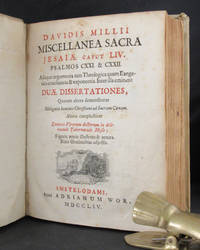
1754réf. 30845Amstelodami Amsterdam: apud Adrianum Wor 1754. First and Only Edition. Very handsomely decorated and illustrated with title in red and black with engraved device and 6 very fine and large engraved folding plates showing the Tabernacle and other decorations and a portrait of the author. With some Hebrew and Greek text. Small 4to bound in contemporary blind-stamped vellum with manuscript title at the spine. 11 326 329-414; 2 329-402 xcviii 6 403-438 4 pp. A very pleasing and handsome copy with clean fresh text and fine plates a very faint and occasional sign of old damp at lower inner margin. VERY RARE FIRST EDITION IN EXEMPLARY CONDITION. This was the only edition of this scarce melange of theological commentary and philological criticism of the Hebrew Scriptures along with the author’s speculations on the construction of the Israelite tabernacle the latter accompanied by five large engraved illustrations. Born at Königsberg Prussia the noted German Orientalist David Mill 1692-1756 was professor of theology at the University of Utrecht. His inaugural oration “De fatis theologiae exegetica” was delivered 10 October 1729 and is included in the present collection along with his “Oratio de erudita pietate” 25 March 1743 a number of commentaries on various psalms and his "Dissertatio de Tabrnaculo Mosis to which five very large folding engraved plates are added. The volume comprises a tribute to professor Mill on the occasion of twenty-five years of service to the University and concludes with two verse encomia: “De erudita pietate peroranti” by Otto Arntzenius; and an “Elegia ad virum celeberrimum Davidem Millium” by Jacobus de Rhoer. In his later years Mill built a model of the Jerusalem Temple which eventually found its way to the attic of the University Library at Utrecht from whence it was rescued in the late nineteenth century by Leendert Schouten for his Biblical Museum Bijbels Museum in Amsterdam. With a fine engraved portrait of Mill. Walch Bibliotheca theologica selecta 4: 834. Not in Horne. apud Adrianum Wor hardcover
1992réf. 54498Wien, Brüder Hollinek, 1992. 4°. Mit zahlr. tlw. ganzs. bzw. farb. Abbildungen. XXIV, 277 S., OLwd. m. illustr. OUmschlag.
19131st edition. Poster, 9x12 inches on 13 x 16 inch linen backing. Text in Hebrew, English, and Yiddish. Prof Dr. Gottlard Deutsch, Prof. Dr. David Neumark, and Mr. Joshua Bloch will speak. Miss Jennie Mannheimer will recite some of H.N Bialiks poems. HERR NAHUM SOKOLOV will deliver an address on The Development and Future of Hebrew Literature.....Rev. Dr. Louis Grossman will preside. Deutsch, Neumark, and Grossman were leaders of the Reform movement at the time; Bloch went on to edid the Journal of Jewish Bibliography and to head the Jewish devision at NYPL. Jennie Mannheimer (1872-1943), aka Jane Manner, was an American elocutionist, acting coach, and teacher of speech and drama. Her father, Sigmund Mannheimer, was a professor and librarian at Hebrew Union College .Jennie Mannheimer was one of the first two women to earn a bachelor's degree in Hebrew Letters from Hebrew Union College, in 1888 .[She] was director of the drama department at the Cincinnati College of Music from 1900 until 1907. She also ran her own school, the Cincinnati School of Expression (1894-1912). In New York, She was founder of the Drama Recital Club, and a member of the New York Drama League, the New York League of American Pen Women, the Council of Jewish Women, and the Temple Emmanu-El Women's Auxiliary (Wikipedia). Ibriah, a Cincinnati organization committed to Hebrew conversation and literature, was, not surprisingly, also a center of Zionist support, despite the Reforms dominance in local Jewish thought and culture. Here the host a gathering to meet leading modern Hebrew writer Nahum Sokolov. Joan Friedman notes in a 2006 article on Solomon Freedhof at HUC during the period that, The hot issue of the day during Freehofs student and early faculty years at the College was Zionism. It was discussed in the Literary Society and everywhere else on campus. During the 19111912 academic year, Silver and Professor Neumark had founded a Hebrew-speaking club, Ibriah, of which Marcus was a member, though he does not mention whether Freehof was also. The CCAR had taken a firm stance against Zionism as early as 1897, although individual rabbis were outspoken Zionists.104 Kohler was a committed anti-Zionist. Nevertheless, despite his best efforts, between 1910 and 1920 the student body gradually shifted to an overwhelmingly pro-Zionist perspective as its demographics changed, world events furthered the Zionist cause, and Louis Brandeis popularized a nonideological Zionism acceptable to American Jews, including many Reform Jews (AJAJ, LVIII, Nr ½, p. 21). Toning, light crease, Very Good Condition. Presume quite rare. (ZION-10-12B)