1813réf. 29398Paris: Imprimerie De Jules Didot Aine 1813-1824. From the first edition of this monumental work on classical art. An original aquatint printed in terracotta-red and black over a white background. This plate features two images. In one a female figure is flanked by two Satyrs men with tails like horses. The second features a bearded figure flanked by two female figures. The figures are printed in black on a terracotta background with stylized foliage around them. Printed on a folio captioned sheet measuring 22.5" x 16.5" the printed area approximately 15" x 10". Now presented in cream mounting boards 26" x 22" glazed behind clear mylar. A fine and beautifully preserved plate in excellent condition. AN IMPRESSIVE PLATE FEATURING A TOTAL OF SIX HUMAN FIGURES. This plate is from the original edition of LaBorde's COLLECTION DES VASES GRECS DE MR. LE COMTE DE LAMBERG. The Count of Lamberg Ambassador to the King of Naples assembled a remarkable collection of approximately 500 vases which included a number given to him by the Queen of Naples. Laborde mindful of faults in the illustrations of the famous Hamilton catalogues was intent on producing an even finer book and rendering the objects with 'extreme fidelity'. Brunet said of the production "the precious pieces in this collection are shown here with remarkable precision." Quérard noted "this work deserves particular attention for its fine execution. It was attempted as much as possible to present facsimiles so to speak of the vases with all the colours and figures that can be seen on these precious pieces. Imprimerie De Jules Didot Aine hardcover
1985réf. mon0000008361Oxford University Press 3/7/1985 12:00:01 AM. hardcover. Very Good. 0.7874 in x 8.7402 in x 5.7480 in. 1st edition. Hardcover with good dust-jacket. Former owner's name penned on interior of front cover. Text clean and binding solid. Wear and some small tears to edges of jacket. Original trade edition. Hand-wrapped and packaged in cardboard. Oxford University Press hardcover
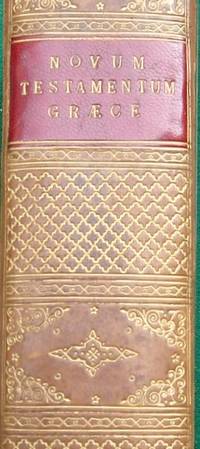
1701réf. 378206Amsterdam: Ex Officina Wetsteniana 1701. 565 2 pp. Without the map found in some copies but not called for by Darlow & Moule or STCN. 16mo. 19th-century red morocco gilt frames and corner fleurons to boards gilt-tooled and lettered spine gilt tooling to outer and inner board edges text block edges gilt multi-colored Dutch pastedowns. Title page printed in red and black. Spine somewhat darkened rubbing to joints. Moderate toning to margins of text block small faint stain to top-edge of first few leaves. A nice copy. Provenance: Frederick Keppel 19th-century armorial bookplate; Douglas Maxwell Moffat; General Theological Seminary bookplates. 565 2 pp. Without the map found in some copies but not called for by Darlow & Moule or STCN. 16mo. According to Darlow & Moule this was the third edition edited by Leusden and "the earliest Greek Testament to bear the name of the publisher Henricus Wetstenius Wetstein or Wettstein" Darlow & Moule 4718a; STCN 242135129 Ex Officina Wetsteniana unknown
1911réf. 054699Attaleia Adalia Antalya: Typg. N. K. Meli or Mele 1911. Soft cover. Very Good. 8vo - over 7¾ - 9¾" tall. Original wrappers. Large 8vo. 21 x 16 cm. In Greek Modern. 21 p. First and only edition of this exceedingly rare and one of the earliest church regulations of the Greek Orthodox community of Attalia Antalya. Attalia was not a large urban center or major trading hub but neither was the Greek Community marginal and it was well integrated into the regional economy. It was different from other areas in Asia Minor due to a combination of factors ranging between demography geography local Orthodox leadership and the city's social milieu. In contrast to the West-coast cities and many villages in Asia Minor with Orthodox majorities Attalia's population was only about one-third Orthodox. The main area of difference in Antalya was the Community leadership which was key to the maintenance of cordial relationships between Christians and Muslims and the secular and ecclesiastical elements of Orthodox leadership in Antalya tended to cooperate for collective benefit. Throughout this period a local elite managed to control education and other Community institutions perpetuating an identity that was compatible with the local Ottoman context. In this last period the Greek Community printed several books and tractates including a brief history of Antalya and this "regulation book" in the Meli Printing House which was the only printing house of the Greek Community in Antalya. Only one institutional copy is located in OCLC 1030075331 Suna Kiraç Library of the Koç University. Typg. N. K. Meli [or Mele] paperback
1725réf. L0823Amstelodami: Sumptibus Societatis David Millius. G : in Good condition without dust jacket. Covers rubbed. Loss to spine leather of volume 2. Occasional slight foxing. 1725. Seventh Edition. Brown hardback leather cover. 170mm x 100mm 7" x 4". 903pp; 928pp. Written in Greek. Bookplate of Montagu Burgoyne. Title page with small woodcut engraving. The second recognised edition from the Vatican in Rome. . Sumptibus Societatis [David Millius] hardcover
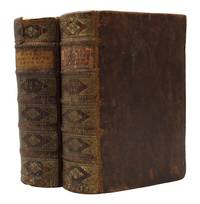
1725réf. AQ30436Trajecti ad Rhenum i.s. Utrecht: Apud Guilielmum vande Water et Jacobum van Poolsum 1725. In two volumes. 138 24 903 1; 2 928pp. Titles in red and black. Text printed in double columns. Contemporary gilt-tooled calf marbled edges. Extremities rubbed wear to head and foot of both spines Vol. I without lettering-piece lettering-piece of Vol. II chipped. Ink library stamps and recent bookplates of R. A. Levisson to both FFEPs scattered spotting. The Septuagint or the Koine Greek version of the Hebrew Bible is the earliest translation of the Hebrew Bible into Greek appearing between the first and third centuries before Christ in Alexandria. Embraced by the Catholic Church which includes many of the texts that Reformed churches ignore or consider Apocryphral the authorised Papal version of the Septuagint was first produced in Rome 1587 under the reign of Pope Sixtus V. A direct by-product of the Council of Trent the production of the Septuagint was the suggestion of Cardinal Pole who encouraged making available the Bible in Hebrew and Greek as well as the Latin vulgate in order to counter charges of the Reformers. This edition was compiled by German oriental philologist and reformed theologian David Mill 1692-1756 and was published simultaneously in Amsterdam. Darlow and Moule 4736. First Millius edition. 8vo. Apud Guilielmum vande Water et Jacobum van Poolsum unknown
1796réf. AQ12097Etonae i.e. Eton: Excudit M. Pote 1796. iv 2 1-2 7-148pp 96pp only i.e. sections of Homer's Odyssey Hesiod and Theocritus excepted from the larger collection in both Greek and Latin the former interleaved with blanks but lacking two printed leaves of the Odyssey. Contemporary vellum lettered in manuscript to spine. Marbled endpapers. Slightly rubbed and marked text occasionally spotted. Bookplate of James Stewart to FEP ink inscription to verso of FFEP and 'E Libris John Arthur Lloyd. Harrow 1807' Interleaving extensively annotated in Lloyd's hand to the sections of Hesiod and Theocritus. A deliberately excerpted part of the polyglot Etonian schoolbook of Greek poetry studied and comprehensively annotated in both Latin and Greek with extensive references to other classical works including most notably the Latin poets Horace Ovid and Virgil. This copy has a rather interesting provenance: being used at Eton's greatest public school rival by the Harrovian John Arthur Lloyd who was famously the Captain of a Harrow cricket XI in 1805 on the occasion of the first match against Eton. This team included Lord Byron who scored only 9 runs in two innings and took a single wicket and on whom the former commented 'he should never have been in the eleven if my counsel had been taken'. Lloyd was later elected a member of the Roxburghe Club. Part of ESTC T123296. Fifth edition. 8vo. Excudit M. Pote hardcover
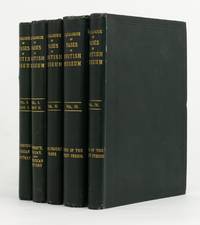
1893réf. 142910London: British Museum 1893. First Edition. Hardcover. Very Good. London British Museum 1893 to 1925 all first editions. Small quarto four volumes in five full details below; original dark green cloth lettered in gilt on the spines; minimal signs of age and use but essentially in excellent condition throughout. Volume I Part I: Prehistoric Aegean Pottery by E.J. Forsdyke 1925; xliv 228 pages with numerous illustrations plus 16 plates. Volume I Part II: Cypriote Italian and Etruscan Pottery by H.B. Walters 1912; xxxii 276 pages with numerous illustrations plus 34 plates. Volume II: Black-figured Vases by H.B. Walters 1893; iv 314 pages with '40 illustrations in text' plus 7 plates. Volume III: Vases of the Finest Period by Cecil H. Smith 1896; vi 426 pages with '28 illustrations in text' plus 28 plates. Volume IV: Vases of the Latest Period by H.B. Walters 1896; vi 276 pages with '30 illustrations in text' plus 16 plates. The out-of-sequence dates of publication of the two parts of the first volume are explained in the respective prefaces. The one in Part II 1912 notes that 'When the present Catalogue . was planned in 1891 Volume I was assigned to the vases then exhibited in the First Vase Room which are for the most part of an early date and represent the beginnings of Greek Vase-painting in many places and styles. The subsequent growth of the collection especially in the sections dealing with Crete and Cyprus has made it necessary to divide the volume into two parts the second of which is the first to be ready for issue'. The preface in Part I 1925 adds that 'The lapse of time consequent on the interruption of the War and the further growth of the collection have caused an additional sub-division. The Second Part of Vol. I is devoted to the special groups of Cypriote Early Italian and Etruscan Vases. The Third Part when it appears will deal with the Geometric Early Corinthian and Ionian wares intermediate between the prehistoric pottery of Part I and the black figure vases which are the subject of Vol. II'. This Part III appears not to have been published. 5 items. British Museum hardcover
réf. BN104412Editions de l'Amandier. Softcover. Les soeurs d'Icare Les soeurs d'Icare Editions de l'Amandier paperback
1813réf. 29400Paris: Imprimerie De Jules Didot Aine 1813-1824. From the first edition of this monumental work on classical art. An original aquatint printed in terracotta red and black over a white background. This plate features two images. The upper images features three warriors two of which carry shield and wear helmets the lower features two Satyrs with the seated figure of a king or elder. Each figure also features cranes. Printed on a folio captioned sheet measuring roughly 23" x 16" the printed area approximately 15" x 10". Now presented in cream mounting boards 26" x 22" glazed behind clear mylar. A fine and beautifully preserved plate in excellent condition. AN IMPRESSIVE PLATE FEATURING WARRIORS AND SATYRS. This plate is from the original edition of LaBorde's COLLECTION DES VASES GRECS DE MR. LE COMTE DE LAMBERG. The Count of Lamberg Ambassador to the King of Naples assembled a remarkable collection of approximately 500 vases which included a number given to him by the Queen of Naples. Laborde mindful of faults in the illustrations of the famous Hamilton catalogues was intent on producing an even finer book and rendering the objects with 'extreme fidelity'. Brunet said of the production "the precious pieces in this collection are shown here with remarkable precision." Quérard noted "this work deserves particular attention for its fine execution. It was attempted as much as possible to present facsimiles so to speak of the vases with all the colours and figures that can be seen on these precious pieces. Imprimerie De Jules Didot Aine hardcover
réf. 2f3284Arnaldo Forni Bologna um 1987. Zusammen 1.987 S. mit zahlr. Tafeln Leinen mit goldgeprägten Rückentiteln Namensstempel auf Vorsatz. - sehr gute Faksimile-Ausgabe/very good condition/Enthalten: Cataloque of the greek coins of Palestine Galilee Samaria and Judea/The Ptolemies kings of egypt/Cataloque of the greek coins of Troas Aeolis and Lesbos/Cataloque of the greek coins of Galatia Cappadocia and Syria/Pontus Paphlagonia Bithynia and the kingdom of Bosporus/Cataloque of the coins of Parthia/Cataloque of the greek coins of Arabia Mesopotamia and Persia - unknown
réf. elala5083Geneva: Jean Crispin 1567. Crispin had previously published the Iliad in 1559; the two works are listed together in the bibliographies. Adams H756. Brunet III 271. Graesse III 327. Moss II 485. 16mo. pp. 2 p.l. 528 i.e. 428. text in Greek. woodcut printer's device on title. woodcut headpieces & initials. 17th century calf covers paneled in blind joints rubbed corners & spine worn & chipped at head & tail light dampstaining to outer leaves some headlines shaved [Geneva:] Jean Crispin, 1567 unknown
1998réf. x-1566765927Technomic Pub Co 1998. Hardcover. New. 1st edition. 656 pages. 8.80x6.00x1.40 inches. Technomic Pub Co hardcover
réf. 2080202103700919Editions du Center National de la Recherche Scienfitique N.A. Soft Cover. Fine. Page size: 2 v. Size: 25 cm Editions du Center National de la Recherche Scienfitique paperback
1793réf. 12481BASKERVILLE'S GREEK TYPE first edition thus in Baskerville type tall 8vo. in fours 676pp. printed on fine ie. thick paper attractive three-quarter sprinkled calf probably nineteenth century smooth spine very richly decorated in gilt in panels of contrasting and alternating design scarlet morocco label gilt marbled paper on sides and as endpapers half-title and last leaf a trifle dusty rear joint cracking else a fine fresh and bright copy. A particularly handsome copy. ESTC t94889 Darlow & Moule 4756 Only two books were printed in this type the octavo and quarto Testaments both in 1763. Edited by John Mill. 2000 copies printed. E Typographeo Clarendoniano hardcover
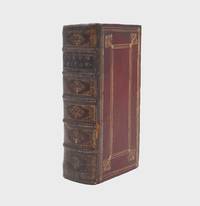
1698réf. 255818Amsterdam: Ex Officina Westeniana 1698. 3rd Leusden edition. Additional engraved title-page and 2 folding engraved maps the Holy Land and the Mediterranean. 337 1. colophon; 142 1 pp. 8vo signatures alternating in 8s and 10s. 18th-century red morocco covers with gilt-rolled bordersgilt-tooled and -lettered spine multi-colored Dutch pastedowns without free endpapeers. a.e.g. Head of spine starting otherwise quite attractive. 3rd Leusden edition. Additional engraved title-page and 2 folding engraved maps the Holy Land and the Mediterranean. 337 1. colophon; 142 1 pp. 8vo signatures alternating in 8s and 10s. D & M doesn't mention the two fine engraved maps found in this copy; nor the separately printed COMPENDIOLUM 1699 with Leusden's useful concordance of all Greek words found in the New Testament. The Dutch Calvinist philologist Johann Leusden 1624 - 1699 was one of the foremost Biblical experts of his time. His edition of the Greek New Testament first appeared in 1675; this 1698 edition is quite scarce in the US and very rare with the Compendiolum. Darlow & Moule 4718a "Apparently the earlies Greek New Testament to bear the name of the publisher Henricus Wetstenius"; OCLC: 64158458 Ex Officina Westeniana unknown
1945réf. 66739New York: The Greek American Council 1945. Wraps. Good. No dust jacket. 6 137 3 pages. 28 cm. Cover is worn soiled front cover creased and small piece of corner missing. Minor water staining at bottom of several pages. Minor loss of material at botton of several pages. Pencil erasure residue on t-p. Produced by Co-op Mimeo Service of New York City. From Wikipedia: "The National Liberation Front was the main movement of the Greek Resistance during the Axis occupation of Greece during World War II. Its main driving force was the Communist Party of Greece KKE but its membership throughout the Occupation period included several other leftist and republican groups. EAM became the first true mass social movement in modern Greek history and even established its own government the Political Committee of National Liberation in the areas it had liberated in spring 1944. At the same time from late 1943 onwards the political enmity between EAM and rival resistance groups from the centre and right evolved into a virtual civil war which was ended only with the Lebanon conference in May 1944. The organisation reached its peak after Liberation in late 1944 when it controlled most of the country before suffering a catastrophic military and political defeat in the December 1944 events. This marked the beginning of its gradual decline and the open persecution of its members accusing it for crimes against political rivals and Soviet perspective and leading eventually to the outbreak of the Greek Civil War.After Liberation in October 1944 the tensions between EAM and right-wing nationalist or western-oriented republican forces which were supported by Great Britain escalated. Originally as agreed at the Lebanon conference EAM participated in the government of national unity under George Papandreou with 6 ministers. Due to disagreements regarding the disarmament of ELAS and the formation of a national army on 1 December the EAMite ministers left. EAM organized a demonstration in Athens on December 3 1944 against British interference. The exact details of what happened have been debated ever since but gendarmes opened fire on the crowd resulting in 25 dead protesters including a six-year-old boy and 148 wounded. This clash escalated into a month-long conflict between ELAS and the British and Greek governmental forces known as the "December events" Dekemvrianá which resulted in a British and Greek government victory. In February the Varkiza agreement was endorsed leading to the disbandment of ELAS. In April the S and LD parties left EAM. EAM was not dissolved but was hence for all intents and purposes merely an expression of the KKE. During the 1945-1946 period a conservative terror campaign the "White Terror" was launched against EAM-KKE supporters. The country became polarized eventually leading to the outbreak of the Greek Civil War in March 1946 which lasted until 1949. In its aftermath and in the context of the Cold War KKE was outlawed and EAM/ELAS vilified as an attempt at "Communist take-over" and accused for various crimes against political rivals. The issue remains a highly controversial subject to this day. With the coming of Andreas Papandreou to power in 1981 however EAM was recognized as a resistance movement and the fighters of ELAS were honored and given state pensions." The Greek American Council paperback
1813réf. 29399Paris: Imprimerie De Jules Didot Aine 1813-1824. From the first edition of this monumental work on classical art. An original aquatint printed in terracotta red and black over a white background. This plate features three images. In each is featured a human figure along with Satyrs in two of the images and a centaur in the third. Sets of apotropaic eyes are prominently featured between them in each image. Printed on a folio captioned sheet measuring roughly 23" x 16" the printed area approximately 11" x 12". Now presented in cream mounting boards 26" x 22" glazed behind clear mylar. A fine and beautifully preserved plate in excellent condition. AN IMPRESSIVE PLATE FEATURING BOLD SETS OF apotropaic eyes SATYRS CENTAURS AND HUMANS. This plate is from the original edition of LaBorde's COLLECTION DES VASES GRECS DE MR. LE COMTE DE LAMBERG. The Count of Lamberg Ambassador to the King of Naples assembled a remarkable collection of approximately 500 vases which included a number given to him by the Queen of Naples. Laborde mindful of faults in the illustrations of the famous Hamilton catalogues was intent on producing an even finer book and rendering the objects with 'extreme fidelity'. Brunet said of the production "the precious pieces in this collection are shown here with remarkable precision." Quérard noted "this work deserves particular attention for its fine execution. It was attempted as much as possible to present facsimiles so to speak of the vases with all the colours and figures that can be seen on these precious pieces. Imprimerie De Jules Didot Aine hardcover
2009réf. 727Chestertown Md: Chester River Press 2009. First thus. Hardcover. New/New. Lawrence Avery. New still in publisher's shrink-wrap. This scarce two-volume set of "The Iliad" and "The Odyssey" a 2009 first edition/first printing is the very definition of a "fine edition" and it might be the very definition of "luxury item" as well. It was published by Chester River Press a firm that specializes in bespoke books that are designed in cooperation with the individual commissioning a publication. In this case that anonymous individual went all out with separate hardcover folio copies for each text with the original Homeric Greek edited by Barry B. Powell Professor of Classics Emeritus at the University of Wisconsin-Madison in parallel columns with the great Alexander Pope translation. Steven Shankman Professor Emeritus at the University of Oregon and UNESCO Chair in Transcultural Studies Interreligious Dialogue and Peace wrote a two-part introduction that tells the reader first about Homer then about Pope. It may be the illustrations that make these volumes especially distinguished however. Most of the approximately 55 original prints produced by Avery Lawrence are in the form of full-page recreations of red-and-black Greek pottery that illustrate the stories being told.if "recreations" is the right word for images that follow the exacting artistic forms but still spring from Lawrence's imagination. The facing captions provide the applicable quotes for the action being depicted but also the date and even the artist or collector of the vessel used as a prototype. The print is dignified and sized to be easy to read and the paper is sturdy without being overly thick in a cream color that is gentle on the eyes. They are bound in identical black Dutch cloth with differences in their decoration and obviously their lettering but following the same format. "The Iliad" has an ancient Greek plumed helmet in profile stamped in gold on its front cover. A smaller copy of that helmet is at the top of the spine with the publisher's name at the bottom. The title in large Greek letters is between. All are stamped in bright gold. "The Odyssey" is similar in appearance. Instead of a helmet its cover is decorated with an ancient Greek ship and the title is again in Greek lettering. Unlike many books that come in slipcases these volumes have dustjackets made of sturdy glossy black paper. The spines of the dustjackets match the spines of the binding of the volumes only with orange printing instead of gold but the covers are quite different from the covers of the volume bindings. Here the Greek titles are printed in large orange letters with the titles repeated in smaller orange letters beneath along with Homer's and Alexander Pope's names. Shankman's and Lawrence's names are beneath those even smaller again in orange. We have described the text block to some extent above but we did not mention that each volume has a bright gilt top edge and comes with double black and gold satin ribbon bookmarks. The two volumes share a single slipcase and in this case even that slipcase is extraordinary - black sturdy with an attached broad satin ribbon that is serves as a booklift to help take the volumes out without damage. There are also small blocks built into the bottom of the interior of the slipcase that serve as supports for the text blocks so they don't drag on the binding helpful as the volumes are substantive and large: 15"x13"x1.75" to 2". These books won't be easy to cuddle up with but they will be volumes to be treasured as exemplars of the book arts. That is likely why institutions as far afield as the National Library of New Zealand and as prestigious as the Wren Library at Trinity College Cambridge University have copies. Now you can possess one too. Ours are new and still in shrink wrap as delivered by the publisher. See attached photos. Happy to address any questions. For overseas shipments please consult with us on mailing costs. Postage free with the US. Chester River Press hardcover
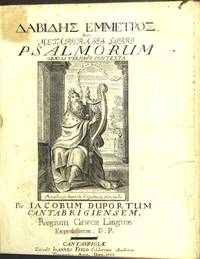
1666réf. 25559Cantabrigiæ: excudit Ioannes Field 1666. 4to pp. 72 431; inserted engraved vignette title-p.; parallel text in Greek and Latin; 2 short tears in fore-edge of title-p. not touching any letterpress worm track occasionally touching letters in first 60 leaves; stains on G2-G4; lacking the portrait of Charles II; contemporary calf-backed marbled boards red morocco label on spine; minor rubbing and wear small cracks starting at the extremities of the joints else generally a very good copy. Paraphrase in Homeric language and verse and its translation in Latin prose on opposite pages with a prefatory treatise on the ancient versions of the Old Testament. Translated by Jacob Duport. "Immediately after the Restoration he was made one of the king's chaplains and reinstated in the possession of his prebend at Lincoln but not of the archdeaconry of Stow as he preferred holding his fellowship and vice-mastership in Trinity College. Widdrington was now dispossessed of the Greek professorship and Duport restored to it but he resigned the chair the same year in favour of his pupil Isaac Barrow. On 19 July 1660 he was by royal mandate with many other learned divines created D.D. at Cambridge Kennett p. 251. He was installed dean of Peterborough 27 July 1664. In 1668 on the death of Dr. John Howorth master of Magdalene College Duport was recalled to Cambridge and appointed by James earl of Suffolk possessor of Audley End to fill the vacant headship. In the following year Duport was elected vice-chancellor of the university. Bishop Monk says that Duport 'appears to have been the main instrument by which literature was upheld in this university Cambridge during the civil dissensions in the seventeenth century and though seldom named and little known at present he enjoyed an almost transcendent reputation for a great length of time among his contemporaries as well as in the generation which immediately succeeded" DNB. Wing B2739a. excudit Ioannes Field unknown
1763réf. 2548Oxonii Oxford: E Typographeo Clarendoniano 1763. 8vo pp. iv 676. Near-contemporary tree calf spine elaborately gilt in compartments red morocco label marbled endpapers edges yellow. Some light toning and spotting. Expertly rebacked by Bernard Middleton with old backstrip laid down hinges relined. An attractive copy. In 1758 Baskerville proposed the casting of a new set of Greek types to the Oxford University Press and they ordered 2000 copies of this octavo New Testament plus 500 in quarto to be printed with the resulting type - which ended up being its only use. Negative critical reception may have contributed to its abandonment but Baskerville’s Greek face has recently been reassessed by Gerry Leonidas as an important predecessor of more modern types if perhaps not quite as elegant as that used by the Foulis press that had fallen afoul of an arbitrary typographic orthodoxy. Gaskell Add. 2; ESTC T94889; D&M 4756. E Typographeo Clarendoniano unknown
1694réf. 20082Trajecti ad Rhenum: Ex Officini Francisci Halma 1694. First Tollius edition. 4to pp. 28 408 12. Engraved title-page; Printed with Greek and Latin texts on facing pages woodcut printer's device ornaments and initials full vellum backed marble boards with leather label. Upper margin along the hinge shows a water mark in the preliminary matter o/w a very nice clean copy. Longinus was a Greek Platonic philosopher and rhetorician of the 3rd century AD. He studied in Alexandria and taught in Athens. He was beheaded by Emperor Aurelian in 273 A.D. but is remembered for his Philosophical Discourses On First Principles On the Chief End. His authorship of the present work is desputed. Praised by Dibdin and Gibbon this edition of these commentaries on The Sublime by the anonymous author known as Longinus "is one of the greatest of all critical acheievements. An illuminating dissertation on style accompanied by many penetrating judgements as well as suggestive pronouncements on critical standards and principles the treatise is unique in its interpretation of the classical spirit its compelling enthusiasms its sanity its freshness and its unerring insights into the essentials of art."OCD. Ex Officini Francisci Halma unknown
1941réf. 0001137NEW JERSEY FORT MCCLELLAN ALABAMA. Good. 1941. This is the personal 1941-1942 diary of Joseph M. Grego of 110 Bright St. Jersey City NJ. Grego served with the US Armed Forces during WWII Service #32074892. He enlisted on June 5 1941 at 23 years-old. He was stationed at Fort Dix NJ Camp Croft SC Fort McClellan AL as well as California. In his diary Grego outlines his training including drill inspections trench warfare as well as range practice on a number of different types of firearms and bayonets. July 5 1941: "Extended drill barracks inspection in bed with sunburn went to a dance and met a girl from Virginia. Rain. July 14 1941: "Had instruction with 45 caliber revolver appointment with dentist two teeth filled extended order drill saw 'Buck Privates' Rain." August 6 1941: "Filled fortifications digging fox holes missed athletics boxing went to show and saw 'Blood and Sand'." August 13 1941: "Climbed trees and laid wire across trees telephone instruction and use. Cleaned barracks. Went to bed." Like most servicemen Grego suffers from the boredom of living on a base. To occupy his time he goes on leave writes letters home goes drinking gambles with friends and goes to socials and dances. Feb 2 1941: "Went on a trip to Stockton went skating and met a blonde named Lois." Sept 2 1941: "Rifle marksmanship. Went to tavern and got drunk." Sept 28 1941: "Stayed at camp all day. Washed clothes went to a show and saw Dr. Jekyll and Mr. Hyde." Dec 3 1941: "Worked in Regiment. Played cards with Manny in tent.lost $112." While Grego is stationed at Fort McClellan AL he works with military justice on the court martial of other officers. His entries don't go into to much detail but he records case loads working in court interviewing witnesses as well as preliminary inquiry preparations. This diary begins on July 1 1941 and runs until Feb 20 1942 with an entry for each day. The diary is written in a card stock bound "Roto-Process Soldiers Diary" and contains a personal information page a military information section the diary section followed by a directory listing the names and addresses of individuals mentioned in the diary pages. Overall G.; Manuscript; 24mo - over 5" - 5¾" tall; LEGAL JAG WWII WORLD WAR TWO WORLD WAR II SECOND WORLD WAR MARINES HANDWRITTEN MANUSCRIPT DOCUMENT LETTER AUTOGRAPH DIARY JOURNAL LOG KEEPSAKE WRITER HAND WRITTEN DOCUMENTS SIGNED LETTERS MANUSCRIPTS HISTORICAL HOLOGRAPH WRITERS DIARIES JOURNALS LOGS AUTOGRAPHS PERSONAL MEMOIR MEMORIAL PERSONAL HISTORY AMERICANA WORLD WAR II WWII RED SUN HIROSHIMA ATOMIC WARFARE ATOMIC BOMB A-BOMB NUCLEAR BOMBJAPAN NAGASAKI HIROSHIMA antiquité contrat vélin document manuscrit papier Antike Brief Pergament Dokument Manuskript Papier oggetto d'antiquariato atto velina documento manoscritto carta antigüedad hecho vitela documento manuscrito . hardcover
réf. 1659Amstelodami: Sumptibus P. & J. Blaeu Waesbergen Boom à Someren & Goethals 1699. Hardcover. Good. Octavo. xii 564pp. Later probably nineteenth-century quarter calf over marbled boards repaired. 0 Amstelodami: Sumptibus P. & J. Blaeu, Waesbergen, Boom à Someren, & Goethals, 1699. hardcover
1665réf. 310448Cambridge: John Field 1665. Second edition of the Septuagint printed in England; variant B with misprint in Greek title and sun and cup transposed in motto on title. 2 19 1 755 i.e. 767 1 516 273 pp. Text in Greek type in two columns. 12mo. Full morocco gilt to style by John Gardner Borough Green marbled edges and endpapers. One gathering sprung. Second edition of the Septuagint printed in England; variant B with misprint in Greek title and sun and cup transposed in motto on title. 2 19 1 755 i.e. 767 1 516 273 pp. Text in Greek type in two columns. 12mo. A handsome copy of the second edition of the Septuagint printed in England following the first of 1653 and the first edition to include the oft reprinted preface by John Pearson. John Field was printer to Cambridge University. "Possibly a reissue by Hayes who was University Printer from 1669 to 1680" Darlow & Moule. Darlow & Moule 4702 John Field unknown