[Bible in Greek, New Testament]Biblio.com

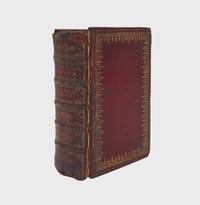
1584réf. 48696Antverpiae: Ex officina Christophori Plantini 1584. Folio 6 parts in 1; pp. 8 186 2; 128; collating: ¶ⴠA-Yâ´ Zâ¶; Aa-Qqâ´; woodcut device on title page; bound with: Biblica Hebraica Antverpiae 1584 Hebrew-Latin Old Testament Greek-Latin Apocrypha etc. in various pagings from back of book viz.: pp. 20 183 1; 283 1; 84; 203 1; collating from the back: †ⴠ‡ⶠA-OⶠPâ¸; a-xⶠy-z⸠aa-ggⶠAA-RRâ¶; in all 551 leaves; text in double column in Hebrew Greek and Latin; early 18th century calf blindstamped panels on covers red morocco label on spine; covers with dampstains corners bumped and showing small cracks starting at the extremities of the joints occasional light minor dampstaining but in all a very good and reasonably sound copy. Terminal flyleaf with elaborately penned inscription: "Isaac Sharpe flourishes dono Patris 1719." On the rear pastedown is Sharpe's early "Coll. Mag." bookplate dated April 4 1683 - possibly the date of his matriculation at Magdalene College Cambridge. The Greek N.T. starts at the beginning of the volume and the Hebrew O.T. at the end with the Greek Apocrypha of 128 pages between them. Each Testament has its own title page and the mention of the Apocrypha on both suggests that it was intended to form an appendix to either of the Testaments if they were issued separately. See Darlow & Moule 4645 and 5106: "This forms the latter half of the complete Bible in the original languages with an interlinear Latin translation; the whole reprinted from the Antwerp polyglot"; Voet A2 p. 320. Ex officina Christophori Plantini unknown
1549réf. 378214Lutetia i.e. Paris: Ex officina Roberti Stephani typographi Regii 1549. Second Estienne edition. 528; 361 7 pp. Complete with 2 terminal blanks. Second part has special title page. Woodcut Estienne devices to both titles. 16mo. Later eighteenth-century red morocco tooled gilt frames to boards lettered gilt spine with raised bands gilt tooling to outer and inner board edges marbled endpapers gilt edges. All pages ruled in red ink. Light rubbing to exterior front board nearly separated rear joint cracked chipping to spine ends. Moderate toning to margins light fox-spots to a few leaves partial crack in text block before second title page all leaves secure. Provenance: Douglas Maxwell Moffat bookplate; General Theological Seminary bookplates. Second Estienne edition. 528; 361 7 pp. Complete with 2 terminal blanks. Second part has special title page. Woodcut Estienne devices to both titles. 16mo. Produced in his twin capacities as a skilled printer and a trained classical scholar the Biblical output of Robert Estienne Latinized as Stephanus "had perhaps more influence than that of any other single man in the sixteenth century" Wordsworth in Darlow & Moule. He is known not only for the editions of the Bible that placed him on the Louvain faculty's index of prohibited books but as a publisher of important dictionaries Roman classics and contemporary educational writings. After his flight to Geneva around 1550 he also became an important publisher of the works of John Calvin. The 1546 & 1549 editions of the Greek New Testament are referred to as the "O mirificam" editions after the opening of the Latin preface. They are especially desirable as specimens of the typography of Claude Garamond who was commissioned by the king to design the Greek type used in Estienne's editions of the New Testament. "Estienne felt strongly the propriety of consecrating as it were the Royal Greek types in this way. He evidently felt also some stirrings of ambition as an editor; might not the resources of the King's Library now at his disposal enable him to produce a better text than that of Erasmus especially as he could use also the Complutensian text" Armstrong. Estienne's editorial ambitions culminated in the folio edition of 1550 which included a full critical apparatus but still reveal themselves in the texts of the O mirificam editions. Like the first edition the text of the 1549 edition largely agrees with Erasmus but it indeed incorporates the Complutensian text and also makes a number of independent readings with minor changes from the 1546 edition Darlow & Moule. An important and beautifully printed work. USTC 150379; Darlowe & Moule 4620; Renouard 73 1; Schreiber 102; Adams B1660. Armstrong Robert Estienne Royal Printer 136 Ex officina Roberti Stephani typographi Regii unknown
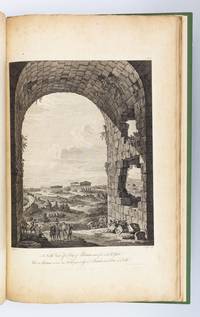
1768réf. ST17496-011London: Chez l'auteur 1768. First Edition in French. 590 x 380 mm. 23 1/4 x 15". 52 2 pp. Modern brown quarter morocco over green linen boards brown morocco label with gilt lettering on smooth spine edges untrimmed. WITH 25 FULL-PAGE ENGRAVED PLATES OF GRECIAN RUINS and seven smaller engraved plates in text including one on dedication page. A Large Paper Copy. Fowler p. 157; Millard British 41; Blackmer 1065; Brunet III 1329. Head of spine partly torn but with no loss contents with not infrequent light marginal soiling though plates uniformly clean other minor imperfections but an excellent copy with greatly generous margins with deep impressions of the type and with strong impressions of the plates. This work is the first significant account of the ancient city of Paestum being in the words of Blackmer "larger and much more complete than any of the previous publications." Located in the Tyrrhenian Sea off the coast of southern Italy Paestum or Poseidonia in Greek was founded by Greek colonists in the sixth century B.C. and still contains beautifully preserved ruins from that period including temples an amphitheater and painted tombs. Abandoned in the Medieval period Paestum wasn't rediscovered by the West until the 18th century with the first modern publication of the site not appearing until 1764 when a suite of plans by G. P. M. Dumont appeared with no text based on the observations of Jacques-Germain Soufflot. As Millard indicates the genesis of the present publication has an extremely complex history we do not even know with certainty who wrote the text but we do know that engraver Thomas Major 1729-99 whom DNB calls "the first great English landscape engraver" was responsible for preparing the plates. Because he had no first-hand knowledge of the site Major relied on images by other artists including Antonio Joli Gaetano Magri Robert Mylne and Jacques-Germain Soufflot. The text was first published in English and then in French the same year. According to Fowler "this work . . . was an important eighteenth-century pioneer contribution to the knowledge of Greek architecture in England"; and Millard tells us that "the book was surprisingly well received by reviewers" in both England and France remaining "the standard reference to Paestum until 'Les Ruines de Paestum ou Posidonia' by C.-M. Delagardette was issued in 1798.". Chez l'auteur unknown
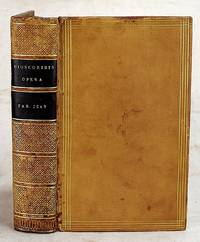
1549réf. 2307040014Paris: Benoit Prevost for P. Haultin; Apud Petrum Haultinum 1549. Hardcover. Good. Pharmacology: Early printing Greek / Roman Medicine Bound In 19th century polished calf. Gilt spine. Triple gilt ruled covers. All edges gilt. Front hinge starting. Blue marbled end sheets. Woodcut printer's device. Printed in double columns in Greek and Latin. 20 392 leaves. Dioscorides's 1st-century A.D. materia medica remained authoritative into the early modern era. Today the Greek physician is considered the father of pharmacology for his work in herbal medicine. Provenance: From the library of Nicolas Yemeniz 1783-1871 one of the great French bibliophiles of the late 19th-century. "Lugdun" bookplate. Refs: Adams D-657; Durling 1135; Wellcome I 1779. Paris: (Benoit Prevost for) P. Haultin; Apud Petrum Haultinum hardcover
1653réf. 255179Londoni: Excudebat Rogerus Daniel: prostat autem venale apud Joannem Martin & Jacobum Allestrye sub signo Campanae in Cometerio D. Pauli 1653. The first edition of the Septuagint printed in England. 8 1279 1; 186 2 pp. plus terminal blank. 1 vols. 4to signed in 8's 195 x 143mm. Old vellum titled and dated in manuscript on the spine. Terminal leaves slightly soiled two ownership inscriptions on front endsheets and small Lincoln's Inn release/sale stamp vellum a bit handsoiled occasional modest foxing and dusting along upper margins but a very good copy. The first edition of the Septuagint printed in England. 8 1279 1; 186 2 pp. plus terminal blank. 1 vols. 4to signed in 8's 195 x 143mm. The first edition of the Septuagint printed in England with the Scholia the scarce printing in quarto format. The text is derived from the Sixtine text and edited by John Biddle 1615-1662 the Unitarian controversialist who was imprisoned by the Parliamentary Commissioners for his religious views. The SCHOLIA . has a separate title-leaf register and pagination. The same setting was imposed in both quarto and octavo formats the latter with rules separating the columns of text. In regard to institutional representation the edition in quarto is much more uncommon than that in octavo: ESTC locates 4 copies of the quarto printing in North America as opposed to 19 of the octavo printing. Occasionally Daniel's reprint of the New Testament is bound up with the octavo printings to form a complete Bible. Brunet cites that format but notes the sale of a copy on "Gr. Pap." presumably a copy in this format. Over the last 35 years ABPC records sale of one copy in quarto 1999 and four in octavo. ESTC R12599 & R236817; Wing B2718 octavo edition only; Darlow & Moule 4692; Brunet I:863 Excudebat Rogerus Daniel: prostat autem venale apud Joannem Martin & Jacobum Allestrye, sub signo Campanae in Cometerio D. Pauli unknown
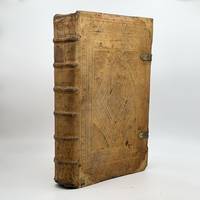
1609réf. 371891Geneva: Pierre de la Rouière 1609. In two columns. 28 184 283 1 84 203 1; 8 186 2 134 2pp. Folio 15 x 9-1/2 inches. Contemporary pigskin covers blocked in gilt and blind remnants of paper label on the spine gauffered edges lacks bosses and hinges and clasps worn at extremities and bottom of spine. Provenance: Johann Georg Feuchter of Jura-Weickersroda inscription on pastedown that the bible was purchased at an August 6 1728 auction for 4 florins and 30 groschen; General Theological Seminary blindstamp. In two columns. 28 184 283 1 84 203 1; 8 186 2 134 2pp. Folio 15 x 9-1/2 inches. Edited with introduction by Benito Arias Montanus 1527-1598 Spanish orientalist and editor of the Antwerp Polyglot a reprint of Plantin's similar edition. Darlow & Moole 5113 OT and 4662 NT Pierre de la Rouière unknown
1653réf. 371930London: Roger Daniel 1653. Title in red and black. Engraved printer's device on the title state B. Text in two columns. 8 1279 1 pp. 4to 7-3/8 x 5-3/8 inches. Eighteenth century red morocco panelled in gilt spines gilt with black morocco lettering pieces marbled endpapers gilt edges. Provenance: Viscount Palmerston bookplate; General Theological Seminary bookplate. Title in red and black. Engraved printer's device on the title state B. Text in two columns. 8 1279 1 pp. 4to 7-3/8 x 5-3/8 inches. The rare first printing in England of the Septuagint the earliest translation of the Hebrew Old Testament into Greek the scarce printing in quarto format. The text is derived from the Sixtine text and edited by John Biddle 1615-1662 the Unitarian controversialist who was imprisoned by the Parliamentary Commissioners for his religious views. "Roger Daniel's version of the text of the Sixtine edition was prepared for the use of the scholars at Westminster School. This appeared in 1653 and was edited by the Socinian John Biddle. Its publication may have owed something to the interest in the Septuagint generated by Codex Alexandrinus and the frustration produced by the failure of Young's attempts to edit it" S. Mandelbrote "English Scholarship and the Greek Text of the Old Testament" p. 87. A rare issue from the same setting as the octavo edition imposed in quarto without rules separaring the columns. Wing 2nd ed. B2718A; ESTC R12599; Darlow & Moule 4692 Roger Daniel unknown
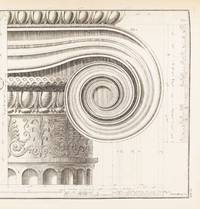
1758réf. ST17496-017Paris: H. L. Guerin & L. F. Delatour Jean-Luc Nyon and Jean Neaulme 1758. FIRST EDITION. 608 x 445 mm. 24 x 17". xiv 56; 2 vi 28 pp. Two parts in one volume. Later early 20th century quarter sheep over marbled boards raised bands compartments gilt reddish-brown leather label with gilt lettering all edges untrimmed. With large woodcut vignette on title and 60 ENGRAVED PLATES by Le Bas Littret de Montigny Neufforge and Patte after Le Roy. Brunet III 103; Millard French 101. A little rubbing to corners and head and tail of spine leather a bit faded chafed and freckled in places but the binding entirely sound and still quite pleasing; very faint diagonal crease at lower corner of many leaves a handful of plates slightly browned one more noticeably so other minor issues but quite a fine copy internally--the vast majority of the contents clean and bright with deep impressions of the text with the engravings richly impressed and with vast margins. With engravings by the some of the most esteemed artists of the day this imposing work contains beautiful depictions of Greek ruins and monuments that proved extremely influential to the development of French Neoclassical architecture. The text is divided into two parts the first covering the history of various monuments and Le Roy's thoughts on the principles of architecture and the second primarily containing a discussion of the orders of columns--particularly the Doric order--as well as several reconstructions of ruined temples. According to Millard this work "breaks new ground in providing a synthesis of archaeological findings with a body of architectural theory developed and expanded from the important controversy of Claude Perrault and Francois Blondel i.e. quarrel of the Ancients and the Moderns. . . . Perhaps most important Le Roy's treatise provides the theoretical framework and many of the actual models for French neoclassical architecture." Although "Les Ruines" came under some criticism especially by British rivals James Stuart and Nicholas Revett it nevertheless "made a strong public impact" in the words of the Dictionary of Art Historians and "greatly influenced the architects of the day particularly Jacques-Denis Antoine Jean-Arnaud Raymond Alexandre-Théodore Brongniart and François-Joseph Bélanger." This was in no small part due to the exquisite plates that included many picturesque views engraved by talented artists such as Louis-Joseph Le Lorrain Pierre-Charles Le Mettay Claude-Antoine Littret de Montigny and Jacques Philippe Le Bas among others. The son of the horologer to Louis XV Julien-David Le Roy 1724-1803 was an architect art historian and archaeologist. He was a protégé of Jacques-François Blondel 1705-74 whom he later succeeded as professor at the Académie Royale d'Architecture. After winning the Prix de Rome in 1754 Le Roy spent time in Greece studying and measuring ancient architecture and developing many of the theories that he would eventually publish in the present work. H. L. Guerin & L. F. Delatour, Jean-Luc Nyon, and Jean Neaulme unknown
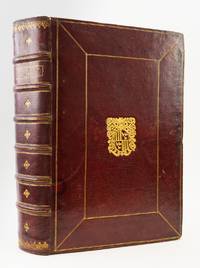
1597réf. ST19351Frankfurt: heirs of Andreas Wechel Claude de Marne & Johann Aubry 1597. Fourth Complete Greek Bible printed in Germany. 388 x 258 mm. 15 1/8 x 10 1/8". 4 p.l. 1 blank leaf attached to backing of folio :4 1098 2 pp. VERY STATELY 17TH CENTURY RED MOROCCO covers with mitered gilt frame gilt supralibros of Baderon de Maussac Olivier 745 at center raised bands spine panels with gilt flower gilt lettering all edges gilt. Printer's Pegasus device on title and final page. Front flyleaf with ink inscription recording the purchase on 24 February 1680 at Toulouse for 24 livres. Darlow & Moule 4653; VD16 B 2578; Adams B-979. ◆Three minute dents to front board a hint of wear to bands and corners isolated faint foxing blank recto of frontispiece leaf and blank verso of final leaf with faint blue shadow from endpapers but all of these quite trivial and otherwise A BEAUTIFUL COPY--fresh clean and bright internally with very wide margins and strong impressions of the plates and in a lustrous binding showing few signs of use. This handsome and remarkably well-preserved tall folio Greek Bible from a distinguished German printing firm comes in a shiny armorial binding with aristocratic French provenance. Darlow & Moule assigns the editing of this issue to Franciscus Junius François du Jon or Friedrich Sylburg noting that the Old Testament "is based on the Basel edition of 1545 . . . with correction from the Complutensian text and useful notes." The New Testament follows the text of Robert Estienne's 1568-69 edition. The Wechel family had a long tradition of humanist printing with an emphasis on Greek texts beginning with the press of Christian Wechel fl. 1520-54 in Paris and continuing after his son Andreas d. 1581 fled to Frankfurt to escape the persecution of Protestants in France. Andreas' descendants carried on the business through the first quarter of the 17th century. Olivier's "Reliures Armoriées Françaises" 1926 pl. 745 offers three possible attributions for the supralibros here all from the Languedoc region during the first half of the 17th century: Jean de Baderson; Jacques de Baderon seigneur de Maussac a member of the Parlement of Toulouse; and Jacques de Baderon de Maussac seigneur de Montagnac et de Corneillan and commandant of the city of Collioure. The inscription on the flyleaf here indicating that the book was purchased in Toulouse perhaps supports the case for the member of the Parlement in that city. The 24 livres paid for our imposing volume in 1680 would have represented as much as two months' wages for a worker in the region of its purchase. heirs of Andreas Wechel, Claude de Marne & Johann Aubry unknown
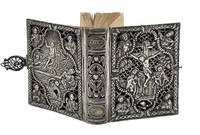
réf. 2026316mo 106 x 69 mm 165 i. e. 167-1 f. a–z8 A–H8; aa–xx8 text in greek some decorative headpieces Woodcut printer's device on the title and the verso of the last leaf XX8. 19 th C. Armenian silver binding openwork with embossed parts on red velvet spine decorated with putti and the letters TETP for Tetra in a medallion sides displaying on the front cover the Crucifixion and on the lower cover the Resurrection both with the four Evangelists in the corners; minor restoration to the margin of the final leaf. Second part of the New Testament printed by Benoît Prévost for Pierre Haultin. It contains the Epistles of Saint Paul the Catholic Epistles and the Apocalypse of Saint John. Both parts were published separately with their own pagination. The printer mark of Pierre Haultin I appears on the title page BATYR no. 27878 with his motto in Greek and Latin: Kratos thanatou kai zôēs. Imperium mortis & vitae. According to Renouard Benoît Prévost and Pierre Hautin share the same allegorical printer's mark: alpha and omega on an open Bible with a sword and pen intertwined beneath a radiant sun background. Fine copy in a lavish Armenian silver embossed binding. Provenance: Roderick Terry his bookplate clergyman and a renowned book collector of Newport Rhode Island not in his catalogue. References: USTC 160075. French Vernacular Books 57900; Renouard Imprimeurs parisiens 305-306 et 177-178. For example of Armenian silver binding see Kouymjian Dickran "Armenian bookbinding from manuscript to printed book Sixteenth to nineteenth century" in: Gazette du livre médiéval n°49. Automne 2006. pp. 1-14. Mariam Vardanyan "The Collection of Silver Book Bindings of the Armenian Museum in Bucharest and their Relationship to Eastern and Western Arts" in Series Byzantina Studies on Byzantine and Post -Byzantine Art Vol. XV 2017. pp. 81-96. Paris, Benedictus Praevotius, 1549 hardcover
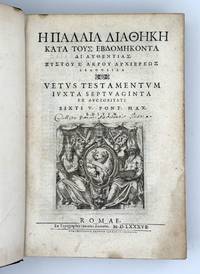
1587réf. 371783Rome: Franciscus Zanetti 1587. Text in Greek with short Latin notes at the end of each verse in two columns. Large engraved vignette on title with figures of Moses and Esdras on either side of the arms of Sixtus V. aâ´ A-3Sⶠ3Tâ¸. 8 783 1pp. Folio. Eighteenth century red morocco arms of the second Duke of Newcastle on the covers marbled endpapers gilt edges minor darkening to spine and wear to joints. Scattered minor dampstaining at lower outer corner of a few leaves. Provenance: Collegii Paris. Societas Jesu.early inscription on title; Douglass Maxwell Moffat booklabel with original invoice purchasing the volume from Davis & Orioli in 1940; General Theological Seminary bookplates. Text in Greek with short Latin notes at the end of each verse in two columns. Large engraved vignette on title with figures of Moses and Esdras on either side of the arms of Sixtus V. aâ´ A-3Sⶠ3Tâ¸. 8 783 1pp. Folio. Commissioned by Pope Sixtus V to assist the revisers who were preparing the Latin Vulgate edition ordered by the Council of Trent the "Sixtine" or "Roman" edition of the Septuagint was edited by Cardinal Antonio Carafa based on the Codex Vaticanus and became the standard for all the later editions of the Septuagint for three centuries after its publication. Darlow & Moule no. 4647; Adams B1246; BM STC Italian 1465-1600 p. 94 Franciscus Zanetti unknown
1533réf. 26505Basel: Hieronymus Froben e Nikolaus Episcopius 1533. The Editio Princeps the first printing of the work in the original Greek. Greek and roman type. Woodcut printer’s device of Johann Froben by Hans Holbein der Jünger The Younger on the title-page and on fol. CC4v Heitz-Bernoulli 50. Woodcut decorated headpieces decorated and animated initials on black ground from different alphabets designed by Holbein; on fol. a1r 8-line initial showing Heraclitus and Democritus from the capital Latin alphabet of May 1520 drawn by Holbein and by Jacob Faber cfr. Hollstein’s German xivB n. 119. 4to 210x146 mm. In a very rarely encountered contemporary binding of Dutch blind-tooled leather over wooden boards. The covers are framed by two borders of blind tooled fillets a floral tool at each corner; the central panel is divided into diamond designs with rosettes on the upper cover and fleur-de-lys on the rear. Turn–ins and cords fixed at the inner boards. Antique spine and clasps renewed at a somewhat later date and accomplished with the greatest skill. The guard leaves are composed of two bifolia from a 14th-century manuscript breviary. Collation: 1 2 3 4 a-z4 A-Z4 aa-zz4 AA-CC4 fols. 1v CC4r blank. 8 573 3 pp A beautiful and fine broad-margined copy in a wonderful contemporary binding faint water staining to the inner corner of the first quires a minor repair to the gutter of the first leaves two tiny wormholes in the last three quires. Provenance: John Alfred Spranger 1889-1968; book-plate on front pastedown and stamp on title-page. EXTREMELY RARE FIRST PRINTING OF THE EDITIO PRINCEPS OF THIS REMARKABLY IMPORTANT BOOK AND A COPY WHICH IS OF THE VERY FINEST STATE AND CONDITION. The editio princeps of Diogenes Laertius’ Lives of the Famous Philosophers is the most important source of our knowledge in the history of Greek philosophy from Thales to Pyrrho. The text was known only in the Latin translation by Ambrogio Traversari 1386-1439 which made its first appearance in print in Rome around 1472 and which was widely reprinted during the fourteenth and the first decades of the sixteenth century. This is the first printing of the book in its original language. The edition is dedicated by the typographers Froben and Episcopius to the scholars and in their epistle they declare their publishing plan: to print at least a work per year able to combine usefulness and pleasure. The text follows a manuscript provided by the professor of Greek and Hebrew at the University of Wittenberg Matthaeus Goldhahn 1480-1553 called Aurigallus probably a copy of the codex Raudnitzianus Lobkowicensis vi.F.c.38 at the time preserved in Komotau Bohemie in the house of the politician Bohuslav Lobkowitz von Hassenstein c. 1460-1510 and presently in the Library Národní Knihovna of Prague. Hieronymus Froben e Nikolaus Episcopius hardcover
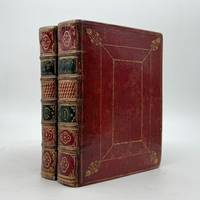
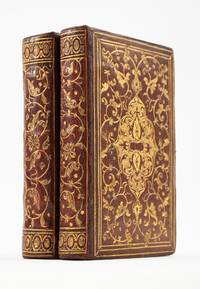
1568réf. ST20921Lutetia Paris: Robert Estienne II 1568. 128 x 87 mm. 5 x 3 1/2". Two volumes. LOVELY CONTEMPORARY RED MOROCCO GILT covers with large central azured arabesque surrounded by curling vines with azured leaves smooth spines with similar vines head and foot of spines with egg-and-dart roll similar to one used by Claude de Picques second volume with faint blind lettering to spine all edges gilt perhaps with some minor early restorations but if so then done with such care as to preclude certainty. Housed in modern suede-lined calf-backed clamshell boxes with magnetic closures. Printer's device on titles and final page decorative initials and headpieces. Front pastedown of volume I with ex-libris of Georgios Arvanitidis. Renouard 171:1; Schreiber 239; Darlow & Moule 4633; Adams B-1670. See: Verron "Les Reliures de l'Entrée de Charles IX à Paris 1572 . . . réalisées par Claude Picques" in Bulletin du Bibliophile 2014 no. 2 pp. 282-98. Just a touch of rubbing to extremities front hinge of second volume open but everything quite tight text with occasional mild browning small spots trivial smudges or tiny worm trails but A BEAUTIFUL COPY clean and fresh internally and the bindings tight and lustrous with very bright gilt With exceptional visual appeal these two precious volumes shining with gilt and containing the Greek New Testament from the renowned Estienne family of printers are of special interest because of their typography their bindings and their provenance. With the expressed goal of printing Greek texts from manuscripts in the royal library at Fontainebleau François I established the post of royal printer in Greek in 1539 appointed Robert Estienne I 1503-59 to the position in 1542 and commissioned the renowned Claude Garamond to cut a new Greek font for this project. To design the type the King called on his own celebrated calligrapher Angelo Vergecio who produced in collaboration with Garamond three different sizes of what came to be called the Royal Types or "grecs du roi." According to Schreiber "These cursive Greek types are universally acknowledged as the finest ever cut." In 1548 and 1549 Robert Estienne issued the press' first Greek Testament known as the "O mirificam" edition for the opening of the dedication to the king in 16mo or "pocket" format using the smaller font of Garamond's "grecs du roi." In 1550 Robert a Protestant moved to Geneva while his son Robert II 1533-70 a Catholic remained in Paris and took over as the royal printer in Greek. Our 1568 Testament--the only one issued by the son--is a reprinting of the "O mirificam" edition but expanded with the critical apparatus from the 1550 folio edition issued by the father. Schreiber notes that our edition is interesting from a typographical point of view as it contains an even more minute version of the already small grecs du roi type for the Table of Chapters. The exceptionally pretty volumes are done in the style of royal binder Claude Picques fl. 1539-78 and employ a decorative roll very similar to one that appears on the spine of the vellum bindings Picques did for "L'Entrée de Charles IX à Paris" 1572. Our volumes once graced the library of Constantinople collector Georgios Arvanitidis 1876-1953 whose library included a number of Estienne Greek editions. They were later in the distinguished library of Frederick B. Adams 1910-2001 director of the Pierpont Morgan Library from 1948-69 and then president of the prestigious Association Internationale de Bibliophilie from 1974-83. And they were featured in the celebrated 1929 Gumuchian catalogue of 398 historically exceptional bindings as item #71. Robert Estienne II unknown
1503réf. 4503Venice: In Aedibus Aldi Mense Novembri 1503. FIRST ALDINE EDITION the first ed. of the text was published in 1494. Also includes the EDITIO PRINCEPS of the 6th-century Byzantine poem “In Thermas Pythias et aquarum miracula”on the warm baths of Pythia in Bithynia attributed to Paulos Silentiarius. Hardcover. Fine. Text in Greek type 4:79 first part of title register and colophon in roman 10:82. Bound in a contemporary Greek-style binding see below. A tall copy contents in very good condition with scattered ink stains mostly light and minor marks dampstain at head of some gatherings and in a few gutters; half of leaf L2 supplied from another copy text-block slightly rounded at corners minor marginal worm in a few gatherings not affecting the text. Woodcut Aldine device on title and final leaf. With scattered contemporary annotations additions and corrections longer ones on C6 E6v E8r I8v GG4r and HH3r those on C6 with added verses of Theocritus concerning Aphrodite “he kupris ou pandemos”. This copy is remarkable for its Greek-style “alla greca” “à la grecque” binding very worn board edges damaged slight losses at head and tail of spine; lacking straps but remnants preserved inside both boards and clasps one clasp peg preserved. Both end-bands are intact. The Greek-Style Binding: “The book was undoubtedly bound by a Greek bookbinder in the genuine Greek style possibly coming from Crete or trained in the tradition of Cretan bookbinding who was probably working in the Veneto but not necessarily Venice i.e. perhaps Padua as the university there would have provided a good market for such bindings and that the book was certainly tooled in Italy making the supposition that the binder was working in the Veneto more likely. The worn condition of the book makes it very difficult to get an accurate impression of the book as it looked when new but it is not finished with the precision of the best work in Venice of the time though the cutting of the grooves in the edges of the boards and working of the endbands are both very nicely executed. It is always possible therefore that the book was bound up the point of being sewn in boards and with endbands by a very competent Greek binder it was work that fell outside the experience of Italian binders at the time and that the covering and decoration was done afterwards possibly by another not necessarily Greek binder. The tools have not been identified but there are some structural features that might yet lead to a more precise provenance.”Nicholas Pickwoad “From archival data cited by De Marinis 1960 vol. 1 pp. 31ff.; vol. 2 p. 45 it is clear that in Italy the term 'alla greca' was in use by the second half of the fifteenth century: documents dating from 1455 to 1499 clearly distinguish bindings with 'une serratura greca' 'libri ala grechessa' and 'legate alla greca' from those of the kind 'ligatum more latino'. A bill made out for four bindings of either type 'doy in grecho e doy non grechi' proves that the same workshop could handle either technique; the specification that 'sei volumi greci should be bound ala grecha' attests the early humanists' traditional preference to have classical Greek texts bound accordingly. In his chapter on 'alla greca' bindings De Marinis 1960 vol. 3 pp. 36-49 lists 225 examples from Italy of the fifteenth and sixteenth centuries c.15 per cent and 85 per cent respectively; Venice and Rome are the most frequent places of origin. The 'alla greca' vogue had equally caught on in France where the royal libraries of Francis I and Henri II at Fontainebleau assembled a rich collection of no less than 600 Greek works bound 'alla greca' now in BNF A. Hobson 1989 pp. 172-212. Humanist collectors far and wide followed the fashion: members of the Fugger family in Augsburg had their Greek books bound in Paris Venice and also in Germany and Cardinal Granvelle even if he knew no Greek made sure that the Greek texts received an appropriate binding probably from Italy; see Piquard 1942; 1951.”Szirmai The Archaeology of Medieval Bookbinding “The fashion for Greek-style bindings amongst the wealthier humanist scholars and book collectors of Western Europe appeared first in Italy in the second half of the fifteenth century. The fall of Constantinople to the Ottoman Turks in 1453 led to the arrival in western European countries of increasing numbers of Greek scholars and scribes and with them their books. Famous libraries such as that of Cardinal Bessarion 1403-1472 became available to western scholars and as the Italian binding historian Tommaso de Marinis has claimed the association between Greek texts and ‘alla greca’ bindings became firmly fixed in the Italian humanist’s mind. The demand for texts was such that there was an active trade in copying Greek manuscripts mostly in Italy but even as far afield as England where the scribes Joannis Serbopoulos and Emmanuel of Constantinople worked together in the last quarter of the fifteenth century. It would seem that a high proportion of these books followed in the last quarter of the fifteenth century by books printed in Greek were bound in the Greek style. This phenomenon is in part explained by the highly recognisable differences between Greek and western bindings which are immediately evident to the most casual observer. “The differences may be simply summarised as the smooth spines which result from unsupported sewing techniques as opposed to raised bands across the spine created by raised sewing supports; wooden boards which are the same size as the textblocks often with grooved edges; endbands which therefore project beyond the height of the boards and which are sewn to the head and tail edges of the boards; clasps formed by metal rings attached to the back board by double or triple interlaced straps which fasten onto pins which project from the edges of the front board. The placing of the fastenings at head and tail is often eccentric in that they are in many bindings located closer to the foredge than the spine. The spines are often heavily rounded but the foredges are cut square flush with the board edges. This results in foredge margins of different widths throughout the book. All or any of these features might be taken up by the binders who made versions of these books in western Europe depending on how close they came to Greek originals.”Pickwoad “How Greek is Greek Western European Imitations of Greek-Style Bindings” in Vivlioamphiastis 3 ed. Niki Tsironis 2008. The “Planudean Anthology” was written by the Byzantine scholar Maximus Planudes. It was the first collection of Greek epigrams to be printed 1494 and the only one known until the Palatine Anthology emerged from obscurity 1606 to supersede it. Planudes’ work is based upon the compilation of Constantine Cephalas Konstantanos Kephalas a Byzantine schoolmaster who in about the year 900 excerpted all the major ancient manuscript collections of epigrams. Planudes lived during the reigns of Michael VIII Palaiologus and Andronikos II Palaiologus. He was born at Nicodemia in 1260 but the greater part of his life was spent in Constantinople where as a monk he devoted himself to study and teaching. On entering the monastery he changed his original name Manuel to Maximus. Planudes’ anthology of Greek epigrams is neatly arranged in seven books with complex subdivisions. It is not known what sources he used: certainly the collection of Cephalas probably two others closely resembling the Palatine Anthology… He included nearly 400 epigrams which are not in the Palatine manuscript; in modern editions these are printed as book 16 of the Greek Anthology. The result called the Planudean Anthology has survived in Planudes’ own autograph now in Venice dated 1301 perhaps a mistake for 1299: it was the first collection of Greek epigrams to be printed 1494 and the only one known until the palatine Anthology emerged from obscurity 1606 to supersede it.”. In Aedibus Aldi, Mense Novembri hardcover
1514réf. 372265Alcala de Henares: Arnao Guilem de Brocar 1514. First edition of the New Testament in Greek published as volume 5 of the Complutensian Polyglot. Woodcut arms of Cardinal Jiménez on title page with woodcut borderswoodcut initials. Text in Greek and Latin in two columns Collation: a4 A-Q6 a6 R-Z6 AA-LL6 MM8 2a11 3a6 b-f6 g4 -g4. 271 of 272 leaves lacking final blank. 1 vols. Folio. Recent full black morocco spine gilt gilt turn-ins red morocco doublures gilt marbled flyleaves. Minor toning or soiling to a few leaves. A clean fresh copy. First edition of the New Testament in Greek published as volume 5 of the Complutensian Polyglot. Woodcut arms of Cardinal Jiménez on title page with woodcut borderswoodcut initials. Text in Greek and Latin in two columns Collation: a4 A-Q6 a6 R-Z6 AA-LL6 MM8 2a11 3a6 b-f6 g4 -g4. 271 of 272 leaves lacking final blank. 1 vols. Folio. Produced under the patronage of Cardinal Ximenes archbishop of Toledo and founder of the university of Alcala. As part of the Complutensian Polyglot Bible the New Testament was printed first dated 10 January 1514; the Old Testament was completed only in 1517 and publication was delayed until 1522. "Undoubtedly the finest Greek fount ever cut and the only one of which it can be affirmed with certainty that it is based on the writing of a particular manuscript" Proctor. Pope Leo X lent the Codex Vaticanus to Ximenes and it was upon this manuscript that Brocar modelled his type. Proctor used it as the model for the type in his edition of the Oresteia of 1904. This volume complete with the six leaves of the travels of St. Paul printed only in Greek and often lacking as it was printed later. This is the first Greek New Testament ever printed 1514 but as it was not published until 1522 this text was unknown to Erasmus when he published his Greek New Testament in 1516. Douglas Maxwell Moffat 1881-1956 Yale class of 1903 was a Grolier Club member from 1929 until his death; the libraries at Yale University and the General Theological Seminary were beneficiaries of gifts from his widow. "As a collector he was interested in three fields primarily: editions of Vergil; Greek and Latin lyric poetry; and fine printing. Almost all his books were in superb condition and often of very interesting provenance" Yale University Library Gazette 35:2 p. 122. THE MOST FAMOUS PIECE OF PRINTING EXECUTED IN SPAIN. Darlow & Moule 1412/4593; PMM 52; Adams B968 Vol. 5; Norton Printing in Spain 1501-1520 27; Proctor Printing of Greek p. 144. Provenance: Douglas Maxwell Moffat bought from E.P. Goldschmidt; General Theological Seminary gift of Mrs. Douglas M. Moffat Arnao Guilem de Brocar unknown