25.549 Ergebnisse
1953Best.-Nr. 47241Concepción: by the Company 1953-4. First Edition. Quarto 27cm. Twelve monthly issues comprising the entire first year of publication. Bound into cloth-backed boards front and rear wrappers retained; each issue 16pp. Moderate external wear; punch-holes in bound margin of each issue else Very Good. A graphically impressive company journal issued by the major Chilean mining and manufacturing firm Compañia de Acero del Pacifico CAP. Founded in 1947 CAP is still one of the largest industrial concerns in all of Latin America. Huachipato a publication aimed toward the company's employees chronicles activities both within the company and in the surrounding apparently vast company town. In addition to industrial and technological achievements the publication documents the social life of the company's workers with much coverage of sporting and cultural events the town's soccer team also called Huachipato was elevated to Chile's primera división as early as 1965. The journal is noteworthy for its graphical sophistication with photo-montaged covers sprightly layouts and a mid-century aesthetic reflecting Latin America's internationalist ambitions during this period. Rare; OCLC 2020 locates just scattered holdings all for three or fewer issues; Texas and Cornell only in North America. by the Company unknown books
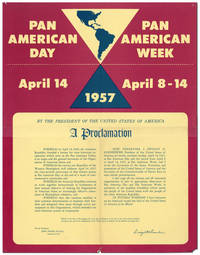
Best.-Nr. 42513Washington: GPO 1957. Offset-printed broadside in three colors 21-1/2" x 17"; printed recto-only. Old folds probably as issued; a few small nicks to extremities; Very Good or better. Announces the establishment of Pan American Week April 8-14; and Pan American Day April 14 and reprints the full text of Eisenhower's proclamation. Pan-American Day is still celebrated in some Latin American countries though news of its establishment never seems to have made a lasting impression on the U.S. populace. Though clearly intended for display this broadside is apparently scarce with no example recorded in commerce and none catalogued in OCLC as of October 2018. unknown books
1958Best.-Nr. 39123Geneva: International Labour Organization ILO 1958. First Edition. Octavo. Pictorial card wrappers; 103pp; illus. Mild cover wear with erasure at upper corner of front wrapper; horizontal tear to one text leaf; Very Good. Well-illustrated propectus for the ILO's Andean Programme designe to raise living and working standards for indigenous peoples of Colombia Ecuador Peru and Bolivia. Uncommon. International Labour Organization (ILO) unknown books
1933Best.-Nr. 29764Antofagasta: Partido Comunista de Chile 1933. Lithographed postal card ca 19.5cm x 9cm 5-1/4" x 3-1/2". Mild discoloration; corners slightly rounded; Very Good. Recto is a captioned portrait; verso printed for mailing with text providing a brief biography of Anabalon a communist-affiliated college professor who was arrested tortured and killed by Chilean government forces in 1932. A rare memorial of this little-remembered but briefly influential event. [Partido Comunista de Chile] unknown books
1982Best.-Nr. 26131N.p. San Salvador: FPL 1982. Photolithograph in colors; 56.5cm x 37.5cm ca 22-1/4" x 15-1/2". A vivid unfaded example free of wear; Fine. Poster celebrating the twelfth anniversary of the Fuerzas Populares de Liberación "Farabundo Martí" FPL. The FPL was one of five Marxist organizations that joined in 1980 to form the FMLN which is today the mainstream left party of El Salvador. The still somewhat provisional nature of the alliance in 1982 may be gauged from the fact that in this poster the FPL continues to maintain its own identity publishing under its own imprint and adding a caption in the lower margin "Miembro del FMLN." Photo-illustrated with five scenes from the Salvadoran civil war including active scenes combat surrounding a quote by the Communist revolutionary leader Cayetano Carpio aka "Marcial". Not found in OCLC though web search does turn up a copy at IISH Netherlands. FPL unknown books
1982Best.-Nr. 15372Baltimore: John Hopkins Press 1982. First English Language Edition. Octavo. Cloth boards; no jacket; 243pp; includes bibliography. Removed from a non-circulating private library with ink ownership markings to front endpaper and accompanying black ink elisions from de-accession. Slightly soiled boards; else unmarked crisp copy in very good condition. John Hopkins Press unknown books
1886Best.-Nr. 7206Washington: GPO 1886. 491pp disbound two large folding maps. Very Good. GPO unknown books
Best.-Nr. 123233Paris: Boudet Desaint et Avignon Merande 1767-1773. 17 vols 4to 33 engraved plates some folding 6 letterpress tables some folding. Contemporary/original mottled calf spines gilt and gilt-lettered. A bit dry and worn but quite sound. § A lovely quarto edition of the Bible in Latin and French also issued in 8vo -- this is much the more preferable version. The plates and maps are outstanding and the physical feat of printing all seventeen volumes in 6 years is astonishing. Complete sets in commerce are surprisingly scarce though widely held by institutions. Brunet I 888: “Ce livre connu sous le nom de Bible de Vence mais qui devrait plutôt porter celui de Rondet son éditeur est fort estimé”. Not in Darlow and Moule under Latin or French. Boudet unknown books
1801Best.-Nr. 6703Breé 1801. Octavo 16.5 x 10 cm. 1-159 170 contiguous-175 176-205 pages. The title page has a neat decorative border in pen and ink and the hand is neat and quite legible throughout. ~ Evidently two recipe collection recorded in Latin in one volume. Combined the work contains approximately nine hundred fifty recipes for various botanical and medico-pharmaceutical remedies and medicines including preparations against rheumatism arthritis itching birth pains etc. The first part - which appears to be unpublished - occupies the initial 158 pages of the work and contains approximately five hundred fifty recipes in a rough alphabetical order. About the compiler of this first part Henri-Hubert Van der AA we have located little. The second part of the text 159 ff. is labeled "C.F. Reuss Dispens. universale" and appears to be a fair copy drawn from the Dispensatorium Universale seu lexicon chemico-pharmaceuticum ad tempora nostra accommodatum of Dr. Christian Frederick Reuss first published Argentorati Strasbourg in 1786 and then again in 1791. The formulae - approximately four hundred recipes - in the Dispensatorium Universale offered in alphabetical order are more detailed than the first part as they give both recipe and the circumstances in which the remedy can be used. Reuss was a Danish-born German botanist and professor of medicine at the University of Tübingen 1745-1813 and author of a number of important botanical and medico-pharmaceutical works. Subjects include Forumla Emitica Linctus Expectorantes F. Tonica Digestivae F. Absinth F. Antihysterica Ad Scabiem Contra Herpetem F. Anti-rheumatica F. Anti-arthriticae Ad Icterum Ad morbos Ad epilepsium Aqua Opthalmica Bacilli Ceratum Saturni Decoctum Lusitanicum Elixir Proprietat. Paracelsi Confectio Japonica Balsamodendron of Lucatelli Oleum Absinthii and many others. Some of the recipes have attributions and names include Matthews Hoffmann Sydenham Richard Millar Rosenstein Plencki Klein and Brickmann. ~ Contemporary paste paper over half sheepskin on raised bands; boards and edges rubbed corners rounded. Generally near very good. hardcover books
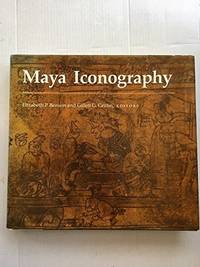
1988Best.-Nr. 222Princeton: Princeton University Press 1988. First Edition First Printing. 1/4 cloth. Very good/fine. Very good first printing. Brown cloth under buckram quarter cloth binding. Cream endpapers. Pages are clean and bright. Rear endpaper and page 379 have short tear at bottom. From the private library of Larry Southwick collector's marginalia pencilled near front hinge. In a fine dust jacket now protected in a clear removable archival cover. Profusely illustrated with photos and drawings. 379 pp. including bibliography and index. Quarto 10 1/2 x 10 inches tall. Large and heavy item billed at actual shipping charges. Princeton University Press hardcover books
1529Best.-Nr. 66850Beautiful French Woodcut Bible BIBLE IN LATIN. Textus Biblie. Lyons: Per Johanem Crespin 1529. Second Crespin edition reprinted from the 1527 edition. Folio 13 15/16 x 10 inches; 354 x 252 mm. 304 leaves 18 CCLXVIII 18 leaves. Complete with final blank leaf. Gothic type. Text in double columns within rule borders. Title printed in red and black with small woodcut of St. Jerome repeated three times in the text with Jeromeís prefaces within a four-part woodcut border showing God the Father and two angels in a tympanum the six days of Creation and the Last Supper. Large six-part Creation woodcut at the beginning of Genesis half-page woodcut of King Solomon at the beginning of Proverbs full-page Nativity woodcut at the beginning of the New Testament and 121 small text woodcuts including twenty-three repetitions: ninety-one Old Testament woodcuts within strip borders including eight repetitions and thirty New Testament woodcuts without borders including fifteen repetitions. Decorative woodcut initials. The Eusebian canons leaves D1-D3 are printed in red and black in a red architectural framework. Contemporary pigskin over wooden boards roll-tooled in blind to a panel design. Lacking clasps. Original index tabs. Binding worn with some loss of pigskin on upper corner of front cover. Title soiled lower margin of first few leaves wormed and frayed with some loss to woodcut title border a few short marginal tears some mostly marginal dampstaining minor worming to lower inner margins a few inkstains slight discoloration throughout. Despite these minor flaws this is a beautiful example of a French woodcut Bible completely unsophisticated. Contemporary ink inscription on back pastedown dated 1534 contemporary ink inscription on the recto of D4 beneath the Nativity cut eighteenth- or nineteenth-century inscription on title: B.V. Maria in F¸rstenfeld. Some early underlining and coloring of woodcuts in red. A few early ink marginalia. Housed in a custom quarter brown morocco clamshell case. The illustrations follow the schema of the Sacon Bibles printed in Lyons in 1518 and 1521. Crespinís blocks with the exception of the Creation are close copies of those used in Jacques and Jean Mareschalís Lyons Bibles of 1523-1541 as is the layout of the text within ruled columns. The borders for the Old Testament blocks include a strip with the initials ìPBA.î Fairfax Murray French 36. Harvard French 66. Not in Brunet Rothschild Darlow and Moule. HBS 66850. $9500 Per Johanem Crespin hardcover books
1937Best.-Nr. 9023717Cambridge: Harvard University Press 1937. 1st. Hardcover. Near fine. Bound in publisher's original red cloth with the front cover and spine stamped in gilt. Lightly rubbed edges and extremities. Huntington Browns stamp on ffep. Harvard University Press hardcover books
1937Best.-Nr. 9023718Cambridge: Harvard University Press 1937. 1st. Hardcover. Near fine. Bound in publisher's original red cloth with the front cover and spine stamped in gilt. Lightly rubbed edges and extremities sunned spine. Harvard University Press hardcover books
1648Best.-Nr. 41618Amsterdam: Prostant apud Neminem 1648. 12mo 13.4 cm 5.27". Frontis. 4 252 14 index 2 blank 71 1 pp. with separate title-page Stymmelius Christoph. Studentes sive comoedia de vitâ studiosorum. Alentopholi: In Aedibus Iberiorici Nobilimi 1647. 12mo. 88 pp. and Senatus et consultatio sacerdotum quorundam super mandato praesulis facto ut concubinas habitas abigant & posthac nullas alant. Amsterdam: 1648. 12mo. 8 pp. This compendium of witticisms jests and comedy opens with a copper-engraved frontispiece of a jovial drunkard and a first title-page bearing a woodcut of a peddler and his dog. The first part offers a collection of ironic questions and answers on satirical topics often concerned with women e.g. what is a liberal woman as well as with curiosities e.g. why are Ethiopians black is begging preferable to wealth it is. There follow essays on assorted topics including pseudo-medicine "Quid sit medicina culinaris"; the Pugna porcorum this Battle of the Pigs being => a satirical poem written solely and perhaps preposterously with words beginning with P; while the Crepundia poetica is a collection of short poems on sundry subjects from doctors to astrologers. The Nugae venales first appeared in 1632 with subsequent publications making use of various combinations of sections. => This early edition adds a comedy about university life Studentes sive comoedia de vita studiosorum and a satirical poem on the clergy. Provenance: Front fly-leaf with pencilled inscription of E. Kijper noting purchase price of "IV florines" in 1920. Brunet IV 136-137; Graesse IV 701; VD17 23:629766P. Contemporary vellum with yapp edges spine with hand-inked title and date; light dust-soiling overall with spine and edges darkened vellum just starting to chip at back joint. Front pastedown and fly-leaf with later pencilled annotations. Studentes bound out of order with title-page and prologue towards the end; a helpful hand has tried to make sense of the situation by adding page numerals. One leaf with short tear from outer margin touching a few words without loss; one short wormtrack touches two lines on each side of one leaf. Pages age-toned otherwise clean. => A solid interesting example of this popular work in an early stage of its evolution. Prostant apud Neminem hardcover books
1785Best.-Nr. 40318Parisiis: Excudabat Fr. Amb. Didot natut maj. 1785. 8vo in 4s 19 cm 7.5". 8 vols. I: xvi 501 1 pp. II: 2 ff. 450 pp. III: 2 ff. 393 1 pp. IV: 2 ff. 428 pp. V: 2 ff. 400 pp. VI: 2 ff. 444 pp. VII: 2 ff. 407 1 pp. VIII: 2 ff. 373 1 pp. Produced here in fine French bibliophilic style is the most extensive collection of => Old Latin versions which exist only in fragments compiled from manuscripts and the writings of the Fathers by Pierre Sabbathier and continued after his death under the care of Vincent de La Rue Darlow & Moule. This edition following the first Rheims 173949 was issued In the Didot series Collection des auteurs classiques françois et latins. Binding: Full red crushed morocco gilt spine and boards; gilt rule on board edges; gilt rolls on turn-ins; marbled endpapers. All edges gilt. => Bindings signed Petit Succs. de Simier. Provenance: Bookplates of Casimir L. Stralem Clarence E. Clark and Brian Douglas Stilwell. WorldCat locates only six U.S. libraries reporting ownership of => all eight volumes as present here NYPL Cornell Seton Hall Holy Cross College New York Historical Society UC-Berkeley Law and two libraries reporting ownership of incomplete sets Harvard Divinity vols. 1 2 only University of Dayton vol. 3 only. . Darlow & Moule III 6263; Jammes Les Didot 25. Bound as above some joints outside showing cracking but all intact. All volumes housed in light marbled-paper open-back cases some with tape repairs. => Very good. Excudabat Fr. Amb. Didot natut maj. hardcover books
1599Best.-Nr. 39429Heidelberg: Ex officina Commeliniana 1599. 8vo 19.9 cm 7.75". 14 827 1 pp. Lacks interior blank only. One of the last 16th-century interlinear editions of the Greek New Testament and Vulgate Latin as first presented in Plantin's monumental Royal Antwerp Polyglot Bible of 156972. The text is printed in Greek with the Vulgate in roman type inter-linearly; additionally there are decorative letters and head and tailpieces. When the Vulgate differs from the Greek its text is printed in the margin as a shouldernote and a literal Latin rendering by the great Spanish theologian Benedictus Arias Montanus a.k.a. Benito Arias Montano is printed in italics in the text. The Commelin device appears on the title-page which describes this printing as "Editio postrema multò quàm antehac emendatior." Evidence of Readership: Marginal notes or accents in at least two early hands have been added in ink in two dozenplus places with one page used for scribbling and content ranging from a squiggle to a word to real notes; two Latin words and the publication date in Arabic numerals under the publisher's roman have been inked to the title-page. Provenance: Early calligraphic ownership note of "Dudley" dated 1843 on binder's blank; later ownership signature of E.F. Whitehouse with the shelfmark 354 and an acquisition note including the collectorly report "It was all to bits I had it bound and consider it a great curiosity. Adams B1716; Darlow & Moule 4656a; VD16 ZV 1904; USTC 440704. Recent half brown calf and mustard buckram cloth red leather spine label lettered in gilt all edges speckled brown new endpapers; very gently rubbed one short tear at bottom gutter of binder's blank. Light age-toning and waterstaining of various darknesses throughout most of the text with the occasional spot. The title leaf has been backed with a later paper with no loss of content; interior blank only lacking as above three leaves with small interior holes affecting letters two leaves with marginal sections torn away. Readership and provenance evidence as above with some inked notes trimmed or bled onto surrounding leaves. => Read and engaged with by multiple people and all the more intriguing because of it. Ex officina Commeliniana hardcover books
1562Best.-Nr. 37346Lugduni Lyons: apud Theobaldum Paganum 1562. 16mo 11.5 cm; 4.5". 284 pp. 16th-century printers seem to have been fond of printing these particular books of the Bible as a unit in small format for personal use. The palm-sized "poetical books" or "wisdom literature" do not survive in the appreciable numbers that the octavo and larger format whole Bibles or Testaments do. => In fact of this edition in North American libraries we trace only this now deaccessioned copy and one other in a Canadian institution. Pagan's variant of the famous Estienne printer's device appears on the title-page. Text is printed in roman type with occasional use of italic and Hebrew and a few nice historiated initials here and there. Early limp vellum dust-soiled and gently cocked. Exseminary library with rubber-stamp on bottom edge of closed volume others on front and rear pastedowns bookplate at front shadows of librarian's pencilling erased from title and verso. Light age-toning small chipping to first and last few leaves light inking on verso of front fly-leaf. apud Theobaldum Paganum hardcover books
1588Best.-Nr. 37032Genevae: Henricus Stephanus 1588. Folio 33 cm; 13". 6 ff. 555 1 blank pp. 8 ff. lacks final blank leaf; lacks vol. II Epistles Revelation. An interleaved and heavily annotated copy of the Gospels and Acts of "Beza's third major edition of the Greek New Testament. The text follows that of the second major edition 1582 with only five exceptions" Darlow and Moule. => One should note that the title-page proclaims this "quarta editio" and that this is Estienne's third folio printing of Beza's N.T. Beza's New Testament Greek text is here accompanied by his Latin and the Vulgate i.e. Catholic Latin translations the trio appearing in parallel columns on each page with => extensive notes that often fill as much as one-third to one-half of a page and with parallel references additionally set in the margins. The volume's title-page is printed in red and black and bears Henri Estienne's printer's device; a different finely wrought woodcut headpiece opens each book with each column on those pages bearing a woodcut initial at its head and a few of the books of the N.T. end with woodcut tailpieces. Evidence of readership: An interleaved copy with => the vast majority of the leaves bearing an early 19th-century reader's notes and annotations. The notes cite references published as late as 1809 and it is clear that the natively German-speaking scholar was comfortable in Greek Hebrew Latin and English. Provenance: Ownership signature on title-page of Leon St. Vincent. Later in The Howell Bible Collection Pacific School of Religion properly released; no markings. The paper stock used for the interleaving has the classic ProPatria watermark and that and its countermark match Churchill's 151 which has a starting date of 1799. Darlow & Moule 4650; Adams B1711. On the interleaves' watermarks see: Churchill Watermarks in paper in Holland England France etc. in the XVII and XVIII centuries. 19th-century half vellum with German pastepaper over boards spine with tinted and tooled label text recased and new endpapers; vol. I only of this production without the Epistles and Revelation. Title-page creased and dust-soiled all leaves before pp. 9/10 rodent-gnawed in lower outside corner with loss of paper but not of text or manuscript annotation and a bit of light waterstaining to rearmost leaves only. => An important edition and a singular copy. [Henricus Stephanus] hardcover books
1774Best.-Nr. 10669Goettingae: Recudi fecit vidua b. Abr. Vandenhoeck 1774. 4to 23 cm. 2 494 pp. Signed presentation copy from the Rev. Edward Bouverie Pusey Regius Professor of Hebrew Oxford University dated 1835. Edited by Simon de Magistris. Greek and Latin text printed in parallel columns. Illustrated with an engraving on p. 104 and engravings of Greek coins on p. 194. WorldCat locates only one copy of this edition in U.S. libraries. Not in Darlow & Moule but see 4760 for the 1773 edition and 4759 for the first edition. Contemporary plain wrappers paper over spine chipped and with lengthwise cracks; binding coming apart with final 14 pages separated. Gift inscription dated 1835 on verso of title-page. Bookplate of a theological seminary on inside of front cover. Some pages unopened. Foxed. Dog-eared. => Uncut mostly unopened copy. Recudi fecit vidua b. Abr. Vandenhoeck unknown books
1611Best.-Nr. WRCAM40080Spain 1611. 12pp. leaves numbered 1-6. In Spanish. Folio. Dbd. Early folds mild foxing. Very good. An early and evidently unrecorded 17th- century Spanish petition to the King on behalf of mendicant and monastic communities in the Spanish Americas. The authors argue that the churches attempting to tax their incomes and force them to pay tithes are hurting religious efforts in the Americas and infringing upon the historical independence of the religious orders from the churches. The document is signed in print by eleven monks each representing a different order: the Benedictines Hieronymites Franciscans Cistercians Mercedarians Dominicans Augustinians Trinitarians Jesuits Premonstratensians and Carmelites. The Jesuit signer is Pedro de Caruajal presumably Pedro de Carbajal former magistrate and judge of the Vilcas Huamán province of Peru and author of DESCRIPCION FECHA DE LA PROVINCIA DE VILCAS GUAMAN.EN EL AÑO 1586. unknown books
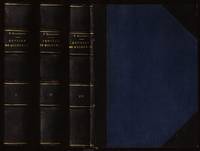
1932Best.-Nr. CA0246Description: 3 volumes. xxix-574 pages with 4 folding maps; 466 pages with folding coats of arms 6 folding native illustrations and map; 469 pages with 2 coats of arms one folding and 6 folding native illustrations. Royal octavo 9 1/2" x 7" bound in three quarter blue leather with raised spine bands and gilt lettering to spine. Introduction by Rafael Lopez. From the library of George Foster. Publicaciones del Archivo General de la Nacion volume XVII XVIII and XIX. There are only meager biographical data about Pablo de la Purísima Concepción Beaumont whose work is a major source on Michoacán. Despite its title "Chronicle of the Holy Apostles St Peter and St Paul of Michoacán" Beaumont's work in fact spans a much greater area including much of western Mexico northward to New Mexico and tending toward a general history. It provides details to 1565. Beaumont divided his total work into tow major parts the firs or Aparato intended to be introductory to the second or the Crónica proper. the first seems complete but the second was never finished. The Aparato takes up fully a third of the extant Beaumont work although nominally introductory. It deals with the discovery of America and the conquest of Mexico to the year 1521. It was twice published before appearance of the total work. Far more valuable is the Crónica. It consists of two books and one chapter of book 3. Beaumont drew on a wide variety of sources. He tell us us that he gathered a large quantity of manuscripts from various Franciscan archives as well as listing 30 standard writers in printed sources. He gives full copies of some of his documents of which several have since disappeared. He speaks of obtaining a native painting possibly from which his illustrations came. These paintings show incidents of the first visits of Spaniards to Michoacán there reception by Tarascans labors of the Franciscans coats of arms of principal cities of Michoacán. It is usually through that Beaumont composed his work around 1777. That is the last date in the later copies of the original manuscript. Unfortunately his original manuscript is lost. It was copied in Mexico City around 1792 to for volumes 7-11 of a 32 volume Collection of Memories on New Spain ordered by Viceroy Conde de Revilla Gigedo and compiled by Manuel de la Vega. Three partially complete sets of these Vega Memorias are known; from one or another of them come other recopied manuscript copies as well as the printed versions. Editions of the work have a somewhat unfortunate publishing history. In 1826 Bustamante published an incomplete and useless edition of the Aparato attributing it to Vega who had owned the manuscript Bustamante used. In 1873-74 a five volume edition of both Aparato and Crónica appeared in Mexico; it lacks the Indian drawings and was based on a secondary manuscript copy made b y J F Ramirez that then belonged to Alfredo Chavero. A three volume version was published by the National Archives of Mexico in 1932 based on their copy of the 1792 collection of Memorias; it contains the Indian drawings and an introduction by Rafael Lopez. The text seems slightly corrupt but it may be near the original as Beaumont said his Spanish was defective owing to his Parisian rearing. George McClelland Foster Jr born in Sioux Falls South Dakota on October 9 1913 died on May 18 2006 at his home in the hills above the campus of the University of California Berkeley where he served as a professor from 1953 to his retirement in 1979 when he became professor emeritus. His contributions to anthropological theory and practice still challenge us; in more than 300 publications his writings encompass a wide diversity of topics including acculturation long-term fieldwork peasant economies pottery making public health social structure symbolic systems technological change theories of illness and wellness humoral medicine in Latin America and worldview. The quantity quality and long-term value of his scholarly work led to his election to the National Academy of Sciences in 1976. Virtually all of his major publications have been reprinted and/or translated. Provenance from the executor of Foster's library laid in. Condition: Some underlining in pencil through out by Foster. Foster's date of acquire on front paste down early owner's name on front end paper. some light soiling and rubbing to extremities else a very good set. Talleres Graficos de la Nacion hardcover books
1755Best.-Nr. CA011424531 pages with engraved allegorical frontispiece and index. Small folio 11 1/2" x 8 1/2" bound in original full leather with raised spine bands and decorative gilt lettering. Palau 266572. Sabin 70785 First edition. Full of original documents respecting the establishment of the Church in the Indies and the protection of the Indians together with all the bulls referred to from that of Alexander VI to the time of publication. With the additional 24 preliminary leaves not in all printings. The ancestors of Rivadeneira on both sides had served the Crown for centuries in the Reconquista in high positions of Church and State and in the conquests of Mexico and the Darién. Among his relatives is the Marquis de Moncada lieutenant colonel of the Puebla Regiment. Rivadeneira received a bachelor's degree in Philosophy and Law from the University of Mexico. He obtained a scholarship at the Colegio Mayor de Todos Santos on November 11 1731 served in various positions competed for the Chair of Institutes and remained in residence until 1746. The Audiencia de México approved him to practice as a lawyer in 1733. While still in Todos Santos Rivadeneira began serving in various positions. He was an advisor to the mayors of the city and town of Carrión in Valle Atrisco. The interim viceroy-archbishop Juan de Bizarrón appointed him a lawyer for the poor of the Courtroom of the Audiencia in 1739 with similar capacity in the Tribunal del Santo Oficio the city of Puebla and the Agustino Convent of Mexico. In 1744 Rivadeneira became fiscal agent of the room of the Crime. He served as an advisor to the viceroy Duke of the Conquest and was commissioned to settle a dispute over land by his successor the Count of Fuenclara. In 1746 Rivadeneira decided to go to Spain for family businesses and to secure a position. For a payment of 13000 pesos he obtained the appointment as supernumerary judge of the Audiencia de Guadalajara by decree of January 30 and title of February 20 1748. Without occupying this position he obtained the criminal prosecution of the Audiencia de Mexico on December 22 of 1753. He obtained a license to sail to New Spain with the servants José Ostos of Écija; Diego Ibiricu from Cádiz; Antonio de la Cruz from Zacatecas and Manuel Tagle a "free black". Rivadeneira returned to New Spain in 1755 in the same vessel in which the new viceroy Marquis de las Amarillas went and assumed his post on October 30 1755. As a prosecutor he opposed the activities of the Tribunal de Acordada. Assigned to the civil prosecutor's office to replace Luis de Mosquera and Aranda by consultation of April 28 and title of June 21 1760 the following year by consultation of May 14 and title of August 15 was appointed to replace the deceased Francisco López Adán as judge of the Audiencia. He served until his death. While he was an oidor he was denounced for possessing forbidden books. While in Spain in 1752 Rivadeneira published El Pasatiempo for the use of Ex.mo Señor Carvajal and Lancaster a history of the world from creation to Fernando VI in three volumes. This long didactic and religious poem was an effort to obtain a position and Beristain perhaps not knowing of the payment of 13000 pesos by Rivadeneira considered his first appointment of audience due to the sponsorship of José de Carvajal. As a prosecutor in 1755 Rivadeneira wrote the Handbook compendium of the Indian Board of Trustees which traced the royal patronage to the Book of Genesis an achievement for which the Crown gave him 4000 pesos. He also wrote the Defense of Royal Jurisdiction in 1763 the remarkable newspaper of His Excellency Marquise de las Amarillas and the draft of the protest sent to Spain by the City Council of Mexico City in 1771 on a claim of appointments for Americans. Condition: Missing some of spine label small crack along the heal font hinge spine ends chipped light rubbing to extremities with the corners rubbed through internally very nice over all a very good copy. Antonio Marín hardcover books
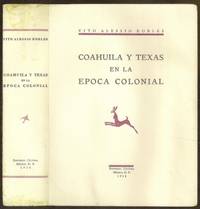
1938Best.-Nr. CA0116xii751 pages with color frontispiece maps some foldout plates some in color diagrams and illustrations. Royal octavo 9 1/2" x 7" bound in original wrappers. Inscribed by the author. Howes 382 Limited to 1000 copies.Vito Alessio Robles was born on August 14th of 1879 in Saltillo Coahuila son of Dominic Alessio and Cristina Robles. There he studied at the Ateneo Fuente. He graduated as an engineer at the Military College of Mexico City. In 1910 a lieutenant colonel in the Federal Army under the command of Colonel Samuel Garcia Cuellar fought Madero in the Battle of Casas Grandes Chihuahua. Before he had taken up arms against the Yaquis. Under Madero he served as Inspector General of Police Public Works and deputy military attache in Rome. n 1913 he returned to Italy as a result of the fall of Madero. Under the Victoriano Huerta presidency he was arrested and detained and imprisoned. Following this he joined the Constitutionalist ranks first operated in San Luis Potosi under the command of General Alberto Carrera Torres and then was sent north with Francisco Villa. At the onset of division of the revolutionary leaders in the Convention of Aguascalientes he remained with the convention and was a delegate and became secretary. He held the governorship of the Federal District during the presidency of Roque Gonzalez Garza allowing its inhabitants to bear arms. After 1920 he held a deputation by the Federal District and a senate of Coahuila . In 1925 and 1926 had moved in diplomatic circles as a minister of Mexico in Sweden. As Chairman of the National Anti Party fought against Plutarco Elias Calles and Alvaro Obregon. He ran for governor of Coahuila in 1929 and in that same year he was banished from the country finding acceptance in Austin Texas where he devoted himself to historical research. Vito Alessio Robles also excelled as a great journalist was director of the Heraldo de Mexico and The Democrat and contributor to El Universal Excelsior and La Prensa among others under the pseudonyms "Tobias O. Soler" and "Pingüino Macho". Condition:Still has the original onion skin wrapper. Inscribed on half title slight stain to head and tail of spine else a very good to fine copy. Editorial Cultura paperback books
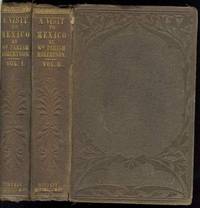
1853Best.-Nr. BOOKS0066102 volumes xxii332 pages with folding frontispiece and folding map; ii478 pages. Small Octavo 7 3/4" x 5 1/4". Bound in original embossed brown cloth with gilt lettering to spine. The map is titled Mexico and Texas and shows the Republic of Texas including a large sectin of today's New Mexico Kansas and southern Colorado northward to the Arkansas River and westward to the Rio Grade. Sabin 72016 1st American edition. 2 volumes. xxii332 pages with fold out frontispiece and foldout map; ii478 pages with appendix. Small Octavo 7 3/4" x 5 1/4". Bound in original decorative blind stamped brown cloth with gilt lettering to spine. The map is titled Mexico and Texas and shows the Republic of Texas including a large section of today's New Mexico Kansas and southern Colorado northward to the Arkansas River and westward to the Rio Grade. Sabin 72016 First American edition. Robertson was appointed Mexican commissioner in 1848. He journeyed with his daughter from Southampton to Bermuda on the Avon and then to the Yucatan Peninsular on the Forth. Written in the form of a journal the book includes both details of everyday life on board ship and dramatic events such as shipwreck. Both father and daughter contributed to the book which gives an interesting perspective on Robertson's sojourn in Mexico. The book provides information on the country's mines politics and mores as well as anecdotes of the Yucatan and West Indies. Condition: Front inner hinge of volume one cracked through spine ends and corners chipped and rubbed previous owner's name on front end papers. A good copy. Simpkin, Marshall & Co hardcover books
1910Best.-Nr. CA01065 volumes: volume 1 Texto: xx607 pages with frontispiece portraits illustrations facsimiles maps and plates; volume 2 Documentos: 552 pages; volume 3 Vida de Ercilla: 337 pages with portraits illustrations and index; volumes 4-5 Illustrations: 512 pages with facsimile titles to the first publications; 559 pages with facsimile signatures plates and index. Folio 15" x 10 3/4" with original wrappers bound in to cloth binding. Compiled and arranged by Jose Toribio Medina. First edition. La Araucana is an epic poem in Spanish about the Spanish conquest of Chile by Alonso de Ercilla; it is also known in English as The Araucaniad. It was considered the national epic of the Kingdom of Chile and one of the most important works of the Spanish Golden Age Siglo de Oro. The poem consists of 37 cantos that are distributed across the poem's three parts. The first part was published in 1569; the second part appeared in 1578 when it was published with the first part; the third part was published with the first and second parts in 1589. The poem shows Ercilla to be a master of the octava real the complicated stanza in which many other Renaissance epics in Castilian were written. A difficult eight-line unit of 11-syllable verses that are linked by a tight rhyme scheme the octava real was a challenge few poets met. It had been adapted from Italian only in the 16th century and it produces resonant serious-sounding verse that is appropriate to epic themes. The work describes the initial phase of the Arauco War which was born as a Spanish conquests attempt not at all comparable in importance to those of Hernán Cortés who helped conquer the Aztec empire and Francisco Pizarro who initiated the overthrow the Inca empire. Contrary to the epic conventions of the time however Ercilla placed the lesser conquests of the Spanish in Chile at the core of his poem because the author was a participant in the conquest and the story is based on his experiences there. On scraps of paper in the lulls of fighting Ercilla jotted down versified octaves about the events of the war and his own part in it. These stanzas he later gathered together and augmented in number to form his epic. It was the first poem of its kind written by a participant in the course of the events narrated and the first to immortalize the beginnings of a modern country. In the minds of the Chilean people La Araucana is a kind of Iliad that exalts the heroism pride and contempt of pain and death of the legendary Araucanian leaders and makes them national heroes today. Thus we see Ercilla appealing to the concept of the "noble savage" which has its origins in classical authors and took on a new lease of life in the renaissance - c.f. Montaigne's essay Des Canibales and was destined to have wide literary currency in European literature two centuries later. He had in fact created a historical poem of the war in Chile which immediately inspired many imitations. La Araucana is deliberately literary and includes fantastical elements reminiscent of medieval stories of chivalry. The narrator is a participant in the story at the time a new development for Spanish literature. Influences include Orlando furioso by Ludovico Ariosto. Also features extended description of the natural landscape. La Araucana's successes—and weaknesses—as a poem stem from the uneasy coexistence of characters and situations drawn from Classical sources primarily Virgil and Lucan both translated into Spanish in the 16th century and Italian Renaissance poets Ludovico Ariosto and Torquato Tasso with material derived from the actions of contemporary Spaniards and Araucanians. The mixture of Classical and Araucanian motifs in La Araucana often strikes the modern reader as unusual but Ercilla's turning native peoples into ancient Greeks Romans or Carthaginians was a common practice of his time. For Ercilla the Araucanians were noble and brave—only lacking as their Classical counterparts did the Christian faith. Caupolicán the Indian warrior and chieftain who is the protagonist of Ercilla's poem has a panoply of Classical heroes behind him. His valour and nobility give La Araucana grandeur as does the poem's exaltation of the vanquished: the defeated Araucanians are the champions in this poem which was written by one of the victors a Spaniard. Ercilla's depiction of Caupolicán elevates La Araucana above the poem's structural defects and prosaic moments which occur toward the end when Ercilla follows Tasso too closely and the narrative strays from the author's lived experience. Ercilla the poet-soldier eventually emerges as the true hero of his own poem and he is the figure that gives the poem unity and strength. The story is considered to be the first or one of the first works of literature in the New World cf. Cabeza de Vaca's Naufragios—Shipwrecked or Castaways for its fantastical/religious elements it is arguable whether that is a "traveler's account" or actual literature; and Bernal Díaz del Castillo's Historia verdadera de la conquista de Nueva España The Conquest of New Spain. La Araucana's more dramatic moments also became a source of plays. But the Renaissance epic is not a genre that has as a whole endured well and today Ercilla is little known and La Araucana is rarely read except by specialists and students of Spanish and Latin American literatures and of course in Chile where it is subject of special attention in the elementary schools education both in language and history. La Araucana makes Chile the only American country that was founded under the lights of an epic poem. Condition: Bound in red cloth with original wrappers bound in. Volume one first 15 pages closed tear at heal repaired back page fore edge repaired. A very good set. Imprenta elzeviriana hardcover books