26 051 résultats
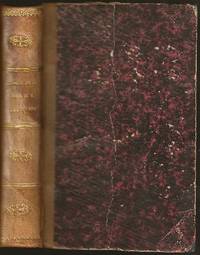
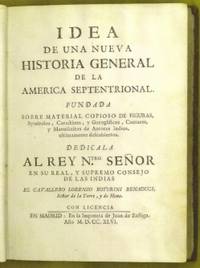
1746réf. A0068xxxvi167viii96 pages. Octavo 8 1/4" x 6 1/4" bound in full leather with decorative gilt and lettering to spine. From the library of George M Foster. First edition. Lorenzo Boturini Benaducci born in Italy of noble parentage studied in Milan and lived in Trieste and Vienna. He was a knight of the Holy Roman Empire. Forced to flee Austria because of the war with Spain Boturini arrived in Spain via England and Portugal. In Madrid he met the Condesa de Santibáñez oldest daughter of the Condesa de Moctezuma. The mother authorized him to collect a pension due her as a descendant of the Aztec Emperor Moctezuma II from the royal treasury in New Spain. Boturini went to New Spain in 1736 where he remained eight years. During those years he assembled a vast collection of paintings maps manuscripts and native codices. He copied more than 500 pre-Columbian inscriptions and made his own drawings of monuments and sculptures and he investigated the history of the apparition of the Virgin of Guadalupe on the hill of Tepeyac. He traveled widely and on his travels brought together the largest collection of Mexican antiquities assembled to that time by a European. Not only did he intend to write the history of the Virgin of Guadalupe but he also had plans to crown her image with a gold crown. For that purpose he sought donations from the bishops and from the public. This brought him to the attention of the colonial government which was suspicious of the motives of a foreigner making this proposal. On June 2 1743 after an investigation the recently arrived viceroy Pedro Cebrián y Agustín had him imprisoned and impounded his collection. He was accused of entering New Spain without license from the Council of the Indies and of introducing papal documents without a royal permit. After eight months in prison Boturini was sent to Spain. He fell into the hands of pirates who eventually released him at Gibraltar. From there he traveled to Madrid in miserable conditions. In Madrid he met Mariano Fernández de Echeverría y Veytia another passionate collector of Indian antiquities. Fernández de Echeverría y Veytia offered Boturini a place to live and financial support and got the Council of the Indies to reconsider his case. Boturini was absolved. The king named him royal chronicler of the Indies ordered that his collection be returned to him and extended an invitation for him to return to New Spain. Boturini however declined to return to New Spain and his collection was never restored. It appears that he was granted recompense and a stipend to work on his projected history of the colony. In Madrid he wrote a history of ancient Mexico unpublished at the time of his death in 1753. The library at the Basílica de Nuestra Señora de Guadalupe is named for him. The Boturini Collection was formed between 1735 and 1743 to serve as the basis of a projected Historia de América Septentrional. It consisted of many valuable documents the majority of them of Indian provenance. Among these were hieroglyphic paintings that had belonged to Juan de Alva Ixtlilxochitl a descendant of the rulers of Texcoco. Ixtlilxotchitl bequeathed these documents to Carlos de Sigüenza y Góngora. The collection was confiscated by Viceroy Pedro Cebrián y Agustín at the time of Boturini's arrest in 1743. It was deposited in the office of the secretary of the viceroyalty. The documents were neglected there for years and suffered considerable pilferage. The subsequent viceroy Juan Francisco de Güemes 1st Count of Revillagigedo granted the historian and antiquary Fernández de Echeverría y Veytia Boturini's friend from Madrid the paintings and documents he solicited for his own studies. On Fernández de Echeverría y Veytia's death they passed to Antonio de León y Gama. He died in 1802 and the collection passed to his heirs. Shortly thereafter 16 paintings were obtained by Alexander von Humboldt during his visit to Mexico in 1802-03. He published them in Vues des cordillères et monuments des peuples indigènes d'Amérique. The originals of these are now in the Berlin State Library. Part of the remainder of the collection may have passed to Father José Pichardo an amateur antiquarian. Joseph Alexis Aubin beginning in 1827 or shortly thereafter obtained important parts of the collection from a variety of sources. He sold his collection to Eugène Goupil who was of French and Mexican descent. This part of the collection passed by donation or purchase to the National Library in Paris where it remains under the name Aubin-Goupil Collection. George McClelland Foster Jr born in Sioux Falls South Dakota on October 9 1913 died on May 18 2006 at his home in the hills above the campus of the University of California Berkeley where he served as a professor from 1953 to his retirement in 1979 when he became professor emeritus. His contributions to anthropological theory and practice still challenge us; in more than 300 publications his writings encompass a wide diversity of topics including acculturation long-term fieldwork peasant economies pottery making public health social structure symbolic systems technological change theories of illness and wellness humoral medicine in Latin America and worldview. The quantity quality and long-term value of his scholarly work led to his election to the National Academy of Sciences in 1976. Virtually all of his major publications have been reprinted and/or translated. Provenance from the executor of Foster's library laid in. Condition: Lacks frontispiece portrait. Lacks Foster's stamp or date of purchase. some damp stains to end papers neat old marginalia in Spanish to back end paper worm hole ant head and heal of spine going through spine extremities bumped and rubbed old owner's label to front paste down 1" chip at back head hinge and name to front end paper scuffed else a good copy of a rare item. En la Imprenta de Juan de Zuniga hardcover books
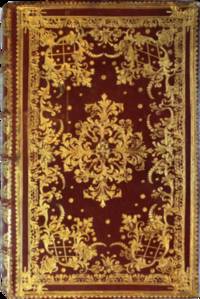
1756réf. 4062Rome: Gioacchino & Giovanni Giuseppe Salvioni Stampatori Pontificii Vaticani 1756. 8vo 210 x 135 mm. 24 407 1 pp. 2 parts the Office of the Dead separately titled. Printed in red and black. Engraved frontispiece and 12 full-page engravings by Arnold Van Weserhout and Jacob Frey after Joseph Passarus Giuseppe Passaro two engraved title vignettes and 12 tailpiece vignettes a few unsigned others by Frey after Passaro or by M. Schedi engraver 3 engraved initials numerous red-printed woodcut initials. Occasional light browning. 18th-century Roman gold-tooled red goatskin covers with densely tooled dentelle border built up from leafy plant tools sprigs floral and arabesque tools each cornerpiece enclosing a grid with gold dots blossom tools and dots in central field ornamental centerpiece of large foliate arabesque and dandelion tools spine in six uniformly gold-tooled compartments block-printed pastedown endpapers with flower and fruit design stencil-colored in red green and yellow gilt edges with gauffred border design; upper cover a bit faded and bowed corner bumped a couple of scrapes to lower cover. Provenance: Horace de Landau 1824-1904 bookplate shelfmark no 47854; Vicomte de Cossette armorial bookplate. A rococo binding on a luxuriously printed and illustrated Office of the Virgin from the Salvioni press official printers to the Vatican. The Salvioni press used several workshops sometimes collectively mislabeled as the "Vatican" or "Salvioni" bindery. Those bound for the papal library were finely executed and different binderies can be identified by their tools color of leather and stylistic details. The present pretty but crowded binding decor with its in places overlapping tooling does not seem to belong to the corpus of binderies represented in for example the Vatican Library's 1977 exhibit catalogue of papal bindings. Stylistically it uses types of tools and decoration - the wide "Louis XV" style border and the basketweave cornerpieces - in vogue during the reigns of Clement XIV 1769-1774 and Pius VI 1775-1799. Its decoration is similar for example to binding no. 262 in Legature papali but it is of inferior workmanship and does not use the same tools. It was probably produced in a Roman shop executing many commissions and forced to work quickly although it could even be a provincial binding. Cf. Biblioteca Apostolica Vaticana Legature papali da Eugenio IV a Paolo VI no. 262 plate CXCI. Gioacchino & Giovanni Giuseppe Salvioni, Stampatori Pontificii Vaticani hardcover books
1883réf. E0564Title leaf & 13 leaves of maps being mounted albumen photograph reductions of the original map. Photographs are approximately 7¼" x 8¾" on card stock leaves. Oblong royal octavo 9 "x 12½" bound in original red cloth rebacked with modern leather with original gilt-lettered leather spine laid on. References: P-LG 5121. El Territorio Mexicana Vol II p 457 reproduces 5th map of 1st edition. International Geographical Exposition and Congress of London. Geographical and Exploring Commission of the Mexican Republic. Catalogue of the Exhibits presented by the Commission with a short sketch of its organization and labors by the Directing Engineer Julio Alvarado C. E. Mexico 1895. p 32 First and only edition. Rare atlas of photographs of the map of the region around Puebla southwest of Mexico City. Warren Heckrotte describes the atlas and the enterprise that produced it: "The Comision Geografica-Explordora was established by a decree of December 13 1877. It was directed to prepare a map of the Republic with all the scientific accuracy desirable. The region around the town of Puebla southwest of Mexico City was the first effort of the Commission. The surveying was done by astronomical determinations and triangulation. Between 1879 and 1882 the planned nine sheets lithographed in Mexico City were issued at a scale of 1:20000. Elevations are shown by contour lines. For this atlas the sheets were issued as photographs the maps reduced in scale to 1:50000. A photographic edition at the scale of 1:100000 was also issued. Other areas of the country were mapped. The ultimate goal was to produce a map of the country at a scale of 1:100000 in 1100 sheets. At the time the Commission closed shop in 1914 a little over 200 sheets had been completed. This mode of production suggests that a small number of these atlases were produced." Indeed OCLC/WorldCat locates only two copies at the University of California Berkeley and Dartmouth College. Condition: Some soiling to covers; expertly rebacked by Sandra Good; new endpapers; internally fine or nearly so a bit of darkening to margins of mounts. Comisión Geográfico-Exploradora hardcover books
1932réf. CA02463 volumes. xxix-574 pages with 4 folding maps; 466 pages with folding coats of arms 6 folding native illustrations and map; 469 pages with 2 coats of arms one folding and 6 folding native illustrations. Royal octavo 9 1/2" x 7" bound in three quarter blue leather with raised spine bands and gilt lettering to spine. Introduction by Rafael Lopez. From the library of George Foster. Publicaciones del Archivo General de la Nacion volume XVII XVIII and XIX. There are only meager biographical data about Pablo de la Purísima Concepción Beaumont whose work is a major source on Michoacán. Despite its title "Chronicle of the Holy Apostles St Peter and St Paul of Michoacán" Beaumont's work in fact spans a much greater area including much of western Mexico northward to New Mexico and tending toward a general history. It provides details to 1565. Beaumont divided his total work into tow major parts the firs or Aparato intended to be introductory to the second or the Crónica proper. the first seems complete but the second was never finished. The Aparato takes up fully a third of the extant Beaumont work although nominally introductory. It deals with the discovery of America and the conquest of Mexico to the year 1521. It was twice published before appearance of the total work. Far more valuable is the Crónica. It consists of two books and one chapter of book 3. Beaumont drew on a wide variety of sources. He tell us us that he gathered a large quantity of manuscripts from various Franciscan archives as well as listing 30 standard writers in printed sources. He gives full copies of some of his documents of which several have since disappeared. He speaks of obtaining a native painting possibly from which his illustrations came. These paintings show incidents of the first visits of Spaniards to Michoacán there reception by Tarascans labors of the Franciscans coats of arms of principal cities of Michoacán. It is usually through that Beaumont composed his work around 1777. That is the last date in the later copies of the original manuscript. Unfortunately his original manuscript is lost. It was copied in Mexico City around 1792 to for volumes 7-11 of a 32 volume Collection of Memories on New Spain ordered by Viceroy Conde de Revilla Gigedo and compiled by Manuel de la Vega. Three partially complete sets of these Vega Memorias are known; from one or another of them come other recopied manuscript copies as well as the printed versions. Editions of the work have a somewhat unfortunate publishing history. In 1826 Bustamante published an incomplete and useless edition of the Aparato attributing it to Vega who had owned the manuscript Bustamante used. In 1873-74 a five volume edition of both Aparato and Crónica appeared in Mexico; it lacks the Indian drawings and was based on a secondary manuscript copy made b y J F Ramirez that then belonged to Alfredo Chavero. A three volume version was published by the National Archives of Mexico in 1932 based on their copy of the 1792 collection of Memorias; it contains the Indian drawings and an introduction by Rafael Lopez. The text seems slightly corrupt but it may be near the original as Beaumont said his Spanish was defective owing to his Parisian rearing. George McClelland Foster Jr born in Sioux Falls South Dakota on October 9 1913 died on May 18 2006 at his home in the hills above the campus of the University of California Berkeley where he served as a professor from 1953 to his retirement in 1979 when he became professor emeritus. His contributions to anthropological theory and practice still challenge us; in more than 300 publications his writings encompass a wide diversity of topics including acculturation long-term fieldwork peasant economies pottery making public health social structure symbolic systems technological change theories of illness and wellness humoral medicine in Latin America and worldview. The quantity quality and long-term value of his scholarly work led to his election to the National Academy of Sciences in 1976. Virtually all of his major publications have been reprinted and/or translated. Provenance from the executor of Foster's library laid in. Condition: Some underlining in pencil through out by Foster. Foster's date of acquire on front paste down early owner's name on front end paper. some light soiling and rubbing to extremities else a very good set. Talleres Graficos de la Nacion hardcover books
1800réf. E0068viii514 pages with frontispiece map. Quarto 10 1/2" x 8 3/4" housed in a custom slipcase. Translated by Maurice Keatinge. First English edition. Bernal Dïaz del Castillo was a conquistador who wrote an eyewitness account of the conquest of Mexico by the Spaniards under Hernan Cortes himself serving as a rodelero under Cortes. Born in Medina del Campo Spain he came from a family of little wealth and he himself had received only a minimal education. He sailed to Cuba in 1514 to make his fortune but after two years found few opportunities there. Much of the native population of the island had already been killed by epidemics and forced labor and in 1517 an expedition was sent to the smaller Caribbean islands to find alternative sources of labor. Dïaz joined this group under the command of Francisco Hernandez de Cordoba. It was a difficult venture and although they discovered the Yucatan coast by the time the expedition returned to Cuba they were in disastrous shape. Nevertheless Dïaz returned to the coast of Yucatan the following year on an expedition led by Juan de Grijalva with the intent of exploring the newly discovered lands. Upon returning to Cuba he enlisted in a new expedition this one led by Hernan Cortes. In this third effort Dïaz took part in one of the legendary military campaigns of history bringing an end to the Aztec empire in Mesoamerica. During this campaign Dïaz spoke frequently with his companions in arms about their experiences collecting them into a coherent narration. The book that resulted from this was Historia verdadera de la conquista de la Nueva Espana English: The True History of the Conquest of New Spain. In it he describes many of the 119 battles in which he claims to have participated culminating in the fall of the Aztec Empire in 1521.As a reward for his service Dïaz was appointed governor of Santiago de los Caballeros present-day Antigua Guatemala. He began writing his history in 1568 almost fifty years after the events described in response to an alternative history written by Cortes's chaplain who had not actually participated in the campaign. He called his book the Verdadera Historia True History in response to the claims made in the earlier work. Dïaz died in 1585 without seeing his book published. A manuscript was found in a Madrid library in 1632 and finally published providing an eye-witness account of the events often told from the perspective of a common soldier. Today it is one of the most important sources in understanding the campaign that led to the collapse of the Aztec Empire and the Spanish conquest of Mexico. Condition:Spine renewed with new period spine label and original boards which the corners and edges are heavily rubbed some foxing to early pages. Frontispiece map repaired. Custom made red slipcase with Japanese toggles and leather spine label in gilt lettering else about a very good copy in a near fine case. Printed for J Wright by John Dean hardcover books
1910réf. CA01065 volumes: volume 1 Texto: xx607 pages with frontispiece portraits illustrations facsimiles maps and plates; volume 2 Documentos: 552 pages; volume 3 Vida de Ercilla: 337 pages with portraits illustrations and index; volumes 4-5 Illustrations: 512 pages with facsimile titles to the first publications; 559 pages with facsimile signatures plates and index. Folio 15" x 10 3/4" with original wrappers bound in to cloth binding. Compiled and arranged by Jose Toribio Medina. First edition. La Araucana is an epic poem in Spanish about the Spanish conquest of Chile by Alonso de Ercilla; it is also known in English as The Araucaniad. It was considered the national epic of the Kingdom of Chile and one of the most important works of the Spanish Golden Age Siglo de Oro. The poem consists of 37 cantos that are distributed across the poem's three parts. The first part was published in 1569; the second part appeared in 1578 when it was published with the first part; the third part was published with the first and second parts in 1589. The poem shows Ercilla to be a master of the octava real the complicated stanza in which many other Renaissance epics in Castilian were written. A difficult eight-line unit of 11-syllable verses that are linked by a tight rhyme scheme the octava real was a challenge few poets met. It had been adapted from Italian only in the 16th century and it produces resonant serious-sounding verse that is appropriate to epic themes. The work describes the initial phase of the Arauco War which was born as a Spanish conquests attempt not at all comparable in importance to those of Hernán Cortés who helped conquer the Aztec empire and Francisco Pizarro who initiated the overthrow the Inca empire. Contrary to the epic conventions of the time however Ercilla placed the lesser conquests of the Spanish in Chile at the core of his poem because the author was a participant in the conquest and the story is based on his experiences there. On scraps of paper in the lulls of fighting Ercilla jotted down versified octaves about the events of the war and his own part in it. These stanzas he later gathered together and augmented in number to form his epic. It was the first poem of its kind written by a participant in the course of the events narrated and the first to immortalize the beginnings of a modern country. In the minds of the Chilean people La Araucana is a kind of Iliad that exalts the heroism pride and contempt of pain and death of the legendary Araucanian leaders and makes them national heroes today. Thus we see Ercilla appealing to the concept of the "noble savage" which has its origins in classical authors and took on a new lease of life in the renaissance - c.f. Montaigne's essay Des Canibales and was destined to have wide literary currency in European literature two centuries later. He had in fact created a historical poem of the war in Chile which immediately inspired many imitations. La Araucana is deliberately literary and includes fantastical elements reminiscent of medieval stories of chivalry. The narrator is a participant in the story at the time a new development for Spanish literature. Influences include Orlando furioso by Ludovico Ariosto. Also features extended description of the natural landscape. La Araucana's successes—and weaknesses—as a poem stem from the uneasy coexistence of characters and situations drawn from Classical sources primarily Virgil and Lucan both translated into Spanish in the 16th century and Italian Renaissance poets Ludovico Ariosto and Torquato Tasso with material derived from the actions of contemporary Spaniards and Araucanians. The mixture of Classical and Araucanian motifs in La Araucana often strikes the modern reader as unusual but Ercilla's turning native peoples into ancient Greeks Romans or Carthaginians was a common practice of his time. For Ercilla the Araucanians were noble and brave—only lacking as their Classical counterparts did the Christian faith. Caupolicán the Indian warrior and chieftain who is the protagonist of Ercilla's poem has a panoply of Classical heroes behind him. His valour and nobility give La Araucana grandeur as does the poem's exaltation of the vanquished: the defeated Araucanians are the champions in this poem which was written by one of the victors a Spaniard. Ercilla's depiction of Caupolicán elevates La Araucana above the poem's structural defects and prosaic moments which occur toward the end when Ercilla follows Tasso too closely and the narrative strays from the author's lived experience. Ercilla the poet-soldier eventually emerges as the true hero of his own poem and he is the figure that gives the poem unity and strength. The story is considered to be the first or one of the first works of literature in the New World cf. Cabeza de Vaca's Naufragios—Shipwrecked or Castaways for its fantastical/religious elements it is arguable whether that is a "traveler's account" or actual literature; and Bernal Díaz del Castillo's Historia verdadera de la conquista de Nueva España The Conquest of New Spain. La Araucana's more dramatic moments also became a source of plays. But the Renaissance epic is not a genre that has as a whole endured well and today Ercilla is little known and La Araucana is rarely read except by specialists and students of Spanish and Latin American literatures and of course in Chile where it is subject of special attention in the elementary schools education both in language and history. La Araucana makes Chile the only American country that was founded under the lights of an epic poem. Condition: Bound in red cloth with original wrappers bound in. Volume one first 15 pages closed tear at heal repaired back page fore edge repaired. A very good set. Imprenta elzeviriana hardcover books
1951réf. 2222239First edition presumed first issue in gilt stamped green cloth. 24 illustrations. Dust jacket unclipped. Enclosed in a green morocco slipcase with three leather labels. Very good. 398 pages. Signed and inscribed by author to noted book collector George A. Zabriskie on front free endpaper. With two snake skin pieces bookplates on the front and rear pastedowns. Eyre & Spottiswoode hardcover books
1882réf. CA0128xv488 pages with appendices. Octavo 8 1/2" x 5" bound in quarter leather with gilt lettering to spine in stiff boards. From the library of Professor George M Foster. Second edition. Alonso de la Rea was born in Queretaro in 1610. He wrote his Cronica in 1637-1639 providing data on Michoacán and Jalisco. For many matters he leaned heavily on Torquemada who in turn had copied them from Mendieta. Ricard quoting an 18th century opinion mentions that Rea lacked interest in chronology to an excessive degree. His work was however an official and methodical chronicle of the province preserving considerable detail about it. Rea's Cronica . 1639 was first published in 1643 and is now a bibliographical rarity. The volume is divided into three books totaling 92 chapter. Book 1 describes the region products people their dealings with Aztecs their general traits religious rites the last native emperors and coming of the Spaniards. This is followed by arrival of the Franciscan missionaries with biographies of some of these pioneer friars. Book 2 begins with the division of the province between Michoacán and Jalisco 1606 and contains numerous biographies of the members of that order. Book 3 is also a series of lives and an account of the Custodio del Rio Verde. The second edition was published in Mexico 1882. It includes additional relevant documents in three appendices. At the end of the text there is a table of contents but no index. George McClelland Foster Jr born in Sioux Falls South Dakota on October 9 1913 died on May 18 2006 at his home in the hills above the campus of the University of California Berkeley where he served as a professor from 1953 to his retirement in 1979 when he became professor emeritus. His contributions to anthropological theory and practice still challenge us; in more than 300 publications his writings encompass a wide diversity of topics including acculturation long-term fieldwork peasant economies pottery making public health social structure symbolic systems technological change theories of illness and wellness humoral medicine in Latin America and worldview. The quantity quality and long-term value of his scholarly work led to his election to the National Academy of Sciences in 1976. Virtually all of his major publications have been reprinted and/or translated. Provenance from the executor of Foster's library laid in. Condition: Foster's stamp to title. Corners bumped edge wear to boards rubbing to paper boards else a very good copy. Imprenta de J R Barbedillo hardcover books
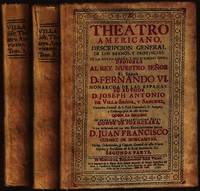
1952réf. CA02502 volumes. Royal octavo 9 1/4" x 6 3/4" bound in facsimile velum with title printed in red and black on covers and horizontally ink lettered. Introduction by Francisco Gonzalez de Cossio. From the library of George M Foster. Second edition limited to 500 copies of which this is number 13. José Antonio Villaseñor y Sánchez was an 18th-century geographer historian and mathematician in New Spain. He was born in San Luis Potosí México and studied at San Ildefonso in Mexico City. He became an accountant and later official cosmographer geographer of New Spain. By order of Philip V the viceroy of New Spain Conde de Fuenclara was commanded in 1740 to have a report prepared on the true condition of the provinces of his jurisdiction. He commissioned José Antonio Villaseñor y Sánchez to prepare the report. Villaseñor occupied a number of important posts: official mayor of the Contaduria de Reales Tributos contador general de la azogues and cosmographer of New Spain. He wrote a number of works of mathematical and astronomical interest. The outcome of this commission by Fuenclara was the Theatro Americano descripción general de los reinos y provincias de la Nueva España y sus jurisdicciones. It appeared in two volumes in 1746 and 1748. The first volume contains introductory chapters on pre-Spanish and Spanish history of Mexico followed by a jurisdiction-by jurisdiction description of the archdiocese of Mexico and diocese of Puebla. The second volume continues the description for the diocese of Puebla. The second volume continues the description for the diocese of Michoacán Oaxaca Guadalajara and Durango. The work comprehends a great mass of data regarding the ethnology and population of the Mexican provinces in the mid-18th century. Handbook of Middle American Indians. George McClelland Foster Jr born in Sioux Falls South Dakota on October 9 1913 died on May 18 2006 at his home in the hills above the campus of the University of California Berkeley where he served as a professor from 1953 to his retirement in 1979 when he became professor emeritus. His contributions to anthropological theory and practice still challenge us; in more than 300 publications his writings encompass a wide diversity of topics including acculturation long-term fieldwork peasant economies pottery making public health social structure symbolic systems technological change theories of illness and wellness humoral medicine in Latin America and worldview. The quantity quality and long-term value of his scholarly work led to his election to the National Academy of Sciences in 1976. Virtually all of his major publications have been reprinted and/or translated. Provenance from the executor of Foster's library laid in. Condition: Foster's stamp to front limited page some wear to edges small linear tear at spine head of volume 2 else a very good copy. Editora Nacional paperback books
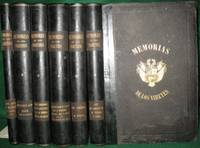
1859réf. CA02406 volumes. xxx379index pages; 426index pages; 388index pages; 51620 tables and index pages; 39317 tables and index pages; 39456 tables and index with large fold out map at back and 12 plates. Folio 12 1/4" x 8 1/4" bound in original publisher's dark brown pebbled cloth ruled in blind with front boards with armorial gilt device. New spines with original title in gilt laid on. Palau 95426 Sabin 26119 First editions. These memoirs prepared by ten of the viceroys were intended to apprise each successor of the nature and duties of his post of the distribution of offices and presidencies of the privileges of the natives their hereditary customs and character. The work forms a glorious monument of statesmanship; and it may be conjectured that if the Spaniards had always formed their conduct according to these Memorias they would never had lost their colonies in the New World. Bibliographico-Linguistica 312 part III The series was edited under the direction of the Ministerio de Hacienda. Some foxing in all volumes some water staining varying in degrees in volumes worming to some volumes in varying degrees a few affecting text but all readable. Spine replaced with original spine labels affixed else a good set of a scare colonial item. Due to the size and/or weight of this lot extra shipping and/or handling charges may apply. Libreria Central de Felipe Baily hardcover books
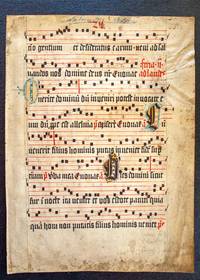
1516réf. 6584Germany 15th or 16th century. Good. Manuscript leaf on vellum 290 x 400mm. Eight staves and eight lines of text on recto and verso. Seven elaborate polychrome decorated letters in blue black green and gold. Text in black with rubrication staves in red. Old inscription in upper margin of recto old pencil notes in lower margin. Single leaf extracted from an antiphonary. Main text is from Isaiah 55. Remarkable decorated initials in Gothic style. hardcover books
réf. TM 796MEDIEVAL ILLUMINATED MANUSCRIPT IN ITALIAN ON PAPER Northeastern Italy Veneto Venice c. 1474. Dimensions 328-332 x 230 mm. 188 folios missing at least three leaves written in brown ink in an Italian cursiva libraria script EIGHT ILLUMINATED INITIALS of seven lines one-line paraphs in red or blue simple two- to four-line in red or blue initials. BINDING: re-cased using original binding materials of brown half leather over bevelled wooden boards with three double bands remains of four straps present. TEXT: Italian translation of Gregory the Great's Moralia in Job one of the most important and widely copied texts of the Middle Ages. Though forty copies of this translation survive this volume is unusual in its incorporation of Venetian dialectal forms. All other copies are in European institutions and have not been on the market for the last century. PROVENANCE: scribal colophon on f. 190v provides a date for this manuscript's completion and helps localize its production within Italy: "Scripto per mi zuane de zane zoielier condam per simon et chi li lezeranno priegi dio per lo scriptore. MCCCCLXXIIII" Written by me Zuane de Zane jeweler once for Simon and may whoever will read it pray to God for the writer. 1474. There is no Zuane de Zane on record elsewhere as a scribe; the name itself is Venetian and evidence of the manuscript's watermark and decoration also suggest an origin in the region of Veneto and possibly Venice specifically. The manuscript was later acquired by a private European collection. CONDITION: slight tears in the lower margin of f. 25 and upper margin of ff. 37 and 160 from f. 161 to the end there is a slight loss to the upper outer corner slight water staining visible parchment reinforcement present prickings visible. Full description and images available. TM 796 Northeastern Italy, Veneto (Venice?), dated 1474 books
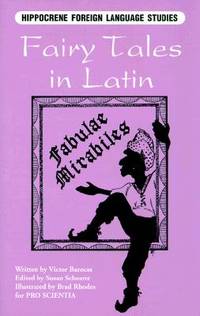
2001réf. 90018NY:: Hippocrene Books. Fine in Fine dust jacket. 2001. Hardcover. 0781807875 . Text is in Latin. Edited by Susan Schearer. Second printing. Fine in a fine dust jacket. . Hippocrene Books, hardcover books
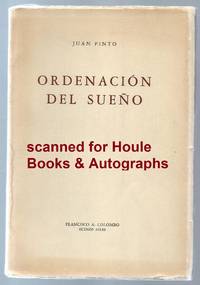
1961réf. 2221673First edition. Octavo. Frontispiece drawing of Adam and Eve by Tomas Di Taranto. Original stiff white wrappers light soiling; short tear. No dust jacket. Very good. 143 pages. Signed and inscribed by Pinto on half title page to poet Alicia Ghiragossian; with name stamped on title page. Francisco A. Colombo paperback books
1965réf. 2221599First edition. Small thin octavo. Preface by Felix B. Visillac. Original stiff tan wrappers stamped in black. Text browned due to paper quality. Very good. 54 pages. Signed and inscribed by author to poet Alicia Ghiragossian on title page. Direccion Lafuente paperback books
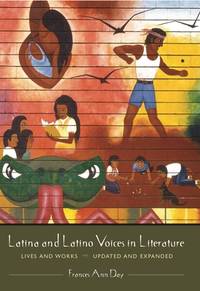
2003réf. 31672Westport: Greenwood Press. As New. 2003. Hardcover. 0313323941 . First printing. As new in glossy illustrated boards. No dust jacket as issued. . Greenwood Press hardcover books
2000réf. 28629NY: St. Martin's. Fine in Near Fine dust jacket. 2000. Hardcover. 031223144X . First printing. Fine in a very near fine hint of sun fading along spine dust jacket. . St. Martin's hardcover books
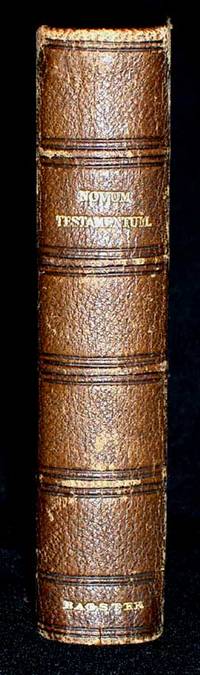
1852réf. 8235London. Samuel Bagster. 1852. Bound in full blind ruled morocco. Blind ruled spine compartments with raised bands. Gilt titles. a.e.g. 32mo 2" x 3.5". A bit of rubbing to extremities. A Near Fine crisp sweet little copy. Samuel Bagster. hardcover books
1797réf. 66681CBLeipzig, Caspar Fritsch/Dürr, 1797-1800. 8°. 22,5 x 14,5 cm. LXXXVIII, 740, 724, LXII, 776, 576, VI, 538 und 798 Seiten. Halblederbände der Zeit mit goldgeprägten Rückentiteln auf roten und grünen Lederschildchen, goldgeprägter Buchschmuck und Innenfileten sowie Rundum-Goldschnitten.
1991réf. 24696Cambridge; New York u.a., Cambridge University Press, 1991. XXV, 388 S., Kt. 8°, OPb.
2001réf. 24085CBAachen, Shaker (= Berichte aus der Literaturwissenschaft), 2001. gr.8°, IV, 176 S. mit s/w-Abbildungen und einer Karte, zweisprachig: lateinisch und deutsch, illustr. original Kartonage (Paperback), 2., erweiterte Auflage Einbandecken bestoßen, erste und letzte Seiten an den Ecken minimal bestoßen, sonst gutes, sauberes Exemplar.
1710réf. 2501100018xbvkAmsterdam, Offizin Hendrik Wetstein, 1710. Copperplate-titlepage, printed titlepage in red and black with woodblock flower-bucket; (8) 315 pages, 1 blank sheet; ALL ON UNTRIMMED PAPER. - Vellum-binding with gilt-titled red spinelabel; small-8vo.(ca. 16 x 9 x 2 cm).
1775réf. c2412110474xbvkLouvain / Leuven, Belgium; 1775. Titlesheet (former blank front flyleaf), (9) pages 'Proemium Rhetorica / ...' and 'Deperiodo.', 5 blank sheets, pages 17-257 (of?), 1 blank sheet, blank rear flyleaf. - Vellum binding of the period over 5 raised bands with colour-marble-paper covered panel with vellum corners and red edges; small 4to.(ca. 19 x 16 x 2 cm).
1961réf. 2104130193xbvkHarmondsworth, Penguin Books, 1961. x, 159 (1) pages. - Publisher's illustrated softcover; 8vo.(ca. 18 x 12 cm).
1967réf. 1109292125xbvkSlough - Bucks, Centaur Books, 1967. 72 pages. - Publisher's brown softcover; 8vo.(ca. 21 x 15 cm).