26 220 résultats
réf. A9789211220698Paperback / softback. New. Examines the social impact of an unprecedented crisis. The effects of the COVID-19 pandemic have spread to all areas of human life altering the way we interact crippling economies and bringing about profound changes in societies. The pandemic has highlighted and exacerbated the major structural gaps in the region. paperback
réf. A9789211219630Paperback / softback. New. The central theme of this edition of Social Panorama of Latin America is social inequality seen as a fundamental challenge and obstacle to sustainable development. Some of the axes and aspects of social inequality are addressed drawing attention to how they intersect with and reinforce one another. paperback
2009réf. __1935302035Tan Books & Pub 2009. Leather Bound. New. lea edition. 1408 pages. 9.00x6.00x1.50 inches. Tan Books & Pub hardcover
réf. B9781999809522Paperback / softback. New. paperback
réf. B9780464213680Paperback / softback. New. paperback
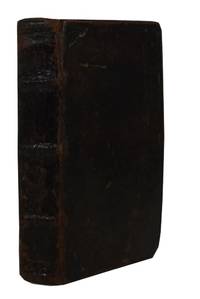
1652réf. 85679Amsterdam: sumptibus regiis L. Elzevier 1652. Editio nova ab auctore sucta et recognita. Hardcover. Very Good. 499p. Later old leather. 14 cm. No cover titling. Edges and joints rubbed. Backstrip crazed. Outer blanks partially pasted down. Old name Daniel Keim inked on a couple of leaves. Narrowly margined. Latin text. This defense of Charles I and of the divine right of kings was first published in the year 1649 that Charles I was executed. This "Edition nova" appears to be rather scarce. sumptibus regiis [L. Elzevier] hardcover
réf. 6827510Harvard University Press . Hardback. New. pp. 424 Harvard University Press hardcover
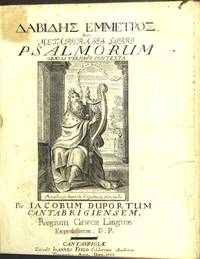
1666réf. 25559Cantabrigiæ: excudit Ioannes Field 1666. 4to pp. 72 431; inserted engraved vignette title-p.; parallel text in Greek and Latin; 2 short tears in fore-edge of title-p. not touching any letterpress worm track occasionally touching letters in first 60 leaves; stains on G2-G4; lacking the portrait of Charles II; contemporary calf-backed marbled boards red morocco label on spine; minor rubbing and wear small cracks starting at the extremities of the joints else generally a very good copy. Paraphrase in Homeric language and verse and its translation in Latin prose on opposite pages with a prefatory treatise on the ancient versions of the Old Testament. Translated by Jacob Duport. "Immediately after the Restoration he was made one of the king's chaplains and reinstated in the possession of his prebend at Lincoln but not of the archdeaconry of Stow as he preferred holding his fellowship and vice-mastership in Trinity College. Widdrington was now dispossessed of the Greek professorship and Duport restored to it but he resigned the chair the same year in favour of his pupil Isaac Barrow. On 19 July 1660 he was by royal mandate with many other learned divines created D.D. at Cambridge Kennett p. 251. He was installed dean of Peterborough 27 July 1664. In 1668 on the death of Dr. John Howorth master of Magdalene College Duport was recalled to Cambridge and appointed by James earl of Suffolk possessor of Audley End to fill the vacant headship. In the following year Duport was elected vice-chancellor of the university. Bishop Monk says that Duport 'appears to have been the main instrument by which literature was upheld in this university Cambridge during the civil dissensions in the seventeenth century and though seldom named and little known at present he enjoyed an almost transcendent reputation for a great length of time among his contemporaries as well as in the generation which immediately succeeded" DNB. Wing B2739a. excudit Ioannes Field unknown
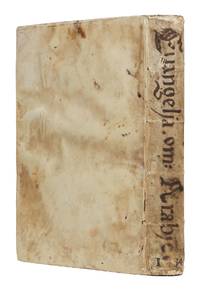
réf. 66827Romae Rome: In Typographia Medicea 1591. FIRST EDITION. Folio 33 x 21.5 cm. pp.9-4621 colophon as issued without title and preliminaries. Contemporary limp vellum with manuscript title on spine. With 149 text woodcuts by Leonardo Parassole c.1570-c.1630 after Antonio Tempesta 1555-1630 their monograms appearing on a number of the illustrations. The woodcuts are remarkable examples of Tempesta's work notable for their clarity of composition and their didactic narrative of the episodes depicted. Some occasional toning as usual and occasional light scattered foxing remnants of old paper label to spine vellum with some light soiling and rubbing to edges generally a very good copy in a handsome contemporary binding. First edition of the Gospels in Arabic and Latin - a landmark cultural encounter - and the editio princeps of the Arabic translation of the New Testament widely accepted as being the first successful printing of any Arabic text using moveable type and the first book ever published by the Medici Press in Rome. In 1584 the last year of the papacy of Gregory XIII who had constantly endeavoured to effect a union between the Church of Rome and the eastern Christians Cardinal Ferdinando de' Medici the brother and later the successor of the Grand Duke of Tuscany founded a printing press in Rome with a vast selection of oriental types cut by the French typographer Robert Granjon. Run by a versatile orientalist Giovan Battista Raimondi the press had various aims. One was to produce propaganda which would attract the eastern Christians to Roman Catholicism. Another was to corner the publishing market in an area where typography was prohibited and to make a financial profit from the sale in the east of books printed in Arabic. The third aim was to further European knowledge and to provide good editions of Arabic versions of certain standard non-religious texts. These included the writings of Avicenna al-Idrisi's geographical compendium al-Tusi's adaptation of Euclid's text on geometry and various works on Arabic grammar and syntax. The first major publication was the 1591 edition of the Gospels. This copy has an interlinear Latin translation but the work was also issued solely in Arabic. It contains 149 fine woodcut illustrations made by Leonardo Parasole mainly after designs by one of the best known Florentine artists of his day Antonio Tempesta who owed much of his fame to the frescoes he painted in the Vatican and in a number of Roman palaces. The woodcut in the Gospel of St Mark of the presentation of the head of John the Baptist to Salome Mark 6:28 by a man in Turkish dress reminds us of the common association between the great enemy of Christendom in the sixteenth century and the ancient heathens. The Arabic text is printed in Robert Granjon's famous large fount generally considered the first satisfactory Arabic printing type; as all early printed editions of the Arabic Gospels it is based on the Alexandrian Vulgate cf. Darlow/M. 1636. The Latin version is by Leonardo Sionita. The work begins with page 9 without a title-page or any preliminary matter at all: "the intended prefatory matter was apparently never published" Darlow/M.; these first eight pages were not supplied until the 1619 re-issue. Brunet 1122-1123 Romae [Rome]: In Typographia Medicea, 1591. hardcover
1970réf. 83025Eugene OR: Third World Students Coalition Undated but mid-1970s. Original lithographed poster offset printed in three colors on white stock measuring 35.5cm x 51cm 14" x 20". Subtle toning and some inoffensive dust-soil on verso; Near Fine. A scathing poster featuring a detourned image of Chilean military dictator Augusto Pinochet where the heads of his military advisors have been substituted with those of Gerald Ford Richard Nixon and Henry Kissinger who were enmeshed in planning and executing the military takeover of President Salvador Allende's government in September 1973. Not separately listed in OCLC though we do find an example held at the Library of Congress. 83025. Third World Students Coalition unknown
1967réf. 87336Santiago: Editorial Cooperativa Lambda 1967. First Edition. Octavo 24cm. Coated card wrappers with French flaps; unpaginated 193pp; illus. Very light wear to covers; internally complete and clean but for a few faint pencil marginal markings by the previous owner the noted poet and translator Nathaniel Tarn. Near Fine. Text entirely in Spanish. A collaborative book-length work combining poetry and conceptual imagery; published anonymously but compiled and edited primarily by Chilean avant-garde poet Godofredo Iommi. "Amereida" a composite neologism for "American Aeneid" is a conceptual chronicle of a literal cross-country trek from Tierra del Fuego to Southern Bolivia undertaken in 1965 by a group of like-minded poets architects designers philosophers and artists including Iommi 1925-2001 the architect Alberto Cruz 1917-2013 sculptor Claudio Girola 1923-1994 French philosopher François Fédier 1935-2021 and numerous others. Many of the participants in this first "Travesia Amereida" had originally coalesced around the surrealist group in post-war Paris and were later responsible for modernizing the faculty and curriculum of the College of Architecture at the Universidad Católico de Valparaíso. In 1971 the group founded an intentional community the "Ciudad Abierta" "Open City" in Ritoque Chile some kilometers southwest of Valparaíso; the community is still in existence and the tradition of the "Travesias" continues with annual journeys through the South American wilderness that become stages for performance poetry readings and art installations. La Ciudad Abierta quoting the editorial introduction to the poem in the Oxford Book of Latin American Poetry ".is probably the only site in the world where architecture is conceived as an outgrowth of poetry" OBLAP p.362ff. The current volume nominally the community's founding document is notoriously scarce almost never encountered in commerce; OCLC locates only about a dozen holdings worldwide 8 in North America. Editorial Cooperativa Lambda unknown
réf. 83486San Juan: 1970. Original serigraph in three colors; 80.5cm x 50.5cm 31-1/2" x 19-3/4". Signed and dated in plate at lower left. A few inobtrusive creases at margins; printed area clean and bright. Near Fine. Eduardo Vera Cortés 1926-2006 a prominent figure among the "Fifties Generation" of Puerto Rican artists studied printmaking under Félix Bonilla at the University of Puerto Rico. His work was nearly all produced with a social focus as was the film advertised here the 1956 short drama "Ignacio" in which the citizens of a rural village confront their political leaders to clean up their water supply. unknown
réf. 83085San Francisco: La Raza 1978-79. Original silkscreened poster in colors 58.5cm x 44.5cm approx. 23" x 17-1/2". Tackholes at margins; lightly toned on verso and unprinted borders else Near Fine. Issued without imprint. An unsigned poster by San Francisco printmaker Alfonso Maciel supporting the Nicaraguan and Salvadoran revolutions of 1979. Reproduces and translates to English a Sandino quote: "Nos hacía falta que el mundo supiera que aún estábamos en la lucha" - "We needed the world to know that we were still in the struggle." The attribution to Maciel and La Raza are from the Library of Congress cataloguing data. OCLC notes only the Library of Congress copy. unknown
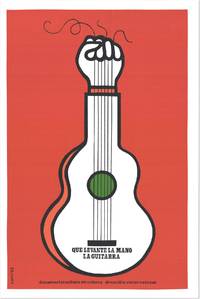
1983réf. 83069Havana: S.i. 1983. Original illustrated poster with text and pictorial elements silkscreened in four colors on white stock measuring 51cm x 76.25cm 20 1/8" x 30". Mild handling to extremities ele a bright Fine copy unbacked. Striking poster designed by Concepción Robinson Mendoza aka. "Coni" for Victor Cassaus's 1983 documentary Que Levante la Mano la Guitarra centered around Cuban musician and folk singer Silvio Rodríguez Domínguez. 83069. S.i. unknown
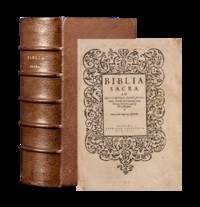
1554réf. 6212Lyon: Jean de Tournes 1554. First edition. Octavo 6 3/4 x 4 3/4 inches; 171 x 121 mm. . 16 1152 76 pp bound without the last two blank leaves as in most copiese.g. Mortimer OCLC. The penultimate leaf had only a fleuron at the foot of the page and the final leaf was blank. Arabesque title border and 198 with 1 repeat woodcuts in the text by Bernard Salomon. Title-page with faint early ink "ex-Libris petri ------ at top blank margin. Title-page expertly cleaned some occasional mainly marginal faint foxing otherwise a superb example of this wonderfully illustrated mid sixteenth-century Latin Bible. Bound ca. 1880 by Chambolle-Duru in full brown crushed levant morocco spine with five raised bands lettered in gilt gilt ruled board edges decorative gilt turn-ins marbled endpapers all edge gilt. Armorial bookplate "In Memori: Weiler Bibliotheca Trautner Falkiana" on verso of front free endpaper. First De Tournes Latin Bible based on Robert Estienne's text and beautifully illustrated with 198 woodcuts by Bernard Salomon. "Considerable work could be done on Salomon's sources for these cuts. The Expulsion from Paradise suggests Holbein's version; the New Testament shows some dependence on the set owned by Sébastien Gryphius. the Apocalypse blocks are enlarged copies of the fine Janot Apocalypse. But the cumulative effect of Salomon's carefully detailed scenes is that of an individual contribution to Bible illustration. Particularly interesting from the point of view of technique are the night scenes in Exodus and the storm over Noah's ark. In this 1554 Bible the New Testament blocks are printed with arabesque strip borders at the sides. Arabesque and type ornament headpieces." Mortimer Contents include: Old Testament; Psalms; New Testament Epistles Acts; Index Testimoniorum & Index Epistolarum. Robert I Estienne 1503-1559 was a French protestant printer and scholar born into a printmaking family. He would take over his family's Paris firm in 1526 where he printed significant works in Latin Greek Hebrew and other languages. His 1531 Thesaurus linguae latinae is considered a major milestone in lexicography. Despite his many commissions for the King religious tensions forced Estienne to flee to Geneva. This bible was illustrated by Bernard Salomon c.1508-1561 a French artist who is known for engravings and illustrations. Although little is known about his life his art reveals stylistic influences from Mannerism and the School of Fontainebleau executed in a detailed and small scale. Salomon is known to have collaborated with the printer Jean de Tournes and produced decoration for emblem books bibles and classic texts. Many of his engravings also appear as source material for art objects such as a Faience plate at the MET featuring the Sacrifice of Noah. Brunet I 876 & Supplement I 125; Darlow & Moule 6134 note; Mortimer French no. 81. Jean de Tournes unknown
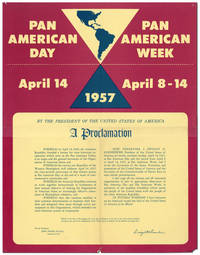
réf. 42513Washington: GPO 1957. Offset-printed broadside in three colors 21-1/2" x 17"; printed recto-only. Old folds probably as issued; a few small nicks to extremities; Very Good or better. Announces the establishment of Pan American Week April 8-14; and Pan American Day April 14 and reprints the full text of Eisenhower's proclamation. Pan-American Day is still celebrated in some Latin American countries though news of its establishment never seems to have made a lasting impression on the U.S. populace. Though clearly intended for display this broadside is apparently scarce with no example recorded in commerce and none catalogued in OCLC as of October 2018. unknown
réf. 27909N.p.: S.i. 2009. Original silkscreened poster text printed in black on thin powder gray stock made with coca leaf pulp measuring 49.75cm x 70cm 19.5" x 27.5". Old folds smoothed out small unobtrusve tear at center with faint smudge at upper left corner; very Near Fine / A-. Collaborative work created by Colombian artist Wilson Díaz and San Francisco native Amy Franceschini. In 2009 Franceschini an artist and educator in her own right received an Art Matters grant for support in traveling to Cali Colombia to work with Díaz on a new body of work titled Movement of the Liberation of the Coca Plant MLCP. The two have been involved in creating a number of conceptual works which communicate the various political social and economic powers at play around the conservation and perpetuity of the coca plant from which cocaine is derived. Díaz has been known for incorporating pigment extracted from coca seeds into his works as well creating works on paper made with coca leaf pulp highlighting some of the plants traditional non-illicit uses. S.i. unknown
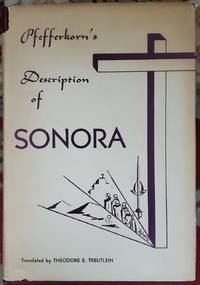
1949réf. xxx009Albuquerque: Univ of New Mexico 1949. First Thus. Hardcover. Very Good/Good. 1st printing of UNM Press reprint. Royal 8vo gilt-stamped cloth. 329pp. Illustrated with photos. Appendices. Index. Folding map in front of Appendix A "To accompany." Quoting JSTOR From the pen of an eighteenth-century German Jesuit has come thisDescription of Sonora¹ a geographical historical and ethnographical description of Sonora Mexico. Father Ignaz Pfefferkorn the author was missionary to the land which he has so painstakingly described. He came to Sonora as a young man and spent eleven very active years among the Pima Opata and Eudebe Indians before the expulsion of the Society forced his departure. Subsequent to the expulsion Pfefferkorn with a number of his companions was held captive in Spain under suspicion of treason. Eight years of enforced sojourn in Spain were finally terminated Upper fore corner of front board bumped else fine copy in good dj graded such because of large chip at head of backstrip. Rather scarce in this edition. "A Southwestern Classic" JSTOR. Univ of New Mexico hardcover
réf. 63499Romae Rome: Ex Typographia Medicea 1619. Folio 33.5x21 cm. pp. 4 9-462 2 with at recto the printer's letter repeated with the date of the 1591 original edition blank at verso. Contemporary green vellum spine with raised bands and gilt-decorated compartments red Morocco label marbled endpapers edges dyed red. Title printed in red and black with Medici's woodcut coat-of-arms printer's advice "Typographus lectori". With 149 text woodcuts by Leonardo Parassole c.1570-c.1630 after Antonio Tempesta 1555-1630 their monograms appearing on a number of the illustrations. The woodcuts are remarkable examples of Tempesta's work notable for their clarity of composition and their didactic narrative of the episodes depicted. Ex libris Luigi Bossi Milan 1758-1835 with his engraved heraldic bookplate to front pastedown along with T. Fenteman & Sons Leeds booksellers label to upper corner. Title-page lightly browned boards faded and discoloured some occasional light toning generally a very good copy printed on thick paper the woodcuts in strong impressions throughout. Rare 1619 reissue or of the original 1591 stock of the Arabic Medicean Gospels. The text lines are almost identical with those of the Arabic issue but now have an interlinear Latin version added which was prepared by Antonius Sionita. In 1584 the last year of the papacy of Gregory XIII who had constantly endeavoured to effect a union between the Church of Rome and the eastern Christians Cardinal Ferdinando de' Medici the brother and later the successor of the Grand Duke of Tuscany founded a printing press in Rome with a vast selection of oriental types cut by the French typographer Robert Granjon. Run by a versatile orientalist Giovan Battista Raimondi the press had various aims. One was to produce propaganda which would attract the eastern Christians to Roman Catholicism. Another was to corner the publishing market in an area where typography was prohibited and to make a financial profit from the sale in the east of books printed in Arabic. The third aim was to further European knowledge and to provide good editions of Arabic versions of certain standard non-religious texts. These included the writings of Avicenna al-Idrisi's geographical compendium al-Tusi's adaptation of Euclid's text on geometry and various works on Arabic grammar and syntax. The first major publication was the 1591 edition of the Gospels. This copy has an interlinear Latin translation but the work was also issued solely in Arabic. It contains 149 fine woodcut illustrations made by Leonardo Parasole mainly after designs by one of the best known Florentine artists of his day Antonio Tempesta who owed much of his fame to the frescoes he painted in the Vatican and in a number of Roman palaces. The woodcut in the Gospel of St Mark of the presentation of the head of John the Baptist to Salome Mark 6:28 by a man in Turkish dress reminds us of the common association between the great enemy of Christendom in the sixteenth century and the ancient heathens. The Arabic text is printed in Robert Granjon's famous large fount generally considered the first satisfactory Arabic printing type; as all early printed editions of the Arabic Gospels it is based on the Alexandrian Vulgate cf. Darlow/M. 1636. The Latin version is by Leonardo Sionita. The work begins with page 9 without a title-page or any preliminary matter at all: "the intended prefatory matter was apparently never published" Darlow/M. Darlow & Moule 1637 & 1643; Schnurrer Bibliotheca arabica 318; Brunet II 1122-23; Graesse II 531 Romae [Rome]: Ex Typographia Medicea, 1619. hardcover
réf. 59948Lugdunum Lyon: Jean Mareschal 1532. Large folio 43.5 x 23 cm. ff.827624. Full eighteenth-century bluish green French morocco sides ruled with gilt foliate border spine with raised bands and lavishly gilt in compartments each with central fleuron device red morocco label lettered in gilt the edges of boards decorated with gilt roll marbled endpapers all edges gilt. Title-page printed in red and black along with the tables of canons. Latin text printed in double and triple column within printed border. Title-page with elaborate woodcut borders and vignette of St. Jerome in his study full-page woodcut illustration of God creating the earth at the head of the Old Testament captioned 'Opus sex dierum' three-quarter woodcut depicting the Nativity scene at the head of the New Testament half-page woodcut of King Solomon at the head of proverbs 112 woodcut vignettes and numerous additional woodcut initials in the text. Engraved bookplate of "L'Olivette" with "G.O." monogram to front pastedown the bookplate engraved by Silvain Guillot a Parisian armorial engraver to front pastedown along with a small library shelf mark. Title-page bears the old ownership inscription of the Jesuit College in Antwerp; in the same hand are an additional 5 instances of marginal annotations on ff. 2r 57v 141v 156v and 175v. Minor shelfwear internally generally very good but with some light occasional damp-staining four small marginal holes on E7 not affecting the text and some repairs to edges of the last few leaves overall a well-illustrated edition of the Vulgate in a superb French binding. Mareschal's Bible was the first to include the Third Book of Maccabees an addition which resulted in his later condemnation by the Council of Trent which declared the book to be apocryphal forcing him to flee to Switzerland and subsequently to take up permanent residence in Heidelberg. The woodcut of the Nativity scene is a close copy of Hans Springinklee's woodcut which first appeared in a 1517 prayer book before being used for the 1520 Lyon edition of the Bible Mortimer Harvard French 63 as well as Luther's 1524 German Translation of the Old Testament with a different artist's monogram. The smaller woodcuts are more simplistic copies of those found in other Lyon bibles from this time produced by Mareschal Crespin and Sacon such as Mortimer Harvard French 66 Crespin's 1529 Bible. USTC locates 15 copies all in Europe save for 2 copies in the UK. Adams 1012. Lugdunum [Lyon]: Jean Mareschal, 1532. hardcover
réf. B9781479723942Hardback. New. hardcover
réf. 73070Stockholm P. A. Norstedt & Söner 1921-41. 8:o. Sammanbundna i blåa kbd med något nötta kanter. Två volymer. Från Oscar Östergrens bibliotek med stämplar på främre omslagens insidor. I årsboken för 1929-30 återfinns en historik över Södra latin 1879-1929 unknown
1981réf. BN729841Paris : Les Belles Lettres 1981. 1981. Traite de Physiognomonie. In Französisch und Latein Traite de Physiognomonie. In Französisch und Latein André Jacques und Anonyme Latin Paris : Les Belles Lettres unknown