26 235 résultats
1754Les 10 "livres" du "bréviaire" de l'historien latin EUTROPE (IVè siècle après Jésus-Christ), abrégé d'histoire romaine, de la fondation de Rome à 364 après Jésus-Christ, suivis de variantes, remarques et index: édition de de LINES, ornée d'un frontispice d'EISEN gravé par de LA FOSSE, de 16 vignettes en bandeaux et culs-de-lampe gravées par de LA FOSSE, de lettrines et d'ornements. (D'après QUERARD, "les vignettes ne sont pas les mêmes dans tous les exemplaires"). Un des fameux classiques latins publiés par Joseph Gérard Barbou (successeur de Joseph Barbou) dans l'esprit de la collection des Elzevier, édition citée par BRUNET (supplément) parmi "celles qu'il est préférable de choisir". Latin
1880réf. R320083046DESCLEE, DE BROUWER ET CIE. 1880. In-8. Relié demi-cuir. Bon état, Couv. convenable, Dos satisfaisant, Intérieur frais. XVII + 951 pages + Paginé de 954 à 1719 - Quelques lettrines et frises en noir et blanc + 1 CARTE DEPLIANTE EN COULEUR en debut du Tome 1er - Dos insolés - Plats et contre-plats jaspés - Etiquette collée en coiffe en pied - Auteur, titre, filets et tomaison dorés au dos - 3 PHOTOS DISPONIBLES.. . . . Classification Dewey : 470-Langues italiques. Latin
réf. 14355Liège, Dessain, 1911.
1826réf. RO40245946Fredericus Fleischer, Lipsiae. 1826. In-8. Broché. Etat d'usage, Tâchée, Dos abîmé, Intérieur acceptable. 872 pages. Etiquette de code sur la couverture. Quelques tampons de bibliothèque.. . . . Classification Dewey : 470-Langues italiques. Latin
1830réf. RO40245947Fredericus Fleischer, Lipsiae. 1830. In-8. Relié cuir dos-coins. Etat d'usage, 2ème plat abîmé, Dos à nerfs, Rousseurs. 805 pages. Pièce de titre rouge sur le dos. Titre et filets dorés sur le dos. Tranche rouge. Etiquette de code sur la couverture. Quelques tampons de bibliothèque. Plats frottés.. . . . Classification Dewey : 470-Langues italiques. Latin
1869réf. R320076846EXCUDEBAT H. GOEMAERE. 1869. In-8. Relié demi-cuir. Bon état, Couv. convenable, Mors fendus, Intérieur frais. 304 pages - Plats jaspés - Auteur, titre, filets et fleurons dorés au dos - Dos en cuir marron foncé. Epidermures.. . . . Classification Dewey : 470-Langues italiques. Latin
réf. R320081134EXCUDEBAT H. GOEMAERE. XIXe SIECLE. In-8. Relié demi-cuir. Etat d'usage, Couv. convenable, Dos satisfaisant, Intérieur frais. 519 + 498 pages - Plats jaspés - Coins émoussés - Auteur, titre, tomaison, fleurons et filets dorés aux dos + 1 CARTE depliante en couleur.. . . . Classification Dewey : 470-Langues italiques. Latin
réf. 66827Romae Rome: In Typographia Medicea 1591. FIRST EDITION. Folio 33 x 21.5 cm. pp.9-4621 colophon as issued without title and preliminaries. Contemporary limp vellum with manuscript title on spine. With 149 text woodcuts by Leonardo Parassole c.1570-c.1630 after Antonio Tempesta 1555-1630 their monograms appearing on a number of the illustrations. The woodcuts are remarkable examples of Tempesta's work notable for their clarity of composition and their didactic narrative of the episodes depicted. Some occasional toning as usual and occasional light scattered foxing remnants of old paper label to spine vellum with some light soiling and rubbing to edges generally a very good copy in a handsome contemporary binding. First edition of the Gospels in Arabic and Latin - a landmark cultural encounter - and the editio princeps of the Arabic translation of the New Testament widely accepted as being the first successful printing of any Arabic text using moveable type and the first book ever published by the Medici Press in Rome. In 1584 the last year of the papacy of Gregory XIII who had constantly endeavoured to effect a union between the Church of Rome and the eastern Christians Cardinal Ferdinando de' Medici the brother and later the successor of the Grand Duke of Tuscany founded a printing press in Rome with a vast selection of oriental types cut by the French typographer Robert Granjon. Run by a versatile orientalist Giovan Battista Raimondi the press had various aims. One was to produce propaganda which would attract the eastern Christians to Roman Catholicism. Another was to corner the publishing market in an area where typography was prohibited and to make a financial profit from the sale in the east of books printed in Arabic. The third aim was to further European knowledge and to provide good editions of Arabic versions of certain standard non-religious texts. These included the writings of Avicenna al-Idrisi's geographical compendium al-Tusi's adaptation of Euclid's text on geometry and various works on Arabic grammar and syntax. The first major publication was the 1591 edition of the Gospels. This copy has an interlinear Latin translation but the work was also issued solely in Arabic. It contains 149 fine woodcut illustrations made by Leonardo Parasole mainly after designs by one of the best known Florentine artists of his day Antonio Tempesta who owed much of his fame to the frescoes he painted in the Vatican and in a number of Roman palaces. The woodcut in the Gospel of St Mark of the presentation of the head of John the Baptist to Salome Mark 6:28 by a man in Turkish dress reminds us of the common association between the great enemy of Christendom in the sixteenth century and the ancient heathens. The Arabic text is printed in Robert Granjon's famous large fount generally considered the first satisfactory Arabic printing type; as all early printed editions of the Arabic Gospels it is based on the Alexandrian Vulgate cf. Darlow/M. 1636. The Latin version is by Leonardo Sionita. The work begins with page 9 without a title-page or any preliminary matter at all: "the intended prefatory matter was apparently never published" Darlow/M.; these first eight pages were not supplied until the 1619 re-issue. Brunet 1122-1123 Romae [Rome]: In Typographia Medicea, 1591. hardcover
Fredericus Fleischer, Lipsiae. 1830. In-8 Carré. Relié cuir dos-coins. Etat d'usage. 2ème plat abîmé. Dos à nerfs. Rousseurs. 805 pages. Pièce de titre rouge sur le dos. Titre et filets dorés sur le dos. Tranche rouge. Etiquette de code sur la couverture. Quelques tampons de bibliothèque. Plats frottés. 'Quatuor N.T. Evangelia', Tomus II, Evangelium Marci. Recensuit et cum Commentariis Perpetuis Edidit Carol. Fred. Augustus Fritzsche.
Fredericus Fleischer, Lipsiae. 1826. In-8 Carré. Broché. Etat d'usage. Tâchée. Dos abîmé. Intérieur acceptable. 872 pages. Etiquette de code sur la couverture. Quelques tampons de bibliothèque. 'Quatuor N.T. Evangelia', Tomus I, Evangelium Matthaei. Recensuit et cum Commentariis Perpetuis Edidit Carol. Fred. Augustus Fritzsche.
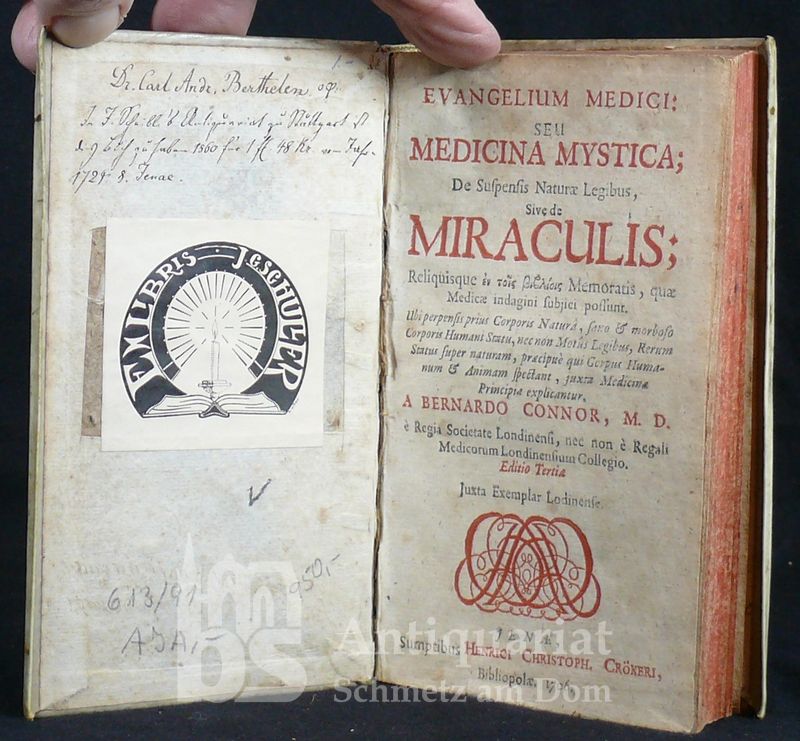
1706réf. 40159ABJena, Heinrich Christoph Cröker 1706. Kl.-8°. [8] Bll., 193, [1] S., [5] Bll. Pgmt der Zt mit geprägtem Rückentitel. Teils etwas gebräunt, Einband leicht altersfleckig. Exlibris, Eintragungenen von alter Hd an den Spiegeln.
DESCLEE, DE BROUWER ET CIE. 1880. In-8 Carré. Relié demi-cuir. Bon état. Couv. convenable. Dos satisfaisant. Intérieur frais. XVII + 951 pages + Paginé de 954 à 1719 - Quelques lettrines et frises en noir et blanc + 1 CARTE DEPLIANTE EN COULEUR en debut du Tome 1er - Dos insolés - Plats et contre-plats jaspés - Etiquette collée en coiffe en pied - Auteur, titre, filets et tomaison dorés au dos - 3 PHOTOS DISPONIBLES. OUVRAGES EN LATIN.
1944réf. K40087Paris, Les Belles Lettres 1944 231pp., dans la série "Collection d'études latines. Série pédagogique" vol.V, br.orig., non coupé, bel état
1971réf. AUB-3801Berne, éd. Francke 1971 (10e éd.) Bel exemplaire relié, reliure pleine toile ornée d'éd., in-8, 294 pages avec index.
1944231pp., dans la série "Collection d'études latines. Série pédagogique" vol.V, br.orig., non coupé, bel état
réf. 196329Montbrison, Imprimerie Eleuthère Brassart, 1912 in-8, [4]-55 pp., broché. Rousseurs.
réf. 86325Hannover, Hahn, 1997.
1735réf. est218t4Dimension extérieure 35,9 x 50,5 cm, cuvette 27 x 43. Magnifique eau-forte de Venise, réalisée par Antonio Visentini, d’après Canaletto (1697-1768). Gravure en excellent état, déchirures comblées. Planche 12. Dimensioni esterne 35,9 x 50,5 cm, ciotola 27 x 43. Bella acquaforte di Venezia di Antonio Visentini, da Canaletto (1697-1768). Incisione in ottime condizioni, lacrime riempite. External dimension 35,9 x 50,5 cm, bowl 27 x 43. Beautiful etching of Venice by Antonio Visentini, after Canaletto (1697-1768). Engraving in excellent condition, tears filled.
réf. 73558Paris, Brunot-Labbe, 1826 - 1827.
1802réf. 216511802 Paris, de l'Imprimerie de Didot l'Ainé, An X-1802. In-8 , demi veau brun, dos lisse orné de filets et fleurons dorés, (Reliure de l'époque).
1733réf. 93321733 1 volume comprenant 2 tomes reliés ensemble (one volume composed 2 books linked together), reliure plein veau (binding full calfskin) in-octavo, dos 5 nerfs (spine with raised bands) - entre-nerfs à fleuron (floweret) au centre avec des petits fers isolés en remplissage et des feuillages exécutés aux filets courbes aux angles dans un encadrement à filet simple - pièce de titre (piece of title) avec filet or sur fond bordeaux (piece of title), plats épidermés (light scratches), roulettes (fillets) sur les coupes (manque de dorure - lack of gilt), cahiers légèrement déboîtés (leafs lightly dislodged), sans illustration (no illustration), 439 pages avec Approbation & Privilège, 1733 à Nannetis (Nantes) Apud Guillelemum Cors Bibliopolam,
1765réf. R69896Gandavi [Gand], typis Petri de Goesin 1765 [8] + 439pp., 18cm., text in latin, modern blind wrappers, few foxing, Good copy, R69896
1847réf. RO40141555Apud Vid. Poelman, Gandavi - Apud Alph. Greuse, Bruxellis. 1847. In-12. Broché. Etat d'usage, Plats abîmés, Dos abîmé, Non coupé. 640 pages. Papier annoté (titre) et étiquettes de code collés sur le dos. Tampons de bibliothèque et annotations d'époque en page de titre. Manques sur les bords des plats.. . . . Classification Dewey : 470-Langues italiques. Latin
1721réf. R98679Antverpiae [Antwerpen], typis Joannis Pauli Robyns 1721 [20] + 373 + [27] pp., 2nd edition ("In hac secunda editione amplificatum: cum praxi compendiosa utiliter assistendi infirmis & moribundis"), text in Latin, Schoonaerts dedicated this work to Petrus Josephus De Francken-Sierstorff (bishop of Antwerp 1706-1727), with engraved coat of arms "Intrepide et sapienter" (bishop De Francken-Sierstorff) by Hendrik Frans Diamaer (Flemish engraver), contemporary full-leather binding (intact, gilt title and decorations at spine but partly faded, some use at edges and some stains), two small stamps at verso of title page, text clean with only few stains at t.p., good condition, R98679