26 919 résultats
réf. 14093
réf. 159886Oxford, OUP, 2009.
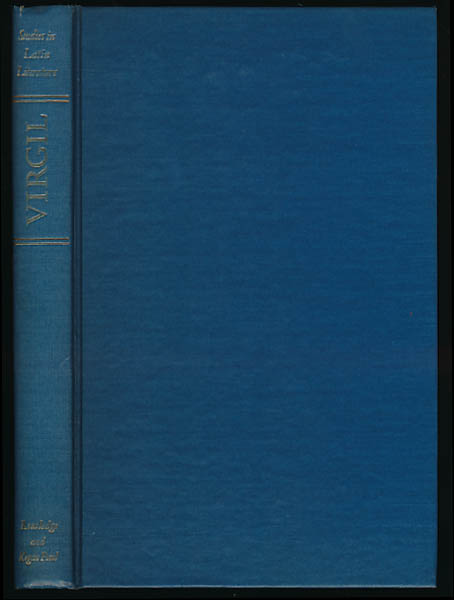
1969réf. 51396CBLondon, Routledge & K. Paul, 1969. Groß-8°. 23 cm. XI, 219 Seiten. Original-Leinenband mit goldgeprägtem Rückentitel. (Studies in Latin literature and its influence).
réf. 100506Zürich, Stuttgart, Artemis Verlag, 1967.
réf. 157056Oxford, OUP, 1979.
réf. 78846New York, St. Martin's Press, 1999.
réf. 73814N.Y., Modern Libr., 1934.
1970Minor Shelfwear to book. Scholar's bookplate to inner cover (G. P. Goold). Foxing/dustsoiling to textblock. DJ spine browned. Minor chipping. Large tear to front panel (repaired with tape). ; Study of the Aeneid which first comes to grips with the text and then draws conclusions about Virgil's art. The first work to deal with the verbal construction of the Aeneid, its line-by-line analysis of four books of the epic reveals patterns of symbolic images which brilliantly express the poet's ideas. ; 398 pages
1946Foxing to textblock and endpapers. Former owner's initials on ffep. DJ has some tears, browning, chipping. Tape applied to 1 small area of DJ. DJ is price-clipped. ; Reprint of 1947 Edition. Looks at the Symbolism & the mental associations of the epic poem which reveal the ways Virgil's mind worked; 182 pages
1907Foxing to prelims and textblock. Scholar's bookplate to inner cover (G. P. Goold). Spine a bit browned. Minor pencil marginalia to a few pages. ; 146 pages
1980Foxing to textblock. Former owner's name to ffep in pen (G. P. Goold). DJ has very minor chipping. Dustjacket spine is sunned. DJ has foxing to obverse of DJ. ; 311 pages
1998Very faint bump to base of spine else very light shelfwear. ; Xxxii, 467 pp. This book studies Virgil's ideas of nature, history, sense of nation, and sense of identity, combined with the study of attitudes towards nature throughout antiquity. Blending literature with history, and in the case of Lucretius, philosophy, it offers a vision and an interpretation of the culture of the 1st century B. C. As a whole. It argues that Lucretius and Virgil affected a revolution in Western sensibility; claiming that a book about poetry should be a book about life, it combines scholarship and precision with a sense of the importance of literature and its capacity to enhance our understanding of our past and of ourselves. ; 728 pages
1993Foxing/dustsoiling to top of textblock. Minor shelfwear to book and DJ. ; 1 x 9.5 x 6.75 Inches; 396 pages; Heinze's study, originally published in German in 1903, remains a classic of Virgil scholarship. His pioneering work remains a basic text for students and scholars today, providing a study of the techniques by which Virgil composed his epic on Aeneas. This translation makes the book available in English for the first time. Translation by Hazel and David Harvey and Fred Robertson.
1993Book is fine. DJ has very light shelfwear. ; 1 x 9.5 x 6.75 Inches; 396 pages; Heinze's study, originally published in German in 1903, remains a classic of Virgil scholarship. His pioneering work remains a basic text for students and scholars today, providing a study of the techniques by which Virgil composed his epic on Aeneas. This translation makes the book available in English for the first time. Translation by Hazel and David Harvey and Fred Robertson.
1987Foxing/dustsoiling to top of textblock. DJ has 1 small tear and a bit of rubbing. ; A critical analysis of the poem. ; 9.0 X 6.0 X 1.0 inches; 268 pages
1987DJ has a bit of rubbing and very minor chipping. ; A critical analysis of the poem. ; 9.0 X 6.0 X 1.0 inches; 268 pages
1923Endpapers browned. Minor shelfwear. ; Argues that the minor Virgilian corpus might possibly constitute a Biographia Litteraria. ; 192 pages
1923DJ spine is browned and DJ darkened. Dustjacket has edgewear with light chipping to extremities-slight fraying to top of spine. Light foxing to prelims. ; Argues that the minor Virgilian corpus might possibly constitute a Biographia Litteraria. ; 192 pages
1923Light browning to ffeps. Author's gift inscription on ffep: "To Donald Robson -with my best compliments. N. W. D." ; Argues that the minor Virgilian corpus might possibly constitute a Biographia Litteraria. ; 192 pages; Signed by Author
1989Minor shelfwear to book. DJ has some edgewear with chipping and small tears to spine ends and corners. Sticker damage to bottom corner of front wrap. R. E. Fantham's notes in pen and pencil to rear DJ flap. ; An examination of the main characters in the Aeneid - Aeneas himself, Dido and Turnus - in the light of Virgil's contemporary Augustan political and literary ideology. The characters and the plot and incident of the epic are seen as embodying and exemplifying first the ancient ideals of kingship and concord, and second the Roman self-identification as at once 'Italian' and 'Trojan', and finally as reflecting the literary self-evaluation of the Augustan age. In the literary area, Virgil's relations with contemporary Roman elegy, with early Greek lyric and, most important, with Homer, are studied and reevaluated. Virgilian scholars and students of Augustan literature in general will find this book of interest to them. ; 296 pages
1989Very Minor shelfwear to book and DJ. DJ has faint soiling to rear panel. ; An examination of the main characters in the Aeneid - Aeneas himself, Dido and Turnus - in the light of Virgil's contemporary Augustan political and literary ideology. The characters and the plot and incident of the epic are seen as embodying and exemplifying first the ancient ideals of kingship and concord, and second the Roman self-identification as at once 'Italian' and 'Trojan', and finally as reflecting the literary self-evaluation of the Augustan age. In the literary area, Virgil's relations with contemporary Roman elegy, with early Greek lyric and, most important, with Homer, are studied and reevaluated. Virgilian scholars and students of Augustan literature in general will find this book of interest to them. ; 296 pages
1989Foxing/dustsoiling to top of textblock. DJ has minor edgewear. ; An examination of the main characters in the Aeneid - Aeneas himself, Dido and Turnus - in the light of Virgil's contemporary Augustan political and literary ideology. The characters and the plot and incident of the epic are seen as embodying and exemplifying first the ancient ideals of kingship and concord, and second the Roman self-identification as at once 'Italian' and 'Trojan', and finally as reflecting the literary self-evaluation of the Augustan age. In the literary area, Virgil's relations with contemporary Roman elegy, with early Greek lyric and, most important, with Homer, are studied and reevaluated. Virgilian scholars and students of Augustan literature in general will find this book of interest to them. ; 296 pages