Robinson, Professor of English Charles EBiblio.com

44 081 résultats
réf. 1120857120.Ghardcover. Good. Access codes and supplements are not guaranteed with used items. May be an ex-library book. hardcover
réf. 1120055245.Gpaperback. Good. Access codes and supplements are not guaranteed with used items. May be an ex-library book. paperback
1980réf. KOS00500158Kanazawa 21st Century Art Museum 1980. Soft Cover. Fine. KOS00500158 Kanazawa 21st Century Art Museum paperback
réf. 2684011 Queen's Road West Chelsea. 12mo 1 p. Fair on aged paper folded twice. "I'm awfully busy this week but I'll try to come on Friday. You don't say the hour - is it 7. I'll understand it so that you need not trouble to write again if that will do." 11 Queen's Road West, Chelsea unknown
réf. 26844On letterhead of 9 Egerton Place S.W. 12 Feb. 1915. 2pp.8vo black-bordered bifolium good condition. "I am at the present time so tied by public work that I should hesitate to take any fresh engagement but in addition to this Ifeel that the times are unsuitable First World War for anniversary celebrations for which none of us can have much heart at tyhe moment. I beg of you therefore to excuse meand did I not fear to be impertinent I should suggest that it would be more consonant with everyone's feelings at the present time if the Union postponed the celebration of its centenaryuntil the War is over." Note: Barnard had just become President of The Cambridge University Union Society. He obtained a commission to the Rifle Brigade in 1915 and was killed in action in August 1916. On letterhead of 9 Egerton Place, S.W., 12 Feb. 1915.. unknown
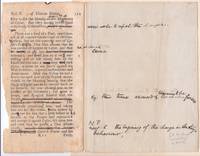
réf. 11593Undated early 1850s. The two leaves were evidently disbound from a copy of an edition of Dryden's Plutarch in which the grey 4to leaf of writing paper following the 12mo printed leaf was one of those that interleaved the volume. In fair conditon on lightly-aged paper. The two leaves are tipped in onto a larger leaf removed from an album. The printed leaf is 12mo from volume 5 of Dryden's translation with the pages numbered 511 and 612 sic. The two sides of the leaf carry a total of approximately 25 emendations and deletions. Both sides of the 4to leaf carry longer interpolations by Clough those on the verso relating to a page not present. In pencil at foot of recto: 'A. H. Clough's corrections of proof' and on verso also in pencil 'MS Arthur Clough'. Clough began work on his revision of Dryden's translation in the early 1850s. Undated [early 1850s?] unknown
réf. 1300272 Addison Road London W14. Christmas 1928. 12pp. in original buff wraps with 'EIGHT POEMS' in red on front cover. In good condition on lightly-aged paper with rusty staples. A nice production With the name 'Robert Lynd' added in manuscript probably by Bax himself in a space provided on the title for such personalisation. Uncommon: the only copies on COPAC at the British Library National Library of Scotland Edinburgh and Cambridge. 72 Addison Road, London, W14. Christmas 1928. paperback
réf. 0867197897.Ghardcover. Good. Access codes and supplements are not guaranteed with used items. May be an ex-library book. hardcover
réf. 1163430269.Ghardcover. Good. Access codes and supplements are not guaranteed with used items. May be an ex-library book. hardcover
réf. 0804725470.Ghardcover. Good. Access codes and supplements are not guaranteed with used items. May be an ex-library book. hardcover
réf. 26366‘30 August 1858 / 7 Upper Hyde Park St. / Hyde Park Squre’. See his entry and those of his father wife and Kenney in the Oxford DNB. 2pp 12mo. On first leaf of a bifolium the blank second leaf of which carries a thin strip of tape from the mount. In good condition lightly aged. Folded twice. Good bold signature ‘C. Kean’. Begins: ‘My dear Kenney / Would you like a Private. Box or stalls next Friday being the opening night of our season - I should like you to give a kind of notice of my past season and of my intended retirement from management next July to which I shall refer in the parting words I purpose delivering according to the custom’. He ends by asking him to let him know what his wishes are respecting this matter and with regards to his wife. ‘30 August 1858 / 7 Upper Hyde Park St. / Hyde Park Squre’. unknown
réf. 26350‘Chertsey March 8th. c. 1865'. The phrase ‘Box and Cox’ has entered the English language. See the OED and the two men’s entries in the Oxford DNB. 2pp landscape 12mo. Neatly inserted in a trimmed windowpane mount. In good condition lightly aged. Folded twice. Signed ‘John M Morton’. Begins: ‘Dear Webster. / As Mr Anson informs me that you are “on the forward course to regenerated health” I hope I need not apologise for writing again. I find a letter of your’s respecting Woodcock’s little game produced in 1864 & two one act farces you offer me £15 per Act with the privilege of repurchasing the pieces at the same price in the event of your not having produced them’. He asks if he will do the same ‘in the case of the 4 Acts’ he has recently sent him. ‘If not let me beg of you to return them by post as I really cannot afford the expence of coming to Town!’ He continues: ‘I was served with a Writ yesterday for the first time in my life!!’ and adds ruefully: ‘I’m afraid the veteran farce writer’s “little game” is nearly up!” He concludes with surprising candour: ‘Thank God I could never get any children - not for want of trying I’m ashamed to say.’ ‘Chertsey March 8th. [c. 1865]'.. unknown
réf. 26346‘Theatre Royal / Drury Lane / London / July 20th 1892’. 1p 12mo. On thin paper. In good condition lightly aged in trimmed and spotted windowpane mount. Good bold signature ‘Fanny Brough.’ Addressed to ‘Revd. J. C. Westly’. She has ‘much pleasure’ in sending him ‘the autograph’ and will do her best to get him ‘a few others which may be interesting to send out to you’. ‘Theatre Royal / Drury Lane / London / July 20th 1892’. unknown
réf. 39481Philadelphia: Printed by C. Sherman 5605. 8vo 5 volumes. 8 7/8 x 5 1/2 inches. Hebrew and English text on facing pages. Each volume inscribed at the head of the English-language title "To my beloved wife from her affectionate husband" the first volume with a later family annotation. Contemporary purple morocco spine in six compartments with raised bands lettered in gilt in the second and fourth repeating gilt decoration in others marbled edges marbled endpapers. Provenance: Solomon Nunes Carvalho each cover stamped in gilt Rare large-paper association copy of the first Jewish translation of the Pentateuch into English. More than any other person of his time Isaac Leeser 1806-1868 envisioned the development of a major center of Jewish culture and religious activity in the United States. He single-handedly provided American Jews with many of the basic religious texts institutions and conceptual tools they needed to construct the cultural foundation of what would later emerge as the largest Jewish community in the history of the Jewish people. Printed in 1845 this edition of the Pentateuch in five volumes included a vocalized Hebrew text of each of the Five Books of Moses together with an English translation and notes as well as the haftarot prophetic readings. Leeser actually began working on The Law of God in 1838. Among the factors involved in his decision to begin systematically working on a translation was the recent opening of Rebecca Gratz's Sunday School which met for the first time in March 1838 in Philadelphia and was desperately in need of appropriate study material. Students were compelled to use the King James Bible for want of a Jewish alternative. Religiously objectionable passages in other texts provided by Protestant organizations were either pasted over or torn out by Gratz's staff. Leeser who supported the Sunday School and was its chief academic resource person felt compelled to find more suitable texts for the students. The impetus for Leeser throughout was always his desire to provide the Jews of America with an English text of the Bible that was produced by one of their own and was not tainted by conversionist motivations. This copy with provenance to Solomon Nunes Carvalho who was a noted American painter photographer writer and inventor best known for traveling with John C. Fremont on his fifth expedition through Kansas Colorado and Utah. He published an account of that journey titled "Incidents of Travel and Adventure in the Far West; with Colonel Fremont's Last Expedition" 1860 and was considered a pioneer in travel photography. Isaac Leeser the hazzan of Congregation K.K. Mikveh Israel married Carvalho and his wife Sarah Miriam Solis on October 15 1845 in Philadelphia where Carvalho's father had a workshop. Rosenbach 569; Singerman 884; Goldman 7; Lance J. Sussman "Another Look at Isaac Leeser and the First Jewish Translation of the Bible in the United States" Modern Judaism Vol. 5 No. 2 Gershom Scholem Memorial Issue. May 1985 pp. 159-190. Printed by C. Sherman unknown
réf. 2461910 December 1918; on letterhead of Flat 64 3 Whitehall Court SW1 London. 1p 12mo. In fair condition lightly aged and creased with one dog-eared corner. He writes that he has ‘had the engraving photographed’ and can ‘return it together with the casting’ with ‘very many thanks to you for being so kind as to lend it to me’. 10 December 1918; on letterhead of Flat 64, 3 Whitehall Court, SW1 [London]. unknown
réf. 24602No date. ‘No. 4.’ The Religious Tract Society instituted 1799 56 Paternoster Row; and 65 St. Paul’s Churchyard. Printed by William Clowes and Sons Duke street Lambeth. Four copies on JISC only one in a deposit library NLS; now scarce. 12pp 12mo. Disbound. Worn and discoloured. After the end of the prose work are two poems pp.11-12: ‘Hymn. / Frail Life and Succeeding Eternity’ and ‘The Danger of Delay.’ In addition to being the ‘Godfather of English Hymnody’ Watts was a noted logician producing a successful work on the subject and despite the repetition of the phrase ‘Time shall end!’ throughout the present extract treats the subject of ‘The End of Time’ in an unusually thoughtful way for a work of theology. For example: ‘Am I walking in a garden and do I stand to observe the slow motion of the shadow upon a dial there It passes over the hour lines with an imperceptible progress yet it will touch the last line of daylight shortly’. No date. ‘No. 4.’ The Religious Tract Society, instituted 1799, 56, Paternoster Row; and 65, St. Paul’s Churchyard. Printe unknown
réf. 2460313 January 1888. Acocks Green Birmingham. An interesting letter casting light on the Victorian provincial press. Scott’s entry in the Oxford DNB states that while he was living in Birmingham ‘H. J. Palmer offered him a staff appointment on the Birmingham Gazette; but he had to leave when he stipulated that as a Liberal he should write nothing in support of the Conservative cause. He was working again as a freelance when in 1887 he was invited by W. T. Stead to join him on the Pall Mall Gazette. He worked for six years on that paper under Stead and then Edward T. Cook.’ 4pp 12mo. On bifolium. In fair condition lightly aged. Folded once for postage. The final page is smudged including the signature which clearly reads ‘J. W. Robertson-Scott’ with a hyphen. Begins: ‘My dear Walters. / I heard a few days ago in a prominent B’ham politician’s family that the Gazette was going into Radical hands! - of course the Rad. Unions was mentioned. Are you able to put two and one together yet to the manufacturing of an aquaferous this word is original & patented theory as to Birmingha. Daily. Gazette. future If you haven’t I have but a poor opinion of you.’ He continues with reference to ‘H. J. P.’ i.e. H. J. Palmer see above The Times plagiarism Macaulay Charles Blount Milton’s Areopagitica and the Biographia Britannica’. Postscript begins: ‘The whole matter is pretty well settled if one knew whether H. J. P. was sacked or not.’ 13 January 1888. Acocks Green, Birmingham. unknown
réf. 24606No date 1940s. Stamped ‘FOR & ON BEHALF OF / THE NEW ENGLISH WEEKLY. / 15 REGENT’S PARK TERRACE / GULiver 3875’. On one side of a 12mo a piece of grey-green paper; creased worn and torn at the bottom. A fifteen-line poem in five three-line stanzas titled ‘REST’. At end: ‘JOHN GAWSWORTH’. Proof directions in pencil to convert a full-stop at the end of the fourth stanza to a comma. While the poet's attempt at direct simplicity verges on triteness one should recall that he served manfully in the RAF: ‘Beneath the oaks the soldiers lie / Staring at the open sky / Drowsily lazily. / Like England is this plot of green / But in the mountains all unseen / The guns’ complaint affects the scene. / Death is abroad this sunny day. / Life has no time for idle play: / Soon these will go their comrades’ way. / Meanwhile the oaks throw chequered shade / Upon the brows of many a blade / Still eager and still unafraid / And overhead the clouds scud on / Unto their own oblivion / Whence soon these men too will be gone.’ Apparently published in the Briarcliffe Quarterly - Volumes 1-12 - Page 50 1944 but Google don't even give a snippet. No date [1940s]. Stamped ‘FOR & ON BEHALF OF / THE NEW ENGLISH WEEKLY. / 15 REGENT’S PARK TERRACE / GULiver 3875’. unknown
réf. 2457515 June 1933. On letterhead of The Actors’ Orphanage Langley Hall Langley Bucks. See his entry in the Oxford DNB. 1p 4to. Signed ‘With reiterated thanks’ ‘Gerald du Maurier’ with ‘President’ typed beneath. The letterhead is printed in black and green with details of officers and committee members. On aged and creased paper with closed tears and nicks to edges. Folded three times for postage. He asks him to accept his ‘most grateful thanks for your splendid efforts at the Garden Party’. He understands the ‘new show’ which Arlton ‘put in this year’ has proved ‘very popular’. 15 June 1933. On letterhead of The Actors’ Orphanage, Langley Hall, Langley, Bucks. unknown
réf. 24465May 1781. No. "59" in top corner from album of commonplace book. Entitled "Hope - to the Dutchess of Devonshire" an Ode to her daughter adapted from Mason's "Ode 13" or vice versa - see Note below. Four pages 4to aged but clear and complete fold mark right edge uneven and glue remnant from album of commonplace book presumably. Text begins: "What magic warblings to my Ear" and concludes 39 lines later if I've counted correctly itself in quotation marks "Nor will I quit thee at the grave". Another hand suspiciously resembling Georgiana Duchess of Devonshire's roughest hand has added the words "on reading his Ode to Hope" and adds to the end of the poem "This ode is in the hand writing of Georgiana Daughter of the Rt Honorable Stephen Poyntz married to John first Earl Spencer & mother of Georgiana Duchess of Devonshire". Georgiana Spencer became the Duchess of Devonshire upon marriage in 1774 presumably. See Images very readable. I found one reference to the first line of this Ode "Hope-to the Dutchess of Devonshire" via Googlebooks which recognised the first line "What Magic" in the Beinecke Library's Volume of first lines but now Googlebooks is denying that vision! BUT the Second verse of Mason's Ode XIII runs as follows: "What tender warblings to my ear On Zephyr's borne aspire To draw me from my sapphire sphere Charmed by her magic lyre I come; she wakes the willing strings With careless grace her hand she flings The soft symphonious chords among; Nor ever on the listening plain Since the sweet Lesbian tuned her strain." full text no. of stanzas in "The British Poets including Translations" Vol. LXXVI Mason vol.1 Chiswick 1822 pp.61-64. The earliest publication of this Ode pace Googlebooks seems to be 1811. I have yet to find an earlier publication date begging the question whether Mason wrote/published the version in British Poets before or after the tribute to Georgiana in which she is named. But "Ode XIII" could well be a tribute to her without naming. And perhaps Mason circulated a MS of the Poem before publication long before. May 1781. No. "59" in top corner (from album of commonplace book). unknown
réf. 0132162008.Ghardcover. Good. Access codes and supplements are not guaranteed with used items. May be an ex-library book. hardcover
réf. 1108963706New. Never used book
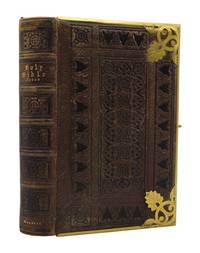
réf. AQ32799London: Samuel Bagster and Sons s.d. c. 1860 Finely bound in publisher's luxurious blind-decorated gilt- titled brown morocco gilt-metal corner bosses to beveled boards gauffered edges marbled endpapers gilt dentelles morocco label to FEP lettered in gilt 'FROM INTERNATIONAL EXHIBITION - 1862'. Lightly rubbed gilt-metal clasp broken away and absent. An exhibition quality Victorian Neo-Gothic binding executed by Bagster and Sons for display at the Great London Exposition of 1862. The International Exhibition of 1862: The Illustrated Catalogue of the Industrial Department p.87 issued to accompany the event states: 'The publishers of London show together in a collective case where may be seen some of the most luxurious volumes produced by the leading houses. The reprint of the first edition of Shakespeare; the Bibles of Bagster and Spottiswoode are also in this collection.' Founded by Samuel Bagster the elder 1772-1851 who was succeeded in the by his sons Samuel Bagster the Younger 1800-1835 and Jonathan Bagster 1813-1872 Bagster and Sons was renowned in the early nineteenth-century for bringing a wealth of rare scholarly Bibles and Liturgical texts to the mass market most notably Polyglot Bibles and reprints of early protestant translations by Tyndall Wycliff and Cranmer. Their efforts in producing affordable yet finely printed versions of Biblical texts allowed the Bagsters to pioneer the avoidance of the monopoly printing of the Authorized version. . 8vo. Samuel Bagster and Sons, [s.d., c. 1860] paperback
réf. 1935716255.Gpaperback. Good. Access codes and supplements are not guaranteed with used items. May be an ex-library book. paperback
1934réf. 0096231934. Hardcover. Very Good. Publisher: McGraw-Hill Book Company Inc. 1934 V. Good HB 324 pp. hardcover