Rosanna Mann,Biblio.com

16 612 résultats
2017réf. DBS-9781632398086Callisto 2017. 1St. Hardcover. New. Callisto hardcover
réf. 9780905895215Good. Exact ISBN match. Immediate shipping. No funny business. unknown
1968réf. DADAX0714623334Routledge 1968-06-01. 1. hardcover. New. 5.50x1.19x8.50. Buy with confidence. Excellent Customer Service & Return policy. Routledge hardcover
réf. ACI5KJZB49-9-1Aspen Publishing. 8. New. The item is brand new never used or read. It's in perfect condition and may include supplements and/or access codes or come shrink-wrapped. Aspen Publishing unknown
réf. 26946824like new. unknown
réf. 26946824-nnew. unknown
2011réf. DADAX3540775269Springer 2011-05-08. 3. v. hardcover. New. 6.14x1.56x9.21. Buy with confidence. Excellent Customer Service & Return policy. Springer hardcover
1939réf. 177730New York: Knopf 1939. First Edition; Sixth Printing. Hardcover. Both volumes Very Good in a Very Good slipcase. Bookplate on front pastedown of both volumes. Rubbing along slipcase opening edges. Knopf hardcover
1999réf. 189779Norwalk Connecticut: Easton Press 1999. First Edition; First Printing. Hardcover. Near Fine Accented in 22kt gold printed on archival paper with gilded edges smyth sewing & concealed muslin joints. Bound In full leather with hubbed spines. ; Collector's Edition.; First Easton Press Edition. Easton Press hardcover
1982réf. 312854New York: Franklin Library / Oxford University Press 1982. First Edition; First Printing. Hardcover. Illustrated by Gonzalo Fonseca. Near Fine Bound in one quarter premium full leather. Accented in 22kt gold. Printed on archival paper with gilded edges. Decorated endsheets and with a silk ribbon page marker. Smyth sewing and concealed muslin joints.; First Franklin Library Edition. Franklin Library / Oxford University Press hardcover
1971réf. Q-0394433041A. A. Knopf 1971-01-01. Hardcover. New. In shrink wrap. Looks like an interesting title! A. A. Knopf hardcover
réf. A9780714651293Hardback. New. This work dramatically revises scholarship on the cultural impact of trans-Atlantic slavery between Africa and Brazil. hardcover
2000réf. x-0313308802Greenwood Pub Group 2000. Hardcover. New. 384 pages. 9.50x6.50x1.25 inches. Greenwood Pub Group hardcover
2011réf. 5366New York: Alfred A. Knopf 2011. First Edition First Printing. Hardcover boards. A First Edition so stated signed in person by historian and journalist Charles C. Mann in ink across the title page. Book is clean and tightly bound without flaws or internal markings. Complete dust jacket price present with some scuffing light signs of shelf wear along the edges and a small closed tear to the front panel by the gutter. Uncommon signed. A fascinating read. In an interview with NPR broadcast in 2011 Mann spoke about the worldwide changes following Columbus’ voyage: "It was a tremendous ecological convulsion — the greatest event in the history of life since the death of the dinosaurs.And this underlies a huge amount of history learned in schools: the Industrial Revolution the Agricultural Revolution the rise of the West — all of these are tied up in what's been called the 'Columbian exchange.” Mann’s previous publication “1491” received the U.S. National Academy of Science’s Keck Award for the best book of the year. Alfred A. Knopf hardcover
réf. 50697276like new. unknown
réf. BN547197Aisthesis. Hardcover. Essays und Publizistik - Band 2: Oktober 1904 - Oktober 1918 Essays und Publizistik - Band 2: Oktober 1904 - Oktober 1918 Heinrich Mann Aisthesis hardcover
2002réf. DADAX0815331657Routledge 2002-12-20. 1. hardcover. New. 6.25x0.75x9.00. Buy with confidence. Excellent Customer Service & Return policy. Routledge hardcover
2012réf. DADAX1409428044Routledge 2012-04-28. 1. hardcover. New. 6.25x0.75x9.25. Buy with confidence. Excellent Customer Service & Return policy. Routledge hardcover
1999réf. 2-0826409709Continuum Intl Pub Group 1999. Hardcover. New. 320 pages. 8.75x6.00x1.50 inches. Continuum Intl Pub Group hardcover
2019réf. x-1501340646Bloomsbury USA Academic 2019. Hardcover. New. 244 pages. 9.00x6.00x0.75 inches. Bloomsbury USA Academic hardcover
réf. DADAX3596294355Fischer Taschenbuch Verlag GmbH 0000-00-00. pocket_book. New. 4.76x0.86x7.48. Buy with confidence. Excellent Customer Service & Return policy. Fischer Taschenbuch Verlag GmbH unknown
réf. Z1-J-019-01389John WileyWie. Used - Good. Ships from UK in 48 hours or less usually same day. Your purchase helps support Sri Lankan Children's Charity 'The Rainbow Centre'. Ex-library so some stamps and wear but in good overall condition. 100% money back guarantee. We are a world class secondhand bookstore based in Hertfordshire United Kingdom and specialize in high quality textbooks across an enormous variety of subjects. We aim to provide a vast range of textbooks rare and collectible books at a great price. Our donations to The Rainbow Centre have helped provide an education and a safe haven to hundreds of children who live in appalling conditions. We provide a 100% money back guarantee and are dedicated to providing our customers with the highest standards of service in the bookselling industry. John Wiley(Wie) unknown
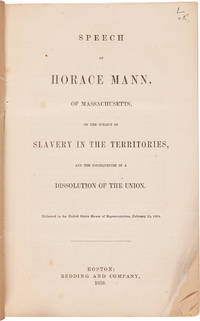
1850réf. 62509Boston: Redding and Company 1850. Opposing the Extension of Slavery in the Territories with Interesting Provenance Boston edition of a speech by Horace Mann before the United States House of Representatives in which Mann declares his opposition to the extension of slavery in the territories. Horace Mann 1796-1859 was an education reformer politician and abolitionist from Massachusetts. In 1848 following the death of John Quincy Adams Mann was elected to the U.S. House to serve out the remainder of Adams's term. For more than a decade Mann had fought for education reform as secretary of the Massachusetts State Board of Education and he hoped his seat in Congress would give him the opportunity to bring about reform at the national level. Instead however Mann found himself preoccupied with what was perhaps the most pressing political issue of the day: slavery and its extension in the territories. This is the subject of the present speech given on the floor of the House of Representatives on February 15 1850. In it Mann states his opposition to slavery and its extension on moral and legal grounds. Embracing "the epithet 'Free-Soiler'" Mann insists that he "will engage in any honorable measure most likely to secure freedom to the new Territories" and "resist any and every measure that proposes to abandon them to slavery." Mann goes on to adopt the rallying cry "No more slave Territories no more slave States." Given the South's ultimatum of extension or secession Mann closes with what turned out to be his most forceful – and most controversial – statement: "In conclusion I have only to add that such is my solemn and abiding conviction of the character of slavery that under a full sense of my responsibility to my country and my God I deliberately say better disunion - better a civil or a servile war - better any thing that God in his providence shall send than an extension of the bounds of slavery." Much to Mann's disappointment later that year saw the passage of the Compromise of 1850 which not only failed to prohibit slavery's extension in the territories but worse still Mann thought included the Fugitive Slave Act which required the return of escaped slaves to their owners while denying them the rights of habeas corpus and a trial by jury. Mann's outspoken opposition to the act as well as his criticism of fellow Whig Daniel Webster who helped broker the compromise cost Mann the party's nomination for his congressional seat in 1850. However in a turn of events that in retrospect made his comments from the previous February about being a "Free-Soiler" seem prophetic Mann managed to secure the Free Soil nomination before going on to win reelection by a landslide. This copy bears the bookplate of Walter L. Pforzheimer 1914-2003 a lawyer intelligence officer and book collector. Pforzheimer was one of the founders of the Central Intelligence Agency having served as an Army Air Force intelligence officer and worked on a number of operations for the Office of Strategic Services - the forerunner to the C.I.A. - during World War II. Among these was an operation called the "Yale Library Project" a mission for which Pforzheimer as a member of the Yale Library Associates used his role as a cover to launder money for the O.S.S. In 1956 Pforzheimer founded the C.I.A.'s Historical Intelligence Collection and went on to serve as the collection's first curator. The rear wrapper of this Boston edition notes other speeches on slavery published by Redding and Company including by Henry Clay John C. Calhoun and William Seward. Another edition of Mann's speech appeared the same year in Washington D.C. and the speech was reprinted the following year as part of a collection of Mann's speeches on the subject. A powerful speech attacking slavery from one of the most contentious legislative sessions in the history of the United States Congress. Original printed brown wrappers. Rear wrapper detached but present. Wrappers chipped tanned and soiled. Text lightly soiled with some handwritten textual corrections in ink. Small blue bookplate of Walter L. Pforzheimer on rear of front wrapper see below. Good. LIBRARY COMPANY AFRO-AMERICANA 6323. DUMOND p.77. ANB 14 pp.424-27. Ernest Cassara "Reformer as Politician: Horace Mann and the Anti-Slavery Struggle in Congress 1848–1853" in Journal of American Studies Vol. 5 no. 3 December 1971 pp.247-63. Robin W. Winks Cloak & Gown: Scholars in the Secret War 1939–1961 2nd ed. New Haven 1996 pp.116-51. unknown
1850réf. 62509Boston: Redding and Company 1850. Opposing the Extension of Slavery in the Territories with Interesting Provenance Boston edition of a speech by Horace Mann before the United States House of Representatives in which Mann declares his opposition to the extension of slavery in the territories. Horace Mann 1796-1859 was an education reformer politician and abolitionist from Massachusetts. In 1848 following the death of John Quincy Adams Mann was elected to the U.S. House to serve out the remainder of Adams's term. For more than a decade Mann had fought for education reform as secretary of the Massachusetts State Board of Education and he hoped his seat in Congress would give him the opportunity to bring about reform at the national level. Instead however Mann found himself preoccupied with what was perhaps the most pressing political issue of the day: slavery and its extension in the territories. This is the subject of the present speech given on the floor of the House of Representatives on February 15 1850. In it Mann states his opposition to slavery and its extension on moral and legal grounds. Embracing "the epithet 'Free-Soiler'" Mann insists that he "will engage in any honorable measure most likely to secure freedom to the new Territories" and "resist any and every measure that proposes to abandon them to slavery." Mann goes on to adopt the rallying cry "No more slave Territories no more slave States." Given the South's ultimatum of extension or secession Mann closes with what turned out to be his most forceful – and most controversial – statement: "In conclusion I have only to add that such is my solemn and abiding conviction of the character of slavery that under a full sense of my responsibility to my country and my God I deliberately say better disunion - better a civil or a servile war - better any thing that God in his providence shall send than an extension of the bounds of slavery." Much to Mann's disappointment later that year saw the passage of the Compromise of 1850 which not only failed to prohibit slavery's extension in the territories but worse still Mann thought included the Fugitive Slave Act which required the return of escaped slaves to their owners while denying them the rights of habeas corpus and a trial by jury. Mann's outspoken opposition to the act as well as his criticism of fellow Whig Daniel Webster who helped broker the compromise cost Mann the party's nomination for his congressional seat in 1850. However in a turn of events that in retrospect made his comments from the previous February about being a "Free-Soiler" seem prophetic Mann managed to secure the Free Soil nomination before going on to win reelection by a landslide. This copy bears the bookplate of Walter L. Pforzheimer 1914-2003 a lawyer intelligence officer and book collector. Pforzheimer was one of the founders of the Central Intelligence Agency having served as an Army Air Force intelligence officer and worked on a number of operations for the Office of Strategic Services - the forerunner to the C.I.A. - during World War II. Among these was an operation called the "Yale Library Project" a mission for which Pforzheimer as a member of the Yale Library Associates used his role as a cover to launder money for the O.S.S. In 1956 Pforzheimer founded the C.I.A.'s Historical Intelligence Collection and went on to serve as the collection's first curator. The rear wrapper of this Boston edition notes other speeches on slavery published by Redding and Company including by Henry Clay John C. Calhoun and William Seward. Another edition of Mann's speech appeared the same year in Washington D.C. and the speech was reprinted the following year as part of a collection of Mann's speeches on the subject. A powerful speech attacking slavery from one of the most contentious legislative sessions in the history of the United States Congress. Original printed brown wrappers. Rear wrapper detached but present. Wrappers chipped tanned and soiled. Text lightly soiled with some handwritten textual corrections in ink. Small blue bookplate of Walter L. Pforzheimer on rear of front wrapper see below. Good. LIBRARY COMPANY AFRO-AMERICANA 6323. DUMOND p.77. ANB 14 pp.424-27. Ernest Cassara "Reformer as Politician: Horace Mann and the Anti-Slavery Struggle in Congress 1848–1853" in Journal of American Studies Vol. 5 no. 3 December 1971 pp.247-63. Robin W. Winks Cloak & Gown: Scholars in the Secret War 1939–1961 2nd ed. New Haven 1996 pp.116-51. unknown books
1949réf. 160938Beverly Hills CA: Metro-Goldwyn-Mayer MGM 1949. Vintage mini-banner poster for the 1949 film noir. A part-time mail carrier decides to steal what he believes to be $200 from a lawyer's office on his mail route but ends up taking thousands pulling him into a shadowy world of crime and deceit. Farley Granger and Cathy O'Donnell's second pairing following the noted 1948 noir "They Live By Night" directed by Nicholas Ray. Shot on location in New York City. 4.75 x 28 inches. Very Good plus with light creasing at the extremities. Grant US. Selby Master List. Silver and Ward US. Spicer US. Metro-Goldwyn-Mayer [MGM] unknown