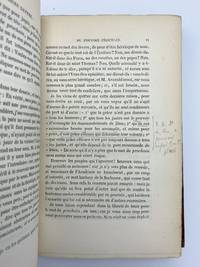
1872réf. 409286Paris: Librarie de Firmin Didot 1872. From the Bart Auerbach Collection. Light wear at extremities but in very good condition. 8vo. Text in French. Engraved frontispiece portrait. Contemporary brown half morocco top edges gilt; in a greyish-tan cloth slipcase. Matthew Arnold's copy with 51 penciled annotations – totaling 590 words – by him on 31 pages plus marginal markings and underlinings on these and numerous other pages. Some of the annotations are lengthy: 83 words in one case 48 in another; the annotations average 19 words. Bookplate of Kenneth A. Lohf. BA. Librarie de Firmin Didot unknown books
1657réf. 28515Cologne" i.e. Paris: Chés Pierre de la Vallée 1657. First edition first issue the 18 separate letters plus the refutation bound together. 23.7 x 17.5 cm. Letters 1-15 have 8 pages; 16-18 have 12 pages. "Refutation de la reponse a la douziéme lettre" bound before the 12th letter. Full brown morocco gilt a.e.g. by Riviere. Small chip at the top of the spine; joints neatly repaired edges lightly rubbed; former owners' signature and bookplate. Fifth letter lightly browned; small hole repaired with loss of a few letters on 18:7/8. First state of advertisement leaf with spelling"advertisement". "These letters were originally issued clandestinely in eighteen parts as a series of separate publications by a variety of different printers between 23 January 1656 and 15 January 1657. No detailed or authoritative information on these separate issues is available" PMM. "The Lettres Provinciales as they are called are the first example of French prose as we know it today perfectly finished in form varied in style and on a subject of universal importance.Pascal was an infant prodigy whose work in mathematics and natural science attracted considerable attention before he was sixteen. But he will always be chiefly remembered as a moralist more especially as the great apologist for Jansenism the seventeenth-century French ascetic movement of reform inside the Roman Catholic Church.At the end of 1655 the movement had been much under attack from the Jesuits and Pascal was persuaded to write a rejoinder.his counter-attack took the form of a brilliant exposure of the casuistical methods of argument employed by the Jesuits.Pascal's weapon was irony and the freshness with which the gravity of the subject contrasts with the lightness of the manner is an enduring triumph. The vividness and distinction of his style recalls Milton at its best." Printing and the Mind of Man 140. Chés Pierre de la Vallée unknown books
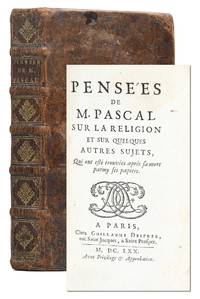
1670réf. 7821Paris: Guillaume Desprez 1670. First edition. Very Good. Large duodecimo 157 x 89 mm pp. lxxxii 365 1 20. Woodcut vignette to title page woodcut initials head- and tailpieces wood-engraved headpiece on p. 1. Contemporary mottled calf spine decorated and lettered in gilt edges sprinkled red. Near-contemporary ink annotation to foot of p. 52 later pencil annotations and emendations to several pages. Light bumping and rubbing rear joint cracked at head but holding firm spine slightly cocked and with spot of worming to foot infrequent minor damp staining offsetting and foxing. A Very Good copy. Pascal's Pensées is one of the great theological works in history a seminal example of Christian apologetics and a classic of French literature. Writing amid the explosion of Cartesian rationalism Pascal emphasizes an intuitionist-style approach to religion while at the same time outlining one of the best-known rational arguments for religious belief - the wager. Writing early in the book Pascal observes that regardless of one's actual beliefs the very notion of God requires one to take a loaded gamble on his existence: "ouy; mais il faut parier" p. 56. At his death in 1662 Pascal left behind bundles of fragmentary notes for an inchoate book of Christian apologetics. The proper order of these notes has been debated for centuries but this edition contains the arrangement devised by his executors and particularly his sister Gilberte who had previously published a biography of her illustrious brother. A "pré-originale" printing of this first edition with a title page dated 1669 is known in two surviving copies and was an advance issue likely for circulation to Pascal's associates and to gain approbations. Very Good. Guillaume Desprez unknown books