Érasme, Jean Second, Victor Develay (traduction)Livre Rare Book

3.744 resultados
1872ref. 0418Érasme et Jean Second, 5 volumes. Un livre de Jean Second, Amours, et quatre livres d'Érasme, Le Cyclope, Les mendiants riches, Le revenant et L'enterrement. Publiés à Paris, Académie des Bibliophiles, 1869 pour le premier ; Librairie des bibliophiles, 1872-3 pour les quatre autres (il s'agit toujours de la même maison d'édition). Traductions nouvelles de Victor Develay à tirage limité. Tous in-16, 115 x 75 mm, reliés demi-maroquin cerise avec dos à 4 nerfs, titres et nom d'auteur en doré, fleuron en forme de pissenlit doré, date en queue en doré. Tranches supérieures dorées. Plats marbrés en camaïeu de couleurs à dominante rouge, filet doré à la jonction des charnières et plats marbrés, gardes marbrées à dominante rouge, couvertures conservées, signet vert clair, tranchefile. *************** Les Amours (Jean Second) : l'un des 515 sur papier vergé de Hollande, celui-ci portant le no. 228. Gravure de l'auteur en frontispice sous papier de soie. Bandeaux, cul-de-lampe à la fin du texte. 85 pp. Gravure "Encore plus de lumière" à la dernière page et au plat de 4e de couverture conservée. *************** Le cyclope : l'un des 500 sur papier vergé, non numéroté. Gravure sur bois de Polyphème en frontispice sous papier de soie. Bandeau et lettrine au début du texte, cul-de-lampe à la fin. 34 pp. (5 ff.). Gravure de l'imprimeur Jouault au plat de 4e de couverture conservée. *************** Les mendiants riches : l'un des 500 sur papier vergé, non numéroté. Gravure sur bois d'un mendiant encapuchonné en frontispice sous papier de soie. Bandeaux et lettrines au début du bref mot d'Érasme placé en avant-propos, puis du texte, cul-de-lampe à la fin de chaque. 68 pp. (3 ff.). Gravure de l'imprimeur Jouault au plat de 4e de couverture conservée. *************** Le revenant : l'un des 500 sur papier vergé, non numéroté. Gravure sur bois d'une scène d'un homme barbu "ayant commerce" avec une jeune femme en frontispice sous papier de soie. Bandeaux et lettrines au début du bref mot d'Érasme placé en avant-propos, puis du texte, cul-de-lampe à la fin de chaque. 41 pp. Gravure de l'imprimeur Jouault au plat de 4e de couverture conservée. *************** L'enterrement : l'un des 500 sur papier vergé, non numéroté. Plat de couverture conservé roussi. Gravure sur bois d'une chimère en frontispice sous papier de soie. Bandeaux et lettrines au début du bref mot d'Érasme placé en avant-propos, puis du texte, cul-de-lampe à la fin de chaque. 76 pp. Papier légèrement jauni, très légères traces de mouillures à certaines marges sans perte au texte. Gravure de l'imprimeur Jouault au plat de 4e de couverture conservée.
2016ref. BN5615422016. 2016. Ausgewählte Schriften. Sieben von acht Bänden Ausgewählte Schriften. Sieben von acht Bänden Desiderius Erasmus von Rotterdam unknown
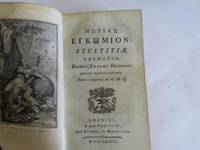
ref. 9a647Barbou London und Paris. 1777. XVI/169 S./XXVIII/204 S. mit einer Titelkupfertafel von H. Gravelot nach de Longueit original Ledereinband mit goldgeprägtem Rücken und Filetten etwas berieben und bestossen/Rücken mit kleiner Fehlstelle/oberes Kapital ausgebrochen. - Desiderii Erasmi & Thomae Mori Joco-Seria id est stultitiae Laudatio Utopia Insula - unknown
1765ref. 8777Apud Barbou, via Mathurinensium 10 x 16 Londini, et venit Parisiis 1765 Petit in-8, reliure de l'époque plein veau marbré et glacé, dos lisse orné de fleurons dorés compartimentés par des doubles filets dorés, pièce de titre de maroquin rouge, titre doré; plats encadrés d'un triple filet doré, tranches dorées, roulette dorée intérieure, gardes à la coquille, faux titre, frontispice gravé sur cuivre par de Longueil d'après Gravelot sous-titré "La Pazzia Regina del Mondo" (La folie reine du monde), XIII-[1]-214 pp., marques de l'imprimeur-libraire au titre. Edition du célèbre traité d'Erasme par Anne-Gabriel Meusnier de Querlon, qui témoigne de son actualité au siècle des Lumières. Meusnier de Querlon avait réédité et annoté en 1751 la traduction du texte latin de Gueudeville parue en 1713 (cf. "Monitum editoris" qui rappelle les différentes éditions de "L'éloge de la folie", notamment celle illustrée par Holbein). Meusnier de Querlon sera également le premier éditeur du journal de Montaigne, retrouvé en 1770. Edition soignée, manque à la coiffe supérieure, coins et coupes un peu usés. Bon exemplaire. (BJB72) PHOTOS NUMERIQUES DISPONIBLES PAR EMAIL SUR SIMPLE DEMANDE-DIGITAL PHOTOGRAPS MAY BE AVAILABLE ON REQUEST
1765ref. 8777Apud Barbou, via Mathurinensium 10 x 16 Londini, et venit Parisiis 1765 Petit in-8, reliure de l'époque plein veau marbré et glacé, dos lisse orné de fleurons dorés compartimentés par des doubles filets dorés, pièce de titre de maroquin rouge, titre doré; plats encadrés d'un triple filet doré, tranches dorées, roulette dorée intérieure, gardes à la coquille, faux titre, frontispice gravé sur cuivre par de Longueil d'après Gravelot sous-titré "La Pazzia Regina del Mondo" (La folie reine du monde), XIII-[1]-214 pp., marques de l'imprimeur-libraire au titre. Edition du célèbre traité d'Erasme par Anne-Gabriel Meusnier de Querlon, qui témoigne de son actualité au siècle des Lumières. Meusnier de Querlon avait réédité et annoté en 1751 la traduction du texte latin de Gueudeville parue en 1713 (cf. "Monitum editoris" qui rappelle les différentes éditions de "L'éloge de la folie", notamment celle illustrée par Holbein). Meusnier de Querlon sera également le premier éditeur du journal de Montaigne, retrouvé en 1770. Edition soignée, manque à la coiffe supérieure, coins et coupes un peu usés. Bon exemplaire. (BJB72) PHOTOS NUMERIQUES DISPONIBLES PAR EMAIL SUR SIMPLE DEMANDE-DIGITAL PHOTOGRAPS MAY BE AVAILABLE ON REQUEST
Petit in-12 (130 x 74 mm), maroquin janséniste rouge, dos à 5 nerfs, titre doré, coupes et coiffes filetées, tranches dorées sur marbrures, large dentelle intérieure dorée (rel. signée de David), 189 p., (1) p. Édition à la date de l'originale 'à la sphère'. Claude Joly destina cette édition commentée du 'Codicille d'Or' d'Erasme à l'instruction du Dauphin, fils de Louis XIV. L' 'Epitre à Charles d'Autriche' et le 'Codicille d'or' sont accompagnés d'essais et de critiques complémentaires ayant trait aux théories du pouvoir royal. "Par le fait qu'il s'attaque aux institutions existantes, on peut considérer Claude Joly comme un précurseur des écrivains qui contribueront à ruiner les principes de l'Ancien Régime" (H. See, 'Les idées politiques au XVIIe s.', p. 122). (Brunet, II, 1044. Van der Haegen, 'Bibliotheca Erasmiana', p. 112. Willems, n°1355). Très bel exemplaire très, très bien relié par David.
ref. 110063Lugduni Batavorum, Ex Officina Ioannis Maire, 1641, 2 textes reliés en 1 volume in-18 de 125x75x30 mm environ, 1 f.blanc, 4 ff. (titre avec vignette à la marque de l'imprimeur, préface)-229 pages-2 ff.blancs-330 pages- 2 ff.blancs, reliure plein veau blond, dos à 4 nerfs portant titres dorés, orné de caissons à fleurons dorés, nerfs ornés, plats encadrés d'un double filet doré, tranches finement mouchetées. Un ex-libris collé sur le premier contreplat et des ex-libris manuscrits sur la page de titre et dans le texte par endroits. Coins et coupes légèrement émoussés, des auréoles sur le cuir, début de fente sur 2 mors, frottements sur le dos, coiffe supérieure arasée. Texte en latin
1677Dalla presentazione della prima edizione italiana: "I "Colloquia" sono tante cose: innanzitutto un manuale di insegnamento del latino, dove l'arguzia di Erasmo si manifesta anche nell'inventare esercizi, nel trovare giochi di parole a scopo didattico; poi un documento su come la cultura classica poteva servire da modello nella vita rinascimentale; infine un pamphlet religioso attraversato da echi riformistici." Edizione originale in latino, magistralmente restaurata nell'800 alle primissime carte. Bella stampa raffigurante l'Autore seduto a colloquio con due notabili. Ottimo esemplare Tutta pergamena, pp. 8, 589, 3, in 16°
1688ref. 49228Cologne disguised; Paris or the Netherlands: Adrian Le Jeune 1688. First edition. Hardcover. Very good . Duodecimo. Collation: aster.12 2aster.6 A-R12 S4 = 226 leaves. 36 415 1 blankpp. Engraved frontispiece and headpiece; woodcut lettrines head- and tailpieces; printed side notes. Contemporary calf mildly worn at extremities; gilt tooled spine with raised bands gilt lettering piece; edges sprinkled in red. Old inscription cropped from top edge title; one leaf with clean marginal tear just extending into text else fine and crisp throughout. First edition of this defense of Jansenism via the celebrated scholar of Rotterdam. Among the works reviewed by Locke for Jean Le Clerc the present title “indicated a new wave of interest in Erasmus” Mansfield. “Jean Richard 1615-1686 wanted to persuade the Roman Catholic Church that in persecuting the Jansenists it was as much in error as it had been when it denounced Erasmus. He also wanted to convince the English monarch that despite appearances to the contrary Erasmus had never adopted any stance outside the Catholic Church” van Herwaarden. The author surely intends the quotation from Cyprian at the verso of the title as a reference to both Erasmians and Jansenists: “This is always the devil’s work to destroy with lies the servants of God and defame their glorious name with false opinions” trans. Mansfield. Early modern reviews were mixed: Bayle considered it a “pity that the author. stopt at the first part of it” General Dictionary 5 1737 “Erasmus” 85 note T. Burigny Vie d’Erasme Paris: 1758 judged it “. so badly done and so filled with invectives and declamations that it does not lead one to wish for the second” 547; quoted in Mansfield 293n. In 1660 the French cleric Jean Richard was imprisoned by the archbishop of Rouen de Harlay a bitter opponent of Jansenism."During this personal crisis he published two works in defense of his Jansenist belief and behaviour. As we shall see there are grounds for believing that his Sentimens. was meant in part at least to achieve the same end. Nevertheless mysteries surround the work: it was published posthumously Richard died in 1686 having been prior of Beaulieu Saint-Avoie since 1673; what we have is the first part and we may only guess at how seriously the promise of a second part was intended. As it stands this is an ill-organized book repetitive with many digressions but filled with a naive enthusiasm and fascinating partly because of the evidences of a sound judgment about Erasmus partly because of the tantalizing but insoluble problem of the author’s aims. The avowed aim was proselytism. The book is dedicated -- on the eve of the Revolution of 1688 -- to James II of England a new Theodosius who is hazarding three kingdoms for the sake of the kingdom of heaven. May it help the English people to follow the king’s example in conversion to Catholicism by showing them the true character of Erasmus’ religion" Mansfield. References: Barbier 4:467. J. v. Herwaarden Between Saint James and Erasmus Studies in Late-Medieval Religious Life 598; Jöcher 3:2078; VD17 12:110664Q. For a thorough discussion see B. Mansfield Phoenix of His Age: Interpretations of Erasmus c. 1550–1750 Toronto 1979 163–174. Locke’s review appears in Bibliotheque universelle et historique VII 1688: 106-122. Adrian Le Jeune hardcover
1688ref. 49228Cologne disguised; Paris or the Netherlands: Adrian Le Jeune 1688. First edition. Hardcover. Very good . Duodecimo. Collation: aster.12 2aster.6 A-R12 S4 = 226 leaves. 36 415 1 blankpp. Engraved frontispiece and headpiece; woodcut lettrines head- and tailpieces; printed side notes. Contemporary calf mildly worn at extremities; gilt tooled spine with raised bands gilt lettering piece; edges sprinkled in red. Old inscription cropped from top edge title; one leaf with clean marginal tear just extending into text else fine and crisp throughout. First edition of this defense of Jansenism via the celebrated scholar of Rotterdam. Among the works reviewed by Locke for Jean Le Clerc the present title “indicated a new wave of interest in Erasmus” Mansfield. “Jean Richard 1615-1686 wanted to persuade the Roman Catholic Church that in persecuting the Jansenists it was as much in error as it had been when it denounced Erasmus. He also wanted to convince the English monarch that despite appearances to the contrary Erasmus had never adopted any stance outside the Catholic Church” van Herwaarden. The author surely intends the quotation from Cyprian at the verso of the title as a reference to both Erasmians and Jansenists: “This is always the devil’s work to destroy with lies the servants of God and defame their glorious name with false opinions” trans. Mansfield. Early modern reviews were mixed: Bayle considered it a “pity that the author. stopt at the first part of it” General Dictionary 5 1737 “Erasmus” 85 note T. Burigny Vie d’Erasme Paris: 1758 judged it “. so badly done and so filled with invectives and declamations that it does not lead one to wish for the second” 547; quoted in Mansfield 293n. In 1660 the French cleric Jean Richard was imprisoned by the archbishop of Rouen de Harlay a bitter opponent of Jansenism."During this personal crisis he published two works in defense of his Jansenist belief and behaviour. As we shall see there are grounds for believing that his Sentimens. was meant in part at least to achieve the same end. Nevertheless mysteries surround the work: it was published posthumously Richard died in 1686 having been prior of Beaulieu Saint-Avoie since 1673; what we have is the first part and we may only guess at how seriously the promise of a second part was intended. As it stands this is an ill-organized book repetitive with many digressions but filled with a naive enthusiasm and fascinating partly because of the evidences of a sound judgment about Erasmus partly because of the tantalizing but insoluble problem of the author’s aims. The avowed aim was proselytism. The book is dedicated -- on the eve of the Revolution of 1688 -- to James II of England a new Theodosius who is hazarding three kingdoms for the sake of the kingdom of heaven. May it help the English people to follow the king’s example in conversion to Catholicism by showing them the true character of Erasmus’ religion" Mansfield. References: Barbier 4:467. J. v. Herwaarden Between Saint James and Erasmus Studies in Late-Medieval Religious Life 598; Jöcher 3:2078; VD17 12:110664Q. For a thorough discussion see B. Mansfield Phoenix of His Age: Interpretations of Erasmus c. 1550–1750 Toronto 1979 163–174. Locke’s review appears in Bibliotheque universelle et historique VII 1688: 106-122. Adrian Le Jeune hardcover books
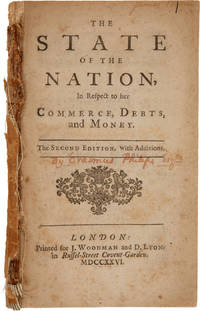
1726ref. 23206London: J. Woodman and D. Lyon 1726. The second edition with additions after the first of the year before. An overview of British commerce from 1688 with consideration of the economic impact of wars with France. With references to American colonial trade silver mines in Peru and the "Asiento" or Spanish slave trading contract. Dbd. Titlepage a bit soiled tanning and very light foxing faint dampstain to lower gutter of last few gatherings. Good plus. EUROPEAN AMERICANA 726/165. SABIN 62455. GOLDSMITHS 6428. KRESS 3661. unknown
1726ref. 23206London: J. Woodman and D. Lyon 1726. The second edition with additions after the first of the year before. An overview of British commerce from 1688 with consideration of the economic impact of wars with France. With references to American colonial trade silver mines in Peru and the "Asiento" or Spanish slave trading contract. Dbd. Titlepage a bit soiled tanning and very light foxing faint dampstain to lower gutter of last few gatherings. Good plus. EUROPEAN AMERICANA 726/165. SABIN 62455. GOLDSMITHS 6428. KRESS 3661. unknown books
1804ref. 41039London 1804. 468 x 376 mm. image size 282 x 241 mm. excluding caption. A few small marginal tears faint crease in lower margin but very good. Fine portrait of physician / naturalist Erasmus Darwin grandfather of Charles who himself included a statement of evolution in his poem "The Botanic Garden." The portrait was engraved by J. Heath after the portrait by James Rawlinson 1769-1848. unknown
1804ref. 41039London 1804. 468 x 376 mm. image size 282 x 241 mm. excluding caption. A few small marginal tears faint crease in lower margin but very good. Fine portrait of physician / naturalist Erasmus Darwin grandfather of Charles who himself included a statement of evolution in his poem "The Botanic Garden." The portrait was engraved by J. Heath after the portrait by James Rawlinson 1769-1848. unknown books
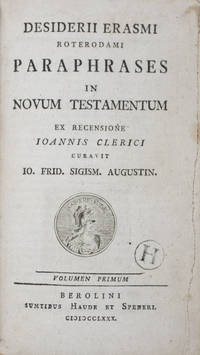
1780ref. 43177Berolini Berlin: Haude et Speneri 1780. Later edition. Hardcover. vg. Octavo 8 1/2 x 5". xxxvi 546pp Vol. 1; xxii 398pp Vol. 2; xliv 399-995 1pp. Modern full black cloth with gold lettering to spines. Title vignettes. Originally published in 1548 "Paraphrases in Novum Testamentum" were composed between May 1517 and January1524. They consist of a series of commentaries on every book of the New Testament except "Apocalypse" a book for which Erasmus had no great regard. The Paraphrases were successful beyond expectation and were quickly translated into French German English and other languages. Modern endpapers and fly leaves. Small letter "H" stamped on title pages of first and third volumes. Text in Latin. Bindings and interior in overall very good condition. The publication history of the "Paraphrases" is complicated. Erasmus began with the Pauline Epistles. The paraphrase of Romans was published in quarto by Dirk Martens in Louvain in November 1517 and reprinted by Erasmus's friend Johann Froben in January of the following year; it sold well and was soon reprinted in octavo. Corinthians was published by Martens in February 1519 and reprinted in Basel by Froben in March; Galatians appeared later that year with editions from both publishers. The remaining Epistles followed in 1520 and 1521 the last to appear being Hebrews. In the autumn of 1521 Erasmus moved from Louvain to Basel and from that time Froben published the first editions of the remaining Paraphrases. Erasmus now turned to the Gospels Matthew appearing in March 1522 in both folio and octavo - from now on there are no more quartos John in February folio and March octavo 1523 Luke in August 1523 and Mark in early 1524 with a title page dated 1523. Acts followed quickly the dedication copy being dated February 13 1524. Froben published a complete edition in two volumes the first "a stout octavo volume of 400 leaves dated 1523 and called Tomus secundus" contained the Epistles and the Tomus primus containing the Gospels and Acts appeared the following year. "This was a considerable investment and the firm kept it in their list for ten years" resetting portions as needed without a change of date. The Paraphrases were reissued in various formats and combinations during the following decades; Roger Mynors writes: "When one is faced with one of these editions in folio one has to remember that a purchaser would see them as composed of separable parts out of which sets could be made up in any way that supply might dictate." For more information see: R.A.B. Mynors "The Publication of the Latin Paraphrases" in Robert Dick Sider ed. New Testament Scholarship: Paraphrases on Romans and Galatians Collected Works of Erasmus University of Toronto Press 1984 pp. xx-xxix. About the author: Desiderius Erasmus Roterodamus 1466-1536 known as Erasmus or Erasmus of Rotterdam was a Dutch Renaissance humanist Catholic priest social critic teacher and theologian. Erasmus was a classical scholar and wrote in a pure Latin style. Among humanists he enjoyed the sobriquet "Prince of the Humanists" and has been called "the crowning glory of the Christian humanists." Using humanist techniques for working on texts he prepared important new Latin and Greek editions of the New Testament which raised questions that would be influential in the Protestant Reformation and Catholic Counter-Reformation. He also wrote On Free Will The Praise of Folly Handbook of a Christian Knight On Civility in Children Copia: Foundations of the Abundant Style Julius Exclusus and many other works. From Wikipedia. Haude et Speneri hardcover
1780ref. 43177Berolini Berlin: Haude et Speneri 1780. Later edition. Hardcover. vg. Octavo 8 1/2 x 5". xxxvi 546pp Vol. 1; xxii 398pp Vol. 2; xliv 399-995 1pp. Modern full black cloth with gold lettering to spines. Title vignettes. Originally published in 1548 "Paraphrases in Novum Testamentum" were composed between May 1517 and January1524. They consist of a series of commentaries on every book of the New Testament except "Apocalypse" a book for which Erasmus had no great regard. The Paraphrases were successful beyond expectation and were quickly translated into French German English and other languages. Modern endpapers and fly leaves. Small letter "H" stamped on title pages of first and third volumes. Text in Latin. Bindings and interior in overall very good condition. The publication history of the "Paraphrases" is complicated. Erasmus began with the Pauline Epistles. The paraphrase of Romans was published in quarto by Dirk Martens in Louvain in November 1517 and reprinted by Erasmus's friend Johann Froben in January of the following year; it sold well and was soon reprinted in octavo. Corinthians was published by Martens in February 1519 and reprinted in Basel by Froben in March; Galatians appeared later that year with editions from both publishers. The remaining Epistles followed in 1520 and 1521 the last to appear being Hebrews. In the autumn of 1521 Erasmus moved from Louvain to Basel and from that time Froben published the first editions of the remaining Paraphrases. Erasmus now turned to the Gospels Matthew appearing in March 1522 in both folio and octavo - from now on there are no more quartos John in February folio and March octavo 1523 Luke in August 1523 and Mark in early 1524 with a title page dated 1523. Acts followed quickly the dedication copy being dated February 13 1524. Froben published a complete edition in two volumes the first "a stout octavo volume of 400 leaves dated 1523 and called Tomus secundus" contained the Epistles and the Tomus primus containing the Gospels and Acts appeared the following year. "This was a considerable investment and the firm kept it in their list for ten years" resetting portions as needed without a change of date. The Paraphrases were reissued in various formats and combinations during the following decades; Roger Mynors writes: "When one is faced with one of these editions in folio one has to remember that a purchaser would see them as composed of separable parts out of which sets could be made up in any way that supply might dictate." For more information see: R.A.B. Mynors "The Publication of the Latin Paraphrases" in Robert Dick Sider ed. New Testament Scholarship: Paraphrases on Romans and Galatians Collected Works of Erasmus University of Toronto Press 1984 pp. xx-xxix. About the author: Desiderius Erasmus Roterodamus 1466-1536 known as Erasmus or Erasmus of Rotterdam was a Dutch Renaissance humanist Catholic priest social critic teacher and theologian. Erasmus was a classical scholar and wrote in a pure Latin style. Among humanists he enjoyed the sobriquet "Prince of the Humanists" and has been called "the crowning glory of the Christian humanists." Using humanist techniques for working on texts he prepared important new Latin and Greek editions of the New Testament which raised questions that would be influential in the Protestant Reformation and Catholic Counter-Reformation. He also wrote On Free Will The Praise of Folly Handbook of a Christian Knight On Civility in Children Copia: Foundations of the Abundant Style Julius Exclusus and many other works. From Wikipedia. Haude et Speneri hardcover books
1699ref. 94182Christopheri Salfeldii b. 1699. Hard cover. Fair/No jacket. Bin 4 Long Case. From the library of Friedrich Adolf Trendelenburg and containing his bookplate. Trendelenburg was a key influence on Soren Kierkegaard and the teacher of Franz Brentano and Wilhelm Dilthey. In Latin. Cover is heavily worn browned and soiled. Parts of spine are missing and the rest is peeling off binding but remains attached to cover boards. Spine is cracked but all pages remain attached to binding. Pages are tanned and heavily foxed but text is legible. Christopheri Salfeldii b. unknown
1745ref. 37491a Amsterdam: chez Francois l'Honore 1745. 6 folding plates 74 wood engravings. xxiv 340 20. 1 vols. 12mo. Full tan contemporary continental calf. some minor loss. Holbein Hans. 6 folding plates 74 wood engravings. xxiv 340 20. 1 vols. 12mo. This translation of Ersasmus's "In Praise of Folly is the most popular french translation by Nicolas Guedeville c. 1654-1721. The plates after Holbein 1497-1543 are equally famous. Probably a counterfeit imprint Biblio Eras. VII 1908 p. 166 or Lewine p. 170 chez Francois l'Honore unknown
1745ref. 37491a Amsterdam: chez Francois l'Honore 1745. 6 folding plates 74 wood engravings. xxiv 340 20. 1 vols. 12mo. Full tan contemporary continental calf. some minor loss. Holbein Hans. 6 folding plates 74 wood engravings. xxiv 340 20. 1 vols. 12mo. This translation of Ersasmus's "In Praise of Folly is the most popular french translation by Nicolas Guedeville c. 1654-1721. The plates after Holbein 1497-1543 are equally famous. Probably a counterfeit imprint Biblio Eras. VII 1908 p. 166 or Lewine p. 170 chez Francois l'Honore unknown books
1661ref. 647Paris: Apud Claudium Thiboust 1661. Third edition. Contemporary full speckled calf gilt-tooled spine in six compartments with raised bands and gilt title “Colloq. Erasmi.” Binding is complete but well worn with rubbing edge wear and chipping at head and tail of spine; corners rounded joints starting yet sound. A mid-17th-century Parisian edition of Erasmus of Rotterdam’s famous Colloquia Familiaría one of the foundational works of Renaissance humanism and early modern pedagogy. Originally written as conversational exercises for students learning Latin Erasmus’s dialogues evolved into a brilliant and witty critique of contemporary morals superstition and scholastic excess. Through satirical exchanges on everyday subjects—friendship marriage travel religion and education—Erasmus offers insight into both Christian ethics and humanist reform. The Colloquia enjoyed immense popularity for two centuries as both a language text and a guide to civility and it remains a monument of Renaissance learning style and social commentary. This 1661 edition edited by Nicolas Mercier includes scholarly notes a Latin–French life of Erasmus and extensive commentary designed for academic study. The volume opens with an elaborate engraved frontispiece portrait of Erasmus at his desk beneath cherubs holding a banner the emblematic motto Nulli cedo “I yield to no one” above him. The typography and ornamentation typify Parisian classical printing of the reign of Louis XIV with woodcut initials and headpieces throughout. The book closes with Mercier’s biographical essay Vita Desiderii Erasmi Roterodami and an index of the numerous colloquies—each a mirror of Erasmus’s wit and moral philosophy. Condition: Text block solid pages evenly toned with occasional foxing and light damp staining. Small early ink inscriptions on endpapers and title some early marginal notes. Engraved frontispiece crisp and well preserved. Overall- good. Apud Claudium Thiboust unknown
ref. 1430A Amsterdam: Chez François L'Honoré 1731. Hardcover. Good. Small octavo. xxii 234 xviiipp. 6-5 A8-P8 Q4 R2. Title-page in red-and-black. Contemporary calf rebacked. With an engraved frontispiece a portrait plate showing Erasmus More and Holbein six folding plates and seventy-five textual engravings. These are the same copperplates as were used in the first "counterfeit" edition of 1713/1714. Lewine Bibliography of 18th Century Art & Illustrated Books p. 170; Cohen-de Ricci 348; Kossman 1069; Van Der Haeghen I 126; Sander 613. 0 A Amsterdam: Chez François L'Honoré, 1731. hardcover
ref. 003594Francofurti: Sumptibus Jo. August Raspe 1757. Hardcover. Very Good. Octavo. 2 volumes. I: viii 374pp.; II: 448pp. Volume II is issued in two parts paged continuously. Pages 251-252 mis-bound in volume I before page 247. Contemporary calf worn. Corners worn labels chipped. Volume II is slightly chipped at crown. Some cracking of front hinge. All edges marbled red. Volume I has frontispiece of Ulrich von Hutten and 11 other portrait engravings. Volume II has engraved frontispiece portrait of Erasmus. In total there are 12 engravings. With ink and pencil notations on front endpaper of volume I and top corner of frontispiece and title-page somewhat dampstained. 0 Francofurti: Sumptibus Jo. August Raspe, 1757. hardcover
1843ref. 353481London: William Pickering. Frankfurt o/M. Jaeger's Library 1843. With engraved plate of the forms of Runes at end. viii 272 2 corrigenda & runes pp. 1 vols. 8vo. Later green cloth with the original green printed wrappers bound in. With engraved plate of the forms of Runes at end. viii 272 2 corrigenda & runes pp. 1 vols. 8vo. Uncommon Pickering title printed in Germany and a notable milestone in Icelandic scholarship by this dfamous Danish scholar and philologist. Not in Keynes; See PMM 266 William Pickering. Frankfurt o/M., Jaeger's Library unknown books
1830ref. 57111Copenhagen Schultz 1830. 8vo. Uncut in the original blank boards. Handwritten title label to spine. Spine slightly rubbed. Scattered brownspots. XII184 pp. First edition of Rask's Danish Grammar which was later translated into Danish by Rask's half-brother. The present copy belonged to the Danish linguist Ludvig F. A. Wimmer 1839-1920 and carries his signature to the front endpaper. Hjelmslev I 176. hardcover
1830ref. 57111Copenhagen, Schultz, 1830. 8vo. Uncut in the original blank boards. Handwritten title label to spine. Spine slightly rubbed. Scattered brownspots. XII,184 pp.