3650 risultati
2010rif. NF3401Alciphron or The Minute Philosopher. In Seven Dialogues. Containing an Apology for the Christian Religion against those who are called Free-thinkers From Sidney's Press for Increase Cooke & Co. 1803 first American edition both covers detached spine starting to join them staining to the text block but with all contents still easily readable else there in what most certainly looks like the original leather binding speaking of which a new one here vouldn't hurt. An important book in the Philosophy Canon by this author from which came the name of a certain city in Northern California not to mention an university of some renown as well. From the library of the former premier Walt Whitman collector bibliophile and philanthropist Charles Feinberg. From Sidney's Press, for Increase Cooke & Co. hardcover books
1980rif. 105277Hamburg: Meiner 1980. XL, 175 Seiten. 8° (17,5-22,5 cm). Orig.-Broschur. [Softcover / Paperback].
1979rif. 1163302Hamburg : Meiner, 1979. LXVI, 147 S. ; 19 cm; kart.
2004rif. 151289Hamburg: Meiner 2004. XLIX, 125 Seiten. 8° (17,5-22,5 cm). Orig.-Broschur. [Softcover / Paperback].
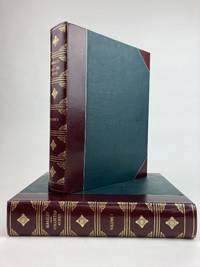
2009Mm 105x175 Collana "I Classici del Pensiero". Edizione a cura di Silvia Parigi - Volume rilegato in similpelle verde con titolo e decorazioni in oro al dorso, custodia figurata in cartoncino morbido, 705 pagine con nastrino in stoffa verde. Contiene: Saggio per una nuova teoria della visione; Trattato sui principi della conoscenza umana; Tre dialoghi tra Hylas e Philonous; Saggi pubblicati sul Guardian (1713); Sul movimento; Corrispondenza filosofica tra George Barkley e Samuel Johnson (1729-1730); La teoria della visione difesa e chiarita; Siris. Esemplare in condizioni pari al nuovo, mai letto. SPEDIZIONE IN 24 ORE DALLA CONFERMA DELL'ORDINE.
1745rif. 27513Amsterdam Pierre Mortier 1745
1913rif. 260247Leipzig: Verlag von Felix Meiner 1913. xxiv 139p. plus a brief menu of publisher's offerings hardbound in 7.5 x5 inch grey boards with olive-drab backstrip neatly spine-titled possibly custom work certainly professional. Top edge tinted. Pastedown bears an unobjectionable old bookplate with scientific trimmings covers a little edgeworn label slightly rubbed a nice sound copy. Philosophische Bibliothek Band 149. Use "tar-water" to ameliorate plague symptoms. Berkeley addresses the question which sort of tar-water. Verlag von Felix Meiner unknown books
1744rif. 113771744. BERKELEY GEORGE. Siris: A Chain of Philosophical Reflexions and Inquiries Concerning the Virtues of Tar Water and Divers other Subjects Connected Together and Arising One from Another. London: For W. Innys and C. Hitch and C. Davis 1744. 174 2 p. Removed from a bound volume. Very good. Second English edition the variant with the author's name on the title page. An investigation into the medicinal properties of tar water. A highly popular text that was reprinted many times. Keynes 67; Osler 1071; Wellcome II p. 149; NLM/Blake p. 43; Kress 4685. unknown books
1878rif. 000011096London: William Tegg & Co 1878. First Simon edition. Hardcover. Good. Small 8vo. 5 vi-lii 5 6-220 pp. Bound in green cloth with both boards bordered in blind lettering and rule stamped in gold on the front board. Yellow/green endpapers and pastedowns. Algaier Reconstructing the Library of William James; Gay Wilson Allen William James; Mead 18. This is the first edition edited and with introduction and appendix by Simon. The free front endpaper has two ownership stamps of philosopher and psychologist William James the first is crossed out being the older 18 Garden Street address where James resided until moving to his new house in 1889 the second is the 95 Irving Street address in Cambridge where he lived from 1889 until his death in 1910. There is also a slip of paper tipped in to the front endpaper with "PHILOS. III." printed on it. This book is not in Algaier who lists all of James' books and pamphlets that were donated to Harvard University by James and others 2554 items nor is it listed in the catalogue of The Hocking Collection at the University of Massachusetts-Lowell. Therefore this book must be one of the many that were given away as gifts to colleagues or sold at the "yard sale" held in 1923. The photographs of James' library circa 1923 see Algaier p. 4-5 suggest that it consisted of at least 4000 volumes Algaier suggests it may be double that so a large portion of James' personal library is either lost or privately held. The book does contain underlining and light marginalia vertical bars to emphasize passages and reference numbers mostly in pencil but we are unable to ascertain if this is the work of James himself or a later owner. James is one of the most important American philosophers of the nineteenth century and books from his personal library are scarce in commerce. The book is in Good-only condition with rubbing and wear to the boards and the binding although holding is in jeopardy. William Tegg & Co hardcover books
1784rif. 1352898Dublin: John Exshaw 1784. Hardcover. Quartos two volumes; VG; Rebound in half-red leather with green cloth boards and gilt lettering and ruling to spines; Boards show minimal wear to corners and bottom edges; Text-blocks have moderate age-toning and light foxing to speckled edges light shelf-wear to bottom edges and occasional light foxing to the first several pages of Volume I; Both volumes bear the library stamp of the "Training College Library Avenue Southampton"; Volume I includes a frontispiece portrait of Berkeley and Volume II includes a fold-out map prefacing the title-page; Contents: Vol. I. 4 ci 646 pages; Vol. II. iv 663 pages. Oversized books. Additional postage necessary for expedited/international orders. Economy International shipping unavailable due to size/weight restrictions. For international/expedited customers please inquire for rates.; RW consignment. Shelved in Room X. 1352898. Special Collections - Downstairs. John Exshaw hardcover books
rif. CA09A-00049John Exshaw. Collectible - Good. Dublin: John Exshaw 1784. 2 volume set. 4to. ci646666pp. Frontis. figures fold-out map. Good book. Spine ends worn and chipped. Joints worn. Boards scuffed and chipped. Back board detached from vol. 1. Front hinge open in vol. 2. Elaborate gifter's inscription on f.f.e. verso of vol. 1. Light pencil notations in both volumes. Some browning and spotting to text pages. Inquire if you need further information. John Exshaw hardcover books
1820rif. 15730London: Printed by J.F. Dove…for Richard Priestley 1820 First octavo edition of the collected works of Berkeley first published in quarto in 1784. See Keynes Bibliography of George Berkeley p. 262. Both the quarto and the octavo collected works are uncommon on the market. Contemporary diced calf. Double-ruled gilt fillets on covers gilt decorated spine with brown morocco labels marbled edges and endpapers. . Three volumes octavo. . Volume II contains diagrams and an engraved folding plate of Tabula Lusoria. Volume III contains a large engraved folding plate of "The City of Bermuda Metropolis of the Summer Islands. Some corners lightly bumped light foxing old ink signature in each volume. A very good attractive set. Printed by J.F. Dove…for Richard Priestley, books
1913rif. 198327Chicago: Open Court Pub Co 1913. Hardcover. Good. Good Piece of spine coming off. Pages soiled on bottom corner. Open Court Pub Co hardcover books
1954rif. 116745IN: Library of Liberal Arts 1954. Softcover. Good. Good in wrappers. Writing and notations in text. Light browning of pages. Cover rubbed with some staining and browning. Library of Liberal Arts unknown books
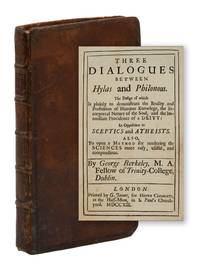
1713rif. 140947370London: Henry Clements 1713. First Edition Third Edition. First edition first printing of George Berkeley's work of philosophy. x 166 vi 44 pp. Octavo bound in full contemporary mottled calf laced in boards. Blindstamped ruled borders red morocco title label to spine all edges speckled red. Bound together with the third edition of another work by Berkeley also published by Henry Clements in 1713: Passive Obedience Or the Christian Doctrine Of Not Resisting the Supreme Power Proved and Vindicated upon the Principles of the Law of Nature. In a Discourse Deliver'd at the College-Chapel. Very Good with moderate wear to boards cracking to leather at extremities minimal chipping at head and tail of spine and rounded and bumped corners. Joints repaired leather coated with preservative. Previous owner names have been torn from free endpapers cut more carefully from upper margins of first two leaves. Several 18th century ink markings and inscription "Owner / 1720" remain on the endpapers. The two books are printed on different paper stock. Three Dialogues is slightly tanned with scattered foxing to margins; Passive Obedience is heavily toned. Both books collated complete. From the library of William A. Strutz with his small bookplate to the front pastedown. George Berkeley 1685 - 1753 was an Anglo-Irish philosopher and clergyman who advocated the view that objects cannot exist without being perceived. He wrote Three Dialogues in order to expand on the ideas expressed in his most notable work A Treatise Concerning the Principles of Human Knowledge. Passive Obedience is a call to obey established authorities God above all. That a third edition was published just one year after the first is testament to the intensity of Enlightenment debates about the relationships between individuals and church and state. Henry Clements unknown books
1874rif. 69444Philadelphia: J.B. Lippincott & Co 1874. Philadelphia: J.B. Lippincott & Co. 1874. Full Description: BERKELEY George. A Treatise Concerning the Principles of Human Knowledge. With Prolegomena and with Annotations Select Translated and Original by Charles P. Krauth D.D. Philadelphia: J.B. Lippincott & Co. 1874. First American edition of the book which shook the intellectual world with its theory of immaterialism. Octavo 8 3/4 x 5 3/4 inches; 222 x 144 mm. 2 blank 424 2 blank pp. Publisher's full orange cloth. Boards ruled in blind. Spine stamped and lettered in gilt. Brown coated endpapers. Previous owner's ink name on front and back pastedown. Some minor rubbing to head and tail of spine and corners. Otherwise about fine. "The principle which underlay all Berkeley's philosophical writing was based on a rejection of all speculation such as Locke's about the meaning and necessity of matter as a primal necessity to any theory of human understanding. Briefly Berkeley maintained that no existence is conceivable or possible which is not conscious spirit or the ideas of which such a spirit is conscious. This presupposes complete equation of subject and object: no object can exist without a Mind to conceive it. Without the pre-existence of the Mind mater and substance cause and effect can have no meaning. In the Principles externality absolutely independent of all mind is shown to be an unreal impossible conception: true substance is the conscious spirit and true causality the free action of such a spirit. Physical substance and causes are relations among phenomena arbitrary though by the action of the Mind constant. Connexions between them are viewed subjectively as the suggestion or associations of the human mind and objectively as the operation of the Universal Mind. Thus the universe is the sum of human experience and forms a symbol of the divine universal intelligence: esse est percipi" Printing and the Mind of Man. Norman Library 196. PMM 176. HBS 69444. $1500. J.B. Lippincott & Co unknown books
1922rif. 1110172330xbvkBerlin, Reuther & Reichard, 1922. 72 Seiten. - Orig.-Umschlag mit Deckel- und Rückentitel; 8vo.
1999rif. 219000Columbia: MJB 1999. First. hardcover. very good. A few Illus. 8vo blue cloth. Columbia: MJB 1999. Very good Bibliography of books on World War I published by Matthew J. Bruccoli. MJB unknown books
1947rif. 432481947. Berkeley Edmund C. 1909-88. Electronic machinery for handling information and its uses in insurance. Offprint from Transactions of the Actuarial Society of America 48 1947. 36-52pp. 228 x 153 mm. Original printed wrappers a few tiny spots almost invisible staple-holes in front wrapper. Very good copy. Former owner's name-stamp Clifford J. Maloney on wrappers. First Edition Offprint Issue. The first published paper on the commercial application of electronic / electromechanical computing in private industry outside of the telephone company. Drawing on material that he would later publish in his famous Giant Brains or Machines that Think 1949 Berkeley described the four large-scale computing machines then in operation-MIT's Differential Analyzer; Harvard's Automatic Sequence Controlled Calculator; the Moore School's ENIAC; and Bell Laboratories' Relay Calculator-and discussed the machines' information-processing capabilities and their potential uses in the insurance industry. "It is natural to call these machines mechanical or electronic brains and to speak of them as machinery that thinks. This new machinery is certain to have far-reaching effects in all fields where the handling of information is the bulk of the work. . . . Much of the material in this paper is taken from a forthcoming book on the subject by the present writer and is used by special permission of the publisher" p. 36. Berkeley a seminal figure in the history of modern computing was introduced to computing using punched-card machine methods while working as an actuary at Prudential Insurance. In 1942 he joined the Navy and was assigned to the Harvard Computation Laboratory where he worked with Howard Aiken on the Harvard Mark II. In 1946 Berkeley returned to Prudential where he helped create a prototype premium billing trial for the Harvard Mark I and participated in studies that led to Prudential's purchase of one of the first UNIVAC I computers. He also began working on Giant Brains and in 1947 founded the Association for Computing Machinery. In 1948 he left Prudential to found his own company and in 1951 he began editing and publishing Computers and Automation later renamed Computers and People the first periodical specifically devoted to computing. He also headed his own publishing firm consulted for industry and invented and sold several build-it-yourself electronic computers and small robots Simon Squee Tyniac Brainiac etc. as educational tools. In his later years he became known as the conscience of the computer industry through his often-expressed belief that computers should be used not for military or destructive purposes but only for the benefit of society. . unknown books
1958rif. 15574New York: John Wiley and Sons Inc 1958. Hardcover. Near Fine/Near Fine. Sixth Printing. Signed by Berkeley on the front endpaper. Near Fine in a Near Fine dust jacket unclipped no price a few short tears and shallow chips. Beige cloth with black ink lettering and rules on the spine and boards. Square and firmly bound foxed at the top edge clean internally. Berkeley's general audience work about early computers and artificial intelligence. John Wiley and Sons Inc hardcover books
1992rif. dacs997Gainesville: University Press of Florida 1992. First Edition. Octavo gray cloth hardcover xv 808 pp 1 pp. Frontis. ports. Fine. University Press of Florida, (1992). First Edition. hardcover books
1963rif. qms435Chapel Hill: The University of North Carolina 1963. Octavo green cloth hardcover gilt letters ix 236 pp. Very Good with neat former-owner stamp & signature and former-owners published review pasted to rear endpaper in a Very Good dust jacket with light foxing. From jacket: As plant collector and early systematic botanist John Clayton 1694-1773 Cerk of Court of Gloucester County Virginia occupies a key position in the eighteenth-century international botanical circle. His chief monument is the Flora Virginica published in Leiden in 1739 and 1762. Compiled by J. F. Gronovius from plants and descriptions supplied by Clayton it is the first important North American flora and the only one devoted soley to Virginia. The University of North Carolina, (1963). hardcover books
rif. 34444BERKELEY Edmund and Dorothy Smith Berkeley. THE REVEREND JOHN CLAYTON A PARSON WITH A SCIENTIFIC MIND HIS WRITINGS AND OTHER RELATED PAPERS. Charlottesville: UP of Virginia 1965. 8vo. Cloth. xv xlviii 170 pages. First edition. Definitive collection of the writings and letters of the noted seventeenth century Virginia clergyman and local botanist and scientist. Very good. unknown books
1975rif. 76129Chapel Hill: University of North Carolina Press. Very Good in Very Good dust jacket. 1975. Hardcover in jacket. 9 1/4 x 6 1/2 inches bound in blue cloth with pictorial end pages. Complete in 283 pages with some illustrations. . University of North Carolina Press hardcover books
1978rif. 19381New York: Charles Scribner's Sons 1978. cloth dust jacket. thick 8vo. cloth dust jacket. xx 565 pages. First edition. Fine in fine dust jacket. Introduction by Clifton Waller Barrett followed by sections on the Fundamentals Rudiments and Areas in Which to Collect. Includes sections on forgery and forgers. Charles Scribner's Sons unknown books