ANONYMOUSBiblio.com
263.192 resultados
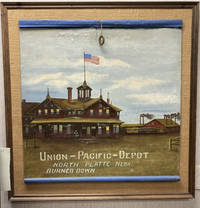
1900ref. 39803North Platte: Artist Unknown n.d. ca 1900. 1900. First edition. 28" x 28" full color painting of the Union Pacific Railroad's Bailey Yard in North Platte Nebraska. It was named for the president of the Union Pacific Edd H. Bailey. It is the largest railroad classification yard in the world as it is 8 miles long and 2 miles wide. The yard covers 2800 acres and within it are 315 miles of track. Today every 24 hours Bailey Yard handles 10000 railroad cars 3000 of which are sorted in either the eastward or westward yards nicknamed "hump" yards with 120 - 140 trains a day that pass through Bailey Yard. The first train to enter North Platte was on December 3 1866. By January 2 1867 the main line of operations officially commenced in North Platte. From 1873 to 1913 "Buffalo Bill" Cody lived and organized his Wild West Show from his ranch north of the rail yard and transported his show via rail and wagon. In 1897 E. H. Harriman purchased the Union Pacific at an auction held in Omaha Nebraska. The construction of the second main line commenced through North Platte in 1910. This art is painted on a 28" x 28" linen window shade and depicts the Bailey Yard Railroad Depot and hotel both of which burned on November 17 1915. An important painting of the depot and hotel along with train cars and an iron worker's factory building prior to that fire. Minor flaking and an old small repair to the linen else a fine example of both window shade art and a depiction of the historically important Union Pacific Rail Road Depot at North Platte Nebraska. Artist Unknown, n.d. (ca 1900). unknown
1585ref. 209071585 DUTCH History Chronicle Divisiekroniek Netherlands Holland Zealand Woodcuts "The keystone work of Middle Dutch historiography!" The "Divisiekroniek" was the first and most important 16th-century Dutch national chronicle. It was notable for containing some of the most famous descriptions of Dutch history providing insight into the Renaissance in Northern Netherlands – Holland Zealand and Friesland – first printed in 1517. According to Blok the 'Divisiekroniek' "was the usual reading-book in the 16th- and 17th-centuries for the ancient history of the countship of Holland and may be reckoned as the keystone of Middle Dutch historiography." While the contents of this work are indisputably important the in-text woodcuts of kings and Dutch royals with their coats-of-arms are highly desirable and make this already famous work highly coveted. Item number: #20907 Price: $4950 anonymous Die cronycke van Hollant Zeelant ende Vrieslant. Noch is hier byghevoecht een cort verhael vande regeringe totten jare 1584 Dordrecht: Pieter Verhaghen 1585. Details: · Collation: Complete with all pages; 2 parts o 16 CCLXXXIIII 284 leaves; XCIIII 94 leaves o 19 woodcut engravings · References: Petrus Blok History of the People of the Netherlands p. 396 · Language: Dutch · Binding: Leather; tight and secure o Includes two clasps · Size: ~12in X 8in 30.5cm x 20cm · Exceedingly rare valuable and desirable with auction records and price comparisons at upwards of $7500-$10000 Our Guarantee: Very Fast. Very Safe. Free Shipping Worldwide. Customer satisfaction is our priority! Notify us with 7 days of receiving and we will offer a full refund without reservation! 20907 Photos available upon request. Pieter Verhaghen hardcover
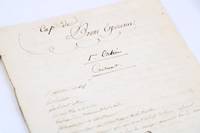
1830ref. 91260n. l.: s. n. 1830. Fine. s. n. n. l. s. d. 1830 16.3 x 20.6 cm En feuilles sous chemise et étui Anonymous manuscript of 23 pages complete as this first notebook accompanied by a title leaf bearing a manuscript table of nine articles and entitled Cap de Bonne Espérance. 1er cahier. The title identifies it as a first notebook although no continuation accompanies the present group. On one page the text shows a visible revision with a word crossed out and corrected; the manuscript therefore appears to be a working draft rather than a final fair copy. A small brown stain affects one page of the arrival narrative without impairing legibility. The manuscript is preserved in loose sheets within a half dark blue morocco folder with marbled-paper boards housed in a matching slipcase edged in dark blue morocco with marbled-paper sides and a gilt title to the spine. The manuscript captures the Cape at a moment of transition that is still clearly visible: the port is now British the gun salute is negotiated with the governor and the English flag answers that of the ship. In the town however the author still finds traces everywhere of the former Dutch colony. This overlap of administrations languages and customs gives the account its particular character: the traveller is discovering not so much a new city as a territory that has only recently passed from one empire to another. Alongside these political and urban observations appears another face of the Cape more social and more familiar to European travellers: Constantia. The wine he tastes there already belongs to a genuine geography of prestige served on European tables and even during Napoleons exile on Saint Helena. The manuscript thus moves from military ceremony to the sociability of the wine estates and then to the landscape itself with the ascent of Table Mountain. Within the few pages of this notebook the Cape appears in turn as a British port a former Dutch town a French stopping place a celebrated wine district and a spectacular landscape. More than a simple account of a stopover the text preserves a very concrete portrait of a place still divided between several histories. To our knowledge unpublished this notebook thus offers a first-hand account of the Cape probably written in the 1820s at a time when British administration was already firmly established while the town still retained everywhere the imprint of its Dutch past. s. n. hardcover
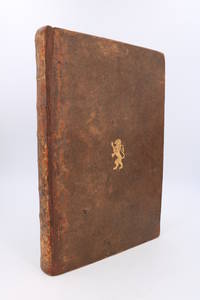
1750ref. 90724n. l.: s. n. 1750. Fine. s. n. n. l. s. d. 1750 20.5 x 31 cm Relié Folio manuscript from the second half of the 18th century comprising 2 unnumbered leaves and 258 foliated pages containing extracts and summaries of royal orders and dispatches of the Conseil de Marine from September 1715 to March 1723. The volume therefore covers the entire period of activity of this institution created at the beginning of the Regency as part of the polysynody and maintained until its disappearance in 1723. Contemporary restored full tan calf. Smooth spine decorated with gilt compartments and gilt tools partly faded lettering-piece lacking a gilt rampant lion stamped at the centre of each board marbled-paper endleaves and pastedowns double gilt fillets to the board edges. Rubbing and corners worn. The extracts are carefully dated and systematically accompanied in the margins by references to the register and folio of the original minutes from which they were taken. Such precision goes well beyond that of a simple scholarly compilation: it reveals a genuine archival survey and suggests that the compiler had direct access to the records of the Department of the Navy. The manuscript could thus serve as a practical reference tool allowing an earlier decision to be located rapidly without having to consult the complete original registers. Its contents are divided into nineteen principal headings: Admiralty; Armaments with subdivisions devoted in particular to the regulation of armaments the campaigns of 1716-1717 the war with Spain from 1718 to 1720 the Barbary powers and the Guinea coast; Artillery; Classes and Seamen; Colonies and Levant Ports; Commerce including Spain Portugal the South Guinea the African Company and the Compagnie des Indes; Shipbuilding and Refits; Finance; Coastguards; Honours Rank and Command; Justice Police and Discipline; Munitions Merchandise and Timber; Officers; Fisheries; Ports and Roads; Prizes; Salutes; Troops; and Provisions. The Conseil de Marine was established in September 1715 as one of the councils created by Philippe dOrléans in an attempt to associate the high nobility with government during the minority of Louis XV. Placed under the authority of the Comte de Toulouse it occupies an exceptional position in the history of the polysynody: when most of the other councils were abolished in 1718 the Conseil de Marine was retained and continued to function until 1723 when the kings majority brought the system to an end and naval administration reverted to a secretary of state. The present manuscript therefore follows almost day by day the activity of the last great council of the Regency. Its scope extends from the organisation of the fleet and dockyards to the recruitment of crews provisioning maritime justice prizes fisheries coastal defence the colonies and trading companies. Through this thematic arrangement emerges the full range of responsibilities exercised by a maritime state confronted with war colonial expansion and the reorganisation of overseas commerce. Several passages give the volume particular historical interest. It includes a detailed account of French British Dutch Danish and Carib possessions and settlements in the Lesser Antilles in 1723 together with instructions relating to religious regulation in the colonies. In the context of Franco-British cooperation the manuscript also records the dispatch of six hundred French seamen to reinforce Admiral Norriss squadron in the Baltic in 1719. Other extracts concern the great trading companies notably the Compagnie des Indes reorganised under Laws financial system in 1719. An early pencil note on the first flyleaf reads: Aux armes du Maréchal Duc de Duras de lAcadémie française. It most probably refers to Emmanuel-Félicité de Durfort fourth Duc de Duras 1715-1789 Marshal of France and member of the Académie française from 1775 whose substantial library was dispersed at auction in 1790. By virt s. n. unknown
1880ref. 840941880. Fine. A Rare Painted Shunga Album from the Early Meiji Period Preserved in Its Original Wooden Case s. d. 1880 21 x 24 cm Album en accordéon Unique album comprising ten original polychrome paintings on beige silk laid down on gilt paper with gilt and embossed floral endpapers. The final painting bears two red seals. Albums of this nature are almost invariably anonymous making the presence of such seals - possibly identifying either the artist or the workshop - particularly unusual. Each composition occupies a square of silk measuring 16.8 × 16.8 cm. With the exception of three scenes incorporating a hanging curtain or folding screen the compositions are devoid of background focusing entirely on the figures rendered with refined highly stylised draughtsmanship and a deliberately restrained palette of warm browns heightened with touches of red against a beige ground. Accordion album covered in blue silk decorated with gilt motifs. Preserved in its original two-part wooden case 24.5 × 28.5 cm the lid bearing a contemporary manuscript inscription; the manuscript label on the album rubbed. Corners worn with small losses to the silk rubbing to the gilt paper occasional soiling and faint marginal waterstaining to several paintings. The survival of the original storage case intended to conceal and protect an object of this nature is itself uncommon. The proposed dating circa 1880 remains necessarily tentative: as a unique painted object it cannot be securely dated by external evidence although the restrained style and simplified palette are entirely consistent with production during the Meiji period. The term shunga literally ""spring pictures""- ""spring"" being a traditional euphemism for sexuality in Japanese - designates Japanese erotic art as a whole. Before this designation became widespread painted and manuscript albums were commonly referred to as makura-e or ""pillow pictures"". Among the most celebrated works in this tradition is the Utamakura ""Poem of the Pillow"" the celebrated suite of twelve erotic prints published in 1788 attributed to Kitagawa Utamaro and issued by Tsutaya Jzabur now preserved among other institutions at the British Museum and widely regarded as one of the masterpieces of the genre. Although the paintings in the present album retain several defining conventions of shunga - most notably the deliberate exaggeration of the genitalia and the use of drapery simultaneously to conceal and reveal the body - they stand apart through the exceptional refinement of their execution. Far removed from the more demonstrative character of Edo-period erotic woodblock prints they favour an economy of line a deliberately restrained chromatic range and compositions in which male and female figures are accorded an unusually balanced presence. This restraint lends the album an elegance of remarkable distinction. The Meiji period 1868 - 1912 marked by a programme of Westernisation and public moral reform witnessed the gradual introduction of increasingly restrictive legislation concerning erotic imagery with the first censorship measures appearing as early as 1869. Combined with the growing popularity of Western-style erotic photography this changing cultural climate helps explain the rarity of painted albums from the period few of which bear signatures or dates many eventually finding their way into European and American collections during the height of the Japonisme movement. A rare survival of the painted shunga tradition at the dawn of the Meiji era this unique album combines the rarity of an original hand-painted work preserved in its original wooden case with a level of artistic refinement seldom encountered among the better-known Japanese erotic prints. unknown
2006ref. mon0000099883Public Health Institute 2006-01-01. Spiral-bound. Good. 0.2000 in x 8.9000 in x 6.9000 in. 2004 Spiral-bound Paperback. Pages are in nice condition. Some minor surface/edge wear to cover. Public Health Institute unknown
2024ref. Gyan-9788121271240Gyan Publishing House 2024. 28 Vols. In 52 Bindings. Hardcover. New. 28.94 x 22.59 x 208.78 cm. English Gyan Publishing House hardcover
2024ref. Gyan-9788121271240Gyan Publishing House 2024. 28 Vols. In 52 Bindings. Hardcover. New. 28.94 x 22.59 x 208.78 cm. English Gyan Publishing House hardcover
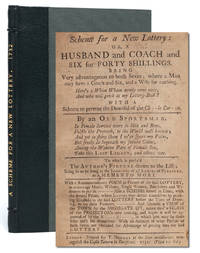
1732ref. 6120London: Printed for T. Dormer 1732. First edition. Modern quarter morocco over cloth with gilt to spine. Measuring 180 x 111mm and collating complete including frontis folding game board and concluding woodcut: 2 62 2. From the collection of stage magician Ricky Jay with his bookplate to upper pastedown. Top margin trimmed close with consistent loss to running headers and occasional loss to page numbers with no other text effected. Pages somewhat toned with minor marginal chips but otherwise unmarked. A scarce satire playing both on the rising popularity of get-rich-quick schemes and on the economics of the marriage market the present is the only example to appear in the auction record. OCLC locates only twelve institutional copies. The present is the only example currently in trade. A Scheme for a New Lottery warns readers against the dangers posed by get-rich-quick schemes targeting large-scale scams like the recently burst South Sea Bubble sometimes called the world's first Ponzi scheme and the pawn-broking swindle of the so-called Charitable Corporation. These scams were appealing to ordinary people at a time when few were "successful in using wealth from trade to found a landed family" Rapp. Mocking both the conmen and the conned A Scheme satirically proposes "Another Lottery which may prove a general benefit to all concern'd; as there is no better Remedy for a Bite from a Mad Dog than the Liver of the Dog that bit." The proposed lottery filled with abstruse rules and convoluted promises ensures that the cycle continues. A Scheme also mocks marriage as a scam in which women could either make a wise match in a rich man or lose it all by marrying down. The lottery provides "Fifty Thousand tickets to be deliver'd to Maids or Widows or any that appear to be such" in the hopes of winning a financially stable husband represented by the tickets drawn. Such a match could be a good one: "A Ware-House Keeper with the Salary of a Hundred Pounds" or "the Governour." It could also by virtue of lottery be a loss: "2 Scotchmen both Pedlars 500 Broken Booksellers" and a range of other ruinous bounders are also listed as prizes. For those who desire an advance attempt the folding game bound in the book invites blindfolded women to stick a pin in the board to claim their prize. The present copy was played gently with pin marks revealing a Blacksmith and a Valet de Chambre among those husbands won The popularity of A Scheme resulted in a reissue the same year with a canceled title page as The Ladies Lottery and falsely attributed to Swift. ESTC N20921. Printed for T. Dormer unknown
1732ref. 6120London: Printed for T. Dormer 1732. First edition. Modern quarter morocco over cloth with gilt to spine. Measuring 180 x 111mm and collating complete including frontis folding game board and concluding woodcut: 2 62 2. From the collection of stage magician Ricky Jay with his bookplate to upper pastedown. Top margin trimmed close with consistent loss to running headers and occasional loss to page numbers with no other text effected. Pages somewhat toned with minor marginal chips but otherwise unmarked. A scarce satire playing both on the rising popularity of get-rich-quick schemes and on the economics of the marriage market the present is the only example to appear in the auction record. OCLC locates only twelve institutional copies. The present is the only example currently in trade. A Scheme for a New Lottery warns readers against the dangers posed by get-rich-quick schemes targeting large-scale scams like the recently burst South Sea Bubble sometimes called the world's first Ponzi scheme and the pawn-broking swindle of the so-called Charitable Corporation. These scams were appealing to ordinary people at a time when few were "successful in using wealth from trade to found a landed family" Rapp. Mocking both the conmen and the conned A Scheme satirically proposes "Another Lottery which may prove a general benefit to all concern'd; as there is no better Remedy for a Bite from a Mad Dog than the Liver of the Dog that bit." The proposed lottery filled with abstruse rules and convoluted promises ensures that the cycle continues. A Scheme also mocks marriage as a scam in which women could either make a wise match in a rich man or lose it all by marrying down. The lottery provides "Fifty Thousand tickets to be deliver'd to Maids or Widows or any that appear to be such" in the hopes of winning a financially stable husband represented by the tickets drawn. Such a match could be a good one: "A Ware-House Keeper with the Salary of a Hundred Pounds" or "the Governour." It could also by virtue of lottery be a loss: "2 Scotchmen both Pedlars 500 Broken Booksellers" and a range of other ruinous bounders are also listed as prizes. For those who desire an advance attempt the folding game bound in the book invites blindfolded women to stick a pin in the board to claim their prize. The present copy was played gently with pin marks revealing a Blacksmith and a Valet de Chambre among those husbands won The popularity of A Scheme resulted in a reissue the same year with a canceled title page as The Ladies Lottery and falsely attributed to Swift. ESTC N20921. Printed for T. Dormer unknown books
1930ref. 1715341930. HAENZI Erich. Farbenlehre. 23 Original watercolour plates some with multiple images. Folio 340 x 240 mm. original cloth. N.p.: n.d. ca. 1930. A wonderfully executed manuscript on colour theory by a Swiss commercial artist whose objective was to enhance the work of decorators fashion designers graphic artists and set designers. Divided into ten sections comprising colour and achromatic antagonism colour values light-dark antagonism cold-warm antagonism quality contrast intensity contrast quantity contrast complementary contrast simultaneous contrast and successive contrast. According to the seller the work is by a Swiss commercial artist named Erich Haenzi. hardcover
1930ref. 1715341930. HAENZI Erich. Farbenlehre. 23 Original watercolour plates some with multiple images. Folio 340 x 240 mm. original cloth. N.p.: n.d. ca. 1930. A wonderfully executed manuscript on colour theory by a Swiss commercial artist whose objective was to enhance the work of decorators fashion designers graphic artists and set designers. Divided into ten sections comprising colour and achromatic antagonism colour values light-dark antagonism cold-warm antagonism quality contrast intensity contrast quantity contrast complementary contrast simultaneous contrast and successive contrast. According to the seller the work is by a Swiss commercial artist named Erich Haenzi. hardcover books
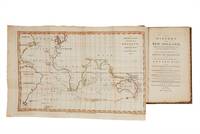
1787ref. 5001050London: John Stockdale 1787. Octavo with two folding maps hand coloured in outline; a very good copy edges uncut in contemporary calf gilt spine neatly repaired. An important book and a sometimes neglected precursor to the Australian First Fleet: this was one of the earliest descriptions of Australia published to coincide with the departure from England of the First Fleet. "It is an extremely interesting work and an essential inclusion in all comprehensive collections" Davidson. In discussing the fleet's imminent departure the anonymous compiler lists numbers and equipment as well as the principal officers and there is also material in both preface and text about transportation as well as an "Introductory Discourse" on the subject by William Eden which has often led to the misattribution of the whole book to him. This is an example of the important second edition published the same year as the first and after parliamentary approval of the Botany Bay plans and with a very significant new section: an additional ten prefatory pages appear for the first time in this edition discussing in detail the hopes for the new settlement. The anonymous writer reports that many of the convicts awaiting transportation have embraced the idea with excitement: "strange to tell! there have not been wanting voluntary candidates for banishment to that remote shore.". The "Eden" as it is often called was written "to present at one view a connected description of the whole country of New Holland". The book is clearly aimed at a public eager for information on the new colonial venture and for details of Botany Bay itself which is here described at length. This is the form in which many of the participants in the First Fleet must have absorbed what little information existed about conditions in Australia. The maps show the continent Botany Bay and most interestingly the "passage from England to Botany Bay in New Holland 1787" highlighting the route that the fleet must take. The book is of some importance too for its Cook material: as Cook's bibliographer Holmes points out "the greater part of the book is devoted to Cook's discoveries.". His charting of the east coast of Australia is here put into context in a form anticipating the actual settlement of the new coastline. . John Stockdale unknown
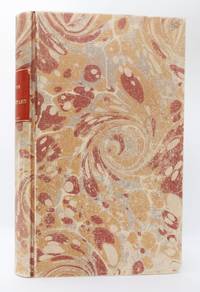
1727ref. 1405949London: W. Mears 1727. First Edition. Hardcover. Octavo 192 pages. In Very Good condition. Spine marbled paper with red textblock and gilt lettering. Fully bound in later marbled boards. Minor shelfwear and soiling. Textblock toning consistent with age. Minimal soiling. Bookplate pasted to inside of front board. GH consignment. Shelved in Case showcase. This work of early English viticulture printed for W. Mears is presumed to be authored by the 18th century botanical writer Richard Bradley 1688-1732 whose work Mears had published before. This text is exceptionally scarce especially in the original form. 1405949. Shelved Dupont Bookstore. W. Mears hardcover
1727ref. 1405949London: W. Mears 1727. First Edition. Hardcover. Octavo 192 pages. In Very Good condition. Spine marbled paper with red textblock and gilt lettering. Fully bound in later marbled boards. Minor shelfwear and soiling. Textblock toning consistent with age. Minimal soiling. Bookplate pasted to inside of front board. GH consignment. Shelved in Case showcase. This work of early English viticulture printed for W. Mears is presumed to be authored by the 18th century botanical writer Richard Bradley 1688-1732 whose work Mears had published before. This text is exceptionally scarce especially in the original form. 1405949. Shelved Dupont Bookstore. W. Mears hardcover books
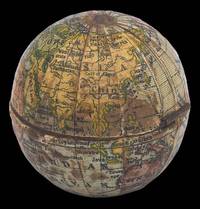
1850ref. 15729c1850. Diameter: 51mm 2 inches. Sign on the meridian line Globe hand-coloured engraved gores on two concave brass hemispheres hinged containing internal glass inkwell spring mounted seal gilt finish to interior flattened base. With old paper label to base. One or two inkstains. Prior to the widespread use of fountain pens in the late nineteenth century it was common to carry ink while travelling. Portable inkwells also known as travel wells or travellers were devised for this purpose. It was of the utmost importance for the design to prevent the ink inside the travel wells from leaking and the well itself was usually made from glass and concealed within a case. These cases took on many decorative forms including the present example designed as a globe. Geography The cartography is typical of Victorian maps but simplified with no relief shown on the land. The continents and many of the countries are identified by name along with some major rivers. unknown
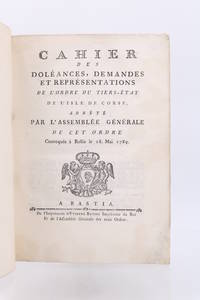
1789ref. 89656Bastia: Batini 1789. Fine. The Corsican Third Estates Cahier in French and Italian Batini Bastia 2 juin 1789 16.3 x 22.4 cm Broché Rare first bilingual edition of the cahier of grievances of the Third Estate of Corsica printed in Bastia in 1789 by Étienne Batini Printer to the King and to the General Assembly of the Three Orders. One quarto volume of 75 pages on laid paper. The French text printed in roman type faces its Italian translation in italic under the title Quaderno delle doglianze dimande e rappresentazioni dellOrdine del Terzo Stato dellIsola di Corsica. The title-page bears a vignette of the arms of Corsica a Moors head surmounted by a royal crown and supported by two winged genii; an ornamental initial opens each version. Cf. Starace 4747; Conlon XXIV 89:1617 who records only the 32-page octavo edition. Not in Roland Bonaparte. Original stitched state in plain grey-paper wrappers. A few paper repairs to the lower right margins of the opening leaves; foxing to the upper and lower right corners without affecting the text. A well-preserved and attractive copy. French and Italian printed facing one another reflect very concretely the situation of Corsica in 1789: having passed under French sovereignty after the Treaty of Versailles of 1768 the island still remained deeply connected with the Italian language in its written culture. French and Italian face one another page by page while the Moors head emblem of Corsica appears on the title-page: the very form of the book thus brings together several allegiances at a moment when the political order was being transformed. The general assembly of the islands three orders opened in Bastia on 18 May 1789 in the church of the Fathers of Christian Doctrine. The Third Estate adopted this cahier at the beginning of June; a few days later Christophe Saliceti and Pierre-Paul Colonna de Cesari Rocca were elected deputies with Barthélemy Arena and Ange Chiappe as substitutes. The text opens with an unequivocal declaration: the Third Estate professes its vive joie at seeing Corsica réunie à la Nation Française and become an integral part of this Monarchy. This adhesion did not however erase the islands own demands. Alongside claims common to many cahiers throughout the kingdom - regular meetings of the Estates-General freedom of the press judicial reform and access for the Third Estate to offices - appear measures specific to Corsica: the right for Corsican ships to display the Moors head the establishment of a lazaretto for Levantine trade the creation of a free port preference in appointments for Corsicans and French residents of the island and finally the restoration at Corte of a university funded by the revenues of religious houses. Six months later on 30 November 1789 the Constituent Assembly decreed on Salicetis motion that Corsica formed part of the French Empire. The text therefore affirms at once Corsicas adhesion to France and the continued assertion of demands specific to the island. Printed in Bastia in both French and Italian this cahier gives particularly tangible form to Corsicas position in 1789: an island now incorporated into the French political framework while still retaining in its language emblems and demands a distinct identity of its own. Batini unknown
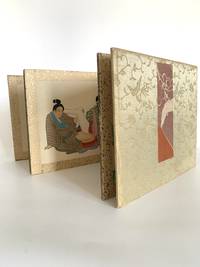
1920ref. 734821920. Fine. 1920 16 x 19 cm Album en accordéon sur soie An album containing 14 gouaches on silk including 12 erotic paintings. The first painting on each side of the folding shows a bird and on the other side maple leaves thus masking on each of the first pages the erotic aspect of the collection. Shunga is the generic Japanese term that designates erotic art it literally means Spring Image spring being a euphemism and figure of style expressing sexuality. The term Shunga having been reserved for a long time for prints collections or albums have often been designated by the appellation Pillow Books or notes for the pillow etc. Utamaro: The Song of the Pillow 1788. Japanese accordion album covered with damask silk with flowers and birds in pale gold. Silk band on the first cover serving as a label but mute. Each painting 12.8x16cm is mounted on cardboard. The cardboard folding sections are covered with cream paper speckled with gold. Very fine condition edges rubbed with small lacks to fabric. The paintings respect the canons of Japanese erotic representation: oversized genitals body hair women with white skin and men of flesh color. No decorative element comes to distract the eye from the sexual act only one painting contains a mirror the bodies being most of the time clothed in rich kimonos. These collections were still in the modern era offered to newlyweds particularly to women. The whole is of fine workmanship the 2 introductory paintings the bird and the maple leaves are particularly successful. This type of representation was forbidden in Japan and therefore contains no signature it is however evident that there existed painters whose profession and specialty this was and whom one went to see for private commissions; it is also not forbidden to think that the painter made several on his own initiative and that he offered them for sale as was done with collections of colored photographs at the end of the 19th century. Precious and rare ensemble in superb condition. hardcover
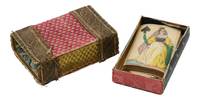
1880ref. 140949222France: Unknown publisher 1880. Very Good. A suggestive set of translucent erotic playing cards likely created in France in the mid-19th century. Set consists of 35 hand-colored playing cards 32 of which are from around 1840 featuring 11 court cards 3.25 x 2.25" and three slightly larger cards 3.5 x 2.5" possibly from the late Victorian period. Housed in a much earlier handmade late-18th century sliding box 4.5 x 2.75" made from thin plywood with pasted decorative paper wrapped in voided velvet and trimmed with gold and silver metal silk woven ribbon. They were once a part of The Stuart and Marilyn Kaplan Playing Card Collection. Very Good. Cards are lightly bowed with general wear and light toning; four of diamonds is the most worn with creasing and small spot of loss to one of the corners.The box they are held in is quite fragile with tarnishing to the metal ribbon and slight soiling to velvet boards. Popular in mid-1800s France and often associated with brothels these cheap seemingly innocuous risque novelties were crafted with two pasteboard layers. When held to light favorably candle light they reveal hidden sensual often pornographic images. While the cards inside were economically manufactured the little box they are held in is rather sumptuously bedecked in high quality velvet and expensive gilt metal thread ribbon. The average layman did not have access to trim or fabric as seen here indicating that this may have been owned by a rather wealthy individual. It should be added that sets as generously populated as this even when mixed are uncommon and desirable curiosa objects. [Unknown publisher] unknown
1880ref. 140949222France: Unknown publisher 1880. Very Good. A suggestive set of translucent erotic playing cards likely created in France in the mid-19th century. Set consists of 35 hand-colored playing cards 32 of which are from around 1840 featuring 11 court cards 3.25 x 2.25" and three slightly larger cards 3.5 x 2.5" possibly from the late Victorian period. Housed in a much earlier handmade late-18th century sliding box 4.5 x 2.75" made from thin plywood with pasted decorative paper wrapped in voided velvet and trimmed with gold and silver metal silk woven ribbon. They were once a part of The Stuart and Marilyn Kaplan Playing Card Collection. Very Good. Cards are lightly bowed with general wear and light toning; four of diamonds is the most worn with creasing and small spot of loss to one of the corners.The box they are held in is quite fragile with tarnishing to the metal ribbon and slight soiling to velvet boards. Popular in mid-1800s France and often associated with brothels these cheap seemingly innocuous risque novelties were crafted with two pasteboard layers. When held to light favorably candle light they reveal hidden sensual often pornographic images. While the cards inside were economically manufactured the little box they are held in is rather sumptuously bedecked in high quality velvet and expensive gilt metal thread ribbon. The average layman did not have access to trim or fabric as seen here indicating that this may have been owned by a rather wealthy individual. It should be added that sets as generously populated as this even when mixed are uncommon and desirable curiosa objects. [Unknown publisher] unknown books
ref. 16356Italy: n.p. n.d. Ruled manuscript notebook with engraved frontispiece. Preface and discourse in two parts. Contemporary black roan and preserved in a black roan-backed box. The text is very clean. A handsome copy. With the bookplate of Roberto Gabbani engraved by Costante Costantini. A discourse in the form of a mock-address to an educated and learned public of women. The author is inspired to write this praise after he had accidentally stepped onto a pile of excrement. He addresses the ladies and in the first part theorizes the ancient and noble origins of defecation from the beginning of time with Adam and Eve. The object of his ode is universal and unites all peoples of the world. The second part is devoted to the usefulness and benefits of excrement: it’s healthy nourishes the trees and the soil and provides work to those that transport it from cities to villages. The author ends his tribute talking to ### directly inviting her/him not to blame humans that don’t appreciate her/him. Costantini Florence 1921-2006 was an Italian engraver illustrator and writer. His talent for drawing was sharpened by his studies and by trips abroad in his youth. In Vienna he became a friend of Kokoshka’s and in Paris he followed courses at the Grande Chaumière Academy. He is noted for his elegant woodcuts and his intaglio prints made from punched metal plates. He was awarded several prizes in both fields. n.p. unknown
ref. 16356Italy: n.p. n.d. Ruled manuscript notebook with engraved frontispiece. Preface and discourse in two parts. Contemporary black roan and preserved in a black roan-backed box. The text is very clean. A handsome copy. With the bookplate of Roberto Gabbani engraved by Costante Costantini. A discourse in the form of a mock-address to an educated and learned public of women. The author is inspired to write this praise after he had accidentally stepped onto a pile of excrement. He addresses the ladies and in the first part theorizes the ancient and noble origins of defecation from the beginning of time with Adam and Eve. The object of his ode is universal and unites all peoples of the world. The second part is devoted to the usefulness and benefits of excrement: it’s healthy nourishes the trees and the soil and provides work to those that transport it from cities to villages. The author ends his tribute talking to ### directly inviting her/him not to blame humans that don’t appreciate her/him. Costantini Florence 1921-2006 was an Italian engraver illustrator and writer. His talent for drawing was sharpened by his studies and by trips abroad in his youth. In Vienna he became a friend of Kokoshka’s and in Paris he followed courses at the Grande Chaumière Academy. He is noted for his elegant woodcuts and his intaglio prints made from punched metal plates. He was awarded several prizes in both fields. n.p. unknown books
1928ref. 002034Hvidore: s. n. 1928. Softcover. Original silver gelatin photographic postcard of the Empress sitting on a padded bench in her garden holding an umbrella and a bouquet of flowers; 5 x 3 1/4; minor wear to corners and image; a bit of age-toning and a manuscript note in pencil to verso; near fine condition. Signed in ink: "Maria Hvidore" in the lower half of the photo. Possibly one of Maria Feodorovna's last photographs the anonymous note on the back stated: "The Empress sent me this not long before she passed away at Hvidore." Empress Consort of Russia Maria Feodorovna 1847 – 1928 christened Dagmar was the wife of Tsar Alexander III and mother of Emperor Nicholas II of Russia whom she outlived by ten years. The second daughter of King Christian IX of Denmark and Louise of Hesse-Cassel she was bethroted to Tsarevich Nicholas Alexandrovich of Russia but after his death from meningitis in 1865 Maria honored his last wish and married his younger brother the future Alexander III. She converted to Orthodoxy and became Grand Duchess Maria Feodorovna of Russia. With Alexander II's assassination in 1881 she and her husband were crowned Emperor and Empress of Russia. After Alexander III's death in 1894 she became Dowager Empress and her son Nicholas II and his wife Alexandra were crowned the new rulers. The outbreak of the Revolution in 1917 forced her to travel to Crimea where she received the devastating news that her sons daughter-in-law and grandchildren had been murdered. She refused to believe it and declared it a rumor. Although the monarchy would be overthrown she would not leave Russia until 1919 - first to London and eventually to her native Denmark where she would settle in Hvidore a former country house near Copenhagen. Maria died on October 13 1928 at the age of 80 having outlived four of her six children. Hvidore: s. n. paperback
1928ref. 002034Hvidore: s. n. 1928. Softcover. Original silver gelatin photographic postcard of the Empress sitting on a padded bench in her garden holding an umbrella and a bouquet of flowers; 5 x 3 1/4; minor wear to corners and image; a bit of age-toning and a manuscript note in pencil to verso; near fine condition. Signed in ink: "Maria Hvidore" in the lower half of the photo. Possibly one of Maria Feodorovna's last photographs the anonymous note on the back stated: "The Empress sent me this not long before she passed away at Hvidore." Empress Consort of Russia Maria Feodorovna 1847 – 1928 christened Dagmar was the wife of Tsar Alexander III and mother of Emperor Nicholas II of Russia whom she outlived by ten years. The second daughter of King Christian IX of Denmark and Louise of Hesse-Cassel she was bethroted to Tsarevich Nicholas Alexandrovich of Russia but after his death from meningitis in 1865 Maria honored his last wish and married his younger brother the future Alexander III. She converted to Orthodoxy and became Grand Duchess Maria Feodorovna of Russia. With Alexander II's assassination in 1881 she and her husband were crowned Emperor and Empress of Russia. After Alexander III's death in 1894 she became Dowager Empress and her son Nicholas II and his wife Alexandra were crowned the new rulers. The outbreak of the Revolution in 1917 forced her to travel to Crimea where she received the devastating news that her sons daughter-in-law and grandchildren had been murdered. She refused to believe it and declared it a rumor. Although the monarchy would be overthrown she would not leave Russia until 1919 - first to London and eventually to her native Denmark where she would settle in Hvidore a former country house near Copenhagen. Maria died on October 13 1928 at the age of 80 having outlived four of her six children. Hvidore: s. n. paperback books
1798ref. FLO147Six volumes only of this rare eight-volume set. Vol. VIII was discontinued after only 4 issues with 12 plates. With 352 hand-coloured engraved plates of 360. Incomplete set of this rare handy pocket-sized edition of 18th century natural history describing many newly discovered species. Text and plates copied from accounts published by Count Buffon George Edwards George Shaw James Bruce Thomas Pennant Maria Sybilla Merian and others. Includes the extinct dodo and sukotyro endangered animals and birds Siau Island tarsier white rhinoceros polar bear Indian bustard great green macaw wild water buffalo banded cotinga Russian mink African grey parrot. Also notable for the early images of plants and animals discovered in New South Wales Australia short-beaked echidna kangaroo black swan eastern quoll waratah Banksia etc. Half contemporary calf with red and black morocco gilt spine labels marbled boards scuffed front board off Vol. VI. Some plates loose or trimmed foxing and finger-marks to text and plates. Harrison, Cluse and Co. hardcover