ANONYMOUS; PARISABAA
211.041 resultados
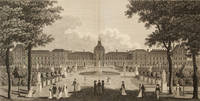
1816ref. 1435761816. PARIS. Graphic Illustrations of the Most Prominent Features of the French Capital; with Characteristic Figures in the Foregrounds comprised in Twelve Stroke Engravings From Accurate Designs Taken in Paris during the Imperial Reign of Buonaparte. With Descriptive Notices and Interesting Anecdotes. 26 pp. Illustrated with 12 double-page engravings. Folio 430 x 380 mm bound in contemporary French three-quarter black morocco over marbled boards gilt title and floral vignettes on spine paper label with ms. number "20" on front cover and spine. London: Harper and Co. 1816. A fine copy of this extremely rare collection of views of Paris consisting of twelve artistically-conceived views of Paris engraved by English artists. The large double-page engravings incorporate local Parisians participating in daily routines within the setting of each view. Panoramic views include: the Military School and the Church of the Invalides; View of Paris from the South Boulevard; View of Paris from Montmartre; South View of the Old and New Louvre; The Mint and The Façade of the Louvre; View of La Place de la Concorde; The Garden of the West Front of the Tuileries; Palace of the Tuileries Facing La Place du Carrousel; Garden of the Tuileries; The Luxembourg or Palais du Senat with the Gardens; The Elysian Fields Distant Gardens of the Tuileries; Entrance to Les Champs Élysées and La Place de la Concorde. Each plate is followed by two pages of text giving historical details and anecdotes about the site illustrated. Minor wear to outer edges of binding plates and text clean. Rare: OCLC lists 6 copies worldwide of which only one is held in America Bowdoin College. hardcover books
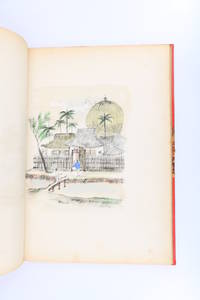
1885ref. 89859No Location: s. n. 1885. Fine. Superb collection of 49 original watercolours offering a rare and valuable glimpse into Tonkin at the dawn of the French protectorate s. n. No Location s. d. 1885 23 x 32.5 cm Relié No publisher no place no date 18851890. Quarto 32.5 × 23 cm 1 blank leaf and 49 unnumbered leaves. Contemporary half red percaline over corners smooth spine covered in red shagreen pebble-grain paper-covered boards blue paper endpapers. An exceptional collection of 49 original unsigned watercolours each measuring approximately 20 × 15 cm within the margins finely executed in Indian ink and watercolour with gouache highlights mounted on guards. Several leaves bear the watermark ""Latune et Cie Blacons"" that of a paper mill in the Drôme region active throughout the final third of the nineteenth century. Rubbing to the spine a few marginal spots of foxing. Accompanied by a strip of tawny calf 4 × 32 cm inscribed in manuscript: ""Souvenir du Tonkin 1885-90"". The iconographic programme offers a remarkable panorama of rural Tonkinese society at the dawn of the French protectorate. It encompasses guard posts and Tonkinese riflemen wearing the traditional salacco agricultural scenes - ploughing rice transplanting and harvesting- weaving the transport of produce fishing religious and funerary ceremonies scenes of justice - including corporal punishment and executions - as well as a variety of leisure pursuits among them cockfighting wrestling hunting and groups of musicians. Western presence appears only once in the form of a steamship glimpsed in the background of a riverside scene a discreet indication of a colonial authority still in its infancy. The album belongs to the years immediately following the Treaties of Hu 1883 and 1884 and the Treaty of Tientsin of 9 June 1885 which established the French protectorate over Tonkin. The Tonkinese rifleman who opens the series belongs to a corps only recently created while the many scenes devoted to the daily activities occupations and customs of the local population reveal a genuine documentary purpose. Through their precision and close observation of everyday life these watercolours anticipate on a more modest scale the vast ethnographic survey that Henri Oger would undertake in Hanoi some twenty years later for his Technique du peuple annamite. Remarkable both for its scope and its coherence this collection constitutes an exceptional visual record of Tonkin during the earliest years of the French protectorate predating by several decades the major ethnographic surveys of the early twentieth century. s. n. hardcover
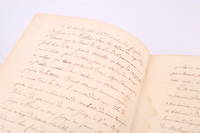
1830ref. 896041830. Fine. Original manuscript logbook of a French naval officer 18121823: privateering naval engagements and voyages aboard the Rubis Aréthuse Illyrienne Hermione and other vessels s. d. 1830 19 x 24.6 cm Relié Unpublished manuscript logbook kept by a French naval officer an eyewitness to the celebrated action between the Aréthuse and HMS Amelia 1813 and to the campaigns that accompanied the restoration of French authority in the West Indies. Unpublished autograph manuscript of 189 pages the first 31 paginated the remainder unnumbered kept by an anonymous French naval officer and covering without interruption the period from 25 November 1812 to 4 May 1823. Contemporary half tan calf smooth spine decorated with repeated gilt rolls and naval ornaments burgundy calf lettering-piece brown paper-covered boards. Spine renewed and restored occasional waterstaining affecting the greater part of the leaves. The manuscript opens with the technical particulars and crew list of the frigate Le Rubis commanded by Commander Ollivier capitaine de frégate followed by those of the Aréthuse under the command of Captain capitaine de vaisseau Bouvet. It then begins on 25 November 1812 a day-by-day journal from the departure of the two frigates from the roads of Saint-Nazaire. Over the course of the following decade its author served successively aboard the Rubis the Aréthuse the Illyrienne the Hermione the transport vessel La Normande - on which he completed two campaigns - the brigs L'Isère and Le Railleur and finally the corvette L'Hébé. Exceptionally rich in nautical detail - manoeuvres courses steered sea conditions and vessels encountered or captured - the narrative unfolds in two distinct phases. The first recounts the commerce-raiding campaign waged against British shipping off the Cape Verde Islands and the West African coast between 1812 and 1814. The second follows its author to the West Indies North America the Indian Ocean and the Mediterranean through a succession of missions that intersect with several notable episodes of the period: the restoration of French possession of Guadeloupe in December 1814 the transport of troops to the colony in 1816 an oath of allegiance to Napoleon sworn at New York in May 1815 an anchorage at Bourbon Island in June 1817 and a passage off Gibraltar in June 1819. Extracts: On the 28th November 1812 we captured an English brig . The Aréthuse took possession of her and lost one of her boats the sea being too rough. The vessel of about 200 tons mounted 8 guns and carried a crew of 12 men. She was laden with dried fruit and was sailing from Málaga to London; she also carried Alicante wine. The commanding officer of the Rubis ordered her to be set on fire the sea being too rough for anything to be salvaged . On the morning of the 12th December the Aréthuse boarded an American schooner bound from New York to Nantes laden with cotton and coffee; she was allowed to continue her voyage after taking our letters for France. pp. 5-7. On 24 December we captured a large Portuguese three-master. She was called the Delfina of 400 tons sailing from Lisbon to Pernambuco present-day Recife Brazil laden with wine cloth trade goods and carrying 40 passengers; she had a crew of 30 men and mounted ten 8-pounder guns. p. 9. On 6 February 1813 the Aréthuse having pursued an English frigate with advantage until evening lost sight of her during the night and did not regain contact until the following day . When she had come within pistol-shot the Aréthuse fired a broadside to which the enemy replied . The action lasted from 7.45 until 10 o'clock the fire of the Aréthuse proving superior to that of the English frigate. Captain Bouvet then attempted to board her in turn but with his braces and bowlines cut and his rigging and sails riddled with shot he was unable to reach the enemy . In the course of the eng hardcover
1840ref. 038511United States: M.M. Noah & A.S. Gould 1840. First Edition Thus . Leather Bound. Good/NO Dustwrapper. 8vo - over 7¾" - 9¾" tall. Referred to in Joshua and Second Samuel & APOCRYPHA. Preface by M. M. Noah.THE BOOK OF JASHER or Sefer Hayashar: Faithfully Translated from the Original Hebrew into English. One of the Sacred Books of the Bible with Certificates of authenticity and several Prefaces. APOCRYPHA No title page Second text and also one of the many Sacred Books of the Bible lost hidden or suppressed and omitted from the Bible. Handwritten notes at the beginning of the Apocrypha "FW Briggs Eton College 1831; M.A. Hayes Windsor Cloisters 1834" seem to indicate that this is 2 books bound into one. First Edition Thus. M.M. Noah & A.S. Gould New York USA 1840. ii xxiv 268 232pp hb No Dust-wrapper ornate gilt full calf-leather with raised seams aeg front cover semi-detached covers rubbed & scraped pages browned part of title label missing contents sound scarce book. overall good M.M. Noah & A.S. Gould hardcover
1830ref. 89604s. d. [1830] | 19 x 24.6 cm | Relié
ref. 3240France c. 1700. Two volumes complete. AN ENTIRELY UNKNOWN UNPUBLISHED AND COMPLETE EXEGETICAL MANUSCRIPT BY A CONTEMPORARY OF BOSSUET CALMET LE CLERC AUSTRUC RICHARD SIMON CAPELLUS GROTIUS AND GUYON. Volume I: 1 leaf; 592 pp. Volume II: 1 leaf; 360 pp; 2 blank leaves; 324 pp. Written in ink in a very fine accomplished almost calligraphic hand on extremely fine thick laid paper. Volume I and the first half of volume II is a verse-by verse commentary on Ezekiel; the second half of volume II is a commentary on selected chapters of Daniel. While this manuscript was created during an important period perhaps the most important period in the history of biblical exegesis it is entirely original and very different from all published exegeses. 4to. BEAUTIFULLY BOUND IN CONTEMPORARY FRENCH CALF SPINES RICHLY GILT IN SIX COMPARTMENTS morocco spine-labels. Marbled endleaves. Minimal wear to extremities of bindings else FINE AND BRIGHT. Unique and important. France, c. 1700 unknown
1710ref. 86508Edinburgh: Various. Very Good. 1710-1717. Leather. Compilation Bound Together of 12 Books/Pamphlets Etc From Early 1700's About Religious Persecution in Eng. & Scotland; PROFESSIONALLY REBOUND IN FINE LEATHER WITH RAISED BANDS GILT LETTERING AND NEW MARBLED BOARDS AND ENDPAPERS. GORGEOUS!! VERY VERY SCARCE!! The title continues: "More particularly her approving of and going into the legal establishment of the Prelatic constitutions of England. The generality of ministers swearing in the Oath of Abjuration to maintain Erastianism Prelacy and English Popish Ceremonies. Non-Jurants joining with Jurants judicially approving that practice to be free of scandal. The Church's establishing tyranny in government against all who will not join in communion with her and approve her practices without redress of grievances. Wherein these and several other causes of withdrawing are proven to be justly chargeable on the Church demonstrated to be contrary to the Word of God and Reformed principles of this Church and just grounds of withdrawing and setting up judicatures distinct from her; and the objections of Jurants and others fully answered."This is a classic detailed statement of the old covenanted principles and the biblical attainments of the second Reformation like the Solemn League and Covenantthe Westminster standards etc. It is also an excellent defense against the modern malignants who counsel Christ's children to remain in the backsliding and covenant breaking denominations that abound in our day. This constitutes 264 pages. The next largest ones bound in this book is: SHIELDS ALEXANDER. A true and faithful relation of the sufferings of the Reverend and learned Mr. Alexander Shields minister of the Gospel.; 772 pages . Various hardcover
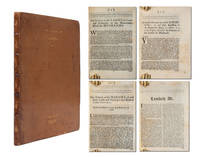
1693ref. 4178London: Various 1693. First editions. Late 18th - early 19th century full polished calf with gilt to spine and front board. Marbled endpapers. A pleasing square copy with just a bit of rubbing to extremities. Gilt and embossed bookplate of bibliophile Edward Hailstone 1767-1851 to front pastedown. Containing four complete exceedingly scarce pamphlets from the 17th century querelle des femmes debates about women's humanity and place in society interleaved with blanks likely for manuscript glossing although all remain unmarked. Comprised of: 1. Petition of the Ladies of London and Westminster to the Honourable House for Husbands. London: Printed for Mary Want-man the fore-maid of the petitioners and sold by A. Roper in Fleetstreet 1693. First edition. Complete including all four pages called for by ESTC and listing its imprint in the colophon. ESTC records only 8 copies with only 3 listed in the modern auction record since 1940. 2. An Humble Remonstrance of the Batchelors in and about London.in Answer to the Late Paper Intituled A Petition of the Ladies for Husbands. London: Printed for and Sold by the Bookselling Batchelors in St. Paul's Churchyard 1693. First edition. Complete including all four pages called for by ESTC and listing its imprint in the colophon. In all a clean and neat copy of this scarce and important part of the debate on women. ESTC lists only 8 extant copies with only 2 listed in the modern auction record. ESTC R4393. 3. The Petition of the Widows in and about London and Westminster for a Redress of their Grievances. By the Same Solicitor that Drew up The Petition for Ladies. London: Printed for the Use of the Wide--ows 1693. First edition. Complete including all four pages called for by ESTC with the imprint appearing at the rear colphon. A scarce piece recorded at only 7 institutions by ESTC and recorded only twice at auction since 1927. ESTC R25582. 4. Lambeth Ale. London: Printed for Abel Roper 1693. First edition. Complete in four pages with the imprint recorded on the rear colophon. With no listing on ESTC and no appearances at auction a truly scarce piece. A unique opportunity to trace a string of direct argument-and-response publications rapidly produced within one year of the 17th century querelle des femme pamphlet wars. Brought together in one binding by solicitor and bibliophile Edward Hailstone whose remarkable library at Walton Hall included rare books and antiquities. The Querelle des Femmes the Woman Question was a debate on women's status that raged across Europe and England through the 16th to 18th century depicted at times in drama and literature but most often enacted through broadsides and pamphlets. While early iterations of the debate focused on whether women were humans or indeed possessed souls emphasis began shifting as an increasing number of women began printing responses of their own. In this collection's first pamphlet "Mary Want-man the fore-maid of the petitioners" the anonymous female author draws attention to the negative impacts that misogynist bolster lectures have had on the general state of matrimony. By labeling women as natural harlots predestined to cuckold their husbands the Petition alleges polemicists endangered women and men alike: the former would lack economic and legal security without a spouse and the former would turn to drink and debauchery. "Mary Want-man" in this sense turns the tables on the terms of the debate. Men are morally weak without a helpmeet and need wives -- and women are placed at social disadvantage by the rules that define them as men's companions. To this end the Petition sets out the demand that men be required to marry much as women have been and that they meet five terms: "First that all men of Quality and Degree soever shall be obliged to marry as soon as they are one and twenty and that those persons who decline so doing shall for their Liberty as they call it pay yearly to the State.Secondly that no Excuse shall be admitted but that of natural Frigidity or Impotence.Thirdly since it is found by experience that the generality of young men are such Idolators of the Bottle.that no person whatsoever shall be privileged to enter a Tavern who is not married.That every Poet or pretender to be a poet or anyone who is hired to write .to the derogation of the Matrimonial State shall be obliged to marry before Lady day ensuing.Lastly.every person of Quality pretending to keep a Miss.must dispose of her in Marriage to his Footman or Groom." Biting and witty this feminist satire suggests that men must be corralled and that marriage is the means by which to do it thus also ensuring stability for women. Soon after the "Bookselling Batchelors" engaged "Mary" with their own publication -- and in attempting to break down the Petition's satirical arguments An Humble Remonstrance relies on many of the misogynistic commonplaces that the Ladies decried. And in its conclusion Remonstrance teases the possibility that women were right about men's current debauched tendencies shifting The Petition's desire for social instability to one of bawdy fulfillment for men's benefit. "The Ladies are weary of lying alone and so are we: They would fain be advantageously married and so would your humble Servants. The Quarrel on their side is therefore unjustly begun.but because Jacob could serve two Apprenticeships for his Rachel they imagine that we must do the same; not considering that the Race of Methuselahs and Patriarchs is quite extinct." Unwilling to be outdone the women clap back; and a pamphleteer claiming to represent the interests of the region's Widows joins the printed fray. "Last week a petition subscribed by the unmarried Ladies came before you.Tis true we wondered to find an Army of Maids from whom the world usually expects modesty and silence.Widowes indeed who lye under no such restrictions are allowed to speak for themselves." Thus the Widows point out a crucial and problematic differentiation among women based on marital status: the division of the femme covert unmarried or married women with legal identities subsumed by fathers or husbands under coverture versus femme sole orphaned or widowed women with more independent legal and social status. To this end the widows recognize the need of the Maids to raise concerns about the issues most affecting them; while the more empowered widows can build on this foundation and push for a further expansion of rights. While the final pamphlet of the group is not a direct engagement with the others it does suggest the collector's own interest in the role alcohol plays in much of the behavior decried by women in these works. An opportunity unlikely to arise again for acquiring three incredibly scarce directly related arguments released only weeks apart. Various unknown books
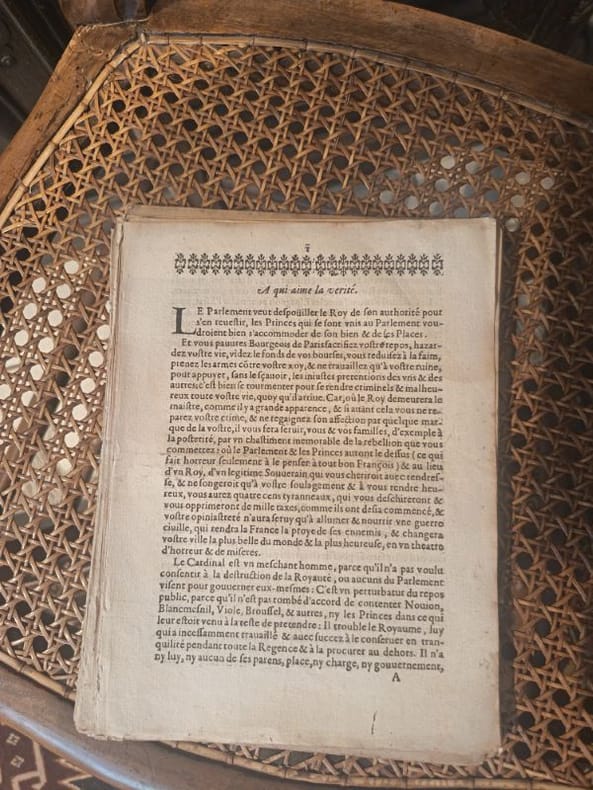
1649ref. LCI-60291649-1651 Voici une opportunité rare de posséder non pas des livres, mais des pièces d'archives intactes. Ces dix Mazarinades d'exception sont les munitions médiatiques de la Fronde, l'écho papier de la seule guerre civile française du XVIIe siècle qui vit la presse pamphlétaire triompher du pouvoir absolu. Elles offrent une immersion physique dans l'effervescence de Paris assiégé (1649–1651).Le véritable trésor ici réside dans la qualité muséale de ces feuillets : Ces imprimés, fragiles par nature, sont parvenus jusqu'à nous dans un état "excellent". Le papier, souvent de mauvaise qualité à l'époque car imprimé à la hâte, est ici étonnamment frais et propre. C'est une rareté qui témoigne d'une conservation sans altération durant près de 375 ans.Feuillets Libres Authentiques : La présentation en pages volantes réunit dans une pochette simple n'est pas un défaut, mais une preuve d'authenticité. Elle rappelle la manière dont ces pamphlets étaient distribués à la criée dans les rues de Paris, échappant à la reliure pour une diffusion maximale.La sélection inclut des pièces maîtresses : le Testament solemnel (la satire la plus célèbre) et la Déclaration du Roy (l'acte officiel d'interdiction de Mazarin), assurant à ce lot une valeur documentaire et collectionneur de premier planCes imprimés sont l'ADN d'une révolution médiatique. Pour l'amateur d'histoire, d'imprimés anciens ou de journalisme politique, ce lot représente un investissement dans un pan unique de notre patrimoine écrit.
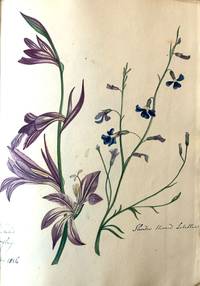
1812ref. G7542Original Watercolours of Plants Including American Small folio; contemp. half calf with title on spine "drawings of plants". Small folio.On front pastedown: "M.H. Speirs 1820. Beautiful album with 53 high-quality original watercolour drawings mostly with flower names in English or Latin and mainly dated from 1812 to April 1817. - 2 plates folded in the margins. Slightly foxed. Contemporary half leather spine rubbed. Predominantly with flower names in English and Latin and Format ca. 14-24: 10-17 cm; on firm paper chamois format ca. 28 : 18 cm. Illustrations of lilies and aloe as well as numerous American flowers "Virginian Dragonhead" "American Atragen" "Virginian Platonica" and many more "Chinese Epidendrum".
1822ref. 14997Guangzhou c1822. 302 by 500mm. 12 by 19.75 inches. Woodcut on paper mounted on wooden sticks. A rare Chinese fan depicting the provincial city of Guangdong province which is now part of Guangzhou city. Guangzhoufu Guangzhou prefecture is depicted at the centre encircled by city wall. The names of streets bridges temples forts rivers and mountains are marked in Chinese and represented by two-dimensional diagrams. Several famous sites can be identified on the map for example immediately below the middle of the top rim is depicted a pagoda and marked in Chinese: Wucenglou Five-Storied Pagoda which now is known as Zhenhailou Sea-Guardian Building. It is located in Yuexiu Park in central Guangzhou and now houses the Guangzhou Museum. It was first built in 1380 at the beginning of the Ming dynasty by the Yongjia Marquis Zhu Liangzu . The tower is 92 feet 25 meters in height 102 feet 31 meters in width and 52 feet 16 meters in depth. Above the lower rim to the left is a house with two floors symbolising a temple marked as " ". Haitongsi is a Buddhist temple and monastery on Henan Island in Guangzhou. The official English form of the name is 'Hoi Tong Monastery' a transcription of the Cantonese pronunciation of the Chinese translation of the Indian Buddhist monk S garadhvaja. The monastery was first established as the Qianqiu Temple under the Southern Han a tenth century Tang successor state whose capital was at Xingwang now Guangzhou. The walled city lay north of the Pearl River while Henan Island and the monastery lay to its south. By the end of the Ming the temple operated within the private garden of Guo Longyue who was responsible for renaming it after the Buddhist monk S garadhvaja. The temple complex was particularly important to foreign visitors as it was one of the few locations in Guangzhou Canton open to them before the First Opium War. unknown
1732ref. 59418Ca 1732. Hardcover. Very Good Solid Rebacked Retaining Lable Contents Clean Wear At Extremities and Loss To Top Of Original Spine And Along the Hinges Panel Decorated Partial Darkened Suede . Folio Six RAised Bands Suede Leather Royal Emblazonded Binding In Contmporary Calf Boards With Blind Roll-Stamps and Fleurons Coat Of Arms In The Middle Red Sprinkled Edges. Figures Large Lettered Caligraphic Headings. This Extensive Manuscript Appears Designed For Private Tutoring Young Men of Mathematical Calculation Navigation etc. Blank Pages At the rear This is a Rare Important Manuscript That Covers Major Areas Of Science Essential In The Training Of A Young Royal Destined To Be In The Navy. Coat of Arms Has Moto: Dieu et mon droit French for God and my Right. hardcover
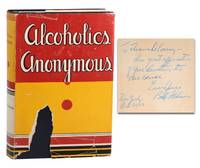
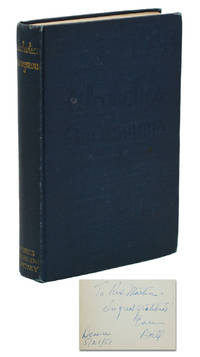
1950ref. 140949962New York: Works Publishing Inc 1950. Thirteenth Printing. Near Fine/Fair. First edition thirteenth printing. Signed by Bill Wilson and warmly inscribed on the front free endpaper "To Florence DeCoursey - In great appreciation of your devotion to our cause. Ever Yours signed Bill Wilson New York - Oct 31/50." Bound in publisher's dark blue cloth with titles stamped in blind on the upper board and in gilt on the spine. Near Fine with light wear and light lean to binding several small light water droplet stains to front cover boards worn through to several spots at top and bottom edges top corner bumped. In a tattered dust jacket missing a large piece from the bottom of the front panel. A foundational text of Alcoholics Anonymous colloquially called The Big Book signed by AA co-founder Bill Wilson. Works Publishing, Inc unknown
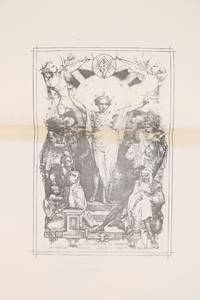
1870ref. 90176Paris: Teissier et Cie 1870. Fine. ""Extremely rare and probably unique collection of 38 lithographed Masonic plates"" Teissier et Cie Paris s. d. 1870 32.5 x 49.5 cm Relié Paris Teissier et Cie undated circa 1868-1870. Folio 38 leaves mounted on guards 32.5 x 49.5 cm. An exceptionally rare collection probably unique in this form comprising thirty-eight proofs and working states of lithographed Masonic plates most designed to be viewed across a double page. Numbered in red pencil from 1 to 40 in a discontinuous sequence including several bis plates. Caillet and Dorbon describe the Rameau d'or d'Éleusis to which part of this iconography relates but record no comparable independent corpus of working plates. Modern full black cloth plain spine printed title label mounted on the front board. Repaired tear in the left margin of plate 10; two marginal corner tears to plate 12 neither affecting the image. The plates bear the imprint of the Masonic bookseller Teissier et Cie and were lithographed principally by J. Rigal et Cie with several by A. Appert. Their preparatory nature is visible in the objects themselves: manuscript numbering bis plates corrections and most strikingly the pencilled instruction ""à effacer"" ""to be deleted"" on several compositions. The volume is therefore more than a collection of illustrations removed from a published book. It preserves traces of their production correction and circulation within the workshop. The opening sheets are dominated by the large allegorical compositions of Charles-Désiré Rambert several dated 1862. Beraldi specifically records a series for the Rameau d'or d'Éleusis under Rambert's name in that year. Jacques-Étienne Marconis de Nègre's work first published in 1861 was conceived as a vast synthesis of Masonic history rites degrees and symbolism. Its author was the leading exponent of the Rite of Memphis one of the so-called Egyptian currents of French Freemasonry. In the published Rameau d'or the illustrative apparatus was limited to a small group of major symbolic lithographs by Rambert. The present collection opens onto a much wider body of material: alongside compositions directly associated with that undertaking are designs for diplomas emblems and ornamental borders intended for other Masonic purposes. It thus allows us to pass from the finished book to the stock of images from which a specialist Masonic publisher could draw. Rambert was particularly suited to such imagery. A draughtsman and lithographer specialising under the Second Empire in allegorical decorative and visionary compositions he had developed since the 1840s a visual language in which symbols accumulate within large moral and philosophical scenes. Jean-Alfred Fournier who knew him remembered a man ""built like Hercules"" with a remarkably expressive face and ""the eyes of an inspired man"" a portrait later recorded by Beraldi. Alongside these images associated with the Rite of Memphis is a second group more directly connected with the institutional practice of Freemasonry. Several are designs for diplomas intended for the Grand Orient of Haiti founded in 1824; others refer to Rome or Venezuela. The same Parisian presses were thus producing both Marconis's initiatory imagery and official documents intended to identify ornament or legitimise brethren and lodges thousands of miles away. The Teissier firm stood at the centre of this circulation. Charles-Adolphe Teissier bookseller publisher and manufacturer and dealer in Masonic regalia was himself an officer of the Grand Orient de France. After his death in 1863 the business continued under the name Teissier et Compagnie. Some sheets still bear the address 37 rue de Grenelle-Saint-Honoré while others give 37 rue Jean-Jacques-Rousseau. The street was officially renamed on 2 April 1868. The coexistence of these addresses helps explain the formation of the collection. Individual compositions may have been drawn and lithographed at differen Teissier et Cie hardcover
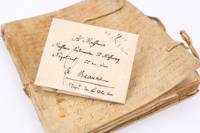
1787ref. 92325Beaune: s. n. 1787. Fine. Rare 18th-century Register of the Burgundy Wine Trade s. n. Beaune 1787 17.8 x 22.1 cm Relié Ledger of wine sales for shipment kept by a Beaune wine-trading house 63 leaves 124 pp. written in ink followed by 26 blank leaves. The entries span the years 1787-1795 followed by a few pages dated 1809 containing draft letters often sent from Koblenz relating to delivery probably drafted by intermediaries. A rare order book from a wine-trading house probably the Patriarche constituting one of the earliest surviving records of their trading activity. This unpublished first-hand source fills gaps in our knowledge of the house's early years shedding light on export routes and the prices charged for the various appellations and vintages. Limp vellum with ties the covers made from a reused skin bearing text in ink the lower cover split in several places with tears affecting the spine in two places. The register covers the years 1787-1795 for a trading house that benefited from an edict issued in 1776 under Turgot's influence which fully liberalized the free circulation and trade of wine throughout the kingdom Jean-Marc Bonnefoy Le monde de la vigne dans la région de Nolay de la fin du XVIIIe siècle à 1914 p. 95. Entries are recorded from September 1787 onward only a few months after Thomas Jefferson's visit to the region during which he delighted in the wines of Meursault Pommard and Volnay as recorded in his travel notes Notes of a Tour into the Southern Parts of France. The eighteenth century saw the founding of some fifteen trading houses among them Patriarche established in 1780. Several elements point to this firm in particular: a bibliographer's note on the paste-down together with an 1809 letter accompanying the register addressed to Patriarche et Misserey by a delinquent debtor pleading for an extension to settle his account. Between 1808 and 1811 the merchants' directory indeed lists Patriarche et Misserey as partners under Beaune. Several grades appear first second and third quality as well as old wine along with the true appellations of origin a practice that became widespread from the 1730s onward: Meursault Beaune Volnay Pommard Chassagne namely. The earliest vintage recorded dates from 1784. The clientele consisted mainly of wine professionals merchants dealers and innkeepers with the remainder drawn from the social elite: holders of offices and official posts wealthy private individuals or clergymen pooling their orders. Trade extended across northern and eastern France occasionally Normandy as well as Paris Vienna Turin Brussels and Switzerland Basel Bern and Neuchâtel. Most orders are recorded in feuillettes bottles or pièces more rarely in quarteaux while prices are generally given according to the quantity of a queue around 500 bottles. Business was brought in through various intermediaries among them Canon Fromageot of Beaune whose reputation was praised throughout Europe by Count von Rosenberg a frequent presence in the register's entries for his numerous wine orders to be sent to Austria: Count Rosenberg tells me that his correspondent for Burgundy wine is Abbé Fromageot canon of Beaune that a pièce costs him 240 livres tournois and that I need only have it brought down the Rhône for him. Europäische Aufklärung Zwischen Wien und Triest. Die Tagebücher des Gouverneurs Karl Graf Zinzendorf 1776-1782. Certain bottles were sometimes to be marked with monograms noted in the margins. Most orders are specific at times cryptic neither old nor new; with body; no vintage specified only the time at which it should be bottled - a full-bodied wine from Beaune or Pommard sic is wanted and include vintages colour or even rather amusing remarks: not good do not ship !. An exceedingly rare wine-trade archival document from the turbulent times of the Revolution and the Directory offering new data on major houses whose s. n. hardcover
ref. 17877France first half of the 15th century. Single column 21 lines of text written in black and red in a beautiful gothic book hand. Illuminated initial in gold red blue green and white; ruled in red rubrics in red an numerous initials in red and blue. Contemporary blind-stamped calf over wooden boards raised bands two brass fore-edge clasps missing. A very beautiful manuscript from the library of antiquary William Henry Blacking and of George Dunn of Woolley Hall near Maidenhead with their 2 bookplates with coat of arms on paste down. A very attractive collection of sermons and homilies preserved in its original panel-stamped binding with tools. Presumably the personal pocket manuscript of a preacher presbyter Johannes Venuto. Venuto is an Italian originally Tuscan name. The note on the front flyleaf is an invocation to the Lord for having the sins forgiven and removed. The big initial was clearly drawn later as it covers the original text. Originally it is assumed that a calendar occupied the first 77 pages and that calendar has been removed. George Dunn 1865-1912 of Woolley Hall near Maidenhead Berkshire was an English bibliophile and keen student of paleography and early printing. Throughout his life he built up an impressive library at Woolley Hall collecting early English law books medieval manuscripts early printed books including volumes from unusual towns and presses. After his death in 1912 his library was broken up and sold off at Sotheby's between 1913 and 1917 realising over £30000. unknown
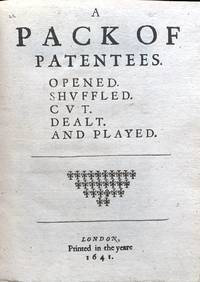
1641ref. 17940London: n.p. 1641. FIRST EDITION. Type ornament device on title and woodcut headpiece. Polished calf signed “F. Bedford triple gilt fillet round sides spine gilt a.e.g. From the library of Lord Fairfax of Cameron with his armorial bookplate and the Huth bookplate lot 5630 Sotheby’s sale of July 17 1917. First edition of the very rare satire on the granting of monopolies. The anonymous author piles on the criticism of monopolies and patents granted on goods such as coal soap starch leather wine salt tobacco and butter. By the reign of James I patents had become so numerous and unfairly granted that they were considered oppressive and unjust to certain classes of people especially tradesmen and manufacturers. Except for “novel inventions” the King was finally forced to revoke all existing monopolies and declare that henceforth patents were only to be used for “projects of new invention.” This “Statute of monopolies” enacted in 1624 became the foundation for all later developments in patent law in England and elsewhere. It was a fundamental landmark in the transition of Britain’s economy from the feudal to the capitalist. Unfortunately James’s successor Charles I continued to abuse the patent system and it was only during the Restoration that the abuse was finally curtailed. The present work written during the reign of Charles I bitterly describes the injustices within certain trades and industries. Wing P156; ESTC locates 4 copies in North America Harvard Huntington NYPL McGill. n.p. unknown
1920ref. 845121920 | 15 x 869 cm | Un rouleau comportant 12 peintures sur soie
1880ref. 85937s. d. [1880] | 33.50 x 45.50 cm | relié
2013ref. 81725Valencia: Scriptorium S.L s. XIII - -2013. Scriptorium, S.L unknown
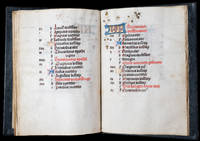
1425ref. 0526> i 12 i leaves ruled in ink written in Gothic textualis in seventeen lines per page in brown and red ink; two-line KL initials in burnished gold on red grounds with blue borders and pen-drawn flourishing of geometric and foliate forms accented with liquid gold. Bound in modern black leather over boards the spine lettered in gilt capitals "16th Century Manuscript Calendar." Dimensions: 147 × 110 mm. Manuscript (Book of Hours) hardcover
1945ref. 140938015New York: Works Publishing Inc 1945. Very Good. Signed by Bill Wilson and inscribed to a former owner on the front free end paper. First edition eighth printing. 400 pp. Bound in publisher's dark blue cloth with title stamped in blind on the front cover and in gilt on the spine; lacking the dust jacket. Very Good. Cloth lightly rubbed at corners and spine ends lightly rubbed and with a few small stains and a small crease to the bottom of the front board. Spine gilt partially rubbed. Previous owner name to front paste down and several notations written in pencil on the front free end paper. Light tidemark to top corner of text block affecting margins in varying degrees throughout. A nice copy of the AA Big Book signed by the co-founder of Alcoholics Anonymous Bill W. Works Publishing, Inc unknown books
1793ref. 60748Paris, Impremerie du depot des lois, An II (1793). 4to. In contemporary half calf with gilt lettering and ornamentation to spine. Wear to extremities. Upper part of back hinge split, with minor loss of letters. Small dampstain to upper inner margin, otherwise a nice copy. (2), VII, (2)-116, 100, 8 pp.
1845ref. 45055Sunflower County Mississippi: Privately printed 1845-1869. 1845-1869. MISSISSIPPI BRAND BOOK. First edition. 12" x 8" quarter leather spine and blue paper over boards n. p. 36 pp. 4 pp. blank 4 pp. All brands and description are in manuscript. This is a most unusual brand book. Some actual brands are shown as drawn and others are described. Some writing on the covers mentions Sun Flower County Mississippi. Perhaps there were ranchers in the vicinity. This is the first and only manuscript brand book we have seen or heard about for Mississippi or a printed version. This manuscript brand book with reference to Sunflower County Mississippi presents numerous hand-drawn brands and descriptions. We are unaware of any printed or manuscript brand books from Mississippi. The period of 1845 to 1869 is very early for any brand book! Sunflower County was formed 15 Feb 1844 from Bolivar County. It was named for the Sunflower River which flows through it. One early settler B.G. Humphries later became the Govenor. Other notable settlers were: James J. Chenning Chewning G.B. Wilds Col. Eli Waits J.Y. McNeill mcMeal Col. Hezekiah McNabb Ezekiel McNabb Mayor Frank Hawkins and Capt John Hawkins. Research of an 1847 tax list and a list of federal land grants given to individuals in the area offer names of early landowners . Several of these names and brands are included in this brand book. lists included Not listed in Adams' Rampaging Herd. We feel this is a very rare brand book. Original blue cover paper is chipped else a very good copy housed in a cloth clamshell case with leather label on the spine and titles stamped in gilt. Privately printed, 1845-1869. hardcover
1631ref. BTETM0002695Paris: Chez Jean Messager ruë S. Jacques à lEsperance Paris. Avec Privilège du Roy. 1631. 1st Edition. Hardcover. Very Good/No Jacket. Octavo Standard 8vo 6 נ9 in 152 נ229 mm . Jean Messager. Please email for Photographs or further information.1631 First Paris EditionLES EMBLEMES D'AMOUR DIVIN ET HUMAIN ENSEMBLEBy Anonymous Un Père CapucinKEY DETAILSCondition: Very GoodFormat: Hardcover Octavo Standard 8vo 6 נ9 in 152 נ229 mm Note: Binding/size selection follows standard bibliographic conventions and is approximate; exact measurements may vary.Published By: Chez Jean Messager ruë S. Jacques à lEsperance Paris. Avec Privilège du Roy. Paris 1631Language: French / LatinIllustrated By: Jean MessagerCollation: Complete numbered emblem sequence 1118 together with the engraved title.SKU: BTETM0002695Shipping Info: Approximate Package Dimensions H: 12.5 L: 30 W: 25 Units: cm W: 2KgTracked Shipping Insurance Coverage as per Customer RequestDESCRIPTIONLes Emblemes D'Amour Divin Et Humain EnsembleLes Emblemes d'Amour Divin et Humain Ensemble. Expliquez par des vers françois par un Père CapucinBy Un Père Capucin probably Ludovicus van Leuven Philippe de VilersA handsome and complete example of one of the most visually compelling French devotional emblem books of the seventeenth century: the first Paris edition of 1631 containing the complete numbered sequence of 118 full-page copper-engraved emblems contrasting Divine and Human Love.Published in Paris by the engraver and print publisher Jean Messager the volume transforms theology into a remarkable sequence of miniature allegorical dramas. Winged personifications of Divine and Human Love hunt fish fight play suffer travel trade and confront temptation vanity demons death and salvation. Each image is accompanied by a Latin motto or scriptural reference and explanatory French verse creating an extraordinarily rich visual meditation upon desire mortality and the struggle between earthly attachment and spiritual love.The engravings remain the great attraction of the book: frequently strange sometimes macabre and often unexpectedly playful they include scenes of skeletons devils apparitions crucifixion archery hunting games domestic pursuits and symbolic landscapes. Taken together they form a distinctive piece of Baroque visual theology and an important contribution to the Counter-Reformation emblem tradition.The work is anonymous on the title-page attributed only to un Père Capucin. Modern bibliographical scholarship including the Morgan Library catalogue following Adams considers the author probably to have been Ludovicus van Leuven secular name Philippe de Vilers the Capuchin responsible for the major 1629 expansion of the earlier Antwerp emblem sequence.The iconographical ancestry of the book is complex. An earlier series Amoris divini et humani effectus varii had appeared at Antwerp in 1626 under Michiel Snijders. A pirated Paris issue followed in 1628 and Ludovicus van Leuven's considerably enlarged Amoris divini et humani antipathia appeared in 1629 with 83 engravings. The present 1631 Paris publication expanded the concept further to 118 numbered emblems presenting the mature French form of the series.It also belongs to the broader seventeenth-century flourishing of devotional emblem literature associated with works such as Herman Hugo's enormously influential Pia Desideria while remaining a distinct work with its own unusual and extensive iconographical programme.A particularly appealing copy in handsome nineteenth-century dark-blue morocco with the complete emblem sequence strong impressions and attractive marbled endpapers.Les Emblemes d'Amour Divin et Humain Ensemble belongs to the great European tradition of the emblem book in which image motto and text combine to communicate meanings that no single element conveys alone.Here the central opposition is between Divine Love and Human or Worldly Love.Love is personified repeatedly as winged or childlike figures who perform recognisable human activities. They hunt fish barg - For full description please contact the seller Chez Jean Messager, ruë S. Jacques à lEsperance, Paris. Avec Privilège du Roy. hardcover