263.898 resultados
2024ref. Gyan-9788121256711Gyan Publishing House 2024. In 245 Bindings. Hardcover. New. 28.94 x 22.59 x 828.17 cm. English Gyan Publishing House hardcover
1750ref. 78168s. l. 1750 | 23 x 38 cm | 2 manuscrits reliés en un volume
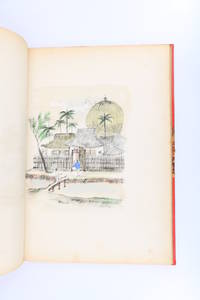
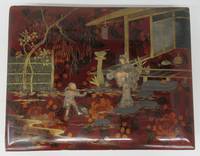
1880ref. 127847ca. 1880s-90s. Good. Forty 20.5 x 27 cm albumen hand-coloured photographs pasted into 28 x 35 cm laquer album. Each photo has number and short descriptive caption. Front board of album damaged where ivory was pried off. Board coming loose. Front free endpaper detached and chipped. Tissue guards between plates some detached and folded or chipped. Last three photos detached. Accompanied by one 11.5 cm photograph of woman Bernard & Co. mounted on 19 cm card as well as twenty-one 9 x 13.5 cm photos six with inscriptions on rear. Photos in very fine condition. These tremendous photographs illustrate Japan during the Meiji Period 1868-1912. During this time period Japan abandoned its centuries-old isolationism and began a period of industrial growth and Westernization. Prince Meiji Mutsuhito encouraged his people to work or study abroad and also invited Westerners to tour his country. During this era Japanese photography began to blossom. A Greek photographer named Felice Beato went to Japan and started documenting the country's landscapes villages and people. When he started to delicately hand colour his black and white albumen prints the Japanese themselves began to take an interest in his work. Soon there were numerous practitioners of the art of handcolouring albumen prints for tourists. These prints are now eminently collectable. The scenes in this album show tea houses restaurants temples fishermen rice growers stores a lantern maker toy shop basket seller farm workers and domestic scenes. The richly decorated album once including ivory in its design was meant for tourists to fill with various personally chosen commercial photos available for purchase. unknown
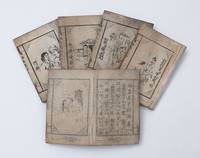
ref. 11459Woodblock-printed throughout in hangul & Chinese characters of different sizes. 350 woodcut illus. 70; 70; 70; 70; 70 folding leaves. Five kwÅn in five vols. of six. 8vo 254 x 177 mm. orig. white paper wrappers with printed title-slips orig. stitching. Korea: late ChosÅn period. One of two known copies of this anonymous Korean erotic book which juxtaposes the vernacularized hagiography of ÅšÄkyamuni with hundreds of erotic prints showing all manners of sexual intercourse and masturbation as well as related scenes of courtship and violence. To our knowledge this is the only known example of a Korean woodblock-printed erotica. Not in WorldCat or KORCIS. The prevailing cultural conservatism in ChosÅn Korea 1393-1910 meant that erotic pictures K. chunhwa 春畫 when they finally emerged as an artistic genre in the late 18th century tended to be painted sparingly for private collectors rather than printed en masse for the marketplace as they were in the neighboring countries of China and Japan. Only a handful surviving painted erotic albums are known today the most famous of which are the KÅn'gon irhoe to ä¹¾å¤ä¸€æœƒåœ– attributed to Sin Yun-bok ç”³æ½¤ç¦ 1758-1813 and the Unu toch'Åp 雲雨圖帖 attributed to Kim Hong-do é‡‘å¼˜é“ 1745-1806. In the 2020 article "A Brief Comparison of Old Erotic Paintings in the Far East" Won Whe Kim notes that "unlike China and Japan no record of erotic woodcut paintings was found in Korea.Korean erotic albums were drawn privately by painters or amateurs and were hidden in the home of the collectors" pp. 6-7. As the editors of Korean Erotic Paintings Seoul: 2001 point out "Korean erotic paintings have either been lost or overlooked before historians could get their hands on them because they were considered obscene. That was due to Korea's narrow-mindedness toward sex. The number of known erotic paintings is very little. It is difficult to do research on them because the ones with any artistic value are hidden in the homes of the collectors" n.p. On the history of erotica in Korea the editors further explain that "the origin of Korean erotic art can be found from the introduction of paintings from China's Ming Dynasty. Eroticism in the late ChosÅn era was likely to have been under the influence of Chinese eroticism. However.eroticism was able to develop its originality. It broke away from being just copies of Chinese paintings and attained a style that reflected ChosÅn's sex culture in a unique way.One of the main characteristics of Korean eroticism is that it realistically reveals the sexual customs of those times through its description of various social classes and situations" n.p. The title of this woodblock-printed erotic album contains two references: the "flowery camp" K. hwayÅng is a well-known euphemism for the brothel and sexual activities more generally and the "biography of ÅšÄkyamuni" K. sÅkpo refers to the WÅrin sÅkpo 月å°é‡‹èœ a 15th-century Korean translation of the Buddha's biography and one of the first documents to be printed with the newly invented hangul alphabet. Our album contains 350 folding leaves bound into five volumes in the Korean style with five rather than four stitch-holes each with a woodcut illustration on the recto and the mixed-script text of the WÅrin sÅkpo on the verso. The faint polygonal lines around some illustrations suggest that they were carved on smaller blocks separate from the larger frame and its WÅrin sÅkpo text and those smaller blocks were either affixed to the larger blocks during printing or impressed separately onto the blank area after the text was printed. Regardless the facing pages that result thus conjure and subvert a typical format of the genre's Chinese and Japanese precedents where erotic pictures are playfully paired with corresponding verses or literary excerpts. Additionally the first illustration of each volume and some interior illustrations have printed "captions" that are fragmentary excerpts from the WÅrin sÅkpo and other Buddhist texts bearing no obvious relation - descriptive or satirical - to the image itself. In contrast to the aforementioned painted albums that reflected the elevated style of renowned artists the printed illustrations in this album are noticeably more rustic if not sometimes comical. Figures and objects appear in monochrome sketches with facial features and limbs traced out in minimal sometimes distorted lines. The stylistic rusticity of the album echoes its various settings and protagonists: sexual activity takes place not in decorated studios or a scenic landscape but within rural farmhouses or in the vicinity of villages; the figures involved are not well-dressed ladies or esteemed officials but ordinary men and women who labored in the fields common soldiers who arrive on horseback and rural gentry without official positions. The female figures always wear a simple knot bun K. tchok that signaled their status as common married women rather than the elaborate wigs K. Ånjŭn mÅri or adolescent braids K. taenggi mÅri worn by courtesans in painted albums. Men with headwear that suggests elevated status appear mostly in plot illustrations see below and they almost always wear a top knot K. sangt'u during the sexual activities. These stylistic and thematic features suggest that this album was produced during the 19th century when as the editors of Korean Erotic Paintings point out erotica was increasingly produced and consumed by people across all social strata and the refined genre painting of earlier times gave way to simpler and popular styles. See also ì´íƒœí˜¸ "조선후기 ì¶˜í™”ì˜ 발달과 퇴조" p. 807. An impressive variety of sexual activities is depicted across the work's 350 illustrations including scenes of seduction initiated by both men and women dressing and undressing voyeurism rope bondage vaginal and oral intercourse in every imaginable position and location heterosexual intercourse and female masturbation with objects dusting wand tree carrot bestiality women with fish dog mouse fellatio and cunnilingus and threesomes two men with a woman two women with a man. The occasional depiction of figures enjoying the sight of copulating animals references a recurring motif in earlier Korean erotic paintings. While typical East Asian erotic albums consisted of isolated images without plot or recurring figures this album is somewhat unusual in that it contains longer sequences of illustrations that seem to constitute coherent narratives although the absence of any verbal description makes the stories quite difficult to discern. In the first volume certain short sequences of images appear to be connected: in one image an undressing woman sitting outside is approached by an enthusiastic dog and in the next image the two engage in sexual intercourse. But starting from the third volume longer sequences of images feature recurring identifiable characters and somewhat legible plot lines. For example at the beginning of Vol. III soldiers bearing swords capture a village woman and convince her depicted in a "bubble" that her lover has been arrested. She is then carried away it is implied to be raped by one of the soldiers. Her lover later returns and watches her bathe through a window and the two - fully dressed - share a romantic moment atop a hill only for the soldiers to reappear and after a brief conflict capture the woman again while her lover protests. Such longer narrative sequences including scenes such as literati drinking parties and official courts in addition to intercourse thus ingeniously weave the erotic life of commoners into their broader social and political lives substantially enriching the erotic album itself. As mentioned above this erotic album belongs to a genre within late ChosÅn popular culture of which few examples are known and about which very little has been written in any language. We refrain here from further conjecturing the significance of the very peculiar image-text pairing in the album or attempting to analyze the complexity of the longer narrative sequences. What is clear is that expert research into these problems will shed light not only on the album itself but also on a long-overlooked aspect of Korean cultural history. The only other copy of this title we find is part of the TaegokhÅn collection gifted by Yi ChÅng-dong to the Yulgok Institute of Korean Studies item #93 in ì›ì£¼ 대곡헌 published by ìœ¨ê³¡ì—°êµ¬ì› in 2024 which contains an additional sixth volume. Very good set with some discoloration and spotting in Vols. III and IV and light worming in the final volume. â§ ì›ì£¼ 대곡헌 율곡연구ì›: 2024 #93. On Korean erotica see also ì´íƒœí˜¸ "조선후기 ì¶˜í™”ì˜ 발달과 퇴조" 역사학연구 11 1997 pp. 783-810. éŸ“åœ‹ì˜ 春畫 미술사랑: 2001. Won Whe Kim "A brief comparison of old erotic paintings in the Far East" Korean Journal of Sexual Health 4 no. 1 2020 pp. 3-8. 서윤정 "조선후기 춘화春畵: ì ë”ì ê´€ì ì—서 본 경계와 차별 ìž¬í˜„ì„ 둘러싼 문제" 미술사학보 No. 58 2022: pp. 131-55. unknown
ref. 11459Woodblock-printed throughout in hangul & Chinese characters of different sizes. 350 woodcut illus. 70; 70; 70; 70; 70 folding leaves. Five kwÅn in five vols. of six. 8vo 254 x 177 mm. orig. white paper wrappers with printed title-slips orig. stitching. Korea: late ChosÅn period. One of two known copies of this anonymous Korean erotic book which juxtaposes the vernacularized hagiography of ÅšÄkyamuni with hundreds of erotic prints showing all manners of sexual intercourse and masturbation as well as related scenes of courtship and violence. To our knowledge this is the only known example of a Korean woodblock-printed erotica. Not in WorldCat or KORCIS. The prevailing cultural conservatism in ChosÅn Korea 1393-1910 meant that erotic pictures K. chunhwa 春畫 when they finally emerged as an artistic genre in the late 18th century tended to be painted sparingly for private collectors rather than printed en masse for the marketplace as they were in the neighboring countries of China and Japan. Only a handful surviving painted erotic albums are known today the most famous of which are the KÅn'gon irhoe to ä¹¾å¤ä¸€æœƒåœ– attributed to Sin Yun-bok ç”³æ½¤ç¦ 1758-1813 and the Unu toch'Åp 雲雨圖帖 attributed to Kim Hong-do é‡‘å¼˜é“ 1745-1806. In the 2020 article "A Brief Comparison of Old Erotic Paintings in the Far East" Won Whe Kim notes that "unlike China and Japan no record of erotic woodcut paintings was found in Korea.Korean erotic albums were drawn privately by painters or amateurs and were hidden in the home of the collectors" pp. 6-7. As the editors of Korean Erotic Paintings Seoul: 2001 point out "Korean erotic paintings have either been lost or overlooked before historians could get their hands on them because they were considered obscene. That was due to Korea's narrow-mindedness toward sex. The number of known erotic paintings is very little. It is difficult to do research on them because the ones with any artistic value are hidden in the homes of the collectors" n.p. On the history of erotica in Korea the editors further explain that "the origin of Korean erotic art can be found from the introduction of paintings from China's Ming Dynasty. Eroticism in the late ChosÅn era was likely to have been under the influence of Chinese eroticism. However.eroticism was able to develop its originality. It broke away from being just copies of Chinese paintings and attained a style that reflected ChosÅn's sex culture in a unique way.One of the main characteristics of Korean eroticism is that it realistically reveals the sexual customs of those times through its description of various social classes and situations" n.p. The title of this woodblock-printed erotic album contains two references: the "flowery camp" K. hwayÅng is a well-known euphemism for the brothel and sexual activities more generally and the "biography of ÅšÄkyamuni" K. sÅkpo refers to the WÅrin sÅkpo 月å°é‡‹èœ a 15th-century Korean translation of the Buddha's biography and one of the first documents to be printed with the newly invented hangul alphabet. Our album contains 350 folding leaves bound into five volumes in the Korean style with five rather than four stitch-holes each with a woodcut illustration on the recto and the mixed-script text of the WÅrin sÅkpo on the verso. The faint polygonal lines around some illustrations suggest that they were carved on smaller blocks separate from the larger frame and its WÅrin sÅkpo text and those smaller blocks were either affixed to the larger blocks during printing or impressed separately onto the blank area after the text was printed. Regardless the facing pages that result thus conjure and subvert a typical format of the genre's Chinese and Japanese precedents where erotic pictures are playfully paired with corresponding verses or literary excerpts. Additionally the first illustration of each volume and some interior illustrations have printed "captions" that are fragmentary excerpts from the WÅrin sÅkpo and other Buddhist texts bearing no obvious relation - descriptive or satirical - to the image itself. In contrast to the aforementioned painted albums that reflected the elevated style of renowned artists the printed illustrations in this album are noticeably more rustic if not sometimes comical. Figures and objects appear in monochrome sketches with facial features and limbs traced out in minimal sometimes distorted lines. The stylistic rusticity of the album echoes its various settings and protagonists: sexual activity takes place not in decorated studios or a scenic landscape but within rural farmhouses or in the vicinity of villages; the figures involved are not well-dressed ladies or esteemed officials but ordinary men and women who labored in the fields common soldiers who arrive on horseback and rural gentry without official positions. The female figures always wear a simple knot bun K. tchok that signaled their status as common married women rather than the elaborate wigs K. Ånjŭn mÅri or adolescent braids K. taenggi mÅri worn by courtesans in painted albums. Men with headwear that suggests elevated status appear mostly in plot illustrations see below and they almost always wear a top knot K. sangt'u during the sexual activities. These stylistic and thematic features suggest that this album was produced during the 19th century when as the editors of Korean Erotic Paintings point out erotica was increasingly produced and consumed by people across all social strata and the refined genre painting of earlier times gave way to simpler and popular styles. See also ì´íƒœí˜¸ "조선후기 ì¶˜í™”ì˜ 발달과 퇴조" p. 807. An impressive variety of sexual activities is depicted across the work's 350 illustrations including scenes of seduction initiated by both men and women dressing and undressing voyeurism rope bondage vaginal and oral intercourse in every imaginable position and location heterosexual intercourse and female masturbation with objects dusting wand tree carrot bestiality women with fish dog mouse fellatio and cunnilingus and threesomes two men with a woman two women with a man. The occasional depiction of figures enjoying the sight of copulating animals references a recurring motif in earlier Korean erotic paintings. While typical East Asian erotic albums consisted of isolated images without plot or recurring figures this album is somewhat unusual in that it contains longer sequences of illustrations that seem to constitute coherent narratives although the absence of any verbal description makes the stories quite difficult to discern. In the first volume certain short sequences of images appear to be connected: in one image an undressing woman sitting outside is approached by an enthusiastic dog and in the next image the two engage in sexual intercourse. But starting from the third volume longer sequences of images feature recurring identifiable characters and somewhat legible plot lines. For example at the beginning of Vol. III soldiers bearing swords capture a village woman and convince her depicted in a "bubble" that her lover has been arrested. She is then carried away it is implied to be raped by one of the soldiers. Her lover later returns and watches her bathe through a window and the two - fully dressed - share a romantic moment atop a hill only for the soldiers to reappear and after a brief conflict capture the woman again while her lover protests. Such longer narrative sequences including scenes such as literati drinking parties and official courts in addition to intercourse thus ingeniously weave the erotic life of commoners into their broader social and political lives substantially enriching the erotic album itself. As mentioned above this erotic album belongs to a genre within late ChosÅn popular culture of which few examples are known and about which very little has been written in any language. We refrain here from further conjecturing the significance of the very peculiar image-text pairing in the album or attempting to analyze the complexity of the longer narrative sequences. What is clear is that expert research into these problems will shed light not only on the album itself but also on a long-overlooked aspect of Korean cultural history. The only other copy of this title we find is part of the TaegokhÅn collection gifted by Yi ChÅng-dong to the Yulgok Institute of Korean Studies item #93 in ì›ì£¼ 대곡헌 published by ìœ¨ê³¡ì—°êµ¬ì› in 2024 which contains an additional sixth volume. Very good set with some discoloration and spotting in Vols. III and IV and light worming in the final volume. â§ ì›ì£¼ 대곡헌 율곡연구ì›: 2024 #93. On Korean erotica see also ì´íƒœí˜¸ "조선후기 ì¶˜í™”ì˜ 발달과 퇴조" 역사학연구 11 1997 pp. 783-810. éŸ“åœ‹ì˜ 春畫 미술사랑: 2001. Won Whe Kim "A brief comparison of old erotic paintings in the Far East" Korean Journal of Sexual Health 4 no. 1 2020 pp. 3-8. 서윤정 "조선후기 춘화春畵: ì ë”ì ê´€ì ì—서 본 경계와 차별 ìž¬í˜„ì„ 둘러싼 문제" 미술사학보 No. 58 2022: pp. 131-55. unknown books
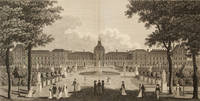
1816ref. 1435761816. PARIS. Graphic Illustrations of the Most Prominent Features of the French Capital; with Characteristic Figures in the Foregrounds comprised in Twelve Stroke Engravings From Accurate Designs Taken in Paris during the Imperial Reign of Buonaparte. With Descriptive Notices and Interesting Anecdotes. 26 pp. illustrated with 12 double-page engravings. Folio 430 x 380 mm. bound in contemporary French three-quarter black morocco over marbled boards gilt title and floral vignettes on spine paper label with ms. number "20" on front cover and spine. London: Harper and Co. 1816. A fine copy of this extremely rare collection of views of Paris consisting of twelve artistically conceived views of Paris engraved by English artists. The large double-page engravings incorporate local Parisians participating in daily routines within the setting of each view. Panoramic views include: the Military School and the Church of the Invalides; View of Paris from the South Boulevard; View of Paris from Montmartre; South View of the Old and New Louvre; The Mint and The Façade of the Louvre; View of La Place de la Concorde; The Garden of the West Front of the Tuileries; Palace of the Tuileries Facing La Place du Carrousel; Garden of the Tuileries; The Luxembourg or Palais du Senat with the Gardens; The Elysian Fields Distant Gardens of the Tuileries; Entrance to Les Champs Élysées and La Place de la Concorde. Each plate is followed by two pages of text giving historical details and anecdotes about the site illustrated. Minor wear to outer edges of binding plates and text clean. Rare: OCLC lists 6 copies worldwide of which only one is held in America Bowdoin College. hardcover
1816ref. 1435761816. PARIS. Graphic Illustrations of the Most Prominent Features of the French Capital; with Characteristic Figures in the Foregrounds comprised in Twelve Stroke Engravings From Accurate Designs Taken in Paris during the Imperial Reign of Buonaparte. With Descriptive Notices and Interesting Anecdotes. 26 pp. illustrated with 12 double-page engravings. Folio 430 x 380 mm. bound in contemporary French three-quarter black morocco over marbled boards gilt title and floral vignettes on spine paper label with ms. number "20" on front cover and spine. London: Harper and Co. 1816. A fine copy of this extremely rare collection of views of Paris consisting of twelve artistically conceived views of Paris engraved by English artists. The large double-page engravings incorporate local Parisians participating in daily routines within the setting of each view. Panoramic views include: the Military School and the Church of the Invalides; View of Paris from the South Boulevard; View of Paris from Montmartre; South View of the Old and New Louvre; The Mint and The Façade of the Louvre; View of La Place de la Concorde; The Garden of the West Front of the Tuileries; Palace of the Tuileries Facing La Place du Carrousel; Garden of the Tuileries; The Luxembourg or Palais du Senat with the Gardens; The Elysian Fields Distant Gardens of the Tuileries; Entrance to Les Champs Élysées and La Place de la Concorde. Each plate is followed by two pages of text giving historical details and anecdotes about the site illustrated. Minor wear to outer edges of binding plates and text clean. Rare: OCLC lists 6 copies worldwide of which only one is held in America Bowdoin College. hardcover books
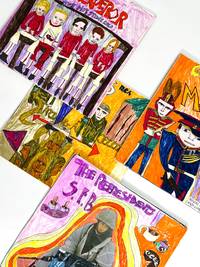
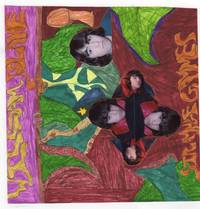
ref. 40620n.p.: n.p. 1990. Very good plus. Stunning and extensive collection of original artwork album covers and two lengthy reference books - all describing a vast imaginary world of 20th century rock-and-roll that never existed. Introducing the auto-fanfictive outsider art of The Indoor Kid - a Henry Darger of Greil Marcuses Syd Barrett of Daisy Ashfords Robert Christgau of Richard Dadds - who fell through the pages of ten thousand music magazines into a wonderland of his own making. The anonymous creator hereafter The Artist fashioned an entirely fictitious musical universe. From dozens of albums drawn and collaged over actual LPs as well as what might perhaps best be described as concept art for those albums to extensive accompanying commentaries whose tone owes a great deal both to zines of old and the once-popular Encyclopedias of Rock the impression is one of carpeted suburban bedrooms and children longing to escape both backwards into lost decades and forwards into the autonomy and sexuality of imagined adulthood. The Artist's mock-authoritative assertions of judgment and offhand omniscience speak of a child raised by a stacks of ROLLING STONE and CREAM in lieu of the foundling's traditional pack of wolves. His major fascinations - psychedelia the particular flavor of British whimsy that preceded it and hippie-tinged heavy metal of the Zeppelin-Black Sabbath era- are all in line with this lineage and with the character of the solitary late-'80s adolescent. THE DREAM OF FAME BEATS FAME ITSELF: The Artist's record collection most immediately calls to mind the work of Mingering Mike the D.C.-based self-made recording artist who constructed scores of fake albums by "unheard artists such as Joseph War the Big 'D' and Rambling Ralph on labels such as Fake Records Inc. Decision Sex and Mother Goose" Hadar. Discovered at a flea market in the early 2000s Mike's work found instant cult and early online fame. The present collection however can be dated with a great deal of confidence to the mid-late 1980s through perhaps the very early 1990s from the issue dates of the original repurposed albums as well as triangulating particular contemporary references coupled with certain early laser-print fonts. Thus while it is almost certainly impossible that the one could have influenced the other the similarities of technique imagination and single-minded dedication in their respective oeuvres are striking. Their art styles however are highly individuated. Though both may be placed under the broad umbrella of outsider art our Artist abhors a vacuum; he does not have Mike's appreciation of negative space. Lacking any formal skills or apparent training and with a representational style much younger than his assumed years he works in blasts of color in layers of collage and pen and children's marker in puns and allusions and call-backs both verbal and visual. And whereas Mingering Mike's invented record labels and bands lent verisimilitude to his own fantasied career in which he was the star The Artist is self-effacing to a fault. His dream is pure and strange. Not so much the protagonist of this created world but its chronicler publicist. In short that most reviled and necessary of creatures: the rock journalist. "OPIUM: ONE OF THE MOST POTENT DRUGS. NOW THE NAME OF A NEW ROCK AND ROLL BAND." Clearly a deep reader if only of music journalism the artist scatters little gems in the corners. Little clusters of mini-trends pop up in band names: the exquisitely named Sand Witch Witch-ita Falls Witching Hour and Witches Comettee sic; Mezzanine Anecdote and The Syntax Man; Tar-O and the O-CULT Band. Elsewhere there's a knowing nod to the Bonzo Dog Doo Dah Band clearly a source of inspiration; a song called "Austin Osmanspare" described as a "creepy tale of a black magic practitioner"; a reference to vocals vocals! like H.P. Lovecraft. Well-versed in the style of Bangsian word-omelettes "a sound full of ponderous organ pounding plodding rhythms screaming operatic vocals fast blitzkrieg-Bach-inspired guitar runs" some of the song titles are undoubtedly jokes on purpose: "Who When And Where Is Our Love Machine" "Soldier Sentry Squabbie Cockleshell Army" "666 All in the Name of Satan" Death Banquet's "Let Me Bludgeon You" followed by "No No No Don't Break The China" and the magisterial "Surrender Your Arms Sexual Metaphor." Meanwhile the real world does exist but is kept resolutely peripheral: nods to Timothy Leary praise from George Harrison glowing comparisons to Ozzy Osbourne and sneering ones to Michael Bolton creep in. Occasionally a deep-cut cover appears like "Magic Handkerchief" Bown/Bannister always scrupulously attributed. In a stroke of crossover genius one of the two encyclopedic notebooks explains that the imaginary band Iron Maiden had to change its name when the other real Iron Maiden got too famous. Poets too feature not only in certain liner notes "The group are heavily into Shelly sic Byron Keats William Blake and Sigfried Sasoon sic" but also most intriguingly in one unique piece of album art: "Strange Games" by "WILLIAM BLAKE." Unlike all the others however this album incorporates actual photographs of a teenage boy sulking theatrically for the camera in a red-collared black cape heavy bangs and incipient wispy mustache. We suspect the subject of being the artist and if we are correct his choice of pseudonym is impeccable. ENTRANCE TO THE SOLAR MINE What became of the creator is unknown and likely unknowable. Perhaps like Mingering Mike he decided that "the dream of fame beats fame itself" Washington City Paper. Perhaps he put away childish things and went on to be a sober and square maker of spreadsheets and never reminisced about a single song no one else had ever heard. Or perhaps he struggled when abruptly deposited in an adult world more real but less beloved than his own - a sadly more likely scenario as this collection was rescued from a storage locker auction. What is known for certain however is that the most compelling of pasts is the dream-past just before one's own birth well-remembered by parents and better-known to cool older siblings but eternally opaque to oneself. It is tragically the strangest history of all farthest away yet tantalizingly close. One cannot remember it so one invents. Wasn't Satanic Brittanica's "Moanin' Alone If You Leave Me Girl" a banger And that the song "Bastard" by Dallas sure rocks. Tune the FM dial of the aimless drives of youth. You remember. Collection includes the following 101 items: 52 original hand-colored and collaged record album sleeves. Two handwritten clamp-bound journals. Six color xerox reproductions and 41 original color marker-and-collage artworks for a subtotal of 47 different images; the color xeroxes do not reproduce any of the original works present and though some band names and iconographic motifs recur no images repeat from the album covers. Collaged materials include one piece with several original photographs of a young man tentatively identified as the anonymous artist. All materials show minor wear with occasional glue separation of artwork from original album cover; on the whole spectacularly well preserved. A complete inventory is available as well as a document with further sample quotes. n.p. unknown
ref. 40620n.p.: n.p. 1990. Very good plus. Stunning and extensive collection of original artwork album covers and two lengthy reference books - all describing a vast imaginary world of 20th century rock-and-roll that never existed. Introducing the auto-fanfictive outsider art of The Indoor Kid - a Henry Darger of Greil Marcuses Syd Barrett of Daisy Ashfords Robert Christgau of Richard Dadds - who fell through the pages of ten thousand music magazines into a wonderland of his own making. The anonymous creator hereafter The Artist fashioned an entirely fictitious musical universe. From dozens of albums drawn and collaged over actual LPs as well as what might perhaps best be described as concept art for those albums to extensive accompanying commentaries whose tone owes a great deal both to zines of old and the once-popular Encyclopedias of Rock the impression is one of carpeted suburban bedrooms and children longing to escape both backwards into lost decades and forwards into the autonomy and sexuality of imagined adulthood. The Artist's mock-authoritative assertions of judgment and offhand omniscience speak of a child raised by a stacks of ROLLING STONE and CREAM in lieu of the foundling's traditional pack of wolves. His major fascinations - psychedelia the particular flavor of British whimsy that preceded it and hippie-tinged heavy metal of the Zeppelin-Black Sabbath era- are all in line with this lineage and with the character of the solitary late-'80s adolescent. THE DREAM OF FAME BEATS FAME ITSELF: The Artist's record collection most immediately calls to mind the work of Mingering Mike the D.C.-based self-made recording artist who constructed scores of fake albums by "unheard artists such as Joseph War the Big 'D' and Rambling Ralph on labels such as Fake Records Inc. Decision Sex and Mother Goose" Hadar. Discovered at a flea market in the early 2000s Mike's work found instant cult and early online fame. The present collection however can be dated with a great deal of confidence to the mid-late 1980s through perhaps the very early 1990s from the issue dates of the original repurposed albums as well as triangulating particular contemporary references coupled with certain early laser-print fonts. Thus while it is almost certainly impossible that the one could have influenced the other the similarities of technique imagination and single-minded dedication in their respective oeuvres are striking. Their art styles however are highly individuated. Though both may be placed under the broad umbrella of outsider art our Artist abhors a vacuum; he does not have Mike's appreciation of negative space. Lacking any formal skills or apparent training and with a representational style much younger than his assumed years he works in blasts of color in layers of collage and pen and children's marker in puns and allusions and call-backs both verbal and visual. And whereas Mingering Mike's invented record labels and bands lent verisimilitude to his own fantasied career in which he was the star The Artist is self-effacing to a fault. His dream is pure and strange. Not so much the protagonist of this created world but its chronicler publicist. In short that most reviled and necessary of creatures: the rock journalist. "OPIUM: ONE OF THE MOST POTENT DRUGS. NOW THE NAME OF A NEW ROCK AND ROLL BAND." Clearly a deep reader if only of music journalism the artist scatters little gems in the corners. Little clusters of mini-trends pop up in band names: the exquisitely named Sand Witch Witch-ita Falls Witching Hour and Witches Comettee sic; Mezzanine Anecdote and The Syntax Man; Tar-O and the O-CULT Band. Elsewhere there's a knowing nod to the Bonzo Dog Doo Dah Band clearly a source of inspiration; a song called "Austin Osmanspare" described as a "creepy tale of a black magic practitioner"; a reference to vocals vocals! like H.P. Lovecraft. Well-versed in the style of Bangsian word-omelettes "a sound full of ponderous organ pounding plodding rhythms screaming operatic vocals fast blitzkrieg-Bach-inspired guitar runs" some of the song titles are undoubtedly jokes on purpose: "Who When And Where Is Our Love Machine" "Soldier Sentry Squabbie Cockleshell Army" "666 All in the Name of Satan" Death Banquet's "Let Me Bludgeon You" followed by "No No No Don't Break The China" and the magisterial "Surrender Your Arms Sexual Metaphor." Meanwhile the real world does exist but is kept resolutely peripheral: nods to Timothy Leary praise from George Harrison glowing comparisons to Ozzy Osbourne and sneering ones to Michael Bolton creep in. Occasionally a deep-cut cover appears like "Magic Handkerchief" Bown/Bannister always scrupulously attributed. In a stroke of crossover genius one of the two encyclopedic notebooks explains that the imaginary band Iron Maiden had to change its name when the other real Iron Maiden got too famous. Poets too feature not only in certain liner notes "The group are heavily into Shelly sic Byron Keats William Blake and Sigfried Sasoon sic" but also most intriguingly in one unique piece of album art: "Strange Games" by "WILLIAM BLAKE." Unlike all the others however this album incorporates actual photographs of a teenage boy sulking theatrically for the camera in a red-collared black cape heavy bangs and incipient wispy mustache. We suspect the subject of being the artist and if we are correct his choice of pseudonym is impeccable. ENTRANCE TO THE SOLAR MINE What became of the creator is unknown and likely unknowable. Perhaps like Mingering Mike he decided that "the dream of fame beats fame itself" Washington City Paper. Perhaps he put away childish things and went on to be a sober and square maker of spreadsheets and never reminisced about a single song no one else had ever heard. Or perhaps he struggled when abruptly deposited in an adult world more real but less beloved than his own - a sadly more likely scenario as this collection was rescued from a storage locker auction. What is known for certain however is that the most compelling of pasts is the dream-past just before one's own birth well-remembered by parents and better-known to cool older siblings but eternally opaque to oneself. It is tragically the strangest history of all farthest away yet tantalizingly close. One cannot remember it so one invents. Wasn't Satanic Brittanica's "Moanin' Alone If You Leave Me Girl" a banger And that the song "Bastard" by Dallas sure rocks. Tune the FM dial of the aimless drives of youth. You remember. Collection includes the following 101 items: 52 original hand-colored and collaged record album sleeves. Two handwritten clamp-bound journals. Six color xerox reproductions and 41 original color marker-and-collage artworks for a subtotal of 47 different images; the color xeroxes do not reproduce any of the original works present and though some band names and iconographic motifs recur no images repeat from the album covers. Collaged materials include one piece with several original photographs of a young man tentatively identified as the anonymous artist. All materials show minor wear with occasional glue separation of artwork from original album cover; on the whole spectacularly well preserved. A complete inventory is available as well as a document with further sample quotes. n.p. unknown books
2024ref. BIBHB0334000832024. Hardcover. New. Due to the very old age and scarcity of this book some pages are missing and may be hard to read due to the blurring of the original text. The Title 'District Gazetteers of India In 245 Bindings written/authored/edited by Anonymous' published in the year 2024. The ISBN 9788121256711 is assigned to the Hardcover version of this title. This book has total of pp. 82817 Pages. The publisher of this title is Gyan Publishing House. This Book is in English. The subject of this book is History. Size of the book is 22.59 x 28.94 cms Vol: Volume In 245 Bindings hardcover
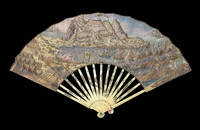
1780ref. 2221Spain c1780. Folding paper fan with a fine large hand-coloured engraved view of the Siege of Gibraltar with Spanish ships and troops in the foreground the verso with engraved key in Spanish decorated with weapons of war on either side mounted on ivory sticks the ivory sticks decorated in silver and gilt with a fort ship and flag the gaurdsticks carved and pierced and with silver and gilt depicting a ship and drums. The unsuccessful siege of Gibraltar began in 1779 and lasted until February 1783 when the siege was lifted. This fan which it has been suggested belonged to the Earl of Minto is not in the Schreiber Collection. unknown
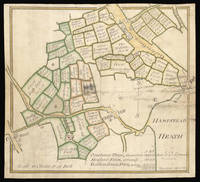
ref. 14549mid-18th century. 285 by 315mm 11.25 by 12.5 inches. Pen and ink and wash colour on vellum. A manuscript map of Golders Green extending from Cricklewood to Hampstead Heath now Golders Hill Park. This remarkable map shows the division Golders Green and the surrounding area during the mid to late eighteenth century. The area was divided into three farms: Cowhouse Farm green; Hodford Farm orange; and Golders Green Farm yellow. Each of the farms fields are meticulously laid out with their name and area in acres roods and perches marked. The largest landowners at the time were the Dean of Westminster and the Trustees of Eton College. To the lower right is a table of the total holdings of each farm Golders Green being by far the largest; with the total land of all three farms amounting to just over 470 acres. Common land is marked with a 'X' and amounts to just over six acres. Several buildings are marked on the plan including the Cowhouse Farm and The Cock and Hoop Ale House. In 1896 the authorities closed the Cock and Hoop when it was discovered that the named licensee Mr Robinson had been dead for four years! Eighteenth century manuscript plans of London boroughs are very rare especially on such a large scale. Scale: 10 chains to one inch or 1/8th a mile to one inch. Colloms W & M Kilburn and West Hampstead Past; Howkins F. The Story of Golders Green and its remarkable development London 1923. hardcover
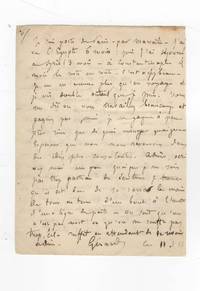
1844ref. 75148Paris 1844. Fine. Paris 11 février 1844 10.40 x 13.60 cm quatre pages sur deux feuillets Three autograph letters signed by Gérard de Nerval 2 pages signed « Gérard » Théophile Gautier 1 page and a third unsigned letter 1 page penned by a certain « Robert » cf. Nerval's letter Louis Desessart Théophile Gautier's appointed publisher co-published Nervals play Léo Burckart with Barba in 1839. Following financial difficulties he was forced to take refuge « in that sad and charming city of Brussels ». The three friends wrote this letter from Paris where they had reunited following Nervals long journey to the East: « I spent six months in Egypt; then three months in Syria four months in Constantinople and the rest en route. Its quite beautiful. I only enjoy myself while traveling and try to live twice as much as I can. » This journey deeply impressed Théophile Gautier who would only travel to Turkey and Egypt years later: « I am in Paris and wish I were in Cairo from where Gérard is returning. » The exoticism of distant lands starkly contrasts with the melancholy and severity of Europe: « How sad Paris is when one returns from sunlit countries. » Nerval And in Paris far from dreams of escape life means toil and melancholy: « We are like sick people who are never comfortable anywhere. I think the good times are gone and the golden hours of the past when we spoke such wise follies will never return. Whats the point of living if we must work and cannot see our friends or write to them or do anything we would like » Gautier The two writers express great compassion for their friends Belgian exile with Brussels appearing as the capital of spleen: « What ! Youre still in that sad and charming city of Brussels ! . Brussels is even darker poor fellow ! » Nerval This joint letter was in fact initiated by « Robert » : « Isnt it true my dear friend that Im quite skilled at making you forget my faults . as a way of making it up to you Im sending you the autographs of two of your . comrades your fondest memories two men of fame who despite all their affection and friendship for you would never have written a word had I not trimmed their quills and handed them paper like sulky children and told them : write at once at once to the exile you love most. » unknown
2024ref. Gyan-9788121256728Gyan Publishing House 2024. In 245 Bindings. Paperback. New. x x 579.719 cm. English Gyan Publishing House paperback
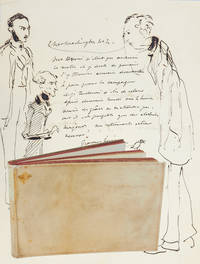
1870ref. 89636No Location: Sans nom d'éditeur 1870. Fine. Sans nom d'éditeur No Location s. d. 1870 40.5 x 27.9 cm Relié CONSTANTINOPLE Exceptional album of 54 original caricatures some captioned executed in India ink pencil and watercolour together with three small pencil drawings on loose leaves. Undated circa 1872-1873. Small oblong folio 47 pp. 40.5 x 27.9 cm. Contemporary overlapping ivory vellum smooth spine with red rules a tear at the head of the spine skilfully restored red fillet border to the boards a few stains to the covers comb-marbled endpapers red edges. Almost certainly compiled by a talented amateur this engaging and highly personal album recounts the adventures and misadventures of a small circle of recurring figures apparently connected directly or indirectly with the French Embassy to the Sublime Porte. A fragment of stationery bearing the printed heading « Ambassade de France » French Embassy inserted between two leaves further supports this provenance. The opening scenes take the reader to Florence in September 1872 before continuing in Rome during November and December of the same year. Among the subjects depicted are the Temple of Vesta an ancient arena humorously transformed into an allusion to the Roman circus games « Ave Cesar » Hail Caesar evenings at the theatre walks on the Capitoline Hill and outings on horseback as well as a large panoramic watercolour satirising the Franco-Prussian War of 1870 and its principal protagonists. The autograph captions lend these lively scenes the character of an illustrated chronicle in which travel private amusement and social satire are deftly interwoven. The small company portrayed in Rome includes the vicomtes de Bresson de Mareuil d'Hauterive and d'Hérisson General de Castelbajac and Baron de Talleyrand. The album also preserves an autograph letter signed in black ink embellished in the margins with pen-and-ink caricatures addressed to « Monsieur H. Fournier » Mr H. Fournier and opening with the playful salutation « Cher Washington n°2 » Dear Washington No. 2. A finely executed pencil portrait is identified as depicting Khalil Bey. The Vicomte de Bresson may be identified with considerable confidence as Paul Alfred Vicomte de Bresson 1834-1904 then secretary to the French Embassy in Rome precisely at the time when the scenes recorded in the album took place. He would later pursue a distinguished diplomatic career serving successively in Brussels Madrid Belgrade and Switzerland. The recipient of the satirical letter appears to be Hugues Marie Henri Fournier 1821-1898 who would later become the 53rd French Ambassador to the Sublime Porte being appointed on 31 December 1877. The pencil portrait accompanying this material is identified in the album as Khalil Bey 1831-1879 the celebrated Ottoman diplomat and statesman born in Cairo and appointed ambassador to Vienna in 1868 before returning to Constantinople in 1872 to marry the Egyptian princess Nazli Fazl. Khalil Bey's name has endured chiefly through his extraordinary collection of paintings dispersed at auction in Paris on 16 January 1868 in order to settle his gambling debts. It included among other masterpieces Gustave Courbet's L'Origine du monde and Le Sommeil Ingres' Le Bain turc and Delacroix's L'Assassinat de l'évêque de Liège - works now preserved in the Musée d'Orsay the Petit Palais and the Louvre. A rare illustrated record of French diplomatic circles during the closing years of the Second Empire and the early Third Republic this album brings together travel recollections political satire and a chronicle of society while casting new light on several figures who would play a notable part in relations between France and the Ottoman Empire. Sans nom d'éditeur hardcover
1885ref. 89859No Location: s. n. 1885. Fine. Superb collection of 49 original watercolours offering a rare and valuable glimpse into Tonkin at the dawn of the French protectorate s. n. No Location s. d. 1885 23 x 32.5 cm Relié No publisher no place no date 18851890. Quarto 32.5 × 23 cm 1 blank leaf and 49 unnumbered leaves. Contemporary half red percaline over corners smooth spine covered in red shagreen pebble-grain paper-covered boards blue paper endpapers. An exceptional collection of 49 original unsigned watercolours each measuring approximately 20 × 15 cm within the margins finely executed in Indian ink and watercolour with gouache highlights mounted on guards. Several leaves bear the watermark ""Latune et Cie Blacons"" that of a paper mill in the Drôme region active throughout the final third of the nineteenth century. Rubbing to the spine a few marginal spots of foxing. Accompanied by a strip of tawny calf 4 × 32 cm inscribed in manuscript: ""Souvenir du Tonkin 1885-90"". The iconographic programme offers a remarkable panorama of rural Tonkinese society at the dawn of the French protectorate. It encompasses guard posts and Tonkinese riflemen wearing the traditional salacco agricultural scenes - ploughing rice transplanting and harvesting- weaving the transport of produce fishing religious and funerary ceremonies scenes of justice - including corporal punishment and executions - as well as a variety of leisure pursuits among them cockfighting wrestling hunting and groups of musicians. Western presence appears only once in the form of a steamship glimpsed in the background of a riverside scene a discreet indication of a colonial authority still in its infancy. The album belongs to the years immediately following the Treaties of Hu 1883 and 1884 and the Treaty of Tientsin of 9 June 1885 which established the French protectorate over Tonkin. The Tonkinese rifleman who opens the series belongs to a corps only recently created while the many scenes devoted to the daily activities occupations and customs of the local population reveal a genuine documentary purpose. Through their precision and close observation of everyday life these watercolours anticipate on a more modest scale the vast ethnographic survey that Henri Oger would undertake in Hanoi some twenty years later for his Technique du peuple annamite. Remarkable both for its scope and its coherence this collection constitutes an exceptional visual record of Tonkin during the earliest years of the French protectorate predating by several decades the major ethnographic surveys of the early twentieth century. s. n. hardcover
1830ref. 896041830. Fine. Original manuscript logbook of a French naval officer 18121823: privateering naval engagements and voyages aboard the Rubis Aréthuse Illyrienne Hermione and other vessels s. d. 1830 19 x 24.6 cm Relié Unpublished manuscript logbook kept by a French naval officer an eyewitness to the celebrated action between the Aréthuse and HMS Amelia 1813 and to the campaigns that accompanied the restoration of French authority in the West Indies. Unpublished autograph manuscript of 189 pages the first 31 paginated the remainder unnumbered kept by an anonymous French naval officer and covering without interruption the period from 25 November 1812 to 4 May 1823. Contemporary half tan calf smooth spine decorated with repeated gilt rolls and naval ornaments burgundy calf lettering-piece brown paper-covered boards. Spine renewed and restored occasional waterstaining affecting the greater part of the leaves. The manuscript opens with the technical particulars and crew list of the frigate Le Rubis commanded by Commander Ollivier capitaine de frégate followed by those of the Aréthuse under the command of Captain capitaine de vaisseau Bouvet. It then begins on 25 November 1812 a day-by-day journal from the departure of the two frigates from the roads of Saint-Nazaire. Over the course of the following decade its author served successively aboard the Rubis the Aréthuse the Illyrienne the Hermione the transport vessel La Normande - on which he completed two campaigns - the brigs L'Isère and Le Railleur and finally the corvette L'Hébé. Exceptionally rich in nautical detail - manoeuvres courses steered sea conditions and vessels encountered or captured - the narrative unfolds in two distinct phases. The first recounts the commerce-raiding campaign waged against British shipping off the Cape Verde Islands and the West African coast between 1812 and 1814. The second follows its author to the West Indies North America the Indian Ocean and the Mediterranean through a succession of missions that intersect with several notable episodes of the period: the restoration of French possession of Guadeloupe in December 1814 the transport of troops to the colony in 1816 an oath of allegiance to Napoleon sworn at New York in May 1815 an anchorage at Bourbon Island in June 1817 and a passage off Gibraltar in June 1819. Extracts: On the 28th November 1812 we captured an English brig . The Aréthuse took possession of her and lost one of her boats the sea being too rough. The vessel of about 200 tons mounted 8 guns and carried a crew of 12 men. She was laden with dried fruit and was sailing from Málaga to London; she also carried Alicante wine. The commanding officer of the Rubis ordered her to be set on fire the sea being too rough for anything to be salvaged . On the morning of the 12th December the Aréthuse boarded an American schooner bound from New York to Nantes laden with cotton and coffee; she was allowed to continue her voyage after taking our letters for France. pp. 5-7. On 24 December we captured a large Portuguese three-master. She was called the Delfina of 400 tons sailing from Lisbon to Pernambuco present-day Recife Brazil laden with wine cloth trade goods and carrying 40 passengers; she had a crew of 30 men and mounted ten 8-pounder guns. p. 9. On 6 February 1813 the Aréthuse having pursued an English frigate with advantage until evening lost sight of her during the night and did not regain contact until the following day . When she had come within pistol-shot the Aréthuse fired a broadside to which the enemy replied . The action lasted from 7.45 until 10 o'clock the fire of the Aréthuse proving superior to that of the English frigate. Captain Bouvet then attempted to board her in turn but with his braces and bowlines cut and his rigging and sails riddled with shot he was unable to reach the enemy . In the course of the eng hardcover
1840ref. 038511United States: M.M. Noah & A.S. Gould 1840. First Edition Thus . Leather Bound. Good/NO Dustwrapper. 8vo - over 7¾" - 9¾" tall. Referred to in Joshua and Second Samuel & APOCRYPHA. Preface by M. M. Noah.THE BOOK OF JASHER or Sefer Hayashar: Faithfully Translated from the Original Hebrew into English. One of the Sacred Books of the Bible with Certificates of authenticity and several Prefaces. APOCRYPHA No title page Second text and also one of the many Sacred Books of the Bible lost hidden or suppressed and omitted from the Bible. Handwritten notes at the beginning of the Apocrypha "FW Briggs Eton College 1831; M.A. Hayes Windsor Cloisters 1834" seem to indicate that this is 2 books bound into one. First Edition Thus. M.M. Noah & A.S. Gould New York USA 1840. ii xxiv 268 232pp hb No Dust-wrapper ornate gilt full calf-leather with raised seams aeg front cover semi-detached covers rubbed & scraped pages browned part of title label missing contents sound scarce book. overall good M.M. Noah & A.S. Gould hardcover
1830ref. 89604s. d. [1830] | 19 x 24.6 cm | Relié
ref. 3240France c. 1700. Two volumes complete. AN ENTIRELY UNKNOWN UNPUBLISHED AND COMPLETE EXEGETICAL MANUSCRIPT BY A CONTEMPORARY OF BOSSUET CALMET LE CLERC AUSTRUC RICHARD SIMON CAPELLUS GROTIUS AND GUYON. Volume I: 1 leaf; 592 pp. Volume II: 1 leaf; 360 pp; 2 blank leaves; 324 pp. Written in ink in a very fine accomplished almost calligraphic hand on extremely fine thick laid paper. Volume I and the first half of volume II is a verse-by verse commentary on Ezekiel; the second half of volume II is a commentary on selected chapters of Daniel. While this manuscript was created during an important period perhaps the most important period in the history of biblical exegesis it is entirely original and very different from all published exegeses. 4to. BEAUTIFULLY BOUND IN CONTEMPORARY FRENCH CALF SPINES RICHLY GILT IN SIX COMPARTMENTS morocco spine-labels. Marbled endleaves. Minimal wear to extremities of bindings else FINE AND BRIGHT. Unique and important. France, c. 1700 unknown
1710ref. 86508Edinburgh: Various. Very Good. 1710-1717. Leather. Compilation Bound Together of 12 Books/Pamphlets Etc From Early 1700's About Religious Persecution in Eng. & Scotland; PROFESSIONALLY REBOUND IN FINE LEATHER WITH RAISED BANDS GILT LETTERING AND NEW MARBLED BOARDS AND ENDPAPERS. GORGEOUS!! VERY VERY SCARCE!! The title continues: "More particularly her approving of and going into the legal establishment of the Prelatic constitutions of England. The generality of ministers swearing in the Oath of Abjuration to maintain Erastianism Prelacy and English Popish Ceremonies. Non-Jurants joining with Jurants judicially approving that practice to be free of scandal. The Church's establishing tyranny in government against all who will not join in communion with her and approve her practices without redress of grievances. Wherein these and several other causes of withdrawing are proven to be justly chargeable on the Church demonstrated to be contrary to the Word of God and Reformed principles of this Church and just grounds of withdrawing and setting up judicatures distinct from her; and the objections of Jurants and others fully answered."This is a classic detailed statement of the old covenanted principles and the biblical attainments of the second Reformation like the Solemn League and Covenantthe Westminster standards etc. It is also an excellent defense against the modern malignants who counsel Christ's children to remain in the backsliding and covenant breaking denominations that abound in our day. This constitutes 264 pages. The next largest ones bound in this book is: SHIELDS ALEXANDER. A true and faithful relation of the sufferings of the Reverend and learned Mr. Alexander Shields minister of the Gospel.; 772 pages . Various hardcover