171.111 resultados
2024ref. Gyan-9788121271363Gyan Publishing House 2024. 21 Vols. In 65 Bindings. Hardcover. New. 28.94 x 22.59 x 267.58 cm. English Gyan Publishing House hardcover
2024ref. Gyan-9788121271301Gyan Publishing House 2024. 28 Vols. In 49 Bindings. Hardcover. New. 28.94 x 22.59 x 253.21 cm. English Gyan Publishing House hardcover
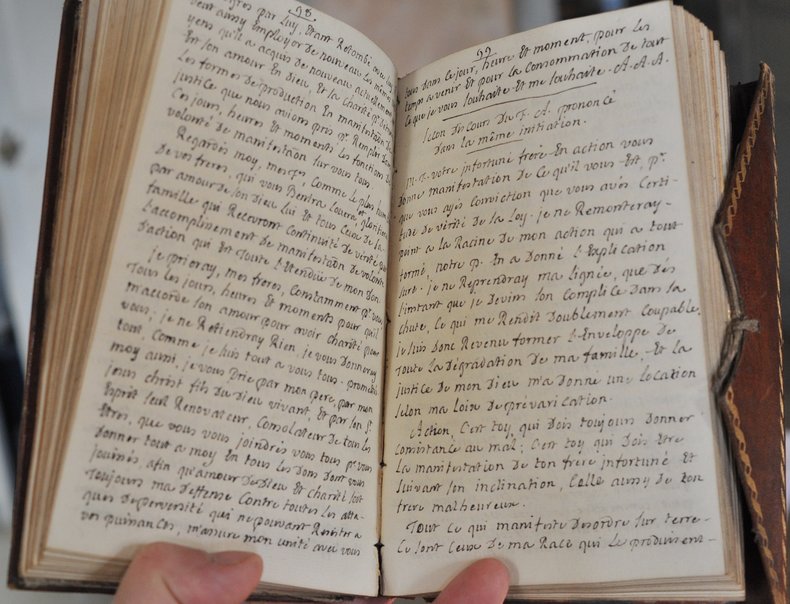
1800ref. 46405264, vers 1800 ; in-12, relié dans un portefeuille en basane brune, plats et rabat encadrés d’un motif géométrique doré, dos orné du même motif, tranches dorées. 194 pp.Lettre écrite par Mr. A... à Grenoble, adressée à M. F. 2 pp. «... Heureux si le métal a assez de pureté pour en soutenir l'épreuve, mais quel est le métal qui peut souffrir une extension la plus soutenue, la plus égale et la plus facile. Distinguez dans les sept métaux celui qui a le plus de facultés (…) je puis vous assurer, M. F. que l'affinité que vous avez avec celui que je touche, ne me fasse désirer d'avoir le même avantage que vous mais quel qu'obstacle qu'il se trouve rien ne peut résister à nos désirs mutuels. Rappelez-vous toujours que trois désirs sont trois feux. Et que si ces trois feux ne forment une fois par leur contact qu'un seul faisceau ils ne peuvent que produire une grande clarté puisque le soleil est l'unité des trois et qu'il n'est trois que parce que celui qui l'a produit est trois (...)»p. 2 à p. 6: explications de citations des psaumes de David.p. 6 à 9: explication d'un passage du Talmud (avec un fragment du texte en grec)p. 9 à 17: Lettre écrite à Grenoble par M. F. au … «L'état dans lequel vous me faites connoitre où vous êtes est certainement bien critique, car en l'état de l'homme éclairé, d'avec celui qui ne voit point, la lumière est le guide de l'un et les ténèbres sont le partage de l'autre (…) si vous avez des obstacles levés, vous verrez la vérité et la vérité vous verrez. Alors toutes les misères n'existeront autour de vous que pour vous prouver qu'elles ne sont que poussière, et que vous n'avez que vous soyez vérité, et alors vous verrez le chemin qui vous conduit à la porte étroite et celui qu'il lui même fait de lui à vous. Entendez M. F. et comprenez, vous avez deux loix à suivre comme Dieu les a tracées en vous (…)»p. 17-21. Relation. C'est le récit d'un rituel auquel a assisté le narrateur, impliquant des bougies, des caractères tracés au sol, une grande croix en or, des lectures de S. Jean, etc. Au cours cette cérémonie une apparition est entrée dans la pièce avec qui l'officiant a pu discuter pendant plusieurs minutes.p. 21-25 . 2e histoire. Autre séance avec les mêmes. Le narrateur donne d'autres détails sur le rituel, la disposition des objets, etc. Avec cette fois l'apparition de deux esprits.p. 25-27. Texte non titré sur l'histoire des sociétés occultes et la franc-maçonnerie.p. 27-34. extrait du Schasta d'après la traduction littérale faite par Monsieur le ch. de St. Lubin. C'est la description des 6 livres qui composent ce texte sacré de l'Inde: récit de la Genèse, création des trois incarnations de Dieu et des anges, révolte d'une partie des anges, intervention des bons anges et création de la terre, expiation des anges, mission de Brama, doctrine des Brames, connaissance du sanskrit, la pierre salagrame, etc. Suivi de remarques sur les coutumes des Indiens, castes, culte de l'Indus et du Gange, religieux errants...Le chevalier de Saint Lubin était un aventurier et trafiquant qui a séjourné dans le Sud de l'Inde en 1778-79. Il s'était emparé du commandement du vaisseau de commerce français Le Sartine en se faisant passer pour un agent du roi, afin de se livrer au trafic d'armes. Il fut embastillé à son retour en 1780 après une vie d'aventurier en Inde dans un contexte de conflit franco-anglais. Ses traductions de textes sanskrits n'ont jamais paru.p. 35-55. Lettre écrite par Mr A. «M. T. C. F. & F. en Ch.» Il s'agit de recommandations d'un maître à ses disciples suivi d'une exégèse de l'évangile de Jean, en particulier sur la signification des nombres (les 3 femmes, 22000 boeufs, 153 poissons, 66 qui est le nombre de la bête dans l'Apocalypse, etc.), les 7 planètes, les 7 branches du chandelier, la trinité... Calcul pour prouver que nombre 9 n'est rien, le cercle d'expiation ou de purification. Considérations sur les évangélistes. Émanation de l'homme, prévarications. Rôle des sens, la nature de l'homme...p. 55-95. Lettre à un F. C'est la poursuite des considérations développées dans la lettre précédente. Sur la correspondance entre les organes du corps humain, les scènes de la vie du Christ, des passages de l'Ancien testament, les nombres, l'architecture des temples et des églises et les principes d'action, de pensée, de volonté, etc.p. 95-99. Discours du F. A. prononcé dans une assemblée d'inauguration. p. 99-105. Second discours du F. A. prononcé dans la même initiation.p. 105-119. Copie d'une lettre d'un chercheur avancé à un homme qui annonce quelques désirs. Considérations sur la nature de l'homme, de Dieu, selon Mercure Trismegiste. Sur les différences entre hommes et femmes, l'amour, le mariage, etc. « … la distinction que je vous présente éloigne toute espèce d'idée de convention humaine pour établir la supériorité de l'homme sur la femmes; ces deux êtres n'en font qu'un, ainsi ne cherchons point de différence dans leur nature... Regardons comme une méprise essentielle toute idée qui porteroit à croire la femme d'une nature différente de celle de l'homme...»p. 119-121. Principes de la morale des Juifs. La sagesse des Juifs est énoncée en 14 principes.p. 121-124. Copie d'une lettre de Mr. de St. M. [de Saint-Martin?] - p. 124-126. Fragment d'une autre lettre du même.La fin du volume est constituée de courtes observations, de notes de lecture de la bible, de travail sur les nombres, le calendrier, etc. La dernière porte une écriture d'une autre main qui a noté: «Couleur rouge et blanche – l'écriture regarde la première comme le symbole du péché et la seconde comme celui de la pureté – Sur les prières sacramentelles. Le concile de Rome tenu sous le pape Zacharie dans le VIIIe siècle, condamna les hérétiques Albert & Clément. On y lut une prière employée par eux, dans laquelle se trouvait ces paroles Supplico vos Angelos Uriel, Raguel, Tubuel, Michael, Adimis, Eubuas, Sabaoth, Simiel. Cette prière fut condamnée par le concile tamquam Magica, erroris & Superstitionis plena.»La pointe du rabat a été découpée, peut-être pour faire disparaître une marque de provenance.
2024ref. Gyan-9788121271202Gyan Publishing House 2024. 27 Vols. In 58 Bindings. Hardcover. New. 28.94 x 22.59 x 234.03 cm. English Gyan Publishing House hardcover
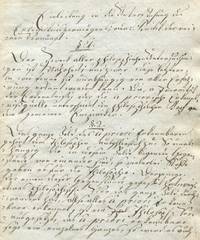
1790ref. 846n/a: n/a 1790. First Edition. Cardboard covers. Very good. Early Manuscript Defense of the Critique of Pure Reason Original one-of-a-kind handwritten manuscript defense of Kants Epistemology. 196-page manuscript in clear German cursive with some deletions and corrections ink on clean paper. 1790 Quarto. An extensive presentation and defense of Kant's theory of knowledge probably written as the basis for a lecture or series of lectures. There are five main sections: Einleitung 34 paragraphs Theorie des Vorstellungsvermögens überhaupt 30 paragraphs Theorie der Sinnlichkeit 35 paragraphs Theorie des Verstandes 64 paragraphs Kritik der bisherigen Methaphisick 21 paragraphs Many of the paragraphs contain numbered Anmerkungen" further reflections. In these the author shows himself to be a stout defender of Kant's controversial new theories: "Vor Kant ist es keinem eingefallen die Gemüthsvermögen zu untersuchen die Erkenntniße aus dem Erkennbaren zu schöpfen und die Philosophie nicht von den so genannten Objeckten zu erbetteln. Man begehet keine tolle Freiheit wenn man behauptet daß es vor Kant wohl resonierende Köpfe und philosophische Versuche aber eigentlich keine Philosophie und Philosophen gegeben habe. The identity of the author remains unknown. Interestingly the final sentence announces a sequel: "Näher darüber in unseren zukünftigen moralischen Untersuchungen wo wir für das Ens Entium einen begreiflicheren Gott wieder finden werden. CONDITION: Very good or better in contemporary plain boards with minimal spotting edges untrimmed. PHOTOS AVAILABLE UPON REQUEST n/a
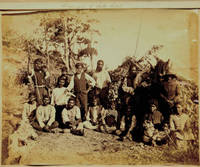
1888ref. 15347Australia 1888. Wonderful photograph album of Victoria New South Wales and Tasmania with large photographs and manuscript titles. A total of 47 photos with 33 of Victoria 6 of New South Wales 5 of Tasmania 1 of New Zealand and 2 others. Each photograph is lightly tipped on to the album paper with blank verso. Most of the photographs are by an unknown photographer; there are also some signed by J.W. Beattie Thomas Foster Chuck Frank Arnold Coxhead C. Rudd and J.P. possibly John Paine. Beginning with a large photograph is of "Aboriginals of Lake Tyers". It is an outdoor view of a family group of aborigines from children to grand parents dressed in western clothing with spear boomerangs and lean-to behind them. Others include some rather poetic views of woodcutters at Black Spur & Fernshaw; a couple of gold mining at Bendigo including Garden Gully United Gold Mining Company with houses in fore and background. Melbourne 33 photos including the Empire Building Collins St. West; Prell's Building corner of Queen St. and Flinders Lane; Austral Chambers Queen St. with Austral Chambers sign and "Offices to Let" by Selby & Co. 97 Queen St.; Grand Hotel Spring St. with carriages at the front; Federal Coffee Palace Collins St. #102 showing electrical workers 3 of whom have climbed electrical poles; "Tuck's Buildings" or Luck's Elizabeth & Flinders St with the caption "Rent of Shop L 22.10 per week"; Government Public Offices Melbourne #48 with a dirt road in the foreground; Melbourne Hospital with a train moving past in the foreground; Centennial Exhibition Procession August 1st 1888 with Victorian Confectioner's Society banner in front; St. Kilda Jetty busy with people fishing; another showing neighboring jetty Hegerty's Railway Baths for Gentlemen and fishermen with the town behind them; The New Prince's Bridge with scattered construction debris; The Melbourne Hotel #10 with the #220 Carlton and Abbotsford tram in the foreground; Collins St. from Elizabeth St. looking east #73 with a busy street scene and a George & George flag flying; Modern Permanent Building Society offices with Kilpatrick & Co. Watchmakers & Jewelers a police box and Auchalps Sales Rooms; Bourke St. Melbourne full length looking west with trams a horse and cart Mayger's Imperial Hotel at the right and Old Whitehart Hotel at the left; Town Hall Melbourne a view looking down with 2 trams & Martin & Leasances Pharmacy sign visible; Elizabeth St. Melbourne a great snap shot view of people traffic a wagon and cart electric lights and a large Cullis Hill & Co. sign; Elizabeth St. Melbourne a snap shot view with street traffic a tram the Sunbeam Tea and Luncheon Rooms in the foreground and Lincoln Stuart & Co. in the distance; Bourke St. Melbourne a snap shot view toward E. A. Petherick Booksellers & Publishers with trams and traffic. There are three views of clipper ships - H. M. S. Calliope in Port Philip Hobson's Bay with 3 yachts a tender and row boat; The Liverpool largest sailing ship afloat sailing under the Red Ensign. Steamship Cavo Romano New Orleans Feb 26th 94 docked with several crew sitting on barrels with a tear. The NSW photographs are taken in and around Sydney mostly signed "J.P." possibly John Paine 1834 - 1915 including Manly Cove; Harbour from Neutral Bay with a building under construction in the foreground and harbour and ships in the distance; Harbour from Mr McMahon's Hill with flags ferries row boats and sailing ships; Farm Cove with ships and Government House in the distance; Coogee with a hut in the foreground; trams in a turning circle a beach and vacant land in the distance and an unidentified grand public building with a horse and carriage visible. The Tasmanian photographs are unsigned. "Port Arthur Tasmania" is a small panoramic view with the Penitentiary ruins of Church and Model Prison noted in the margins. Hobart from the lower slopes of Mt. Wellington overlooking the harbour River Derwent; a beautifully artistic photograph "Glimpse of Port Arthur shewing side entrance to Peninsula & ruined church in distance" is framed by trees and bushes the buildings visible in the distance. The photographs vary in size - the largest is 29 x 23 cm; the smallest 9.5 x 15 cm; most are approximately 20 x 15 cm. Most are bright and unfaded while some have some fading. The album is bound in red cloth with title in blue and gold gilt and black decoration at front cover. A little loose in binding with the last few pages blank. Overall a very interesting album in very good condition. Full details of each photo and size available on request. unknown
1703ref. 652981 vol. in-4 (279 x 211 mm. en marges) reliure de l'époque plein veau blond, dos à 5 nerfs orné d'un semis de lys et de flammes, dentelle dorée d'encadrement en plats, fers fleuronnés à la Colombe du Saint Esprit en écoinçons, armes royales de Louis XIV au centre des plats, coupes et chasses ornées, toutes tranches dorées, De l'Imprimerie Royale, [Par les soins d'Anisson, directeur de l'Imprimerie Royale, à Paris ], 1703, 1 f. blanc, 2 ff., 212 pp., 3 ff. n. ch., 2 ff. blancs
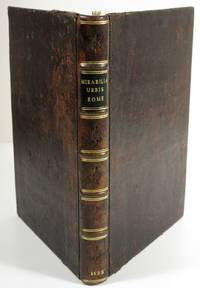
1522ref. 9527Rome: Marcello Silber. Very Good with no dust jacket. 1522. Leather. Very scarce post-incunable edition of the famous marvels of the City of Rome bound as is common with a work on the indulgences of the churches of Rome. With 8 full page woodcuts papal arms and large initial. In two parts: 55 of 56 8 ff. A8-g8 missing a1 plus the 8 unnumbered leaves of the Mirabilia without signatures or catch phrases. Printing information on the Indulgentiae on g8 lacks title with image of wolf feeding the twins. Leaves have old hand-inked page numbers continuous through both parts. Small marks and occasional light stainsfirst few leaves have damp mark at bottom edge first leaf has marginal losses at bottom and stronger marks old neat ink notation at top of leaf date of 1522 written in top of leaf has papal seal of Hadrian VI 1522-1523. The Mirabilia has no title colophon nor illustration it is 22/23 lines with the only woodcut being the small first initial. In renewed leather boards with a new handsome spine with 5 raised bands and gilt. Renewed endpapers. Handsomely printed in Gothic type with 8 magnificent full page woodcuts plus the insignia on a2. The lines on the legendary Pope Joan have been neatly crossed out. The Mirabilia Romae is a rare text one of the first printed guide books to the marvels of the Eternal City. The tradition of the Mirabilia started in the medieval period as a guide for the use of Pilgrims combining Christian beliefs and the mythology and history of Rome. "Unhampered by any very accurate knowledge of the historical continuity of the city the unknown author has described the monuments of Rome displaying a considerable amount of inventive faculty" according to the Catholic Encyclopedia. The printer of this work is Marcello Silber who ran the family establishment in Rome until 1527. His father Eucharius Silber had printed a number of earlier editions of the Mirabilia including a 1491 incunable edition. This work with its wonderful woodcut illustrations is scarce in any edition. The Indulgentie conforms to G-250 of Rossetti's Rome I with 24 lines. We have not been able to identify which Mirabilia Rome Urbis this is: although the printing looks like Silber the paper is not the same as the Indulgentiae and as far as we can tell it does not conform to any of the Mirabilia in OCLC Rossetti Sander nor USTC. A very attractive copy inside and out. Provenance: the Joseph Mendham collection. ; Woodcut; 8vo 8" - 9" tall; 55 8 pages . Marcello Silber hardcover
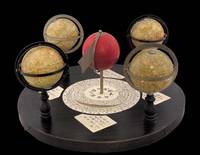
1950ref. 15336Japan c1950. 280 by 230mm. 11 by 9 inches. Four small globes on turned stands surrounding a red sphere with a directional wind tail attached to a demi-meridian ring all mounted on a central metal pole fitted on a circular wooden base. Two manuscript paper disks overlapping on the wooden base with the top one movable and the bottom attached to the base. Four other manuscripts are attached to the base in between the stands. A unique fortune-telling astronomical instrument made in Edo Japan based on the "Nine-star Ki" ky seikigaku form of divination adapted and refined from traditional Chinese methods by Shinjiro Sonoda 1876-1961 in 1924. "Nine-star Ki" refers to nine-year and nine-month cycles of the Ki/Qi element on Earth which relate to the solar and seasonal cycles. These cycles are believed to have common effects across the planet on mental and physical development and life experiences. The 'stars' of "Nine-Star Ki" are numbers representing those cycles which can be calculated for anyone using their birthdates. This instrument was specifically designed to calculate the numbers of "Nine-Star Ki". Constructed on a circular wooden plate are four small terrestrial globes on turned stands which surround a red sphere mounted on a metal pole at the centre. A bronze signpost attached to the sphere is engraved with three characters " " " " " " "cold" "warm" and "hot" respectively referring to the seasons . Directly beneath the sphere are two circular manuscript charts. The smaller uppermost chart is rotatable bearing the title " " "Fortune-telling Nine astronomical bodies rotating chart". It shows three concentric rings radially divided into sixty sections. The first ring shows a cycle from " " one to " " sixty in anti-clockwise order and there are two characters " " "this year" marked in red above the former indicating the beginning of the cycle. In the second ring every consecutive nine characters represent the Navagraha or "nine celestial bodies of universe" in Hindu astrology. They represent different elements of nature as well as season personality family and direction. These are " " the Sun " " the Moon " " Mars " " Mercury " " Jupiter " " Venus " " Saturn " " Solar Eclipse and " " Lunar Eclipse. The third ring shows the names of Bagua the eight symbols of Taoist cosmology which are " " Heaven " " Earth " " under" "Water" "Mountain" "Wind" "Flame " " Lake. The larger chart beneath is attached to the plate showing two more rings. The first ring is an extension on the Bagua ring it encircles. It shows the sexagenary cycle which is a cycle of sixty terms each corresponding to one year used for reckoning time in China and other parts of East Asia. The outermost ring has thirty divisions each containing a character that represents one of the "Five Phases' " ": " " Wood " " Fire " " Earth " " Metal and " " Water. The system of five phases was used for describing interactions and relationships between phenomena including geomancy and astrology. Rotating the top chart to align the divisions on the five rings would give a combination of numbers and signs. Hence using one's date of birth one could rotate the chart to reveal a set of numbers and figures that signifies one's fortune according to the divination of the "Nine-Star Ki". Surrounding the main chart are four sheets of manuscript text. The top right sheet bears the date " " "May 9th Eleventh year of Bunsei era - 1828" yet this does not appear to be the year of publication since Korea is labelled as " " "Republic of Korea" and China " " "Republic of China" on the terrestrial globes. Given the establishment of the Republic of Korea in 1948 and the Republic of China in 1949 the instrument can be dated to roughly the following decade. This instrument is extremely rare and perhaps unique. We are unable to trace any other examples. unknown
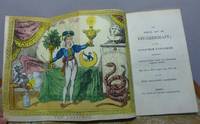
ref. 53218Derby Thomas Richardson circa 1830. FIRST EDITION circa 1830 pamphlet approximately 185 x 100 mm 7¼ x 4 inches folding hand coloured plate as frontispiece pages: 4 5-24 last page not numbered original publisher's yellow printed wrappers. Spine neatly repaired frontispiece slightly trimmed with slight loss to border not affecting image pale offset to title page upper wrapper slightly dusty near spine otherwise a very good copy. See: Raymond Toole Stott A Bibliography of English Conjuring 1581-1876 page 236 No. 718; Some Printers & Publishers of Conjuring Books and other Ephemera 1800-1850 by Trevor Hall and Percy Muir page 54. MORE IMAGES ATTACHED TO THIS LISTING ALL ZOOMABLE FURTHER IMAGES ON REQUEST. POSTAGE AT COST AND ALL PARCELS SENT FULLY TRACKED AND FULLY INSURED. Derby, Thomas Richardson, circa 1830.
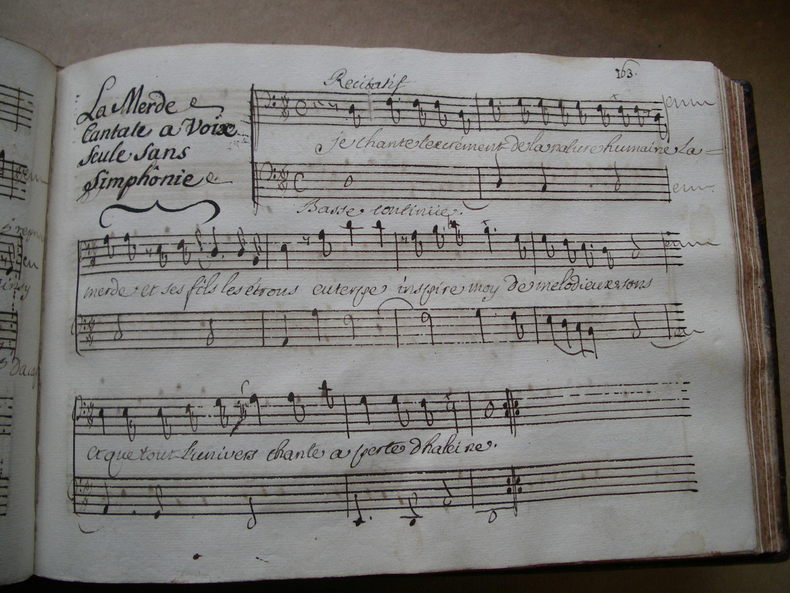
ref. 10794Paris, Hertman Barbé, 1566. In-12 (165 x 102 mm), 48 feuillets non chiffrés réglés à l'encre brune. Maroquin bleu nuit, plats ornés d'un encadrement de triples filets dorés, dos à nerfs richement orné, titre et date dorés, double filet doré sur les coupes, chasses ornées d'une riche dentelle florale dorée, tranches dorées sur marbrure, étui bordé (Mercier suc. de Cuzin).
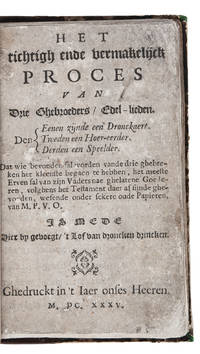
1635ref. 1616Amsterdam 1635. Small 8vo 14.5 x 9 cm. Jacob Aertsz. Colom Half calf ca. 1830s with the binder's stamp on an endleaf F. DUQUESNE À GAND chemical marbled sides 2 black spine labels marbled endpapers. With 2 decorative initial letters castings made from woodcuts and a decoration made from cast fleurons on the title-page. The main text is set in roman type with long passages in italic and textura. 136 1 1 blank; 30 pp. Second known copy of the third edition 1635 of a rare satirical Dutch adaptation first and second editions 1634 of a moralistic story in Latin by Filippo Beroaldo 1453-1505 possibly intended in this adaptation to satirize the Princes of Orange. The quotations from classical sources are given in Latin each followed by a Dutch verse translation that takes some liberties with the text. Pieter Nootmans active 1627-1635 contributed a verse about the book printed on the back of the title-page. Following the main text is a drinking song by H. Rulant active 1632-1634 with its own part-title which had been published separately in 1632. We have located only one other copy of the present edition in the library of Tresoar in Leeuwarden.The British Library database of bindings includes one binding by this Ghent binder. The title-page is worn and dirty with a small abrasion obliterating the letter S in "Stichtigh" and the upper outside corner of the last leaf has been restored with the loss of a few words of the text of the added drinking song. The binding is good with some cracks in the hinges and minor damage along the edges.l KVK & WorldCat 1 copy; cf. Kruyskamp Jan Mommaert en het "Stichtelyck Proces" in: Het Boek XXX pp. 306-312 1640 ed. ART ARCHITECTURE & PHOTOGRAPHY LITERATURE & LINGUISTICS LOW COUNTRIES Caricature & Satire Dutch Literature Netherlands unknown
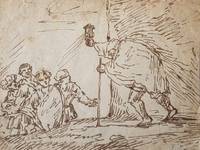
1650ref. 2105Dutch mid-17th century drawing possibly by Rembrandt pupil Willem Drost. Depicted is Diogenes in robes with his lantern in his left hand and a staff in his right and a group of four figures. Diogenes the Cynic 4th cent. BC renounced material possessions and lived in poverty. He would go out with a lighted lantern in broad daylight to look for an honest man instead he would only find that everyone around him was morally corrupted. He would scare passersby with his lantern causing them to lose their mask and reveal their true intentions.In the present drawing the group of four is clearly scared by the lantern of Diogenes who seems to be towering over them. In fact the artist has placed Diogenes on a higher plane than the passersby an invention that effectively enhances the morality of the scene. This is not found in other contemporary depictions of the same story by artists like Rubens Sandrart Castiglione and Jordaens.The artistdisplays a masterful understanding and application of chiaroscuro. Not only does he use it for the composition he also applies it to benefit the narrative. Light is literally and figuratively at the center of the scene. The artist from the "Rembrandt school" who made most use of stark chiaroscuro in his drawings was Willem Drost 1633-1659. He became a student of Rembrandt around 1650 which corresponds with the dating of the watermark. The style of drawing is also close to drawings attributed to Drost. The facial type of Diogenes in particular the pointy nose corresponds with that found in each of Drost's drawings in the Rijksmuseum. Also the hatchingsmatch those in other works by Drost who made much use of individual lines instead of a continuous zig-zagging stroke and penstrokes of varying thickness to create depth in his compositions Bonny van Sighem 2000.Condition: Number 3 in pencil at the bottom previous attribution to Ferdinand Bol written in pencil on the back. Several small brown spots and a couple minor defects including one on the face of the central figure in the group top edge slightly frayed and creaded. Old repair with tape on the back at the top.Literature: B. van Sighem 'attributed to Willem Drost David Prevents Abishai from Killing Saul Amsterdam c. 1650 - c. 1655' in J. Turner ed. Drawings by Rembrandt and his School in the Rijksmuseum online coll. cat. Amsterdam 2000 Bonny van Sighem 2000; for the watermark cf. Churchill fig. 305; Heawood 305 & 307.
1950ref. 019790New York 1950. Minor surface wear ink light at a few points with "Bill" on the dark portion of his suit but still visible. Near Fine. A scarce 8" x 10" Black-and-White Formal Photograph SIGNED by Bill Wilson: "To Martie C--/With affection/and thanks/Bill/NY -- 9/50." unknown
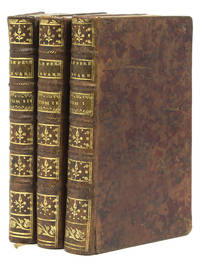
1770ref. 307572Paris: Desventes de Ladoué 1770. First edition. xvi 359 iii; 334; 360pp. 3 vols. 12mo. Bound in full contemporary mottled calf. With the bookplate of the Vicomte de Noailles engraved by Agry in each volume. Upper joint of vol. III with short start at foot otherwise a fine and fresh copy. First edition. xvi 359 iii; 334; 360pp. 3 vols. 12mo. A satirical response to Rousseau's Emile ou l'Education 1762. Where Émile is guided by a wise tutor the author of Le Père avare mocks from the outset Rousseau's dictum "le véritable précepteur est le père" for the narrator's father M. d'Erigny grew up poor and gained wealth through his friendship with a government minister; his child has been spoiled from infancy. While M. d'Erigny is drunk his mistress gets him to sign an order from her jeweler for 20000 francs of precious stones and skips out. The extravagance is discovered and the father becomes miserly in the extreme. The son now 15 years old is entrusted to a unscrupulous précepteur or tutor who involves the youth in a swindle and vanishes with the money. This is a confessional so we learn it all: the narrator soon discovers love and devotes himself to pleasure using the family name to run up accounts everywhere before being deceived and fleeced. M. d'Erigny is furious; Madame intercedes: his debts are paid and he is sent off to exile in a provincial town. He is befriended by a well-connected gentleman but repays this trust with deceit. Besotted with an actress he forges a criminal denunciation of a rival but his scheme is discovered and his in consigned to "une de ces maisons de force" a private prison for the reform of licentious youth. To escape this close confinement the narrator embarks with a flotilla of colonists bound for the island of C in the new world. His mother's continued good influence follows him across the ocean cushioning him from the worst excesses of a brutal colonial regime amply detailed. Florainville a mistress who has managed her money well comes to the colony to rescue him but falls afoul of the corrupt Intendant and her health fails her. She dies but not before she has made him her legatee. The narrator assists the colonial governor in prosecuting the Intendant and returns to France. He retires to a rural abbey and contemplates his experiences. Before long he becomes the benefactor of a village community and sees it thrive. Only edition of this little-known work of fiction set partly in the Americas. OCLC records two copies in N. America Princeton UCLA two in France and one at Trinity College Dublin Desventes de Ladoué unknown
ref. 6685N.p. but likely New York 1839. Lithograph 10.25” x 12” plus margins. CONDITION: Good narrow margins upper margin expertly extended lightly soiled paper pulp reinforcements on verso. A rare and anonymously-produced political cartoon attacking Henry Clay’s duplicitous position on slavery the issue that was at the fulcrum of so many political moral and legal conflicts in antebellum America. Clay at the time a Senator from Kentucky and one of the country’s most popular politicians grew infamous for his attempts to play both sides of the slavery issue. This cartoon takes the opportunity of one of his 1839 Senate speeches to skewer his views on slavery as he angled for another presidential nomination. The text points out the hypocrisy and contradictions in his words and attitudes. Audiences above the Mason-Dixon Line hear Clay proclaim: “I consider Slavery as a Curse a curse to the Master and a grievous wrong to the Slave” insisting he was “no friend to slavery” while those in the South are assured that as an owner of three-score humans he “will continue to oppose any scheme whatever of emancipation gradual or immediate.” The text also points out his contradictory views on dueling. An illustration of Mason & Dixon’s Line separates his views on slavery. South Carolina’s John Calhoun who with Clay was two-thirds of the Senate’s “Great Triumvirate” and was the country’s most prominent slavery advocate shakes Clay’s hand and promises his support. He assures Clay that abandoning his “‘folly & delusion’ about liberty” and endorsing slavery as the “‘most safe & stable basis for free institutions’” will also secure South Carolina’s support in his next presidential run: “you shall be made President for life.” Both men are mindlessly standing with one foot upon a prone enslaved man. In addition Clay stands upon a torn portion of a Kentucky Convention Bill likely addressing the issue of fugitive slaves and Calhoun’s left foot stands on a torn part of a memorials and resolutions from Vermont and Massachusetts affirming that “All men are created equal and entitled to liberty &c.’” The afflicted and enslaved African-American man on which they trample to the viewer in a quote from the Old Testament Book of Micah 7:8 relating to the rise of Israel: “Rejoice not against me O mine enemy when I fall; I shall arise.” Though this print bears no publication information the style and substance point toward the work of H.R. Robinson of New York who produced a number of sharp political attacks in the form of satirical prints in the 1830s. Not in Reilly. Rare with only three copies recorded in OCLC at the Library of Congress Boston Public Library and the American Antiquarian Society. REFERENCES: Weitenkampf p. 60; OCLC 741723538 and 1038126677. [N.p., but likely New York, 1839] unknown
1770ref. 307572Paris: Desventes de Ladoué 1770. First edition. xvi 359 iii; 334; 360pp. 3 vols. 12mo. Bound in full contemporary mottled calf. With the bookplate of the Vicomte de Noailles engraved by Agry in each volume. Upper joint of vol. III with short start at foot otherwise a fine and fresh copy. First edition. xvi 359 iii; 334; 360pp. 3 vols. 12mo. A satirical response to Rousseau's Emile ou l'Education 1762. Where Émile is guided by a wise tutor the author of Le Père avare mocks from the outset Rousseau's dictum "le véritable précepteur est le père" for the narrator's father M. d'Erigny grew up poor and gained wealth through his friendship with a government minister; his child has been spoiled from infancy. While M. d'Erigny is drunk his mistress gets him to sign an order from her jeweler for 20000 francs of precious stones and skips out. The extravagance is discovered and the father becomes miserly in the extreme. The son now 15 years old is entrusted to a unscrupulous précepteur or tutor who involves the youth in a swindle and vanishes with the money. This is a confessional so we learn it all: the narrator soon discovers love and devotes himself to pleasure using the family name to run up accounts everywhere before being deceived and fleeced. M. d'Erigny is furious; Madame intercedes: his debts are paid and he is sent off to exile in a provincial town. He is befriended by a well-connected gentleman but repays this trust with deceit. Besotted with an actress he forges a criminal denunciation of a rival but his scheme is discovered and his in consigned to "une de ces maisons de force" a private prison for the reform of licentious youth. To escape this close confinement the narrator embarks with a flotilla of colonists bound for the island of C in the new world. His mother's continued good influence follows him across the ocean cushioning him from the worst excesses of a brutal colonial regime amply detailed. Florainville a mistress who has managed her money well comes to the colony to rescue him but falls afoul of the corrupt Intendant and her health fails her. She dies but not before she has made him her legatee. The narrator assists the colonial governor in prosecuting the Intendant and returns to France. He retires to a rural abbey and contemplates his experiences. Before long he becomes the benefactor of a village community and sees it thrive. Only edition of this little-known work of fiction set partly in the Americas. OCLC records two copies in N. America Princeton UCLA two in France and one at Trinity College Dublin Desventes de Ladoué unknown books
ref. 6685N.p. but likely New York 1839. Lithograph 10.25” x 12” plus margins. CONDITION: Good narrow margins upper margin expertly extended lightly soiled paper pulp reinforcements on verso. A rare and anonymously-produced political cartoon attacking Henry Clay’s duplicitous position on slavery the issue that was at the fulcrum of so many political moral and legal conflicts in antebellum America. Clay at the time a Senator from Kentucky and one of the country’s most popular politicians grew infamous for his attempts to play both sides of the slavery issue. This cartoon takes the opportunity of one of his 1839 Senate speeches to skewer his views on slavery as he angled for another presidential nomination. The text points out the hypocrisy and contradictions in his words and attitudes. Audiences above the Mason-Dixon Line hear Clay proclaim: “I consider Slavery as a Curse a curse to the Master and a grievous wrong to the Slave” insisting he was “no friend to slavery” while those in the South are assured that as an owner of three-score humans he “will continue to oppose any scheme whatever of emancipation gradual or immediate.” The text also points out his contradictory views on dueling. An illustration of Mason & Dixon’s Line separates his views on slavery. South Carolina’s John Calhoun who with Clay was two-thirds of the Senate’s “Great Triumvirate” and was the country’s most prominent slavery advocate shakes Clay’s hand and promises his support. He assures Clay that abandoning his “‘folly & delusion’ about liberty” and endorsing slavery as the “‘most safe & stable basis for free institutions’” will also secure South Carolina’s support in his next presidential run: “you shall be made President for life.” Both men are mindlessly standing with one foot upon a prone enslaved man. In addition Clay stands upon a torn portion of a Kentucky Convention Bill likely addressing the issue of fugitive slaves and Calhoun’s left foot stands on a torn part of a memorials and resolutions from Vermont and Massachusetts affirming that “All men are created equal and entitled to liberty &c.’” The afflicted and enslaved African-American man on which they trample to the viewer in a quote from the Old Testament Book of Micah 7:8 relating to the rise of Israel: “Rejoice not against me O mine enemy when I fall; I shall arise.” Though this print bears no publication information the style and substance point toward the work of H.R. Robinson of New York who produced a number of sharp political attacks in the form of satirical prints in the 1830s. Not in Reilly. Rare with only three copies recorded in OCLC at the Library of Congress Boston Public Library and the American Antiquarian Society. REFERENCES: Weitenkampf p. 60; OCLC 741723538 and 1038126677. [N.p., but likely New York, 1839] unknown books
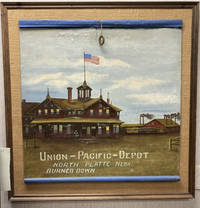
1900ref. 39803North Platte: Artist Unknown n.d. ca 1900. 1900. First edition. 28" x 28" full color painting of the Union Pacific Railroad's Bailey Yard in North Platte Nebraska. It was named for the president of the Union Pacific Edd H. Bailey. It is the largest railroad classification yard in the world as it is 8 miles long and 2 miles wide. The yard covers 2800 acres and within it are 315 miles of track. Today every 24 hours Bailey Yard handles 10000 railroad cars 3000 of which are sorted in either the eastward or westward yards nicknamed "hump" yards with 120 - 140 trains a day that pass through Bailey Yard. The first train to enter North Platte was on December 3 1866. By January 2 1867 the main line of operations officially commenced in North Platte. From 1873 to 1913 "Buffalo Bill" Cody lived and organized his Wild West Show from his ranch north of the rail yard and transported his show via rail and wagon. In 1897 E. H. Harriman purchased the Union Pacific at an auction held in Omaha Nebraska. The construction of the second main line commenced through North Platte in 1910. This art is painted on a 28" x 28" linen window shade and depicts the Bailey Yard Railroad Depot and hotel both of which burned on November 17 1915. An important painting of the depot and hotel along with train cars and an iron worker's factory building prior to that fire. Minor flaking and an old small repair to the linen else a fine example of both window shade art and a depiction of the historically important Union Pacific Rail Road Depot at North Platte Nebraska. Artist Unknown, n.d. (ca 1900). unknown
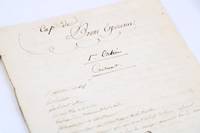
1830ref. 91260n. l.: s. n. 1830. Fine. s. n. n. l. s. d. 1830 16.3 x 20.6 cm En feuilles sous chemise et étui Anonymous manuscript of 23 pages complete as this first notebook accompanied by a title leaf bearing a manuscript table of nine articles and entitled Cap de Bonne Espérance. 1er cahier. The title identifies it as a first notebook although no continuation accompanies the present group. On one page the text shows a visible revision with a word crossed out and corrected; the manuscript therefore appears to be a working draft rather than a final fair copy. A small brown stain affects one page of the arrival narrative without impairing legibility. The manuscript is preserved in loose sheets within a half dark blue morocco folder with marbled-paper boards housed in a matching slipcase edged in dark blue morocco with marbled-paper sides and a gilt title to the spine. The manuscript captures the Cape at a moment of transition that is still clearly visible: the port is now British the gun salute is negotiated with the governor and the English flag answers that of the ship. In the town however the author still finds traces everywhere of the former Dutch colony. This overlap of administrations languages and customs gives the account its particular character: the traveller is discovering not so much a new city as a territory that has only recently passed from one empire to another. Alongside these political and urban observations appears another face of the Cape more social and more familiar to European travellers: Constantia. The wine he tastes there already belongs to a genuine geography of prestige served on European tables and even during Napoleons exile on Saint Helena. The manuscript thus moves from military ceremony to the sociability of the wine estates and then to the landscape itself with the ascent of Table Mountain. Within the few pages of this notebook the Cape appears in turn as a British port a former Dutch town a French stopping place a celebrated wine district and a spectacular landscape. More than a simple account of a stopover the text preserves a very concrete portrait of a place still divided between several histories. To our knowledge unpublished this notebook thus offers a first-hand account of the Cape probably written in the 1820s at a time when British administration was already firmly established while the town still retained everywhere the imprint of its Dutch past. s. n. hardcover
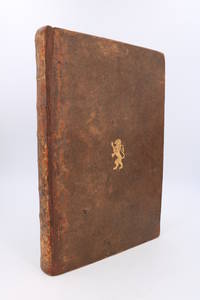
1750ref. 90724n. l.: s. n. 1750. Fine. s. n. n. l. s. d. 1750 20.5 x 31 cm Relié Folio manuscript from the second half of the 18th century comprising 2 unnumbered leaves and 258 foliated pages containing extracts and summaries of royal orders and dispatches of the Conseil de Marine from September 1715 to March 1723. The volume therefore covers the entire period of activity of this institution created at the beginning of the Regency as part of the polysynody and maintained until its disappearance in 1723. Contemporary restored full tan calf. Smooth spine decorated with gilt compartments and gilt tools partly faded lettering-piece lacking a gilt rampant lion stamped at the centre of each board marbled-paper endleaves and pastedowns double gilt fillets to the board edges. Rubbing and corners worn. The extracts are carefully dated and systematically accompanied in the margins by references to the register and folio of the original minutes from which they were taken. Such precision goes well beyond that of a simple scholarly compilation: it reveals a genuine archival survey and suggests that the compiler had direct access to the records of the Department of the Navy. The manuscript could thus serve as a practical reference tool allowing an earlier decision to be located rapidly without having to consult the complete original registers. Its contents are divided into nineteen principal headings: Admiralty; Armaments with subdivisions devoted in particular to the regulation of armaments the campaigns of 1716-1717 the war with Spain from 1718 to 1720 the Barbary powers and the Guinea coast; Artillery; Classes and Seamen; Colonies and Levant Ports; Commerce including Spain Portugal the South Guinea the African Company and the Compagnie des Indes; Shipbuilding and Refits; Finance; Coastguards; Honours Rank and Command; Justice Police and Discipline; Munitions Merchandise and Timber; Officers; Fisheries; Ports and Roads; Prizes; Salutes; Troops; and Provisions. The Conseil de Marine was established in September 1715 as one of the councils created by Philippe dOrléans in an attempt to associate the high nobility with government during the minority of Louis XV. Placed under the authority of the Comte de Toulouse it occupies an exceptional position in the history of the polysynody: when most of the other councils were abolished in 1718 the Conseil de Marine was retained and continued to function until 1723 when the kings majority brought the system to an end and naval administration reverted to a secretary of state. The present manuscript therefore follows almost day by day the activity of the last great council of the Regency. Its scope extends from the organisation of the fleet and dockyards to the recruitment of crews provisioning maritime justice prizes fisheries coastal defence the colonies and trading companies. Through this thematic arrangement emerges the full range of responsibilities exercised by a maritime state confronted with war colonial expansion and the reorganisation of overseas commerce. Several passages give the volume particular historical interest. It includes a detailed account of French British Dutch Danish and Carib possessions and settlements in the Lesser Antilles in 1723 together with instructions relating to religious regulation in the colonies. In the context of Franco-British cooperation the manuscript also records the dispatch of six hundred French seamen to reinforce Admiral Norriss squadron in the Baltic in 1719. Other extracts concern the great trading companies notably the Compagnie des Indes reorganised under Laws financial system in 1719. An early pencil note on the first flyleaf reads: Aux armes du Maréchal Duc de Duras de lAcadémie française. It most probably refers to Emmanuel-Félicité de Durfort fourth Duc de Duras 1715-1789 Marshal of France and member of the Académie française from 1775 whose substantial library was dispersed at auction in 1790. By virt s. n. unknown
2006ref. mon0000099883Public Health Institute 2006-01-01. Spiral-bound. Good. 0.2000 in x 8.9000 in x 6.9000 in. 2004 Spiral-bound Paperback. Pages are in nice condition. Some minor surface/edge wear to cover. Public Health Institute unknown