263.597 resultados
2024ref. Gyan-9788121271271Gyan Publishing House 2024. 23 Vols. In 41 Bindings. Paperback. New. x x 97.23 cm. English Gyan Publishing House paperback
1729ref. r029F.023GB: J Roberts 1729. DISBOUND TEXT No covers. Text commences at title page and ends on last index page with FINIS at base. Last numbered page is 432. 2 and 32 and 432 and index. Library stamps on title page and last page. Title page deatched and slight damage at inner margin. Else a very good clean tight text most suitable to rebind. . 1st Edition. Hardback. Good/No DW. J Roberts Hardcover
1795ref. 62704Baltimore: Printed by Samuel Sower for Keating's Book-Store 1795. Uncommon American Edition of a Rare Minerva Gothic Novel The first Baltimore printing of this gothic novel first published by the Minerva Press in the UK in 1794 with a second edition appearing the following year. There was also a Philadelphia printing in 1795 Bristol B9069 ESTC W37628 priority unknown. The narrative is set in medieval Lombardy and follows the trials and tribulations of the virtuous Rhinaldo and his beloved Isabel. Rhinaldo's father Count Roderic has been murdered and his throne seized by the usurper Astolpho who has imprisoned Isabel. The story of Rhinaldo's struggle to win back his birthright and save Isabel includes many of the traditional elements of the Gothic novels of the Romantic era including of course a castle complete with dungeon and vengeful spectre. Count Roderic's Castle was well-received by early readers with an 1807 French translation and new editions in the UK in 1840 and 1846. A modern edition with an introduction by Hannah D. Hudson appeared in 2017. Both Minerva Press editions are quite rare with only three copies of the first and two of the second located in ESTC. ESTC locates copies of this Baltimore printing to only six institutions: the American Antiquarian Society Harvard the Library Company of Philadelphia New York Public Library the Library of Congress and the University of Pennsylvania while ten holdings of the New York printing are reported. 12mo. Contemporary sheep spine gilt gilt leather label. Shallow losses at spine ends unobtrusive scrape to rear board. Moderate foxing and some soiling to outer leaves else a good sound copy of an uncommon cheaply printed book. ESTC W37627. EVANS 28486. BLOCK p.49. SUMMERS p.286. BLEILER 1978 p.6. BLAKEY p.164. hardcover
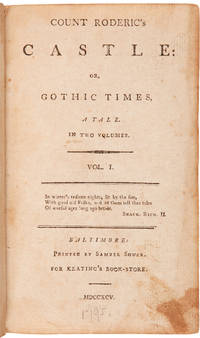
1795ref. 62704Baltimore: Printed by Samuel Sower for Keating's Book-Store 1795. Uncommon American Edition of a Rare Minerva Gothic Novel The first Baltimore printing of this gothic novel first published by the Minerva Press in the UK in 1794 with a second edition appearing the following year. There was also a Philadelphia printing in 1795 Bristol B9069 ESTC W37628 priority unknown. The narrative is set in medieval Lombardy and follows the trials and tribulations of the virtuous Rhinaldo and his beloved Isabel. Rhinaldo's father Count Roderic has been murdered and his throne seized by the usurper Astolpho who has imprisoned Isabel. The story of Rhinaldo's struggle to win back his birthright and save Isabel includes many of the traditional elements of the Gothic novels of the Romantic era including of course a castle complete with dungeon and vengeful spectre. Count Roderic's Castle was well-received by early readers with an 1807 French translation and new editions in the UK in 1840 and 1846. A modern edition with an introduction by Hannah D. Hudson appeared in 2017. Both Minerva Press editions are quite rare with only three copies of the first and two of the second located in ESTC. ESTC locates copies of this Baltimore printing to only six institutions: the American Antiquarian Society Harvard the Library Company of Philadelphia New York Public Library the Library of Congress and the University of Pennsylvania while ten holdings of the New York printing are reported. 12mo. Contemporary sheep spine gilt gilt leather label. Shallow losses at spine ends unobtrusive scrape to rear board. Moderate foxing and some soiling to outer leaves else a good sound copy of an uncommon cheaply printed book. ESTC W37627. EVANS 28486. BLOCK p.49. SUMMERS p.286. BLEILER 1978 p.6. BLAKEY p.164. hardcover books
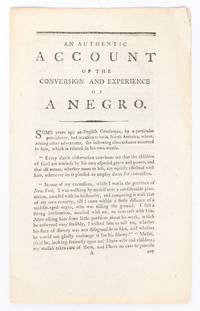
1795ref. 7213London: T. Wilkins 1795. First British edition. First separate edition. Measuring 205 x 120mm and complete in 4 pages. A Fine example. Scarce in all formats it was first printed in Vermont in 1793 and also contained a"faithful narrative.towards Polly Davis" one copy survives at AAS; soon after an edition was released from Maine containing "a poem on Christian Experience" only two copies survive both at NYPL. The present first British edition is also the first separately printed edition recorded by ESTC at only 9 libraries. It has come to auction on only five occasions with the present being the only example currently in trade. An Authentic Account records a brief encounter between a white Englishman and an enslaved Black man on a plantation in New York. Focusing their dialogue on the word of God and on salvation the white narrator asserts that the two men could find common ground as "children of God.equally effectual with him" despite their diametrically opposed positions within the social power structure. "Neither the color of his body nor the condition of his present life could prevent him from being my dear brother in our dear saviour." Despite this argument for the spiritual equality of men of all races the white narrator in An Authentic Account never questions nor seeks to subvert a power structure that would empower him while violently debasing Black people. Rather he passively participates in the Evangelical attitude so common of the era which considered enslavement an opportunity for saving the souls of uncivilized peoples who otherwise could not access the word of God. It was a position which abolitionist Evangelicals including William Wilberforce and Hannah More would decry as the height of hypocrisy in their own work during the period calling upon Christians not only to see Black people as spiritual equals but also as humans deserving equal liberty and dignity. ESTC T224026. T. Wilkins unknown
1795ref. 7213London: T. Wilkins 1795. First British edition. First separate edition. Measuring 205 x 120mm and complete in 4 pages. A Fine example. Scarce in all formats it was first printed in Vermont in 1793 and also contained a"faithful narrative.towards Polly Davis" one copy survives at AAS; soon after an edition was released from Maine containing "a poem on Christian Experience" only two copies survive both at NYPL. The present first British edition is also the first separately printed edition recorded by ESTC at only 9 libraries. It has come to auction on only five occasions with the present being the only example currently in trade. An Authentic Account records a brief encounter between a white Englishman and an enslaved Black man on a plantation in New York. Focusing their dialogue on the word of God and on salvation the white narrator asserts that the two men could find common ground as "children of God.equally effectual with him" despite their diametrically opposed positions within the social power structure. "Neither the color of his body nor the condition of his present life could prevent him from being my dear brother in our dear saviour." Despite this argument for the spiritual equality of men of all races the white narrator in An Authentic Account never questions nor seeks to subvert a power structure that would empower him while violently debasing Black people. Rather he passively participates in the Evangelical attitude so common of the era which considered enslavement an opportunity for saving the souls of uncivilized peoples who otherwise could not access the word of God. It was a position which abolitionist Evangelicals including William Wilberforce and Hannah More would decry as the height of hypocrisy in their own work during the period calling upon Christians not only to see Black people as spiritual equals but also as humans deserving equal liberty and dignity. ESTC T224026. T. Wilkins unknown books
ref. 59256[No place nor year, but presumably last quarter of the 18th Century]. Folio (415 x 260 mm). 45 quires loosely inserted in contemporary cardboard binding. French manuscript in brown ink in very fine legible hand within double framed borders. Binding with wear, internally very fine and clean. [Vol. 1:] XXXII, 76 pp [vol. 2:] (8), 156 pp. [vol. 3:] (6), 219 pp.
ref. 59256No place nor year but presumably last quarter of the 18th Century. Folio 415 x 260 mm. 45 quires loosely inserted in contemporary cardboard binding. French manuscript in brown ink in very fine legible hand within double framed borders. Binding with wear internally very fine and clean. Vol. 1: XXXII 76 pp; vol. 2: 8 156 pp. vol. 3: 6 219 pp. Very nice French manuscript on the War of the Austrian Succession. Thomas Georg Martin: Codices manu scripti Bibliothecae Regiae Monacensis Gallici 155.OCLC locates one similar manuscript Bayerische Staatsbibliothek BSB-Hss Cod.gall. 107 unknown
1810ref. 89240S.n. | s.l. s. d. ( circa 1810) | 17.7 x 23.5 cm | Relié
1788ref. 89862s. n. | Rouen 1788 | 12.5 x 20 cm | Broché
ref. 13978754[Bruxelles, 2007] in-4, pagination multiple. Broché, très bon état. Publication privée tirée à petit nombre, rare.
1993ref. 19399Lucerne, Faksimile Verlag Luzern, 1993, E.O. (de luxe), n° 286 d'un tirage unique limité à 290 ex. 2 vol. in-8°, 1 vol. de commentaires de pp. (français, allemand) et 1 vol. fac-similé de 366 pp. Reliure plein veau fin brun orné de gaufrage, de fermoirs ornés en plaqué or, de ferrures d'angle et de rosaces, tr. dorées, vol. de commentaire, dans une boîte en plexiglas. Comme neuf (plexi avec qqs traces d'us., 2 "reposoirs" en latex en queue du pexiglass sont un peu us.).
1996ref. 9688Lucerne, Faksimile Verlag Luzern, 1996. n° 506 d'un tirage unique limité à 980 ex., in-4°, 1 vol. de commentaires en Allemand de 703 pp. et 1 vol. fac-similé illustré de 28 superbes miniatures. 2 vol. reliés : pleins velours verts, dos lisses dont un avec pièce de titre en cuir, plats du facsimile encadrés de motifs à feuillages et plat sup. estampé doré aux armes, toutes tranches du facsimile dorées, protégés dans une boîte en plexiglass. Proche de l'état neuf (un coin de la glissière du plexi cassé mais recollé, petites traces d'us. au plexi).
ref. 13148(1893). Fort in-4 carré, (211) ff. montés sur onglets, reliure de l'époque plein chagrin à coins, dos orné, tête dorée (mors et coiffes un peu frottés).
2007ref. 81728Madrid: A y N Ediciones s. XIV - 2007. A y N Ediciones unknown
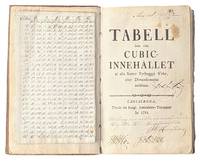
1783ref. 2190Anonymous. Tabell som visar cubic-innehallet af alla sorter fyrhuggit virke ester dimensionerne utraknat. Carlscrona Amiralitets-Tryckeriet 1784. 181 1 2 blank pages mostly tables. bound with: Anonymous. Kongel. Svenska maetare och wraekare ordningen af ar 1776. Carlscrona Amiralitets-Tryckeriet 1783. 43 1 pages 3 1 folded leaf 4 tables 3 folded engraved plates. Cont. calf gilt label to spine. Label with minor loss. Covers browned. Spine rubbed. Front cover with manuscript inked signature by one Aug. d'Ailly. Both works first edition. Title with manuscript initials J. H. D'A a working copy owned by the Swedish ship-building engineer Jakob Henrik d'Ailly 1789-1858 and a further manuscript inked ownership entry by his son Aug. D'Ailly Johan Christian August d'Ailly 1822-1877 who constructed steamships for the Swedish navy. In 1862 he was sent to North America to learn more about constructional features of ironclads with John Ericson. Back home he constructed monitors gunboats and others. Front fly-leaf with manuscript tables on recto and verso. A contemporary manuscript comprising 23 pages with further tables loosely laid in. The first work consists of exacting timber calculations specific to shipbuilding. The second work provides detailed instructions for shipbuilding with sections on the keel the prow masts crooked logs how to bend timber making beams and knees for a galleon straight timber and anchor logs. The plates depict how to cut and bend timber. OCLC and KVK each with only one copy for both titles: National Library Sweden and UB Greifswald. Second work with a few brown spots here and there. Amiralitets-Tryckeriet
1989ref. BRG-20_6_888Penguin Classics 1989-06-06. paperback. Very Good. 5x0x7. Very Good condition.Crisp pages. Clean cover and pages. Book shows minimal shelf wear. No highlighting/marking. Not Satisfied Contact us to get a refund. Penguin Classics paperback
1913ref. 777P50Weimar: Gustav Kiepenheuer 1913. Leather. Fine. 10" by 7.5". Edmund Dulac. A beautifully bound limited edition German edition of 'Arabian Nights' illustrated in colour vividly by Edmund Dulac. In a near fine binding with original working clasps. A limited edition limited to one hundred copies of which this is numbered forty-five.In a lovely red morocco binding with the original clasps in fine working condition.Translated into German.Illustrated with fifty tipped-in colour plates.Collated complete.'Arabian Nights' or 'One Thousand and One Nights' is a collection of folk tales from the Middle East. It was collected over centuries with the roots of the tales being traced from Greek Indian Arabic Persian Turkish and Jewish folklore.The tales are being told by Scheherazade to the King Shahryar in a bid to save her life. After discovering his wife was cheating on him he killed her and vowed to marry a new virgin every day and then behead them the next. In this vein he had killed one-thousand and one women before marrying Scheherazade. Scheherazade entices the King by telling him a story on their first night together pausing halfway through as the sun came up. The King being absorbed by the story keeps Scheherazade alive eager to hear more from her.Illustrated by Edmund Dulac. Dulac was a French British illustrator known for his book illustrations and stamp designs. His first commission was the illustrated the novels of the Bronte Sisters. The stamps he designed heralded the beginning of the Queen Elizabeth II's reign.Undated dated from WorldCat. In a full morocco binding with the original clasps intact. Externally smart with some light marks to the boards and spine. Clasps are in full working condition. Internally firmly bound. Pages are only lightly age-toned and clean. Fine Gustav Kiepenheuer hardcover
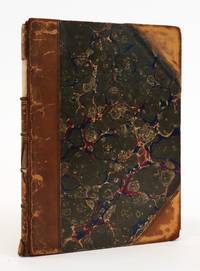
1662ref. 1381629London: s.n. 1662. First Edition. Hardcover. Small Quarto 2 pp. 5 - 134 2. In Good condition. Later three-quarter calf and marbled paper boards with significant wear to leather on spine lacking spine label. Boards are detached. Moderate wear to leather on boards light wear to edges and significant wear and chipping to leather along spine. Text block has moderate plus age toning to speckled edges significant age toning to front and back free end pages along edges moderate age toning to pages throughout interiorly and occasional ink marginalia in a seventeenth century hand. The bottom inch of page 131/132 has been torn away impacting the last four lines of text on both pages. An eight-line ink inscription appearing to be in an 18th century hand appear on the errata page "From the Printer to the Reader." listing errors found in the text. Text complete despite pagination. EH Consignment. References: ESTC R21850; Sabin 98500. Henry Vane 1613-1662 emigrated from England to New England in 1635. A member of the most radical wing of the Puritans he was elected governor of Massachusetts in 1636 but returned to join the Long Parliament in 1637. Vane's stay in Massachusetts was tempestuous and he returned to England in 1637 to become a member of the Long Parliament though his interest in New England continued. After the Restoration he was imprisoned for two years convicted of treason and executed. The present text authored by a partisan in favor of Vane includes the speech Vane intended to give from the scaffold but was barred by the court. The speech argues for parliamentary sovereignty and other radical political ideas that proved influential among American colonists. 1381629. Special Collections - Downstairs. [s.n.] hardcover
1662ref. 1381629London: s.n. 1662. First Edition. Hardcover. Small Quarto 2 pp. 5 - 134 2. In Good condition. Later three-quarter calf and marbled paper boards with significant wear to leather on spine lacking spine label. Boards are detached. Moderate wear to leather on boards light wear to edges and significant wear and chipping to leather along spine. Text block has moderate plus age toning to speckled edges significant age toning to front and back free end pages along edges moderate age toning to pages throughout interiorly and occasional ink marginalia in a seventeenth century hand. The bottom inch of page 131/132 has been torn away impacting the last four lines of text on both pages. An eight-line ink inscription appearing to be in an 18th century hand appear on the errata page "From the Printer to the Reader." listing errors found in the text. Text complete despite pagination. EH Consignment. References: ESTC R21850; Sabin 98500. Henry Vane 1613-1662 emigrated from England to New England in 1635. A member of the most radical wing of the Puritans he was elected governor of Massachusetts in 1636 but returned to join the Long Parliament in 1637. Vane's stay in Massachusetts was tempestuous and he returned to England in 1637 to become a member of the Long Parliament though his interest in New England continued. After the Restoration he was imprisoned for two years convicted of treason and executed. The present text authored by a partisan in favor of Vane includes the speech Vane intended to give from the scaffold but was barred by the court. The speech argues for parliamentary sovereignty and other radical political ideas that proved influential among American colonists. 1381629. Special Collections - Downstairs. [s.n.] hardcover books
ref. NL-02380Quite likely the only surviving example. From time to time we encounter works that despite our best efforts resist definitive identification. Such is the case with this fascinating 17th-century engraved view of Jerusalem. The sheet which survives in excellent condition appears to have been designed for inclusion in a larger publication. However the absence of editorial data institutional records or market parallels makes it impossible to determine the intended work or its creator with certainty. A somewhat schematic bird's-eye view of the fortified ancient city of Jerusalem dominates the center of the composition. Among the recognizable landmarks are the large enclosure of the Temple Mount Haram al-Sharif and the Roman amphitheater below it. Mount Zion with the palaces of David and Solomon appears as a small walled cluster near the bottom of the scene. Outside the city walls crosses mark the site of Golgotha — locus of the Crucifixion. Above the city view virtually dominating the composition is a large circular panel depicting the crucified Christ flanked by the Virgin Mary and Mary Magdalene. Hovering above this scene God the Father looks down with open hands offering a gesture of blessing. The triangular halo symbolizes the Trinity and his presence completes the Trinitarian theme complemented by the dove of the Holy Spirit and the Son depicted in the panel below. The entire composition is framed by an elaborate architectural border in the ornate Baroque style typical of the period. At the base a large blank cartouche—meant to hold editorial information—is held by two monks. Above two additional monks support the circular panel of Christ. While the monks serve as generic emblems of sacred authority and devotion the frame's four corners include identifiable saints: at the top St. Bernardino of Siena left and St. Francis of Assisi right; at the bottom St. Bonaventure left and St. Anthony of Padua right each flanking a second pair of empty cartouches intended for annotation. Census We have not been able to identify the publication for which this engraving was intended. Indeed we do not even know if that publication ever came to fruition or who was behind it. From our extensive descriptive and pictorial searches we have found no parallels or bibliographic references allowing us to conclude that this view is very rare.
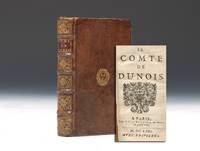
1752ref. 859861752. First Edition. ANONYMOUS. Le Comte de Dunois. Paris: Chez Lois Billaine 1671. 12mo contemporary full dark brown speckled calf elaborately gilt-decorated spine covers with the arms of the House of Bourbon-PenthiÂvre raised bands red morocco spine label. $2200.First edition of this novel preceded by a dedicatory letter to the Duchess of Nemours this copy finely bound in contemporary calf-gilt with the arms of Louis-Jean-Marie de Bourbon Duke of PenthiÂvre son of the Count of Toulouse Grand Admiral of France and a renowned book collector.Louis-Jean-Marie de Bourbon was the son of Louis Alexandre de Bourbon and his wife Marie Victoire de Noailles; he was also a grandson of Louis XIV of France and his mistress Madame de Montespan. In 1733 at the age of six he was made a field marshal and the next year a lieutenant general. In 1740 he received the Order of the Toison dÕOr from the king and in 1742 the Order of the Holy Spirit. He served in the military under his maternal uncle the Duke of Noailles and fought brilliantly at Dettingen in 1743 and Fontenoy in 1745. PenthiÂvre was one of the wealthiest men of his day and probably the richest in France. He was known to be very charitable. Bibliographers variously attribute authorship of Le Comte de Dunois to Mme. Desjardins Mme. de Villedieu Comtesse Henriette de Murat or to Pierre dÕOrtigue de VaumoriÂre. Later engraved armorial bookplate of the House of Rochefoucauld.Expert restoration to corners and spine ends. A lovely volume in excellent condition with noble provenance. hardcover