170,472 results
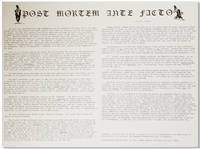
1969ref. 46442New York: Situationist International 1969. First Edition. Broadside 44cm x 57cm. Printed offset in black on white uncoated lithograhic paper; text in two columns beneath headline in Gothic type. Minor wrinkling at margins else Fine. Issued January 10 1969 as a "supplement" to the first issue of the American journal Situationist International the imminent publication of which it announces. Possibly the first official pronouncement of the American Situationists following their admission to the SI in December 1968. The broadside actually pre-dates publication of the first journal issue by some six months; and though earlier materials by the same core group of authors primarily Robert Chasse were published in 1967-8 these were issued prior to the admission of the American Section all under the imprint of "The Council for the Liberation of Daily Life." Not in RASPAUD. Situationist International unknown books
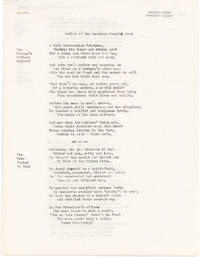
1934ref. 43069n.d. but 1934. Original clean copy typescript poem; 9ll. on onionskin; previous mail folds ex-Mooney Papers Bancroft Library with their small rubberstamps to each leaf else Very Good and sound. Lengthy unpublished ballad of 86 4- and 5-line stanzas recounting the plight of iron molder and IWW leader Tom Mooney from his birth to the present date 1934 based on the penultimate stanza on p. 6 describing Judge Griffin: "all these eighteen years since the 1916 trial / Has fought on Mooney's side". Though no author is provided the poet has a detailed knowledge of Mooney's biography and trial beginning before his birth with his father "A tall trade-union Irishman / Choking his lungs out mining coal"; progressing to Mooney's early childhood helping his widowed mother make ends meet as a paperboy; and the first trial against him after dynamite was found or planted on a boat in the San Pablo Bay a crime for which he was exonerated. The poem additionally recounts the first meetings between Mooney and Warren K. Billings as well as the tireless travel and work his mother and sister shouldered to bring justice after it was revealed that the star witness Frank Oxman had perjured himself. The poem ends with the heartbreaking death of Mother Mooney who was laid in state at the gates of San Quentin and the mournful plea: "Warren Billings is forty years old. / Tom Mooney's hair grows white. / How soon will California turn / Her long long wrong to right" Another five years would pass before liberal Governor Culbert Olson would pardon him in 1939. unknown books
1831ref. 44788London: William Kidd 1831. First Edition. Slim 12mo 16.5cm.; late 19th-century maroon cloth gilt-lettered spine original pictorial wrappers laid in; 35pp.; frontispiece and one additional plate by Robert Seymour. A hint of wear to cloth extremities late 19th-century engraved ex-libris of a Gulielmi Gemmell illustration signed in plate "E.G." to front pastedown; mid-20th century ex-libris of Nathan Comfort Starr to front free endpaper; old bookseller's description tipped to p. 36 blank. Very Good or better overall. Satirical verses inspired by Germany's annual Valpurgis night first published in the London paper "Intelligence" with illustrations by Robert Seymour best known for his contributions to the works of Dickens. BIBLIOTHECA DIABOLICA 1831 catalogued under the pseudonym "Facetiae" noting an 1833 edition illustrated by Cruikshank. At least one scholar tenuously attributes the text to author of the "Ingoldsby Legends" Richard Harris Barham based on stylistic similarities see Graham E. Veritt "English Caricaturists and Graphic Humorists of the Nineteenth Century" 1893 p. 216n. William Kidd unknown books
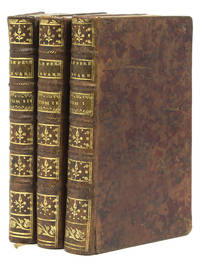
1770ref. 307572Paris: Desventes de Ladoué 1770. First edition. xvi 359 iii; 334; 360pp. 3 vols. 12mo. Bound in full contemporary mottled calf. With the bookplate of the Vicomte de Noailles engraved by Agry in each volume. Upper joint of vol. III with short start at foot otherwise a fine and fresh copy. First edition. xvi 359 iii; 334; 360pp. 3 vols. 12mo. A satirical response to Rousseau's Emile ou l'Education 1762. Where Émile is guided by a wise tutor the author of Le Père avare mocks from the outset Rousseau's dictum "le véritable précepteur est le père" for the narrator's father M. d'Erigny grew up poor and gained wealth through his friendship with a government minister; his child has been spoiled from infancy. While M. d'Erigny is drunk his mistress gets him to sign an order from her jeweler for 20000 francs of precious stones and skips out. The extravagance is discovered and the father becomes miserly in the extreme. The son now 15 years old is entrusted to a unscrupulous précepteur or tutor who involves the youth in a swindle and vanishes with the money. This is a confessional so we learn it all: the narrator soon discovers love and devotes himself to pleasure using the family name to run up accounts everywhere before being deceived and fleeced. M. d'Erigny is furious; Madame intercedes: his debts are paid and he is sent off to exile in a provincial town. He is befriended by a well-connected gentleman but repays this trust with deceit. Besotted with an actress he forges a criminal denunciation of a rival but his scheme is discovered and his in consigned to "une de ces maisons de force" a private prison for the reform of licentious youth. To escape this close confinement the narrator embarks with a flotilla of colonists bound for the island of C in the new world. His mother's continued good influence follows him across the ocean cushioning him from the worst excesses of a brutal colonial regime amply detailed. Florainville a mistress who has managed her money well comes to the colony to rescue him but falls afoul of the corrupt Intendant and her health fails her. She dies but not before she has made him her legatee. The narrator assists the colonial governor in prosecuting the Intendant and returns to France. He retires to a rural abbey and contemplates his experiences. Before long he becomes the benefactor of a village community and sees it thrive. Only edition of this little-known work of fiction set partly in the Americas. OCLC records two copies in N. America Princeton UCLA two in France and one at Trinity College Dublin Desventes de Ladoué unknown books
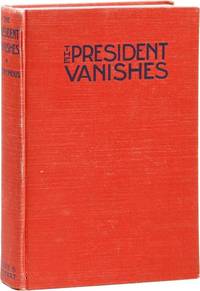
1934ref. 20859New York: Farrar & Rinehart 1934. First Edition. Octavo 20.5cm.; original red cloth upper cover and spine lettered in blue dark blue topstain; 8296pp.; photographic frontispiece 3 leaves of illus. printed on rectos and versos. Light rubbing to spine ends else a Near Fine unfaded copy albeit lacking the scarce dust jacket. "A fantasy of future politics. When Congress tries to force the nation into a European war the president disappears and a crisis ensues" HANNA 2935. Farrar & Rinehart unknown books
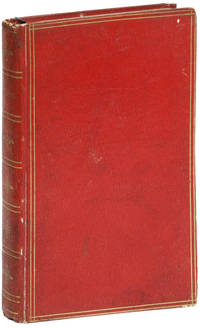
1784ref. 26075Londres i.e. Paris: Et se trouve à Paris chez Pissot 1784. First Edition. Octavo; pp. 6264pp.; 4 A-Q8 R4; woodcut title page vignette head- and tail-pieces; full contemporary red imitation morocco double ruled in gilt flat spine decorated in gilt. Extremities rubbed with boards occasionally exposed contemporary blue ribbon marker detached but present. A Very Good attractive copy. Pechmeja's best-selling prose poem published anonymously under the patronage of one Madame de Beauvau presumably the Marquise de Boufflers. The work enjoyed both enthusiastic and scathing reviews from the most celebrated literary figures of the time. Readers admired the work's literary beauty and its touching description of friendship while others found fault with the moral and economic message which would be described as socialist in the modern sense. Among the most notable Télephe detractors was the author Jean-François de la Harpe who wrote "The author seems like Rousseau to make a crime out of private property without which no society could exist. He doesn't want children to inherit their fathers' fortunes as if inheritance wasn't a natural right and as if the fathers themselves didn't work for the sake of their children" my translation. Others including the relatively enthusiastic reviewer the Baron von Grimm were nonplussed by Pechmeja's dour description of the fate of man and the injustices of oppression maintaining that while virtue must always be exercised little happiness can ultimately be experienced even with the purest intentions my paraphrase of Michaud and Grimm. Grimm rejects comparisons made to Fénelon's novel Les Aventures de Télemaque 1699 saying that if Marmontel's Les Incas 1747 is the Télemaque for the age of the encyclopedia then Télephe is the Télemaque for economists. Within three weeks of publication sales had dropped dramatically and while the book was reprinted once in the 1790s and subsequently translated into English and German Télephe never re-experienced its initial popularity. ESTC T132203. References: Baron von Grimm and Denis Diderot's Correspondance Littéraire Philosophique et Economique Vol. XII mars 1794 pp. 80-3. Joseph Fr. Michaud Biographie Universelle Ancienne et Moderne Vol. 33 pp. 244-6. Et se trouve à Paris, chez Pissot unknown books
1889ref. 28843New York: Pollard & Moss 1889. Reprint. Octavo 19cm.; original brown decorative cloth embossed in black gilt-lettered spine; 21864adspp. Textblock uniformly toned due to poor paper stock contemporary gift bookplate of the Salem Lodge no. 100 I.O.O.F. accomplished in manuscript. Very Good to Near Fine. Novel of two sisters from a prosperous rural British family and the struggles they face when their fortunes change. First serialized in The Cornhill Magazine edited by William Makepeace Thackeray. Quite scarce in any edition: OCLC lists Iowa's copy only of this imprint; 5 more for the first Harper edition. Pollard & Moss unknown books
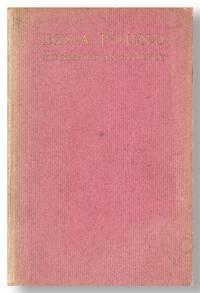
1719ref. 21983New York: Alfred A. Knopf 1917 but 1918. First Edition. Octavo 19.25cm.; original rose paper-covered boards upper cover lettered in gilt unadorned spine; 31pp.; frontispiece. Spine faded to tan gilt lettering a bit dulled else Very Good and sound. One of 1000 copies published. Written anonymously by Eliot and edited by Pound. Eliot's second published work. GALLUP Eliot A2; GALLUP Pound B17. Alfred A. Knopf unknown books
1833ref. 26134London: James J. Welsh 1833. First Edition. Octavo 19.5cm.; original red cloth printed cream paper cover label; 4693adspp.; engraved portrait frontispiece. Expertly rebacked to match original cloth a bit faded along extremities; frontispiece heavily foxed recent bookseller label to front pastedown else Very Good and sound. Errata slip bound in rear. With numerous contemporary holograph corrections throughout most likely made in preparation of the second edition as many are of a semantic rather than purely factual nature for example on p. 12 lines 2 and 3 from the bottom the text reads: ".figures of the poverty-stricken music-professors of Heilbronn haunted their imaginations". A second edition was published by the London firm of C. & H. Senior in 1840 published under the authorship of a John Sayer and revised by "a lady intimately acquainted for a long period with the circumstances of Mr. Eulenstein's life by whom a few additional facts have been supplied." Whether the annotations in this copy are in Sayer's Welsh's Senior's or the lady's hand is unclear. Traces of a contemporary inscription on original pastedown now obscured by new pastedown would potentially reveal the original owner. Short biographical sketch of the popular German musician Charles or Carl/Karl Eulenstein 1802-1890 whose performances gained him celebrity in Great Britain in the late 1820s and whose preferred instrument the Jews' harp Eulenstein also played the guitar is described on p. 1 as both "eminently beautiful" and in a quotation in a footnote more dissonant than "the creaking of hinges or the mewing of cats." Etymologically the Jews' Harp is not in fact a Jewish musical tradition but a corruption of "Jaw's Harp" one of the oldest known musical instruments dating as far back in China as the 4th century B.C. OCLC locates 11 copies as of April 2015 only 4 outside the United Kingdom Iowa Newberry Texas and Western U. Ontario. James J. Welsh unknown books
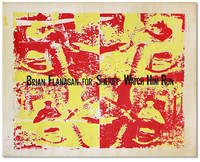
ref. 19730N.p. Chicago: 1969. Original silk-screened poster in three colors 23" x 29". Professionally backed on archival tissue; minor toning at margins still Near Fine. Brian Flanagan b. 1946 was a member of both SDS and the Weathermen and directly connected to the fatal Greenwich Village apartment explosion in which three Weathermen were killed while preparing for a bomb attack on Fort Dix Flanagan had reputedly left the apartment briefly for more supplies. This rare poster promotes Flanagan's parodic write-in campaign for Mayor of Chicago during the Days of Rage. Following a fateful run-in with City Attorney Richard Elrod on the streets of Chicago in which Elrod was left with a broken neck and partial paralysis Flanagan was tried for attempted murder and inciting mayhem. He was eventually acquitted on all charges but the case became a cause celebre for the Weathermen and other radical left groups. An extremely ephemeral piece likely produced in tiny quantities and posted even less. unknown books
1855ref. 242185Boston: John P. Jewett. New York : Sheldon Lamport & Blakeman 1855. First Edition. 347 1 12 ads pp. 1 vols. 8vo. Original cloth. First Edition. 347 1 12 ads pp. 1 vols. 8vo. Anti-Catholic novel. JC-NY/AmLit John P. Jewett. New York : Sheldon, Lamport & Blakeman unknown books
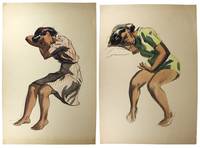
1950ref. 50163N.p. United States: s.i. 1950. Very Good. United States: 1950s or later. Pair of large watercolor and marker portraits of likely the same woman on thick cream paper one slightly shorter than the other 55x36cm; 52x36cm. Lacking any identifying artist markings. Edges toned corners creased and mild dust-soiling overall. Closed tear to bottom right corner of the larger portrait. Otherwise Very Good or better. Likely from a large sketch book the same young woman reclines barefoot for two different sittings. In one she sits in her red-striped shirt dress resting her head on her crossed arms gazing off past the left of the artist. In the other she reclines similarly but in a green playsuit leaning on her right arm with the left at rest in her lap her gaze shifted more towards the artist who sits closer to her this time. The date range is based on her clothing and likely done fairly close together. s.i. unknown books
1501ref. dacs1574London: Raphael Tuck n.d. ca. 1890. No. 1501. Octavo color-illustrated self-wrappers printed entirely on linen 12 pp. Color illustrations. Good wrinkled perimeter a bit frayed. Raphael Tuck, n.d. [ca. 1890.] No. 1501. unknown books
1890ref. dacs1057New York: The Great Atlantic and Pacific Tea Company n.d. ca. 1890. Octavo stiff color-illustrated wrappers iv 48 pp. Illustrated with wood engravings throughout. “The Easy Book given away with One Pound of Tea or Two Pounds of Coffee or One Pound of Baking Powder.” Very Good light shelf wear. The Great Atlantic and Pacific Tea Company, n.d. [ca. 1890.] unknown books
1710ref. 1200341710. First Edition. SLAVERY ANONYMOUS. A True State of the Present Difference Between the Royal African Company and the Separate Traders. London: No publisher 1710. Slim octavo period-style full tan sheep gilt red morocco spine label raised bands; pp. 40. $1650.First edition of this argument against providing a monopoly over the British slave trade to the Royal African Company with tipped-in diagram of one of the Royal African Company's forts.This work attempts to highlight the irregularities of the business practices of the Royal African Company and to argue for the superiority of open trade in Africa particularly as a means of supplying slaves to the American plantations. Founded in 1660 by the royal Stuart family and the City of London the Royal African Company was founded to exploit natural resources like gold along the west coast of Africa. While the Royal African Company did participate heavily in the gold trade the majority of their income came from slave-trading. The Royal African Company was part of a concerted effortÑfully elaboration in the Navigation ActsÑto establish dominance in the slave trade since the Dutch had been the leading slave-traders prior to the Restoration. To that end the Royal African Company established a brutal and highly efficient slave-trading system eventually providing more slaves to the West Indies than any other company or state. The slaves were branded with the initials of the company or its longtime governor the Duke of York. Children were included in the transports. Between 1662 and 1731 the Company transported approximately 212000 slaves a fifth of whom died enroute. While the Company formally gave up slave-trading in 1731 they remained involved in the trade of ivory and gold dust industries dependent on labor exploitation and slavery. Goldsmiths 4605. Kress 2677. Early ink underlining and marginal notations.Small paper repair to diagram text and diagram trimmed close affecting portion of imprint and scattered catchwords not affecting readability. A very good copy. hardcover books
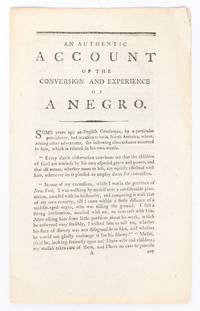
1795ref. 7213London: T. Wilkins 1795. First British edition. First separate edition. Measuring 205 x 120mm and complete in 4 pages. A Fine example. Scarce in all formats it was first printed in Vermont in 1793 and also contained a"faithful narrative.towards Polly Davis" one copy survives at AAS; soon after an edition was released from Maine containing "a poem on Christian Experience" only two copies survive both at NYPL. The present first British edition is also the first separately printed edition recorded by ESTC at only 9 libraries. It has come to auction on only five occasions with the present being the only example currently in trade. An Authentic Account records a brief encounter between a white Englishman and an enslaved Black man on a plantation in New York. Focusing their dialogue on the word of God and on salvation the white narrator asserts that the two men could find common ground as "children of God.equally effectual with him" despite their diametrically opposed positions within the social power structure. "Neither the color of his body nor the condition of his present life could prevent him from being my dear brother in our dear saviour." Despite this argument for the spiritual equality of men of all races the white narrator in An Authentic Account never questions nor seeks to subvert a power structure that would empower him while violently debasing Black people. Rather he passively participates in the Evangelical attitude so common of the era which considered enslavement an opportunity for saving the souls of uncivilized peoples who otherwise could not access the word of God. It was a position which abolitionist Evangelicals including William Wilberforce and Hannah More would decry as the height of hypocrisy in their own work during the period calling upon Christians not only to see Black people as spiritual equals but also as humans deserving equal liberty and dignity. ESTC T224026. T. Wilkins unknown books
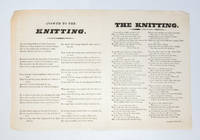
1820ref. 5877Bury: Birchinall Printer 1820. First edition. Near Fine. Broadside measuring 245 x 380mm and printed to verso only; the layout and placement of the imprint suggest that this piece was meant to be folded down the center with The Knitting appearing first and Answer appearing at rear. A very nearly Fine example with just a bit of creasing at the corners and faint offsetting along the left margin. Unrecorded by the Bodleian Library of Broadside Ballads or by OCLC the typeface suggests that it was produced toward the end of W. Birchinall's operations 1806-1829. A common thread connecting the Birchinall broadsides recorded by OCLC is the sensational depictions of 19th century true crime -- from the murder of Mary Booty in 1806 to the execution of Thomas South and his companions in 1816 to the burglary trial of James Philips and John Wade in 1822. The Knitting and Answer to the Knitting stand apart from these in a number of ways. Not only are they not sensationalizing identifiable local activities using names and dates clearly within their titles they take a more literary and satirical tone in relating young Susan's education in "knitting" and her resulting pregnancy and rejection by the shepherd Johnny. The Knitting focuses not only on Johnny's seduction but even more so on Susan's public exposure to gossip and social rejection as a result of his refusal to marry her. The text's serious warning to young women -- that whether right or wrong they will ultimately be blamed for the outcomes of unwed sex -- is undercut however by the followup Answer. Unlike The Knitting which opens with a more formal communal overture "come all ye pretty maidens fair" Answer creates a more private conspiratorial tone with its "It's of a young damsel as I have heard say." Lured into gossip by the narrator readers hear how Johnny returns to Susan after being required to pay child support for their son; how he secretly confesses his love in order to lure Susan again into a tryst; and how the couple's intercourse in a grove is a source of humor with Johnny's lovemaking resembling "a man that had fits". Unlike The Knitting's widely shared community knowledge and its use of gossip to warn young women and curb their sexual behavior Answer depicts how gossip spreads individual to individual with the narrator having heard this story from an unnamed friend and then sharing it with the reader among men to warn them against getting caught for their indiscretions. A research rich piece and the only known copy further work could be done on the physical object its typography and its printer. On a literary level further analysis could be done on how the pairing connects to other call-and-response poems such as the 17th century Passionate Shepherd to His Love and The Nymph's Reply and to the pastoral tradition. On a social history level further study could connect the work to 19th century gossip helping historians to understand how the practice of gossip differed in groups of various genders or classes especially surrounding sexuality and shame. Near Fine. Birchinall, Printer unknown books
1847ref. 9959Hartford: Brown and Parsons 1847. Hardcover. Good. Good. Publisher's binding generally soiled rubbed and bumped at the edges and corners. Square hinges a bit loose but with a firmly bound textblock former owner's name and address on the endpapers foxing throughout. A work "intended as an elegant little present for those who have recently entered the state of 'Holy Matrimony.'" The work consists of quotes about marriage domestic duties and Christianity. Brown and Parsons hardcover books
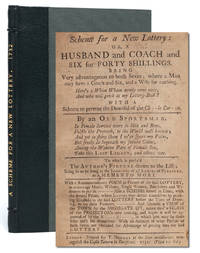
1732ref. 6120London: Printed for T. Dormer 1732. First edition. Modern quarter morocco over cloth with gilt to spine. Measuring 180 x 111mm and collating complete including frontis folding game board and concluding woodcut: 2 62 2. From the collection of stage magician Ricky Jay with his bookplate to upper pastedown. Top margin trimmed close with consistent loss to running headers and occasional loss to page numbers with no other text effected. Pages somewhat toned with minor marginal chips but otherwise unmarked. A scarce satire playing both on the rising popularity of get-rich-quick schemes and on the economics of the marriage market the present is the only example to appear in the auction record. OCLC locates only twelve institutional copies. The present is the only example currently in trade. A Scheme for a New Lottery warns readers against the dangers posed by get-rich-quick schemes targeting large-scale scams like the recently burst South Sea Bubble sometimes called the world's first Ponzi scheme and the pawn-broking swindle of the so-called Charitable Corporation. These scams were appealing to ordinary people at a time when few were "successful in using wealth from trade to found a landed family" Rapp. Mocking both the conmen and the conned A Scheme satirically proposes "Another Lottery which may prove a general benefit to all concern'd; as there is no better Remedy for a Bite from a Mad Dog than the Liver of the Dog that bit." The proposed lottery filled with abstruse rules and convoluted promises ensures that the cycle continues. A Scheme also mocks marriage as a scam in which women could either make a wise match in a rich man or lose it all by marrying down. The lottery provides "Fifty Thousand tickets to be deliver'd to Maids or Widows or any that appear to be such" in the hopes of winning a financially stable husband represented by the tickets drawn. Such a match could be a good one: "A Ware-House Keeper with the Salary of a Hundred Pounds" or "the Governour." It could also by virtue of lottery be a loss: "2 Scotchmen both Pedlars 500 Broken Booksellers" and a range of other ruinous bounders are also listed as prizes. For those who desire an advance attempt the folding game bound in the book invites blindfolded women to stick a pin in the board to claim their prize. The present copy was played gently with pin marks revealing a Blacksmith and a Valet de Chambre among those husbands won The popularity of A Scheme resulted in a reissue the same year with a canceled title page as The Ladies Lottery and falsely attributed to Swift. ESTC N20921. Printed for T. Dormer unknown books
1956ref. 65873NY: Macaulay 1956. First US edition. 88 pp. Pages browned acidic paper else near fine in near fine dust jacket that is lightly rubbed overall. Preface and illustrations by Cocteau. Young 709 uk ed. NY: Macaulay unknown books
1934ref. 7215New York: Farrar and Rinehart Inc 1934. First Edition. Hardcover. Very Good/Very Good. Very Good in an about Very Good jacket unclipped $2.00 generally toned a few chips and bumps at the edges some creases affecting the lettering on the spine. Red buckram lightly rubbed with blue ink lettering on the spine and front board. Square and firmly bound with a blue top stain clean internally. Rex Stout's anonymously published novel about the president's disappearance two hours before delivering a message about America entering the war. Farrar and Rinehart, Inc hardcover books
1968ref. 6780City of Industry: Collectors Publication 1968. First Edition. Mass Market Paperback. Near Fine. CP 21204. Near Fine. Wraps lightly toned. Square and firmly bond with toned pages clean internally. Collectors Publication paperback books
1969ref. 6779City of Industry: Collectors Publication 1969. First Edition. Mass Market Paperback. Very Good. CP 21311. Very Good. Wraps toned lightly bumped at the corners. Square and firmly bond with toned pages clean internally. Collectors Publication paperback books
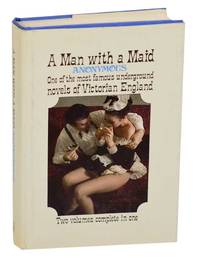
1968ref. 178235New York: Grove Press 1968. First edition thus. Hardcover. Originally published in England in either the late 1890s or early 1900s this is the first time it was published in the U.S. A sexually based novel that involves BDSM. An about very good copy with a bookplate to the front free endpaper and some spotting to the boards in a very good dust jacket that has some minor wear. Seemingly uncommon. Grove Press unknown books
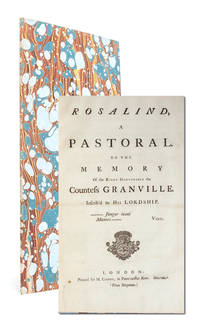
1745ref. 4023London: Printed for M. Cooper in Pater-Noster Row 1745. First edition. Fine. Recent marbled card wrappers. Bookplate of J.O. Edwards to front pastedown. Folio measuring 195 x 310mm and collating 7 1: complete. Pro-Patria watermark as called for. Internally a wide margined and fresh copy with a slight central fold across the title page and small paper repair to the inner margin of same page not affecting text. An exceedingly scarce work in praise of a woman who generated feminist shockwaves in her all too brief life ESTC lists only five known copies. It has never before appeared at auction and the present is the only one on the market. An anonymous poetical tribute to the Lady Sophia Fermor whose writing had already placed her among England's intellectual elite and whose two years' marriage to John Certeret second Earl Granville additionally placed her within London's political power center before her early death at age 24. Hailed by Lady Mary Wortley Montagu as having "few equals in beauty or graces" ODNB she was also the thinly veiled author of the revolutionary feminist tract Woman Not Inferior to Man or A Short and Modest Vindication of the Natural Right of the Fair Sext to a Perfect Equality of Power 1739. Released before her marriage with the by-line of "Sophia a Person of Quality" and predating Wollstonecraft's Vindication of the Rights of Woman by nearly half a century the book was a sensation. Pointing to unequal access to education and unfair treatment under the law as the only reasons for women's cultural inferiority Lady Sophia "exhorted all my sex.to betake themselves to the improvement of their minds and.shew our selves worthy.Let us shew them by what little we do without aid of education the much we might do if they did us justice" Woman Not Inferior. Her marriage was a companionate and loving one both gossiped about and admired. And her loss to puerperal fever in 1745 was felt widely. The present work was a tribute to Lady Sophia's irreplaceability. Though on the surface fixated on her external beauty the verses constantly recall women of Ovid and Shakespeare whose uniqueness stemmed from their interior strength and their ability to move others to action. The pastoral emphasis and the name Rosalind immediately evoke Shakespeare's headstrong and outspoken heroine from As You Like It who escaped the injustices of men by dressing and acting as one to protect herself and her best friend. In the poem Rosalind's disappearance to the land of the shades away from her husband Albino's gaze references Eurydice whose life and death inspired Orpheus' powerful songs. And the narrator's pleas for owls and nightingales to quiet themselves harken to stories of female anger and revenge notably Philomela who surived brutality to take her vengeance. The result is something more learned and serious a celebration of a complex woman who could have given more if only she had more time. ESTC T45227. Fine. Printed for M. Cooper in Pater-Noster Row unknown books