5.161 Ergebnisse
2024Best.-Nr. CBS-9798886263480American Academic Publisher Exclusive 2024. New. American Academic Publisher (Exclusive) unknown
1858Best.-Nr. 411Folio 36.2 x 26.2 cm. x 143 pp.; 12 engraved plates with explanatory text leaves a few text figures. Original quarter linen over limp boards. Printed label with title mounted on front board. = Written by Darwin's Bulldog the zoologist Thomas Henry Huxley 1825-1895 who was a ship's assistant surgeon and naturalist on board of HMS Rattlesnake. The Rattlesnake charted the Great Barrier Reef and the seas northwards to New Guinea. Huxley's paper On the anatomy and the affinities of the family of Medusae' was published in 1849 by the Royal Society in its Philosophical Transactions. Huxley united the Hydroid and Sertularian polyps with the Medusae to form a class to which he subsequently gave the name of Hydrozoa. The connection he made was that all the members of the class consisted of two cell layers enclosing a central cavity or stomach. This is characteristic of the phylum now called the Cnidaria. He compared this feature to the serous and mucous structures of embryos of higher animals. When at last he got a grant from the Royal Society for the printing of plates Huxley was able to summarise this work in The Oceanic Hydrozoa published by the Ray Society in 1859'. The value of Huxley's work was recognised and on returning to England in 1850 he was elected a Fellow of the Royal Society. In the following year at the age of twenty-six he not only received the Royal Society Medal but was also elected to the Council Wikipedia. On the front pastedown an armorial bookplate of the Rashleigh family Menabilly. At least one Rashleigh Jonathan junior 1845-1872 was interested in marine biology. A pencilled annotation on the Ray Society title. Boards and spine a bit worn at edges; text and plates mostly clean. A very good copy housed in a custom dark green slipcase with paper label. An excellent survivor preserved in the Publisher's original state. Nissen ZBI 2065. Ray Society paperback
1936Best.-Nr. BOOKS344988London UK: Chatto & Windus. Good/NO DUSTJACKET. 1936. . Hardcover. All plates included . 8vo. 154 pp. cover rubbed bumped endpaper foxing . Chatto & Windus hardcover
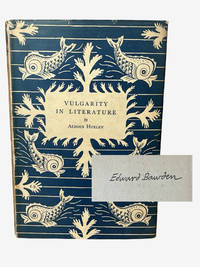
1930Best.-Nr. 004026Chatto & Windus. BAWDEN Edward; HUXLEY Aldous. Vulgarity in Literature: Digressions from a Theme. Edward Bawden's Copy with his signature to the front free end paper London: Chatto & Windus 1930. First edition. 8vo. 59 pp. Original cream paper-covered boards decorated in red with a design by Edward Bawden in the original blue and cream dust jacket repeating Bawden's design. Signed by the artist on the front free endpaper the book is from Bawden's library. The boards are lightly marked with some faint spotting to the endpapers. A split of approximately 20 mm at the foot of the rear joint has been neatly repaired. The dust jacket has rubbing and wear to the spine and extremities with several short closed tears small areas of loss and evidence of old repair. A Very Good copy. Edward Bawden's own copy of Aldous Huxley's extended essay on the meaning and nature of vulgarity in literature. Huxley ranges widely through literary criticism language morality and taste questioning both the possibility and usefulness of defining the vulgar while examining its place within literature and society. Published as the first volume in Chatto & Windus's Dolphin Books series the work was issued in striking decorated boards with a corresponding dust jacket designed by Edward Bawden. The playful marine design with fish dolphins seaweed and shells is an early example of Bawden's distinctive style. A pleasing association copy: not merely signed by Bawden but his personal copy from his library of a book whose boards and dust jacket he designed. . Very Good. Hardcover. 1st Edition. 1st Printing. 1930. Chatto & Windus hardcover
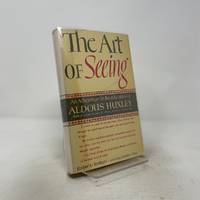
1942Best.-Nr. 555753Harper & Brothers Publishers 1942. FIRST EDITION. Hardcover. Very Good/Very Good. First Edition Later Printing July 1955. Published by Harper & Brothers Publishers 1942. Octavo. Hardcover. Book is very good. Dust jacket is very good price-clipped. Signed by author on flyleaf. Scare signed copy. Dust jacket spine fading. Harper & Brothers Publishers hardcover
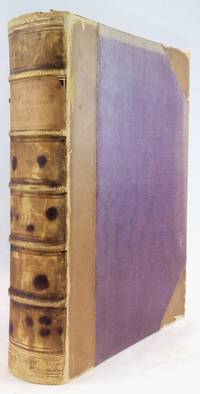
1860Best.-Nr. 1908London: Zoological Society of London 1860-1872. First editions. 44 OFFPRINTS COLLECTED BY PROMINENT BRITISH NATURALIST AUTHORED AND INSCRIBED BY COLLEAGUES IN THE DECADE FOLLOWING DARWIN'S ORIGIN OF SPECIES. 14x21.5 cm 3/4 leather & burgundy cloth bound collection of offprints from Proc Zool Soc London 1860-1872 presumably collected by JB Pettigrew to whom a number of the papers is inscribed by the authors. The papers vary in length from 2 pages to substantial monographs total size in the region of 400 pp. with 10 colored plates and several full page engraved plates as well as numerous text ills. Most concern mammalian or avian anatomy. Of the 44 29 are by James Murie 2 jointly with Mivart 6 by Mivart alone 3 by Cobbold and 4 by Flower and one each by Kirk and Huxley. Flower sided with Darwin against Richard Owen over the nature of the human brain and one of the papers here is on the anatomy including brain of the South American saki monkey Pithecia monachus. Cobbold was a leading authority on helminthology on which a 22 pp. paper is included here along with one on the anatomy of the giraffe. Murie himself is best known for work on the Thames fisheries and some African adventures but was for some time assistant in the museum of the Royal College of Surgeons. He appears to have been a friend of Pettigrew 13 of his papers being inscribed to him sometimes as 'my friend' or similar. Pettigrew was an eminent Scottish naturalist and museum curator who became a leading authority on animal locomotion and flight even designing an ornithopter on which he published several works as well as an anti-Darwinian 3 volume book on 'Design in Nature' completed 1908. This volume is in excellent condition being internally clean and tight with only occasional brown spotting though there is some cloth fading and surface marking to leather on gilt panelled spine. The spine label has gone but impression remains reading 'Papers by Doctors Murie Mivart Flower Cobbold &c'. It was apparently one of a series of similar volumes being numbered 'III' in one of the panels. An early hand-written list of the paper titles is laid in but missing 2 papers by Murie. THOMAS SPENCER COBBOLD 1828 - 1886 was an English scientist. After graduating in medicine at the University of Edinburgh in 1851 he was appointed lecturer on botany at St Mary's Hospital London in 1857 and also on zoology and comparative anatomy at Middlesex Hospital in 1861. He was elected a Fellow of the Royal Society in June 1864. His special subject was helminthology particularly the worms parasitic in man and animals and as a physician he gained a considerable reputation in the diagnosis of cases depending on the presence of such organisms. WILLIAM HENRY FLOWER 1831 - 1899 was an English comparative anatomist and surgeon. Flower became a leading authority on mammals and especially on the primate brain. He supported Thomas Henry Huxley in an important controversy with Richard Owen about the human brain and eventually succeeded Owen as Director of the Natural History Museum. Flower succeeded John Thomas Quekett as Conservator of the Hunterian Museum of the Royal College of Surgeons of England on the recommendation of Huxley and others. Flower became associated with Huxley's controversy with Richard Owen concerning the human brain. Owen had erroneously said that the human brain had structures that were not present in other mammals and separated man off into a Sub-Class of its own instead of a genus in the primates. At the 1862 meeting in Cambridge when Owen read a paper maintaining his claims Flower stood up and said "I happen to have in my pocket a monkey's brain" - and produced the object in question! report in the Times. In 1882 he was awarded the Royal Medal of the Royal Society. He was President of the Zoological Society of London from 1879 to 1899. THOMAS HENRY HUXLEY 1825 – 1895 was an English biologist and anthropologist who specialised in comparative anatomy. He has become known as "Darwin's Bulldog" for his advocacy of Charles Darwin's theory of evolution. He became the finest comparative anatomist of the later 19th century. He worked on invertebrates clarifying relationships between groups previously little understood. Later he worked on vertebrates especially on the relationship between apes and humans. JOHN KIRK 1832 - 1922 was a Scottish physician naturalist companion to explorer David Livingstone and British administrator in Zanzibar. He earned his medical degree from the University of Edinburgh. He was a keen botanist throughout his life and was highly regarded by successive directors of the Royal Botanic Gardens Kew: William Hooker Joseph Dalton Hooker and William Thistleton-Dyer. ST. GEORGE JACKSON MIVART 1827 - 1900 was an English biologist initially an ardent believer in natural selection but later becoming one of its fiercest critics. Mivart attempted to reconcile Darwin's theory of evolution with the beliefs of the Catholic Church and finished by being condemned by both parties. Fellow of the Linnean Society from 1862 Secretary from 1874-80 and Vice-President in 1892. In 1867 he was elected a Fellow of the Royal Society for his work "On the Appendicular skeleton of the Primates". Mivart was someone Darwin took seriously. One of his criticisms to which Darwin responded in later editions of the Origin of Species was a perceived failure of natural selection to explain the incipient stages of useful structures. Taking the eye as an example Darwin was able to show many stages of light sensitivity and eye development in the animal kingdom as proof of the utility of less than perfect sight argument by intermediate stages. JAMES MURIE 1832-1925 earned his MD from the University of Glasgow and specializing in zoology he first worked at the Royal Infirmary Glasgow proceeding to the Royal College of Surgeons in London as assistant in the Museum where under Prof. J. E. Queckett he was a comparative anatomist specializing in aquatic mammals. PROVENANCE: JAMES BELL PETTIGREW 1834 - 1908 was a distinguished naturalist in Edinburgh and London and at St Andrews University from 1875 until his death. Pettigrew was an internationally acknowledged authority on animal locomotion. In 1862 Pettigrew accepted the post of Assistant Curator at the Hunterian Museum of the Royal College of Surgeons in London which he held for five years. In 1867 he retired to Ireland to study the flight of birds and bats. In 1868 at the age of 36 Pettigrew was elected a Fellow of the Royal Society. In 1873 Pettigrew published Animal Locomotion: or Walking Swimming and Flying his most popular work. COMPLETE LIST OF PAPERS AVAILABLE ON REQUEST. Zoological Society of London hardcover
1860Best.-Nr. 1908London: Zoological Society of London 1860-1872. First editions. 44 OFFPRINTS COLLECTED BY PROMINENT BRITISH NATURALIST AUTHORED AND INSCRIBED BY COLLEAGUES IN THE DECADE FOLLOWING DARWIN'S ORIGIN OF SPECIES. 14x21.5 cm 3/4 leather & burgundy cloth bound collection of offprints from Proc Zool Soc London 1860-1872 presumably collected by JB Pettigrew to whom a number of the papers is inscribed by the authors. The papers vary in length from 2 pages to substantial monographs total size in the region of 400 pp. with 10 colored plates and several full page engraved plates as well as numerous text ills. Most concern mammalian or avian anatomy. Of the 44 29 are by James Murie 2 jointly with Mivart 6 by Mivart alone 3 by Cobbold and 4 by Flower and one each by Kirk and Huxley. Flower sided with Darwin against Richard Owen over the nature of the human brain and one of the papers here is on the anatomy including brain of the South American saki monkey Pithecia monachus. Cobbold was a leading authority on helminthology on which a 22 pp. paper is included here along with one on the anatomy of the giraffe. Murie himself is best known for work on the Thames fisheries and some African adventures but was for some time assistant in the museum of the Royal College of Surgeons. He appears to have been a friend of Pettigrew 13 of his papers being inscribed to him sometimes as 'my friend' or similar. Pettigrew was an eminent Scottish naturalist and museum curator who became a leading authority on animal locomotion and flight even designing an ornithopter on which he published several works as well as an anti-Darwinian 3 volume book on 'Design in Nature' completed 1908. This volume is in excellent condition being internally clean and tight with only occasional brown spotting though there is some cloth fading and surface marking to leather on gilt panelled spine. The spine label has gone but impression remains reading 'Papers by Doctors Murie Mivart Flower Cobbold &c'. It was apparently one of a series of similar volumes being numbered 'III' in one of the panels. An early hand-written list of the paper titles is laid in but missing 2 papers by Murie. THOMAS SPENCER COBBOLD 1828 - 1886 was an English scientist. After graduating in medicine at the University of Edinburgh in 1851 he was appointed lecturer on botany at St Mary's Hospital London in 1857 and also on zoology and comparative anatomy at Middlesex Hospital in 1861. He was elected a Fellow of the Royal Society in June 1864. His special subject was helminthology particularly the worms parasitic in man and animals and as a physician he gained a considerable reputation in the diagnosis of cases depending on the presence of such organisms. WILLIAM HENRY FLOWER 1831 - 1899 was an English comparative anatomist and surgeon. Flower became a leading authority on mammals and especially on the primate brain. He supported Thomas Henry Huxley in an important controversy with Richard Owen about the human brain and eventually succeeded Owen as Director of the Natural History Museum. Flower succeeded John Thomas Quekett as Conservator of the Hunterian Museum of the Royal College of Surgeons of England on the recommendation of Huxley and others. Flower became associated with Huxley's controversy with Richard Owen concerning the human brain. Owen had erroneously said that the human brain had structures that were not present in other mammals and separated man off into a Sub-Class of its own instead of a genus in the primates. At the 1862 meeting in Cambridge when Owen read a paper maintaining his claims Flower stood up and said "I happen to have in my pocket a monkey's brain" - and produced the object in question! report in the Times. In 1882 he was awarded the Royal Medal of the Royal Society. He was President of the Zoological Society of London from 1879 to 1899. THOMAS HENRY HUXLEY 1825 – 1895 was an English biologist and anthropologist who specialised in comparative anatomy. He has become known as "Darwin's Bulldog" for his advocacy of Charles Darwin's theory of evolution. He became the finest comparative anatomist of the later 19th century. He worked on invertebrates clarifying relationships between groups previously little understood. Later he worked on vertebrates especially on the relationship between apes and humans. JOHN KIRK 1832 - 1922 was a Scottish physician naturalist companion to explorer David Livingstone and British administrator in Zanzibar. He earned his medical degree from the University of Edinburgh. He was a keen botanist throughout his life and was highly regarded by successive directors of the Royal Botanic Gardens Kew: William Hooker Joseph Dalton Hooker and William Thistleton-Dyer. ST. GEORGE JACKSON MIVART 1827 - 1900 was an English biologist initially an ardent believer in natural selection but later becoming one of its fiercest critics. Mivart attempted to reconcile Darwin's theory of evolution with the beliefs of the Catholic Church and finished by being condemned by both parties. Fellow of the Linnean Society from 1862 Secretary from 1874-80 and Vice-President in 1892. In 1867 he was elected a Fellow of the Royal Society for his work "On the Appendicular skeleton of the Primates". Mivart was someone Darwin took seriously. One of his criticisms to which Darwin responded in later editions of the Origin of Species was a perceived failure of natural selection to explain the incipient stages of useful structures. Taking the eye as an example Darwin was able to show many stages of light sensitivity and eye development in the animal kingdom as proof of the utility of less than perfect sight argument by intermediate stages. JAMES MURIE 1832-1925 earned his MD from the University of Glasgow and specializing in zoology he first worked at the Royal Infirmary Glasgow proceeding to the Royal College of Surgeons in London as assistant in the Museum where under Prof. J. E. Queckett he was a comparative anatomist specializing in aquatic mammals. PROVENANCE: JAMES BELL PETTIGREW 1834 - 1908 was a distinguished naturalist in Edinburgh and London and at St Andrews University from 1875 until his death. Pettigrew was an internationally acknowledged authority on animal locomotion. In 1862 Pettigrew accepted the post of Assistant Curator at the Hunterian Museum of the Royal College of Surgeons in London which he held for five years. In 1867 he retired to Ireland to study the flight of birds and bats. In 1868 at the age of 36 Pettigrew was elected a Fellow of the Royal Society. In 1873 Pettigrew published Animal Locomotion: or Walking Swimming and Flying his most popular work. COMPLETE LIST OF PAPERS AVAILABLE ON REQUEST. Zoological Society of London hardcover books
1928Best.-Nr. 50806New York: Chatto & Windus 1928. Signed Limited Edition. Hardcover - as published. Very Good green cloth #203/256 signed limited signed by Huxley on the limitation page. Spine slightly sunned. Front hinge weakened deckled edges t.e.g. A very nice copy. Chatto & Windus, hardcover
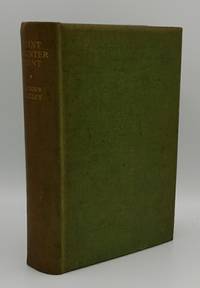
1928Best.-Nr. C796879Chatto & Windus. Good. 1928. 1st Edition. Hardcover. Signed by Author; 8vo - over 7¾" - 9¾" tall; 601 pp; Limited Edition - #83 of 256. Author Signed. Book has previous owner's name dated 1929. Book is bound in green fabric spine sun darkened hinges are cracked but holding front hinge was repaired with tape lightly foxed throughout pages unmarked. . Chatto & Windus hardcover
1948Best.-Nr. D20701London: Chatto and Windus 1948. First Edition. Hardcover. Near Fine/Very Good. 8vo. pp xviii 366. Photographs throughout. Folding map at rear. Cloth in pictorial dustwrapper missing lower 4cm of spine portion otherwise quite attractive. An uncommon title in the first edition this is an exceptional association copy INSCRIBED by Elspeth Huxley to American born conservationist Esmond Bradley Martin. Martin settled in Kenya as an adult and spent the balance of his life there courageously fighting on behalf of the elephant and the rhinoceros and the illegal trading of ivory and rhinoceros horns. Chatto and Windus hardcover
1948Best.-Nr. D20701London: Chatto and Windus 1948. First Edition. Hardcover. Near Fine/Very Good. 8vo. pp xviii 366. Photographs throughout. Folding map at rear. Cloth in pictorial dustwrapper missing lower 4cm of spine portion otherwise quite attractive. An uncommon title in the first edition this is an exceptional association copy INSCRIBED by Elspeth Huxley to American born conservationist Esmond Bradley Martin. Martin settled in Kenya as an adult and spent the balance of his life there courageously fighting on behalf of the elephant and the rhinoceros and the illegal trading of ivory and rhinoceros horns. Chatto and Windus hardcover books
Best.-Nr. elala4784London & Edinburgh: Williams And Norgate 1863. First Edition of this important work in which Huxley provided the first synthesis of the anatomical and embryological evidence of human evolution. He showed that there is less anatomical difference between man and the higher apes than between the latter and the lower primates. Freeman 1855. Bib. Osleriana 1605. Garrison & Morton 165. Waller 10853. 8vo. pp. 4 p.l.incl. frontis. 159 viiiads dated Feb. 1863. wood-engraved text illus. some full-page. ads on flyleaves. modern quarter calf first few leaves with institutional blindstamps some spotting & light soiling London & Edinburgh: Williams And Norgate, 1863 unknown
1913Best.-Nr. 86743New York: Dodd Mead and Company 1913. Presumed First U. S. Edition First printing. Hardcover. Fair. Edward A. Wilson Color illustrations. 2 Volume Set. Volume I xxiv 443 1 pages. Glossary. Appendix. Volume II. xiv 2 376 8 pages. Footnote. Appendix. Index. Maps and illustrations collated and found to be complete. Some page discoloration noted. Large volumes and boards show some weakness. This is a heavy set and if sent outside of the United States would require additional shipping charges. With photogravure frontispieces 6 original sketches in photogravure by Dr. E. A. Wilson 18 coloured plates 16 from drawings by Dr. Wilson 260 full page and smaller illustrations from photographs taken by Herbert G. Ponting and other members of the expedition panoramas and maps. Name of previous owner Ralph Steinhardt Jr.--possibly the member of the Special Engineer Detachment of the Manhattan Project stationed at Los Alamos during WWII inside front covers. Preface by Sir Clements R. Markham. Volume I appears to have a typographical error in the colour illustrations with the item differently title and the page given as 288 instead of its location at 238. Leonard Huxley 11 December 1860 - 3 May 1933 was an English schoolteacher writer and editor. Huxley's major biographies were the three volumes of Life and Letters of Thomas Henry Huxley and the two volumes of Life and Letters of Sir Joseph Dalton Hooker OM GCSI. He also published Thomas Henry Huxley: a character sketch and a short biography of Darwin. He was assistant master at Charterhouse School between 1884 and 1901. He was then the assistant editor of Cornhill Magazine between 1901 and 1916 becoming its editor in 1916. Captain Robert Falcon Scott CVO 6 June 1868 - c. 29 March 1912 was a British Royal Navy officer and explorer who led two expeditions to the Antarctic regions: the Discovery expedition of 1901-04 and the Terra Nova expedition of 1910-13. On the first expedition he set a new southern record by marching to latitude 82°S and discovered the Antarctic Plateau on which the South Pole is located. On the second venture Scott led a party of five which reached the South Pole on 17 January 1912 less than five weeks after Amundsen's South Pole expedition. A planned meeting with supporting dog teams from the base camp failed despite Scott's written instructions and at a distance of 162 miles from their base camp at Hut Point and approximately 12.5 miles from the next depot Scott and his companions died. When Scott and his party's bodies were discovered they had in their possession the first Antarctic fossils discovered. The fossils were determined to be from the Glossopteris tree and proved that Antarctica was once forested and joined to other continents. Before his appointment to lead the Discovery expedition Scott had a career as a Royal Navy officer. In 1899 he had a chance encounter with Sir Clements Markham the president of the Royal Geographical Society and learned of a planned Antarctic expedition which he soon volunteered to lead. His name became inseparably associated with the Antarctic the field of work to which he remained committed during the final 12 years of his life. Following the news of his death Scott became a celebrated hero a status reflected by memorials erected across the UK. Dodd, Mead and Company hardcover
1982Best.-Nr. 11173FISCHER 05/1982. 951.-1000. Tsd. softcover. FISCHER paperback
1983Best.-Nr. 11262FISCHER 03/1983. 1001.-1051. Tsd. softcover. FISCHER paperback
1993Best.-Nr. 11174FISCHER 07/1993. 1561.-1600. Tsd.ND. softcover. Nova Titolbildo! FISCHER paperback
1996Best.-Nr. 11177FISCHER 11/1996. 1601.-1640. Tsd.ND. softcover. Nova Kovrajoformado! FISCHER paperback
1983Best.-Nr. 11263FISCHER 08/1983. 1051.-1100. Tsd.ND. softcover. Nova Kovrajoformado! FISCHER paperback
1986Best.-Nr. 11176FISCHER 07/1986. 1261.-1290. Tsd.ND. softcover. Nova Titolbildo! FISCHER paperback
1936Best.-Nr. 316637New York: Harper & Brothers 1936. First Edition; First Printing. Hardcover. Good in a Fair dust jacket. Nameplate on front pastedown. Spine slightly cocked. Large open tearing on spine crown and top rear panel. Small open tears on top and bottom front and rear panels spine heel and panel corners. Closed tear on spine. Harper & Brothers hardcover
1970Best.-Nr. 11175FISCHER 08/1970. 258.-277. Tsd.ND. softcover. Nova Titolbildo! FISCHER paperback
1979Best.-Nr. 11261FISCHER 05/1979. 716.-765. Tsd.ND. softcover. FISCHER paperback
1980Best.-Nr. 11260FISCHER 10/1980. 816.-865. Tsd. softcover. FISCHER paperback
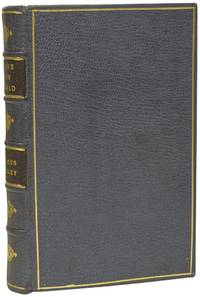
Best.-Nr. 75752London: Chatto and Windus 1932. Dystopian novel FIRST EDITION first impression. Octavo 20 x 14cm pp.8 306 2. Elegantly hand-bound in recent full blue oasis morocco twin black title labels gilt tooling top edge gilt publisher's cloth backstrip bound in. Contents clean but for light sporadic foxing exterior as new. A modern highlight and a landmark of 20th century fiction suggesting that a future of boundless materialist happiness designer narcosis and no strings sex might not be all its made out to be. Aldous Huxley was awarded the 1939 James Tait Black Memorial Prize for 'After Many A Summer Dies The Swan'. London: Chatto and Windus, 1932 unknown