HUXLEY, Thomas HenryBiblio.com
5 161 résultats
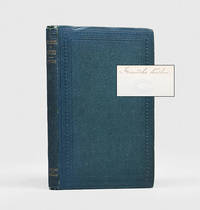
1863réf. 181331London: Williams and Norgate 1863. Exploring human evolution some seven years before Darwin's Descent of Man First edition first issue presentation copy inscribed in a secretarial hand "from the author" on the half-title. Evidence is Huxley's key work deliberately written for a non-specialist audience and among his most influential contributions to the theory of human evolution being the first to bring together anatomical and embryonic evidence. In the Origin of Species Darwin carefully avoided the implications of his theory for humanity but Huxley boldly brought them to the fore. In the early 1860s Richard Owen had asserted that human and ape brains were fundamentally different and that the hippocampus minor was exclusively found in humans. In Evidence Huxley uses extensive dissectional evidence to disprove this emphasizing the human-ape commonality and relying on Darwinian evolution for his theoretical underpinnings. The work was also among the first to publicize the discovery of Neanderthal man. The first issue prints the frontispiece on the verso of the second leaf forming an integral part of the preliminaries and the "Advertisement to the Reader" appears on the recto of the fourth. Octavo pp. viii 159 1 8. Wood-engraved frontispiece extensive illustrations in the text. With 8 pp. of publisher's advertisements dated February 1863 at rear. Original green pebble-grain cloth spine lettered in gilt and ruled in blind covers panelled in blind brownish-red endpapers with printed advertisements. Near-contemporary blue ink ownership stamp of chemist and publisher John Balcomb 1841-1918 of Cheltenham to half-title. Infrequent pencil sidelining to contents. Light bumping wear and toning head of front joint starting infrequent minor foxing to otherwise fresh contents: a very good copy. Cushing H554; Garrison-Morton 165; Heirs of Hippocrates 1033; Norman 1132; Osler 1605; Waller 10853. hardcover
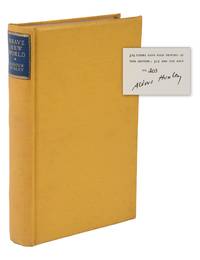
1932réf. 1156London: Chatto and Windus 1932. First Edition. Deluxe issue number 154 of 324 signed copies. 8vo. Fine in the publisher's yellow cloth morocco label to spine lettered in gilt top edge gilt. The UK edition was split into signed and trade issues published simultaneously on 2 February following publication of the signed issue of the US edition on 21 January and preceding the US trade issue on 4 February. Half morocco box. Connolly 75; Eschelbach and Shober 10. "Brave New World" occupies a singular position within the twentieth-century literary canon as a prophetic dystopian vision that transcends mere speculative fiction through its incisive critique of technological determinism consumer capitalism and the erosion of individual autonomy. Unlike contemporaneous dystopian works that focused primarily on political authoritarianism Huxley's novel pioneered the concept of a "soft tyranny" wherein citizens willingly participate in their own subjugation through engineered pleasure and commodified happiness-a prescient anticipation of late capitalism's emphasis on consumption as identity formation. The novel's enduring relevance stems from its philosophical engagement with fundamental questions regarding the tension between individual liberty and social stability the ethical implications of biotechnology and the psychological price of material prosperity achieved through emotional suppression. Chatto and Windus unknown
1932réf. 1156London: Chatto and Windus 1932. First Edition. Deluxe issue number 154 of 324 signed copies. 8vo. Fine in the publisher's yellow cloth morocco label to spine lettered in gilt top edge gilt. The UK edition was split into signed and trade issues published simultaneously on 2 February following publication of the signed issue of the US edition on 21 January and preceding the US trade issue on 4 February. Half morocco box. Connolly 75; Eschelbach and Shober 10. "Brave New World" occupies a singular position within the twentieth-century literary canon as a prophetic dystopian vision that transcends mere speculative fiction through its incisive critique of technological determinism consumer capitalism and the erosion of individual autonomy. Unlike contemporaneous dystopian works that focused primarily on political authoritarianism Huxley's novel pioneered the concept of a "soft tyranny" wherein citizens willingly participate in their own subjugation through engineered pleasure and commodified happiness-a prescient anticipation of late capitalism's emphasis on consumption as identity formation. The novel's enduring relevance stems from its philosophical engagement with fundamental questions regarding the tension between individual liberty and social stability the ethical implications of biotechnology and the psychological price of material prosperity achieved through emotional suppression. Chatto and Windus unknown books
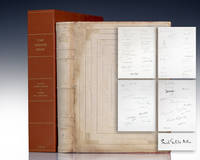
1929réf. 149534London: Privately printed by The Curwen Press for H.R.H. The Prince of Wales 1929. First and limited deluxe edition of the monumental Legion Book; one of only one hundred numbered copies printed for private distribution by the Prince of Wales and signed by a remarkable array of British writers and artists as well as four prime ministers. Quarto original publisher's full deluxe pigskin over boards elaborately decorated in blind and gilt top edge gilt tissue-guarded color frontispiece engraved title-page vignette illustrated with 16 captioned tissued-guarded plates in various techniques some signed by the artist and 32 collotypes. One of one hundred numbered copies printed for private distribution by the Prince of Wales and with five pages signed by each of the 89 contributing writers and illustrators as well as four prime ministers three British Prime Ministers: David Lloyd George Stanley Baldwin and Ramsay MacDonald and French Prime Minister Georges Clemenceau including: Winston Churchill who was not yet a Prime Minister Rudyard Kipling P.G. Wodehouse Eric Gill Stanley Spencer Charles Ricketts W. Heath Robinson Laura Knight William Nicholson Paul Nash David Low Rebecca West John Lavery Max Beerbohm Vita Sackville-West Hilaire Belloc Mark Gertler Edith Sitwell Jacob Epstein W.H. Davies and Aldous Huxley among others. This is number 84. The Legion Book was created at the request of H.R.H. The Prince of Wales—who would later become King Edward VIII and following his abdication the Duke of Windsor—as a fundraising initiative for the British Legion. All profits from its sales were intended to support the organization. The book features contributions from 85 distinguished British writers and artists including Winston Churchill Rudyard Kipling P.G. Wodehouse Aldous Huxley Vita Sackville-West G.K. Chesterton Hilaire Belloc Augustus John Eric Kennington and John Nash. It was compiled and edited by James Humphrey Cotton Minchin 1894–1966 a veteran who served with the Cameronians and the Royal Flying Corps during the First World War. While the trade version saw several reprints a special edition of 600 numbered copies was also produced. Of these 500 bore the editor’s signature but “the first 100 were reserved for H.R.H. the Prince of Wales sponsor of the volume in his gift.” According to the note at the conclusion of the Table of Contents “Five pages of contributors’ signatures appear after the Dedication with additional signed pages opposite Collotype No. 3 and Collotype No. 20.” Every contributor signed the book with the sole exception of John Singer Sargent who died in 1925 before the project was completed. In near fine condition with toning to the extremities of the front panel and front hinge. Housed in the original publisher's custom folding cloth clamshell box. An exceptional example of this rare signed limited edition. Formed in the aftermath of a war that had shattered a generation the Royal British Legion emerged in May 1921 as a unified voice for the countless veterans left wounded—physically mentally and economically—by the First World War. The staggering cost of the conflict with nearly 3.2 million British Empire casualties exposed the inadequacy of postwar support. A fully disabled veteran received just 30 shillings a week and any claim had to be made within seven years of discharge. In response to such injustice several ex-servicemen’s groups came together to create the Legion not merely as a charity but as an advocate for those who had borne the brunt of industrialized warfare. From its inception the Legion fought for fair pensions better employment opportunities and meaningful support for both former service members and their families—laying the groundwork for a broader movement of remembrance welfare and national responsibility that continues to this day. Privately printed by The Curwen Press for H.R.H. The Prince of Wales hardcover
1932réf. 140949470London: Chatto and Windus 1932. Limited First Edition. Near Fine. First edition limited issue. Copy #203 of 324 copies signed by Aldous Huxley on the limitation page at front. viii 306 1 pp. Bound in publisher's yellow cloth with blue morocco title label to spine top edge gilt. Near Fine with light soiling to cloth and rubbing to corners offsetting to endsheets. A beautiful copy of the author's best-known work. Chatto and Windus unknown
1932réf. 140949470London: Chatto and Windus 1932. Limited First Edition. Near Fine. First edition limited issue. Copy #203 of 324 copies signed by Aldous Huxley on the limitation page at front. viii 306 1 pp. Bound in publisher's yellow cloth with blue morocco title label to spine top edge gilt. Near Fine with light soiling to cloth and rubbing to corners offsetting to endsheets. A beautiful copy of the author's best-known work. Chatto and Windus unknown books
1932réf. 23994London: Chatto and Windus 1932. A first edition first printing of 'Brave New World' published by Chatto and Windus in 1932. A very good book with the contemporary ownership inscription of John Gielgud to front free endpaper "John Gielgud : 7 Upper St. Martin's Lane W.C.2" with a further inscription in Gielgud's hand to the lower left of the same page "from Aldous inked out Ralph Richardson / Romeo and Juliet : Oxford 1932 / February 9th" John Gielgud's bookplate to front pastedown original blue cloth gilt-lettered spine rubbed spine darkened and slightly creased at head and foot dust-wrapper with a little chipping to spine tips some internal tape repairs to tips and spine ends not price-clipped retaining the original 7s. 6d. price some spotting to edges of flaps browning to spine and some wear to lower lettering completely original and unrestored. An exceptional theatrical association copy of Huxley's dystopian masterpiece owned by John Gielgud and apparently presented to him in connection with his 1932 Oxford production of 'Romeo and Juliet'. Gielgud's production for the Oxford University Dramatic Society was his directorial debut and featured Gielgud himself as Romeo with the young Peggy Ashcroft as Juliet and Edith Evans as the Nurse. The further inscription in Gielgud's hand records the book as from Ralph Richardson who would shortly afterwards play Mercutio in the BBC National Programme broadcast of 'Romeo and Juliet' produced by Gielgud's brother Val. Richardson and Gielgud remained lifelong friends and together with Laurence Olivier formed the celebrated triumvirate of British stage actors who dominated much of twentieth-century theatre. The association is especially pleasing given the Shakespearean architecture of 'Brave New World'. The title itself is taken from Miranda's line in 'The Tempest' while 'Romeo and Julie' recurs throughout the novel most notably in the Savage's passionate identification with Romeo and his reading of the play in relation to Lenina. A copy linking Huxley's great novel of the future with two of the central figures of the British stage at the very moment of Gielgud's emergence as a director. A remarkable association copy of one of the defining novels of the twentieth century in its completely original unrestored dust-wrapper. Chatto and Windus hardcover
1932réf. 565426London: Chatto & Windus 1932. Hardcover. Fine/Near Fine. First edition. Fine in especially bright and very near fine dust jacket with very small chips at the spine ends and a tiny and seamless internal repair of a miniscule tear. Housed in a custom blue cloth clamshell case with gray morocco gilt spine label. A nice copy of Huxley's masterpiece a bleak and despairing vision of future society. Increasingly rare in collector's condition. A much fresher than usual example. Connolly 100. Chatto & Windus hardcover
1932réf. 565426London: Chatto & Windus 1932. Hardcover. Fine/Near Fine. First edition. Fine in especially bright and very near fine dust jacket with very small chips at the spine ends and a tiny and seamless internal repair of a miniscule tear. Housed in a custom blue cloth clamshell case with gray morocco gilt spine label. A nice copy of Huxley's masterpiece a bleak and despairing vision of future society. Increasingly rare in collector's condition. A much fresher than usual example. Connolly 100. Chatto & Windus hardcover books
1932réf. 140946918London: Chatto & Windus 1932. First Edition. Near Fine/Near Fine. First edition first printing. Bound in publisher's blue cloth with spine lettered in gilt. Near Fine with significant lean to binding and light fading to spine foxing to text block edges and slight perfume odor. In a Near Fine unclipped dust jacket with toning to spine light edge wear and foxing. A striking copy of the dystopian classic. Chatto & Windus unknown
1932réf. 140946918London: Chatto & Windus 1932. First Edition. Near Fine/Near Fine. First edition first printing. Bound in publisher's blue cloth with spine lettered in gilt. Near Fine with significant lean to binding and light fading to spine foxing to text block edges and slight perfume odor. In a Near Fine unclipped dust jacket with toning to spine light edge wear and foxing. A striking copy of the dystopian classic. Chatto & Windus unknown books