Henri Gauthier-Villars dit Willy (1859-1931), écrivain.Livre Rare Book

7 192 résultats
réf. 009090Henri Gauthier-Villars dit Willy (1859-1931), écrivain. L.A.S., sd [1902], 1p in-8 oblong. A Alfred Vallette (1858-1935). « Zut ! je ne sais pas torcher ces choses-là, moi ! Pour P.. je lui avait dit 500f (sans rien lui écrire). Mais, au reçu de votre mot, je lui ai télégraphié que votre assentiment était indispensable, d'autant plus que vous étiez en pourparlers avec Berlin (ce que ce cochon ne m'avait pas dit). [.] Dites-donc, si je faisais distribuer un prospectus de Claudine en Ménage aux Bouffes, qu'en pensez-vous ? ». [291]
réf. 009092Henri Gauthier-Villars dit Willy (1859-1931), écrivain. L.A.S., sd [ca.1899], 1p in-8. A son nègre Christian Beck (1879-1916). Amusante lettre : « Votre lettre est toute drôlette et charmante, et pour bander encore il faudrait que je presse un con bien hirsute ! [.] Merdre [référence à Ubu] pour plusieurs notoires contemporains, parmi lesquels [Ernest] La Jeunesse et l'hystérique bas bleu qui enlaidit les nuits d'Anatole ! ». Précisons que l'hystérique est madame de Caillavet, la maîtresse d'Anatole France. « Les yeux de ma chérie ne voient pas mieux » : il s'agit alors de Colette. Il est question que willy rencontre un ami de Beck et Willy propose aussi à Beck de venir travailler près de lui. [291]
réf. 009093Henri Gauthier-Villars dit Willy (1859-1931), écrivain. L.A.S., sd [ca.1899], 1p in-12. A son nègre Christian Beck (1879-1916). Amusant courrier : « J'ai appris avec plaisir - par votre gentille lettre - que votre voyage en Italie s'était arrêté rue de Milan ; c'est un petit commencement. » S'étonnant qu'il écrive, Willy lui demande ses manuscrits : « Vous savez ce qui fut convenu ». Il demande quand il recevra le début. Joli courrier autour de leur collaboration. [291]
réf. 009096Henri Gauthier-Villars dit Willy (1859-1931), écrivain. L.A.S., sd, 1p in-8. A son nègre Christian Beck (1879-1916). Superbe lettre de reproches, signée simplement W, Beck ne tenant pas ses engagements, d'une petite écriture serrée. « Ah ! les promesses ne vous coûtent guère ! Vous me trompez comme je tromperais ma femme, avec le même insouci désinvolte ; pourtant, je suis aussi supérieur à une femme qu'un blanc à un nègre, que diable ! ». Le reste est à l'avenant. [291]
réf. 017463Henry Gauthier-Villars dit Willy (1859-1931), écrivain, critique. Manuscrit A.S. « L'Ouvreuse », sd [ca.1910], 1p in-4. « Lettre de l'Ouvreuse », chronique de Willy mentionnant La Fiancée du Scaphandrier de Claude Terrasse jouée à l'Athènes de la Sprée (Berlin), Saint Georges Bouhelier, la Schola Cantorum et Vincent d'Indy, Cléo de Mérode, etc. On joint un article signé Willy, mais d'une autre main, « Instantané Pierre Valdagne ». Nombreuses déchirures. [95-2]
1918réf. 88731918. Paris Éditions Martine 1918 - Broché 14 5 cm x 23 cm 147 pages ex. num. (n°328) sur vélin-alfa - Texte de Henry Gauthier-Villars (Willy) portrait de l'auteur bois gravés et dessinés par Robert Barriot deux lettres-préfaces de Colette - Non coupé très bon état - Gounod Berlioz Wagner Saint - Saens La réforme de la musique religieuse Bayreuth Wagner et Nietzche etc
1928réf. 82684Paris Les Editions Martine, 1928, in-8, broché, 146p Un des 800 exemplaires sur Vélin Alfa, après 180 ex. sur Vergé à la Cuve et 20 ex. sur Japon. Très bon état. Texte de toute fraîcheur.
1928réf. 83570Paris Les Editions Martine, 1928, in-8 ( 14,5x23cm), broché, 146p. Bon état. Portrait de l'auteur en frontispice. Un des 800 ex. numérotés sur vélin Alfa après 20 Japon et 180 Vergé.
1940réf. 167041ohne angabe, ohne Angabe, 1940. 12 S., Pappe, farbig illustriert, mit Begleittexten, Gr.-8° OHalbleinen
réf. 124653Gingko Press, Berkeley, 2017. 33 S. ; 26,5 x 21 cm ; pp. ;
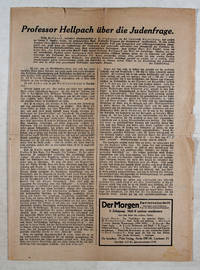
1928réf. 45882Berlin: T.B.-Zeitung 1928. Loose leaf. g. Folio. 4pp. Original newsprint with black lettering protected by modern mylar. Article by Willy Hellpach sixth State President of Baden from 1928 in which he takes a pro-Jewish position pages 55-57 of the T. B. -Zeitung at a time of rising anti-Semitism. The article was published in 1928 the same year of the release of his book "Politische Prognose für Deutschland" and represents the end of the third chapter of the published book his writings on the Jewish Question Judenfrage. The article is published with an explicit disclaimer by the newspaper saying that despite of its disagreement with large parts of the article the sincere attempt of a man of Hellpach's statue to be fair to the Jewish population and culture deserves the publication in order to allow the reader to study Hellpach's position and come to its own conclusion. In view of the miniscule share of Germany's total population 62 million Germans and half a million Jews Hellpach calls it a delusional idea to manufacture a Jewish Question and stoke anti-Semitism with reference to ritual murders and the Protocols of the Elders of Zion. This he claims "is an attempt to make the Jews a people within a people." Though he acknowledges the differences in appearance and social conduct Hellpach claims that these differences would hardly be noticeable if not for the concerted efforts to differentiate between the two groups. He emphasizes that a close look at the "milling masses" of Bavaria where anti-Semitism is cultivated at the Oktoberwiese for example one hardly would experience unfettered aesthetic joy for a noble race. Hellpach states that the physical differentiation is nothing but a tool of non-Jews wielded against the Jews pointing out that this approach has its roots in three facts: the Jew's steadfastness of kin their prosperity and the intellectual curiosity of Jews. Hellpach elaborates and gives examples of cases contributing to the division of the two ethnic groups cites the Russian revolution as a major reason for the unusually high immigration of Jews into Germany and concludes that politically in view of the self-image of Germany as a democracy there is only one way of dealing with the problem: the absolute equality of Jews in public life. A nation like Germany ought to be able to absorb the positive values of Jewish culture. These four pages include an open letter on the subject to Bruno Glaserfeld including the answer a contribution by Professor Grimme on "The Stones of Sinai" and a note on German-Jewish playwright Ernst Lissauer's successful premiere of his play "York" at the Cologne Theater. Includes several illustrated and classified advertisements. Article with wear along edges small chips and closed tears along horizontal fold. Age-toned. T.B.-Zeitung unknown books
1942réf. 1256870Walter de Gruyter; Berlin, 1942. VIII; 224 Seiten; zahlr. Illustr.; graph. Darst.; 24,5 cm; fadengeh. Orig.-Halbleinenband.
1928réf. 45882Berlin: T.B.-Zeitung 1928. Loose leaf. g. Folio. 4pp. Original newsprint with black lettering protected by modern mylar. Article by Willy Hellpach sixth State President of Baden from 1928 in which he takes a pro-Jewish position pages 55-57 of the T. B. -Zeitung at a time of rising anti-Semitism. The article was published in 1928 the same year of the release of his book "Politische Prognose für Deutschland" and represents the end of the third chapter of the published book his writings on the Jewish Question Judenfrage. The article is published with an explicit disclaimer by the newspaper saying that despite of its disagreement with large parts of the article the sincere attempt of a man of Hellpach's statue to be fair to the Jewish population and culture deserves the publication in order to allow the reader to study Hellpach's position and come to its own conclusion. In view of the miniscule share of Germany's total population 62 million Germans and half a million Jews Hellpach calls it a delusional idea to manufacture a Jewish Question and stoke anti-Semitism with reference to ritual murders and the Protocols of the Elders of Zion. This he claims "is an attempt to make the Jews a people within a people." Though he acknowledges the differences in appearance and social conduct Hellpach claims that these differences would hardly be noticeable if not for the concerted efforts to differentiate between the two groups. He emphasizes that a close look at the "milling masses" of Bavaria where anti-Semitism is cultivated at the Oktoberwiese for example one hardly would experience unfettered aesthetic joy for a noble race. Hellpach states that the physical differentiation is nothing but a tool of non-Jews wielded against the Jews pointing out that this approach has its roots in three facts: the Jew's steadfastness of kin their prosperity and the intellectual curiosity of Jews. Hellpach elaborates and gives examples of cases contributing to the division of the two ethnic groups cites the Russian revolution as a major reason for the unusually high immigration of Jews into Germany and concludes that politically in view of the self-image of Germany as a democracy there is only one way of dealing with the problem: the absolute equality of Jews in public life. A nation like Germany ought to be able to absorb the positive values of Jewish culture. These four pages include an open letter on the subject to Bruno Glaserfeld including the answer a contribution by Professor Grimme on "The Stones of Sinai" and a note on German-Jewish playwright Ernst Lissauer's successful premiere of his play "York" at the Cologne Theater. Includes several illustrated and classified advertisements. Article with wear along edges small chips and closed tears along horizontal fold. Age-toned. T.B.-Zeitung unknown
réf. 332298026X.Gpaperback. Good. Access codes and supplements are not guaranteed with used items. May be an ex-library book. paperback
réf. 45469043like new. unknown
réf. 1016432445.Ghardcover. Good. Access codes and supplements are not guaranteed with used items. May be an ex-library book. hardcover
réf. 1161094695.Gpaperback. Good. Access codes and supplements are not guaranteed with used items. May be an ex-library book. paperback
1911réf. 541221911. Leipzig Verlag von Wilhelm Engelmann 1911 8° VI 368 pp. Halbleinenband d.Zt.; St.a.Tit.; feines Expl. Erste Auflage! In einem allgemeinen Sinn hat die Umweltpsychologie eine über einhundertjährige Geschichte. Willy Hellpach 1877-1955 Arzt und Psychologe prägte den Begriff Umweltpsychologie und beschrieb die Wirkungen des Klimas verschiedener Landschaften und z. B. die Wirkungen der Großstadt auf den Menschen Miller 1991. Hellpachs Buch »Die geopsychischen Erscheinungen« 1911 das unter dem Titel »Geopsyche« etliche modifizierte Auflagen erreichte kann als Grundstein der Umweltpsychologie gelten. Hellpachs Vorgehen war geprägt durch die Völkerpsychologie seines Lehrers Wilhelm Wundt und die Anthropogeographie Friedrich Ratzels 1844-1904. Hellpach ging überwiegend beschreibend historisierend und anekdotisch vor schöpfte jedoch aus Reisebeschreibungen geologischen und medizinischen Befunden. In der Tat geht die Diskussion um Fragen der klimatischen Wirkungen auf den Menschen sicher bis ins 18. Jahrhundert zurück u.a. William Falconer 1741-1805; Falconer 1782. Empirische Untersuchungen im heutigen Sinn hat Hellpach nicht durchgeführt. Soweit erkennbar ist auch die Wirkungsgeschichte der Umweltpsychologie Hellpachs gering geblieben. Im angelsächsischen Bereich blieb er unbekannt. Allerdings hat Hellpach schon drei Bereiche der Umweltpsychologie beschrieben die auch heute als Bereiche der Umweltpsychologie gelten: 1. Die natürliche Umwelt 2. Die soziale Umwelt und 3. Die kulturelle Umwelt. " Helmut E. Lück Geschichte der Psychologie: Strömungen Schulen Entwicklungen 4.Aufl. 2009 p.172 unknown
réf. 116845641X.Gpaperback. Good. Access codes and supplements are not guaranteed with used items. May be an ex-library book. paperback
1923réf. 93376BB1923 . 3. neubearb. Aufl. Leipzig: Engelmann 1923. 8°. XX 530 S. Leinen Besitzervermerk auf Titelblatt; ohne mehrfarbige Tafeln unknown
réf. 1019333456.Ghardcover. Good. Access codes and supplements are not guaranteed with used items. May be an ex-library book. hardcover
réf. 0282082530.Gpaperback. Good. Access codes and supplements are not guaranteed with used items. May be an ex-library book. paperback
réf. 3642939937.Gpaperback. Good. Access codes and supplements are not guaranteed with used items. May be an ex-library book. paperback
réf. 0484974017.Gpaperback. Good. Access codes and supplements are not guaranteed with used items. May be an ex-library book. paperback