7.194 Ergebnisse
Best.-Nr. 1589Leipzig/Wien 1903. Half-calf 4to. l Bibliographisches Institut 1903. Zweite Auflage 663 pages 144 extengr. and photographs; 11 col. maps and 20 plates in black and white and colour. Gothic letter. spine discol. and traces of wear. unknown
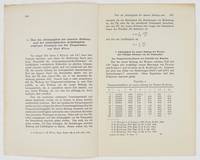
1928Best.-Nr. 680891928. Ann. Phys. 4. Folge 85/7. - Leipzig Verlag von Johann Ambrosius Barth 1928 8° pp.795-811 5 Fig. orig. Broschur. Rare Offprint! Wilhelm Wien 1865-1928 "grew up in the east Prussian town of Rastenburg today Ketrzyn Lithuania. He then studied at the prominent universities of Heidelberg and Göttingen before he eventually completed his doctorate in Berlin. In 1900 he succeeded W.C. Röntgen 1901 Physics Laureate as a professor in Würzburg. Wien's research concerned how various metals radiate heat and he received the Nobel Prize for the law of black-body radiation now known as Wien-Planck's law. It was drawn up jointly with Max Planck Physics 1918 and many felt that they should have shared in the award." "When a completely dark body is heated it emits visible light and other electromagnetic radiation. The spectrum of the radiation is entirely dependent on the temperature of the body and not its composition. In 1893 Wilhelm Wien formulated his displacement law which indicates at which wavelength the radiation is most intense at a certain temperature. He subsequently also formulated a law indicating how the radiation spectrum varies as temperature changes. However this does not apply to long wavelengths and in 1900 Max Planck formulated a law that conforms better." Wilhelm Wien - Facts. NobelPrize/org The Nobel Prize in Physics 1911 unknown
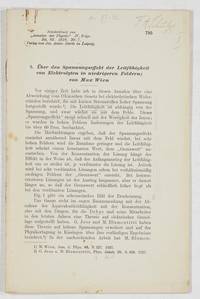
1925Best.-Nr. 680881925. Ann. Phys. 4. Folge 77. - Leipzig Verlag von Johann Ambrosius Barth 1925 8° pp.560-586 7 Fig. orig. Broschur. First Edition! Wilhelm Wien 1865-1928 "grew up in the east Prussian town of Rastenburg today Ketrzyn Lithuania. He then studied at the prominent universities of Heidelberg and Göttingen before he eventually completed his doctorate in Berlin. In 1900 he succeeded W.C. Röntgen 1901 Physics Laureate as a professor in Würzburg. Wien's research concerned how various metals radiate heat and he received the Nobel Prize for the law of black-body radiation now known as Wien-Planck's law. It was drawn up jointly with Max Planck Physics 1918 and many felt that they should have shared in the award." "When a completely dark body is heated it emits visible light and other electromagnetic radiation. The spectrum of the radiation is entirely dependent on the temperature of the body and not its composition. In 1893 Wilhelm Wien formulated his displacement law which indicates at which wavelength the radiation is most intense at a certain temperature. He subsequently also formulated a law indicating how the radiation spectrum varies as temperature changes. However this does not apply to long wavelengths and in 1900 Max Planck formulated a law that conforms better." Wilhelm Wien - Facts. NobelPrize/org The Nobel Prize in Physics 1911 unknown
Best.-Nr. ANAIS-0517709112Knopf Books for Young Readers. hardcover. Good. 9.5X6.5X1.5. Buy with confidence. Excellent Customer Service & Return policy. Knopf Books for Young Readers hardcover
1988Best.-Nr. 1110434Methuen. Very Good/Good. 1988. Book Club BCE/BOMC. Hard Cover. H404 . Methuen hardcover
1996Best.-Nr. 69423New York NY U.S.A.: Crown Publishing Group Incorporated. GOOD- Reading Copy/No Jacket. 1996. Ex-library/worn tape Repaired Pages. Hard Cover. 0517709112 Ex-Library D41 . Crown Publishing Group, Incorporated hardcover
1982Best.-Nr. 06186New York: John Wiley and Sons Ltd 1982. First Edition. Hardcover. Fair/No dust jacket. Some water damage. One fourth of the pages are water warped. The corners are a bit worn. The binding is nice and tight. Sparse margin markings. Electronic delivery tracking will be issued free of charge. John Wiley and Sons Ltd hardcover
Best.-Nr. 42689622like new. unknown
1989Best.-Nr. 009868Henschelverlag Kunst und Gesellschaft Berlin 1989 1989. Hardcover. Fine/Fine. 2. Aufl ; 180 pages : illustrations some color ; 27 cm ; ISBN 9783362004008 3362004008 OCLC 37456197 ; textured beigh cloth in photographic dustjacket ; 185 illustrations showcase the work of Ernst Barlach ; Ernst Heinrich Barlach was a German expressionist sculptor medallist printmaker and writer. Although he was a supporter of the war in the years leading to World War I his participation in the conflict made him change his position and he is mostly known for his sculptures protesting against it. This created many conflicts during the rise of the Nazi Party when most of his works were confiscated as degenerate art. Stylistically his literary and artistic work would fall between the categories of twentieth-century Realism and Expressionism. Barlach studied from 1888 to 1891 at the Gewerbeschule Hamburg. Due to his artistic talent he continued his studies at the Königliche Akademie der bildenden Künste zu Dresden He continued his studies for one more year in Paris at the Académie Julian from 1895 to 1897. After his studies Barlach worked for some time as a sculptor in Hamburg and Altona working mainly in an Art Nouveau style. He produced illustrations for the Art Nouveau magazine Jugend 1897-1902 and made sculpture in a style close to Art Nouveau including some ceramic statues. He also worked for the German journal Simplicissimus and started to produce some literature. His works were shown on various exhibitions. He also spent ten months in Florence Italy in 1909 and afterwards settled in 1910 in Güstrow in Mecklenburg where he spent the rest of his life. In 1936 Barlach's works were confiscated during an exhibition together with the works of Käthe Kollwitz and Wilhelm Lehmbruck and the majority of his remaining works were confiscated as "degenerate art". In addition to his sculpture Barlach also wrote eight Expressionist dramas two novels and an autobiography Ein selbsterzähltes Leben. ; name on front endpaper else FINE/FINE Henschelverlag Kunst und Gesellschaft, Berlin, 1989 hardcover
Best.-Nr. 0483108952.Ghardcover. Good. Access codes and supplements are not guaranteed with used items. May be an ex-library book. hardcover
Best.-Nr. A9781138081505Paperback / softback. New. paperback
Best.-Nr. 50373318like new. unknown
Best.-Nr. 1361704462.Ghardcover. Good. Access codes and supplements are not guaranteed with used items. May be an ex-library book. hardcover
Best.-Nr. 1361706813.Ghardcover. Good. Access codes and supplements are not guaranteed with used items. May be an ex-library book. hardcover
Best.-Nr. 1361706732.Ghardcover. Good. Access codes and supplements are not guaranteed with used items. May be an ex-library book. hardcover
Best.-Nr. B9780765613141Paperback / softback. New. This book challenges the belief that Hong Kong's political culture is one of indifference. "Political indifference" is used to suggest the apathy naivete passivity and utilitarianism of Hong Kong's people toward political life. Taking a historical look at political participation Wai-man Lam argues that this is not a valid view. paperback
Best.-Nr. B9781165322336New. unknown
Best.-Nr. 3755758385.Gpaperback. Good. Access codes and supplements are not guaranteed with used items. May be an ex-library book. paperback
Best.-Nr. 37703Bruxelles, Fonds Mercator, 2012 hardcover, Couverture rigide, 240 x 280mm, 206pp, 160 illustrations en couleur, **tr s bon tat ! Fran ais ISBN 9789061538455.
Best.-Nr. 47866141-nnew. unknown
Best.-Nr. 1258399512.Gpaperback. Good. Access codes and supplements are not guaranteed with used items. May be an ex-library book. paperback
Best.-Nr. 1163366250.Ghardcover. Good. Access codes and supplements are not guaranteed with used items. May be an ex-library book. hardcover
Best.-Nr. 18278295-nnew. unknown
Best.-Nr. ria9783662016978_inpPaperback. New. New Book; Fast Shipping from UK; Not signed; Not First Edition; N/A paperback
Best.-Nr. ria9783662017081_inpPaperback. New. New Book; Fast Shipping from UK; Not signed; Not First Edition; N/A paperback