Peeters, WillyBiblio.com

4 348 résultats
réf. 5f4936Verlinden Publications Lier/Belgium 1993. 36 S. mit zahlreichen Abbildungen kartoniert quer handschriftliches Datum auf Impressum. - sonst gutes Exemplar / good condition / Lock on No. 18 / Aircraft Photo File 761 / Text englisch - unknown
réf. 2h12558in-akustik Ballrechten-Dottingen 2010. 2 DVDs mit einer Spieldauer von 302 Minuten in original Kunststoffhülle im Schuber. unknown
réf. 6f6793Ziemsen Wittenberg 1912 135 Seiten mit Fototafeln Leineneinband. - gutes Exemplar in erster Ausgabe/ Künstler Exlibris auf Vorsatz - unknown
réf. 4c4264L. Mundschenks Buchdruckerei Soltau 1959. 48 S. mit 24 Abbildungen Halbleinen-Einband. - gutes Exemplar - unknown
réf. 5f4928Verlinden Publications Lier/Belgium 1990. 36 S. mit zahlreichen Abbildungen kartoniert quer. - gutes Exemplar / good condition / Lock on No. 10 / Aircraft Photo File 554 / Text englisch - unknown
réf. 5e5737Motorbuch Stuttgart 1997-2005 jeweils circa 160 Seiten mit zahlreichen Abbildungen Pappbände Quart. - neuwertig - unknown
réf. 66779Standaard-boekhandel 1945. Oorspronkelijk uitgevers omslag geniet 23 pag. gekleurde platen. goede staat. Deel van Zoo ik een . was / Vandersteen W. - Antwerpen; vol. 3 Standaard-boekhandel 1945 unknown
réf. 71614London: George G. Harrap and Co. 1909. Metaphysical Poetry FINELY-BOUND FIRST POGANY ILLUSTRATED EDITION. Quarto 28 x 20cm unpaginated. Highly calligraphic and decorated dichromatic text with 24 chromolithographic plates by Pogany interspersed after every two or three leaves. Recently re-bound in red full morocco with raised bands and gilt decoration to spine gilt titles to a black label to upper and further gilt decoration to upper. All edges gilt and marbled endpapers. Black ink ownership of Aida Foster to half-title dated December 1910 and some light spotting to first few leaves otherwise internally clean. A crease to plates facing 'Here with a loaf of bread' and 'For in and out'. Presented in an attractive new leather binding. Very good. 'Ah make the most of what we yet may spend / Before we too into Dust descend'. Polymath poet philosopher and scientist Khayyam was one of the greatest minds of the Islamic Golden Age whose enduring presence in the Anglophone world was cemented by the translations of FitzGerald. London: George G. Harrap and Co., 1909 unknown
1983réf. mon0000544033Severn House Publishers Ltd 28/07/1983 00:00:01. hardcover. Acceptable. in x in x in. Ex-library book usual markings. Well read with some wear but still very useable. With Dust Cover. Severn House Publishers Ltd hardcover
2000réf. 1-0764310232Schiffer Pub Ltd 2000. Hardcover. New. 158 pages. 11.18x8.58x0.87 inches. Schiffer Pub Ltd hardcover
réf. 66977Gent Grijm VZW 1988. Oorspronkelijk uitgevers omslag 160 pagina's 22 x 17 cm editie van 150 stuks deze is 19. Linotype-Garamond korps 12 en gedrukt op Ingres Van Gelder Zonen 95 g. De oplage bedraagt 160 exemplaren waarvan 150 genummerd van 1 tot 150 en 10 niet in de handel van A tot J. Alle exemplaren zijn door de auteur gesigneerd. Dit is nummer 19 Gent Grijm VZW 1988 unknown
1952réf. 1703Stuttgart: Ferdinand Enke Verlag 1952. NAP. Hardcover. Good. 6 3/8 x 9 5/8. Sewn binding in full cloth-covered boards. A solid copy opening widely but sewn binding is firm; hinges are intact; spine is slightly off square. Pencil marks front flyleaf and back pastedown but no marks to text. Condition rated "Good only" however because there is significant foxingto the cloth the endpapers the edges and a few pages. Boards very slightly bowed. Ferdinand Enke Verlag hardcover
1967réf. 5048DB1967. Zürich Emil Matthieu 1967. 58 x 46 cm. 7 signierte Lithografien von Varlin. Halbleinenmappe mit Pappdeckeln. N°. 99 von 100 Exemplaren. Unten rechts mit Bleistift signiert und nummeriert. Mappe und Lithographien in sehr gutem Zustand. unknown
réf. M8417cVery rare. Papyrologica Lugduno-Batava 24. E.J. Brill Leiden 1983. First edition. In-4 x & 165 pages. Original softcover a fine copy. From the library of papyrologist Jean A. Straus with his stamp and markings on the title page. Language: English. This book ships from Europe shipping costs will be updated accordingly BCI. Relevant subjects: Egypt: Greco-Roman Language Texts & Writing Demotic Studies Papyrology Religion & Magic. unknown
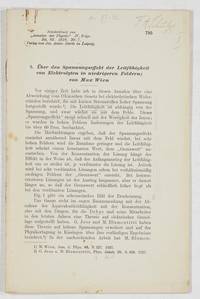
1925réf. 680881925. Ann. Phys. 4. Folge 77. - Leipzig Verlag von Johann Ambrosius Barth 1925 8° pp.560-586 7 Fig. orig. Broschur. First Edition! Wilhelm Wien 1865-1928 "grew up in the east Prussian town of Rastenburg today Ketrzyn Lithuania. He then studied at the prominent universities of Heidelberg and Göttingen before he eventually completed his doctorate in Berlin. In 1900 he succeeded W.C. Röntgen 1901 Physics Laureate as a professor in Würzburg. Wien's research concerned how various metals radiate heat and he received the Nobel Prize for the law of black-body radiation now known as Wien-Planck's law. It was drawn up jointly with Max Planck Physics 1918 and many felt that they should have shared in the award." "When a completely dark body is heated it emits visible light and other electromagnetic radiation. The spectrum of the radiation is entirely dependent on the temperature of the body and not its composition. In 1893 Wilhelm Wien formulated his displacement law which indicates at which wavelength the radiation is most intense at a certain temperature. He subsequently also formulated a law indicating how the radiation spectrum varies as temperature changes. However this does not apply to long wavelengths and in 1900 Max Planck formulated a law that conforms better." Wilhelm Wien - Facts. NobelPrize/org The Nobel Prize in Physics 1911 unknown
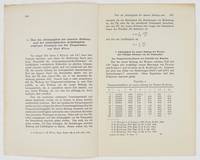
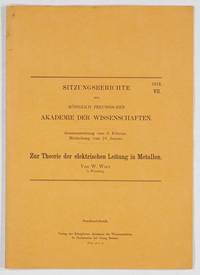
1913réf. 113891913. S.ber. Akad. Wiss. Berl. 1913. - Berlin Verlag der Königlichen Akademie der Wissenschaften / In Commission bei Georg Reimer 1913 Gr.-8° pp.184-200 5 Fig. orig. Broschur. First Edition! "Die Ergebnisse der Strahlungstheorie und die neuere Theorie der spezifischen Wärme haben den Nachweis geliefert daß die Elektronentheorie der Metalle auf eine wesentlich neue Grundlage gestellt werden muß. Man kann nicht mehr die Annahme aufrechterhalten daß die Elektronen in einem Metall wie freie Gasmoleküle herumfliegen und daß ihre mittlere lebendige Kraft der absoluten Temperatur des Metalls proportional ist. Solche Elektronen müssen vielmehr wie Lorentz gezeigt hat eine Wärmestrahlung erzeugen die dem Rayleigh-JEANSschen Gesetz folgt das sich bekanntlich mit der Erfahrung nicht in Übereinstimmung bringen läßt. Man würde nach diesem Gesetz für kürzere Wellenlängen eine viel größere Strahlung erhalten müssen als sie erfahrungsmäßig vorhanden ist. Ebenso zeigt die Theorie der spezifischen Wärme welche die Wärmebewegung in festen Körpern als Schwingungen der Moleküle um feste Zentren auffaßt und diese nach der PLANCKSchen Formel statistisch verteilt durch ihre Übereinstimmung mit den Beobachtungen daß die Elektronen nicht an der Wärmeenergie merklich beteiligt sein können." WienWien Wilhelm Carl Werner Otto Fritz Franz Wien 1864-1928 physicist who in 1893 used theories about heat and electromagnetism to deduce Wien's displacement law which calculates the emission of a blackbody at any temperature from the emission at any one reference temperature. He also formulated an expression for the black-body radiation which is correct in the photon-gas limit. His arguments were based on the notion of adiabatic invariance and were instrumental for the formulation of quantum mechanics. Wien received the 1911 Nobel Prize for his work on heat radiation. unknown
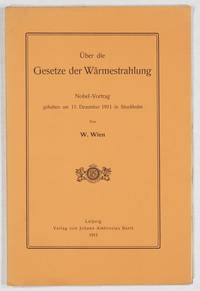
1912réf. 113881912. Leipzig Verlag von Johannes Ambrosius Barth 1912 Gr.-8° 21 3 pp. orig. Broschur; unbeschnittenes Expl. First Edition! Wilhelm Wien 1865-1928 "grew up in the east Prussian town of Rastenburg today Ketrzyn Lithuania. He then studied at the prominent universities of Heidelberg and Göttingen before he eventually completed his doctorate in Berlin. In 1900 he succeeded W.C. Röntgen 1901 Physics Laureate as a professor in Würzburg. Wien's research concerned how various metals radiate heat and he received the Nobel Prize for the law of black-body radiation now known as Wien-Planck's law. It was drawn up jointly with Max Planck Physics 1918 and many felt that they should have shared in the award." "When a completely dark body is heated it emits visible light and other electromagnetic radiation. The spectrum of the radiation is entirely dependent on the temperature of the body and not its composition. In 1893 Wilhelm Wien formulated his displacement law which indicates at which wavelength the radiation is most intense at a certain temperature. He subsequently also formulated a law indicating how the radiation spectrum varies as temperature changes. However this does not apply to long wavelengths and in 1900 Max Planck formulated a law that conforms better." Wilhelm Wien - Facts. NobelPrize/org The Nobel Prize in Physics 1911 unknown
1928réf. 680891928. Ann. Phys. 4. Folge 85/7. - Leipzig Verlag von Johann Ambrosius Barth 1928 8° pp.795-811 5 Fig. orig. Broschur. Rare Offprint! Wilhelm Wien 1865-1928 "grew up in the east Prussian town of Rastenburg today Ketrzyn Lithuania. He then studied at the prominent universities of Heidelberg and Göttingen before he eventually completed his doctorate in Berlin. In 1900 he succeeded W.C. Röntgen 1901 Physics Laureate as a professor in Würzburg. Wien's research concerned how various metals radiate heat and he received the Nobel Prize for the law of black-body radiation now known as Wien-Planck's law. It was drawn up jointly with Max Planck Physics 1918 and many felt that they should have shared in the award." "When a completely dark body is heated it emits visible light and other electromagnetic radiation. The spectrum of the radiation is entirely dependent on the temperature of the body and not its composition. In 1893 Wilhelm Wien formulated his displacement law which indicates at which wavelength the radiation is most intense at a certain temperature. He subsequently also formulated a law indicating how the radiation spectrum varies as temperature changes. However this does not apply to long wavelengths and in 1900 Max Planck formulated a law that conforms better." Wilhelm Wien - Facts. NobelPrize/org The Nobel Prize in Physics 1911 unknown
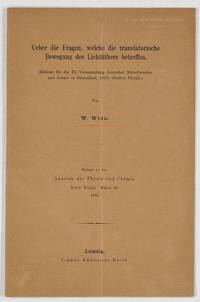
1898réf. 113871898. Ann. Phys. 3. Folge 65. Beilage - Leipzig Verlag von Johann Ambrosius Barth 1898 8° XVIII pp. orig. Broschur; St.a.Tit. Rare Offprint! "Referat für die 70. Versammlung deutscher Naturforscher und Aerzte in Düsseldorf 1898: Section Phys." Wilhelm Wien 1865-1928 "grew up in the east Prussian town of Rastenburg today Ketrzyn Lithuania. He then studied at the prominent universities of Heidelberg and Göttingen before he eventually completed his doctorate in Berlin. In 1900 he succeeded W.C. Röntgen 1901 Physics Laureate as a professor in Würzburg. Wien's research concerned how various metals radiate heat and he received the Nobel Prize for the law of black-body radiation now known as Wien-Planck's law. It was drawn up jointly with Max Planck Physics 1918 and many felt that they should have shared in the award." "When a completely dark body is heated it emits visible light and other electromagnetic radiation. The spectrum of the radiation is entirely dependent on the temperature of the body and not its composition. In 1893 Wilhelm Wien formulated his displacement law which indicates at which wavelength the radiation is most intense at a certain temperature. He subsequently also formulated a law indicating how the radiation spectrum varies as temperature changes. However this does not apply to long wavelengths and in 1900 Max Planck formulated a law that conforms better." Wilhelm Wien - Facts. NobelPrize/org The Nobel Prize in Physics 1911 unknown
2023réf. x-1032111062Routledge 2023. Hardcover. New. 328 pages. 9.69x6.88x0.98 inches. Routledge hardcover
2017réf. x-113851960XTaylor & Francis 2017. Hardcover. New. 247 pages. 9.01x5.98x0.25 inches. Taylor & Francis hardcover
2016réf. 1-3319795856Springer-Verlag New York Inc 2016. Paperback. New. reprint edition. 680 pages. 9.25x6.10x1.54 inches. Springer-Verlag New York Inc paperback
2015réf. 1-3642440533Springer 2015. Paperback. New. reprint edition. 472 pages. 9.45x6.61x1.07 inches. Springer paperback
réf. SKU0569190Routledge 2019-04-24. paperback. Good. 5x0x8. Textbook May Have Highlights Notes and/or Underlining BOOK ONLY-NO ACCESS CODE NO CD Ships with Tracking Routledge paperback
réf. SKU0616697Routledge 2019-04-24. paperback. New. 5x0x8. New Textbook Ships with Tracking Routledge paperback