Sansen, Willy M,Biblio.com

4227 resultados
ref. 29203670-nnew. unknown
ref. 757659-nnew. unknown
ref. 757951-nnew. unknown
ref. 788552like new. unknown
ref. 21980782-nnew. unknown
ref. 920032-nnew. unknown
ref. M8417cVery rare. Papyrologica Lugduno-Batava 24. E.J. Brill Leiden 1983. First edition. In-4 x & 165 pages. Original softcover a fine copy. From the library of papyrologist Jean A. Straus with his stamp and markings on the title page. Language: English. This book ships from Europe shipping costs will be updated accordingly BCI. Relevant subjects: Egypt: Greco-Roman Language Texts & Writing Demotic Studies Papyrology Religion & Magic. unknown
2016ref. x-113825360XTaylor & Francis 2016. Paperback. New. 260 pages. 9.21x6.14x0.59 inches. Taylor & Francis paperback
2009ref. x-0754667928Ashgate Pub Co 2009. Paperback. New. n edition. 282 pages. 9.45x7.13x0.63 inches. Ashgate Pub Co paperback
1925ref. 680881925. Ann. Phys. 4. Folge 77. - Leipzig Verlag von Johann Ambrosius Barth 1925 8° pp.560-586 7 Fig. orig. Broschur. First Edition! Wilhelm Wien 1865-1928 "grew up in the east Prussian town of Rastenburg today Ketrzyn Lithuania. He then studied at the prominent universities of Heidelberg and Göttingen before he eventually completed his doctorate in Berlin. In 1900 he succeeded W.C. Röntgen 1901 Physics Laureate as a professor in Würzburg. Wien's research concerned how various metals radiate heat and he received the Nobel Prize for the law of black-body radiation now known as Wien-Planck's law. It was drawn up jointly with Max Planck Physics 1918 and many felt that they should have shared in the award." "When a completely dark body is heated it emits visible light and other electromagnetic radiation. The spectrum of the radiation is entirely dependent on the temperature of the body and not its composition. In 1893 Wilhelm Wien formulated his displacement law which indicates at which wavelength the radiation is most intense at a certain temperature. He subsequently also formulated a law indicating how the radiation spectrum varies as temperature changes. However this does not apply to long wavelengths and in 1900 Max Planck formulated a law that conforms better." Wilhelm Wien - Facts. NobelPrize/org The Nobel Prize in Physics 1911 unknown
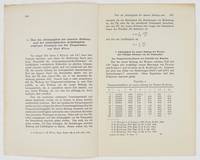
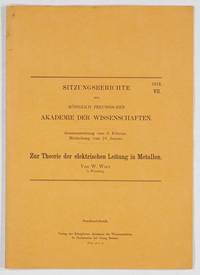
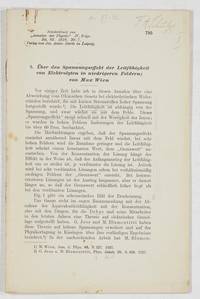
1913ref. 113891913. S.ber. Akad. Wiss. Berl. 1913. - Berlin Verlag der Königlichen Akademie der Wissenschaften / In Commission bei Georg Reimer 1913 Gr.-8° pp.184-200 5 Fig. orig. Broschur. First Edition! "Die Ergebnisse der Strahlungstheorie und die neuere Theorie der spezifischen Wärme haben den Nachweis geliefert daß die Elektronentheorie der Metalle auf eine wesentlich neue Grundlage gestellt werden muß. Man kann nicht mehr die Annahme aufrechterhalten daß die Elektronen in einem Metall wie freie Gasmoleküle herumfliegen und daß ihre mittlere lebendige Kraft der absoluten Temperatur des Metalls proportional ist. Solche Elektronen müssen vielmehr wie Lorentz gezeigt hat eine Wärmestrahlung erzeugen die dem Rayleigh-JEANSschen Gesetz folgt das sich bekanntlich mit der Erfahrung nicht in Übereinstimmung bringen läßt. Man würde nach diesem Gesetz für kürzere Wellenlängen eine viel größere Strahlung erhalten müssen als sie erfahrungsmäßig vorhanden ist. Ebenso zeigt die Theorie der spezifischen Wärme welche die Wärmebewegung in festen Körpern als Schwingungen der Moleküle um feste Zentren auffaßt und diese nach der PLANCKSchen Formel statistisch verteilt durch ihre Übereinstimmung mit den Beobachtungen daß die Elektronen nicht an der Wärmeenergie merklich beteiligt sein können." WienWien Wilhelm Carl Werner Otto Fritz Franz Wien 1864-1928 physicist who in 1893 used theories about heat and electromagnetism to deduce Wien's displacement law which calculates the emission of a blackbody at any temperature from the emission at any one reference temperature. He also formulated an expression for the black-body radiation which is correct in the photon-gas limit. His arguments were based on the notion of adiabatic invariance and were instrumental for the formulation of quantum mechanics. Wien received the 1911 Nobel Prize for his work on heat radiation. unknown
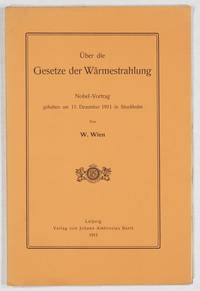
1912ref. 113881912. Leipzig Verlag von Johannes Ambrosius Barth 1912 Gr.-8° 21 3 pp. orig. Broschur; unbeschnittenes Expl. First Edition! Wilhelm Wien 1865-1928 "grew up in the east Prussian town of Rastenburg today Ketrzyn Lithuania. He then studied at the prominent universities of Heidelberg and Göttingen before he eventually completed his doctorate in Berlin. In 1900 he succeeded W.C. Röntgen 1901 Physics Laureate as a professor in Würzburg. Wien's research concerned how various metals radiate heat and he received the Nobel Prize for the law of black-body radiation now known as Wien-Planck's law. It was drawn up jointly with Max Planck Physics 1918 and many felt that they should have shared in the award." "When a completely dark body is heated it emits visible light and other electromagnetic radiation. The spectrum of the radiation is entirely dependent on the temperature of the body and not its composition. In 1893 Wilhelm Wien formulated his displacement law which indicates at which wavelength the radiation is most intense at a certain temperature. He subsequently also formulated a law indicating how the radiation spectrum varies as temperature changes. However this does not apply to long wavelengths and in 1900 Max Planck formulated a law that conforms better." Wilhelm Wien - Facts. NobelPrize/org The Nobel Prize in Physics 1911 unknown
1928ref. 680891928. Ann. Phys. 4. Folge 85/7. - Leipzig Verlag von Johann Ambrosius Barth 1928 8° pp.795-811 5 Fig. orig. Broschur. Rare Offprint! Wilhelm Wien 1865-1928 "grew up in the east Prussian town of Rastenburg today Ketrzyn Lithuania. He then studied at the prominent universities of Heidelberg and Göttingen before he eventually completed his doctorate in Berlin. In 1900 he succeeded W.C. Röntgen 1901 Physics Laureate as a professor in Würzburg. Wien's research concerned how various metals radiate heat and he received the Nobel Prize for the law of black-body radiation now known as Wien-Planck's law. It was drawn up jointly with Max Planck Physics 1918 and many felt that they should have shared in the award." "When a completely dark body is heated it emits visible light and other electromagnetic radiation. The spectrum of the radiation is entirely dependent on the temperature of the body and not its composition. In 1893 Wilhelm Wien formulated his displacement law which indicates at which wavelength the radiation is most intense at a certain temperature. He subsequently also formulated a law indicating how the radiation spectrum varies as temperature changes. However this does not apply to long wavelengths and in 1900 Max Planck formulated a law that conforms better." Wilhelm Wien - Facts. NobelPrize/org The Nobel Prize in Physics 1911 unknown
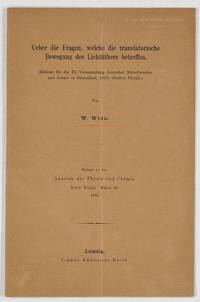
1898ref. 113871898. Ann. Phys. 3. Folge 65. Beilage - Leipzig Verlag von Johann Ambrosius Barth 1898 8° XVIII pp. orig. Broschur; St.a.Tit. Rare Offprint! "Referat für die 70. Versammlung deutscher Naturforscher und Aerzte in Düsseldorf 1898: Section Phys." Wilhelm Wien 1865-1928 "grew up in the east Prussian town of Rastenburg today Ketrzyn Lithuania. He then studied at the prominent universities of Heidelberg and Göttingen before he eventually completed his doctorate in Berlin. In 1900 he succeeded W.C. Röntgen 1901 Physics Laureate as a professor in Würzburg. Wien's research concerned how various metals radiate heat and he received the Nobel Prize for the law of black-body radiation now known as Wien-Planck's law. It was drawn up jointly with Max Planck Physics 1918 and many felt that they should have shared in the award." "When a completely dark body is heated it emits visible light and other electromagnetic radiation. The spectrum of the radiation is entirely dependent on the temperature of the body and not its composition. In 1893 Wilhelm Wien formulated his displacement law which indicates at which wavelength the radiation is most intense at a certain temperature. He subsequently also formulated a law indicating how the radiation spectrum varies as temperature changes. However this does not apply to long wavelengths and in 1900 Max Planck formulated a law that conforms better." Wilhelm Wien - Facts. NobelPrize/org The Nobel Prize in Physics 1911 unknown
2012ref. x-0123851963Academic Pr 2012. Hardcover. New. 1st edition. 450 pages. 9.75x6.50x1.25 inches. Academic Pr hardcover
2003ref. x-0333640772Palgrave Macmillan 2003. Hardcover. New. reprint edition. 185 pages. 8.75x5.75x0.50 inches. Palgrave Macmillan hardcover
2022ref. x-0367632373Routledge 2022. Paperback. New. 480 pages. 9.18x6.12x1.02 inches. Routledge paperback
2010ref. x-0754666026Ashgate Pub Co 2010. Hardcover. New. new edition edition. 272 pages. 9.53x6.50x0.98 inches. Ashgate Pub Co hardcover
2019ref. x-036718866XTaylor & Francis 2019. Hardcover. New. 234 pages. 9.25x6.25x0.75 inches. Taylor & Francis hardcover
2022ref. x-0367532530Routledge 2022. Hardcover. New. 4th edition. 728 pages. 9.69x6.88x1.69 inches. Routledge hardcover
2005ref. x-0754644170Ashgate Pub Co 2005. Hardcover. New. illustrated edition. 277 pages. 9.25x6.25x0.82 inches. Ashgate Pub Co hardcover
2010ref. x-0754662799Ashgate Pub Co 2010. Hardcover. New. 250 pages. 9.41x6.46x0.91 inches. Ashgate Pub Co hardcover
1998ref. x-047196445XJohn Wiley & Sons Inc 1998. Hardcover. New. 452 pages. 10.25x7.25x1.25 inches. John Wiley & Sons Inc hardcover
2008ref. x-0387848363Springer-Verlag New York Inc 2008. Hardcover. New. 639 pages. 9.25x6.25x1.00 inches. Springer-Verlag New York Inc hardcover