Willy PoganyBiblio.com

4 332 résultats
1928réf. 4814New York: Thomas Nelson and Sons 1928. First Edition Fourth Printing. Hardcover. Good/No dust jacket as issued. Willy Pogany. Not the limited edition but a true first edition later fourth printing so stated signed by the illustrator Willy Pogany on the title page: "To Max Herzberg/ with best compliments/ Willy Pogany/ 1930". Spine does show some detachment from text block but still sturdy with pages that are smooth and sewn in still and are clean and bright. Filled with color and b/w illustrations. Original blue boards. Scuffing on boards and to head and tail of spine along with toning to pages. Please see our photographs for details. A still fantastic copy of this unique edition. Thomas Nelson and Sons hardcover
réf. 62868be Gemeentekrediet Pandora/ Snoeck-Ducaju 1997. hardcover couverture 270pp.FR. edition 295 x 245 x 25 mm as New ill. in kleur / z/w ISBN 9789053250723. Emile Claus 1849-1924 est généralement considéré comme l'un des principaux luministes. Cependant sa carrière traverse un demi-siècle de peinture mouvementé ; il évolue de la période anversoise d'inspiration académique en passant par le naturalisme jusqu'à un impressionnisme personnel particulier. Emile Claus a grandi dans un environnement simple et il lui a fallu beaucoup d'efforts pour convaincre son entourage de ses qualités artistiques. Finalement c'est le compositeur Peter Benoit 1834-1901 un compatriote qui lui ouvre la voie à l'Académie d'Anvers 1869-1874. Malgré de bons résultats il n'a pas participé au Prix de Rome. Sa première exposition a lieu à Gand en 1874 sous le regard approbateur de Nicaise de Keyser 1813-1887 directeur de l'académie d'Anvers dans l'atelier de laquelle il travaille alors. Claus a prolongé son séjour à Anvers et a été influencé par les artistes de l'école dite grise d'Anvers. Durant cette période il reçut également des missions officielles de la ville. L'artiste s'impose comme un portraitiste très recherché au sein de la bourgeoisie anversoise. Peut-être sous l'influence des peintures orientalistes de Charles Verlat 1824-1890 Claus entreprend en 1879 un voyage en Espagne au Maroc et en Algérie. Sur la mer Méditerranée Claus a été surpris par les tonalités colorées intenses et les effets de lumière intenses sur l'environnement. La palette anversoise auparavant plutôt sombre s'éclaire et s'anime grandement dans les études et les peintures de cette période. Il ne faut cependant pas attacher trop dimportance à ce voyage ; Artistiquement Claus a poursuivi le chemin qu'il avait suivi à son retour. 1 Emile Claus cité par Karel van De Deserte dans Werken. Troisième partie. Critique I. Art et esprit en Flandre C.A.J. van Dishoeck 1930 p. 222. be Gemeentekrediet, Pandora/ Snoeck-Ducaju 1997 hardcover
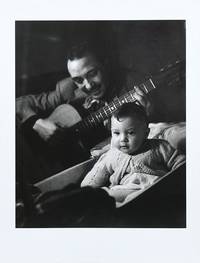
1945réf. 150388Paris: Willy Ronis 1945. Django and son Captivating and deeply compatissant image of Django with his young son Babik captured in 1945 by the celebrated French photographer Willy Ronis. At the time Django and his wife Naguine "were living in such a crummy cramped apartment in Paris Ronis was forced to shoot the image in a mirror to have space to capture them both" Dregni p. 102. Willy Ronis 1910-2009 "has been called 'the most poetic photographer of the menu peuple this century'. He travelled little preferring his native France better still his native Paris and best of all the patch around Belleville-Ménilmontant where he could photograph the local people of the 'popular classes' with whom he felt such a gentle affinity. Ronis was born in Paris the son of a Jewish refugee from Odessa who had a photographic studio near the Place de la Nation. His first love was music. He learned the violin and studied composition but his studies were interrupted in 1932 when his father fell ill and he took over the studio. He later claimed to find a resemblance between music and photography in 'the taste I have for composition particularly counterpoint. Many of my photographs are taken from above either looking down or up three planes in one image like three different melodies in a fugue which work together to give the piece structure and harmony'" The Guardian obituary. Distinguished jazz historian James Lincoln Collier remarks that Reinhardt is "without question the single most important guitarist in the history of jazz and probably would be named on most lists of all-time jazz greats. Despite a crippled left hand he had a solid technique; his melodic conception was formidable. and his ability to swing was immense". Original silver gelatin print image size: 316 x 260 mm sheet size: 400 x 305 mm verso with Ronis's studio wet stamp and pencilled inventory numbers. One or two minor creases otherwise in excellent condition. James Lincoln Collier The Making of Jazz: A Comprehensive History 1978; Michael Dregni Django Reinhardt and the Illustrated History of Gypsy Jazz 2006. unknown
2007réf. x-3039105396Peter Lang Pub Inc 2007. Paperback. New. 1st edition. 333 pages. 8.75x6.00x0.75 inches. Peter Lang Pub Inc paperback
2011réf. x-0415516854Routledge 2011. Paperback. New. reprint edition. 275 pages. 9.25x6.25x0.75 inches. Routledge paperback
2023réf. x-1032301406Routledge 2023. Paperback. New. 264 pages. 9.19x6.13x0.53 inches. Routledge paperback
2019réf. x-1138605867Taylor & Francis 2019. Paperback. New. 242 pages. 8.75x5.75x0.50 inches. Taylor & Francis paperback
2019réf. x-1138562882CRC Pr I Llc 2019. Paperback. New. reprint edition. 188 pages. 9.21x6.14x0.43 inches. CRC Pr I Llc paperback
2019réf. x-0367188694Taylor & Francis 2019. Paperback. New. 234 pages. 9.00x6.00x0.75 inches. Taylor & Francis paperback
2023réf. x-103211102XRoutledge 2023. Paperback. New. 328 pages. 9.69x6.88x0.79 inches. Routledge paperback
2019réf. x-0367341417Routledge 2019. Paperback. New. 308 pages. 9.21x6.14x0.70 inches. Routledge paperback
2017réf. x-1138081507Routledge 2017. Paperback. New. 496 pages. 9.21x6.14x1.10 inches. Routledge paperback
2020réf. x-0367581167Taylor & Francis 2020. Paperback. New. 442 pages. 9.50x6.75x1.00 inches. Taylor & Francis paperback
1989réf. x-0887387810Transaction Publishers 1989. Paperback. New. 247 pages. 9.00x6.25x0.50 inches. Transaction Publishers paperback
2021réf. x-1032241608Routledge 2021. Paperback. New. 355 pages. 9.50x6.75x1.00 inches. Routledge paperback
2020réf. x-0367660113Routledge 2020. Paperback. New. 458 pages. 9.68x6.85x1.04 inches. Routledge paperback
2006réf. x-1841843989Informa Healthcare 2006. Hardcover. New. 1st edition. 271 pages. 9.50x6.50x0.75 inches. Informa Healthcare hardcover
2015réf. x-0765642093M E Sharpe Inc 2015. Paperback. New. 344 pages. 9.69x6.18x0.75 inches. M E Sharpe Inc paperback
2023réf. x-3031057929Birkhauser 2023. Paperback. New. 382 pages. 9.45x6.61x0.79 inches. Birkhauser paperback
2023réf. x-9811903506Springer Nature 2023. Paperback. New. 208 pages. 9.25x6.10x0.45 inches. Springer Nature paperback
1877réf. 622021877. Verh. Naturhist.-Med. Ver. NF 1/5. - Heidelberg Carl Winter's Universitätsbuchhandlung 1877 8° pp.445-512 1 lith. Taf. orig. Broschur; ungeöffnetes Exemplar. First Edition! ". he went to Heidelberg to work in the laboratory of Wilhelm Kühne thus preceding Langley's visit there by a year or two. In 1876 in a paper published jointly with Kühne Lea argued in opposition to the widely accepted view of Rudolf Heidenhain that the pancreatic cells became less rather than more granular during the act of secretion. Langley later extended this view to a wide range of glands showing that granules were stored up during rest and released during secretion. Lea after returning to Cambridge concentrated on physiological chemistry. For Foster's Textbook of Physiology first ed. 1877 he wrote a large chemical section which was later expanded and issued as a separate volume under the title The Chemical Basis of the Animal Body. By 1890 Lea had published a dozen research papers all but one of which were notes or brief ar¬ticles. The longer paper a comparative study of natural and artificial digestions shows the continued strong influence of Kühne." Gerald L. Geison Michael Foster and the Cambridge School of Physiology: The Scientific . p.183 Arthur Sheridan Lea FRS 1853-1915 - "Lea was born in New York but his family returned to England and settled in Liverpool where he went to school. In 1872 he entered Trinity College Cambridge and took a first class in National Sciences Tripos in 1875 MA in 1879 and DSc in 1886. Soon after his success in the Natural Sciences Tripos he accepted a suggestion from Michael Foster that he should devote himself to teaching and research in physiology and he immediately became Demonstrator in Foster's classes. In 1881 he was appointed Lecturer in Physiology and Assistant Tutor at Caius College in 1885 he was elected a Fellow of that College and for two to three years acted as Bursar. In 1884 he became University Lecturer in Physiology. His special interest was Physiological Chemistry although he had no special training as a chemist. His contribution to the teaching was to establish an advanced course of Physiological Chemistry from 1876 until it rather lapsed with his ill-health in 1893. To continue the course Foster then persuaded F. Gowland Hopkins to join his staff in Cambridge. In Foster's Textbook of Physiology of 1877 Lea wrote an appendix on the chemical aspects of the subject which later was enlarged to a separate volume The Chemical Basis of the Animal Body 1892. He was elected a member of the Physiological Society in 1877 at its first annual meeting." W. J. O'Connor Founders of British Physiology: A Biographical Dictionary 1820-1885 p.180 Further we find in this issue - Ewald A. & Kühne W.: Die Verdauung als histologische Methode. Ewald A. & Kühne W.: Ueber einenn neuen Bestandtheil des Nervensystems. Kühne W.: Zur Photochemie der Netzhaut. unknown
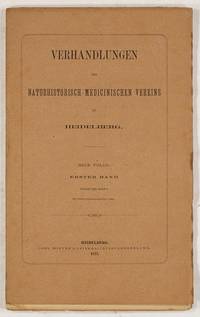
1876réf. 622011876. Verh. Naturhist.-Med. Ver. NF 1/4. - Heidelberg Carl Winter's Universitätsbuchhandlung 1876 8° pp.229-244 1 lith. Taf. orig. Broschur; ungeöffnetes Exemplar. Erstdruck! unknown
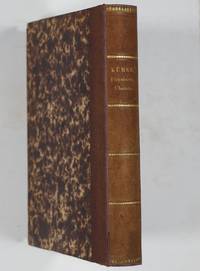
1868réf. 511421868. Leipzig Verlag von Wilhelm Engelmann 1866-1868 8° VIII 605 pp. mit 40 Holzschnitten und einem vollständigen Register Leinenband d.Zt. Erste Ausgabe - "Den Herren C. Ludwig und R. Virchow in Dankbarkeit und Verehrung gewidmet". 1. Lieferung: Verdauung 1866. 2. Lieferung: Chemie der thierischen Flüssigkeiten der Gewebe und der Drüsen 1866. 3. Lieferung: Chemie der thierischen Aussscheidungen 1868. Willy Kühne 1837-1900 gehört zu den Begründern der physiologischen Chemie. Ausschlag zu diesem Urteil gab das vorliegende Lehrbuch. Bereits im Alter von 17 Jahren begann er in Wöhlers Laboratorium mit chemischen Arbeiten. C. Bernard C. Ludwig und E. Brücke übten größten Einfluß auf ihn aus. Ihm verdankt man die Entdeckung des Myosins des flüssigen kontraktilen Muskelplasmas er prägte den Begriff des Enzyms für die umgeformten Fermentvorstufen und des Trypsins für das Pankreasenzym für die Eiweißverdauung. First Edition! "It clearly and concisely presented the state of the science of the time". Kühne introduced the term "enzyme". DSB VII pp.519-521 unknown
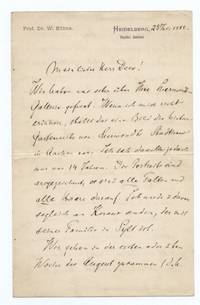
1885réf. 367471885. Heidelberg 23.VII.1885 2 2/3 Seiten gr.-8° mit gedrucktem Briefkopf. Wilhelm Friedrich Kühne 1837-1900 Physiologe entdeckte den Sehpurpur erforschte das Protoplasma und führte den Begriff "Enzym" ein. - An Professor A.G. Dew Smith in Cambridge mit dem er in regem freundschaftlichem und wissenschaftlichem Verkehr stand. Dew Smith plante eine Europa-Reise und Kühne schlägt ein Treffen "in Aachen oder in Antwerpen" vor. ". Schreiben Sie nur wenn Sie erst auf dem Continente sind von irgendwo eine Karte an meine hiesige Adresse die mich immer erreichen wird und ein Zusammenkommen wird sich arrangiren lassen. Sie müssten auch Hugo Kronecker mal in Bern wo ich im März war und es sehr angenehm fand besuchen. Haben Sie im Anfang des Jahres die Instrumente die ich Ihnen zum Copiren in Platin-Iridium schickte erhalten Grüssen Sie herzlich die Freunde in Cambridge ." unknown
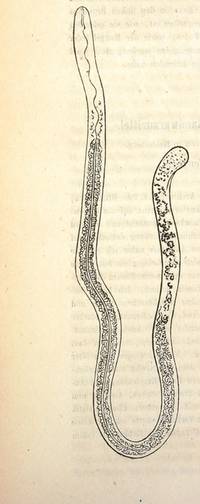
1863réf. 531201863. Virch. Arch. path. Anat. 26. - Berlin Verlag von Georg Reimer 1863 8° IV 588 pp. 14 Tafeln Halbledereinband d.Zt. First Edition! Wilhelm Friedrich Kühne "saw a nematode swimming freely within muscle fiber. In its movements the parasite clearly passed through the striated part of the muscle which closed again behind the nematode's tail. He concluded that the fiber was not as solid as most people thought and reasoned that they consisted of a concentrated solution of albumins". James Southworth Steen A Selected Chronological Bibliography of Biology and Medicine No.300 unknown