Wien, Wilhelm (Willy)Biblio.com
7282 risultati
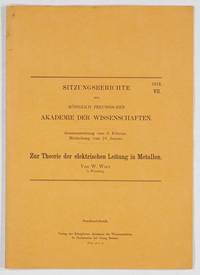
1913rif. 113891913. S.ber. Akad. Wiss. Berl. 1913. - Berlin Verlag der Königlichen Akademie der Wissenschaften / In Commission bei Georg Reimer 1913 Gr.-8° pp.184-200 5 Fig. orig. Broschur. First Edition! "Die Ergebnisse der Strahlungstheorie und die neuere Theorie der spezifischen Wärme haben den Nachweis geliefert daß die Elektronentheorie der Metalle auf eine wesentlich neue Grundlage gestellt werden muß. Man kann nicht mehr die Annahme aufrechterhalten daß die Elektronen in einem Metall wie freie Gasmoleküle herumfliegen und daß ihre mittlere lebendige Kraft der absoluten Temperatur des Metalls proportional ist. Solche Elektronen müssen vielmehr wie Lorentz gezeigt hat eine Wärmestrahlung erzeugen die dem Rayleigh-JEANSschen Gesetz folgt das sich bekanntlich mit der Erfahrung nicht in Übereinstimmung bringen läßt. Man würde nach diesem Gesetz für kürzere Wellenlängen eine viel größere Strahlung erhalten müssen als sie erfahrungsmäßig vorhanden ist. Ebenso zeigt die Theorie der spezifischen Wärme welche die Wärmebewegung in festen Körpern als Schwingungen der Moleküle um feste Zentren auffaßt und diese nach der PLANCKSchen Formel statistisch verteilt durch ihre Übereinstimmung mit den Beobachtungen daß die Elektronen nicht an der Wärmeenergie merklich beteiligt sein können." WienWien Wilhelm Carl Werner Otto Fritz Franz Wien 1864-1928 physicist who in 1893 used theories about heat and electromagnetism to deduce Wien's displacement law which calculates the emission of a blackbody at any temperature from the emission at any one reference temperature. He also formulated an expression for the black-body radiation which is correct in the photon-gas limit. His arguments were based on the notion of adiabatic invariance and were instrumental for the formulation of quantum mechanics. Wien received the 1911 Nobel Prize for his work on heat radiation. unknown
1928rif. 680891928. Ann. Phys. 4. Folge 85/7. - Leipzig Verlag von Johann Ambrosius Barth 1928 8° pp.795-811 5 Fig. orig. Broschur. Rare Offprint! Wilhelm Wien 1865-1928 "grew up in the east Prussian town of Rastenburg today Ketrzyn Lithuania. He then studied at the prominent universities of Heidelberg and Göttingen before he eventually completed his doctorate in Berlin. In 1900 he succeeded W.C. Röntgen 1901 Physics Laureate as a professor in Würzburg. Wien's research concerned how various metals radiate heat and he received the Nobel Prize for the law of black-body radiation now known as Wien-Planck's law. It was drawn up jointly with Max Planck Physics 1918 and many felt that they should have shared in the award." "When a completely dark body is heated it emits visible light and other electromagnetic radiation. The spectrum of the radiation is entirely dependent on the temperature of the body and not its composition. In 1893 Wilhelm Wien formulated his displacement law which indicates at which wavelength the radiation is most intense at a certain temperature. He subsequently also formulated a law indicating how the radiation spectrum varies as temperature changes. However this does not apply to long wavelengths and in 1900 Max Planck formulated a law that conforms better." Wilhelm Wien - Facts. NobelPrize/org The Nobel Prize in Physics 1911 unknown
1925rif. 680881925. Ann. Phys. 4. Folge 77. - Leipzig Verlag von Johann Ambrosius Barth 1925 8° pp.560-586 7 Fig. orig. Broschur. First Edition! Wilhelm Wien 1865-1928 "grew up in the east Prussian town of Rastenburg today Ketrzyn Lithuania. He then studied at the prominent universities of Heidelberg and Göttingen before he eventually completed his doctorate in Berlin. In 1900 he succeeded W.C. Röntgen 1901 Physics Laureate as a professor in Würzburg. Wien's research concerned how various metals radiate heat and he received the Nobel Prize for the law of black-body radiation now known as Wien-Planck's law. It was drawn up jointly with Max Planck Physics 1918 and many felt that they should have shared in the award." "When a completely dark body is heated it emits visible light and other electromagnetic radiation. The spectrum of the radiation is entirely dependent on the temperature of the body and not its composition. In 1893 Wilhelm Wien formulated his displacement law which indicates at which wavelength the radiation is most intense at a certain temperature. He subsequently also formulated a law indicating how the radiation spectrum varies as temperature changes. However this does not apply to long wavelengths and in 1900 Max Planck formulated a law that conforms better." Wilhelm Wien - Facts. NobelPrize/org The Nobel Prize in Physics 1911 unknown
1912rif. 113881912. Leipzig Verlag von Johannes Ambrosius Barth 1912 Gr.-8° 21 3 pp. orig. Broschur; unbeschnittenes Expl. First Edition! Wilhelm Wien 1865-1928 "grew up in the east Prussian town of Rastenburg today Ketrzyn Lithuania. He then studied at the prominent universities of Heidelberg and Göttingen before he eventually completed his doctorate in Berlin. In 1900 he succeeded W.C. Röntgen 1901 Physics Laureate as a professor in Würzburg. Wien's research concerned how various metals radiate heat and he received the Nobel Prize for the law of black-body radiation now known as Wien-Planck's law. It was drawn up jointly with Max Planck Physics 1918 and many felt that they should have shared in the award." "When a completely dark body is heated it emits visible light and other electromagnetic radiation. The spectrum of the radiation is entirely dependent on the temperature of the body and not its composition. In 1893 Wilhelm Wien formulated his displacement law which indicates at which wavelength the radiation is most intense at a certain temperature. He subsequently also formulated a law indicating how the radiation spectrum varies as temperature changes. However this does not apply to long wavelengths and in 1900 Max Planck formulated a law that conforms better." Wilhelm Wien - Facts. NobelPrize/org The Nobel Prize in Physics 1911 unknown
1905rif. 376731905. Verh. Ges. Naturf. Ärzte 77.Vers. Meran 1905. - 12/1 Bd. - Leipzig F.C.W. Vogel 1905 8° 3 308; X 223 pp. Halbleinenband der Zeit. unknown
rif. a107980aLeipzig 1893 first edition. Barth. Hardcover. octavo. Blue and black marbled boards with spine and tips dark grey cloth. Two mounted spine labels top label mostly worn off. Wien landmark article appears on pp.633-641. In German. Entire volume has 760p. and 4 plates most foldout. Good binding secure; hinges not cracked at all; cover somewhat worn; spine ends frayed. Tiny owner stamp on tp - no other owner marks. text clean. . hardcover
rif. a108176Leipzig 1893 first edition. Barth. Hardcover. octavo. Black textured cloth with 3/4 black leather on spine and tips. Raised spine bands; gilt spine lettering. Wien landmark article appears on pp. 633-641. In German. Entire volume has 760p. and 4 plates most foldout. Good binding secure; hinges not cracked ; old library bookplate inside cover but no other library marks. Tips and spine ends worn down. Text bright and clean. . hardcover
rif. a107939Leipzig 1896 first edition Barth. In German. Hardcover. Octavo. Wien article pp . 662-229. Entire volume as 776p. 6 foldout charts xvi. Wilhelm Wien's paper was base for his Nobel Prize. This volume also includes Boltzmann Zur Energetik. at pp. 595-598 and papers by Kolrausch and Rydberg. Blue and black marbled boards with spine and tips dark grey cloth. Two mounted paper spine labels. Small old oval bibliothek stamp. Text clean; binding secure. Hinges not crakced. LIght cover rubbing and wear. VG. Pictures available on request. . hardcover
1896rif. 43069Leipzig Johann Ambrosius Barth 1896. 8vo. Contemporary half cloth with gilt title to spine. Band 58 of "Annalen der Physik und Chemie". Library stamp to verso of title-page. Light wear to edges and capitals and a damp-stain to the lower part of the last three leaves. Otherwise a clean and well preserved copy. The entire volume offered. Pp. 662-669. Entire volume: VIII 776 pp. 6 folded plates. First edition of Wilhelm Wien's highly influential paper on the phenomenon of radiation also known as Wien's displacement law. Wien followed Ludwig Boltzmann's approach when incorporating electrodynamics and thermodynamics in investigating radiation and its characteristics. "He argued that if a system reaches the same temperature by the increase of temperature or by the adiabatic compression of the volume containing heat radiation it should yield the same energy distribution. Considering also the Doppler effect of the radiation Wien arrived at an expression for energy distribution that states that the product of temperature and the wave length is a constant". Mathew Chandrankunnel Philosophy of physics 2000 4 p.Wien's empirical observations functioned as a starting point for Max Planck who wanted prove the theoretical foundation for Wien's wishing thus to justify the entropy law. Today Wien's approximation is also known as Wien-Planck law.This phenomenon was coined "Wien's displacement law" because the energy density curve is displaced correspondingly to the temperature; it implies that the hotter an object is the shorter the wavelength at which it will release most of its radiation. Wien's description of radiation awarded him the Nobel Prize in Physics in 1911. Wien's constant is today used in a wide range of different aspects of physics e.g. cosmic microwave background and the determination of how much energy is emitted from a light bulb. Magie "A Source Book in Physics". Pp. 597-600.Other papers of interest contained in the present volume:KOHLRAUSCH F. Ueber Widerstandsmessungen von Electrolyten mit Wechselströmen durch das Dynamometer. Pp. 514-516.BOLTZMANN L. Zur Energetik. Pp. 595-598.RYDBERG J. J. Die Neuen Grundstoffe des Cleveïtgases. Pp. 674-679.WIEN W. Ueber die auf einer schweren Flüssigkeit möglichen Wellen von sehr Höhe. Pp. 729-735.Etc. hardcover
rif. a90554Article on pp. 48-61 in one hardcover volume of Wiedemann Annalen der Physik und chemie neue folge Band XXXV Leipzig. 1888 Barth. octavo. Complete volume has 840p. and 8 plates. 3/4 black leather with gilt spine bands and gilt lettering. Naval college bookplates - no other ownership marks no spine numbers. Volume contains other important articles by Rontgen "Electrischen Felde befindlichen Dielectricums hervorgerufene elecctrodynamische Kraft"; K E F Schmidt "Zur Theorie des Babinet'schen Compensators" Winkelmann "Ueber die Verdampfung von den einzelmen Theilen einer Kreisformigen freien Oberflache" and others. Good cover rubbed. Cover tips and spine ends rounded and worn. All hinges secure and unbroken. Wilhelm Wien was awarded the Physics Nobel in 1911. . hardcover
1898rif. 43653Berlin J.A. Barth 1898 1901 Without wrappers. In "Annalen der Physik und Chemie. Hrsg. von G. Wiedemann." Neue Folge Bd. 65 No. 7. Entire issues offered. Pp. 241-480. . And Vierte Folge Bd. 5. Pp. 241-488 textillustr. Wien's paper pp. 440-452 textillustrations and pp. 421-435 textillustrations. Clean and fine. The second issue punched in inner margin after cords. no loss of text. First appearance of Wien's importent paper in which he shows that the cathode rays are particles that their velocity is about a third to that of light and he establish the ratio between the mass and the charge.In the paper are "described the experiments by which Wien determined the properties of the canal rays. The firstpart of the paper conatins a description of observations on the cathode rays made with a Lenard Tube in which the cathode rays passed through an aluminium window into an extension of the tube where as high a rarefaction as possible was maintained. The magnetic and electrostatic deflexions of a narrow cathode stream were observed and Wien concludes that it is proved by his investigation that the cathode rays which pass through the windoww carry with them strong negative charges."Magie "Souce Book in Physics" p. 597 ff.Wien was awarded the 1911 Nobel Prize for physics for his discoveries regarding laws governing the radiation of heat. unknown
rif. 63034068Springer . Papeback. New. pp. 170 Reprint edition Springer unknown
1991rif. 97724NY:: Nantier Beall Minoustchine Publishing. Fine. 1991. Paperback. 1561630098 . Translated by Michael Koch. First edition thus paperback. Fine in oversize illustrated wraps. . Nantier, Beall, Minoustchine Publishing, paperback books
1995rif. 241220BBBuer, Heimatverein, (1995). Gr.-8°. 249 S. Ill. OPbd. - Gutes Expl.
2004rif. 0261822004 Van Spijk Hardcover As New
1969rif. 26551969 broché (paperback) in-octavo, dos et première de couverture ornés d'une illustration photographique en couleurs (spine and front cover illustrated in colour), illustrations hors-texte - les cartes (maps) sont de Willy Rousseau et Fils, 352 pages, 1969 à Paris Marabout Université,
rif. 591287Paris, Louvain, Peeters, 2000. Grand in-4 broché, couverture illustrée, 345 pp., 273 notices descriptives commentées avec une photo en couleurs pour chaque objet., index des objets exposés. La partie historique occupe les 141 première pages.
rif. 600979Paris, Louvain, Peeters, 2000. Grand in-4 broché, couv. ill., 345 pp., 273 reprod. photogr. en n/b. et en coul. accompagnées des notices descriptives, la partie historique occupe les 141 premières pp. avec ill., photogr., croquis, plans, cartes, index.
1999rif. C98701Leuven, Peeters 1999 334pp. rijkelijk geïllustreerd, 31cm., geïll. omslag, goede staat, catalogus van gelijknamige tentoonstelling, C98701
rif. 46080Cadran solaire Troyes 1989 Centre d'art contemporain In-8-carre 25 cm 111pp. illustr. tres bon etat Ats34 unknown
rif. BN390225Antoon De Clerck: Visuele hygiëne - Visual hygiene. Antoon De Clerck: Visuele hygiëne - Visual hygiene. William Ploegaert Willy Van den Bussche Paul Demets Roland Jooris Jean-Marie Byttebier Joëlle Dubois. unknown
rif. 62352, Snoeck Publishers / Museum van Deinze , 2023 PB, 280 x 200 mm, 208 pages, ENG-NL edition. ISBN 9789461618658.
2013rif. BN490933Kehl am Rhein. SADIFA MEDIA Verlags GmbH 2013. 2013. Carl Benz - Ein Leben für das Automobil Carl Benz - Ein Leben für das Automobil Williamson Willy Harold und Martin Grünewald Kehl am Rhein. SADIFA MEDIA Verlags GmbH unknown
rif. RO20220583Librairie Ollendorff / Albin Michel / Mercure de France. Non daté. In-12. Relié demi-cuir. Bon état, Coins frottés, Dos à nerfs, Intérieur frais. 307 + 276 + 267 + 311 pages. Nombreuses illustrations en noir et blanc dans et hors texte. Plats et contre-plats jaspés. Auteurs, titre et filets dorés au dos à 4 nerfs. Plats brochés conservés des éditions Librairie Olendorff, Albin Michel et Mercure de France. Epidermures au dos.. . . . Classification Dewey : 840.091-XX ème siècle
1901rif. R110020578PARIS, BOULEVARD MONTMARTRE. 1901. In-8. Broché. Bon état, Couv. convenable, Dos satisfaisant, Intérieur frais. Paginé de 98 à 119 . Ce fascicule ne contient pas d'illustration. Une page photocopiée. Livré sans couverture.. . . . Classification Dewey : 70.4-Journalisme, chronique