Willy RonisBiblio.com

7336 risultati
rif. 500143054Sans date. Très bon état unknown
rif. 500143054Sans date.
rif. BN323706kopaed. Softcover. Töne für Kinder und Jugendliche. 2007/2008: Kassetten und CDs im kommentierten Überblick Töne für Kinder und Jugendliche. 2007/2008: Kassetten und CDs im kommentierten Überblick Heide Germann Katja Bergmann Susanne Brandt Karen Gröning et Willy Gröning kopaed paperback
rif. 201100016Vervier, Marabout Junior, 1959 ; in-12, 156 pp., broché, couverture illustr. Bon état -illustrations anatasio, couverture P. Joubert.
rif. 1168716683.Ghardcover. Good. Access codes and supplements are not guaranteed with used items. May be an ex-library book. hardcover
rif. B9781168716682New. unknown
rif. 1162307749.Ghardcover. Good. Access codes and supplements are not guaranteed with used items. May be an ex-library book. hardcover
rif. 3841612865.Gpaperback. Good. Access codes and supplements are not guaranteed with used items. May be an ex-library book. paperback
2016rif. 1-3841612865Éditions universitaires européennes 2016. Paperback. New. 336 pages. French language. 8.66x5.91x0.76 inches. Éditions universitaires européennes paperback
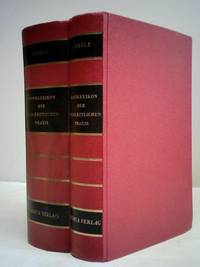
rif. 2c15408Medica Verlag Stuttgart 1953. VI/725/941 Seiten rote Leineneinbände. - enthalten: Band 1: Diagnostik und Therapie/Band 2. Pharmakologie mit Tierarzneimittel-Verzeichnis unknown
1864rif. 525621864. Cbl. med. Wiss. 2/3637. - Berlin August Hirschwald 27. August 1864 und 3. September 8° pp.561-592 Rückenbroschur. unknown
1877rif. 21651877. Cbl. med. Wiss. 15/15. - Berlin Auguat Hirchwald 1877 8° pp.257-272 Rückenbroschur;Papier wie imnmer gebräunt. Sehpurpur löslich in gallensaueren Salzen. Darstellung des Sehpurpurs. Rothschuh Nr.1860 unknown
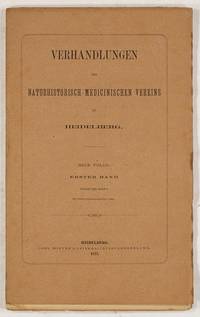
1876rif. 622011876. Verh. Naturhist.-Med. Ver. NF 1/4. - Heidelberg Carl Winter's Universitätsbuchhandlung 1876 8° pp.229-244 1 lith. Taf. orig. Broschur; ungeöffnetes Exemplar. Erstdruck! unknown
1876rif. 328381876. Verh. Naturhist.-Med. Ver. NF 1/3. - Heidelberg Carl Winter's Universitätsbuchhandlung 1876 8° pp.169-228 1 lith. Taf. orig. Broschur; ungeöffnetes Exemplar. Rare Offprint! Introduction of the term "Enzyme" Willy Kühne 1837-1900introduced here for the first time in 1876 the term "enzyme": "Um Missverständnisse vorzubeugen und lästige Umschreibungen zu vermeiden schlägt Vortragender vor die ungeformten oder nicht organisierten Fermente deren Wirkung ohne Anwesenheit von Organismen und ausserhalb derselben erfolgen kann als Enzyme zu bezeichnen." p.190 Garrison & Morton No. 700.1 quotes for the introduction falsely "Erfahrungen und Bemerkungen über Enzyme und Fermente" 1878. Willy Kühne "reports his isolation of trypsin". Garrison & Morton No.1012 unknown
rif. 0270115331.Ghardcover. Good. Access codes and supplements are not guaranteed with used items. May be an ex-library book. hardcover
rif. 0260043141.Ghardcover. Good. Access codes and supplements are not guaranteed with used items. May be an ex-library book. hardcover
1913rif. 566821913. Z. Immunit.forsch. Orig. 17/5. - Jena Verlag von Gustav Fischer 1913 8° pp.487-606 Broschur. Erstdruck! Aus der Experimentell-biologischen Abteilung Prof. H. Sachs des Königl. Institut für experimentelle Therapie zu Frankfurt a.M. Direktor: Geh. Obermed.-Rat Prof. Dr. P. Ehrlich. Sachs Nr.379 unknown
1867rif. 667751867. Virch. Arch. path. Anat. 39. - Berlin Verlag von Georg Reimer 1867 8° 47 pp. Broschur mit eingebundener orig. Titelbroschur. Seltener Sonderdruck! Ein wesentlicher Interessensschwerpunkt Kühnes war die Verdauungsphysiologie. Er entdeckte das eiweißspaltende Verdauungsenzym Trypsin welches er 1867 benannte. Er beobachtete das Vorliegen einer inaktiven Vorstufe Zymogen des Enzyms charakterisierte es hinsichtlich seiner Aktivität im alkalischen Milieu und beschrieb Trennverfahren. Ihm gelang 1867 die weitgehende Isolierung des Trypsins. Der Begriff "Enzym" wurde durch ihn geprägt und verdrängte den bis dahin verbreiteten Begriff "Ferment". Wilhelm "Willi" Kühne 1837-1900 Sohn eines wohlhabenden Kaufmanns legte 1854 am Johanneum Lüneburg das Abitur ab. Er begann im selben Jahr ein Studium an der Universität Göttingen wo er Chemie bei Friedrich Wöhler Physiologie bei Rudolf Wagner und Anatomie bei Jakob Henle studierte. 1856 wurde er bei Wagner mit einer Arbeit über künstlichen Diabetes bei Fröschen zum Dr. phil. promoviert. Anschließend forschte er an der Universität Jena bei Karl Gotthelf Lehmann zum Zuckerstoffwechsel. 1858 wechselte Kühne erst nach Berlin wo er als Mitarbeiter von Felix Hoppe-Seyler an der Chemischen Abteilung des Pathologischen Instituts tätig war und bei Emil Du Bois-Reymond Studien zur Muskulatur betrieb und anschließend nach Paris zu Claude Bernard. 1860 folgte ein Aufenthalt in Wien bei Ernst Brücke und Carl Ludwig. Ab 1861 leitete Wilhelm Kühne das Chemische Labor im Pathologischen Institut Rudolf Virchows in Berlin wo er sich mit Zellphysiologie auseinandersetzte. Von 1868 bis 1871 hatte er den Lehrstuhl für Physiologie der Universität von Amsterdam inne 1871 ging er an die Universität Heidelberg wo er als Nachfolger Hermann von Helmholtz' bis zu seinem Lebensende das Physiologische Institut leitete. Siehe - Hans Neurath Robert Zwilling: Willy Kühne und die Anfänge der Enzymologie. In: Semper apertus. Sechshundert Jahre Ruprecht-Karls-Universität Heidelberg. 1386-1986. Band 2 Springer Heidelberg 1985; W. Creutzfeld G.A. Martini & G. Strohmeyer Milestones in Gastroenterology and Metabolie Research pp.114 Rothschuh Nr. 970: "Isoliert ein eiweiß-spaltendes Ferment "Trypsin" es löst die meisten natürlichen Eiweißkörper". unknown
1877rif. 622021877. Verh. Naturhist.-Med. Ver. NF 1/5. - Heidelberg Carl Winter's Universitätsbuchhandlung 1877 8° pp.445-512 1 lith. Taf. orig. Broschur; ungeöffnetes Exemplar. First Edition! ". he went to Heidelberg to work in the laboratory of Wilhelm Kühne thus preceding Langley's visit there by a year or two. In 1876 in a paper published jointly with Kühne Lea argued in opposition to the widely accepted view of Rudolf Heidenhain that the pancreatic cells became less rather than more granular during the act of secretion. Langley later extended this view to a wide range of glands showing that granules were stored up during rest and released during secretion. Lea after returning to Cambridge concentrated on physiological chemistry. For Foster's Textbook of Physiology first ed. 1877 he wrote a large chemical section which was later expanded and issued as a separate volume under the title The Chemical Basis of the Animal Body. By 1890 Lea had published a dozen research papers all but one of which were notes or brief ar¬ticles. The longer paper a comparative study of natural and artificial digestions shows the continued strong influence of Kühne." Gerald L. Geison Michael Foster and the Cambridge School of Physiology: The Scientific . p.183 Arthur Sheridan Lea FRS 1853-1915 - "Lea was born in New York but his family returned to England and settled in Liverpool where he went to school. In 1872 he entered Trinity College Cambridge and took a first class in National Sciences Tripos in 1875 MA in 1879 and DSc in 1886. Soon after his success in the Natural Sciences Tripos he accepted a suggestion from Michael Foster that he should devote himself to teaching and research in physiology and he immediately became Demonstrator in Foster's classes. In 1881 he was appointed Lecturer in Physiology and Assistant Tutor at Caius College in 1885 he was elected a Fellow of that College and for two to three years acted as Bursar. In 1884 he became University Lecturer in Physiology. His special interest was Physiological Chemistry although he had no special training as a chemist. His contribution to the teaching was to establish an advanced course of Physiological Chemistry from 1876 until it rather lapsed with his ill-health in 1893. To continue the course Foster then persuaded F. Gowland Hopkins to join his staff in Cambridge. In Foster's Textbook of Physiology of 1877 Lea wrote an appendix on the chemical aspects of the subject which later was enlarged to a separate volume The Chemical Basis of the Animal Body 1892. He was elected a member of the Physiological Society in 1877 at its first annual meeting." W. J. O'Connor Founders of British Physiology: A Biographical Dictionary 1820-1885 p.180 Further we find in this issue - Ewald A. & Kühne W.: Die Verdauung als histologische Methode. Ewald A. & Kühne W.: Ueber einenn neuen Bestandtheil des Nervensystems. Kühne W.: Zur Photochemie der Netzhaut. unknown
1864rif. 525571864. Cbl. med. Wiss. 2/24. - Berlin August Hirschwald 4. Juni 1864 8° pp.368-384 Rückenbroschur. unknown
1867rif. 433941867. Virch. Arch. path. Anat. 39. - Berlin Verlag von Georg Reimer 1867 8° IV 618 pp. 18 Tafeln Halbdereinband d.Zt. unknown
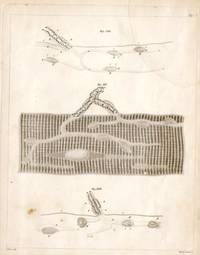
1862rif. 370171862. Leipzig Wilhelm Engelmann 1862 4° VIII 38 pp. 1 Blatt Inhalt 5 feine lith. Tafeln Pappband der Zeit; Titel montiert. Selten! Willy Kühne 1837-1900 described the neuromuscular end organ Kühne spindle and introduced the term 'telolemma' for the outer covering of its sheath." Clarke and O'Mailey Human Brian and Spinal Cord pp.75-78.<T>NUC NK 0319696 locates 5 copies. Garrison & Morton No. 1269 unknown
1885rif. 13946Berlin: Hirschwald 1885. hardcover. very good. Text illustrations and 10 fine folded lithographic plates one in color. 32 pages pp. 494-525 IN Archiv fur klinische Chirurgie. 1885. Volume 31. Whole volume offered Complete. Thick 8vo 1/2 brown calf worn. Berlin: August Hirschwald 1885. Very good. The first description of Trendelenburg's elevated pelvic position. G-M 6091. Hirschwald unknown
rif. a1011731895 first edition. Sitzungsberichte der Konig. reussischen Akad. der Wissen. zu Berlin. XVIII. Original orange printed octavo wraps. 20p. VG folded in half. Wien was awarded the Nobel in Physics in 1911 . . paperback
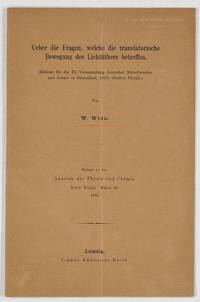
1898rif. 113871898. Ann. Phys. 3. Folge 65. Beilage - Leipzig Verlag von Johann Ambrosius Barth 1898 8° XVIII pp. orig. Broschur; St.a.Tit. Rare Offprint! "Referat für die 70. Versammlung deutscher Naturforscher und Aerzte in Düsseldorf 1898: Section Phys." Wilhelm Wien 1865-1928 "grew up in the east Prussian town of Rastenburg today Ketrzyn Lithuania. He then studied at the prominent universities of Heidelberg and Göttingen before he eventually completed his doctorate in Berlin. In 1900 he succeeded W.C. Röntgen 1901 Physics Laureate as a professor in Würzburg. Wien's research concerned how various metals radiate heat and he received the Nobel Prize for the law of black-body radiation now known as Wien-Planck's law. It was drawn up jointly with Max Planck Physics 1918 and many felt that they should have shared in the award." "When a completely dark body is heated it emits visible light and other electromagnetic radiation. The spectrum of the radiation is entirely dependent on the temperature of the body and not its composition. In 1893 Wilhelm Wien formulated his displacement law which indicates at which wavelength the radiation is most intense at a certain temperature. He subsequently also formulated a law indicating how the radiation spectrum varies as temperature changes. However this does not apply to long wavelengths and in 1900 Max Planck formulated a law that conforms better." Wilhelm Wien - Facts. NobelPrize/org The Nobel Prize in Physics 1911 unknown