Buschak, WillyBiblio.com

3309 risultati
2007rif. BB75297Essen: Klartext 2007. paperback. gebraucht gut Broschur Kanten etwas berieben Anstreichungen und Randnotizen mit Farbstift sonst GUTES EXEMPLAR. 22 x 16 cm. Für Ihre Zufriedenheit versenden wir mit DHL und ausschließlich mit Trackingcode für eine sichere Sendungsverfolgung! Weitere Angebote unter antiquariat-kastanienhof Klartext paperback
rif. 0428328148.Ghardcover. Good. Access codes and supplements are not guaranteed with used items. May be an ex-library book. hardcover
rif. 49564073-nnew. unknown
rif. 49564073like new. unknown
1983rif. __311277860XDe Gruyter 1983. Hardcover. New. 6th reprint edition. 160 pages. German language. 6.69x0.44x9.61 inches. De Gruyter hardcover
rif. 3388465886.Gpaperback. Good. Access codes and supplements are not guaranteed with used items. May be an ex-library book. paperback
rif. 3388485887.Ghardcover. Good. Access codes and supplements are not guaranteed with used items. May be an ex-library book. hardcover
rif. ria9783388485881_inpHardcover. New. New Book; Fast Shipping from UK; Not signed; Not First Edition; Unveränderter Nachdruck der Originalausgabe von 1862. Der Verlag Antigonos spezialisiert sich auf die Herausgabe von Nachdrucken historischer Bücher. Wir achten darauf dass diese Werke der Öffentlichkeit in einem guten Zustand zugängli hardcover
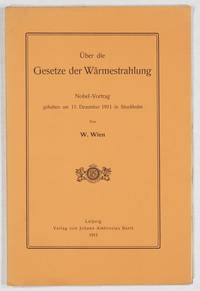
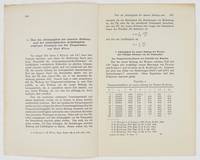
1912rif. 113881912. Leipzig Verlag von Johannes Ambrosius Barth 1912 Gr.-8° 21 3 pp. orig. Broschur; unbeschnittenes Expl. First Edition! Wilhelm Wien 1865-1928 "grew up in the east Prussian town of Rastenburg today Ketrzyn Lithuania. He then studied at the prominent universities of Heidelberg and Göttingen before he eventually completed his doctorate in Berlin. In 1900 he succeeded W.C. Röntgen 1901 Physics Laureate as a professor in Würzburg. Wien's research concerned how various metals radiate heat and he received the Nobel Prize for the law of black-body radiation now known as Wien-Planck's law. It was drawn up jointly with Max Planck Physics 1918 and many felt that they should have shared in the award." "When a completely dark body is heated it emits visible light and other electromagnetic radiation. The spectrum of the radiation is entirely dependent on the temperature of the body and not its composition. In 1893 Wilhelm Wien formulated his displacement law which indicates at which wavelength the radiation is most intense at a certain temperature. He subsequently also formulated a law indicating how the radiation spectrum varies as temperature changes. However this does not apply to long wavelengths and in 1900 Max Planck formulated a law that conforms better." Wilhelm Wien - Facts. NobelPrize/org The Nobel Prize in Physics 1911 unknown
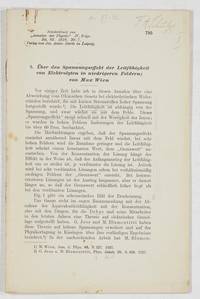
1925rif. 680881925. Ann. Phys. 4. Folge 77. - Leipzig Verlag von Johann Ambrosius Barth 1925 8° pp.560-586 7 Fig. orig. Broschur. First Edition! Wilhelm Wien 1865-1928 "grew up in the east Prussian town of Rastenburg today Ketrzyn Lithuania. He then studied at the prominent universities of Heidelberg and Göttingen before he eventually completed his doctorate in Berlin. In 1900 he succeeded W.C. Röntgen 1901 Physics Laureate as a professor in Würzburg. Wien's research concerned how various metals radiate heat and he received the Nobel Prize for the law of black-body radiation now known as Wien-Planck's law. It was drawn up jointly with Max Planck Physics 1918 and many felt that they should have shared in the award." "When a completely dark body is heated it emits visible light and other electromagnetic radiation. The spectrum of the radiation is entirely dependent on the temperature of the body and not its composition. In 1893 Wilhelm Wien formulated his displacement law which indicates at which wavelength the radiation is most intense at a certain temperature. He subsequently also formulated a law indicating how the radiation spectrum varies as temperature changes. However this does not apply to long wavelengths and in 1900 Max Planck formulated a law that conforms better." Wilhelm Wien - Facts. NobelPrize/org The Nobel Prize in Physics 1911 unknown
1928rif. 680891928. Ann. Phys. 4. Folge 85/7. - Leipzig Verlag von Johann Ambrosius Barth 1928 8° pp.795-811 5 Fig. orig. Broschur. Rare Offprint! Wilhelm Wien 1865-1928 "grew up in the east Prussian town of Rastenburg today Ketrzyn Lithuania. He then studied at the prominent universities of Heidelberg and Göttingen before he eventually completed his doctorate in Berlin. In 1900 he succeeded W.C. Röntgen 1901 Physics Laureate as a professor in Würzburg. Wien's research concerned how various metals radiate heat and he received the Nobel Prize for the law of black-body radiation now known as Wien-Planck's law. It was drawn up jointly with Max Planck Physics 1918 and many felt that they should have shared in the award." "When a completely dark body is heated it emits visible light and other electromagnetic radiation. The spectrum of the radiation is entirely dependent on the temperature of the body and not its composition. In 1893 Wilhelm Wien formulated his displacement law which indicates at which wavelength the radiation is most intense at a certain temperature. He subsequently also formulated a law indicating how the radiation spectrum varies as temperature changes. However this does not apply to long wavelengths and in 1900 Max Planck formulated a law that conforms better." Wilhelm Wien - Facts. NobelPrize/org The Nobel Prize in Physics 1911 unknown
rif. 0267023480.Ghardcover. Good. Access codes and supplements are not guaranteed with used items. May be an ex-library book. hardcover
rif. 0483694495.Ghardcover. Good. Access codes and supplements are not guaranteed with used items. May be an ex-library book. hardcover
rif. 1332673228.Gpaperback. Good. Access codes and supplements are not guaranteed with used items. May be an ex-library book. paperback
rif. 2336473453.Gpaperback. Good. Access codes and supplements are not guaranteed with used items. May be an ex-library book. paperback
1982rif. BN587294Vandenhoeck & Ruprecht 1982. 1982. Softcover. Ästhetische Hermeneutik und frühromantische Kritik : Friedrich Schlegels fragmentarische Entwürfe Rezensionen Charakteristiken und Kritiken 1795 - 1801 Ästhetische Hermeneutik und frühromantische Kritik : Friedrich Schlegels fragmentarische Entwürfe Rezensionen Charakteristiken und Kritiken 1795 - 1801 Willy Michel Vandenhoeck & Ruprecht paperback
rif. ria9791041946761_inpPaperback. New. New Book; Fast Shipping from UK; Not signed; Not First Edition; A travers cet itinéraire fascinant Willy Reichel nous entraîne dans une exploration rigoureuse du magnétisme animal du spiritisme et des manifestations paranormales. Loin des spéculations purement théoriques l'auteur a parcouru la Fr paperback
rif. 1059551944. 41 x 50 cm gerahmt 27 x 36 cm Rückseitig etwas stockfl. sonst schönes Ex. - Bärtschi Willy Alexander 1906 - 1995 Maler Dozent und Publizist .Bauernsohn aus Lützelflüh Gymnasien in Zürich und Frauenfeld Kontakt mit dem Werk des Philosophen Holzapfel. 1928 Eintritt in die Kunstakademie Breslau die er aber bald wieder verliess. 1929 Eintritt in die Kunstakademie in Dresden ab 1930 Schüler von Otto Dix. Von 1934–1938 lebte Bärtschi als freier Maler in Dresden. 1938 Rückkehr nach Zürich kleinere Arbeiten für die Landi. Nach dem Aktivdienst 1943 Lehrer an der Kunstgewerbeschule in Zürich. Nach der Pensionierung 1971 widmete er sich wieder der Malerei. 010 1944 unknown
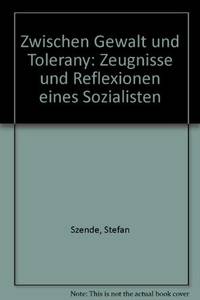
1975rif. BN462007Europäische Verlagsanstalt Frankfurt / Main 1975 1975. 1975. Zwischen Gewalt und Toleranz. Zeugnisse und Reflexionen eines Sozialisten Zwischen Gewalt und Toleranz. Zeugnisse und Reflexionen eines Sozialisten Stefan Szende / Willy Brandt Europäische Verlagsanstalt Frankfurt / Main 1975 unknown
1971rif. BN516903Wien New York : Springer 1971. 1971. Zusammendrückung und Scherfestigkeit von Böden : Anwendungsbeispiele u. Aufgaben. Zusammendrückung und Scherfestigkeit von Böden : Anwendungsbeispiele u. Aufgaben. Bölling Willy H. Wien, New York : Springer unknown
rif. ria9783211810392_inpPaperback. New. New Book; Fast Shipping from UK; Not signed; Not First Edition; Wie die Erfahrung immer wieder zeigt Hillt es dem jungen Ingenieur am Anfang seiner beruflichen Laufbahn schwer das erworbene Schulwissen zur Losung von praktischen technischen Aufgaben anzuwenden. Auch der erfahrene Ingenieur steht paperback
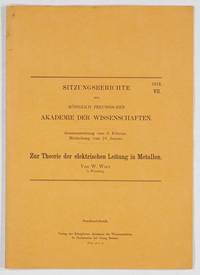
1913rif. 113891913. S.ber. Akad. Wiss. Berl. 1913. - Berlin Verlag der Königlichen Akademie der Wissenschaften / In Commission bei Georg Reimer 1913 Gr.-8° pp.184-200 5 Fig. orig. Broschur. First Edition! "Die Ergebnisse der Strahlungstheorie und die neuere Theorie der spezifischen Wärme haben den Nachweis geliefert daß die Elektronentheorie der Metalle auf eine wesentlich neue Grundlage gestellt werden muß. Man kann nicht mehr die Annahme aufrechterhalten daß die Elektronen in einem Metall wie freie Gasmoleküle herumfliegen und daß ihre mittlere lebendige Kraft der absoluten Temperatur des Metalls proportional ist. Solche Elektronen müssen vielmehr wie Lorentz gezeigt hat eine Wärmestrahlung erzeugen die dem Rayleigh-JEANSschen Gesetz folgt das sich bekanntlich mit der Erfahrung nicht in Übereinstimmung bringen läßt. Man würde nach diesem Gesetz für kürzere Wellenlängen eine viel größere Strahlung erhalten müssen als sie erfahrungsmäßig vorhanden ist. Ebenso zeigt die Theorie der spezifischen Wärme welche die Wärmebewegung in festen Körpern als Schwingungen der Moleküle um feste Zentren auffaßt und diese nach der PLANCKSchen Formel statistisch verteilt durch ihre Übereinstimmung mit den Beobachtungen daß die Elektronen nicht an der Wärmeenergie merklich beteiligt sein können." WienWien Wilhelm Carl Werner Otto Fritz Franz Wien 1864-1928 physicist who in 1893 used theories about heat and electromagnetism to deduce Wien's displacement law which calculates the emission of a blackbody at any temperature from the emission at any one reference temperature. He also formulated an expression for the black-body radiation which is correct in the photon-gas limit. His arguments were based on the notion of adiabatic invariance and were instrumental for the formulation of quantum mechanics. Wien received the 1911 Nobel Prize for his work on heat radiation. unknown
rif. a96216Berlin 1927 first edition. Im Werk-Verlag. Mit Einem Geleitwort von Professor Artur Schnabel. 12mo wraps. 98p. plus 2 p. publisher ads. Good Plus light fraying of cover edges.Binding secure; text. clean. . paperback
rif. 3386993362.Gpaperback. Good. Access codes and supplements are not guaranteed with used items. May be an ex-library book. paperback
rif. __3110051567De Gruyter 1965. Hardcover. New. 2nd reprint edition. 121 pages. German language. 9.06x6.10x0.47 inches. De Gruyter hardcover