2 799 résultats
1905réf. 376731905. Verh. Ges. Naturf. Ärzte 77.Vers. Meran 1905. - 12/1 Bd. - Leipzig F.C.W. Vogel 1905 8° 3 308; X 223 pp. Halbleinenband der Zeit. unknown
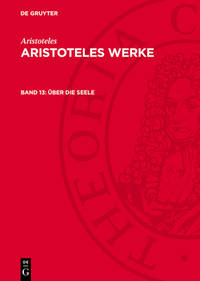
1983réf. __311277860XDe Gruyter 1983. Hardcover. New. 6th reprint edition. 160 pages. German language. 6.69x0.44x9.61 inches. De Gruyter hardcover
1903réf. 116991903. Slg. klin. Vortr. N.F. 356/57. - Leipzig Verlag von Breitkopf & Härtel 1903 8° 80 pp. 5 Abbildungen orig. Broschur. Sehr gutes Exemplar des Erstdruck dieser wichtigen Arbeit. Willy Anschütz Assistent bei Mikuliz habilitierte sich mit diesem Thema. Die Arbneit ist historisch wertvoll: Auf 15 Seiten werden die bis dato bekannten Fälle aufgezählt und die Literatur genannt. unknown
1970réf. 257121964 und 1970. Insel, Frankfurt. Sarkowski 498. Mit Abbildungen aus der Handschrift aus der Bibliotheque Nationale Paris, MS. fr. 12400. Originalpergamentbände mit vergoldetem Rückentitel und blindgeprägter Deckelvignette. 278, [2] - 294, ([2] - [XII], 405, [5] Seiten. [2 Warenabbildungen]
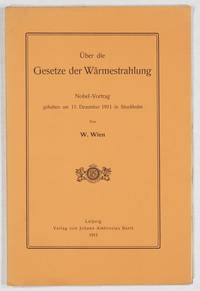
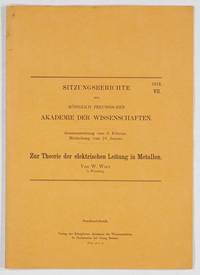
1912réf. 113881912. Leipzig Verlag von Johannes Ambrosius Barth 1912 Gr.-8° 21 3 pp. orig. Broschur; unbeschnittenes Expl. First Edition! Wilhelm Wien 1865-1928 "grew up in the east Prussian town of Rastenburg today Ketrzyn Lithuania. He then studied at the prominent universities of Heidelberg and Göttingen before he eventually completed his doctorate in Berlin. In 1900 he succeeded W.C. Röntgen 1901 Physics Laureate as a professor in Würzburg. Wien's research concerned how various metals radiate heat and he received the Nobel Prize for the law of black-body radiation now known as Wien-Planck's law. It was drawn up jointly with Max Planck Physics 1918 and many felt that they should have shared in the award." "When a completely dark body is heated it emits visible light and other electromagnetic radiation. The spectrum of the radiation is entirely dependent on the temperature of the body and not its composition. In 1893 Wilhelm Wien formulated his displacement law which indicates at which wavelength the radiation is most intense at a certain temperature. He subsequently also formulated a law indicating how the radiation spectrum varies as temperature changes. However this does not apply to long wavelengths and in 1900 Max Planck formulated a law that conforms better." Wilhelm Wien - Facts. NobelPrize/org The Nobel Prize in Physics 1911 unknown
1925réf. 680881925. Ann. Phys. 4. Folge 77. - Leipzig Verlag von Johann Ambrosius Barth 1925 8° pp.560-586 7 Fig. orig. Broschur. First Edition! Wilhelm Wien 1865-1928 "grew up in the east Prussian town of Rastenburg today Ketrzyn Lithuania. He then studied at the prominent universities of Heidelberg and Göttingen before he eventually completed his doctorate in Berlin. In 1900 he succeeded W.C. Röntgen 1901 Physics Laureate as a professor in Würzburg. Wien's research concerned how various metals radiate heat and he received the Nobel Prize for the law of black-body radiation now known as Wien-Planck's law. It was drawn up jointly with Max Planck Physics 1918 and many felt that they should have shared in the award." "When a completely dark body is heated it emits visible light and other electromagnetic radiation. The spectrum of the radiation is entirely dependent on the temperature of the body and not its composition. In 1893 Wilhelm Wien formulated his displacement law which indicates at which wavelength the radiation is most intense at a certain temperature. He subsequently also formulated a law indicating how the radiation spectrum varies as temperature changes. However this does not apply to long wavelengths and in 1900 Max Planck formulated a law that conforms better." Wilhelm Wien - Facts. NobelPrize/org The Nobel Prize in Physics 1911 unknown
1928réf. 680891928. Ann. Phys. 4. Folge 85/7. - Leipzig Verlag von Johann Ambrosius Barth 1928 8° pp.795-811 5 Fig. orig. Broschur. Rare Offprint! Wilhelm Wien 1865-1928 "grew up in the east Prussian town of Rastenburg today Ketrzyn Lithuania. He then studied at the prominent universities of Heidelberg and Göttingen before he eventually completed his doctorate in Berlin. In 1900 he succeeded W.C. Röntgen 1901 Physics Laureate as a professor in Würzburg. Wien's research concerned how various metals radiate heat and he received the Nobel Prize for the law of black-body radiation now known as Wien-Planck's law. It was drawn up jointly with Max Planck Physics 1918 and many felt that they should have shared in the award." "When a completely dark body is heated it emits visible light and other electromagnetic radiation. The spectrum of the radiation is entirely dependent on the temperature of the body and not its composition. In 1893 Wilhelm Wien formulated his displacement law which indicates at which wavelength the radiation is most intense at a certain temperature. He subsequently also formulated a law indicating how the radiation spectrum varies as temperature changes. However this does not apply to long wavelengths and in 1900 Max Planck formulated a law that conforms better." Wilhelm Wien - Facts. NobelPrize/org The Nobel Prize in Physics 1911 unknown
1910réf. 296061910. Arch. Dermat. Syph. 105. - Wien/Leipzig W. Braumüller 1910 8° V 572 LXXXV pp. 22 Taf. Halbleinenband d.Zt. Further: Philippson: Die Erkrankungen der kleinen Hautvenen in ihren Beziehungen zu Hautkrankheiten S.387-406 20 Lichtdrucktafeln mit 40 Abb. unknown
1948réf. 008284Editions De La Paix Ed. originale 1948 453 pages en format -8 - Belle reliure en simili cuir avec dorures et plats en carton marbré
1948réf. 051913Editions De La Paix Broché Paris Bruxelles 1948 453 pages en format 14 - 20 cm
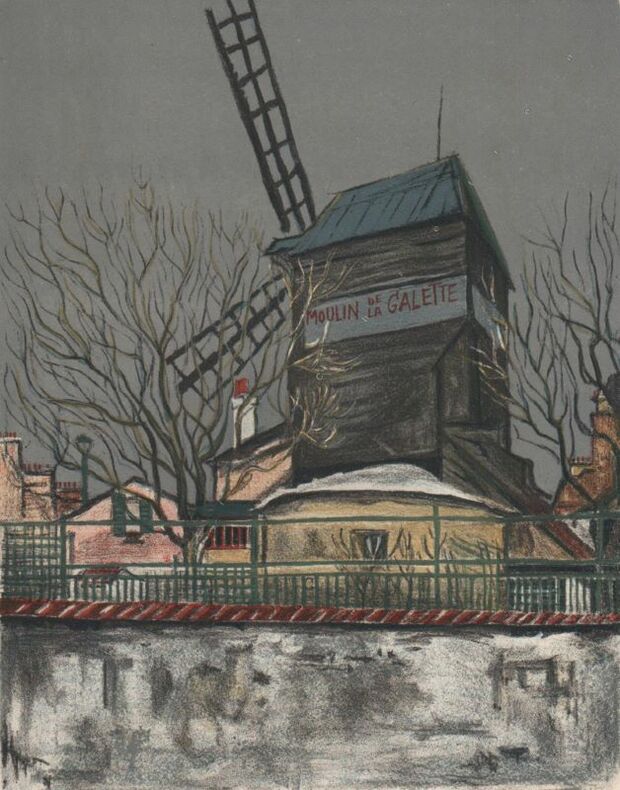
1948réf. 24058Manuel Bruker 1948 1 Orné de lithographies en couleurs. Manuel Bruker éditeur, 1956, broché, in-4, couverture rempliée vert pâle, non chiffré, table des gravures, achevé d'imprimer.
1982réf. BN587294Vandenhoeck & Ruprecht 1982. 1982. Softcover. Ästhetische Hermeneutik und frühromantische Kritik : Friedrich Schlegels fragmentarische Entwürfe Rezensionen Charakteristiken und Kritiken 1795 - 1801 Ästhetische Hermeneutik und frühromantische Kritik : Friedrich Schlegels fragmentarische Entwürfe Rezensionen Charakteristiken und Kritiken 1795 - 1801 Willy Michel Vandenhoeck & Ruprecht paperback
1996réf. 1968Odile Jacob 1996 248 pages 15x22x2cm. 1996. broché. 248 pages.
1959réf. 42431Leipzig, F.A. Brockhaus Verlag, 1959. 327 Seiten , 21 cm, Halbleder
1975réf. BN462007Europäische Verlagsanstalt Frankfurt / Main 1975 1975. 1975. Zwischen Gewalt und Toleranz. Zeugnisse und Reflexionen eines Sozialisten Zwischen Gewalt und Toleranz. Zeugnisse und Reflexionen eines Sozialisten Stefan Szende / Willy Brandt Europäische Verlagsanstalt Frankfurt / Main 1975 unknown
2000réf. 1244263Bonn : Dietz Verlag, 2000. 424 S. : Illustr. ; 21 cm; fadengeh. Orig.-Leinenband mit illustr. OUmschl.
1971réf. BN516903Wien New York : Springer 1971. 1971. Zusammendrückung und Scherfestigkeit von Böden : Anwendungsbeispiele u. Aufgaben. Zusammendrückung und Scherfestigkeit von Böden : Anwendungsbeispiele u. Aufgaben. Bölling Willy H. Wien, New York : Springer unknown
1913réf. 113891913. S.ber. Akad. Wiss. Berl. 1913. - Berlin Verlag der Königlichen Akademie der Wissenschaften / In Commission bei Georg Reimer 1913 Gr.-8° pp.184-200 5 Fig. orig. Broschur. First Edition! "Die Ergebnisse der Strahlungstheorie und die neuere Theorie der spezifischen Wärme haben den Nachweis geliefert daß die Elektronentheorie der Metalle auf eine wesentlich neue Grundlage gestellt werden muß. Man kann nicht mehr die Annahme aufrechterhalten daß die Elektronen in einem Metall wie freie Gasmoleküle herumfliegen und daß ihre mittlere lebendige Kraft der absoluten Temperatur des Metalls proportional ist. Solche Elektronen müssen vielmehr wie Lorentz gezeigt hat eine Wärmestrahlung erzeugen die dem Rayleigh-JEANSschen Gesetz folgt das sich bekanntlich mit der Erfahrung nicht in Übereinstimmung bringen läßt. Man würde nach diesem Gesetz für kürzere Wellenlängen eine viel größere Strahlung erhalten müssen als sie erfahrungsmäßig vorhanden ist. Ebenso zeigt die Theorie der spezifischen Wärme welche die Wärmebewegung in festen Körpern als Schwingungen der Moleküle um feste Zentren auffaßt und diese nach der PLANCKSchen Formel statistisch verteilt durch ihre Übereinstimmung mit den Beobachtungen daß die Elektronen nicht an der Wärmeenergie merklich beteiligt sein können." WienWien Wilhelm Carl Werner Otto Fritz Franz Wien 1864-1928 physicist who in 1893 used theories about heat and electromagnetism to deduce Wien's displacement law which calculates the emission of a blackbody at any temperature from the emission at any one reference temperature. He also formulated an expression for the black-body radiation which is correct in the photon-gas limit. His arguments were based on the notion of adiabatic invariance and were instrumental for the formulation of quantum mechanics. Wien received the 1911 Nobel Prize for his work on heat radiation. unknown
1975réf. 56900ABZürich, VSI, Vereinigung Schweizer Innenarchitekten. (1975). 4°. Ca. 56 n.n. S. als Blockbuch, mit vielen s/w. Abbildungen. Ringbuch mit transparentem bedrucktem Deckblatt.
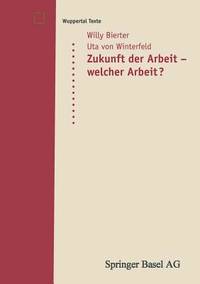
1998réf. x-3764359315Birkhaeuser Basel 1998. Paperback. New. 312 pages. German language. 8.26x5.82x0.71 inches. Birkhaeuser Basel paperback
1998réf. BN301720Birkhäuser Basel Springer Basel 1998. 1998. Softcover. Zukunft der Arbeit welcher Arbeit Zukunft der Arbeit welcher Arbeit Willy Bierter Uta von Winterfeld Birkhäuser Basel, Springer Basel paperback
1928réf. 103767ABLeipzig, Verl. Dt. Buchwerkstäten, 1928. 166 S. Schwarzer OLwd. m. goldgeprägt. Deckelillustr. (aufsteigener Zeppelin). - Buchschnitt etwas fleckig, sonst gutes Ex.
1955réf. 14444o.O. ohne J. ca. 1955. ill. Orig. Geprägter und illustr. Leinwandkassette mit Rücken- und Deckeltitel 20 Tafeln 4° =31 x 25 cm. Wunderschöne Kassette mit auf festem Karton montierten Fotos jedes von hand beschriftet wie SIGNIERT ! Vermutlich kleine Auflage in aufwendiger handarbeit erstellt im Selbstverlag des Photographen. sehr gut erhalten ! ANY QUESTIONS Please don´t hesitate to ask for details !! unknown
1987réf. W91904Brussel, Scripta 1987 178pp., in de reeks "Scripta - Medieval and Renaissance texts and Studies" volume 20, 25cm., goede staat, W91904
1992réf. 102318Freiburg i. Br., Rombach 1992. 135 Seiten. Hardcover/Pappeinband