Voltaire; Gunnar von ProschwitzBiblio.com
VoltaireBiblio.com
Complete Works of Voltaire 60D: Collection des lettres sur les miracles. Ecrites a Geneve et a Neufchatel
réf. 35819305-nnew. unknown

GreatBookPrices · États-Unis178,22 $US≈ 159,22 €
10 419 résultats
réf. 18790432-nnew. unknown
réf. 18790523-nnew. unknown
réf. 35819305-nnew. unknown
réf. 10037285-nnew. unknown
réf. 18796825-nnew. unknown
réf. 24669253-nnew. unknown
réf. 18790377-nnew. unknown
réf. 32461930like new. unknown
réf. 35819305like new. unknown
réf. 25518059-nnew. unknown
réf. 38716792-nnew. unknown
1810réf. 85664London: Longman Hurst Rees & Orme 1810. Fine. Longman Hurst Rees & Orme London 1810 11 x 18 cm 4 volumes reliés First edition. Full caramel calf bindings spines with fine raised bands highlighted with gilt fillets and decorated with richly ornamented double gilt compartments author's name in red calf olive green calf volume labels triple fillets stamped in blind on boards blue paper endpapers and pastedowns blind-stamped borders framing the pastedowns two bookplates pasted on a pastedown of the first volume and following endpapers gilt edges on cuts red speckled edges elegant English bindings Our copy includes in the first volume the portrait of the Marquise du Deffand as frontispiece as well as a facsimile of her handwriting after the preface. Fine copy very handsomely bound. Longman, Hurst, Rees & Orme hardcover
réf. DADAX1436668816New unknown
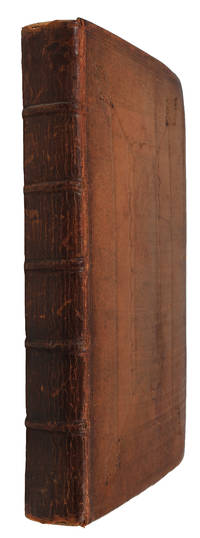
1733réf. 61360London 1733. 8vo. Bound in a lovely contemporary English Cambridge-style full calf binding with a plain spine with five raised bands. Spine a bit cracked vertically and with minor loss to capitals. Corners a bit bumped and adges of boards a bit worn. Binding overall nice and tight. Small damp stain at the lower blank corner of the first few leaves otherwise a very good clean copy on thick crisp paper. 16 -including preface contents advertisements 253 1 18 -Index pp. The important actual first edition of this highly celebrated key work of the Enlightenment in which the anecdote of how Newton discovered gravity the story about Newton and the falling apple appeared for the first time together with the description of the difference between the physical world view of the English and the French the "plenum" and the "vacuum". This seminal work in which Voltaire famously depicts British philosophy science society and culture in comparison to French can be viewed as the Enlightenment equivalent to Tocqueville's "Democracy in America". This series of essays which is based on Voltaire's experiences when living in England was actually written by Voltaire mostly in English which he mastered to perfection. It has often been presumed that the first edition of the work was that published in French in 1734 but actually the present English edition constitutes the actual first appearance of the work as well as the version that is closest to Voltaire's intention as the French language version is the re-written one and the English version the original. Curiously almost all modern English versions are translations into English of the French edition instead of the original English version making this edition of the utmost importance.After the original English edition of 1733 two French editions soon followed the first in 1734. Unlike the British the French resented the book and already in 1734 the French Parliament issued an order for the author's arrest and condemned the work causing the impact of it in France to be delayed. The book was burned for being "dangerous to religion and civil order". At the same time the work became a bestseller in Britain and as much as 14 editions of the work were published in the eighteenth century. "Inspired by Voltaire's two-year stay in England 1726-8 this is one of the key works of the Enlightenment. Exactly contemporary with Gulliver's Travels and The Beggar's Opera Voltaire's controversial pronouncements on politics philosophy religion and literature have placed the Letters among the great Augustan satires. Voltaire wrote most of the book in English in which he was fluent and witty and it fast became a bestseller in Britain. He re-wrote it in French as the Lettres philosophiques and current editions in English translate his French." Nicholas Cronk Introduction to the Oxford's Classics edition from 1999.The great French philosopher Voltaire was greatly impressed by the philosophical and scientific achievements of the English especially those of Newton Locke and Bacon. As a disseminator of scientific knowledge Voltaire came to play a great rôle in the popularization of Newtonian science and its discoveries the present work being a prime example. Although the work was condemned by the French authorities it still came to play a great rôle in the spreading of Newtonian ideas in France. The present work generally came to play a dominant rôle in Enlightenment accounts of the history of science and philosophy. The work focuses on British science and thought and uses the accounts of these to emphasize what is lacking in French society and French thought. The work is generally very critical towards the French "ancient régime" and when Voltaire here discusses the emergence of empiricism it is viewed as an English tradition that stands in opposition to the French rationalist tradition with Descartes as the prime example. This view is taken over by the following Enlightenment historians of science and philosophy e.g. d'Alembert see for instance his "Preliminary Discourse" of 1751. Some of the most influential passages of the work are probably those on Bacon who Voltaire sees as the founder of modern experimental science Newton and Descartes. Letters XIV on Descartes and Newton XV on attraction and XVI on Newton's Optics from 1704 are among the most influential essays of the work. In XVI Voltaire reflects upon Newton's "Optics" and the way that he rejected Descartes' theory and set out his own account of the properties of light. In XV he presents the first account of Newton and the falling apple: "As he was walking one Day in his Garden and saw some Fruits fall from a Tree he fell into profound Meditation on that Gravity the Cause of which had so long been sought but in vain by all the Philosophers whilst the Vulgar think there is nothing mysterious in it. He said to himself that from what height soever in our Hemisphere those Bodies might descend their Fall wou'd certainly be in the Progression discover'd by Galileo; and the Spaces they run thro' would be as the Square of the Times. Why may not this Power which causes heavy Bodies to descend and is the fame without any sensible Diminution at the remotest Distance from the Center of the Earth or on the Summits of the highest Mountains; Why said Sir Isaac may not this Power extend as high as the Moon." pp. 127-28.But perhaps the most famous passage in the volume is the opening of Letter XIV: "A Frenchman who arrives in London will find Philosophy like every Thing else very much chang'd there. He had left the World a "plenum" and he now finds it a "vacuum". At Paris the Universe is seen compos'd of Vortices of subtile Matter; but nothing like it is seen in London. In France 'tis the Pressure of the Moon that causes the Tides; but in England 'tis the Sea that gravitates towards the Moon; so that when you think that the Moon should make it Flood with us those Gentlemen fancy it should be Ebb which very unluckily cannot be prov'd." pp. 109-10. hardcover
1942réf. 91805La Nouvelle France 1942. hardcover. Bueno. París 1942. La Nouvelle France. Piel con dorados. Lomo con nervios. 256 pp. 19x14. Ilustrado por Georges Beuville. Texto en FRANCÉS. La Nouvelle France hardcover
1874réf. 91986Garnier Frères 1874. hardcover. Bueno. París 1874. Garnier Frères. Holandesa. Lomo piel con dorados y nervios. 718 pp. 17x12. Texto en FRANCÉS. Buen estado de conservación. Garnier Frères hardcover
1775réf. 600AG1775. Paris 1775 gez. 1775 Kupferstich Voltaire im Bett liegend von Personen umgeben von Neé und Masquelier nach Non. Bildgrösse: 145 x 18 cm. Blattgrösse: 195 x 23 cm. Leicht fleckig. unknown
1820réf. 26CG1820. O.J. um 1820. Radierung in Crayonmanier Brustbild von Huber Rudolf schweiz. Künstler 1770-1844. Bildgrösse: 225 x 19 cm. Blattformat: 27 x 245 cm. unknown
1983réf. 83242Paris: Gallimard Bibliothèque de La Pléiade 1983. Fine. Gallimard Bibliothèque de La Pléiade Paris 1983 10.50 x 18 cm reliure de l'éditeur sous étui souple et cartonné First edition. Publisher's full brown grained sheep binding orange top edge smooth spine decorated with gilt fillets. Rich iconography. Handsome copy complete with its dust jacket cellophane wrapper and soft slipcase. Gallimard, Bibliothèque de La Pléiade unknown
1901réf. A803981X02F7UNew York: E. R. DuMont 1901. Verite Edition Set #24. Hardcover. Fair. Complete 42 volume set of the Verite Edition set #24 of 700. 3/4 dark leather bindings with marbled paper. Gilt decoration and lettering to covers and spine. Covers have some shelf wear especially to edges and leather. Spines have little to no fading but are worn and some may have cracks. Covers are detached from some volumes. Top edge gilt others rough cut. Endpapers are marbled to match covers. Interiors are clean and completely unmarked with surprisingly little yellowing for the age. Large multi volume set will require extra shipping and ship in multiple boxes. Multivolumes E. R. DuMont hardcover
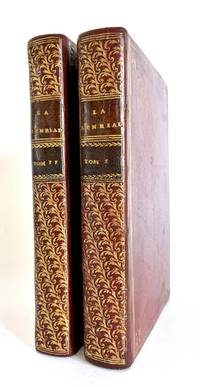
1770réf. 81957à Paris: Chez La veuve DuchesneSaillantDesaint 1770. Fine. Chez La veuve Duchesne Saillant Desaint à Paris 1770 11.80 x 18.50 cm 2 volumes reliés New illustrated edition with first printing by Eisen of a frontispiece an engraved title with the author's portrait in medallion 10 figures and 10 headpieces all engraved by De Longueil. Volume II contains variants and notes: L'essai sur la poésie épique poème sur le désastre de Lisbonne; Poème sur la loi naturelle etc. This edition was partly revised by Voltaire. The publishers' notice announces this edition as the only complete one since there are more than 50 new verses scattered throughout the work. Contemporary full red morocco binding. Smooth spine decorated in grotesque style. Brown morocco title label olive morocco volume label. Triple fillet frame on covers with corner fleurons. Interior fillet. All edges gilt. Traces of rubbing. Some light foxing in margins and verso of certain engravings. Superb copy rare in this condition. Very fine illustration by Eisen. Complete and critical edition with notes from different editions for each canto Marmontel's preface the author's letter of thanks to Eisen. Chez La veuve DuchesneSaillantDesaint unknown
1756réf. 00290050Paris 1756. Hardcover. Good. Original gilt half leather.; Edges and corners cover worn; top spine damaged; name/place stamp on endpaper. Paris hardcover
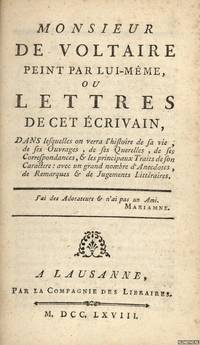
1768réf. 00293190Lausanne : Compagnie des Libraires 1768. Hardcover. Good. Contemporary gilt half calf with moroccan letterpiece.; Name on endpaper. Lausanne : Compagnie des Libraires hardcover
1952réf. 021232Paris: Limited Editions Club 1952. Hardcover. Some rubbing to the leather spine label. Near Fine in a Very Good slipcase. Charming book. Sylvain Sauvage. Octavo 6-1/2" x 8-1/2" bound in brown linen on which a psuedo-oriental design is deposited in gold through silk screens the title stamped in gold on a blue leather spine label; the slipcase covered with gold paper lithographed in brown; 174 pages. Copy #322 of 1500 numbered copies printed on handmade paper and illustrated with more than one hundred drawings in the oriental manner by Sylvain Sauvage printed in collotype and hand-colored by Etienne Giradot. A number of the illustrations are of a mildly erotic nature. Issued unsigned after the artist's death. Limited Editions Club hardcover