6.332 resultados
ref. DADAX0553813129New unknown
1913Very Good Armenian In modern full morocco. Roy. 8vo. (24 x 17 cm). In Armenian. 464 p., b/w plates and maps., 2 portraits of Lynch, bibliography. First and early banned Armenian edition printed in Istanbul (Constantinople) of Lynch's travel account of Armenia and Highlands. Original English First Edition published in 1901 as 2 volumes. Vol. 1 is the Russian provinces, 2 is the Turkish provinces. This Armenian edition contains selections from both volumes. "Henry Finnis Blosse Lynch was born in London in 1862, of Irish parentage. His family ran Lynch Brothers, a firm that traded with and ran shipping lines in Persia and Mesopotamia. Lynch had already traveled widely in those regions before their geographical closeness to Armenia, together with the growing importance of the "Armenian Question", attracted him to Armenia. Lynch later became a member of the British Parliament. He died suddenly in November 1913 of pneumonia. Lynch's two-volume work "Armenia: Travels and Studies" was published in London in 1901, and remains the definitive account in English of Armenia before the 1915 Deportation. An Armenian translation of the book was published in London in 1902, and another in Constantinople in 1913. In modern Turkey, the book was on the official list of banned books until at least the late 90s. "Armenia: Travels and Studies" was the result of two extensive visits he made to the Turkish and the Russian-controlled areas of Armenia - the first visit lasting from August 1893 to March 1894, and the second from May to September 1898. Lynch visited Ani ruins in October 1893 and his account of that visit, with the accompanying photographs, is reproduced below. His footnotes are on a separate page. The border graphic on this page is based on the decorative band on the binding of Lynch's book, was inspired by the vine-scroll relief on the church of the Holy Cross on Acht'amar island.". Source: Virtualani. First and Only Armenian Edition. Extremely rare. A censored and collectible item of Armenian literature.
1857Very Good Turkish, Ottoman (1500-1928) Lithographed Edition. First and Only Edition of this first Turkish book exclusively related to America. This very rare work (both in scarce institutional holdings and market rarity) is the first book in Turkish to describe the discovery and conquest of America. Thus, it is an important and early source on America in the Islamic world. "The first treatise [in Turkish] dedicated exclusively to America" (Strauss). It is printed in a format that is specific to the early printing period of the Ottoman Empire and is written in a tâliq script and has the appearance of a manuscript. It has neither a preface nor a proper title. The heading (serlevha) on the first page which is placed in a decorative floral design reads: "First chapter: On the Islands Discovered by the Venetian and Genoese seafarers, and, secondly, on the discovery of America by Christopher Columbus". It also contains the mandatory praise of the ruler, i.e., Sultan Abdülmecid, and indicates that it was "translated and transferred from some selected writings (ba'z-i evrâk-i müntahabe)". The dramatic events of the discovery and of the different conquests by the Spaniards are vividly described in plain and simple language. Though it is not free from clichés adopted from Western sources, the darker aspects of the European expansion are not omitted. Particular interest is devoted to the fauna and flora of the American continent. The modern territorial divisions of the American continent, and briefly, its political history, are dealt with in a special chapter at the end of the book. This chapter comprises information about both North and South America from the Polar Regions (Arazi-i kutbiyye) and "Russian America" (Amerika-i Rusiyye) to the Banda Oriental (Banda) or the Cisplatine Republic (Çisplatin) and the Province of Patagonia (Patakonya Eyaleti). It takes into account the latest developments. The last event referred to is General Soulouque's takeover in Haiti. "[.] ?in Santa Domingo (Sen Domeng), i.e., the island of Haiti, a general from the Negro people appeared in the Frankish year of 1847 and beat the Spaniards and the French. Assuming the title of 'king', he is known today as Faustin I." (p. 54). In fact, General Soulouque (Emperor of Hayti, (1782-1867)) had assumed the title of 'Emperor' in 1849. His reign lasted until 1859. (Source: Nineteenth-Century Ottoman Americana by Johann Strauss). Original wrappers. Occasionally slight stains on some pages and chipped on front cover, otherwise a very good copy. Roy. 8vo. (23 x 16 cm). In Ottoman script (Turkish with Arabic letters). 56 p. Litho. Only two copies in OCLC: (University of California, Los Angeles & Library of Congress, Karl Süssheim Collection, no. 1717.): 948879228.; TBTK 4412 / 5557.; Özege 1591 / 22639.
ref. 39347In-8 (220 x 140 mm), demi-chagrin grenat à grands coins, dos à 5 nerfs filetés au noir, auteur et titre dorés, couverture illustrée et dos conservés, 390 pages, exemplaire non rogné. Paris, Paul Morihien, 1948 (Levallois, Société Industrielle d'Imprimerie, 15 juin 1948).
ref. 9868Album photos in 8 à l’italienne, pleine toile noire muette. Titre dessiné et peint, avec encadrement peint en grisaille. Suite de 48 photographies originales, contrecollées sur carton fort, montés sur onglets toilés. 14 grandes photos et 34 plus petites, l’ensemble avec encadrements dessinés et peints, tous différents. Très bon état. Probablement fin XIXème.
ref. 39611In-folio (342 x 222 mm), pleine basane acajou, dos à 6 nerfs orné de compartiments cloisonnés et fleuronnés, pièce de titre de maroquin rouge, roulette sur les coupes, tranches dorées (reliure du XVIIe s.), (12), 341, (9) pages, titre dans un encadrement architectural gravé sur bois portant la marque de Galliot du Pré à sa devise, exemplaire entièrement réglé à l'encre brune. Paris, Galliot du Pré (impr. par Guillaume Morel), 1561.
ref. 393392 volumes in-8 (208 x 128 mm), demi-veau blond de l’époque, reliure romantique ornée de 4 nerfs plats guillochés or et de compartiments garnis d’un fer spécial au noir et d’une dentelle dorée, jeux de palettes et roulettes dorées en tête et pied, pièces de titre et de tomaison de veau fauve, tranches marbrées, (4), 430 pages et (4), 475 pages. Paris, Alex Vezard, Le Normant, 1830.
ref. 39267Grand in-8° (218 x 138 mm), maroquin rouge cerise à grain long, dos lisse orné de compartiments ornés de triples filets en place des nerfs et d'un fleuron "Empire" répété au centre, palette en tête et pied, titre doré, filet gras d'encadrement aux plats, tranches mouchetées (rel. début du XIXe dans le style de Bozérian), xvi, 190, (2), 124 pages, 9 planches dépliantes hors-texte et 14 vignettes historiées à tiers de page dans le texte et (61) feuillets non chiffrés dont 39 planches de costumes, 11 feuillets d'explications et 1 feuillet d'approbation. A Paris, chez Vente, Libraire des Menus Plaisirs du Roi, 1775.
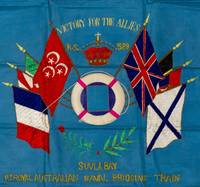
ref. 146922Near fine. Three embroidered silk panels with coloured fabric onlays approximately 545 × 540 mm 470 × 530 mm and 555 × 590 mm. Light creases otherwise in near-fine condition still tacked to the original backing paper. Dutch-born Richard Schenk enlisted on 27 July 1915 and was deployed to Suvla Bay just in time to participate in the evacuation of Allied troops from the Gallipoli Peninsula the RANBT was the last unit to leave. The first of the silks has the text 'Victory for the Allies R.S. 389 Suvla Bay 1st Royal Australian Naval Bridging Train'. The second silk has the text 'Victory of the Allied Army 1916 To Elsie With Love From Richard Cairo Egypt'. Schenk's service record gives as his next of kin his wife Elsie Nellie. The final silk has the text 'Souvenir of The Great National War August 4th 1914'. All three would have been purchased in the Middle East likely all in Cairo where there was a flourishing industry for items such as this. As is often the case all feature flags of allied nations Britain France Belgium Serbia Italy Japan Russia the Russian navy and one has designs of a warship aeroplane and artillery piece. Appropriately for a member of a naval unit all three have a life preserver at the centre of the design two with a window within which to mount a small photograph. They have never been used which accounts for the retention of the original backing paper and the excellent state of preservation. After Gallipoli Schenk spent six months in the Middle East before being discharged due to a finger contraction in July 1916. He reinlisted in 1917 with the new service number 38610 and served as a gunner with the 8th Field Artillery Brigade on the Western Front. 3 items. unknown
1967ref. 012581Forcalquier Robert Morel 1967 In-8 triangulaire Cartonnage toilé illustré Edition originale
1884Very Good French Original map. Oblong Double Elephant Folio. (96x156 cm). In French. Scale: 1/1.500.000. With explanation of geographical terms in Greek, Turkish, Arabic and Persian; With overview sheet: Aperçu general de la division administrative des provinces asiatiques de l'Empire Ottoman. (Jaar: 2011 - Europeana Collections). French edition of Kiepert's huge map of the Imperial Ottoman territories. "Includes list of geographic terms in eastern languages and notes on administrative divisions. Includes notes on materials the cartographer used to put together the map". (See LC copy). Kiepert, (1818-1899), was born in Berlin. He traveled frequently as a youth with his family and documented his travels by drawing. His family was friends with Leopold von Ranke, who inspired Kiepert's creative endeavors. Kiepert was taught by August Meineke in school. Meineke influenced Kiepert's interest in classical antiquity. He attended Humboldt University of Berlin. He studied history, philology, and geography. He published his first geographical work, with Carl Ritter, in 1840, titled Atlas von Hellas und den hellenischen Kolonien. The atlas focused on ancient Greece. In 1848 his Historisch-geographischer Atlas der alten Welt was published. In 1854, his atlas, Atlas antiquus was released. It was translated into five languages. Neuer Handatlas über alle Teile der Erde was first published in 1855. In 1877 his Lehrbuch der alten Geographie was published, and in 1879 Leitfaden der alten Geographie, which was translated into English (A Manual of Ancient Geography, 1881) and into French. In 1894 he created the first part of a larger atlas of the ancient world titled Formae orbis antiqui. He traveled to Asia Minor four times between 1841 and 1848. He created two maps of the region, including Karte des osmanischen Reiches in Asien, in 1844. Kiepert taught geography at the University of Humboldt-Berlin starting in 1854. He taught at the university until his death. Akyol, article 536.; Dagtekin p. 22 (With detailed bibliography on Kiepert's maps). Rare. Preserved in a frame, will be sent without its frame. A wall map.
Very Good Turkish, Ottoman (1500-1928) A modern fine black leather bdg. Small 4to. (26 x 18 cm). In Ottoman script. 3 volumes set: ([13], 448, [11], [6] p.; 386, [12], [6] p.; 203 p). Ibn Battuta was the greatest medieval Muslim traveler and the author of one of the most famous travel books, the Ri?lah (Travels). His great work describes his extensive travels covering some 75,000 miles (120,000 km) in trips to almost all of the Muslim countries and as far as China and Sumatra (now part of Indonesia). Ibn Battuta was from a family that produced a number of Muslim judges (qadis). He received the traditional juristic and literary education in his native town of Tangier. In 1325, at the age of 21, he started his travels by undertaking the pilgrimage (hajj) to Mecca. At first his purpose was to fulfill that religious duty and to broaden his education by studying under famous scholars in Egypt, Syria, and the Hejaz (western Arabia). That he achieved his objectives is corroborated by long enumerations of scholars and Sufi (Islamic mystic) saints whom he met and also by a list of diplomas conferred on him (mainly in Damascus). Those studies qualified him for judicial office, whereas the claim of being a former pupil of the then-outstanding authorities in traditional Islamic sciences greatly enhanced his chances and made him thereafter a respected guest at many courts. That renown was to follow later, however. In Egypt, where he arrived by the land route via Tunis and Tripoli, an irresistible passion for travel was born in his soul, and he decided to visit as many parts of the world as possible, setting as a rule "never to travel any road a second time." His contemporaries traveled for practical reasons (such as trade, pilgrimage, and education), but Ibn Battuta did it for its own sake, for the joy of learning about new countries and new peoples. He made a living of it, benefitting at the beginning from his scholarly status and later from his increasing fame as a traveler. He enjoyed the generosity and benevolence of numerous sultans, rulers, governors, and high dignitaries in the countries he visited, thus securing an income that enabled him to continue his wanderings. From Cairo, Ibn Battuta set out via Upper Egypt to the Red Sea but then returned and visited Syria, there joining a caravan for Mecca. Having finished the pilgrimage in 1326, he crossed the Arabian Desert to Iraq, southern Iran, Azerbaijan, and Baghdad. There he met the last of the Mongol khans of Iran, Abû Sa'îd (ruled 1316-36), and some lesser rulers. Ibn Battuta spent the years between 1327 and 1330 in Mecca and Medina leading the quiet life of a devotee, but such a long stay did not suit his temperament. Embarking on a boat in Jiddah, he sailed with a retinue of followers down both shores of the Red Sea to Yemen, crossed it by land, and set sail again from Aden. This time he navigated along the eastern African coast, visiting the trading city-states as far as Kilwa (Tanzania). His return journey took him to southern Arabia, Oman, Hormuz, southern Persia, and across the Persian Gulf back to Mecca in 1332. There a new, ambitious plan matured in his mind. Hearing of the sultan of Delhi, Mu?ammad ibn Tughluq (ruled 1325-51), and his fabulous generosity to Muslim scholars, he decided to try his luck at his court. Forced by lack of communications to choose a more indirect route, Ibn Battuta turned northward, again passed Egypt and Syria, and boarded ship for Asia Minor (Anatolia) in Latakia. He crisscrossed that "land of the Turks" in many directions at a time when Anatolia was divided into numerous petty sultanates. Thus, his narrative provides a valuable source for the history of that country between the end of the Seljuq power and the rise of the house of Ottoman. Ibn Battuta was received cordially and generously by all the local rulers and heads of religious... Hejra: 1333; 1335; 1336 = Roumi: 1335 ; 1337; 1340 = Gregorian: 1917; 1919; 1921. Ozege: 21289. For fihrist: 5771.
1871Very Good Turkish, Ottoman (1500-1928) Original cloth bdg. with marbled boards. Cr. 8vo. (20 x 13,5 cm). In Ottoman script (Old Turkish with Arabic letters). 176, [1] p. Lithographed edition. Extremely rare first and only edition of this guide to the distances and meridian calculations of some cities from Batumi located on the shores of Black Sea, Europe until Great Britain, Asia, and Africa shores, prepared for Turkish naval officers, mariners, and vessels, describing the shores of the countries located on these routes. ABOUT THE AUTHOR: Ibrahim Edhem Pasha was an Ottoman statesman, who held the office of Grand Vizier at the beginning of Abdul Hamid II's reign between 5 February 1877 and 11 January 1878. He resigned from that post after the Ottoman chances of winning the Russo-Turkish War (1877-1878) had decreased. He furthermore served in numerous administrative positions in the Ottoman Empire including minister of foreign affairs in 1856, then ambassador to Berlin in 1876, and to Vienna from 1879 to 1882. He also served as a military engineer and as Minister of Interior from 1883 to 1885. In 1876-1877, he represented the Ottoman Government at the Constantinople Conference. He was born in Chios of Greek ancestry, in a Christian Greek Orthodox village on the island of Chios. Strangely, his connection to Chios is not well-documented: his son Osman Hamdi Bey claimed that he was a member of the Scaramanga family, but Edhem Pasha himself tried to efface his Greek connections. As a young boy in 1822, he was orphaned and captured by Ottoman soldiers during the massacre of the Greek population of Chios. He was sold into slavery, brought to Constantinople, and adopted by the (later) grand vizier Hüsrev Pasha. Lacking his own children and family, Hüsrev Pasha raised about ten children who had been orphaned or bought as slaves, many of whom ascended to important positions. The child, now named Ibrahim Edhem, quickly distinguished himself with his intelligence and after having attended schools in the Ottoman Empire, he was dispatched along with a number of his peers, and under the supervision of his father, then grand vizier, and of the sultan Mahmud II himself, to Paris to pursue his studies under state scholarship. There he returned with a Bachelor of Arts and was one of the top pupils at the École des Mines. He was a classmate and a friend of Louis Pasteur. He thus became Turkey's first mining engineer in the modern sense, and he started his career in this field. Edhem Pasha was the father of Osman Hamdi Bey, a well-known archaeologist, and painter, as well as the founder of the Istanbul Archaeology Museum and the Mimar Sinan Fine Arts University. Another son, Halil Edhem Eldem took up the archaeology museum after Osman Hamdi Bey's death and has been a deputy for ten years under the newly founded Turkish Republic. Yet another son, Ismail Galib Bey, is considered the founder of numismatics as a scientific discipline in Turkey. Later generations of the family also produced illustrious names. The architect Sedat Hakki Eldem, a cousin, is one of the pillars of the search for modern architectural styles adopted by the Republic of Turkey (called the Republican style in the Turkish context) in its early years and which marks many important buildings dating from the period of the 1920s and the 1930s. A great-grandson, Burak Eldem, is a writer while another, Edhem Eldem, is a renowned historian. More names include Erol Eldem, Tiana Eldem, Levent Eldem, and Ercan Eldem, an architect. (Source: Wikipedia). Özege 4522.; Only one copy in OCLC: 162837008 (Bayerische Staatsbibliothek).
1898Very Good Turkish, Ottoman (1500-1928) Modern full morocco in Ottoman traditional style. Roy. 8vo. (25 x 17 cm). In Ottoman script (Old Turkish with Arabic letters). 119 p., 15 unnumbered b/w plates, and 1 color double-paged map of Northwest Africa and the Sahara Desert. First and only edition of this exceedingly rare book of Sahara and other territories of North Africa, written by Sadik El-Müeyyed, including his surviving report and travel account written to be presented to the Ottoman Sultan Abdulhamid II. It's a reference text that specifies the military and the political measures of the Sahara exploration, gives extensive information about the Benghazi region of Tripoli and about Muhammad al-Senusi, the leader of the Senûsî (Senussi) movement there, and his followers. With the impressive and enthusiastic expression of Sadik el-Müeyyed's descriptions, this work reveals not only the affairs of the Ottoman government but also the mysteries of the journeys that have taken months in the Sahara desert, uncovers the living standards of the desert peoples, and sheds light on an unknown aspect of the North African history. Özege 132.; Not in Kursun.
ref. 39575In-12 (165 x 97 mm), veau fauve écaille de l'époque, dos lisse orné de compartiments cloisonnés et fleuronnés, pièce de titre de maroquin bordeaux, filet sur les coupes, coiffes guillochées, tranches rouges, (4), 204 pages. Avignon, 1759.
1841ref. 002830Paris et Nancy, Tresse, et Chez Lauteur, 1841
ref. 390313 volumes in-8 (240 x 145 mm), demi-veau à coins, dos lisses ornés de fleurs de lys, pièces de titre et de tomaison en vélin rubriqué, tranches rouges et marbrés, (4) (faux-titre et titre), xix, (2), 1-84, xxii, 85-336, xxi-xxiv, 337-432, (1) (errata), (1 bl.) p. avec 4 planches H.T. ; (8) (faux-titre, titre et contenu des chapitres) avec un frontispice, 420, lix, 1 bl., v de table, (1) (errata) avec 3 planches H.T. ; (4) (faux-titre et titre), (26) (liste de souscripteurs), 400, cvi pp., v (table), (1) (errata) avec 4 planches H.T. et deux lettres signées. Londres, de l'imprimerie de Daponte et Vogel, se trouve chez l'auteur [...], 1804 - 1807
1919ref. 5627Paris, Editions de la Sirène, 1919. In-16 presque carré, non paginé, demi-basane fauve, dos à nerfs orné de filets dorés et fleurons à froid, couvertures conservées (le relieur a placé le second plat de couverture avant l'achevé d'imprimer). Initiales frappées au dos: R. M. G.
ref. DADAX0905899059New unknown
ref. 3899514 volumes dont 13 forts in-8° (256 x 167 mm) pour les "Mémoires" et un volume de "Table alphabétique" brochés, couvertures imprimées. Paris, Hachette, 1882-1893 et 1912 (table).
ref. SONG1905422105Used: Good unknown
1944Very Good Turkish, Ottoman (1500-1928) Original wrappers. Slightly split on margins. Otherwise a very good copy. Cr. 8vo. (20 x 14,5 cm). In Ottoman script. 212 p. It's written with a legible hand script. Mehmed Tevfik was a 'Hafiz'. Hafiz is a term used by Muslims for someone who has completely memorized the Quran. His name is not figured out in the literature. Manuscript starts with that he describes to started of neighborhood school in Tosya, Kastamonu and his first teacher Ismail Efendi. We learned that his father was professor in Abdurrezzak Madrasa in Tosya which was first and only madrasa in Tosya. After that he mentions his brother Ali, his primary school was in Çankiri. He describes their family journeys from Çankiri to Tosya in a very bright style which was a day and night and eventful journey. They crossed Devrez Baglari by a horse carriage. He gave some examples from Tosya (Kastamonu) local dialect like 'Kadinine' to 'Nine' [i.e. Grandmother]. He cited in very detail that his father's hajj and Hejaz journey with his grandfather. After that he talked about his first special lessons from a hafiz in 1309 [Hegira]. After two years of that, he started to High School in September of 1311 [Hegira]. His daughter's birth (Fatma Hayriye) and he traveled to Istanbul. He describes his military memoirs in Istanbul and when he saw who cursed to Sultan (Abdulhamid II) he was very surprised. After that confusions and difficulties in the last period of the Ottoman Empire, press in the Ottoman Empire, political events, murders and crimes in Istanbul city was told by Tevfik. All kind of events, according to him, a betrayal to the empire and Islamic culture. Based on his memoirs, he was a conservative person. A fine manuscript is not only describing which is an autobiography as well, showing a person who has passion to be an Islamic scholar, but also reflecting thoughts of an anti-revolutionary and the last period of the Ottoman Empire besides events in Istanbul city which was heart of an empire. It's unpublished. Extremely rare.
1906Very Good Turkish, Ottoman (1500-1928) Original wrappers. Foolscap 8vo. (17 x 12 cm). In Ottoman script (Old Turkish with Arabic letters). 152 p. Roumi: 1324 = Gregorian: 1906. Taken from a volume including multiple books. Spine is restored. A very good copy. First and only edition of this early and extensively rare book including a first-hand account of the topography and descriptions of Hejaz, Mecca, and other parts of Arabian Peninsula such as Taif and Yemen by Sadiq Sherif, who was the first person to take photographs of Mecca, Medina, and the Hajj in 1880 and 1881 as well. Sadiq Sherif was the grandson of Serif Abdulmuttalib, the Emîr of Mecca. This book written by Sherif was dedicated to 'the Progress and Union Society' [i.e. Ittihad ve Terakki Cemiyeti]. The book describes the way of administration and territorial division of Hejaz after giving some information of its geography, borders, tribes and natives, mountains, rivers, crops and products, and animals of this Ottoman 'vilâyat' [i.e. province]. Sherif gives detailed information on how and when the Ottoman Empire ruled Hejaz, the location of Mecca city, its borders, physical and social geography, crops in Mecca and around, its flora, fauna, demographic structure, 'nahiyes', Kâba's construction, and its history, sacred places around, Masjid-i Haram and other masjids, cemeteries, mountains, gifts by Ottoman caliphs to Kaba, 'Taif' area, people who were 'Emîr' of Mecca from the period of Mohammad, Wahhabism and its birth, etc. At the last, Sherif gives place to his personal letter (layihâ) including 49 articles. The letter was about the reforms that Hejaz needs and it was sent to the Ottoman 'sadâret' [i.e. prime ministry]. (Source: History of geographical literature during the Ottoman Empire, Edited by Ihsanoglu). Muhammad Sadiq Sherif Bey was the first person to take photographs of Mecca, Medina, and the Hajj in 1880 and 1881. Sadiq Bey trained as a military engineer after completing his studies in Cairo and at the École Polytechnique in Paris. It is not known when, or from whom, Sadiq Bey learned to take photographs but it was most probably through one of the resident photographers in Egypt. In 1861, prompted by the need to carry out more extensive military land surveys of the area between Wajh and Medina, Sadiq Bey made his first journey to Arabia. He took a camera along with his surveying equipment and took his very first photographs of Medina. In a series of articles published in the Egyptian Military Gazette in 1877, he refers to his early photography at Medina describing the use of a 'photographia'. Sadly, however, none of the photographs from this first journey has survived. In 1880 he was appointed as the treasurer of the Mahmal, the ornate cloth to cover the Ka'ba brought each year on a special litter to Mecca. He accompanied the Mahmal to Medina and Mecca from September 1880 until January 1881. Again equipped with his camera, he succeeded in producing the series of photographs that are now considered some of the earliest known photographs of the region, those of the Ka'ba, taken under great secrecy. Sadiq Bey published various accounts of his travels in Arabia in military journals, through the Emiry Grand Press in Cairo, but the 1880/81 series of photographs appear to have been issued separately for wider distribution through the Société Khédiviale de Géographie. The society's secretary, Dr. Frederic Bonola, advertised sets of photographs for sale. In January and April 1880 Sadiq Bey gave a talk and report to the society on his earlier 1861 expedition, and on 20 May 1881 he presented a report on his recent journey to Mecca; detailed accounts were published in the society's bulletins, numbers 9/10 and 12. (Source: Christie's). Özege 11888.; Karatay, TM II: 695.; MKAHTBK, II: 991.; OCLC 248374684 / 4082352.
1895Very Good Turkish, Ottoman (1500-1928) Original handsome brown quarter leather binding with Ottoman lettered gilt to spine. Five raised bands to spine, separated from each other with lined gilt. Slight stains on the title page. Else a fine copy. Roy. 8vo. (23 x 16 cm). In Ottoman script (Old Turkish with Arabic letters). 99 p. Hegira: 1313 = Gregorian: 1895. Extremely rare first printed edition of this one of the earliest travel accounts, of an Ottoman admiral's early expeditions to the Indian Ocean, Arabian Sea, Red Sea, and Persian Gulf to counter Portuguese piracy and attacks on Muslim pilgrim ships, which describes the lands he has seen during his voyage from India to Constantinople by Sidi (Seydi) Ali Reis (1498-1563) sent by Sultan Suleiman the Magnificent covering the years 1553-1556. During these naval wars, after two marine battles against the Portuguese fleet and a great storm named The Elephant Typhoon (Tufan-i Fil) by the locals, Reis' remaining six galleys drifted to India. The fleet was unserviceable, resulting in his return home overland with 50 men. Reis then arrived at the royal court of the Mughal Emperor Humayun in Delhi, where he met the future Mughal emperor Akbar, who was twelve years old at the time. He returned to the Ottoman Land over Muslim states in South Asia; Afghanistan, Central Asia, and Iran. But he delayed his return because of the war between the Ottoman and the Safavid Empires in Iran. Finally, following the treaty of Amasya in 1555, he was able to return home and present his book of this narrative journey to the Sultan in 1557. This work offers an extensive insight into the Muslim situation in 16th century South and Central Asia and the Middle East, Islamic navigation, and Turkish - Portuguese relations as well as Persian, Afghan, and Indian geography, naval routes, flora, and fauna. Seydi Ali Reis, formerly also written Sidi Ali Reis and Sidi Ali Ben Hossein, was an Ottoman admiral and navigator. Known also as Katib-i Rumi, Galatali, or Sidi Ali Çelebi, he commanded the left wing of the Ottoman fleet at the naval Battle of Preveza in 1538. He was later promoted to the rank of fleet admiral of the Ottoman fleet in the Indian Ocean, and as such, encountered the Portuguese forces based in the Indian city of Goa on several occasions in 1554. Seydi was able to unite several Muslim countries on the coast of the Arabian Sea (such as the Makran Kingdom, Gujarat Sultanate, and Adal Sultanate) against the Portuguese. He is famous today for his books of travel such as the Mir'ât ül Memâlik [i.e. The Mirror of Countries], and his books of navigation and astronomy, such as the Mir'ât-i Kâinât (Mirror of the Universe) and the Kitâb ül Muhit: El Muhit fî Ilmi'l Eflâk ve'l Buhûr [i.e. Book of the Regional Seas and the Science of Astronomy and Navigation] which contain information on navigation techniques, methods of determining direction, calculating time, using the compass, information on stars, sun and moon calendars, wind and sea currents, as well as portolan information regarding the ports, harbours, coastal settlements and islands in the various regions of the Ottoman Empire. His books are translated into numerous languages including English, French, Italian, German, Greek, Arabic, Persian, Urdu, Russian, and Bengali, and are considered among the finest literary works dating from the Ottoman period. "When Sultan Suleiman had taken up his winter residence in Aleppo, I, the author of these pages, was appointed to the Admiralship of the Egyptian fleet and received instructions to fetch back to Egypt the ships (15 galleys), which some time ago had been sent to Basrah on the Persian Gulf. But, 'Man proposes, God disposes.' I was unable to carry out my mission, and as I realized the impossibility of returning by water, I resolved to go back to Turkey by the overland route, accompanied by a few tried and faithful Egyptian soldiers. I traveled through Gujarat, Hind, Sind, Balkh, Zabulistan, Bedakhshan, Khotlan, Turan, and Iran
1875Very Good Turkish, Ottoman (1500-1928) Original quarter black leather. Ottoman title-lettered gilt on the spine with decorative elements in compartments. Demy 8vo. (22 x 14 cm). In Ottoman script (Old Turkish with Arabic letters). 459 p., 32 woodcut plates with tissue papers and a folding color map of Khiva calligraphed by Mehmed Vasfi. AH 1292 = Gregorian: 1875. Extremely rare first Turkish edition of this richly illustrated eye-witness travel account of the 1873 Russo-Khivan war and the fall of the Khivan Khanate, by the American war correspondent MacGahan (1844-1878), which was first published in New York in 1874 as "Campaigning on the Oxus and the fall of Khiva", translated by Ahmed Sükrü (?-1876-77) who was the first Postmaster General. After a daring journey through the Kyzil Kum desert, McGahan joined von Kaufmann's army on the banks of the Amu-Darya, shortly before the fall of Khiva. Interesting and lively report with a description of Kazakh- (systematically called "Kirghiz", following the confusing habit of Russian historians) and Yomud Turkmen nomads, as well as of the settled Uzbek, Sart - and enslaved Persians of the Khanate. Probably one of the most complete and objective descriptions of the fall of the Khivan Khanate to three Russian columns which reach it from North and from East, after difficulties due to the climate and the huge distances. The young American makes many friends with Russian officers and gets a lot of information directly from the horse's mouth. There is also a well-documented report about previous Russian attempts to conquer Khiva, which all turned into disasters. The rather civilized behavior of the Russian army with the vanquished Khivans contrasts very much with their cruel and unfair treatment of the brave Yomud nomads, who offer only serious military opposition despite their heavy losses. The Khivan oasis is described as being very fertile and outstandingly well-cultivated. While Mac Gahan is impressed by the beautiful gardens and orchards of the Khanate, he is disappointed by the city of Khiva, the capital, the main residence of its ruler, and the second largest city of the Khanate. Even the Khan's palace (in which he is allowed to spend a few days by the Russian authorities) is disappointing. He visits the treasury room of the palace, in which the fleeing Khan left most of his possessions. He also left his whole harem behind, in his precipitous escape. The text is illustrated with numerous engravings from original designs and paintings by artists (and Russian officers), like Vereschagin and Feodoroff, and enriched with a great number of anecdotes. MacGahan was an American journalist and war correspondent working for the New York Herald and the London Daily News. His articles describing the massacre of Bulgarian civilians by Turkish soldiers and irregular volunteers in 1876 created public outrage in Europe and were a major factor in preventing Britain from supporting Turkey in the Russo-Turkish War of 1877-78, which led to Bulgaria gaining independence from the Ottoman Empire. He learned in 1873 that Russia was planning to invade the khanate of Khiva, in Central Asia. Defying a Russian ban on foreign correspondents, he crossed the Kyzyl-Kum desert on horseback and witnessed the surrender of the city of Khiva to the Russian Army. There he met a Russian Lieutenant Colonel, Mikhail Skobelev, who later became famous as a Russian commander during the Russian-Turkish War of 1877-78. In 1874 he spent ten months in Spain, covering the Third Carlist War. In 1875, he voyaged with British explorer Sir Allan William Young on his steam yacht HMS Pandora on an expedition to try to find the Northwest Passage from the Atlantic to the Pacific. The expedition got as far as Peel Sound in the Canadian Arctic before it met pack ice and was forced to return. OCLC 1014870496.; Özege 7682.; Atabey 744 (Ed. in English).