THE ART JOURNALABAA

190 résultats
réf. 25583EXPOSITION--LONDON--1851 THE ART JOURNAL. ILLUSTRATED CATALOGUE. THE INDUSTRY OF ALL NATIONS 1851. London: The Art Journal 1851. Folio. Rebacked calf spine and tips with marbled boards. xxvi 328 xvi viii xxii viii viii pages. First edition. Containing hundreds of engravings and articles on science by Robert Hunt textiles by Lewis D.B. Gordon the exhibition itself by Ralph Wornum plants and agriculture by Edward Forbes and color by Mrs. Merrifield. Rebacked else very good. unknown books
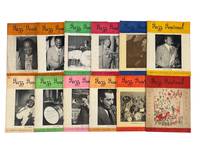
1950réf. 223221950. Complete 1950 run of Jazz Journal Vol. 3 Nos. 1-12. London: L. M. Publications 1950. Complete run of the 1950 volume. Twelve issues with each issue around 20 pages. Black-and-white photo illustrations throughout. Printed paper wraps. Founded in 1948 by editor Sinclair Traill Jazz Journal became a critical platform for serious jazz criticism in Britain at a time when the country began appreciating the impact of African American musical innovation. This volume features twelve monthly issues each spotlighting legendary musicians in deeply reverent portraits: Louis Armstrong Baby Dodds Coleman Hawkins Fats Waller Earl Hines and others. The December cover has a Christmas theme. This archive is a window into Britain's postwar jazz awakening. The articles range from retrospectives to musicology and artist discographies. Floyd Levin's "The American Jazz Scene" captures the transatlantic tone of the journal mourning the death of Buster Wilson and lauding figures like Sidney Anderson and Kid Ory as vanguards of "authentic" jazz-framed as endangered in a postwar America increasingly seduced by commercialism. Meanwhile Derrick Stewart-Baxter's "Preachin' the Blues" traces rural-to-urban migration patterns in blues development analyzing Sleepy John Estes' discography and folk influences. The December issue features a full-page bibliophilic essay "A Case for Books" reviewing A Treasury of the Blues by W. C. Handy whom it names "the composer of the classic Memphis Blues and Joe Turner Blues" emphasizing the book's role in preserving "the true and historical survey of the blues." Taken together the essays discographies and image curation construct a coherent theory of jazz not only as music but as cultural heritage. Moderate and consistent soiling and creasing to wrappers; binding intact but some covers remain delicate. Occasional chipping at spine. Covers remain vivid with strong photographic contrasts. Overall good condition. A complete year's run of one of the earliest and most influential British jazz journals with signatures from leading musicians of the era such as Armstrong Dodds and Hawkins. unknown books
1860réf. 165691860. J. B. Remarks on the Obstacles to the More General Employment of Women and on the Means of Removing Them 1860. First edition of a pamphlet advocating expanded employment opportunities for British women and identifying discriminatory hiring practices opposition from male workers and limited occupational choices as causes of female poverty. Published through the English Woman's Journal a periodical closely associated with the Langham Place circle of women's rights reformers the pamphlet appeared during an organized campaign to open professions and skilled occupations previously reserved for men. Its author directly challenges workplace resistance to female labor: "Women however cannot be employed in England in this manner because of the jealousy of their fellow workmen. If a master were to employ women in any part of the business the whole of his workmen would strike at once." The passage identifies threatened industrial action by male employees as a practical obstacle to women's economic advancement even when employers were willing to hire them. J. B. Remarks on the Obstacles to the More General Employment of Women and on the Means of Removing Them. London: Published at the Office of the English Woman's Journal Company Limited 1860. First edition. 16 pages. Original paper wrappers measuring 8¼ x 5¼ inches. Reprinted from the English Woman's Journal the pamphlet examines barriers preventing women from obtaining sufficient paid employment and proposes measures to expand their opportunities. The author connects occupational exclusion with increasing demands upon public and private charitable institutions: "Workhouses were found to be overcrowded with able-bodies females while charities were besieged with women praying to be provided either with employment or bread." These observations link women's unemployment directly to poverty relief while the discussion of male workers' resistance identifies the exclusionary practices that prevented women from entering better-paid occupations. The pamphlet was published shortly after the establishment of the Society for Promoting the Employment of Women in 1859 an organization associated with Jessie Boucherett Barbara Leigh Smith Bodichon and other members of the Langham Place circle. The Society sought to expand women's access to commercial clerical and skilled employment through vocational training and direct engagement with employers. The pamphlet's discussion of workplace opposition and overcrowded workhouses provides contemporary evidence of the economic conditions these reformers sought to address preceding later campaigns for women's property rights and equal access to professions. Stain to upper left edge of front wrapper toning to final page and light pencil markings in margins. Very good condition. unknown books
1966réf. 214071966. Counterculture Archive of five issues of The Realist the groundbreaking satirical and political magazine founded by Paul Krassner. Known for its radical leftist stance and boundary-pushing commentary The Realist was a critical voice in the countercultural movements of the 1960s blending investigative journalism with dark humor and unflinching critiques of American politics war race relations and the establishment. With contributions from figures such as Robert Anton Wilson Abbie Hoffman and Timothy Leary the publication played a significant role in shaping the political satire of the New Left. Archive includes: 1 The Realist. Issue No. 64 February 1966. Features a striking illustrated cover satirizing American apathy with references to the infamous Kitty Genovese murder the Ku Klux Klan and the House Un-American Activities Committee HUAC. Inside Krassner and his contributors skewer the failures of American justice and political hypocrisy with their signature blend of absurdity and biting critique. This issue exemplifies The Realist's approach to humor as a vehicle for exposing societal failures particularly in race relations and government repression. 2 The Realist. Issue No. 65 March 1966. Includes Robert Anton Wilson's The Fatal Snowball Fight on Cumberland Avenue a darkly humorous piece that examines law enforcement's overreaction to a student snowball fight in Knoxville Tennessee. The article serves as a microcosm of broader societal tensions highlighting the growing rift between youth counterculture and the authoritarian establishment. Other articles in this issue continue The Realist's sharp critiques of the Vietnam War police violence and political paranoia. 3 The Realist. Issue No. 69 September 1966. features one of the magazine's most notable pieces An Impolite Interview with Timothy Leary in which the controversial LSD advocate discusses drug policy consciousness expansion and the First Amendment. This issue also includes The Day the Supreme Court Banned Vaseline a satirical jab at America's obscenity laws and the broader censorship debate as well as Modest Proposals: The Whitey Survival Manual which critiques racial politics in a manner characteristic of The Realist's provocative and often incendiary approach. The cover's headline Lyndon Johnson Loves Nervous Nellie reflects the magazine's ongoing lampooning of the Johnson administration's political anxieties. 4 The Realist. Issue No. 71 November 1966. Provides a prescient discussion of Hollywood's role in politics with the article Remember Next Tuesday: Get Tufts! which speculates on Ronald Reagan's political rise following his election as Governor of California. The cover features a photograph of Reagan highlighting The Realist's scrutiny of the merging of celebrity and political power-a theme that would become increasingly relevant in decades to come. 5 The Realist. Issue No. 72 December 1966. Robert Anton Wilson's The Cybernetic Revolution anticipates the impact of automation and artificial intelligence on society reflecting the counterculture's growing fascination with technology as both a tool of liberation and oppression. Renfreu Neff's Automation and Aberration explores the evolution of sexual mores arguing that traditional notions of deviance and perversion are becoming obsolete in the face of modernity. The issue like many from The Realist blurs the line between genuine inquiry and satirical exaggeration making it both thought-provoking and deeply irreverent. During the 1960s The Realist served as a crucial alternative press outlet for leftist anarchist and countercultural thought. At a time when mainstream media was constrained by Cold War conservatism and corporate control Krassner's magazine became a hub for irreverent unfiltered political satire. The publication targeted institutions such as the military-industrial complex religious orthodoxy and government censorship while also providing a platform for psychedelic culture civil rights and radical activism. All issues are in newsprint format with varying degrees of age toning and edge wear typical of publications of this period. Overall very good condition. An important collection from one of the defining underground publications of the 20th century. unknown books
1970réf. 221271970. FeminismSocialismLaborLGBTQ Underground newspaper Kaleidoscope Milwaukee WI archive of two issues. Vol. 1 No. 7 Oct. 29-Nov. 11 1970; Vol. 3 No. 23 Jan. 15-22 1971. Two original issues from Milwaukee's radical newspaper Kaleidoscope a cornerstone of New Left feminist and countercultural expression in the Midwest. These issues exemplify the intersectional editorial voice of the paper prominently featuring articles on feminist self-determination LGBTQ liberation reproductive autonomy and anti-racist solidarity. The October 29-November 11 1970 issue is especially notable for its explosive front-page headline "OFF SEXIST PIGS!" and its radical feminist manifesto demanding an end to male chauvinism and gender oppression. The text includes direct calls for solidarity among women critiques of workplace discrimination at Harley-Davidson and shout-outs to revolutionary women including Bernadine Dohrn and Angela Davis. Inside readers encounter a full-page satirical parody of the Madison-Milwaukee Bugle-American that mocks local liberal media's co-optation of radical aesthetics alongside critiques of law enforcement welfare policy and censorship. The January 15-22 1971 anniversary issue celebrates four years of Kaleidoscope's publication and centers on both introspection and community engagement. It includes prominent articles such as "OBSTETRICS IN THE WRONG HANDS" which critiques institutionalized misogyny in medical practice and "GAY GUIDE" a resource for Milwaukee's LGBTQ community. A striking article titled "THE EMPEROR'S NEW CLOTHES" explores queer identity and resistance through the lens of Warhol superstar Holly Woodlawn whose image dominates the spread. Elsewhere "faggot faggot faggot" provides a bold reclamation of slurs while analyzing anti-queer violence and legal discrimination. The layout's creative typography and photo-collage aesthetic reflect the underground press's rejection of mainstream journalistic forms. Mild toning to edges with expected brittleness to newsprint; light chipping to spine fold of the earlier issue; both issues remain legible with strong contrast to ink and graphics. Overall very good condition. A powerful primary source capturing the radical ferment of early 1970s Milwaukee this set documents the convergence of feminist queer and anti-authoritarian movements in the heartland-a scarce and potent artifact of Midwest underground publishing. unknown books
1888réf. 224763Vicksburg Miss 1888. FACSIMILE. 1p. printed on verso of floral wallpaper. Folio. Stamped copyright applied for Jan. 1888 on lower margin. Some splitting at old folds. FACSIMILE. 1p. printed on verso of floral wallpaper. Folio. A facsimile of a Confederate wall-paper newspaper printed on the verso of a sheet of wallpaper due to the scarcity of paper. "Compelled to print on one side of the paper only and frequently shorn of advertisements the editor gave to his readers only the military information the local news and occasional quotations from other journals" Brigham. This issue is famous for the note added July 4th at the bottom of the page by just victorious Union soldiers: "Two days bring about great changes. The banner of the Union floats over Vicksburg . this is the last wall paper edition and is excepting this note from the type as we found them. It will be valuable hereafter as a curiousity". Clarence Brigham "Wall-Paper Newspapers of the Civil War unknown books
1868réf. 329Chicago: Root and Cady Publishers 1868. Single issue. 335 x 260 mm. 13 x 10 inches. 8 pp. folded and unopened some light soiling to the paper otherwise very good. Rare musical newspaper published by Ebenezer Toner Root and Chauncy Marvin Cady the leading music publisher's in Chicago before the fire in 1871. The Song Messenger was printed from 1864 to 1871 when the company went bankrupt after the losses caused by the fire. In addition to advertisements for musical instruments lessons and scores this issue contains an "Introductory Course for Congregational Singing" which include instructions for learning Psalm LXVII "Let the People Praise Thee O God Let all the People Praise Thee." Also included is the song Gathering Home music by C. T. Lockwood and lyrics by H. M. Look. Lockwood was prolific song writer producing scores of melodies and marches for Chicago publishers during the 1860 and early 1870's. This issue of The Song Messenger was printed in August 1868 and according to OCLC in known in one copy at the Newberry Library which also holds the April issue of the same year. Knox College in Illinois and the Library of Virginia also hold one issue from the year 1869. Lockwood's Gathering Home was also printed in Western Musical World: A Journal of Music Art and Literature in 1868 by S. Brainard also of Chicago. One copy of this is located at the University of Michigan. 329. Root and Cady, Publishers unknown books
1839réf. 41144Boston. 1839. Volume 2 numbers 3 and 4 of the BOSTON JOURNAL OF NATURAL HISTORY issued in August 1839. A survey of fish in Massachusetts' waters completed as part of a Zoological Survey of Massachusetts. 289-579pp. plus three plates. Later wrappers. In a folding cloth box leather label by James MacDonald. hardcover books
réf. 5300CARIBBEAN TRAVEL JOURNAL. Diary. 101 pages. The Caribbean. c. 1908-9. The handwritten journal belonging to C. B. Benson of Hudson New York. The diary recounts Bensons experience on an organized cruise group visit to Caribbean locations such as St. Thomas Puerto Rico Kingston Jamaica Caracas Venezuela Panama City Panama Port of Spain Trinidad and Martinique. Benson records his experiences in each location including his impressions of the town the locals sights he visited and local travel. He visited forts a school churches a mill a sugar plantation and Carnival celebrations. Benson took his tour during the era of colonial rule the attitudes of which infuse both his experiences and observations. Based on his mention of an earthquake in Kingston Jamaica taking place a year or two before he travelled in 1908 or 1909. St. Thomas where we arrived about 6 A.M. mid morning Jan 26 is one of the Virgin group and we found her framed and frescoed in the principal churches. Columbus in 1493 gave the group of 100 islands rocks andwhich comprise the group. St. Thomas is 13 miles in length and 3 miles in width at its broadest. And I guess we walked the length of it speaking broadly and in the abstract at this distance.The heat of the tropical sun also takes its toll and blurs our ideas of time and distance somewhat. The town of Charlotte Amelia contains 13000 inhabitants merchants and black babies and they are all dressed in their Sunday best to receive us properly.Thursday morning at 8 we went ashore at Porto sic Rico.Returning thro the village streets we stopped at the market place and noticed the display of fruits in baskets a couple of men seated on low stools with blacks in front of them.a native womanwas entertaining us in the middle of the road with a dance.When passing the island of Haiti.Do you know why we do not stop at the Island of Haiti No There are cannibals there there are so many fat people aboard you would lose your wife At St Thomas the American council held open house and received some of us who dared to invade this solitude.An hours railroad ride which was made interesting by stops at every littleand station where the bare legged boy with the oil gun in hand squirted oilbearings sic of the cars and engine. As it was before the 17 miles came to an end the rear axle of the parlor car so called because it had leather covered reclining seats caught fire. But when this happened we were nearly at the end of our journey and we were not delayed much. At the sugar plantation where we detrained we found we had some distance to walk downto the sugar mill. As there was no path and the sticky wet ground to soil made worse by the heavy rain of the night before.A sugar mill is never a clean place.The process is somewhat intricate but way he likened to the process of brewing.The cane piled up in the yard is boiled in a number of vats then is run off with barrels and in a black and solid state in shipped to the Refineries at New York. The fiber of the cane is then hardened and dried and is fed to the furnaces to boilcane. After return to the town San Juan we visited the shops. Walked out to the fort at the entrance of the harbor. The town is excellently policed and paved in the principal streets with telegram blocks.As this day was Thursday we concluded that every day was wash day for the native women and girls who for want of other diversions spend most of their time in this form of dissipation. Even the balconies of the main public street filled with traffic of street cars carriages and drays had their fill of wash some of which are found laying in the street having been carried down by the wind. No one had appropriated it as yet; and we did not add it to our collection of souvenirs. At the officers quarters I applied for a permit of the officer of the day to enter the fort San Cristobal the fort commanding the entrance to the harbor.The fort was like most forts. The high tower gave a commanding view of the town and harbor. Then we visited the Governors Palace. In the Reception Room hanging on opposite sides facing each other are life sized oil paintings of McKinley & Cleveland. In the garden were some large palms tropical ferns a fountain &.Jan 29. early in the morning we were at Kingston in Jamaica. The channel is narrow and tortuous but well Taking a local pilot we soonopposite itof three vessels one of which was the Princess Louise that was caught in the hurricane here three years ago andthe larger of the three vessels was trying to pick up the light from the light house which had been blown down. This destruction of the hurricane.After driving about a mile thru the city the destruction to the buildings & pavements made by the earthquake here a year or two ago half of the city seems to be in ruins and no attempt has been made apparently to rebuild & restore the city. Thousands of lives were lost here at that time which did immense damage to the fruits. Most of the uninhabitable part of the island belongs to the United Fruit Company a Boston Corporation who ships immense quantities of bananas from Port Antonio. Owing to recent destruction by fire of Hotel Litchfield our stop at the port of San Antonio and stay of night at the Hotel was omitted. An excursion across the island by train to Mandeville was arranged in its place.The town of Colon in its principle streets are paved with brick and appear clean. We noticed many buzzards. The air was clear and there was a delightful cool breeze blowing.We stopped at all of the stations going to Panama and noted the wonderful impressions made by the Sanitary Commission. The well ventilated and screened houses. The plan for disposal of garbage the open drainage the cleared landsBut of course the facts are here bug and drain all working to the mutual exclusion of some ideas to the American white employers. Therefore after a few months they must have a reaction in the States toand detach themselves from all absorbing facts. The fighting for life againstfires. Most things arebetween the white employers and the black employees. So we find the White Bar and the Black Bar The White Employees The Silver White Employees &c as signs on the cars intended to carry workmen back and forth from the works.Caracas the capital of Venezuela is about 3000 ft up but the sun in the middle of the day we found very hot.Plaza Bolivar was decorated with rows of colored electric lights. They are preparing for the Carnival season which ushers in Lent in Catholic countries. The market place had counters for dry goods highly colored handkerchiefs etc. Another section was devoted to fruits vegetables etc. We noticed some very large apricots. Mr. Bolivar apparently has done a great deal for his native town. He has given his name while the people furnished the funds for the largest parks a street and the coinage of the plutocrats.The Spaniard theHildago -in his easy subjugation of thepleasure loving tropical savage has replaced the native of simple taste and left in his place the mongrel half-breed with all the vices of the conqueror and none of the virtues of theIndian savage. The diary is in very good condition. It is mostly written in pencil but is quite legible. hardcover books
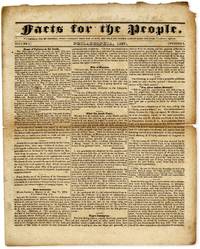
1837réf. 88394Philadelphia: Anti-slavery Society of the City and County of Philadelphia; printed by Merrihew & Gunn 1837. Single quarto issue 29cm x 23cm; ca. 11-1/2" x 9-1/4". Bifolium 4pp pages numbered 9-12. Issued monthly. Old horizontal fold at center as issued; small loss at upper margin away from printed area brief separations at folds without loss to text; complete and Good. Single issue of this very scarce presumably short-lived abolitionist newspaper published by Benjamin S. Jones under the auspices of the Anti-slavery Society of the City & County of Philadelphia. This copy with dated 1864 pencil ownership markings of "J.E. Jones" this possibly being the publisher's spouse the reformer abolitionist and suffragist Jane Elizabeth Jones née Hitchcock; 1816-1896. The paper's contents are devoted almost entirely to exposure of the injustices of the southern slave system with excerpts from Southern papers quoted and sharply rebuked by Jones' editorial comments. This issue also includes a brief notice of the progress of the recently-founded city of Houston Texas which now contained ".about 3000 people two hundred buildings four hotels thirteen retail stores and one wholesale establishment." The extracts quoted in this issue are generally dated from March April and May of 1837 leading us to suggest a May-June date for this issue. It is unclear how many issues of Facts for the People appeared. The only recorded example for a physical copy is at AAS which holds two unspecified issues with the annotation "sparse holdings." Not in LCP Afro-Americana. Not in Blockson. Anti-slavery Society of the City and County of Philadelphia; printed by Merrihew & Gunn unknown books
1813réf. 829801813. Rare Prospectus for a Legal Periodical: Only One Other Copy Known Legal Journal. Williams John of the Inner Temple. The Legal and Literary Journal and Mercantile Magazine. To be Continued Monthly And Number Three to be Published January 1st 1814. Conducted by John Williams Esq. Author of the Laws of Trade and Commerce &c. &c. Assisted by Several Literary and Commercial Gentlemen. London: S.n. circa 1813. 10-1/4" x 8" 26 cm x 20 cm broadside address of recipient and postmark to verso remnants of red wax seal. Moderate toning two horizontal fold lines. A very good copy of a rare item. $350. This is a rare and detailed prospectus for a periodical published under the guidance of John Williams a barrister and author of The Law of Wills and Codicils 1810 The Laws of Trade and Commerce 1812 and A Treatise on the Study and Practice of the Law 1823. Since the prospectus states that issue "Number Three" will be published in January 1814 it may be assumed that two issues had already been printed but today no issues of any date are found in Library Hub OCLC or in major libraries including the British Library or Library of Congress. This prospectus then with its five-part table giving the "Proposed Arrangement" of topics may preserve all that remains of the content and intentions of this serial. The themes of the "Legal Department" included "1. A Copious Epitome of the Decisions in the Courts of Law and Equity as also in the Prize Courts. 2. A Full and Faithful Abridgement of the Public Statutes Immediately on Their Receiving the Royal Signature. 3. Dissertations on Constitutional Subjects. 4. Dissertations on the Various Branches of Law" and 5. Legal Biography. " Rarely will a prospectus state its own print run but this one does: 3000 copies. As we find only one other exemplar in the world at Yale Law School the rarity may be calculated with unusual exactness: the survival rate for copies of this prospectus being one fifteenth of 1%. Yale's catalogue record does not indicate a manuscript address. Ours is addressed on its verso to Robert Thorpe 1771-1847 attorney and Clerk of the Peace in Alnwick Northumberland. There are many extant copies of Williams's treatises. By contrast his periodical The Legal and Literary Journal and its prospectus are his rarest productions by. unknown books
réf. 37131New York: The Hobo News. Unbound. Fair. Undated but marked in pencil November 19 1946. Vol. 6 no. 47. Folded horizontally and very brittle at the folds - a fair only issue of this very uncommon tabloid for hobos. Picture of actress Joanne Dru and others several columns about hobos horse racing. The Hobo News unknown books
1957réf. 223271957. Chinese American newspaper issue The Chinese Journal 美洲日報 published in New York on April 20 1957 offering a rich portrait of midcentury Chinese American life diasporic politics and community organizing during the Cold War era. Issued by the Chinese American World Publishing Corporation and described as "the most progressive intelligent and constructive Chinese daily newspaper in America" the publication served Chinese diaspora readers across the United States particularly on the East Coast providing essential coverage of international relations Chinese nationalist and anti Communist politics immigration developments and the economic life of Chinatown. Entirely printed in Chinese this issue reflects the linguistic and cultural continuity of immigrant communities while also documenting their engagement with global geopolitical tensions especially surrounding U.S. China relations Taiwan and Soviet diplomacy at a moment shaped by McCarthy era anxieties and shifting immigration policy. Vol. 30 No. 93. April 20 1957. Four pages approximately 17 x 22 inches. Headlines include "倫敦決定ç¶æŒèˆ‡è¯è«‡åˆ¤æ”¿ç–" London decides to maintain policy of talks with China reporting on British Prime Minister Harold Macmillan's position on Chinese Communist diplomacy; "美如åå°ä¸æƒœå¬å›žä½¿ç¯€" If the United States opposes it is willing to recall its envoy reflecting U.S. State Department tensions; and "臺備原åé£›å½ˆé˜²è¡›è‡ºåŒ—é ˜ç©º" Taiwan prepares atomic missile defense to protect Taipei airspace capturing fears of mainland Chinese military expansion and Taiwan's strategic alignment with the United States. Additional reporting includes "蘇俄å°å¤–ä¿å¥½å’Œå¹³ç–ç•¥ 游說與æ嚇施併進" Soviet diplomacy mixes peace overtures with threats and coverage of a deadly flood disaster alongside cooperative infrastructure development. The issue also documents local Chinese American community life through notices from organizations such as the Lee Family Association æŽå…¬è¯èª¼æœƒ and advertisements for Chinese owned businesses including China Noodle Co. at 176 Park Row and Jade Florist & Curios at 10 Division Street. The rear page features a full advertising spread with stylized typesetting promoting firms such as United Trading Co. Lun Fat Co. and Quong Yuen Shing & Co. alongside imagery from American President Lines illustrating transnational shipping networks and the economic infrastructure of New York's Chinatown. Newsprint shows minor edge wear and expected brittleness with a horizontal fold small closed tears and light foxing; overall good. A highly uncommon and visually compelling primary source of particular importance to institutional collections focused on Chinese American history immigrant print culture Cold War media and the study of diaspora political consciousness in the twentieth century. unknown books
1855réf. 56140Providence 1855. Folio broadside approx. 15½" x 11" text in double column beneath the running head the whole within a typographic border; some wrinkling but generally very good. First line: "Who knocks a stranger open let him in!" N.Y. Historical and Brown only in OCLC noting a John Miller imprint not present here. unknown books
réf. 4696JAPAN. Diary. January 14 1950 to late 1954. Various places Philadelphia Japan Fort Meade. A lengthy diary of an American officer Lieutenant Louis T. Holtz who was stationed in Japan during the Korean War. It was written on dozens of sheets of loose-leaf notebook pages and it contains many black and white photographs with captions as well as newspaper and magazine cutouts and brochures from places he visited. The diary begins on January 14 1950 in Philadelphia and he discuses seeing shows and such but notes that All in all this constituted a very enjoyable ten days of leave prior to going overseas. Sometimes I wish I could stay at home and live a normal routine life like everyone else. Other times I find myself eager to goAlmost two years ago who could forecast a war in Korea and the manner in which it would rip everyones life to shreds He writes on January 2 1951 from Kurume Japan: perhaps 10 years from now it the diary will be of interest if any of our civilization remains in 1961I collapsed 28 June and spent 3 weeks in the hospital with excessive fatigueI am the Officer-in-charge of the Kurume Office with an area of jurisdiction of approximately 1000 square miles. In April 1951 he mentions I am very busy in my position as OIC Officer In Charge. Its a full 7-day-a-week jobThe Korean mess has everyone guessing as to eh future of the Far Eastbeing the senior official in an area of jurisdiction of nearly 10000 square miles with dozens of mayors and police chiefs constantly catching my every word as official. The next couple dozen pages contain black and white photographs of protests in Japan and Holtzs commentary about the images including When people get hurt propaganda fills the air. The winner: the Kremlin always! Demonstrations take planning and people. You can always be sure the plans were framed in red and the spectators sprinkled liberally with dye-hard communist stooges Demonstrations & rallies are usually fantastically well organized. And as often as not they can be unbelievably orderly and But orderly or violent you can always be sure there is a professional communist keeping the sheep in line or arousing them to maximum fury. In September 1951 Holtz writes from Sapporro life in the Armed Services has been a miserable one because of one bad experience after anotherKurume was one of the most pleasant and enjoyable assignments I ever held. The 45th was without doubt the most bitter and least enjoyable. I gave up so much for so little. Holtz was in Californias Camp Stoneman in November 1951: with all the hundreds of officers here not particularly anxious to go overseas and with several actually fighting the assignment I was amazed to find that someone eager to return is sidetracked so abruptly. He was back in Japan by December and then wrote a lengthy entry entitled The Korean Story starting with Combat precautions make it mandatory that no diaries or personal papers be kept where they may fall into enemy hands and he spends the next seven pages describing his experiences in the Korean War. Holtz wrote in part: Things had not gone well at all with Trubotas unit prior to August 1951. After my arrival working results proved very satisfactoryThree other officers has also joined up in the interim between leaving Sapporo and going to KoreaWhen oriented in Tokyo they were told that the 45th Detachment would remain in Sapporo and they had already alerted their families to start to prepare to join them overseasI had to fight Trubota in order to be able to fight the enemy. In one occasion I was reprimanded for going to a forward observation post and not being personally available to answer the telephone at my CP and the section finishes with a photograph of the USS Marine Lynx the ship that brought him home. The diary continues with his being stationed at Marylands Fort Meade. There are photographs of the mansion he occupied in Kyushu Japanese women at the beach his fellow soldiers after a bowling tournament etc. There are Samples of United Nations propaganda leaflets dropped on North Korean positions early in the Korean conflict that show Truman and MacArthur a December 7 1950 letter signed by the mayor of Kurume City Japan. The condition is fine to very fine. unknown books
1967réf. 206701967. African American Education Archive of five issues of The Journal of Negro Education: A Quarterly Review of Problems Incident to the Education of Negroes published by The Howard University Press for the Bureau of Educational Research Washington D.C. between 1967 and 1973. Original printed blue wrappers. Founded in 1932 by educator and psychologist Charles Henry Thompson the first African American to earn a doctorate in educational psychology and later Dean of Howard University's School of Education the journal became one of the most influential scholarly publications devoted to the study of Black education in the United States. Established during the era of Jim Crow segregation and continuing through the Civil Rights and Black Power movements the journal sought to collect and disseminate research on the education of African Americans critically evaluate educational policies and practices and encourage scholarly investigation into issues affecting Black students and communities. By the 1960s and 1970s it had become a leading forum for examining school desegregation educational inequality Black identity poverty higher education and the social consequences of racial discrimination. The archive includes five substantial issues published during a transformative period in American education and race relations: Winter 1967 Vol. XXXVI No. 1. Articles include Some Effects of Deprivation on Intelligence Achievement and Cognitive Growth; Notes on the Education of Negroes in North Carolina During the Civil War; The Negro Undergraduate Student: Factors Relative to Performance in Predominantly White State Colleges and Universities in Tennessee; and Beyond Poverty of Income. Published amid the national debate surrounding the War on Poverty and educational inequality. Spring 1967 Vol. XXXVI No. 2. Features studies on school improvement unemployment emotional development among Black youth and contemporary trends in Black education reflecting growing concern over urban poverty and unequal educational opportunity. Summer 1967 Vol. XXXVI No. 3. The annual Yearbook Number devoted to The Higher Education of Negro Americans: Prospects and Programs. Essays examine graduate education the role of predominantly white institutions in educating Black students educational opportunity and the experiences of Black college students in the South. Issued during a period of rapidly expanding college enrollment and increasing demands for equal access to higher education. Fall 1969 Vol. XXXVIII No. 4. Published in the aftermath of major civil rights legislation and amid widespread school desegregation efforts. Articles analyze academic desegregation interracial attitudes among college students self-concept among Black and white youth in segregated environments and methodological questions surrounding social science research on race. Winter 1973 Vol. XLII No. 1. Reflecting the intellectual climate of the Black Power era this issue includes studies such as Differences Between Black Youth Who Support the Black Panthers and the NAACP; Do Black Studies Make a Difference in Ghetto Children's Achievements and Attitudes; The Children of Immigrants in the Schools; and School Desegregation Socioeconomic Status Sex and the Aspirations of Negro Adolescents. The issue captures scholarly efforts to evaluate the impact of Black Studies programs and evolving forms of Black political and educational activism. Taken together these volumes document some of the most significant debates in twentieth-century African American educational history including segregation and desegregation educational deprivation Black identity formation civil rights Black Power access to higher education and the continuing struggle for educational equality. The contributors represent a generation of educators psychologists sociologists and policy researchers whose work helped shape both academic scholarship and public discussion of race and education in the United States. Light fading to wrappers primarily along spines and edges with minor staining and handling wear. Bindings remain sound and contents clean. Overall very good condition. An important scholarly archive documenting the evolution of Black educational thought during the Civil Rights and Black Power eras. unknown books
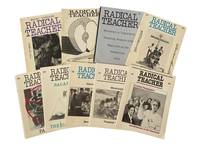
1981réf. 223841981. SocialismLaborFeminismEducation Nine-issue archive of Radical Teacher a socialist and feminist journal devoted to theory and practice in education spanning the 1980s and early 90s. These issues capture a generation of leftist educators and scholars responding to U.S. imperialism apartheid racism sexism and structural inequality through pedagogical critique. The archive foregrounds writing by and about women and people of color particularly Black feminist educators women's studies pioneers and anti-racist activists in academia. Contributors include Sharon Dean Erlene Stetson Sara Freedman Cynthia Kinnard and Becky Thompson among others .Archive includes: 1 Radical Teacher No. 18 Spring 1981. Focuses on feminist teaching and women's studies. Opens with "Flower-Dust and Springtime: Harlem Renaissance Women" by Sharon Dean and Erlene Stetson-a rare educational examination of Zora Neale Hurston Georgia Douglas Johnson and other Black women writers. Essays include feminist teaching guides course design and critical reflections on pedagogy by and for women. Contributors include Nancy Schniedewind Cynthia Kinnard Berenice Fisher and Jean Robinson. Light edgewear. 2 Radical Teacher No. 21 1982. Issue theme: anti-imperialism and critical pedagogy. Features teaching on Nicaragua and essays on apartheid women college students and the return of the draft. Of special note is Renate Duelli-Klein's "Women College Students and Feminism" an intersectional analysis of women's shifting relationship to institutional politics. Also includes coverage of South African resistance and PACE Progressive Adult and Continuing Education. Moderate edge wear else clean. 3 Radical Teacher No. 32 Spring 1987. A cluster on women and labor in socialist Eastern Europe including "Education in Yugoslavia" and Madonne Miner's "Another Women's Play Doesn't That Make Like Number 6"-a critique of the marginalization of women's theatrical texts in English curricula. Also includes discussions of Simone de Beauvoir Fred Ho and Croom Helm and Cold War pedagogy. Light wear very good. 4 Radical Teacher No. 35 Summer 1988. Theme: Christianity and education. Articles examine radical Christianity teaching religion critically and confronting fundamentalism in schools. Notable contributions include Kathleen Sands on religion in the university and Caroline Zinsser on biblical literalism. While not a themed feminist issue several authors critique patriarchy in religious education. Minor corner crease. 5 Radical Teacher No. 36 1989. Family and education theme. Articles include Sara Freedman's "To Love and to Work" on the double burden of women teachers and mothers and Ynestra King's "Family Secrets" on teaching domestic violence. The issue challenges traditional conceptions of the nuclear family through a feminist lens. Excellent feminist scholarship by and about women. Light wear to spine. 6 Radical Teacher No. 37 1989. Theme: balancing the curriculum. Focuses on race gender and class integration in U.S. syllabi. Includes a collective essay by Marie Buncombe and Dorothy O. Helly on curriculum transformation and a review of Women Teaching for Change. Particularly rich in content on BIPOC authors and inclusive pedagogy. Near fine. 7 Radical Teacher No. 38 1990. Special issue on Mississippi Freedom Schools. Includes Charles Cobb Liz Fusco and Jimmy Garrett on education in the 1964 Freedom Summer with facsimiles of original curricula and poetry. Features Susan O'Malley's tribute to Myles Horton. An essential issue for those studying African American education SNCC pedagogy and movement schooling. Excellent condition. 8 Radical Teacher No. 40 1991. Issue on education and revolution. Focuses on Nicaragua Cuba Palestine and apartheid-era South Africa. Judy Brady's "Why Do Cuban Children Learn" and Ellen Fleischmann's "Education in the West Bank" are standout articles. Centers anti-imperialist and decolonial education frameworks. Light wear to fore-edge. 9 Radical Teacher No. 41 1992. Feminist Pedagogies and Difference in the Classroom. A landmark issue featuring Becky Thompson and Signe Disch on anti-oppression teaching Sarah Napier on elementary-level women's studies and Ruth Hsiao's guide to teaching Asian American literature. Noteworthy for its intersectional focus and diverse author pool including multiple women of color educators. Near fine. Overall condition very good with light handling wear and some edge toning. A rich pedagogical archive documenting the intersections of feminism socialism anti-racism and education in late 20th-century activist scholarship. unknown books
1881réf. NF3702THE ART JOURNAL NEW SERIES J. S. Virtue & Co. Lim. 1881 first edition 380 pages some wear to the bottom board edges and fore edge corner tips some flaking to the bottom edge of the spine else a tight solid vg copy bound in green half leather and like pebbled cloth with marbled end-papers and near fine contents containing 12 etchings; 12 steel engravings; 8 facsimiles; 4 steel engravings from sculpture and 1 colored illustration each with original tissue guard not to mention 100's of fine illustrations with the text. We cannot locate any institutional holdings of this item. J. S. Virtue & Co., Lim. hardcover books
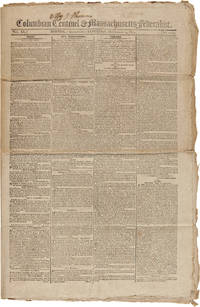
1803réf. 8213Boston. November 5 1803 and June 28 1809. With News of the Louisiana Purchase The earlier issue includes a brief biography of Lucien Bonaparte and various political notices most importantly regarding the negotiations for the Louisiana Purchase its constitutional ramifications for the United States and the reluctance of Spain to recognize the sale of the territory by France to the United States. News of the purchase had become public on October 17. On November 30 Spain formally delivered the colony to the French colonial prefect who transferred the territory to William Claiborne and General Wilkinson the American commissioners on December 20. Vol. XL No. 2048 and Whole No. 2633. Two issues 4pp. each. Folio newspaper. Tanned old folds old ink signature and some wrinkling. Good. BRIGHAM I pp.277-79. unknown books
1988réf. 223411988. Baim Tracy ed. Outlines: The Voice of the Gay and Lesbian Community archive 1988 to 1992 documents Chicago LGBTQ journalism during the AIDS crisis the expansion of queer community media and the intensification of legal cultural and political struggles over gay and lesbian public life. Tracy Baim co-founded Outlines in 1987 after co-founding Windy City Times in 1985 and contemporary accounts describe Outlines as part of a competitive and consequential Chicago LGBTQ newspaper environment that helped record local and national movement history. These issues show the cultural sphere of LGBTQ community journalism through interviews protest photography AIDS coverage lesbian conference reporting arts criticism legislative updates and international news offering insight into how queer periodicals connected Chicago readers to national politics women's culture legal advocacy and media representation. Outlines: The Voice of the Gay and Lesbian Community. Chicago: Lambda Publications 1988 to 1992. Five issues. Archive of five issues from Vol. 2 Nos. 4 and 7; Vol. 4 No. 12; and Vol. 5 Nos. 6 and 8 with visible contents including feature interviews community news protest reporting arts coverage AIDS-related material legal updates and national and international LGBTQ news. 1 Baim Tracy ed. Outlines: The Voice of the Gay and Lesbian Community. Vol. 2 No. 4. Chicago: Lambda Publications 1988. The September 1988 issue carries the headline "Michigan Fest" and centers a report on the Michigan Womyn's Music Festival with additional coverage of an AIDS benefit hosted by Circus Vargas Lily Tomlin and Robin Tyler performances activism against a state AIDS bill protest at the Republican National Convention and a profile of author John Rechy. The issue is especially useful for documenting lesbian cultural space AIDS-era benefit work electoral protest and queer literary visibility within one Chicago-based periodical. 2 Baim Tracy ed. Outlines: The Voice of the Gay and Lesbian Community. Vol. 2 No. 7. Chicago: Lambda Publications 1988. The December 1988 issue features "Torch Song Trilogy-An Interview with Harvey Fierstein" and includes coverage of gay and lesbian choruses queer bookstores LGBTQ representation at Carnegie Hall holiday community programming and World AIDS Day reflections. Its contents place queer performance memorial practice and community institutions within the same field of coverage. 3 Baim Tracy ed. Outlines: The Voice of the Gay and Lesbian Community. Vol. 4 No. 12. Chicago: Lambda Publications 1991. The May 1991 issue headed "3000 at Lesbian Confab" covers a major gathering of lesbian leaders includes an interview with Christie Hefner reports on plans for a Chicago LGBTQ community center and includes global LGBTQ coverage state legislative updates and a section for Asian American Heritage Month. The issue documents lesbian organizing community infrastructure international attention and race-conscious editorial programming. 4 Baim Tracy ed. Outlines: The Voice of the Gay and Lesbian Community. Vol. 5 No. 6. Chicago: Lambda Publications 1991. The November 1991 issue uses the cover title "Victims No More" and documents protests against Cracker Barrel's anti-gay hiring practices and California's veto of gay-rights legislation with a cover image of queer activists confronting authority. Contents include "Dykes Take the Capitol" visuals an interview with Lily Tomlin and legal coverage of Chicago Police Department accountability rulings and internal discipline decisions in a gay case placing street protest lesbian direct action celebrity interview and police accountability in direct relation. 5 Baim Tracy ed. Outlines: The Voice of the Gay and Lesbian Community. Vol. 5 No. 8. Chicago: Lambda Publications 1992. The January 1992 issue headed "World Review: Victories and Setbacks Marked a Momentous 1991" includes coverage of the Thompson/Kowalski guardianship victory international LGBTQ repression including Russia setbacks for LGBTQ political appointments in Chicago Gloria Steinem's Revolution from Within interviews with Dick Sargent and Joe Keenan and legal action against Cracker Barrel. The retrospective format shows how Outlines framed a single year through law family recognition international repression feminism popular culture and workplace discrimination. Mild handling wear age toning to newsprint and creasing consistent with circulation and storage very good overall. Concentrated AIDS-era and early 1990s LGBTQ press archive preserving Chicago-based coverage of lesbian organizing queer cultural production legal rights struggles anti-discrimination protest police accountability and national and international movement news. unknown books
1913réf. 1266351913. Ireland: June 16-18 1913. Small lined notebook 11x17.5 cm 56 pp. orange card covers titled by hand spine reinforced with tape. Approx. 28 pages filled with neat ink manuscript entries illustrated with four small original sepia photos and a hand-drawn folded map tipped to inside of front cover. Covers a little worn contents age-toned but entirely legible. § A delightfully detailed record of an amusingly rushed school trip to Ireland made by an English schoolboy in 1913. The boys and several masters departed from Stonehouse in Gloucestershire it seems likely they attended Wycliffe College prep school and travelled by train to Fishguard in Wales and from there by boat to Rosslare Harbour in Country Wexford Ireland. Then by train char-a-banc a governess cart ponies and finally boats they tore across the south of Ireland to Killarney and back in a single day. The dutiful author of the journal prepares for the trip with several lists: "General time-table" "List of required articles" including "change of socks.cup soup-plate. rug if room" "Things to be noticed" Waterford Harbour Mountains Lakes Cattle Grazing. and a very thorough plan for "Meals" cornflakes chocolate bananas squashed fly biscuits. The journal itself is neatly written and full of detail particularly of the various vehicles Irish trains get a thorough review and his glimpses of "real Ireland". Four small mounted photos show a bridge in Kerry viewed from a boat Ross Castle "A Jaunting Bar" a kind of horse-drawn carriage and happily "the Author" who appears to be in his early teens. The star of the journal is a large folding map of the trip carefully hand-drawn and keyed and mounted inside the front cover. unknown books
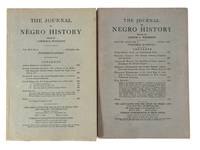
1931réf. 217891931. Woodson Carter Godwin. The Journal of Negro History. Archive of two significant issues published in 1931 and 1938 documenting the institutional growth and expanding scholarly scope of African American historiography during the interwar period. The material records Black intellectual production historical scholarship and diasporic research through the editorial and publishing activities of the Association for the Study of Negro Life and History founded by Carter G. Woodson and Jesse E. Moorland in 1915. These issues include scholarship on slavery Reconstruction Black religious institutions international colonial politics abolitionist movements and urban Black life at a time when Black scholarship remained marginalized within predominantly white academic institutions. The journal served as one of the principal vehicles through which Black historians circulated archival research fostered interdisciplinary inquiry and established African American history as a formal academic field. The archive provides primary-source evidence for the maturation of Black historical studies and diasporic intellectual thought in the early twentieth century. Woodson Carter Godwin ed. The Journal of Negro History. Lancaster PA and Washington D.C.: The Association for the Study of Negro Life and History 1931 and 1938. Two issues in publisher's printed wrappers comprising Vol. XVI No. 4 October 1931 and Vol. XXIII No. 2 April 1938. Each issue measures approximately 10 x 6.5 inches and contains 125 and 144 pages respectively. 1 Vol. XVI No. 4 October 1931. Includes Eugene Portlette Southall's "The Attitude of the Methodist Episcopal Church South Toward the Negro from 1844 to 1870" examining racial theology and denominational policy during and after slavery. Rayford W. Logan contributes "The Anglo-Egyptian Sudan a Problem in International Relations" an early analysis of colonial governance and African international politics anticipating his later work in Pan-African and diplomatic studies. Leo H. Hirsch Jr.'s extensive "The Negro and New York 1783 to 1865" surveys slavery free Black life and antislavery politics in New York before the Civil War. The issue concludes with organizational reports and a memorial tribute titled "The Passing of George W. Cook." 2 Vol. XXIII No. 2 April 1938. Opens with Benjamin Quarles's "The Breach Between Douglass and Garrison" reassessing the political and ideological divide between Frederick Douglass and William Lloyd Garrison within abolitionist movements and Black political organizing. Charles H. Wesley contributes "The Abolition of Negro Apprenticeship in the British Empire" situating emancipation and labor reform within broader imperial and diasporic contexts. Anthropologists Hortense Powdermaker and Joseph Semper examine labor and education patterns among African Americans in Connecticut through "Education and Occupation among New Haven Negroes" while Waldemar Westergaard's "A St. Croix Map of 1796" analyzes plantation geography and Caribbean slavery through archival cartographic evidence. The issue additionally contains scholarly reviews in English and French reflecting the journal's international intellectual orientation. These issues record the widening methodological and geographic range of African American scholarship during the interwar years when Black historians connected local histories of slavery and segregation to international questions of empire labor abolition and diasporic identity. The journal's interdisciplinary composition includes historical research anthropology political analysis religious studies and archival geography within a single scholarly forum. Contributions by Rayford Logan Benjamin Quarles Charles H. Wesley and Hortense Powdermaker reflect the emergence of scholars and allied researchers who reshaped twentieth-century understandings of African American and diasporic history. Minor edgewear and faint toning to wrappers with light handling wear; overall very good condition. A pair of interwar issues documenting the consolidation and internationalization of early African American historical scholarship. unknown books
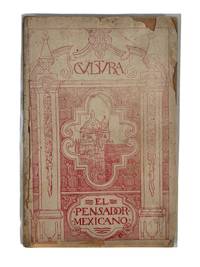
1918réf. 216641918. González Obregón Luis. El Pensador Mexicano: Diálogos sobre cosas de su tiempo sacados del olvido 1918 returns José Joaquín Fernández de Lizardi's reformist literary persona to circulation during the post-revolutionary reconstruction of Mexican historical memory. González Obregón a historian and chronicler of Mexico City selected and presented dialogues associated with "El Pensador Mexicano" Lizardi's influential pseudonym using early republican and nineteenth-century commentary to address national identity civic criticism and cultural inheritance. The issue belongs to Mexican literary-historical culture illustrating how post-revolutionary editors used earlier political writing to recover models of social critique and public intellectual life. González Obregón Luis. El Pensador Mexicano: Diálogos sobre cosas de su tiempo sacados del olvido. México: Cultura 1918. First edition. T. VI Núm. 6. Portada de Valerio Prieto. 78 pages and one leaf. Original printed wrappers with red architectural cover design incorporating Mexico City's Metropolitan Cathedral 8vo. Bibliographic records identify the work as part of the Cultura series and note Valerio Prieto's cover while Stanford records the imprint as México: Typ. Murguía 1918. The wrappers' cathedral imagery links the publication visually to Mexico City's colonial and national past while the text's title "sacados del olvido" states its recovery project directly. Published in 1918 during the unsettled years following the Mexican Revolution and the 1917 Constitution the issue participates in a broader effort to define Mexican civic culture through historical recovery rather than through contemporary polemic alone. González Obregón's treatment of Lizardi places journalism dialogue and moral criticism within a lineage of Mexican public letters useful for studying post-revolutionary literary nationalism and the preservation of nineteenth-century intellectual traditions. Covers heavily worn with edge chipping significant loss to upper right and lower margins and spine creasing; interior pages browned but intact with foxing and minor corner wear; good. A fragile Cultura-series issue connecting post-revolutionary Mexican historical consciousness with the legacy of Lizardi's public criticism. unknown books
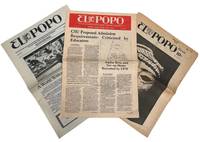
1970réf. 230841970. El Popo student newspaper archive 1970-1991 documents the sustained role of Chicano student journalism as an organizing instrument within the Movimiento Estudiantil Chicanx de Aztlán MEChA network and the broader Chicano Movement. Founded in 1970 by students responding to the absence of Chicana and Chicano perspectives in mainstream media El Popo functioned as a political communication system linking campus activism to labor struggles electoral politics and community-based organizing. The publication's name drawn from the volcano Popocatépetl signaled an explicitly militant and mobilizing ethos aligned with movement-era consciousness. Across the archive coverage of United Farm Workers activity anti-Proposition 38 organizing around bilingual ballots urban displacement and police brutality establishes the newspaper as a primary source for grassroots political discourse while the 1991 issue extends this framework into global and late-Cold War contexts through coverage of the Gulf War AIDS crisis awareness and transnational cultural production. 1 El Popo. Vol. 1 No. 1. Northridge CA: M.E.Ch.A./California State University Northridge November 1970. Early foundational issue produced at the height of the Chicano Movement situating student activism within labor struggles and community resistance. Coverage includes United Farm Workers organizing boycotts arrests and critiques of institutional racism alongside poetry and personal accounts that articulate emergent Chicano political identity. 2 El Popo. Northridge CA: M.E.Ch.A./CSUN March 1985. Mid-period issue reflecting the institutionalization of Chicano Studies and continued student activism. Articles address urban development displacing Latino families police brutality and "tokenism" demonstrating the persistence of structural critiques into the 1980s. The issue maintains bilingual engagement and integrates literary expression with political reporting. 3 El Popo. Vol. 25 No. 1. California State University Northridge Spring 1991. Eight-page tabloid-format issue produced through the Chicana and Chicano Studies Department. Lead article "A World Without Fear" documents Judith F. Baca's World Wall project with front-page caption: "Soviet woman worker prepares the Gorky Park site for the World Wall Exhibition 1990." Additional content includes "An Ecological Disaster" on the Persian Gulf War "AIDS CRISIS AWARENESS" and "Sí Se Puede - Young Latina Forum" alongside a "Poesía" section featuring works such as "Brown Hope" "1990: 20 years since the Chicano Moratorium. Away from the spotlight; little access to a dream" and "A Chicano Will Die Today" by Manuel Castro reprinted from Somos Raza. Layout demonstrates the alternative press practice of embedding political meaning through visual and textual juxtaposition. Three issues total spanning 1970 to 1991 each measuring approximately 11.5 x 16 inches and printed in tabloid newspaper format with bilingual English and Spanish content. The archive traces the evolution of Chicano student press from movement-era militancy through institutional continuity and into late 20th-century global and public health discourse. Newsprint exhibits age toning expected horizontal folds and minor edge wear consistent with student-produced distribution; all issues remain legible with strong textual clarity. Overall condition very good. The archive provides longitudinal evidence of how Chicano student newspapers functioned as durable infrastructures of political communication sustaining activism across decades of shifting social and geopolitical conditions. unknown books
réf. 25582EXPOSITION - LONDON - 1851 THE ART JOURNAL. ILLUSTRATED CATALOGUE. THE INDUSTRY OF ALL NATIONS 1851. London: The Art Journal 1851. Folio. Publisher's gilt calf spine and tips. xxvi 328 xvi viii xxii viii viii pages. First edition. Exhibition catalogue with hundreds of engravings and articles on science by Robert Hunt textiles by Lewis D.B. Gordon the exhibition itself by Ralph Wornum plants and agriculture by Edward Forbes and color by Mrs. Merrifield. Very good. unknown books