JOURNAL DE GENEVE 89e anneeBiblio.com
6 329 résultats
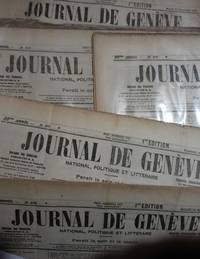
1918réf. 138439Genève 1918. Board Book. Livre en français. Couverture rigide. 91 quotidiens. 35 x 52 cm. 6 à 8 pages. Rousseurs. Petits défauts quelques plis fatigués. Marges brunies. ref. 138439 Genève unknown
réf. 5L1482Philipon Paris 1865. Insgesamt 416 Seiten mit Zeichnungen von Baric Bertall Beyle Cham Darjou Daumier Denoue Grévin Grostiaux Pétit Pelcoc Randon René Stop und Vernier Halbleder-Einband der Zeit folio ca. 30 x 43 cm etwas berieben und fleckig/eine Einbandkante mit kleinem Randausbruch. - sonst gutes Exemplar / "Le Journal pour Rire" wurde als Wochenzeitschrift am 5. 2. 1848 von dem Verleger Charles Philipon gegründet. 1856 wurde es in "Journal amusant" umbenannt und bestand unter diesem Namen bis 1928. "Le Journal pour Rire" und "Le Charivari" waren als Geschwister anzusehen. Sie hatten in der Regel denselben Chefredakteur und dieselben Zeichner. 1856 wurde zusätzlich das "Petit Journal pour rire" als Prämie für die Jahresabonnenten des Charivari gegründet / Anbei ein Verzeichnis der Künstler und dessen Zeichnungen 3 Blatt - unknown
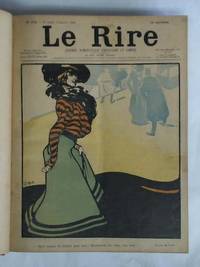
réf. 5L3313Félix Juven Paris 1902. Insgesamt ca. 588 illustrierte Seiten mit colorierten Titelseiten im Halbleinen-Einband mit silbergeprägtem Rückentitel quart die Blätter geringfügig gebräunt/teils etwas eng beschnitten. - Die Zeitschrift "Le Rire" das Gelächter wurde 1894 von Félix Juven gegründet der auch "La vie illustrée" herausgab. Sie erschien jeden Samstag und trieb nach einem Wort von Gustave Flaubert besonders in den Jahren bis zum ersten Weltkrieg 'die allgemeine Schweinerei wie in den Tagen von Bouvard und Pécuchet'. "Le Rire" demaskierte die "falschen Ärsche" von Politik und Gesellschaft und sparte die Kleinbürger dabei nicht aus. Dabei ist es heuzutage eine Banalität von der "Belle Epoque" zu sprechen und dabei zu vergessen daß diese Zeit nur für einige Zeitgenossen schön war. "Le Rire" beschäftigte die besten Zeichner der Zeit wie Toulouse-Lautrec Félix Vallotton Steinlein Forain Léandre der den Gotha du Rire erfand Caran d'Ache Charles Veber Charles Huard Rabier Abel Faivre Roubille Lucien Métivet um nur die bekanntesten unter ihnen zu nennen. Es gibt Karikaturen von Leandre die in ihrer Schärfe und Unversöhnlichkeit an die Arbeiten von Daumier erinnern / Vergl. Georg Pilz. Geschichte der Europäischen Karikatur Berlin 1976 / Text französisch - unknown
réf. 6i3441Bureau du Petit Courrier des Dames Paris 1832. Seiten 169-288 und 168 Seiten mit je 1 Titel und mit 43 koloriarten Kupferstichen reich goldgeprägter Original-Halbledereinband etwas berieben / Kapitale ausgebrochen und fleckig / einige Stempel am Seitenrand. - Colas 2216. Hiler 703. Lippheide ZB 32. Sehr schöne Kupfertafeln im zeitgenössischem Kolorit/ gestoch-Wappenexlibris der Familie "Roschab" auf Vorsatz - unknown
réf. SONG0397010303Used: Good unknown
réf. DADAX0538435240New unknown
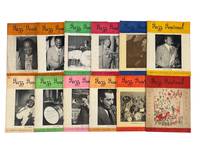
1950réf. 223221950. Complete 1950 run of Jazz Journal Vol. 3 Nos. 1-12. London: L. M. Publications 1950. Complete run of the 1950 volume. Twelve issues with each issue around 20 pages. Black-and-white photo illustrations throughout. Printed paper wraps. Founded in 1948 by editor Sinclair Traill Jazz Journal became a critical platform for serious jazz criticism in Britain at a time when the country began appreciating the impact of African American musical innovation. This volume features twelve monthly issues each spotlighting legendary musicians in deeply reverent portraits: Louis Armstrong Baby Dodds Coleman Hawkins Fats Waller Earl Hines and others. The December cover has a Christmas theme. This archive is a window into Britain's postwar jazz awakening. The articles range from retrospectives to musicology and artist discographies. Floyd Levin's "The American Jazz Scene" captures the transatlantic tone of the journal mourning the death of Buster Wilson and lauding figures like Sidney Anderson and Kid Ory as vanguards of "authentic" jazz-framed as endangered in a postwar America increasingly seduced by commercialism. Meanwhile Derrick Stewart-Baxter's "Preachin' the Blues" traces rural-to-urban migration patterns in blues development analyzing Sleepy John Estes' discography and folk influences. The December issue features a full-page bibliophilic essay "A Case for Books" reviewing A Treasury of the Blues by W. C. Handy whom it names "the composer of the classic Memphis Blues and Joe Turner Blues" emphasizing the book's role in preserving "the true and historical survey of the blues." Taken together the essays discographies and image curation construct a coherent theory of jazz not only as music but as cultural heritage. Moderate and consistent soiling and creasing to wrappers; binding intact but some covers remain delicate. Occasional chipping at spine. Covers remain vivid with strong photographic contrasts. Overall good condition. A complete year's run of one of the earliest and most influential British jazz journals with signatures from leading musicians of the era such as Armstrong Dodds and Hawkins. unknown
réf. DADAX9586145425New unknown
réf. DADAX0130185647New unknown
réf. DADAX1840642831New unknown
réf. DADAX0521833000New unknown
1877réf. ZB393070Commerce Printing and Publishing House 1877. Volumes 2-8 an uninterrupted run of complete volumes partly bound library markings textually clean & tight price is for the lot. - If you are reading this this item is actually physically in our stock and ready for shipment once ordered. We are not bookjackers. Buyer is responsible for any additional duties taxes or fees required by recipient's country. Photos available upon request. Commerce Printing and Publishing House unknown
réf. DADAX000255710XNew unknown
réf. DADAX0198130023New unknown
1860réf. 165691860. J. B. Remarks on the Obstacles to the More General Employment of Women and on the Means of Removing Them 1860. First edition of a pamphlet advocating expanded employment opportunities for British women and identifying discriminatory hiring practices opposition from male workers and limited occupational choices as causes of female poverty. Published through the English Woman's Journal a periodical closely associated with the Langham Place circle of women's rights reformers the pamphlet appeared during an organized campaign to open professions and skilled occupations previously reserved for men. Its author directly challenges workplace resistance to female labor: "Women however cannot be employed in England in this manner because of the jealousy of their fellow workmen. If a master were to employ women in any part of the business the whole of his workmen would strike at once." The passage identifies threatened industrial action by male employees as a practical obstacle to women's economic advancement even when employers were willing to hire them. J. B. Remarks on the Obstacles to the More General Employment of Women and on the Means of Removing Them. London: Published at the Office of the English Woman's Journal Company Limited 1860. First edition. 16 pages. Original paper wrappers measuring 8¼ x 5¼ inches. Reprinted from the English Woman's Journal the pamphlet examines barriers preventing women from obtaining sufficient paid employment and proposes measures to expand their opportunities. The author connects occupational exclusion with increasing demands upon public and private charitable institutions: "Workhouses were found to be overcrowded with able-bodies females while charities were besieged with women praying to be provided either with employment or bread." These observations link women's unemployment directly to poverty relief while the discussion of male workers' resistance identifies the exclusionary practices that prevented women from entering better-paid occupations. The pamphlet was published shortly after the establishment of the Society for Promoting the Employment of Women in 1859 an organization associated with Jessie Boucherett Barbara Leigh Smith Bodichon and other members of the Langham Place circle. The Society sought to expand women's access to commercial clerical and skilled employment through vocational training and direct engagement with employers. The pamphlet's discussion of workplace opposition and overcrowded workhouses provides contemporary evidence of the economic conditions these reformers sought to address preceding later campaigns for women's property rights and equal access to professions. Stain to upper left edge of front wrapper toning to final page and light pencil markings in margins. Very good condition. unknown
1966réf. 214071966. Counterculture Archive of five issues of The Realist the groundbreaking satirical and political magazine founded by Paul Krassner. Known for its radical leftist stance and boundary-pushing commentary The Realist was a critical voice in the countercultural movements of the 1960s blending investigative journalism with dark humor and unflinching critiques of American politics war race relations and the establishment. With contributions from figures such as Robert Anton Wilson Abbie Hoffman and Timothy Leary the publication played a significant role in shaping the political satire of the New Left. Archive includes: 1 The Realist. Issue No. 64 February 1966. Features a striking illustrated cover satirizing American apathy with references to the infamous Kitty Genovese murder the Ku Klux Klan and the House Un-American Activities Committee HUAC. Inside Krassner and his contributors skewer the failures of American justice and political hypocrisy with their signature blend of absurdity and biting critique. This issue exemplifies The Realist's approach to humor as a vehicle for exposing societal failures particularly in race relations and government repression. 2 The Realist. Issue No. 65 March 1966. Includes Robert Anton Wilson's The Fatal Snowball Fight on Cumberland Avenue a darkly humorous piece that examines law enforcement's overreaction to a student snowball fight in Knoxville Tennessee. The article serves as a microcosm of broader societal tensions highlighting the growing rift between youth counterculture and the authoritarian establishment. Other articles in this issue continue The Realist's sharp critiques of the Vietnam War police violence and political paranoia. 3 The Realist. Issue No. 69 September 1966. features one of the magazine's most notable pieces An Impolite Interview with Timothy Leary in which the controversial LSD advocate discusses drug policy consciousness expansion and the First Amendment. This issue also includes The Day the Supreme Court Banned Vaseline a satirical jab at America's obscenity laws and the broader censorship debate as well as Modest Proposals: The Whitey Survival Manual which critiques racial politics in a manner characteristic of The Realist's provocative and often incendiary approach. The cover's headline Lyndon Johnson Loves Nervous Nellie reflects the magazine's ongoing lampooning of the Johnson administration's political anxieties. 4 The Realist. Issue No. 71 November 1966. Provides a prescient discussion of Hollywood's role in politics with the article Remember Next Tuesday: Get Tufts! which speculates on Ronald Reagan's political rise following his election as Governor of California. The cover features a photograph of Reagan highlighting The Realist's scrutiny of the merging of celebrity and political power-a theme that would become increasingly relevant in decades to come. 5 The Realist. Issue No. 72 December 1966. Robert Anton Wilson's The Cybernetic Revolution anticipates the impact of automation and artificial intelligence on society reflecting the counterculture's growing fascination with technology as both a tool of liberation and oppression. Renfreu Neff's Automation and Aberration explores the evolution of sexual mores arguing that traditional notions of deviance and perversion are becoming obsolete in the face of modernity. The issue like many from The Realist blurs the line between genuine inquiry and satirical exaggeration making it both thought-provoking and deeply irreverent. During the 1960s The Realist served as a crucial alternative press outlet for leftist anarchist and countercultural thought. At a time when mainstream media was constrained by Cold War conservatism and corporate control Krassner's magazine became a hub for irreverent unfiltered political satire. The publication targeted institutions such as the military-industrial complex religious orthodoxy and government censorship while also providing a platform for psychedelic culture civil rights and radical activism. All issues are in newsprint format with varying degrees of age toning and edge wear typical of publications of this period. Overall very good condition. An important collection from one of the defining underground publications of the 20th century. unknown
1970réf. 221271970. FeminismSocialismLaborLGBTQ Underground newspaper Kaleidoscope Milwaukee WI archive of two issues. Vol. 1 No. 7 Oct. 29-Nov. 11 1970; Vol. 3 No. 23 Jan. 15-22 1971. Two original issues from Milwaukee's radical newspaper Kaleidoscope a cornerstone of New Left feminist and countercultural expression in the Midwest. These issues exemplify the intersectional editorial voice of the paper prominently featuring articles on feminist self-determination LGBTQ liberation reproductive autonomy and anti-racist solidarity. The October 29-November 11 1970 issue is especially notable for its explosive front-page headline "OFF SEXIST PIGS!" and its radical feminist manifesto demanding an end to male chauvinism and gender oppression. The text includes direct calls for solidarity among women critiques of workplace discrimination at Harley-Davidson and shout-outs to revolutionary women including Bernadine Dohrn and Angela Davis. Inside readers encounter a full-page satirical parody of the Madison-Milwaukee Bugle-American that mocks local liberal media's co-optation of radical aesthetics alongside critiques of law enforcement welfare policy and censorship. The January 15-22 1971 anniversary issue celebrates four years of Kaleidoscope's publication and centers on both introspection and community engagement. It includes prominent articles such as "OBSTETRICS IN THE WRONG HANDS" which critiques institutionalized misogyny in medical practice and "GAY GUIDE" a resource for Milwaukee's LGBTQ community. A striking article titled "THE EMPEROR'S NEW CLOTHES" explores queer identity and resistance through the lens of Warhol superstar Holly Woodlawn whose image dominates the spread. Elsewhere "faggot faggot faggot" provides a bold reclamation of slurs while analyzing anti-queer violence and legal discrimination. The layout's creative typography and photo-collage aesthetic reflect the underground press's rejection of mainstream journalistic forms. Mild toning to edges with expected brittleness to newsprint; light chipping to spine fold of the earlier issue; both issues remain legible with strong contrast to ink and graphics. Overall very good condition. A powerful primary source capturing the radical ferment of early 1970s Milwaukee this set documents the convergence of feminist queer and anti-authoritarian movements in the heartland-a scarce and potent artifact of Midwest underground publishing. unknown
réf. DADAX1461380626New unknown
réf. DADAX3211735739New unknown
réf. DADAX0199795207New unknown
1925réf. 2092902138302173Nihon-do shoten 1925. Soft Cover. Fine. Number of pages: 233p Size: 19cm Nihon-do shoten paperback
réf. DADAX0521841666New unknown
1833réf. 052981Pontefract - Ackworth: C. Elcock & J. Lucas. 1833. First Edition . Hardcover. Average. 8vo. Engraved Title-page and Plates. FIRST EDITION. PONTEFRACT : 1833-1837. Edited by Luke Howard. Hardback. 5 bound volumes of the entire periodical - ceased publication in 1837. Engraved title-page opposite printed title-page to volume one. One fold-out plate facsimile of a letter in 1660 and eight other facsimiles as plates. Contemporary brown calf-leather; spine and corners. Marbled boards. Indexed. Spines worn with loss; main labels present volume numbers missing; strong and sound. Lacks one title-page. Text complete. Average. Very scarce as a complete set. Referenced by: Smith I 983. LUKE HOWARD FRS 1772-1864 was a British manufacturing chemist and an amateur meteorologist with broad interests in science. His lasting contribution to science is a nomenclature system for clouds which he proposed in an 1802 presentation to the Askesian Society. He was born in London the son of Robert Howard a lamp manufacturer and educated at the Quaker school in Burford Oxfordshire. He was a Quaker later converting to the Plymouth Brethren and became a pharmacist by profession. After serving an apprenticeship with a pharmacist in Stockport Cheshire he set up his own pharmacy in Fleet Street in 1793. He was elected a Fellow of the Royal Society in 1821. He spent the years 1824 to 1852 in Ackworth Yorkshire West Riding . He died in Tottenham London. He had married Mariabella Eliott 1769-1852; they had several children including John Eliot Howard FRS chemist and botanist. 8vo. Heavy set; extra postage will be requiredWill be well-packed for posting/shipping. Rosley Books for Antiquarian books CHS Cumberland Everyman GKC Inklings Keswick Literature MacDonald Rarities Theology and History. . C. Elcock & J. Lucas. hardcover
réf. a46596Paris 1966. Twelve consecutive months of this important French bi-monthly literary journal January 1966 through December 1966. In French. Two volumes. Lg.folio bound in buckram. Small institution stamp on front wrap of each issue. VG some issues a bit worn occasional scuffs at a few places. This year includes the special Picasso Supplement Nov 66. Set of twelve consecutive months in two volumes: . hardcover
réf. a46673Paris 1969. Twelve consecutive months of this important French bi-monthly literary journal January 1969 through December 1969. In French. Two volumes. Lg.folio bound in buckram. Small institution stamp on front wrap of each issue. VG some issues a bit worn occasional scuffs at a few places. Set of twelve consecutive months in two volumes: . hardcover