6329 risultati
1819rif. 31400Sydney: Wireless Press 1918-19. Very Good. lge. octavo. cloth binding 770pp. b/w pls. col. ills. diags. maps index Australasian Monthly Journal for the Navy & Mercantile Marine Aviation Radio-telegraphy & Telephony. Vol. 1 No. 1 to Vol. 1 No. 12. Copiously illustrated inc. photos of decorated Australian Sailors & Flyers. Also many fine photos of Australian Ships & AFC aircraft. Very Scarce Wireless Press hardcover
1912rif. 23087London: Iliffe & Sons 1912-13. Very Good. Quarto. pictorial wrappers 31 32 34 34 34 32 32 32pp. b/w pls. diags. 8 Copies of this Early & Interesting Aviation Journal several with original heavy covers bound-in. Fine and Valuable archive of Early Aviation Photography & Information Iliffe & Sons unknown
1913rif. 1266351913. Ireland: June 16-18 1913. Small lined notebook 11x17.5 cm 56 pp. orange card covers titled by hand spine reinforced with tape. Approx. 28 pages filled with neat ink manuscript entries illustrated with four small original sepia photos and a hand-drawn folded map tipped to inside of front cover. Covers a little worn contents age-toned but entirely legible. § A delightfully detailed record of an amusingly rushed school trip to Ireland made by an English schoolboy in 1913. The boys and several masters departed from Stonehouse in Gloucestershire it seems likely they attended Wycliffe College prep school and travelled by train to Fishguard in Wales and from there by boat to Rosslare Harbour in Country Wexford Ireland. Then by train char-a-banc a governess cart ponies and finally boats they tore across the south of Ireland to Killarney and back in a single day. The dutiful author of the journal prepares for the trip with several lists: "General time-table" "List of required articles" including "change of socks.cup soup-plate. rug if room" "Things to be noticed" Waterford Harbour Mountains Lakes Cattle Grazing. and a very thorough plan for "Meals" cornflakes chocolate bananas squashed fly biscuits. The journal itself is neatly written and full of detail particularly of the various vehicles Irish trains get a thorough review and his glimpses of "real Ireland". Four small mounted photos show a bridge in Kerry viewed from a boat Ross Castle "A Jaunting Bar" a kind of horse-drawn carriage and happily "the Author" who appears to be in his early teens. The star of the journal is a large folding map of the trip carefully hand-drawn and keyed and mounted inside the front cover. unknown
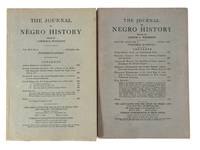
1931rif. 217891931. Woodson Carter Godwin. The Journal of Negro History. Archive of two significant issues published in 1931 and 1938 documenting the institutional growth and expanding scholarly scope of African American historiography during the interwar period. The material records Black intellectual production historical scholarship and diasporic research through the editorial and publishing activities of the Association for the Study of Negro Life and History founded by Carter G. Woodson and Jesse E. Moorland in 1915. These issues include scholarship on slavery Reconstruction Black religious institutions international colonial politics abolitionist movements and urban Black life at a time when Black scholarship remained marginalized within predominantly white academic institutions. The journal served as one of the principal vehicles through which Black historians circulated archival research fostered interdisciplinary inquiry and established African American history as a formal academic field. The archive provides primary-source evidence for the maturation of Black historical studies and diasporic intellectual thought in the early twentieth century. Woodson Carter Godwin ed. The Journal of Negro History. Lancaster PA and Washington D.C.: The Association for the Study of Negro Life and History 1931 and 1938. Two issues in publisher's printed wrappers comprising Vol. XVI No. 4 October 1931 and Vol. XXIII No. 2 April 1938. Each issue measures approximately 10 x 6.5 inches and contains 125 and 144 pages respectively. 1 Vol. XVI No. 4 October 1931. Includes Eugene Portlette Southall's "The Attitude of the Methodist Episcopal Church South Toward the Negro from 1844 to 1870" examining racial theology and denominational policy during and after slavery. Rayford W. Logan contributes "The Anglo-Egyptian Sudan a Problem in International Relations" an early analysis of colonial governance and African international politics anticipating his later work in Pan-African and diplomatic studies. Leo H. Hirsch Jr.'s extensive "The Negro and New York 1783 to 1865" surveys slavery free Black life and antislavery politics in New York before the Civil War. The issue concludes with organizational reports and a memorial tribute titled "The Passing of George W. Cook." 2 Vol. XXIII No. 2 April 1938. Opens with Benjamin Quarles's "The Breach Between Douglass and Garrison" reassessing the political and ideological divide between Frederick Douglass and William Lloyd Garrison within abolitionist movements and Black political organizing. Charles H. Wesley contributes "The Abolition of Negro Apprenticeship in the British Empire" situating emancipation and labor reform within broader imperial and diasporic contexts. Anthropologists Hortense Powdermaker and Joseph Semper examine labor and education patterns among African Americans in Connecticut through "Education and Occupation among New Haven Negroes" while Waldemar Westergaard's "A St. Croix Map of 1796" analyzes plantation geography and Caribbean slavery through archival cartographic evidence. The issue additionally contains scholarly reviews in English and French reflecting the journal's international intellectual orientation. These issues record the widening methodological and geographic range of African American scholarship during the interwar years when Black historians connected local histories of slavery and segregation to international questions of empire labor abolition and diasporic identity. The journal's interdisciplinary composition includes historical research anthropology political analysis religious studies and archival geography within a single scholarly forum. Contributions by Rayford Logan Benjamin Quarles Charles H. Wesley and Hortense Powdermaker reflect the emergence of scholars and allied researchers who reshaped twentieth-century understandings of African American and diasporic history. Minor edgewear and faint toning to wrappers with light handling wear; overall very good condition. A pair of interwar issues documenting the consolidation and internationalization of early African American historical scholarship. unknown
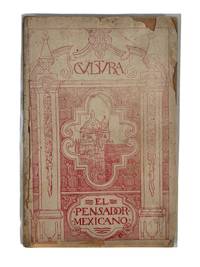
1918rif. 216641918. González Obregón Luis. El Pensador Mexicano: Diálogos sobre cosas de su tiempo sacados del olvido 1918 returns José Joaquín Fernández de Lizardi's reformist literary persona to circulation during the post-revolutionary reconstruction of Mexican historical memory. González Obregón a historian and chronicler of Mexico City selected and presented dialogues associated with "El Pensador Mexicano" Lizardi's influential pseudonym using early republican and nineteenth-century commentary to address national identity civic criticism and cultural inheritance. The issue belongs to Mexican literary-historical culture illustrating how post-revolutionary editors used earlier political writing to recover models of social critique and public intellectual life. González Obregón Luis. El Pensador Mexicano: Diálogos sobre cosas de su tiempo sacados del olvido. México: Cultura 1918. First edition. T. VI Núm. 6. Portada de Valerio Prieto. 78 pages and one leaf. Original printed wrappers with red architectural cover design incorporating Mexico City's Metropolitan Cathedral 8vo. Bibliographic records identify the work as part of the Cultura series and note Valerio Prieto's cover while Stanford records the imprint as México: Typ. Murguía 1918. The wrappers' cathedral imagery links the publication visually to Mexico City's colonial and national past while the text's title "sacados del olvido" states its recovery project directly. Published in 1918 during the unsettled years following the Mexican Revolution and the 1917 Constitution the issue participates in a broader effort to define Mexican civic culture through historical recovery rather than through contemporary polemic alone. González Obregón's treatment of Lizardi places journalism dialogue and moral criticism within a lineage of Mexican public letters useful for studying post-revolutionary literary nationalism and the preservation of nineteenth-century intellectual traditions. Covers heavily worn with edge chipping significant loss to upper right and lower margins and spine creasing; interior pages browned but intact with foxing and minor corner wear; good. A fragile Cultura-series issue connecting post-revolutionary Mexican historical consciousness with the legacy of Lizardi's public criticism. unknown
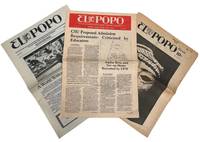
1970rif. 230841970. El Popo student newspaper archive 1970-1991 documents the sustained role of Chicano student journalism as an organizing instrument within the Movimiento Estudiantil Chicanx de Aztlán MEChA network and the broader Chicano Movement. Founded in 1970 by students responding to the absence of Chicana and Chicano perspectives in mainstream media El Popo functioned as a political communication system linking campus activism to labor struggles electoral politics and community-based organizing. The publication's name drawn from the volcano Popocatépetl signaled an explicitly militant and mobilizing ethos aligned with movement-era consciousness. Across the archive coverage of United Farm Workers activity anti-Proposition 38 organizing around bilingual ballots urban displacement and police brutality establishes the newspaper as a primary source for grassroots political discourse while the 1991 issue extends this framework into global and late-Cold War contexts through coverage of the Gulf War AIDS crisis awareness and transnational cultural production. 1 El Popo. Vol. 1 No. 1. Northridge CA: M.E.Ch.A./California State University Northridge November 1970. Early foundational issue produced at the height of the Chicano Movement situating student activism within labor struggles and community resistance. Coverage includes United Farm Workers organizing boycotts arrests and critiques of institutional racism alongside poetry and personal accounts that articulate emergent Chicano political identity. 2 El Popo. Northridge CA: M.E.Ch.A./CSUN March 1985. Mid-period issue reflecting the institutionalization of Chicano Studies and continued student activism. Articles address urban development displacing Latino families police brutality and "tokenism" demonstrating the persistence of structural critiques into the 1980s. The issue maintains bilingual engagement and integrates literary expression with political reporting. 3 El Popo. Vol. 25 No. 1. California State University Northridge Spring 1991. Eight-page tabloid-format issue produced through the Chicana and Chicano Studies Department. Lead article "A World Without Fear" documents Judith F. Baca's World Wall project with front-page caption: "Soviet woman worker prepares the Gorky Park site for the World Wall Exhibition 1990." Additional content includes "An Ecological Disaster" on the Persian Gulf War "AIDS CRISIS AWARENESS" and "Sí Se Puede - Young Latina Forum" alongside a "Poesía" section featuring works such as "Brown Hope" "1990: 20 years since the Chicano Moratorium. Away from the spotlight; little access to a dream" and "A Chicano Will Die Today" by Manuel Castro reprinted from Somos Raza. Layout demonstrates the alternative press practice of embedding political meaning through visual and textual juxtaposition. Three issues total spanning 1970 to 1991 each measuring approximately 11.5 x 16 inches and printed in tabloid newspaper format with bilingual English and Spanish content. The archive traces the evolution of Chicano student press from movement-era militancy through institutional continuity and into late 20th-century global and public health discourse. Newsprint exhibits age toning expected horizontal folds and minor edge wear consistent with student-produced distribution; all issues remain legible with strong textual clarity. Overall condition very good. The archive provides longitudinal evidence of how Chicano student newspapers functioned as durable infrastructures of political communication sustaining activism across decades of shifting social and geopolitical conditions. unknown
rif. SONG1572246332Used: Good unknown
rif. 25114No date 1860s or 1870s. Rochester Monroe County New York State. Accompanying this item is a piece of paper with the following note in a mid-twentieth-century hand: ‘Interesting because of the very rare signature of Everard Peck pioneer printer Father of Wm. F. Peck’. He was a bookbinder from Connecticut who moved to Rochester around 1816 and opened a bookstore. He moved into printing and publishing founded the successful weekly "Telegraph" newspaper and later became a banker. He was a generous benefactor of the early city co-founding the University of Rochester and the Rochester Orphan Asylum and becoming a leader in the Female Charitable Society. He was a member of the Pioneer Society of Rochester and Western N. Y. founded on September 30th 1847 at the Blossom Hotel in Rochester. Membership was open to local residents who had lived in the area since before 1825. The Peck family papers are in the University of Rochester. See Griffith’s obituary in the New York Times 26 November 1872. 2pp folio. Fifty-two lines of text with some underlining in red. In a worn leaf and discoloured leaf of paper with chipping and closed tears to edges but no loss of text. Folded twice into packet docketed: ‘Walter S. Griffith / to / Lewis Setze / Arbitration Bond’. Signed by ‘Walter S. Griffith’ and witnessed by ‘E. Peck’. Begins: ‘Know all men by these Presents that I Walter S. Griffith of the City of Rochester in the County of Monroe and State of New York am held and firmly bound unto Lewis Selze of the same place in the sum of ten thousand dollars lawful money of the United States of America’. Sets out that ‘disputes and differences have arisen’ between Griffith and Selze with regard to ‘certain improvements and expenditures’ made to ‘a certain piece or tract of land lying in the City of Rochester at and above the high falls of the Genesee River’ purchased by them from William W. Mumford. Griffith agrees to accept whatever award is made by the arbitrators Vincent Mathews and Ashley Samson. No date [1860s or 1870s?]. [Rochester, Monroe County, New York State.] unknown
rif. DADAX1999893735New unknown
rif. SONG1432125036Used: Good unknown
2015rif. 2111902160302833Bungeishunju Planning Publishing Department 2015. Soft Cover. Fine. Number of pages: 471 pages Size: B5 size Bungeishunju Planning Publishing Department paperback
1919rif. 011643Northampton 1919. Northampton Herald .1919. Full year 52 issues each issue has 8 pages. Book measures 70x48.cm. Bound in later half cloth cloth boards black lettering. Cloth rubbed some abrasion wear. Binding in good solid condition. Internally some intermittent tanning pages slightly brittle some short tear to edges. Generally some pages are slightly brittle but not perishing. Pages in good clean condition. Friday January 3rd 10th 17th 24th 31st February 7th 14th 21st 28th March 7th 14th 21st 28th April 4th 11th 18th 25 May 2nd 9th 16th 23rd 30th June 6th 13th 20th 27th July 4th 11 18th 25th August 1st 8th 15th 22nd 29th September 5th 12th 19th 26th October 3rd 10th 17th 24th 31st November 7th 14th 21st 28th December 5th 12th 19th 26th. . Cloth. Near Very Good. Folio. Hardcover
1915rif. 011642Northampton 1915. Northampton Mercury. Full year 1915.Book measures 69x52.cm. 52 issues each issue have 8 pages. Large amount of Military reporting local history and events. Bound in modern half cloth cloth boards black lettering. Binding in good clean firm condition. Internally page edges are slightly brittle with some short tears some browning to edges. Generally brittleness to edges mainly to first few month pages can be handled and are not falling apart Friday January 1st 1915 8th 15th 22nd 29th February 5th 12th 19th 26th March 5th 12th 19th 26th April 2nd 9th 16th 23rd 30th May 7th 14th 21st 28th June 4th 11th 18yj 25th July 2nd 9th 16th 23rd 30th August 6th 13th 20th 27th September 3rd 10th 17th 24th October 1st 8th 15th 22nd 29th November 5th 12th 19th 26th December 3rd 10th 17th 24th. . Cloth. Near Very Good. Folio. Hardcover
rif. 25582EXPOSITION - LONDON - 1851 THE ART JOURNAL. ILLUSTRATED CATALOGUE. THE INDUSTRY OF ALL NATIONS 1851. London: The Art Journal 1851. Folio. Publisher's gilt calf spine and tips. xxvi 328 xvi viii xxii viii viii pages. First edition. Exhibition catalogue with hundreds of engravings and articles on science by Robert Hunt textiles by Lewis D.B. Gordon the exhibition itself by Ralph Wornum plants and agriculture by Edward Forbes and color by Mrs. Merrifield. Very good. unknown
rif. 25581EXPOSITION--LONDON--1851 THE ART JOURNAL. ILLUSTRATED CATALOGUE. THE INDUSTRY OF ALL NATIONS 1851. London: The Art Journal 1851. Folio. Publisher's calf spine and tips. xxvi 328 xvi viii xxii viii viii pages. First edition. Exhibition catalogue with hundreds of engravings and articles on science by Robert Hunt textiles by Lewis D.B. Gordon the exhibition itself by Ralph Wornum plants and agriculture by Edward Forbes and color by Mrs. Merrifield. Very good. unknown
1993rif. ZB255774London Mining Journal. 1993. Volume 320; original paper wrappers ex library textually clean. - If you are reading this this item is actually physically in our stock and ready for shipment once ordered. We are not bookjackers. Buyer is responsible for any additional duties taxes or fees required by recipient's country. Photos available upon request. London, Mining Journal. unknown
rif. SONG1250275784Used: Good unknown
rif. M6889dSet of 30 volumes. Centre d'Egyptologie Montségur 2008-2016. First edition. In-4. Original softcover a fine set. From the library of Egyptologist Charles Cornell Van Siclen III VSX. Language: French/Français. This set ships from the USA shipping costs will be updated accordingly TXR. Relevant subjects: Egypt: Journals Egypt. unknown
rif. SONG2299001654Used: Good unknown
1992rif. ZB512204Elsevier 1992. complete volume partly bound ex library overall near very good. - If you are reading this this item is actually physically in our stock and ready for shipment once ordered. We are not bookjackers. Buyer is responsible for any additional duties taxes or fees required by recipient's country. Photos available upon request. Elsevier unknown
rif. DADAX0062500562New unknown
1985rif. 2110502150906959Kazama shobo 1985. Soft Cover. Fine. Volume: 1 Kazama shobo paperback
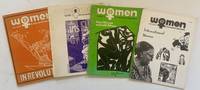
1970rif. 178751970. Women: A Journal of Liberation 1970 to 1975 documenting feminist cultural expression and ideological debate within the Women's Liberation Movement during the early second wave period. The material reflects feminist print culture illustrating themes of gender roles domestic life labor sexuality and global political struggle and offering insight into how activists writers and artists articulated women's experiences and demands for social transformation. It supports research into feminist media intersectional discourse and the evolution of women-centered publishing in the United States. Archive includes: 1 Women: A Journal of Liberation Vol. 1 No. 4. Summer 1970. Baltimore MD: Women: A Journal of Liberation Inc. 1970. This issue's theme is "In Revolution" and its cover bears an image of a shouting woman breaking through chains her chin lifted in determination. On the back wrapper is a photographic collage of feminists and a woman behind bars sweat dripping down her forehead. Articles discuss Vietnam the Russian Revolution Rosa Luxembourg and various current events relating to the women's movement. 2 Women: A Journal of Liberation Vol. 2 No. 1 Fall 1970. Baltimore MD: Women: A Journal of Liberation Inc. 1970. An issue on women in the arts with articles on female authors women in music and film children's literature focused on women female visual artists and women as muse. Cover features a purple print of a woman sitting in a chair and hiding her face from view captioned "model in art class". 3 Women: A Journal of Liberation Vol. 2 No. 2 Winter 1971. Baltimore MD: Women: A Journal of Liberation Inc. 1970. This issue is titled "How We Live and With Whom" and includes articles on family marriage and homelife. Many of these articles explore marital and familial issues affecting women in the 70s including the difficulties of divorce sex education for young girls and alternative lifestyles like communal living. 4 Women: A Journal of Liberation Vol. 3 No. 2 Winter 1972. Baltimore MD: Women: A Journal of Liberation Inc. 1972. Titled "Building a New Culture". An issue exploring the role of women in culture and the impact of popular culture on women including articles on women in music theater and sports as well as women's studies and sociology. Cover features a green print of five women dancing in a circle. 5 Women: A Journal of Liberation Vol. 3 No. 4. Baltimore MD: Women: A Journal of Liberation Inc. 1974. This issue is titled "International Women" and bears cover images of an older woman wearing a bandana and prints of Native women a Black woman and a Vietnamese woman holding artillery in one hand and a baby in another. Articles discuss Vietnam women in the Cuban Revolution Nisei women Chicana culture and various current events relating to the women's movement. 6 Women: A Journal of Liberation Vol. 4 No. 2 Spring 1975. Baltimore MD: Women: A Journal of Liberation Inc. 1975. Titled "The Cost of Living" this is issue centers around the relationship between women and money. Includes articles on women in the workforce welfare living in poverty and women supporting themselves independently. This topic would have been especially relevant in the mid-70s when the Equal Credit Opportunity Act opened up new financial opportunities for women in the US. Six issues spanning 1970 to 1975 each approximately 11 x 8.25 inches. This period coincides with significant developments in U.S. feminist organizing including expanded discourse on workplace equality reproductive rights and financial independence as well as increased attention to global and intersectional perspectives within the movement. The journal's combination of political analysis creative expression and visual design situates it within a broader network of feminist periodicals that shaped activist and intellectual exchange. Light handling wear covers and pages well-preserved with strong color and clarity; overall very good condition. A cohesive and visually distinctive grouping illustrating the breadth of feminist thought and cultural production in the early 1970s. unknown
rif. SONG158771082XUsed: Good unknown
rif. SONG0972875115Used: Good unknown