35 645 résultats
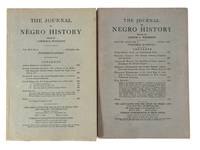
1931réf. 217891931. Woodson Carter Godwin. The Journal of Negro History. Archive of two significant issues published in 1931 and 1938 documenting the institutional growth and expanding scholarly scope of African American historiography during the interwar period. The material records Black intellectual production historical scholarship and diasporic research through the editorial and publishing activities of the Association for the Study of Negro Life and History founded by Carter G. Woodson and Jesse E. Moorland in 1915. These issues include scholarship on slavery Reconstruction Black religious institutions international colonial politics abolitionist movements and urban Black life at a time when Black scholarship remained marginalized within predominantly white academic institutions. The journal served as one of the principal vehicles through which Black historians circulated archival research fostered interdisciplinary inquiry and established African American history as a formal academic field. The archive provides primary-source evidence for the maturation of Black historical studies and diasporic intellectual thought in the early twentieth century. Woodson Carter Godwin ed. The Journal of Negro History. Lancaster PA and Washington D.C.: The Association for the Study of Negro Life and History 1931 and 1938. Two issues in publisher's printed wrappers comprising Vol. XVI No. 4 October 1931 and Vol. XXIII No. 2 April 1938. Each issue measures approximately 10 x 6.5 inches and contains 125 and 144 pages respectively. 1 Vol. XVI No. 4 October 1931. Includes Eugene Portlette Southall's "The Attitude of the Methodist Episcopal Church South Toward the Negro from 1844 to 1870" examining racial theology and denominational policy during and after slavery. Rayford W. Logan contributes "The Anglo-Egyptian Sudan a Problem in International Relations" an early analysis of colonial governance and African international politics anticipating his later work in Pan-African and diplomatic studies. Leo H. Hirsch Jr.'s extensive "The Negro and New York 1783 to 1865" surveys slavery free Black life and antislavery politics in New York before the Civil War. The issue concludes with organizational reports and a memorial tribute titled "The Passing of George W. Cook." 2 Vol. XXIII No. 2 April 1938. Opens with Benjamin Quarles's "The Breach Between Douglass and Garrison" reassessing the political and ideological divide between Frederick Douglass and William Lloyd Garrison within abolitionist movements and Black political organizing. Charles H. Wesley contributes "The Abolition of Negro Apprenticeship in the British Empire" situating emancipation and labor reform within broader imperial and diasporic contexts. Anthropologists Hortense Powdermaker and Joseph Semper examine labor and education patterns among African Americans in Connecticut through "Education and Occupation among New Haven Negroes" while Waldemar Westergaard's "A St. Croix Map of 1796" analyzes plantation geography and Caribbean slavery through archival cartographic evidence. The issue additionally contains scholarly reviews in English and French reflecting the journal's international intellectual orientation. These issues record the widening methodological and geographic range of African American scholarship during the interwar years when Black historians connected local histories of slavery and segregation to international questions of empire labor abolition and diasporic identity. The journal's interdisciplinary composition includes historical research anthropology political analysis religious studies and archival geography within a single scholarly forum. Contributions by Rayford Logan Benjamin Quarles Charles H. Wesley and Hortense Powdermaker reflect the emergence of scholars and allied researchers who reshaped twentieth-century understandings of African American and diasporic history. Minor edgewear and faint toning to wrappers with light handling wear; overall very good condition. A pair of interwar issues documenting the consolidation and internationalization of early African American historical scholarship. unknown books
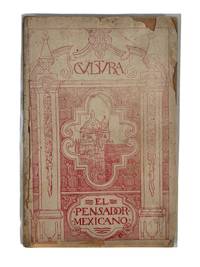
1918réf. 216641918. González Obregón Luis. El Pensador Mexicano: Diálogos sobre cosas de su tiempo sacados del olvido 1918 returns José Joaquín Fernández de Lizardi's reformist literary persona to circulation during the post-revolutionary reconstruction of Mexican historical memory. González Obregón a historian and chronicler of Mexico City selected and presented dialogues associated with "El Pensador Mexicano" Lizardi's influential pseudonym using early republican and nineteenth-century commentary to address national identity civic criticism and cultural inheritance. The issue belongs to Mexican literary-historical culture illustrating how post-revolutionary editors used earlier political writing to recover models of social critique and public intellectual life. González Obregón Luis. El Pensador Mexicano: Diálogos sobre cosas de su tiempo sacados del olvido. México: Cultura 1918. First edition. T. VI Núm. 6. Portada de Valerio Prieto. 78 pages and one leaf. Original printed wrappers with red architectural cover design incorporating Mexico City's Metropolitan Cathedral 8vo. Bibliographic records identify the work as part of the Cultura series and note Valerio Prieto's cover while Stanford records the imprint as México: Typ. Murguía 1918. The wrappers' cathedral imagery links the publication visually to Mexico City's colonial and national past while the text's title "sacados del olvido" states its recovery project directly. Published in 1918 during the unsettled years following the Mexican Revolution and the 1917 Constitution the issue participates in a broader effort to define Mexican civic culture through historical recovery rather than through contemporary polemic alone. González Obregón's treatment of Lizardi places journalism dialogue and moral criticism within a lineage of Mexican public letters useful for studying post-revolutionary literary nationalism and the preservation of nineteenth-century intellectual traditions. Covers heavily worn with edge chipping significant loss to upper right and lower margins and spine creasing; interior pages browned but intact with foxing and minor corner wear; good. A fragile Cultura-series issue connecting post-revolutionary Mexican historical consciousness with the legacy of Lizardi's public criticism. unknown
1918réf. 216641918. González Obregón Luis. El Pensador Mexicano: Diálogos sobre cosas de su tiempo sacados del olvido 1918 returns José Joaquín Fernández de Lizardi's reformist literary persona to circulation during the post-revolutionary reconstruction of Mexican historical memory. González Obregón a historian and chronicler of Mexico City selected and presented dialogues associated with "El Pensador Mexicano" Lizardi's influential pseudonym using early republican and nineteenth-century commentary to address national identity civic criticism and cultural inheritance. The issue belongs to Mexican literary-historical culture illustrating how post-revolutionary editors used earlier political writing to recover models of social critique and public intellectual life. González Obregón Luis. El Pensador Mexicano: Diálogos sobre cosas de su tiempo sacados del olvido. México: Cultura 1918. First edition. T. VI Núm. 6. Portada de Valerio Prieto. 78 pages and one leaf. Original printed wrappers with red architectural cover design incorporating Mexico City's Metropolitan Cathedral 8vo. Bibliographic records identify the work as part of the Cultura series and note Valerio Prieto's cover while Stanford records the imprint as México: Typ. Murguía 1918. The wrappers' cathedral imagery links the publication visually to Mexico City's colonial and national past while the text's title "sacados del olvido" states its recovery project directly. Published in 1918 during the unsettled years following the Mexican Revolution and the 1917 Constitution the issue participates in a broader effort to define Mexican civic culture through historical recovery rather than through contemporary polemic alone. González Obregón's treatment of Lizardi places journalism dialogue and moral criticism within a lineage of Mexican public letters useful for studying post-revolutionary literary nationalism and the preservation of nineteenth-century intellectual traditions. Covers heavily worn with edge chipping significant loss to upper right and lower margins and spine creasing; interior pages browned but intact with foxing and minor corner wear; good. A fragile Cultura-series issue connecting post-revolutionary Mexican historical consciousness with the legacy of Lizardi's public criticism. unknown books
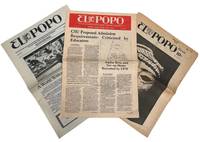
1970réf. 230841970. El Popo student newspaper archive 1970-1991 documents the sustained role of Chicano student journalism as an organizing instrument within the Movimiento Estudiantil Chicanx de Aztlán MEChA network and the broader Chicano Movement. Founded in 1970 by students responding to the absence of Chicana and Chicano perspectives in mainstream media El Popo functioned as a political communication system linking campus activism to labor struggles electoral politics and community-based organizing. The publication's name drawn from the volcano Popocatépetl signaled an explicitly militant and mobilizing ethos aligned with movement-era consciousness. Across the archive coverage of United Farm Workers activity anti-Proposition 38 organizing around bilingual ballots urban displacement and police brutality establishes the newspaper as a primary source for grassroots political discourse while the 1991 issue extends this framework into global and late-Cold War contexts through coverage of the Gulf War AIDS crisis awareness and transnational cultural production. 1 El Popo. Vol. 1 No. 1. Northridge CA: M.E.Ch.A./California State University Northridge November 1970. Early foundational issue produced at the height of the Chicano Movement situating student activism within labor struggles and community resistance. Coverage includes United Farm Workers organizing boycotts arrests and critiques of institutional racism alongside poetry and personal accounts that articulate emergent Chicano political identity. 2 El Popo. Northridge CA: M.E.Ch.A./CSUN March 1985. Mid-period issue reflecting the institutionalization of Chicano Studies and continued student activism. Articles address urban development displacing Latino families police brutality and "tokenism" demonstrating the persistence of structural critiques into the 1980s. The issue maintains bilingual engagement and integrates literary expression with political reporting. 3 El Popo. Vol. 25 No. 1. California State University Northridge Spring 1991. Eight-page tabloid-format issue produced through the Chicana and Chicano Studies Department. Lead article "A World Without Fear" documents Judith F. Baca's World Wall project with front-page caption: "Soviet woman worker prepares the Gorky Park site for the World Wall Exhibition 1990." Additional content includes "An Ecological Disaster" on the Persian Gulf War "AIDS CRISIS AWARENESS" and "Sí Se Puede - Young Latina Forum" alongside a "Poesía" section featuring works such as "Brown Hope" "1990: 20 years since the Chicano Moratorium. Away from the spotlight; little access to a dream" and "A Chicano Will Die Today" by Manuel Castro reprinted from Somos Raza. Layout demonstrates the alternative press practice of embedding political meaning through visual and textual juxtaposition. Three issues total spanning 1970 to 1991 each measuring approximately 11.5 x 16 inches and printed in tabloid newspaper format with bilingual English and Spanish content. The archive traces the evolution of Chicano student press from movement-era militancy through institutional continuity and into late 20th-century global and public health discourse. Newsprint exhibits age toning expected horizontal folds and minor edge wear consistent with student-produced distribution; all issues remain legible with strong textual clarity. Overall condition very good. The archive provides longitudinal evidence of how Chicano student newspapers functioned as durable infrastructures of political communication sustaining activism across decades of shifting social and geopolitical conditions. unknown
1970réf. 230841970. El Popo student newspaper archive 1970-1991 documents the sustained role of Chicano student journalism as an organizing instrument within the Movimiento Estudiantil Chicanx de Aztlán MEChA network and the broader Chicano Movement. Founded in 1970 by students responding to the absence of Chicana and Chicano perspectives in mainstream media El Popo functioned as a political communication system linking campus activism to labor struggles electoral politics and community-based organizing. The publication's name drawn from the volcano Popocatépetl signaled an explicitly militant and mobilizing ethos aligned with movement-era consciousness. Across the archive coverage of United Farm Workers activity anti-Proposition 38 organizing around bilingual ballots urban displacement and police brutality establishes the newspaper as a primary source for grassroots political discourse while the 1991 issue extends this framework into global and late-Cold War contexts through coverage of the Gulf War AIDS crisis awareness and transnational cultural production. 1 El Popo. Vol. 1 No. 1. Northridge CA: M.E.Ch.A./California State University Northridge November 1970. Early foundational issue produced at the height of the Chicano Movement situating student activism within labor struggles and community resistance. Coverage includes United Farm Workers organizing boycotts arrests and critiques of institutional racism alongside poetry and personal accounts that articulate emergent Chicano political identity. 2 El Popo. Northridge CA: M.E.Ch.A./CSUN March 1985. Mid-period issue reflecting the institutionalization of Chicano Studies and continued student activism. Articles address urban development displacing Latino families police brutality and "tokenism" demonstrating the persistence of structural critiques into the 1980s. The issue maintains bilingual engagement and integrates literary expression with political reporting. 3 El Popo. Vol. 25 No. 1. California State University Northridge Spring 1991. Eight-page tabloid-format issue produced through the Chicana and Chicano Studies Department. Lead article "A World Without Fear" documents Judith F. Baca's World Wall project with front-page caption: "Soviet woman worker prepares the Gorky Park site for the World Wall Exhibition 1990." Additional content includes "An Ecological Disaster" on the Persian Gulf War "AIDS CRISIS AWARENESS" and "Sí Se Puede - Young Latina Forum" alongside a "Poesía" section featuring works such as "Brown Hope" "1990: 20 years since the Chicano Moratorium. Away from the spotlight; little access to a dream" and "A Chicano Will Die Today" by Manuel Castro reprinted from Somos Raza. Layout demonstrates the alternative press practice of embedding political meaning through visual and textual juxtaposition. Three issues total spanning 1970 to 1991 each measuring approximately 11.5 x 16 inches and printed in tabloid newspaper format with bilingual English and Spanish content. The archive traces the evolution of Chicano student press from movement-era militancy through institutional continuity and into late 20th-century global and public health discourse. Newsprint exhibits age toning expected horizontal folds and minor edge wear consistent with student-produced distribution; all issues remain legible with strong textual clarity. Overall condition very good. The archive provides longitudinal evidence of how Chicano student newspapers functioned as durable infrastructures of political communication sustaining activism across decades of shifting social and geopolitical conditions. unknown books
1834réf. 7575CBBasel, Mähly & Schabelitz, 1834–1835. 4°. (1) Bl., Mit lithogr. Titelblatt, 4 S. lithogr. Notenbeilagen, 1 gef. Plan (Basler Fasnacht) und 61 Aquatinta-Tafeln. Orig.-Pappband.
1907réf. 5407CBNeue Folge. Achtzehnter Jahrgang. Leipzig. E.A. Seemann 1907 4°. IV, 544 S. Original Leinenbände mit geprägtem Deckel und Rücken in schwarz und gold. berieben. In gutem Zustand.
1914réf. 5417CBNeue Folge. Fünfundzwanzgister Jahrgang. Leipzig. E.A. Seemann 1914. 4°. IV, 332 S. Original Leinenbände mit geprägtem Deckel und Rücken in schwarz und gold. berieben. In gutem Zustand.
1828réf. 376627William Blackwood Edinburgh 1828-43. Half Leather. Very Good Condition. Launched in May 1828 the Quarterly Journal of Agriculture was established by the prominent Scottish publishing firm William Blackwood and Sons as a premier platform for modernizing British farming. Published out of Edinburgh and London the periodical was created in close coordination with the Highland and Agricultural Society of Scotland. It served an essential role in disseminating scientific insights advancements in rural economy and technical breakthroughs. Notably the journal provided early documentation for transformative farming machinery such as Patrick Bell’s reaping machine alongside essays on soil chemistry land drainage and livestock management.The journal reached its peak operational integration between June 1841 and March 1843 when it officially incorporated the prize essays and transactions of the Highland Society directly into its pages. Over its lifespan the publication spanned 13 volumes capturing the rapid transition of agriculture from traditional practice to an industrial science. The influential run under its original format concluded in March 1843 with Volume 13 marking the end of a vital chapter in 19th century agricultural literature The complete 13 volume set with woodcuts and diagrams in the text. Bound in half leather with gilt bands gilt lettered marbled boards. Some scuffing to a couple of spines and rubbing to the boards. All bindings and text blocks very firm with no cracked or loose boards. All volumes very clean throughout. Each volume has the label of Alexander Speirs Elderslie on the front inside paste-down. A solid looking set on the shelf. Size: 13 x 21 cms. Category: Antiquarian & Rare; New Arrivals; This item may require more postage than the rates shown for delivery outside the UK. If extra postage is required we will contact you before processing your order and you will be given the details and option to decline the extra cost. William Blackwood hardcover
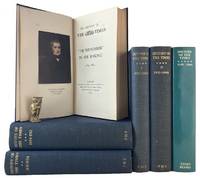
1950réf. 185263London: The Times Publishing Company 1950. Foreword to by Volume V by Charles Douglas-Home. Five volumes in six totalling approximately 4500 pages with 165 plates including frontispieces 4 of which are coloured and tipped-in several other plates folding or double page a few tipped-in a couple of text figures appendices bibliography indices; med. 8vo; navy or dark blue cloth lettered in gilt some of the boards slightly spotted or mottled spines faintly faded; dust wrapper to Volume V only backstrip lightly faded; book label of David Levine Sydney on upper pastedowns minor production trimming fault to bottom fore-corner pp. 483/4 in Volume I a little light foxing; foxed The Office of The Times London 1950-1984. Volumes I-III second impressions; others first editions. Volume I: "The Thunderer" in the Making 1785-1841; Volume II: The Tradition Established 1841-1884; Volume III: The Twentieth Century Test 1884-1912; Volume IV in two parts continuously paginated: The 150th Anniversary and Beyond 1912-1948; Volume V: Struggles in War & Peace 19349-1966. Published anonymously Volumes I-IV were principally written and edited by Stanley Morison. Volume V was written by Iverach McDonald. Three further volumes were published from 1998-2022. The Times Publishing Company unknown
1980réf. KOS04500153TBD 1980. Soft Cover. Fine. KOS04500153 TBD paperback
1988réf. 223411988. Baim Tracy ed. Outlines: The Voice of the Gay and Lesbian Community archive 1988 to 1992 documents Chicago LGBTQ journalism during the AIDS crisis the expansion of queer community media and the intensification of legal cultural and political struggles over gay and lesbian public life. Tracy Baim co-founded Outlines in 1987 after co-founding Windy City Times in 1985 and contemporary accounts describe Outlines as part of a competitive and consequential Chicago LGBTQ newspaper environment that helped record local and national movement history. These issues show the cultural sphere of LGBTQ community journalism through interviews protest photography AIDS coverage lesbian conference reporting arts criticism legislative updates and international news offering insight into how queer periodicals connected Chicago readers to national politics women's culture legal advocacy and media representation. Outlines: The Voice of the Gay and Lesbian Community. Chicago: Lambda Publications 1988 to 1992. Five issues. Archive of five issues from Vol. 2 Nos. 4 and 7; Vol. 4 No. 12; and Vol. 5 Nos. 6 and 8 with visible contents including feature interviews community news protest reporting arts coverage AIDS-related material legal updates and national and international LGBTQ news. 1 Baim Tracy ed. Outlines: The Voice of the Gay and Lesbian Community. Vol. 2 No. 4. Chicago: Lambda Publications 1988. The September 1988 issue carries the headline "Michigan Fest" and centers a report on the Michigan Womyn's Music Festival with additional coverage of an AIDS benefit hosted by Circus Vargas Lily Tomlin and Robin Tyler performances activism against a state AIDS bill protest at the Republican National Convention and a profile of author John Rechy. The issue is especially useful for documenting lesbian cultural space AIDS-era benefit work electoral protest and queer literary visibility within one Chicago-based periodical. 2 Baim Tracy ed. Outlines: The Voice of the Gay and Lesbian Community. Vol. 2 No. 7. Chicago: Lambda Publications 1988. The December 1988 issue features "Torch Song Trilogy-An Interview with Harvey Fierstein" and includes coverage of gay and lesbian choruses queer bookstores LGBTQ representation at Carnegie Hall holiday community programming and World AIDS Day reflections. Its contents place queer performance memorial practice and community institutions within the same field of coverage. 3 Baim Tracy ed. Outlines: The Voice of the Gay and Lesbian Community. Vol. 4 No. 12. Chicago: Lambda Publications 1991. The May 1991 issue headed "3000 at Lesbian Confab" covers a major gathering of lesbian leaders includes an interview with Christie Hefner reports on plans for a Chicago LGBTQ community center and includes global LGBTQ coverage state legislative updates and a section for Asian American Heritage Month. The issue documents lesbian organizing community infrastructure international attention and race-conscious editorial programming. 4 Baim Tracy ed. Outlines: The Voice of the Gay and Lesbian Community. Vol. 5 No. 6. Chicago: Lambda Publications 1991. The November 1991 issue uses the cover title "Victims No More" and documents protests against Cracker Barrel's anti-gay hiring practices and California's veto of gay-rights legislation with a cover image of queer activists confronting authority. Contents include "Dykes Take the Capitol" visuals an interview with Lily Tomlin and legal coverage of Chicago Police Department accountability rulings and internal discipline decisions in a gay case placing street protest lesbian direct action celebrity interview and police accountability in direct relation. 5 Baim Tracy ed. Outlines: The Voice of the Gay and Lesbian Community. Vol. 5 No. 8. Chicago: Lambda Publications 1992. The January 1992 issue headed "World Review: Victories and Setbacks Marked a Momentous 1991" includes coverage of the Thompson/Kowalski guardianship victory international LGBTQ repression including Russia setbacks for LGBTQ political appointments in Chicago Gloria Steinem's Revolution from Within interviews with Dick Sargent and Joe Keenan and legal action against Cracker Barrel. The retrospective format shows how Outlines framed a single year through law family recognition international repression feminism popular culture and workplace discrimination. Mild handling wear age toning to newsprint and creasing consistent with circulation and storage very good overall. Concentrated AIDS-era and early 1990s LGBTQ press archive preserving Chicago-based coverage of lesbian organizing queer cultural production legal rights struggles anti-discrimination protest police accountability and national and international movement news. unknown
1988réf. 223411988. Baim Tracy ed. Outlines: The Voice of the Gay and Lesbian Community archive 1988 to 1992 documents Chicago LGBTQ journalism during the AIDS crisis the expansion of queer community media and the intensification of legal cultural and political struggles over gay and lesbian public life. Tracy Baim co-founded Outlines in 1987 after co-founding Windy City Times in 1985 and contemporary accounts describe Outlines as part of a competitive and consequential Chicago LGBTQ newspaper environment that helped record local and national movement history. These issues show the cultural sphere of LGBTQ community journalism through interviews protest photography AIDS coverage lesbian conference reporting arts criticism legislative updates and international news offering insight into how queer periodicals connected Chicago readers to national politics women's culture legal advocacy and media representation. Outlines: The Voice of the Gay and Lesbian Community. Chicago: Lambda Publications 1988 to 1992. Five issues. Archive of five issues from Vol. 2 Nos. 4 and 7; Vol. 4 No. 12; and Vol. 5 Nos. 6 and 8 with visible contents including feature interviews community news protest reporting arts coverage AIDS-related material legal updates and national and international LGBTQ news. 1 Baim Tracy ed. Outlines: The Voice of the Gay and Lesbian Community. Vol. 2 No. 4. Chicago: Lambda Publications 1988. The September 1988 issue carries the headline "Michigan Fest" and centers a report on the Michigan Womyn's Music Festival with additional coverage of an AIDS benefit hosted by Circus Vargas Lily Tomlin and Robin Tyler performances activism against a state AIDS bill protest at the Republican National Convention and a profile of author John Rechy. The issue is especially useful for documenting lesbian cultural space AIDS-era benefit work electoral protest and queer literary visibility within one Chicago-based periodical. 2 Baim Tracy ed. Outlines: The Voice of the Gay and Lesbian Community. Vol. 2 No. 7. Chicago: Lambda Publications 1988. The December 1988 issue features "Torch Song Trilogy-An Interview with Harvey Fierstein" and includes coverage of gay and lesbian choruses queer bookstores LGBTQ representation at Carnegie Hall holiday community programming and World AIDS Day reflections. Its contents place queer performance memorial practice and community institutions within the same field of coverage. 3 Baim Tracy ed. Outlines: The Voice of the Gay and Lesbian Community. Vol. 4 No. 12. Chicago: Lambda Publications 1991. The May 1991 issue headed "3000 at Lesbian Confab" covers a major gathering of lesbian leaders includes an interview with Christie Hefner reports on plans for a Chicago LGBTQ community center and includes global LGBTQ coverage state legislative updates and a section for Asian American Heritage Month. The issue documents lesbian organizing community infrastructure international attention and race-conscious editorial programming. 4 Baim Tracy ed. Outlines: The Voice of the Gay and Lesbian Community. Vol. 5 No. 6. Chicago: Lambda Publications 1991. The November 1991 issue uses the cover title "Victims No More" and documents protests against Cracker Barrel's anti-gay hiring practices and California's veto of gay-rights legislation with a cover image of queer activists confronting authority. Contents include "Dykes Take the Capitol" visuals an interview with Lily Tomlin and legal coverage of Chicago Police Department accountability rulings and internal discipline decisions in a gay case placing street protest lesbian direct action celebrity interview and police accountability in direct relation. 5 Baim Tracy ed. Outlines: The Voice of the Gay and Lesbian Community. Vol. 5 No. 8. Chicago: Lambda Publications 1992. The January 1992 issue headed "World Review: Victories and Setbacks Marked a Momentous 1991" includes coverage of the Thompson/Kowalski guardianship victory international LGBTQ repression including Russia setbacks for LGBTQ political appointments in Chicago Gloria Steinem's Revolution from Within interviews with Dick Sargent and Joe Keenan and legal action against Cracker Barrel. The retrospective format shows how Outlines framed a single year through law family recognition international repression feminism popular culture and workplace discrimination. Mild handling wear age toning to newsprint and creasing consistent with circulation and storage very good overall. Concentrated AIDS-era and early 1990s LGBTQ press archive preserving Chicago-based coverage of lesbian organizing queer cultural production legal rights struggles anti-discrimination protest police accountability and national and international movement news. unknown books
réf. 0204QYR0RFPHardcover. Good. Good on the outside very good inside full leather with consistent scuffing and ghost of gold lettering still visible. Very good inside. Well bound complete. Friends' Miscellany 1837 Hardcover Isaac Comly Joshua Evans John Hunt John Comly hardcover
réf. DADAX0670272132New unknown
1810Two Volumes. Illustrated with thirteen full page aquatint plates. Offsetting to the text from plates. Mildly XLib. Foxed. 4to. 260 mm. Disbound. Abbey 247. This substantially discounted price allows for a nice re-binding of this important book. **PRICE MUCH REDUCED! TRAVEL/5
1825Two Volumes. LACKS Frontis in both volumes. Illustrated with text portrait in volume one. Marbled endpapers. Bookplate of Rev. Charles Wood in both volumes. Folio. 305mm. Original full green leather bindings. Boards ruled in gold. Front board fragile on volume one. Corners and edges rubbed and worn with some loss. Original leather spine labels on volume one. Volume two labels chipped with small loss. Raised bands. Head of spine on volume one torn without loss. Early re-backing of spines. First Edition. "Pepys is marvelously entertaining. The times and the man peep out in a thousand odd circumstances and amusing expressions. The ablest picture of the Age." - Alibone. This Scarce First Edition has been sadly "Grangerized" and wants many of the portrait plates Hardbound. Perhaps the most famous diary in the English language. Please email us directly about postal charges on these sets. **PRICE MUCH REDUCED! ENGSETS BX 5
1849réf. 6043227Stuttgart, Cotta 1849. 8°. XII, 467 pp., 6 lithographierte Falttafeln. Dekoratives Halbleder der Zeit mit 2 gestochenen Titelschildchen (grün und orange) sowie vergoldeter Rückenprägung und marmorierter Deckelkaschierung. Alterstypische Patina. Block sauber und fest. Tafeln hin und wieder mit kleinerem Staubrand. Schnitt angestaubt. Vorsatzpapiere in den Ecken leicht leimschattig.
1922réf. 26094Paris, 1922. In-4, Avec nombreuses illustrations et photos en noir et blanc. No. 309, 310, 311, 312, 313, 314, 315, 316, 317, 318, 319, 320, 321, 322, 323, 324, 325, 326, 327, 328, 329, 330, 331, 332, 333, 334. Couverture illustrees en couleurs, relie en deux reluires demi veau. - Matieres: Le Salon Automobile de 1922; Tous les brevets francais publies depuis le 1er Mai sur l'auto et les accessoires; Cyclecars et Motocyclettes; Les articles de bureau et la papeterie; Le role economique de la France en Chine; Franco-Irish trade; Le marche japonais, Robes Chapeaux; L'ameublement; La Parfumerie Francaise; Les immenses richesses de notre empire colonial; Les Arts a l'Exposition Coloniale; Les caracteristiques du commerce au Maroc; La Tunisie; Madagascar; Franco-Australian trade relations; Basse-Normandie; La race chevaline normande; L'avion aujourd'hui; La machine textile francaise; etc. Reliures un peu abimees. 1 cachet sur le faux-titre et sur la page de titre de vol. 1, 2 cachets sur la page de titre de cahier 1.
réf. DADAX1572490187New unknown
réf. DADAX1433569116New unknown
réf. 200803464, Le petit journal , 1901 ; in-folio, 416+416 pp., demi toilé. Dimanche 6 janvier 1901 reliure decoussu.
réf. DADAX0444820671New unknown
1994réf. 354805Cambridge: University Press 1994. First Edition. Softcover. Near fine set in the original stiff-card wrappers; edges very slightly dust-dulled and toned. Remains particularly and surprisingly well-preserved; tight bright clean and especially sharp-cornered. Physical description; 36 volumes. Contents; vol. 2 part 1: February 1994 ; v. 2 no. 2: June 1994 ; v. 2 part 3: October 1994 ; v. 3 part 1: February 1995 ; v. 3 part 2: June 1995 ; v. 3 part 3: October 1995 ; v. 8: part 1: February 2000 ; v. 8 part 2: June 2000 ; v. 8: part 3: October 2000 ; v. 11 Part 1: February 2003 ; v. 11 part 2: June 2003 ; v. 11 part 3: October 2003 ; v. 12 part 1: February 2004 ; v. 12 part 2: June 2004 ; v. 12 part 3: October 2004 ; v. 13 part 1: February 2005 ; v. 14 part 1: February 2006 ; v. 14 part 1; February 2006 ; v. 14 part 2: June 2006 ; v. 14 part 3: October 2006 ; v. 15 no. 1: February 2007 ; v. 15 no. 2 June 2007 ; v. 15 no. 3: October 2007 ; v. 14 n.S. 2008 ; v. 16 no. 1: February 2008 ; v. 16 no. 2: June 2008 ; v. 16 no. 3: Special Issue: Colonial Legacies: October 2008 ; v. 17 no. 1: Special Issue: Anthropology of contemporary China: February 2009 ; v. 17 no. 2: May 2009 ; v. 17 no. 3: August 2009 ; v. 17 no. 4: Special Issue: 'Muslim Women' in Europe: November 2009 ; v. 18 no. 1: special issue: Anthropologies of university reform: February 2010 ; v. 18 no. 2: May 2010 ; v. 18 no. 3: August 2010 ; v. 18 No. 4: Special Issue: a cosmopolitan anthropology: November 2010. Subjects; Social Anthropology. Anthropology. Cambridge: University Press paperback
réf. DADAX0415228913New unknown