34.288 risultati
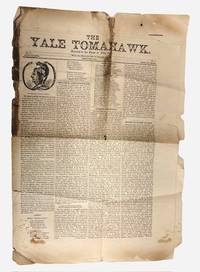
1851rif. 961951851. Poor. 48 x 33 cm. 1 vertical fold and 3 horizontal folds. A worn copy withome splitting tears etc. along folds and edges with only minor loss of text. Outer edges heavily soiled on top section as now folded. Yale's catalog entry describes the paper as published by the Sophomore Society of Alpha Sigma Phi attacking its rivals and the college world in general. Five numbers were published between 1847 and 1852. unknown books
1956rif. 65456Philadelphia 1956. Paperback. Very Good. Folded three-page program. 23cm. Among the honorees was Wilt Chamberlain as Outstanding Athlete. paperback books
1956rif. 75626Philadelphia 1956. Paperback. Very Good. Folded four-page softcover program. 23cm. Very Good. Wilt Chamberlain Rev. Sullivan and nine other individuals were to receive "Afro Awards. paperback books
1419rif. 43317Juneau. March 14 1903. Daily Alaskan newspaper containing news of William Sulzer's speech in support of the territory an idyllic word-portrait of prospecting and numerous advertisements. Sulzer a Democratic Congressman from New York argues that Alaska deserves to be a full-fledged territory rather than just a district owing to its beauty and vast natural resources. Sulzer would later serve as New York's governor and hold the record as the only governor of that state to be impeached; his brother Charles was an Alaskan politician. Alaska would not become a territory until 1912. 4pp. Folio. Chipped and browned at edges. Two leaves separated at fold. Good. unknown books
1839rif. 41144Boston. 1839. Volume 2 numbers 3 and 4 of the BOSTON JOURNAL OF NATURAL HISTORY issued in August 1839. A survey of fish in Massachusetts' waters completed as part of a Zoological Survey of Massachusetts. 289-579pp. plus three plates. Later wrappers. In a folding cloth box leather label by James MacDonald. hardcover books
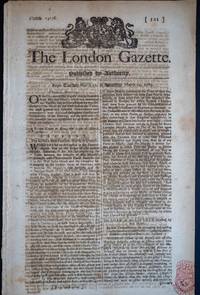
1793rif. 43165London. Nov. 8 1793. Includes an account of the trial of Marie Antoinette and an advertisement for several works by Thomas Paine. 4pp. Folio. Neatly silked on both sides. Minor soil. Very good. unknown books
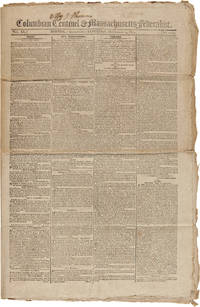
1803rif. 8213Boston. November 5 1803 and June 28 1809. With News of the Louisiana Purchase The earlier issue includes a brief biography of Lucien Bonaparte and various political notices most importantly regarding the negotiations for the Louisiana Purchase its constitutional ramifications for the United States and the reluctance of Spain to recognize the sale of the territory by France to the United States. News of the purchase had become public on October 17. On November 30 Spain formally delivered the colony to the French colonial prefect who transferred the territory to William Claiborne and General Wilkinson the American commissioners on December 20. Vol. XL No. 2048 and Whole No. 2633. Two issues 4pp. each. Folio newspaper. Tanned old folds old ink signature and some wrinkling. Good. BRIGHAM I pp.277-79. unknown books
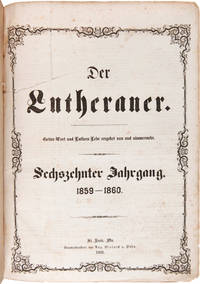
1860rif. 58540St. Louis: Wiebusch und Sohn 1860-1863. Missouri Civil War Newspaper Lutheran German-language newspaper founded in 1844 by Carl Ferdinand Wilhelm Walther 1811-87. The paper and its founder were key components in introducing the idea of an umbrella church for Lutherans in America and the Midwest founding in 1847 the German Evangelical Lutheran Synod of Missouri Ohio and Other States. In the 1840s and '50s Germans were the largest immigrant group in America settling heavily in the Midwest. Four volumes bound in one. 2208; 200 of 208; 4208 lacks pp.137-144; 2200pp. Vol. 17 lacks issue 26. Vol. 18 lacks issue 18. Folio. Half morocco and marbled boards. Spine and corners heavily worn front cover detached. Titlepage of first volume torn; second and third leaves heavily torn with some minor loss. Light to moderate foxing and wear. Else good. hardcover books
rif. 6252EDWARD ALLEN GOODWIN unknown-1862. Goodwin was the Sergeant in Company K of the 23rd Regular Massachusetts Volunteers. This is the diary of Edward A. Goodwin Co. K 23rd Regt. M. of. M. This diary is THE AMERICAN UNION DIARY FOR 1862 an annual published diary accessible and likely provided to Union soldiers during the Civil War. After a few pages that include a calendar and interest tables the diary provides space for each day of the year 1862. Goodwin wrote entries every day from January 1st to April 7th and none thereafter. At the time Goodwin was serving in the 23rd Massachusetts Infantry Regiment which was a part of the Coast Division under General Ambrose Burnside. Entries are handwritten in either pencil or black ink. Notable entries include: aFriday 7: Naval engagementplace lasting from noon till sunset. Troops were landedin the afternoon and evening. Bivouacked on Roanoke Island in the rain. b Saturday 8: Captured a rebel battery in a swamp. Took 3000 rebel provisions and the whole island wasSergt. Howard hurt his foot. W.S. Clark missing. Both entries describe the Battle of Roanoke Island fought February 7th and 8th 1862. Part of General Ambrose Burnsides expedition to capture key ports in the Outer Banks the battle first saw Union gunboats first firing on Confederate forts under the command of Henry Wise until Burnsides soldiers could land ashore unopposed. and the forts on shore engaged in a gun battle with occasional contributions from the Mosquito Fleet. The next day the Union soldiers successfully flanked the Confederate artillery and infantry defenders on both sides forcing a retreat into the Confederate forts. The forts were then individually taken with the Union suffering only 264 casualties and capturing 2500 Confederate defenders. c Friday 14: Fought the battle of New Bern. Took over 100 pieces of artillery ammunitioncamp equipment &c. I arrived at night in the tents of the enemy. This entry describes the Battle of New Bern fought on March 14th 1862. After first advancing up the Trent River General Burnside had his soldiers exploit the weakened center of the line of the defending Confederates under Lawrence O'B. Branch. This allowed the Union Navy to shell Fort Thompson forcing its abandonment and shortly thereafter the city of New Bern too. 90 Union soldiers were killed and 64 Confederates were killed and 413 were captured. d Monday 31: Sick all day. Took horses.e Monday 7: Saw Amoat the hospital. DeceasedRain in the afternoon. These two entries foreshadow Goodwins ultimate fate including his last entry on April 7th 1862. Goodwin would pass away in New Bern on April 16th. Having survived two major battles unscathed at least according to his diary Goodwin most likely succumbed to disease. It is estimated that 2/3 of Civil War soldiers who died during the war died of disease not in battle. His body was ultimately returned to Massachusetts and is buried in Mansfield. The pages of the journal are in good condition but the exterior of black leather is frayed and partially torn. It should be handled very delicately but its value as a lens into the mindset of a Civil War soldier is immense. hardcover books
rif. 5397EUROPEAN TOUR JOURNAL. Handwritten journal. May 22-December 18 1951. France England Italy and Switzerland. 101 pages. The journal of an American man living in Paris and travelling throughout France and surrounding countries. The early part of the journal describes his daily life in Paris including friends and social life love life gossip literature music and aspirations as a writer. He also writes extensively about tennis of which he was an enthusiastic and knowledgeable fan. He attends an international tennis tournament in Paris in May and goes to London for Wimbledon in late June. The latter two-thirds of the journal recount the authors travels. First he takes a whistle-stop tour of France visiting places such as Rouen Mont St. Michel Biarritz and Lourdes. Then he spends time in Italy and Switzerland before ending up back in Paris. In each location he describes leisure activities visiting museums and churches hotels and the local scenery in greater or lesser detail. Most notably he visits the beaches of Normandy only a few years after D-Day: Finally I got to the tiny hamlet of St. Laurent s Mer & the sign Visitez Ohama Beach. I drove down a quiet road & suddenly burst out onto the beach itself a lonely barren stretch made more so by a high mind to the presence of the resting hulks of invasion craft lying mortally stranded just offshore in an angry green sea. There are piles of rusted neglected equipment corresponding to the wrecks in the water which are being collected together by French workmen. A few campers had pitched their tents amongst gasoline drums huge cannisters & decayed tank. I drove slowly along the beach made muddy by recent rain until I came to what had once been a German gun emplacement which according to a plaque had been utilized on D-Day by the CG of the Engineers as his HQ. The German gun a 37 mm still faced through an aperture staring emptily out at the wrecks offshore. Amongst these latter were the concrete slacks that I guessed to be the remains of the preliminary artificial harbour they had sunk right away. The scene with the forgotten appurtenances of war was one of the most indescribable desolateness & I felt in the grip of the strongest of emotions. June 1944 came back to me & how we heard the news of the invasion over loud-speakers in Hangar AD-1 at Burtonwoof & if I listened carefully I felt I could hear the guns booming & the l/cs chugging up to shore & the GIs splashing out in the cold water & moving slowly but desperately up the beach pinned down by the German fire from concrete emplacements & from the high green eminence which rises abruptly from the beach & runs all along the shore. How many men had met their end right where I was standing How many had coughed out their hopes & their life in the din of that horror never understanding why it had to happen to them But I couldnt ear a thing only the sound of the wind & the sea and all I could see were those obscene wrecks & the Frenchmen working among them. This lively journal is in fine condition overall and the writing is uniformly easy to read. unknown books
rif. 5300CARIBBEAN TRAVEL JOURNAL. Diary. 101 pages. The Caribbean. c. 1908-9. The handwritten journal belonging to C. B. Benson of Hudson New York. The diary recounts Bensons experience on an organized cruise group visit to Caribbean locations such as St. Thomas Puerto Rico Kingston Jamaica Caracas Venezuela Panama City Panama Port of Spain Trinidad and Martinique. Benson records his experiences in each location including his impressions of the town the locals sights he visited and local travel. He visited forts a school churches a mill a sugar plantation and Carnival celebrations. Benson took his tour during the era of colonial rule the attitudes of which infuse both his experiences and observations. Based on his mention of an earthquake in Kingston Jamaica taking place a year or two before he travelled in 1908 or 1909. St. Thomas where we arrived about 6 A.M. mid morning Jan 26 is one of the Virgin group and we found her framed and frescoed in the principal churches. Columbus in 1493 gave the group of 100 islands rocks andwhich comprise the group. St. Thomas is 13 miles in length and 3 miles in width at its broadest. And I guess we walked the length of it speaking broadly and in the abstract at this distance.The heat of the tropical sun also takes its toll and blurs our ideas of time and distance somewhat. The town of Charlotte Amelia contains 13000 inhabitants merchants and black babies and they are all dressed in their Sunday best to receive us properly.Thursday morning at 8 we went ashore at Porto sic Rico.Returning thro the village streets we stopped at the market place and noticed the display of fruits in baskets a couple of men seated on low stools with blacks in front of them.a native womanwas entertaining us in the middle of the road with a dance.When passing the island of Haiti.Do you know why we do not stop at the Island of Haiti No There are cannibals there there are so many fat people aboard you would lose your wife At St Thomas the American council held open house and received some of us who dared to invade this solitude.An hours railroad ride which was made interesting by stops at every littleand station where the bare legged boy with the oil gun in hand squirted oilbearings sic of the cars and engine. As it was before the 17 miles came to an end the rear axle of the parlor car so called because it had leather covered reclining seats caught fire. But when this happened we were nearly at the end of our journey and we were not delayed much. At the sugar plantation where we detrained we found we had some distance to walk downto the sugar mill. As there was no path and the sticky wet ground to soil made worse by the heavy rain of the night before.A sugar mill is never a clean place.The process is somewhat intricate but way he likened to the process of brewing.The cane piled up in the yard is boiled in a number of vats then is run off with barrels and in a black and solid state in shipped to the Refineries at New York. The fiber of the cane is then hardened and dried and is fed to the furnaces to boilcane. After return to the town San Juan we visited the shops. Walked out to the fort at the entrance of the harbor. The town is excellently policed and paved in the principal streets with telegram blocks.As this day was Thursday we concluded that every day was wash day for the native women and girls who for want of other diversions spend most of their time in this form of dissipation. Even the balconies of the main public street filled with traffic of street cars carriages and drays had their fill of wash some of which are found laying in the street having been carried down by the wind. No one had appropriated it as yet; and we did not add it to our collection of souvenirs. At the officers quarters I applied for a permit of the officer of the day to enter the fort San Cristobal the fort commanding the entrance to the harbor.The fort was like most forts. The high tower gave a commanding view of the town and harbor. Then we visited the Governors Palace. In the Reception Room hanging on opposite sides facing each other are life sized oil paintings of McKinley & Cleveland. In the garden were some large palms tropical ferns a fountain &.Jan 29. early in the morning we were at Kingston in Jamaica. The channel is narrow and tortuous but well Taking a local pilot we soonopposite itof three vessels one of which was the Princess Louise that was caught in the hurricane here three years ago andthe larger of the three vessels was trying to pick up the light from the light house which had been blown down. This destruction of the hurricane.After driving about a mile thru the city the destruction to the buildings & pavements made by the earthquake here a year or two ago half of the city seems to be in ruins and no attempt has been made apparently to rebuild & restore the city. Thousands of lives were lost here at that time which did immense damage to the fruits. Most of the uninhabitable part of the island belongs to the United Fruit Company a Boston Corporation who ships immense quantities of bananas from Port Antonio. Owing to recent destruction by fire of Hotel Litchfield our stop at the port of San Antonio and stay of night at the Hotel was omitted. An excursion across the island by train to Mandeville was arranged in its place.The town of Colon in its principle streets are paved with brick and appear clean. We noticed many buzzards. The air was clear and there was a delightful cool breeze blowing.We stopped at all of the stations going to Panama and noted the wonderful impressions made by the Sanitary Commission. The well ventilated and screened houses. The plan for disposal of garbage the open drainage the cleared landsBut of course the facts are here bug and drain all working to the mutual exclusion of some ideas to the American white employers. Therefore after a few months they must have a reaction in the States toand detach themselves from all absorbing facts. The fighting for life againstfires. Most things arebetween the white employers and the black employees. So we find the White Bar and the Black Bar The White Employees The Silver White Employees &c as signs on the cars intended to carry workmen back and forth from the works.Caracas the capital of Venezuela is about 3000 ft up but the sun in the middle of the day we found very hot.Plaza Bolivar was decorated with rows of colored electric lights. They are preparing for the Carnival season which ushers in Lent in Catholic countries. The market place had counters for dry goods highly colored handkerchiefs etc. Another section was devoted to fruits vegetables etc. We noticed some very large apricots. Mr. Bolivar apparently has done a great deal for his native town. He has given his name while the people furnished the funds for the largest parks a street and the coinage of the plutocrats.The Spaniard theHildago -in his easy subjugation of thepleasure loving tropical savage has replaced the native of simple taste and left in his place the mongrel half-breed with all the vices of the conqueror and none of the virtues of theIndian savage. The diary is in very good condition. It is mostly written in pencil but is quite legible. hardcover books
rif. 5195NEW JERSEY. Journal. 26 pages of writing. 1846-1854. Caldwell New Jersey. A handwritten journal of expenses kept in 1840s and 1850s New Jersey by a J G Glasby whose name is written on the inside front cover. Glasby listed expenditures for basic provisions manly foodstuffs for people and animals. Butter was by far the most common item purchased. There are many blank pages throughout the middle and end while the last few pages have additional writing. The journal is in good condition although some of the pages have separated from the binding. It has a leather spine and marbled paper-covered boards. hardcover books
rif. 4696JAPAN. Diary. January 14 1950 to late 1954. Various places Philadelphia Japan Fort Meade. A lengthy diary of an American officer Lieutenant Louis T. Holtz who was stationed in Japan during the Korean War. It was written on dozens of sheets of loose-leaf notebook pages and it contains many black and white photographs with captions as well as newspaper and magazine cutouts and brochures from places he visited. The diary begins on January 14 1950 in Philadelphia and he discuses seeing shows and such but notes that All in all this constituted a very enjoyable ten days of leave prior to going overseas. Sometimes I wish I could stay at home and live a normal routine life like everyone else. Other times I find myself eager to goAlmost two years ago who could forecast a war in Korea and the manner in which it would rip everyones life to shreds He writes on January 2 1951 from Kurume Japan: perhaps 10 years from now it the diary will be of interest if any of our civilization remains in 1961I collapsed 28 June and spent 3 weeks in the hospital with excessive fatigueI am the Officer-in-charge of the Kurume Office with an area of jurisdiction of approximately 1000 square miles. In April 1951 he mentions I am very busy in my position as OIC Officer In Charge. Its a full 7-day-a-week jobThe Korean mess has everyone guessing as to eh future of the Far Eastbeing the senior official in an area of jurisdiction of nearly 10000 square miles with dozens of mayors and police chiefs constantly catching my every word as official. The next couple dozen pages contain black and white photographs of protests in Japan and Holtzs commentary about the images including When people get hurt propaganda fills the air. The winner: the Kremlin always! Demonstrations take planning and people. You can always be sure the plans were framed in red and the spectators sprinkled liberally with dye-hard communist stooges Demonstrations & rallies are usually fantastically well organized. And as often as not they can be unbelievably orderly and But orderly or violent you can always be sure there is a professional communist keeping the sheep in line or arousing them to maximum fury. In September 1951 Holtz writes from Sapporro life in the Armed Services has been a miserable one because of one bad experience after anotherKurume was one of the most pleasant and enjoyable assignments I ever held. The 45th was without doubt the most bitter and least enjoyable. I gave up so much for so little. Holtz was in Californias Camp Stoneman in November 1951: with all the hundreds of officers here not particularly anxious to go overseas and with several actually fighting the assignment I was amazed to find that someone eager to return is sidetracked so abruptly. He was back in Japan by December and then wrote a lengthy entry entitled The Korean Story starting with Combat precautions make it mandatory that no diaries or personal papers be kept where they may fall into enemy hands and he spends the next seven pages describing his experiences in the Korean War. Holtz wrote in part: Things had not gone well at all with Trubotas unit prior to August 1951. After my arrival working results proved very satisfactoryThree other officers has also joined up in the interim between leaving Sapporo and going to KoreaWhen oriented in Tokyo they were told that the 45th Detachment would remain in Sapporo and they had already alerted their families to start to prepare to join them overseasI had to fight Trubota in order to be able to fight the enemy. In one occasion I was reprimanded for going to a forward observation post and not being personally available to answer the telephone at my CP and the section finishes with a photograph of the USS Marine Lynx the ship that brought him home. The diary continues with his being stationed at Marylands Fort Meade. There are photographs of the mansion he occupied in Kyushu Japanese women at the beach his fellow soldiers after a bowling tournament etc. There are Samples of United Nations propaganda leaflets dropped on North Korean positions early in the Korean conflict that show Truman and MacArthur a December 7 1950 letter signed by the mayor of Kurume City Japan. The condition is fine to very fine. unknown books
rif. 3751DS. 4pgs. 7 x 12. December 1875. Somerset County New Jersey. A contract for the sale of a Somerset County New Jersey newspaper signed C J Wilson D. W. Wilson and V.D. Honeyman. The contract sates in part: In consideration of one dollar to us in hand paid and for the further consideration to be made as hereafter specified we Charles J .Wilson editor and publisher of the Somerset Gazette a newspaper printed and published in Somerville Somerset County New Jersey and David W. Wilson who has an interest therein do agree to sell and convey and do hereby sell convey transfer and assign unto a van Daren Honeyman of the same place all our right title interest ownership and possession of in and to said newspaper and its appurtenances with all its appliances machinery tools and materials presses type cases forms stencils frames inks and stock of paper on hand being everything whatsoever which is now in the office occupied by said Somerset Gazette. The selling price was $3250.00 which was to be paid in three installments over a period of ten months. All three men signed the bottom of the document. It is in very good condition with several fold lines. unknown books
1830rif. M11919Philadelphia:: L. Johnson 1830. 1830. "4th improved edition." 8vo. 385-90 381 pp. Foxed throughout not hindering legibility. Original red cloth spine paper title label; front cover detached but present ffe loose extremities worn spine chipped. Rear free endpaper early ownership signature. As is. RARE. The first volume of a pioneer American health journal published from 1829-33. It features a selection of fascinating perspectives on medicine including analyses of the effects on health of headwear wine and malt liquor consumption mealtimes and water drinking among other things as well as considerations of race and longevity quacks mothering and more. On tobacco: "'A Victim of the Weed' is desirous of knowing whether he can at once abandon his pipe and segars or must part company in a gradual manner. Our advice is to desist immediately and entirely from the use of tobacco in every form and in any quantity however small" 220. On race: "The differences in this respect are primitive in the different races; the mucous body or varnish which constitutes the layer between the true skin beneath and the outer covering or cuticle being white or nearly so in the European or Caucasian races; yellowish in the Mongul or African; and black in the African" 146. On the education of girls: "Under twelve years of age it should be an invariable rule that the hours of close application should never exceed those of amusement and exercise" 267. Contains nos. 1-24: September 9 1829 through August 25 1830. L. Johnson, 1830. hardcover books
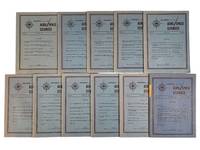
1959rif. 223131959. Journal of the Aerospace Sciences 1959 documents foundational research in American aerospace engineering during the early Cold War space race. Published the year after the establishment of NASA and amid intensified U.S. efforts to match Soviet rocket achievements following the 1957 launch of Sputnik these issues contain contemporary technical studies on hypersonic aerodynamics missile stability spacecraft propulsion and planetary trajectory design. Articles by scientists and engineers working at leading research institutions and government laboratories record the theoretical groundwork that would shape the next decade of American spaceflight including early analytical work on Mars trajectories reentry materials and competing propulsion systems for interplanetary travel. Journal of the Aerospace Sciences. Volume 26 numbers 1 2 4 5 6 7 8 9 10 11 and 12. New York: Institute of the Aeronautical Sciences 1959. Eleven issues from the journal's 1959 volume lacking only the March issue. The periodical served as the principal research forum of the Institute of the Aeronautical Sciences the professional organization that later became the American Institute of Aeronautics and Astronautics. Together these figures represent a cohort of scientists who would define American spaceflight theory and practice in the decade to come.Archive consists of 11 printed volumes in original wrappers approx. 50-80 pages per issue totaling over 800 pages. This archive includes: Volume 26 No. 1 January 1959: Features research on turbulent skin-friction drag at supersonic speeds jet nozzle structures nonlinear flutter problems and B-47 gust response. Includes Frank E. Goddard Jr. T.C. Adamson Jr. S.P. Shen. Vol. 26 No. 2 February 1959: Contains work on spiked bodies at hypersonic speeds reentry missile stability and panel flutter. Contributors include Seymour M. Bogdonoff E.V. Laitone and Frederick L. Ryder. Vol. 26 No. 4 April 1959: Publishes the Twenty-Second Wright Brothers Lecture by Maurice Roy of ONERA France. Other articles include thermal stresses hypersonic shock tunnels and boundary-layer transition. Vol. 26 No. 5 May 1959: Focuses on heat transfer at hypersonic speeds lift-drag ratios at supersonic speeds low-thrust spacecraft flight mechanics and chemically reacting boundary layers. Authors include A.J. Hanawalt Clinton E. Brown and Daniel E. Rosner. Vol. 26 No. 6 June 1959: Includes Hans Bethe's paper on the ablation of glassy materials structural matrix analysis and free-molecule flow dynamics. Vol. 26 No. 7 July 1959: Features M.A. Biot on thermomechanical reciprocity airplane turbulence responses and reentry motion. Also includes research on fatigue stress and laminar dissociated airflows. Vol. 26 No. 8 August 1959: Discusses transonic wing/body aerodynamics supersonic plate divergence mercury plasma tunnels and propellant burning models. Includes Hans U. Eckert. Vol. 26 No. 9 September 1959: Opens with Richard H. Battin's landmark article on planetary reconnaissance trajectories from MIT along with contributions on missile drag optimization rocket flight variational problems and real-gas flows. Vol. 26 No. 10 October 1959: Features George Paul Sutton's comprehensive comparison of interplanetary propulsion systems addressing ion rockets nuclear heating and solar sails. Also includes optimal aircraft climb paths and spherical cap snapping. Vol. 26 No. 11 November 1959: Includes studies on flutter energy equations jet-flap compressors porous-wall cooling and actuator disc dynamics in turbomachinery. Vol. 26 No. 12 December 1959: Closes the year with work on thermal buckling subsonic turbulence reattachment zoom climb optimization and hypersonic similitude. Contributors include Carl Gazley Jr. Wallace D. Hayes and George Gerard. In 1959 the Journal of the Aerospace Sciences served as the official scientific platform for cutting-edge American aerospace research marking the transition from aeronautical to astronautical engineering. That year saw sustained focus on hypersonics ballistic missile trajectories spacecraft propulsion and heat transfer under extreme atmospheric conditions as the U.S. sought to stabilize its strategic position after the 1957 Sputnik crisis and ahead of the 1960 Mercury program. Research in these volumes was underwritten by military contracts NASA collaboration established in 1958 and Cold War exigencies. Light foxing to several wrappers particularly July issue; some edge wear and surface abrasions. Two issues show sticker residue at spine or lower edge. Interiors uniformly clean bindings firm and covers largely bright and intact. Overall very good condition. The studies record the technical environment that produced early American satellite programs and later lunar navigation systems linking university laboratories defense contractors and federal research agencies. unknown books
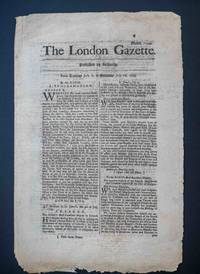
1789rif. 5258London: Numb. 13076 1789. Very Good. 220 x 285 mm; 8 pages numbered 121-128. Paper a bit toned with some bleed-through. Prints an Act of Parliament regulating trade between His Majesty's Colonies in the West Indies Canada and elsewhere and plantations in the United States. Numb. 13076 unknown books
1779rif. 5259London: Numb. 11994 1779. Very Good. 220 x 285 mm; 4 pages unnumbered. Prints a proclamation ordering all horses oxen and cattle not employed in domestic defense forces "to be driven and removed to some place of security" in the face of a threatened invasion from the French Numb. 11994 unknown books
1758rif. 5208London: Vol. III #200 1758. Fine. 210 x 280 mm; 8 pages numbered 339-344. Paper a bit toned. Reportage on events in the French and Indian War also known as the Seven Years' War. The article on "News from America" tells of a successful expedition against the French the Indians returning with a dozen scalps and three prisoners. There is also a description of how the Indian allies crept up on Fort Loudon and scalped French soldiers. Also tells of the meeting of an Indian leader with the governor of Charleston. Vol. III, #200, unknown books
1769rif. 5207London: Vol. XXV #1906 1769. Very Good. 220 x 285 mm; 8 pages numbered 209-216. Outer leaves split along fold. Paper a bit toned. Contains notices of trade ships to and from North America the death of Pope Clement XIII parliamentary debates on marriage and divorce regulations entertaining advertisements farming advice auction notices and so forth. Vol. XXV, #1906, unknown books
1758rif. 5210London: Vol. III #160 1758. Very Good. 210 x 280 mm; 8 pages numbered 17-24. Paper a bit toned. Corners bumped. Outer leaves splitting along fold. The news starts with an article entitled "the present state of the Colonies in North-America brought by the last Mail." The report highlights the savagery of the Seven Years' War. Vol. III, #160 unknown books
rif. 38349WOMAN'S JOURNAL THE PEOPLE'S HOME JOURNAL. JANUARY 1893 Volume VIII No. 1. New York: F.M. Lupton 1893. Folio. Printed wrappers. 20 pages. Begun in 1885 this journal was published until 1929. It features literary contributions by women. This issue includes a mystery "Circumstantial Evidence" by Mrs. M.V. Victor; and "Rosamond: a Tale of Riverside" by Mrs. Mary J. Holmes among several published stories. With numerous advertisements throughout the issue which feature products and services of interest to women and household maintenance. Upper right tip worn else very good. unknown books
rif. 25582EXPOSITION - LONDON - 1851 THE ART JOURNAL. ILLUSTRATED CATALOGUE. THE INDUSTRY OF ALL NATIONS 1851. London: The Art Journal 1851. Folio. Publisher's gilt calf spine and tips. xxvi 328 xvi viii xxii viii viii pages. First edition. Exhibition catalogue with hundreds of engravings and articles on science by Robert Hunt textiles by Lewis D.B. Gordon the exhibition itself by Ralph Wornum plants and agriculture by Edward Forbes and color by Mrs. Merrifield. Very good. unknown books
rif. 25583EXPOSITION--LONDON--1851 THE ART JOURNAL. ILLUSTRATED CATALOGUE. THE INDUSTRY OF ALL NATIONS 1851. London: The Art Journal 1851. Folio. Rebacked calf spine and tips with marbled boards. xxvi 328 xvi viii xxii viii viii pages. First edition. Containing hundreds of engravings and articles on science by Robert Hunt textiles by Lewis D.B. Gordon the exhibition itself by Ralph Wornum plants and agriculture by Edward Forbes and color by Mrs. Merrifield. Rebacked else very good. unknown books
rif. 33859THE JOURNAL OF FABRICS AND TEXTILE INDUSTRIES. Volume XIII Number 82. Bradford England: 1888. 4to. Wrappers. 40 pages. First edition. A trade publication featuring three full-page fabric designs and four samples of woolen products. Bright but lightly chipped. unknown books