1990réf. 2080202104501467Asahishinbunsha 1990. Soft Cover. Fine. Volume: 1 Asahishinbunsha paperback
1989réf. 2082702114902901Kochi University of Medicine 1989. Soft Cover. Fine. Number of pages: 206 pages Size: B5 size Kochi University of Medicine paperback
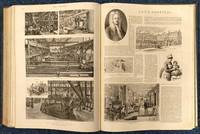
1887réf. 374714Graphic Illustrated Weekly Newspaper London 1887. Half Leather. Good Condition. 734 pages. Bound in contemporary half leather. Gilt lettered spine with gilt ruled bands. Contents sound with no shaken or torn pages. The binding is firm with a very scuffed and rubbed spine and the boards are rubbed and discoloured. Some minor foxing. Given the relatively complex nature of The Graphic volumes and the weekly issues we believe this book is complete but we cannot be absolutely certain in regard to any fold out sections. Size: 29 x 42 cms. Category: Antiquarian & Rare; Graphic Illustrated Weekly Newspaper. This item may require more postage than the rates shown for delivery outside the UK. If extra postage is required we will contact you before processing your order and you will be given the details and option to decline the extra cost. Graphic Illustrated Weekly Newspaper hardcover
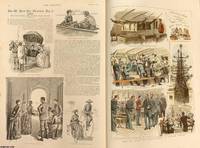
1887réf. 374712Graphic Illustrated Weekly Newspaper London 1887. Half Leather. Good Condition. 686 pages with index. Bound in contemporary green half leather. Gilt lettered spine with gilt ruled raised bands. Contents sound and the binding is firm with a scuffed and rubbed spine and the boards are mildly scuffed. Some minor foxing. Given the relatively complex nature of The Graphic volumes and the weekly issues we believe this book is complete but we cannot be absolutely certain in regard to any fold out sections. Size: 29 x 42 cms. Category: Antiquarian & Rare; Graphic Illustrated Weekly Newspaper. This item may require more postage than the rates shown for delivery outside the UK. If extra postage is required we will contact you before processing your order and you will be given the details and option to decline the extra cost. Graphic Illustrated Weekly Newspaper hardcover
réf. D17552Autograph diary written in pencil signed by Miss Elizabeth Woods of Bowling Green Kentucky. 135 pp. Well educated wealthy American woman's account of seeing Europe; mostly Paris France. Her Southern sensibilities were shocked at seeing a white woman at the same table with a black man. Turns out he was a minister from Haiti and the lady was his wife. Miss Woods saw the Paris Exposition several times; saw Sarah Bernhardt perform; saw President Kruger of South Africa; saw a street where Jews were not allowed to come out after 6pm; describes fancy balls and dinners; shopping for clothes.much of interest. Worn oil cloth binding. Numerous accounts of "charming" or "lovely" people. hardcover
réf. D17552Autograph diary written in pencil signed by Miss Elizabeth Woods of Bowling Green Kentucky. 135 pp. Well educated wealthy American woman's account of seeing Europe; mostly Paris France. Her Southern sensibilities were shocked at seeing a white woman at the same table with a black man. Turns out he was a minister from Haiti and the lady was his wife. Miss Woods saw the Paris Exposition several times; saw Sarah Bernhardt perform; saw President Kruger of South Africa; saw a street where Jews were not allowed to come out after 6pm; describes fancy balls and dinners; shopping for clothes.much of interest. Worn oil cloth binding. Numerous accounts of "charming" or "lovely" people. hardcover books
réf. 2810628580.Gpocket_book. Good. Access codes and supplements are not guaranteed with used items. May be an ex-library book. unknown
réf. 109448sd Non daté - In-4, broché - Couverture illustrée - 44 pages, sans pagination - Très nombreuses reproductions photographiques en N&B
1944réf. B002I56M3YWar Department 1944. Paperback. Very Good. Very Good Softcover. 1944 U.S. Navy. Recognition of Axis and Allied ships. Extremely faint cover mark. Text is flawless. Tight binding. War Department paperback
1820réf. 165851820. Tuckerman H. P. Poetry and prayer journal 1820-1830 documents early nineteenth-century manuscript album culture within Anglo-American Protestant communities with particular attention to women's devotional writing moral instruction and shared literary practices. The volume supports research into gendered authorship religious education and the circulation of poetic and didactic texts in the early republic where handwritten albums functioned as spaces for communal inscription. The presence of multiple hands across dated entries demonstrates a participatory literary culture structured around kinship and social networks while recurring themes of childhood piety mortality and moral virtue situate the text within contemporary evangelical and didactic traditions. Tuckerman H. P. Poetry and prayer journal. Circa 1820-1830. Manuscript volume with 53 handwritten entries by multiple contributors including poems hymns and devotional reflections. Entries include a hymn composed for the British and Foreign School Society emphasizing education and moral uplift through the metaphor "Oh stream of knowledge when thy tides.Forget not then the flowers" alongside gendered moral instruction concluding "woman's Happiest destiny Is only - to be good." Biblical passages including references to Luke 2 appear throughout accompanied by original prayers such as an 1827 entry: "Heaven sees no sight so fair As happy childhood bowed in prayer." Several texts address mortality and impermanence including reflections such as "Life is but a scanty ledge.suspended o'er a fathomless abyss" and a memorial poem introduced as written by a young man shortly before death from consumption invoking Romantic-era associations with illness and artistic sensibility. Additional entries focus on natural landscapes including "Spring Mountain" 1828 which situates spiritual reflection within pastoral imagery. The volume includes an original drawing of a mother and child signed "S. Tuckerman" as well as two pencil drawings of forest scenes reinforcing the integration of visual and literary expression within album practices. This manuscript emerges from a period in which evangelical Protestantism moral education movements and literary cultivation intersected within domestic and semi-public spheres particularly among women and youth. The reference to the British and Foreign School Society situates the volume within transatlantic educational reform efforts emphasizing literacy and moral discipline. The collaborative nature of the entries aligns with early nineteenth-century album traditions where social exchange and authorship were intertwined. Such materials provide insight into how religious belief gender norms and literary expression were internalized and reproduced within everyday practice. Original red half morocco binding with owner's name "H. P. Tuckerman" in gilt on front cover; approximately 120 pages with writing on 76 pages; includes three original drawings; measures 9 x 7 1/2 inches. Light toning and minimal foxing throughout; very good condition. A substantive example of early American manuscript culture linking devotional life gendered authorship and communal literary exchange. unknown
1820réf. 165851820. Tuckerman H. P. Poetry and prayer journal 1820-1830 documents early nineteenth-century manuscript album culture within Anglo-American Protestant communities with particular attention to women's devotional writing moral instruction and shared literary practices. The volume supports research into gendered authorship religious education and the circulation of poetic and didactic texts in the early republic where handwritten albums functioned as spaces for communal inscription. The presence of multiple hands across dated entries demonstrates a participatory literary culture structured around kinship and social networks while recurring themes of childhood piety mortality and moral virtue situate the text within contemporary evangelical and didactic traditions. Tuckerman H. P. Poetry and prayer journal. Circa 1820-1830. Manuscript volume with 53 handwritten entries by multiple contributors including poems hymns and devotional reflections. Entries include a hymn composed for the British and Foreign School Society emphasizing education and moral uplift through the metaphor "Oh stream of knowledge when thy tides.Forget not then the flowers" alongside gendered moral instruction concluding "woman's Happiest destiny Is only - to be good." Biblical passages including references to Luke 2 appear throughout accompanied by original prayers such as an 1827 entry: "Heaven sees no sight so fair As happy childhood bowed in prayer." Several texts address mortality and impermanence including reflections such as "Life is but a scanty ledge.suspended o'er a fathomless abyss" and a memorial poem introduced as written by a young man shortly before death from consumption invoking Romantic-era associations with illness and artistic sensibility. Additional entries focus on natural landscapes including "Spring Mountain" 1828 which situates spiritual reflection within pastoral imagery. The volume includes an original drawing of a mother and child signed "S. Tuckerman" as well as two pencil drawings of forest scenes reinforcing the integration of visual and literary expression within album practices. This manuscript emerges from a period in which evangelical Protestantism moral education movements and literary cultivation intersected within domestic and semi-public spheres particularly among women and youth. The reference to the British and Foreign School Society situates the volume within transatlantic educational reform efforts emphasizing literacy and moral discipline. The collaborative nature of the entries aligns with early nineteenth-century album traditions where social exchange and authorship were intertwined. Such materials provide insight into how religious belief gender norms and literary expression were internalized and reproduced within everyday practice. Original red half morocco binding with owner's name "H. P. Tuckerman" in gilt on front cover; approximately 120 pages with writing on 76 pages; includes three original drawings; measures 9 x 7 1/2 inches. Light toning and minimal foxing throughout; very good condition. A substantive example of early American manuscript culture linking devotional life gendered authorship and communal literary exchange. unknown books
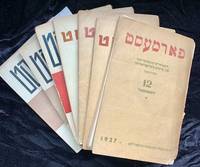
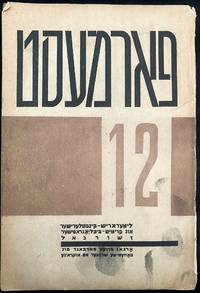
1937réf. 43101Kharkov: Ukrmelukhenatsmindfarlag 1937. First edition. Original illustrated paper wrappers 8vo issues range from 129-196 pages each. Includes illustrations. 21-23 cm. In Yiddish. Title translates roughly as “Challenge: A Literary Artistic and Critical Bibliographical Journal.” At the time the only Yiddish literary periodical in Ukraine. Farmest 1933–1937 was a monthly Yiddish literary magazine published in Kharkhiv Ukraine by the Ukrainian Committee for Soviet Writers. “Edited by the poet Itsik Fefer 1900–1952 it was continued in Sovetishe literatur: Literarish-kinstlerisher un kritish-bibliografisher zhurnal Soviet Literature: Literary-Artistic and Critical-Bibliographical Journal; 1938–1941. In 1927 Fefer was a founding member of the Jewish Section of the All-Ukrainian Union of Proletarian Writers and from 1928 one of the editors of its Kharkov-based journal Prolit Proletarian Literature. He also coedited the nonproletarian Kharkov journal Di royte velt The Red World from 1929. From 1933 to 1937 he edited the Kiev periodical Farmest Challenge; known as Sovetishe literatur Soviet Literature between 1938 and 1941 which replaced Prolit and Di royte velt and was thereafter the only Yiddish literary periodical in Ukraine.” YIVO. Avrom Gontar was also involved in the collective and editorial committee. The editor Itsik Fefer 1900–1952 “began writing poems in 1918 and in 1922 joined Vidervuks New Growth in Kiev a group of young Yiddish literati whose mentor was Dovid Hofshteyn. That same year the appearance of Fefer’s small collection Shpener Splinters established him as a rising literary star. His poetry amalgamated the Kultur-lige poets’ revolutionary romanticism with the propagandist objectives of the workers’ movement. Fefer was known for his literary credo of proste reyd simple speech a concept he formulated in 1922. In the early 1920s poetry particularly avant-garde poetry swamped the literary pages of Soviet Yiddish periodicals. This phenomenon worried editors and critics who were wary of the fact that Yiddish readers usually could not identify with this style of literature. All Yiddish readers by contrast could understand Fefer’s proste reyd. In 1927 Fefer was a founding member of the Jewish Section of the All-Ukrainian Union of Proletarian Writers and from 1928 one of the editors of its Kharkov-based journal Prolit Proletarian Literature. He also coedited the nonproletarian Kharkov journal Di royte velt The Red World from 1929” Gennady Estraikh. For more see: Gennady Estraikh “The Kharkiv Yiddish Literary World 1920s–Mid-1930s” East European Jewish Affairs 32.2 2002: 70–88; Chone Shmeruk “Yiddish Literature in the U.S.S.R.” in The Jews in Soviet Russia since 1917 ed. Lionel Kochan pp. 242–280 London and New York 1970. SUBJECTS: Yiddish literature -- Ukraine -- Periodicals. Yiddish literature. OCLC: 35051038. Some pages brittle some wear to spines. Overall Good Condition. Rare. YID-46-2-LGG-’excc. Kharkov: Ukrmelukhenatsmindfarlag unknown
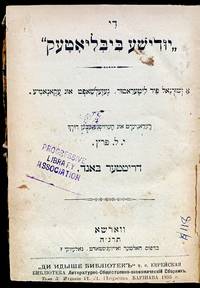
1895réf. 43079Warsaw: Izdanie I.L. Perets 1895. First edition period boards 8vo 179 pages. 23 cm. In Yiddish. Title translates as “The Jewish Library: A Journal for Literature Society and Economics.” Third volume of semiannual publication edited by I.L. Peretz. Di Yudishe Bibliotek was published periodically between 1891 and 1904. This issue includes belle-lettres poetry and scientific essays. “To encourage Jews toward a wider knowledge of secular subjects Peretz for several years wrote articles on physics chemistry economics and other subjects for Di yudishe bibliotek which he also edited.” Encyclopedia Britannica. Yitskhok Leybush Peretz 1852-1915 is one the best known Yiddish and Hebrew authors of the 19th century. Peretz was one of the three classic Yiddish writers with S. Y. Abramovitsh and Sholem Aleichem and the founder of Yiddish modernism. In the first decade of the 20th century he was at the center of an active literary circle in Warsaw. SUBJECTS: Yiddish literature -- Poland -- Periodicals. Jews -- Poland -- Periodicals. Jews. Yiddish literature. OCLC: 992802478. Ex-library with usual markings and normal wear and age to pages but otherwise in good condition. Good Condition. YID-46-19-GGLEX-’cc. Warsaw: [Izdanie I.L. Perets] unknown
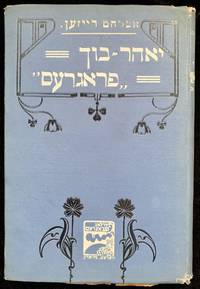
1904réf. 43110Varsha Warsaw: Ferlag "Progress 1904. First edition. Original illustrated printed boards 8vo 162 32 pages plus 7 unnumbered leaves of plates with illustrations. 22 cm. In Yiddish. Title translates as “Yearbook ‘Progress’: A Journal for Literature Science and Criticism.” “Abraham Reisen was a Yiddish poet short-story writer playwright and editor…While he was still a teenager his talent was recognized by Shalom Aleichem and I.L. Peretz who arranged for the publication of his earliest poems. After some years in Minsk Warsaw Krakow and Berlin he settled permanently in New York in 1914. Influenced by Heinrich Heine whom he translated into Yiddish he was one of the first Yiddish poets to make use of folksong material. His poetry though mostly written in conventional quatrains is suffused by a refined sensibility that adumbrates the writing of Di Yunge.” Jewish Virtual Library ”In 1900 Yakov Lidski founded "Progress" publishing house. Its name clearly communicated its goal. This publishing company considered to be the first to deal with modern Yiddish literature published a series of original and translated popular science books along with translated European literature and original Yiddish literature. The first editor of the publishing house was poet Avrom Reyzen.” Wikipedia. SUBJECTS: Yiddish literature. Jews -- Poland -- Periodicals. OCLC: 21651882 Wear to spine some page separation toning and markings. About Good Condition. YID-46-28-GGLEX-’cc. Varsha [Warsaw]: Ferlag "Progress unknown
1930réf. 42139Kiev: Katedr far Yidisher Kultur ba der Ukr. Visnshaftl. Akademye Filologishe Sektsye 1930. Paper Wrappers. 1st edition. Original printed publisher’s color paper wrappers 4to large ca 72-116 columns ca 36-58 pages per issue. 28 cm. In Yiddish. Title translates roughly as “The Yiddish Language.” Succeeded in 1931 by “Afn shprakhfront.”Di Yidishe Shprakh was a “Yiddish linguistic journal published in Kiev from 1927 to 1930. A bimonthly journal Di yidishe shprakh The Yiddish Language was published by the cooperative publishing house Kultur-lige and was the main philological publication of the Kiev Yiddish academic center. Its editor was the veteran Yiddishist Nokhem Shtif a founder of YIVO who had returned to Kiev from Germany in 1926. The journal’s inaugural issue March–April 1927 was published under the auspices of the Central Yiddish Bureau of the Ukrainian Commissariat for Education. With the next issue Di yidishe shprakh was an organ of the Chair and from July to October 1929 it was an organ of the Institute for Jewish later Proletarian Jewish Culture at the Ukrainian Academy of Sciences. Initially defined as a 'journal for practical Yiddish linguistics' from May to June 1927 it appeared as simply a 'journal for Yiddish linguistics. 'Shtif distinguished three language registers: the vernacular of the old generation partly represented in the works of Sholem Aleichem and predecessors; the highbrow language of modern writers such as Dovid Bergelson; and the contemporary 'culture language' most notably of the press. Although Shtif sought to target speakers of the mass 'culture language' the journal’s circulation hovered around 500 copies read mainly by Yiddish teachers.Apart from Shtif who published articles on various language-planning problems the most active contributors to Di yidishe shprakh were Ber Slutski Ayzik Zaretski Elye Falkovitsh Lipe Reznik and Shimen Dobin. In early 1929 Moscow literary critic Aron Gurshteyn criticized the journal for its purist approach to language planning. In the July–October 1929 issue Shtif published his article 'Di sotsyale diferentsiatsye in yidish' The Social Differentiation in Yiddish heralding an intensification of Soviet linguists’ anti-Hebraist campaign. That issue of Di yidishe shprakh adopted completely reformed Soviet spelling omitting for example final consonant letters.Although the last—twenty-fifth—issue of the journal was dated November–December 1930 it included materials from the First All-Union Yiddish Language Conference convened in Kiev from 8 to 13 February 1931 that issue is present here. Published under the imprint of the Central Publishing House this issue also signaled the demise of the remaining vestiges of the Kiev Kultur-lige. Yoysef Liberberg’s article 'Far parteyishkayt in der yidisher visnshaft-arbet' For a Party Approach to Yiddish Linguistics marked a full break with YIVO scholars particularly with YIVO director Max Weinreich whom Liberberg ridiculed for presenting Yiddish as an emanation of the Ashkenazic Jews’ soul. The Yiddish Language Conference decided to change the name of the journal. Between 1931 and 1939 it appeared sporadically under the title Afn shprakhfront On the Language Front reflecting its new more aggressive and politically charged approach' Gennady Estraikh in YIVO Encyclopedia of Jews in Eastern Europe 2010. For more see David Shneer “Yiddish and the Creation of Soviet Jewish Culture 1918–1930” Cambridge and New York 2004. SUBJECTS: Yiddish language -- Periodicals. Title also listed on covers in Russian “Ievreis'ka Mova” and German “Jiddische Sprach”. OCLC: 22840298. Most holdings in OCLC appear to be fragmentary. Covers are browning and fragile as expected but are otherwise very well preserved with very little edgewear. Internal text pages are also toning but remain relatively strong as pulp paper. Very important journal scarce in this degree of completeness Note that Estraikh suggests a circulation of only 500!. B YID-43-5-E. Kiev: Katedr far Yidisher Kultur ba der Ukr. Visnshaftl. Akademye, Filologishe Sektsye unknown
1935réf. 43308Kharkov: Ukrmelukhenatsmindfarlag 1935. First edition. Original illustrated paper wrappers 8vo 156 pages.Includes illustrations. 21-23 cm. In Yiddish. Title translates roughly as “Challenge: A Literary Artistic and Critical Bibliographical Journal.” At the time the only Yiddish literary periodical in Ukraine. Farmest 1933–1937 was a monthly Yiddish literary magazine published in Kharkhiv Ukraine by the Ukrainian Committee for Soviet Writers. “Edited by the poet Itsik Fefer 1900–1952 it was continued in Sovetishe literatur: Literarish-kinstlerisher un kritish-bibliografisher zhurnal Soviet Literature: Literary-Artistic and Critical-Bibliographical Journal; 1938–1941. In 1927 Fefer was a founding member of the Jewish Section of the All-Ukrainian Union of Proletarian Writers and from 1928 one of the editors of its Kharkov-based journal Prolit Proletarian Literature. He also coedited the nonproletarian Kharkov journal Di royte velt The Red World from 1929. From 1933 to 1937 he edited the Kiev periodical Farmest Challenge; known as Sovetishe literatur Soviet Literature between 1938 and 1941 which replaced Prolit and Di royte velt and was thereafter the only Yiddish literary periodical in Ukraine.” YIVO. Avrom Gontar was also involved in the collective and editorial committee. The editor Itsik Fefer 1900–1952 “began writing poems in 1918 and in 1922 joined Vidervuks New Growth in Kiev a group of young Yiddish literati whose mentor was Dovid Hofshteyn. That same year the appearance of Fefer’s small collection Shpener Splinters established him as a rising literary star. His poetry amalgamated the Kultur-lige poets’ revolutionary romanticism with the propagandist objectives of the workers’ movement. Fefer was known for his literary credo of proste reyd simple speech a concept he formulated in 1922. In the early 1920s poetry particularly avant-garde poetry swamped the literary pages of Soviet Yiddish periodicals. This phenomenon worried editors and critics who were wary of the fact that Yiddish readers usually could not identify with this style of literature. All Yiddish readers by contrast could understand Fefer’s proste reyd. In 1927 Fefer was a founding member of the Jewish Section of the All-Ukrainian Union of Proletarian Writers and from 1928 one of the editors of its Kharkov-based journal Prolit Proletarian Literature. He also coedited the nonproletarian Kharkov journal Di royte velt The Red World from 1929” Gennady Estraikh. For more see: Gennady Estraikh “The Kharkiv Yiddish Literary World 1920s–Mid-1930s” East European Jewish Affairs 32.2 2002: 70–88; Chone Shmeruk “Yiddish Literature in the U.S.S.R.” in The Jews in Soviet Russia since 1917 ed. Lionel Kochan pp. 242–280 London and New York 1970. SUBJECTS: Yiddish literature -- Ukraine -- Periodicals. Yiddish literature. OCLC: 35051038. Pages toning as expected some sunning and stains to cover Good Condition. BYID-46-2A-LGG-’excc. Kharkov: Ukrmelukhenatsmindfarlag unknown
1942réf. 647331942 N° 80 - 17 mai 1942 - Revue illustrée - In-Folio, broché - Couverture illustrée - 16 pages - Illustrations et reproductions photographiques en couleurs et en N&B
1942réf. 924151942 N° 70 - 8 mars 1942 - Revue illustrée - In-Folio, broché - Couverture illustrée - 12 pages - Illustrations et reproductions photographiques en couleurs et en N&B
1979«Foglio per l’organizzazione proletaria nella metropoli». Numero unico in attesa di autorizzazione. A cura degli Organismi Proletari della Barona.
1994réf. 21401AB1994. Sigmaringen Thorbecke Verlag 1994. Gr.-8°. 694 Seiten. Hardcover / Originaler Ganzleinenband mit illustriertem Original-Umschlag in Brodart. Bis auf ein Eselsohr ist der Band in tadellosem neuwertigem Zustand. Kein Besitzervermerk! Keine Anstreichungen! Kein Mängelexemplar! Umschlag mit minimalen Gebrauchsspuren ansonsten ebenfalls in sehr gutem Zustand. Der Teutsche Merkur wurde von 1773 bis 1789 von Christoph Martin Wieland als Literaturzeitschrift und Rezensionsorgan in Weimar herausgegeben. Vorbild war nicht nur für den Titel der Mercure de France aber mit Einschränkungen. Wieland schreibt: "Uebrigens soll und kan der deutsche Merkur weder was die Ausführung noch was die Anzahl und Beschaffenheit der Artikel betrift völlig nach dem Französischen gemodelt werden. Selbst die wesentliche Verschiedenheit der Nationalverfassung läßt dies nicht zu. Wir haben keine Hauptstadt welche die allgemeine Akademie der Virtuosen der Nation und gleichsam die Gesetzgeberin des Geschmacks wäre. Wir haben kein feststehendes National-Theater; unsre besten Schauspieler so wie unsre besten Schriftsteller Dichter und Künstler sind durch alle Kreise des deutschen Reiches zerstreut und größtentheils der Vortheile eines nähern Umgangs und einer vertraulichen Mittheilung ihrer Einsichten Urtheile Entwürfe u. s. w. beraubt welche zur Vollkommenheit ihrer Werke so viel beytragen würde." Offenbar war es Wielands Ziel die genannten Nachteile der deutschen Kulturlandschaft durch Schaffung eines publizistischen Bindeglieds ausgleichen zu helfen und die Bildung eines literarischen National-Geschmacks durch Rezensionen zu fördern. Dementsprechend übten er und die Mitarbeiter eine ausgebreitete kritische Tätigkeit aus die sich lange Zeit hindurch auf fast alles erstreckte was für die literarische Welt von Bedeutung war. Darüber hinaus erschienen in der Zeitschrift zahlreiche dichterische Arbeiten Wielands im Erstdruck. Eine solche Publikation die September 1773 erschienenen Briefe über Alceste gaben Goethe und Herder Ärgernis und veranlassten Goethe zum Verfassen der Farce Götter Helden und Wieland. Wieland reagierte auf diesen Angriff mit heiterer Milde. Wikipedia hardcover
1978Edizione originale. Bell’esemplare. Supplemento al «Quotidiano dei lavoratori». Articolato dossier sulla strage di piazza della Loggia di Brescia e sui fascisti che la realizzarono, a cura di Democrazia proletaria.
1980Numeri 1, 3, 4, 5, 10 - 11, 16, 19, 20 - 22. Esemplari in più che buone condizioni complessive. Conservata nel volume primo la cartelletta fuori testo con “Non Sol Antihertz”, opera di Marco Bagnoli. Il periodico trimestrale, che deve il titolo al celebre sonetto di Rimbaud, diretto da Bruno Corà, dedica ogni numero a un ventaglio di artisti diversi che partecipano alla pubblicazione con approfondimenti testuali, riproduzioni delle proprie opere e interventi artistici ideati ad hoc. Protagonisti della rivista sono spesso gli artisti dell’Arte Povera come è evidente fin dal primo numero che ospita tra gli altri: Jannis Kounellis, Mario Merz, Giulio Paolini e Luciano Fabro. La rivista fu pubblicata a partire dal settembre 1980.
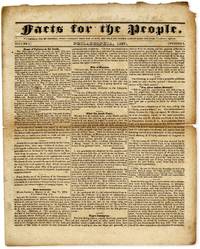
1837réf. 88394Philadelphia: Anti-slavery Society of the City and County of Philadelphia; printed by Merrihew & Gunn 1837. Single quarto issue 29cm x 23cm; ca. 11-1/2" x 9-1/4". Bifolium 4pp pages numbered 9-12. Issued monthly. Old horizontal fold at center as issued; small loss at upper margin away from printed area brief separations at folds without loss to text; complete and Good. Single issue of this very scarce presumably short-lived abolitionist newspaper published by Benjamin S. Jones under the auspices of the Anti-slavery Society of the City & County of Philadelphia. This copy with dated 1864 pencil ownership markings of "J.E. Jones" this possibly being the publisher's spouse the reformer abolitionist and suffragist Jane Elizabeth Jones née Hitchcock; 1816-1896. The paper's contents are devoted almost entirely to exposure of the injustices of the southern slave system with excerpts from Southern papers quoted and sharply rebuked by Jones' editorial comments. This issue also includes a brief notice of the progress of the recently-founded city of Houston Texas which now contained ".about 3000 people two hundred buildings four hotels thirteen retail stores and one wholesale establishment." The extracts quoted in this issue are generally dated from March April and May of 1837 leading us to suggest a May-June date for this issue. It is unclear how many issues of Facts for the People appeared. The only recorded example for a physical copy is at AAS which holds two unspecified issues with the annotation "sparse holdings." Not in LCP Afro-Americana. Not in Blockson. Anti-slavery Society of the City and County of Philadelphia; printed by Merrihew & Gunn unknown
1837réf. 88394Philadelphia: Anti-slavery Society of the City and County of Philadelphia; printed by Merrihew & Gunn 1837. Single quarto issue 29cm x 23cm; ca. 11-1/2" x 9-1/4". Bifolium 4pp pages numbered 9-12. Issued monthly. Old horizontal fold at center as issued; small loss at upper margin away from printed area brief separations at folds without loss to text; complete and Good. Single issue of this very scarce presumably short-lived abolitionist newspaper published by Benjamin S. Jones under the auspices of the Anti-slavery Society of the City & County of Philadelphia. This copy with dated 1864 pencil ownership markings of "J.E. Jones" this possibly being the publisher's spouse the reformer abolitionist and suffragist Jane Elizabeth Jones née Hitchcock; 1816-1896. The paper's contents are devoted almost entirely to exposure of the injustices of the southern slave system with excerpts from Southern papers quoted and sharply rebuked by Jones' editorial comments. This issue also includes a brief notice of the progress of the recently-founded city of Houston Texas which now contained ".about 3000 people two hundred buildings four hotels thirteen retail stores and one wholesale establishment." The extracts quoted in this issue are generally dated from March April and May of 1837 leading us to suggest a May-June date for this issue. It is unclear how many issues of Facts for the People appeared. The only recorded example for a physical copy is at AAS which holds two unspecified issues with the annotation "sparse holdings." Not in LCP Afro-Americana. Not in Blockson. Anti-slavery Society of the City and County of Philadelphia; printed by Merrihew & Gunn unknown books
1980Tutto il pubblicato, ottobre 1980 e marzo 1981. Ottimi esemplari. Presente anche la rara brossura pubblicitaria, pubblicata prima che la rivista uscisse, che contiene interviste, tra gli altri, a Giovanni Anselmo, Alighieri Boetti, Pierpaolo Calzolari, Luciano Fabro, Mimmo Paladino e Gilberto Zorio. Periodico d’arte ricco di articoli su artisti accompagnati da riproduzioni delle loro opere, attento, secondo Maffei, «alle corrispettive tendenze poetiche e letterarie». Interventi, tra gli altri, su Fausto Melotti, Sandro Chia, Mimmo Paladino, Osvaldo Licini, Alighiero Boetti, Scipione, Meret Oppenheim. In appendice traduzioni in inglese e in tedesco degli articoli salienti in ciascun numero. G. Maffei, Libri e documenti. Arte povera 1966-1980, Corraini, 2007, p. 272.Bit. Arte oggi in Italia 2 voll.