Steinbeck, JohnABAA
4 088 résultats
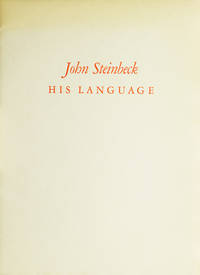
1970réf. 15473Aptos Calif: Roxburghe & Zamorano Clubs 1970. First edition one of 150 copies. Introduction by James D. Hart. 1 vols. 4to. Printed wrappers a little darkened at edges else fine. First edition one of 150 copies. Introduction by James D. Hart. 1 vols. 4to. Steinbeck's translation of a Ukrainian poem into a completely imaginary language. Goldstone & Payne A45a Roxburghe & Zamorano Clubs unknown books
1996réf. 597838New York: The Library of America 1996. Hardcover. Fine/Fine. First edition. Notes by Robert DeMott. Special consultant for this volume Elaine A. Steinbeck. Octavo. 1067pp. Tan cloth. Corners lightly bumped else fine in fine dust jacket. The Library of America hardcover books
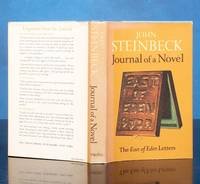
réf. 06578New York: The Viking Press 1969. Steinbeck at Work The Private Notebook Behind a Masterpiece STEINBECK John. Journal of a Novel. The East of Eden Letters. New York: The Viking Press 1969. First edition. Octavo 8 1/4 x 5 5/8 inches; 209 x 143 mm. x 1-2 3-182 pp. Publisher's quarter dark blue linen over blue cloth boards spine lettered in silver decorative endpapers top edge stained light blue. Original color pictorial dust jacket spine faded with minor wear to extremities. A fine copy in an excellent dust jacket. A fascinating and deeply revealing companion to East of Eden comprising Steinbeck's working journal written in the form of letters to his editor and friend Pascal Covici. Composed during the creation of his most ambitious novel these entries provide a rare day-by-day account of the creative process - charting Steinbeck's struggles ambitions and evolving ideas as East of Eden took shape. More than mere ancillary material this volume stands as an intimate self-portrait of the author at work offering insight into his discipline doubts and artistic philosophy. Goldstone & Payne A45a. New York: The Viking Press, 1969 unknown books
1970réf. 08779JOURNAL OF A NOVEL Heinemann 1970 first English edition stains on a couple of pages some soiling to foredes else vg in near fine dust-wrapper. The EAST OF EDEN memoirs. Heinemann unknown books
1969réf. 12803JOURNAL OF A NOVEL Viking 1969 first edition near fine in vg pictorial dust-wrapper with some light wear and tear. The EAST OF EDEN memoirs. Viking Press unknown books
réf. 001620New York The Viking Press 1969. A fine copy in like dust wrapper. Published posthumously this is Steinbeck's day-by-day account of the writing of East of Eden in the form of letters to his friend and publisher Pat Covici. First edition. New York The Viking Press (1969). unknown books
1969réf. 1264681969. New York: The Viking Press 1969. Narrow 4to 148 pp. Yellow card wrappers lettered in black with folding box. Upper wrappers numbered "11" in top left corner. very light wear to spine of wrappers box spotted else very good. § Unrevised proofs. Steinbeck's day-by-day account of the writing of East of Eden in the form of letters to his friend and publisher Pat Covici. The book was published posthumously in an edition of 600 copies. "John Steinbeck in writing East of Eden warmed up for the daily stint ahead in a "letter" to his editor the late Pascal Covici. It was written in pencil usually on the left-hand pages of a large notebook which Covici had supplied. Then when Steinbeck felt ready he proceeded to the text of the novel on the right-hand pages. The writing covered the period from January 29 to November 1 1951. There was a "letter" for every working day. The letter was primarily a method of flexing the author's mental and physical muscles. Steinbeck sometimes used it to adumbrate the problems and purposes of the passage on which he was about to embark-"a kind of arguing ground for the story" as he said once. At other times it consisted of random thoughts trial flights in wordsmanship nuggets of information and comment about the events of the moment both personal and public. But the letters were also full of serious thinking about this novel his longest and most ambitious as well as about novel-writing in general. Never intended for publication they cast a flood of light on the author's mind and on the nature of the creative process. And in the private glimpses of the Nobel-Prize-winning writer-his concern about his sons his hobbies such as wood- carving and carpentry his passion for invention-they are autobiographical material of the first order. In a sense this is Steinbeck's testament. unknown books
réf. AJ3670BLWDel Duca Broché bon état sous jaquette .Contenu propre . Pages non coupées .Jaquette érodée . 1961. 290 pages . PHOTOS SUR DEMANDE
réf. 9782070384570Gallimard
réf. 9782070368815Gallimard
1946réf. 130040Paris, Nrf Gallimard, impr. Presse de l’Imprimerie moderne, à Montrouge 1946 In-12 18 x 11 cm. Cartonnage éditeur noir orné sur les plats et le dos d’une composition polychrome d’après une maquette de Mario Prassinos, 274 pp., table. édition originale de la traduction française. Celui-ci, N 433/990 exemplaires sur pur fil Lafuma Navarre.
réf. 9782070407361Gallimard
réf. 9782073063731Gallimard
réf. 9782070612673Gallimard
réf. KN3527Gallimard jeunesse POCHE EN TRÈS BON ÉTAT.
réf. 9782070368617Gallimard
réf. 9782070366927Gallimard
1978réf. 13949San Francisco: Book Club of California 1978. First edition. One of 500 copies printed at the Plantin Press. xix 119 3 pp. 1 vols. 8vo. Cloth and boards. Mint copy in dust jacket which is very slightly faded at spine. First edition. One of 500 copies printed at the Plantin Press. xix 119 3 pp. 1 vols. 8vo. Book Club of California unknown books
réf. 06579London: Heinemann 1958. Steinbeck & Ricketts in the Gulf of California A Scientific Journey Recast as Literature STEINBECK John. The Log from the the Sea of Cortez. The narrative portion of the book Sea of Cortez with a profile "About Ed Ricketts". London: Heinemann 1958. First U.K. edition. Octavo 8 1/4 x 5 1/2 inches; 210 x 140 mm. lxvii 1 blank 1 1 blank 282 pp. Publisher's blue cloth over boards spine lettered in gilt. Corners a little bumped slight fading approx. 1/8 inch at foot of spine and some very light foxing. Original color printed dust jacket with minimal rubbing at extremities. Blue pencil inscription dated "19.9.58" on verso of front free endpaper. A very good copy in an excellent dust jacket. A reworking of Steinbeck's earlier collaborative expedition narrative with marine biologist Ed Ricketts originally published as Sea of Cortez 1941. In this later version Steinbeck presents the narrative portion alone accompanied by his moving biographical essay on Ricketts written after his friend's death. The result is a more personal and reflective work - part travel narrative part scientific observation and part elegy - capturing both the ecological richness of the Gulf of California and the intellectual companionship that shaped Steinbeck's thinking. Goldstone & Payne: see A40 U.S. edition; U.K. issue not separately enumerated. London: Heinemann, 1958 unknown books
réf. 06573New York: The Viking Press 1938. Steinbeck's Salinas Stories - A Cornerstone Collection First Edition in Exceptional Condition STEINBECK John. The Long Valley. New York: The Viking Press 1938. First edition. Octavo 8 x 5 inches; 203 x 127 mm. 1-8 9-303 1 blank pp. Publisher's quarter light tan buckram over orange cloth boards spine lettered in red top edge stained red. A fine copy in a fine dust jacket. A superb copy of The Long Valley an important early collection by John Steinbeck that brings together some of his finest short fiction much of it set in the Salinas Valley of California. The volume includes such notable stories as The Chrysanthemums The White Quail and The Red Pony in episodic form each reflecting Steinbeck's deep engagement with landscape isolation and the emotional lives of ordinary people. Published just one year before The Grapes of Wrath this collection marks a crucial moment in Steinbeck's development demonstrating his growing command of narrative form and thematic depth. The stories reveal in concentrated form many of the concerns that would define his major novels - loneliness the fragility of dreams and the tension between human aspiration and environmental constraint. The first edition is increasingly difficult to obtain in such fresh condition particularly with the dust jacket intact and unrestored. A cornerstone Steinbeck title here preserved in an unusually fine state-an essential addition to any serious collection of twentieth-century American literature. Goldstone & Payne A11a. New York: The Viking Press, 1938 unknown books
réf. 9782253140054LGF
1924réf. 1090241924 Editions Overseas - 1924 - Petit In-12, broché - 146 p.
1942réf. 14792MAANEN ER SKJULT THE MOON IS DOWN De Danske Studenters April 12 1942 one month after the American publication first Danish edition some light tanning to the margins of the covers else vg in unprinted light green wraps with just about fine contents. This very scarce mimeograph issue of this novel was an underground production by the Danish Resistance as the Nazi's would not allow this title to be published in occupied Denmark during the war. Text in Danish of course. De Danske Studenters paperback books
1942réf. 555911Copenhagen: De Danske Studenters Forlag 1942. Softcover. Near Fine. First Danish edition of The Moon is Down. Quarto. 58 1pp. Mimeographed pages in stapled unprinted beige wrappers. Small tears at the edges of teh slightly oversized yapped wrappers. very good or better. Apparently printed for students. De Danske Studenters Forlag unknown books
1953réf. 69082n.p. 1953. n.p.: 1953. Full Description: STEINBECK John. Manuscript draft for essay entitled "My Short Novels". n.p.n.d ca: 1953. Manuscript draft in Steinbeck's hand for the essay entitled "My Short Novels which served as a preface to the Literary Guild's 1953 edition of "The Short Novels of John Steinbeck." A near word for word representation of the essay which was originally published by The Literary Guild Review and found in their magazine "Wings" in October 1953 Pages 4-8. This manuscript is exciting because it is an close representation but still a draft of what was finally printed. In comparing the two documents you can see that the published piece was trimmed down a bit from what Steinbeck wrote in this manuscript draft. Many of the edits are eliminations of a few words here and there but there are a few places where whole sentences and ideas have been cut. Most of these are some what self-deprecating which is interesting to watch him ultimately play down. Apart from punctuation changes the parts of this manuscript that are not found in the final publication have been indicated by us below by being housed within brackets. Four foolscap legal-sized pages 12 1/2 x 8 inches; 318 x 202 mm. Written in pencil on recto only of each page. With a few notes and corrections. Each page is approximately 28 lines long. Lacking a final leaf which would go on to discuss the final two stories. Some minor toning and a small bump to bottom left corner of all leaves. Still a near fine example of a wonderful Steinbeck manuscript. Housed in a blue quarter morocco clamshell. Another manuscript draft version of this essay was sold at auction in 2023 for 32500 Euros and was also incomplete. Together with A copy of the The Literary Guild Review Magazine "Wings" which includes the entire essay. In the four present pages he discusses the origins of the stories The Red Pony Tortilla Flat Of Mice and Men and The Moon is Down. The final page which is lacking goes on to discuss Cannery Row and The Pearl. The Manuscript reads: "I have never written a preface nor a comment to one of my books before believing that the work should stand on its own feet even if it's legs ankles were slightly wobbly. When I was asked to comment on the five short novels of this volume my first impulse was to refuse. And then thinking over the things that have happened to these stories since they were written I was taken with the idea that the things that happen to a book are very like those that happen to a man. These stories cover a long period of my life. As each one was finished that part of my life it represented was finished. It is true that while he is doing it the writer and his book are one. When the book is finished it is a kind of death a matter of pain and sorrow to the writer. And then he starts a new book and a new life and if he is growing and changing a new life starts. And the writer like a fickle lover forgets his old love. It is no longer his own- the intimacy and the surprise are gone. So much I knew but I had not thought of the poor little stories thrust out into an unfriendly world to make their way. They have experiences too they grow and change or wane and die just as everyone does. They make friends or enemies and sometimes they waste away from neglect. Remembering the careers of these short novels has been interesting to me. All of the have been experiments. That is why no two of them are remotely alike. And experiments are rarely accepted all at once. My stories have been slow starters almost like shy young men who do not make friends quickly. Indeed most of my books have succeeded without trying in making quick and fierce enemies at first. It is pleasing to me that they do in time make lasting and loyal friends. The Red Pony was written a long time ago when there was desolation in my family. The first death had occurred- and the family which every child believes immortal was shattered. Perhaps this is the first adulthood of any man or woman- the first tortured question why and then acceptance and your child was a man. The Red Pony then was an attempt an experiment if you must to set down loss and acceptance death a the transfiguration the adult mind must create for itself. At that time I had had three books published and all of them had failed to come any where near selling their first editions. The Red Pony could not find a publisher. It came back over and over again until at last a foolishly brave editor bought it for The North American Review and paid 90 dollars for it. This was more money than I thought the world contained. What a great party we had in celebration. The Magazine went broke almost immediately and my story disappeared for a good number of years. That it ever came back is the remarkable thing. But it not only did but it seems to gather friends as it goes. It takes only the tiniest pinch of encouragement to keep a writer going and if he gets none he sometimes learns to feed even on the acid of failure. Tortilla Flat grew out of a reading of the sources of The Arthurian cycle- from Mabinogion Through Geoffrey and through the to Tennyson. I wanted to take the stories of my town of Monterey and cast them into a kind of folklore. The result was Tortilla Flat. It followed the pattern. Publisher after publisher rejected it until Pascal Covici finally published it. But it did have one distinction the others had not. It was not ignored. Indeed the Chamber of Commerce of Monterey fearing for its tourist business issued a statement that the book was a lie and that certainly no such disreputable people lived in that neighborhood. But perhaps the chamber did me a good service for this book sold two editions I think and this was almost more encouragement than I could stand. I was afraid I might get used to such profligacy on the part of the public and I knew it couldn't last. A moving picture company bought it and paid 4000 dollars for it- 3600 came to me. It was a fortune. When a few years later the company fired its editor one of the reasons was that he had bought Tortilla Flat. He bought it for the from the company for the original 4000 and several years later sold it to MGM for 90000 dollars a triumph for me albeit shallow a kind of justification for me and a fortune for the editor. Of Mice and Men was another experiment- an attempt to write a novel in three acts to be played from the lines. I had nearly finished it when my setter pup ate it one night- literally made confetti of it. I had to start fresh. I don't know how close the first and second versions would prove to be. This book had some success but as usual it found its enemies. It was called brutal its characters sub humans its story sadistic and one group found homosexuality in it which puzzled me quite a bit. With rewriting however it did become a play and had some success. There were long books written between these little novel. I think the little ones were exercises for the longer ones. The war came on and I wrote The Moon is Down as a kind of celebration of the durability of democracy. I couldn't have conceived that it would be denounced as almost treason. I had written of Germans as men not super men and this was considered a very weak attitude to take. I couldn't make much sense out of this and it seems." HBS 69082. $10000. n.p. unknown books