Aragon, Damien EBiblio.com

6769 risultati
rif. 48920709-nnew. unknown
rif. 45817496like new. unknown
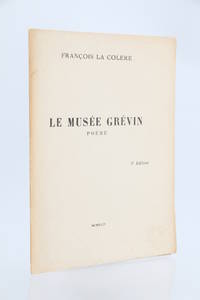
1944rif. 87421s. l. Aurillac: Les Editions de MinuitComité national des écrivains 1944. Fine. Les Editions de Minuit Comité national des écrivains s. l. Aurillac circa aout 1944 13.50 x 19 cm broché First deluxe edition of this masterpiece of Resistance literature one of 100 numbered copies on coated paper the only deluxe copies. A small fold at the foot of the first cover also affecting the following leaves minute foxing in the right margin of the first cover. First published probably simultaneously in the northern zone as a leaflet by ""Les éditions de Minuit"" and in the southern zone as a handmade brochure the cover was wallpaper inaugurating the famous ""Bibliothèque française"" this long poem would subsequently appear for the first time in volume form in October 1943 before it was decided to finally produce a deluxe edition sold for 100 francs instead of 10 francs for the ordinary edition ""intended to honor the financial contributions of Resistance bibliophiles."" Le Musée Grévin considered upon its publication as ""Les Châtiments of 1943"" Les étoiles Dec. 1943 no. 14 would remain with Paul Éluard's Liberté ""one of the masterpieces of clandestine literature."" In L'Intelligence en guerre published in 1945 Louis Parrot would write about it: « ce poème traversé d'images éblouissantes est en même temps qu'une condamnation sans appel des traîtres une prière un acte de fois envers leurs malheureuses victimes. Il peint en termes vengeurs les misérables qui les livrèrent aux bourreaux et évoque le visage de tant de femmes françaises torturées. » This pivotal poem is indeed one of the very first public evocations and the first literary one of the Auschwitz camp: « Aux confins de Pologne existe une géhenne dont le nom siffle et souffle une affreuse chanson. Ausschwitz ! Ausschwitz ! Ausschwitz ! ô syllabes sanglantes ! Ici l'on vit ici l'on meurt à petit feu. On appelle cela l'exécution lente. Une part de nos curs y périt peu à peu ». Exceptional copy printed on fine paper a true act of war whose perilous operation to procure luxury paper in a France where the Nazis controlled printing paper production through the Comité d'organisation des industries arts et commerces du livre COIACL can only be imagined. Les Editions de MinuitComité national des écrivains unknown
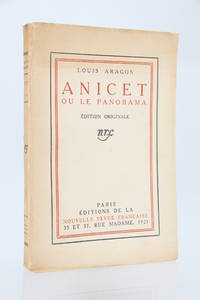
1921rif. 87382Paris: Nrf 1921. Fine. Nrf Paris 1921 13 x 19 cm broché First edition one of 940 numbered copies on wove paper the only deluxe copies with 120 reimposed. Spine and boards very slightly sunned as often some minor foxing. Nrf hardcover
rif. 16222088like new. unknown
rif. 10249078like new. unknown
rif. 10249078-nnew. unknown
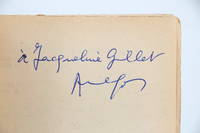
1949rif. 87699Paris: La bibliothèque française 1949. Fine. La bibliothèque française Paris 1949-1951 11.50 x 18.50 cm 6 volumes brochés First edition on ordinary paper for each of the volumes. Complete set in 6 volumes. Handsome copy despite small corner lacks of no consequence to the boards considering the poor quality of this paper. On the first volume autograph inscription signed by Louis Aragon to Jacqueline Gillet enriched with the manuscript signatures of Yves Robert and Daniel Delorme. La bibliothèque française hardcover
rif. JP 9789386056726USA Edition . New. Brand New! Fast Delivery This is an International Edition and ship within 24-48 hours. Deliver by FedEx and Dhl & Aramex UPS & USPS and we do accept APO and PO BOX Addresses. Order can be delivered worldwide within 6-10 days and we do have flat rate for up to 2LB. Extra shipping charges will be requested if the Book weight is more than 5 LB. This Item May be shipped from India United states & United Kingdom. Depending on your location and availability. unknown
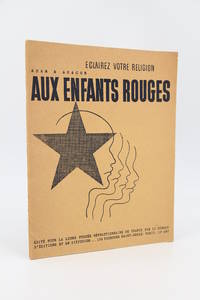
1932rif. 86460Paris: Bureau d'Éditions et de Diffusion 1932. Fine. Bureau d'Éditions et de Diffusion Paris 1932 18 x 23.50 cm agrafé First edition. Illustrated with 16 drawings by Georges Adam. A superb copy of this rare booklet by Louis Aragon a true ""anti-clerical anti-capitalist anti-colonialist anti-patriotic"" Pierre Juquin catechism for the children of the exploited working masses. ""On June 25 1932 the Imprimerie centrale completed printing for the Bureau des éditions et de diffusion 132 Faubourg Saint-Denis Paris a beautiful pamphlet now a bibliophilic rarity . On the cover a large red star - an important and recurrent image in Aragon's work - appears imprinted on children's brains. Sixteen quatrains droll and didactic punctuated for ease of reading alternate with drawings by Georges Adam whose nearly expressionist mockery reminiscent of Rouault's paintings overturns taboos and myths."" Aragon. Un destin français 1897-1939 After breaking with the Surrealists Aragon threw himself wholeheartedly into the Journal de la lutte antireligieuse. He wrote this pamphlet from Moscow and published it on the Party's presses to ignite the fervor of proletarian youth. French poet Jacques Prévert would later follow a similar path with his play Émasculée conception. Anticlerical activism within French Communist associations was in full swing at the time: every symbol and events of religious life were reinterpreted through the lens of class struggle. ""Red baptisms"" were organised forming a community of ""Godless"" children drawing their name from the Association of Godless Workers who corresponded with their Soviet counterparts. Aragon contributed to these new rituals with this particularly radical children's book deemed excessively antipatriotic by Maurice Thorez which he would later disavow at the end of his life. Bureau d'Éditions et de Diffusion unknown
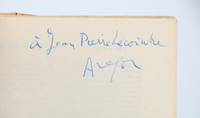
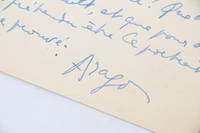
1946rif. 86653Paris: Les Editeurs Français Réunis 1946. Fine. Les Editeurs Français Réunis Paris 1946 12 x 17.50 cm broché New edition. Handsome copy. Autograph inscription signed by Louis Aragon to Jean-Pierre Lecointre. Les Editeurs Français Réunis unknown
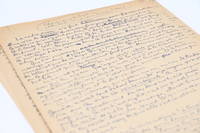
1950rif. 872201950. Fine. It has to be said that we are publishing here this masterpiece deliberately ignored by those who write literary history and which makes existentialist teeth grind or simply spoilt teeth as an example sure that it will not be in vain. s. d. circa 1950 21 x 30 cm une page sur un feuillet Autograph manuscript by Louis Aragon one page in blue ink on a leaf. Precious study by Louis Aragon accompanying the serial publication in Les Lettres Françaises of Marceline Desbordes-Valmore's novel L'Atelier d'un peintre 1833. Aragon rehabilitates the female poet-novelist canceled from the history of literature and snubbed by Existentialists placing her in the tradition of socialist realism. Autograph manuscript by Louis Aragon one page in blue ink on one leaf. Numerous crossed out words and rewritings. Slight rusting due to a paper clip slight shadows of an ink transfer from another page. Published in Les Lettres Françaises episode 16 23 February 1950. In 1949 Aragon chose to publish 'L'Atelier d'un peintre' serially with his own comments. The Cold War made socialist realism the official literary genre for Communist cultural policy: 'For Aragon reading Marceline Desbordes-Valmore is above all reading the history of a generation of a people. More precisely he made Marceline an incarnation of the unfinished Republic of a world still under construction and one that was tending towards freedom. To understand Marceline Aragon invites us to 'date her writings' and not be content to confine her to a single period of her life but to try to find an explanation for her stances which were as different as the regimes during the gestation of the Republic in the nineteenth century'. Aghbarian Lina 'Aragon éditeur de Marceline Desbordes-Valmore' Recherches croisées Aragon - Elsa Triolet no. 14. Of all his comments accompanying 'L'Atelier d'un peintre' this is one of his most polemical: Aragon opposes the Surrealists by contesting Lautréamont's distate of the Romantics with whom Desbordes-Valmore was associated. The writer criticizes the hasty rejection of her work which nevertheless has counterparts in modern literature: 'The Atelier that Aragon reopens with the publication of this novel to rework it to reveal it to give it a second life closer to his own concerns after having disentangled it from its time and emptied it of its Romantic religiosity to lay bare its richness which lies in the feminist cause defended by Marceline Desbordes-Valmore . . For her Ondine the literary character was a transposition of the missing child her son the son of Henri de Latouche her lover. Ondine is thus three times hybrid androgynous real and imaginary daughter and mother at the same time and Léonard her inverted double the one she would have liked to be in order to succeed in the forbidden world of painting. Aragon doubles androgyny with homosexuality as seen in Yorick's phrase 'Talma doubles my existence'. Among other allusions he refers to Henri Miller's Sexus an allusion is made about this work in this manuscript Aragon cultivates the theme of duality on which the whole novel is built. Without abandoning the imaginary world of the novel he seeks to bring out the realistic side of this romantic novel hidden in the shadow of the lyrical novel. In a word Aragon reverses the order of the foreground and background: the romanticism of Marceline Desbordes-Valmore's novel becomes secondary and the historical background takes precedence' ibid. 'We have now come to the night scene in the Place Vendôme which is one of the most intense the most beautiful minutes of the novel of the other century. I know that not everyone will agree. It's come to my attention that there are people who are superbly distracted from L'Atelier d'un peintre and find it wrong that we should publish a story in which there is absolutely nothing of what THEY are looking for in novels and it's possible that those who c unknown
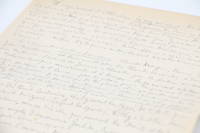
1948rif. 872391948. Fine. ""Nose in the air arms flying with nonchalance with joy as Willy Ronis says. black shoes a large hat a wasp waist skirt in the wind and not the slightest idea what all this could be for but all the sunshine of late April in the veil. and like Paris absurdly inimitable."" s. d. avril 1948 21 x 30 cm 4 pages sur 4 feuillets Exceptional complete autograph manuscript by Louis Aragon. 4 pages in pencil on 4 leaves numbered in his hand. Discrete trace of rust discharge on the first leaf and on the verso of the last. Horizontal fold across all leaves. The article would be published under the title ""L'Art de prendre une photo pour Les Lettres Françaises"" Regards May 14 1948. Aragon accompanies the great Willy Ronis during a photographic session for a fashion portrait for Les Lettres Françaises. Following in Ronis's footsteps as he directs his spinning model the writer takes us through four pages across an enchanting Paris where popular life and worldly elegance intermingle. ""The aim was to illustrate Le Nez au vent by Louis Chéronnet. The column's theme was: The Elegance of Paris is moving westward and more specifically focused on avenue Montaigne"" begins Aragon in his chronicle. For the duration of a day the writer documents with fascination the photographer's work in one of his favorite settings: the streets of Paris. Several tableaux unfold in succession in the Montorgueil quarter at the milliner's in Ronis's studio on avenue Montaigne at the Théâtre des Champs-Elysées. The key word for both Aragon and Ronis is movement. Photography is not static nor are Aragon's impressions. We jump like the model in the photographer's shots from one place to another. The portrait of the elegant woman expands under the writer's pen to her surroundings to the bubbling life of Paris that stops for an instant to contemplate the model's silhouette animated by the photographer's instructions. Sixty years later Ronis would remember that memorable day: ""Aragon had a very beautiful regard for photography. He knew what an image was. Elsa too. He had me work when he founded and directed Les Lettres françaises. I did several reports for him. The first small report was in 1947 or 48 a report on fashion on avenue Montaigne. Aragon came with me we had chosen a model. I was a bit intimidated by Aragon it was my first contact with him. I wanted to get the maximum from my model I was working very hard because I was nervous. Seeing me work amused him so much that he didn't write the report about the model but about me working. I had seen him quite many times afterward we used the familiar form with each other."" Willy Ronis interview in Libération September 14 2009 Their militant paths crossed on numerous occasions - Ronis contributed through his photographs to witness the social revolts that shook the 1930s while Aragon devoted many articles to them. In 1949 the photographer would follow the commemorative day of the Oradour-sur-Glane tragedy in which nearly 400 artists participated at Aragon's initiative. He would also be the author of beautiful portraits of the Aragon-Triolet couple. Excerpts from the manuscript: Willy Ronis had arranged to meet me at 10:30 at the corner of rue Tiquetonne and rue Montorgueil. Apparently he was photographing athletes there. Ah! it was that restaurant where in the past we used to go eat with Vaillant-Couturier and there were Action Française types who would shoot daggers at us with their eyes. Instead of athletes Willy was there in his velvet jacket with his spectacles taking shots left and right at the counter of a couple of lovers. Sweet the lovers. The little one especially. Perhaps it's a sport. . There is nothing more solemn than Caroline Reboux. It is the temple of hats. If he lived in our times this is where Aristotle would write. Caroline Reboux herself made the bonnets for Nana and Eugénie de Montijo; at her place Bel-Ami would twist h unknown
1948rif. 871601948. Fine. ""Pour moi l'amitié des assasins n'est pas l'amitié . tant pis si l'on me juge esclave et qu'on me juge sans coeur !"" For me the friendship of assassins is not friendship . too bad if I am judged a slave and judged heartless! s. d. 1948 21 x 30 cm 8 pages et demi sur 9 feuillets Exceptional autograph manuscript by Louis Aragon entitled ""Chronique de la pluie et du beau temps pour Europe mai"". 8 and a half pages in blue ink on 9 uniformly browned leaves. Numerous deletions and rewritings. Published in Europe no 29 May 1948 and does not appear in the book collecting these chronicles E.F.R. 1979. Superb nine-page militant profession of faith published in the anti-fascist literary review Europe. Aragon finds himself courted after the war in the name of ""friendship"" and ""freedom"" by various reviews but categorically refuses to publish alongside writers with Pétainist tendencies. The writer delivers his impressions after a radio interview in Belgium and meditates on ""two abstract monsters: freedom and friendship"" perverted at will in this early Cold War period when Sovietism becomes - to his great dismay - the new fascism. Very attached to the unified discourse advocated by communism which he calls ""national truth"" this notion serves as the guiding thread of his chronicle. Aragon writes in the midst of the Kravchenko affair and remains convinced by Sovietism which remains for him the great victor over Nazism. As a great literary witness to the suffering endured during the Occupation he is alarmed by the editorial choices of reviews seeking to obtain contributions from him: one shamelessly publishes a text by Montherlant totally oblivious to the Parisian martyrs during the war while the other affectionately justifies the allegiances of many French people to Marshal Pétain. It is also the occasion for a long and beautiful analysis of the idea of nation by Aragon who is unquestionably the national poet of this century. We find there in his inspired tirades the Aragonian ideal of healthy emulation among nations turned toward progress. Beautiful pages by Aragon in the midst of the crystallization of the Eastern and Western blocs. Aragon's ambition is to honor the memory of the Resistance by choosing to ""trust words when they are used for peace"". ""La Nation qui me paraît aujourd'hui encore être le groupe le plus étendu qui puisse se porter garant d'une vérité . la radio peut et doit transmettre à son public la vérité nationale . 'Qu'entendez-vous concrètement par vérité nationale ' Me demande-t-il comme il m'aurait sûrement demandé : qu'entendez-vous en disant qu'il fait grand jour en plein midi si je l'avais dit. C'est là le mécanisme des interviews. J'ai donc pris deux exemples concrets pour expliquer à quoi sert le maniement des abstractions. Deux cas récents où j'ai eu à me mesurer avec deux monstres abstraits : la liberté et l'amitié. La liberté d'abord. On sait comment les pires ennemis de la liberté font usage d'un livre qui s'appelle : J'ai choisi la liberté donnant le bénéfice d'un préjugé favorable de ce mot à tous ceux qui trahissent leur pays quand c'est pour choisir le système capitaliste . . Une revue qui s'édite à Montréal m'avait récemment écrit pour me demander ma collaboration. Son directeur littéraire faisait appel à l'homme libre l'italique est sienne que je suis. Cette façon de distinguer par la typographie en moi la possibilité d'être parfois un homme libre parfois non m'avait un peu inquiété. J'ai voulu voir sa revue . Mon Dieu le fait que ce numéro s'ouvre par un texte de M. de Montherlant me laisse libre de ne pas parler du contexte. On sait et j'imagine que M. Victor Barbeau de Montréal n'ignore pas que M. de Montherlant est sur la liste des écrivains avec lesquels les membres du Comité National des Ecrivains se refusent à collaborer. Ce qui doit sans doute m'expliquer pourquoi M. Barbeau s'adresse en moi à l'homme libre : c'est- unknown
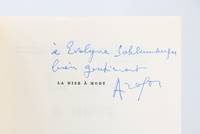
1965rif. 84814Paris: Gallimard 1965. Fine. Gallimard Paris 1965 14 x 20.50 cm broché First edition a Service de Presse advance copy. Spine very slightly sunned and creased without gravity small stains on the second cover. Signed autograph inscription from Louis Aragon to the journalist Evelyne Schlumberger. Gallimard unknown
1974rif. 85125Paris: Gallimard 1974. Fine. Gallimard Paris 1974 15 x 22 cm broché First edition one of 55 numbered copies on Holland paper deluxe copy. A very handsome copy. Gallimard unknown
1965rif. 85122Paris: Gallimard 1965. Fine. Gallimard Paris 1965 14 x 20.50 cm broché First edition one of 50 numbered copies on Holland paper deluxe copy. A very handsome copy. Gallimard unknown
1945rif. 83581Paris: La Bibliothèque Française 1945. Fine. La Bibliothèque Française Paris 1945 14.50 x 21 cm broché First edition one of 535 numbered copies the only deluxe copies. Spine slightly sunned small marginal tears to boards a full-margined copy. La Bibliothèque Française hardcover
1965rif. 83583Paris: Gallimard 1965. Fine. Gallimard Paris 1965 14 x 20.50 cm broché First edition one of 145 numbered copies on pur fil paper the only deluxe copies after 50 on Holland paper. Spine lightly sunned final endpaper shadowed due to the presence of press clippings otherwise handsome copy. Gallimard unknown
1964rif. 84241Paris: Gallimard 1964. Fine. Gallimard Paris 1964 12 x 19 cm broché First edition one of 43 numbered copies on Holland paper deluxe copies. Very fine copy. Gallimard unknown
1965rif. 84238Paris: Gallimard 1965. Fine. Gallimard Paris 1965 14 x 20.50 cm broché First edition one of 50 numbered copies on Holland vellum paper deluxe issue. A very fine copy. Gallimard hardcover
1946rif. 84242Paris: Gallimard 1946. Fine. Gallimard Paris 1946-1953 12 x 19 cm 2 volumes brochés First edition one of 55 numbered copies on vellum for each volume deluxe copies. Spines very lightly sunned without detriment handsome set. Gallimard hardcover
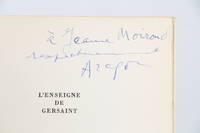
1946rif. 84233Neuchâtel & Paris: Ides et Calendes 1946. Fine. Ides et Calendes Neuchâtel & Paris 1946 16.50 x 22.50 cm broché First edition one of the numbered copies on vellum the only issue with 60 Ingres. The work illustrated with plates by Watteau. Handsome copy. Signed autograph inscription from Louis Aragon to Jeanne Moirond. Ides et Calendes hardcover
1997rif. 83202Paris: Gallimard Bibliothèque de La Pléiade 1997. Fine. Gallimard Bibliothèque de La Pléiade Paris 1997 10.50 x 17.50 cm reliure de l'éditeur sous étui First edition. Rich iconography. Spine of the rhodoid slightly yellowed. Handsome copy complete with its rhodoid and slipcase. Gallimard, Bibliothèque de La Pléiade unknown