4 294 résultats
1909A stunning large-paper copy of the first edition of the definitive text of the author's most important work, one of the chief literary manifestations of Catalan modernism. The first two editions appeared in 1905, and were printed on cheap paper, and there were no large-paper copies. 135 large-paper copies of this 1909 edition were printed, of which THIS IS ONE OF 35 NUMBERED COPIES PRINTED ON FINE JAPANESE PAPER AND SIGNED IN INK BY THE AUTHOR (the remaining 100 large-paper copies were printed on laid paper, and were not signed). 8vo. A PRISTINE COPY IN THE ORIGINAL WRAPS, ADORNED WITH A BEAUTIFUL MODERNIST (i.e., Catalan art nouveau) DESIGN. UNCUT AND UNOPENED. A bit of foxing to edges (not on pages), else FINE AND BRIGHT, with no defects. Complete with prospectus, also printed on Japanese paper. A wonderful copy of perhaps the most important modern Catalan novel--very, very few copies of this deluxe issue have surivived in the original wraps.
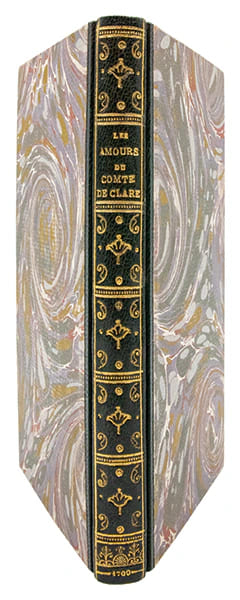
réf. 39564Petit in-12 (140 x 82 mm), demi-maroquin vert bronze à la Bradel, dos lisse richement orné de compartiments cloisonnés et fleuronnés aux petits fers dans le goût de l'époque, titre doré, tête dorée (reliure signée de C. Honnelaître). 144 pages. Amsterdam, Pierre Schaier (à la sphère), 1700.
réf. 39219In-12 (185 x 120 mm), broché, couverture imprimée, 301, (3) pages. Paris, Julliard, 1951.
1673réf. 29231Paris Chez Jean Du Puis, à La Couronne D'or 1673 In-12 8 ff -243 ( 1 ) et un ff d'approbation et privilège , manque de cuir en coiffe de queue et coiffe de tête élimée, dos passé et lors frotté Exemplaire rare en reliure d'époque. édition originale de ce livre essentiel et précurseur qui valut beaucoup d'ennuis à son auteur
réf. DADAX0807067342New unknown
1930Very Good Turkish, Ottoman (1500-1928) The collection includes one full diary, 4 notebooks, 120 letters addressed to Nevin Pertev Demirhan and Meryem Ana Efes ruins photo negatives in an envelope, and ID cards, court documents of Demirhan family (Father Pertev Pasha, brother Ömer Ilhan Demirhan, and mother Hatice Leman Demirhan). 4 notebooks of her from "English High for Girls, Constantinople" including the lessons of dictation, rough notebook, setback, essays, and letters. All notebooks are in English. Also, there are letters addressed to Fatma Behçet Hanim. Diary includes [336] p. with full of writings between the dates August 4, 1955 (Thursday) and November 24, 1955 (Thursday). This collection contains an Ottoman / Turkish intellectual woman's political thoughts, social life, travels, recipes, and friendships in a short time in 1955. A hardcover manuscript diary and letters to and from her. Letters have very interesting correspondences in the mostly Ottoman script as well as in modern Turkish, English, French, and German. One of the letters addressed to her (Ömer Ilhan Demirhan's letter) and some others include very interesting thoughts about women and femininity. Ömer Ilhan told her that he wants to be married and that did not find a suitable wife for himself. Some of the letters in this collection like that have very important and interesting hints for "Turkish women". Letters dated usually from the 1930s to the 1950s. Nevin Pertev Demirhan was an intellectual and translator as well as pianist according to 'Türkischer Biographischer Index'. She translated her father's book titled 'Islam' into English with her father. Her father was Sait Pertev Demirhan who was an important Turkish soldier, intellectual, and politician.
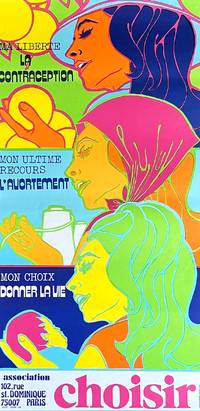
1971réf. 102469Paris Association Choisir imprimexpress Joué-les-Tours n.d. c. 1971. Unsigned poster One sheet folio 35 x 71 cm. A colourful poster published in the beginning of the seventies by the 'Association Choisir'. On April 5 1971 in France 343 filmmakers writers actresses singers and philosophers ended a long-held silence. "One million women have abortions each year in France" they wrote in a manifesto published in the magazine Nouvel Observateur. "I declare that I am one of them. I declare that I've had an abortion. We demand open access to contraceptives; we demand open abortion." Written with the help of star intellectual Simone de Beauvoir and signed by celebrities ranging from Catherine Deneuve to Françoise Sagan the text circulated quickly throughout the country. Shortly after Gisèle Halimini an attorney and Simone de Beauvoir co-founded the feminist group Choisir to protect the women who had signed the Manifesto of the 343. In 1972 Choisir formed itself into a clearly reformist body and the campaign greatly influenced the passing of the law allowing contraception and abortion carried through by Simone Veil in 1974. The association is still active under the name "Choisir la cause des femmes".
réf. 396133 volumes in-4 (210 x 153 mm), papier jauni, basane mouchetée de l'époque, dos à 4 nerfs soulignés de filets dorés, pièces de titre de veau acajou, filet d'encadrement doré sur les plats, tranches mouchetées rouges, (56), 454, (10) p. ; (16), 381, (25) p. et (8), 528 [i.e. 536], (16) p. Paris, Augustin Courbé, 1640-1639 (tome III).
réf. 39364In-16 (133 x 80 mm), veau porphyre de l’époque, dos lisse orné de compartiments garnis d’un fer à la toile d’araignée répété au centre, filets et palettes dorés, pièce de titre de veau vert bronze, (4), xij, [13]-136 pages et 4 pages de catalogue éditeur. Paris, Mercier, s.d. [1796].
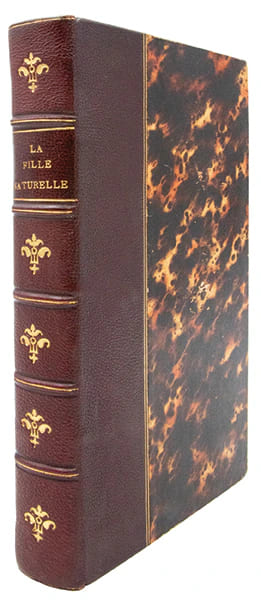
réf. 39347In-8 (220 x 140 mm), demi-chagrin grenat à grands coins, dos à 5 nerfs filetés au noir, auteur et titre dorés, couverture illustrée et dos conservés, 390 pages, exemplaire non rogné. Paris, Paul Morihien, 1948 (Levallois, Société Industrielle d'Imprimerie, 15 juin 1948).
réf. 39263Petit in-12 (128 x 70 mm), vélin rigide de l'époque, dos lisse, 284 pages. Cologne, Pierre du Marteau [i.e. Utrecht, R. Van Zyll], 1685.
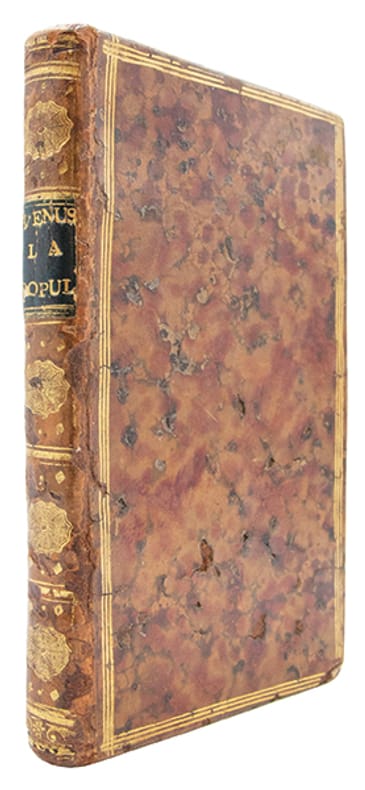
réf. 38483In-12 (164 x 96 mm), plein veau marbré de l'époque, dos à 5 nerfs orné de caissons fleuronnés et cloisonnés, pièce de titre de maroquin bordeaux, filet doré sur les coupes, tranches jaspées, xxiv, 423 p. Amsterdam, Arkstée et Merkus, 1773.
In-12 (164 x 96 mm), plein veau marbré de l'époque, dos à 5 nerfs orné de caissons fleuronnés et cloisonnés, pièce de titre de maroquin bordeaux, filet doré sur les coupes, tranches jaspées, xxiv, 423 p. Première édition française de 'Distinction of Ranks in Society' (1771), traduit par J.-B. Suard, le principal ouvrage de John Millar, qui ne sera réédité qu'une seule fois en français (en 1778). Une partie du tirage de la même édition porte le titre de 'Observations sur la distinction des rangs de la société'. Membre de l'école écossaise, élève puis protégé d’Adam Smith, Millar devint avocat et son enseignement à Glasgow remporta un succès considérable. L’ouvrage, qui défend la thèse que les lois fondamentales qui régissent les sociétés reposent sur des facteurs économiques et non politiques, est considéré de ce fait comme l’un des textes précurseurs du matérialisme historique prémarxiste. D'importantes pages plaident pour l'égalité entre les femmes et les hommes, pour l'abolition de l'esclavage, ou la nécessité d'améliorer les conditions de travail des plus défavorisés. Millar se prononce également en faveur de l'indépendance américaine et d'une large démocratisation du système politique français. Selon Jean Mondot ('Diderot-Raynal et les Lumières écossaises', In "Lumières", 2004, n°3, p. 57), "ce livre constitue la référence principale d'après laquelle Diderot-Raynal composeront leur histoire de l'esclavage". (Conlon, 'Siècle des Lumières', 73:1070. France littéraire, VI, 131. I.E.S.S., X, 348-349). Coins légèrement émoussés. Bel exemplaire, très frais, grand de marges, bien relié à l'époque, imprimé en partie sur papier bleuté.
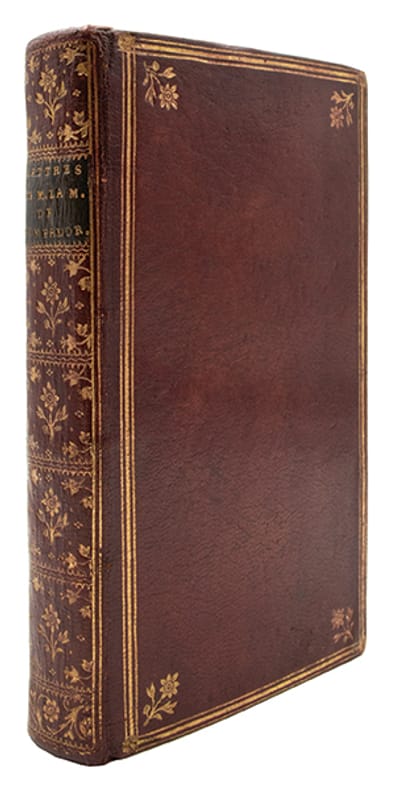
réf. 391513 tomes reliés en un volume in-12 (163 x 94 mm), maroquin rouge de l’époque, dos lisse richement orné de compartiments fleuronnés et cloisonnés, pièce de titre de maroquin bronze, triples filets d’encadrement sur les plats avec fleurons d’angle, roulette sur les coiffes et les coupes, dentelle intérieure, tranches dorées, gardes de papier d’Augsbourg doré et étoilé, (4), 128 p. ; 100, (10) p., (1) f. blanc et (16), 236 p., bandeaux, culs-de-lampe et ornements typographiques gravés sur bois.
17948vo; Period full leather, 12mo, 246 pages. 3 volumes in 1, as issued. With seperate title page for each volume. Included in the "William B. Cairns Collection of American Women Writers 1650-1940" at UWisc-Madison. WR. I, #2252. Susanna Rowson, née Haswell (1762-1824) was a British-American novelist, poet, playwright, religious writer, stage actress, and educator, considered the first woman geographer and supporter of female education. She also wrote against slavery. Rowson was the author of the 1791 novel Charlotte Temple, the most popular best-seller in American literature until Harriet Beecher Stowe's Uncle Tom's Cabin was published serially in 1851-1852 and authored the first human geography textbook Rowson's Abridgement of Universal Geography in 1805. Charlotte: A Tale of Truth [was] later reissued in America as Charlotte Temple, where it became the new nation's first best-selling novel. This popular story of seduction and remorse has gone through more than 200 editions. The novel sparked much controversy, both over its content and whether it could actually be considered a novel due to its minimal number of pages. .in 1791, Susanna and [her husband] William took in his orphaned sister Charlotte Rowson and they all turned to acting .In 1793, the three Rowsons were recruited for the Philadelphia theatre company of Thomas Wignell, also performing with them in Baltimore. Over the next three years in Philadelphia, she wrote a novel, an opera, a musical farce about the Whiskey Rebellion (The Volunteers), a poetical address to the American troops, and several songs for the company in addition to performing 57 roles on the stage in two seasons. Rowson's work as a playwright and actor encouraged the growth of performing art in the United States. In response to her seemingly new-found republicanism and the liberal gender roles in her work, Slaves in Algiers, she was attacked by William Cobbett, who referred to her as 'our American Sappho' (she returned fire, calling him a 'loathsome reptile' in her introduction to Trials of the Human Heart).In 1796, Susanna reestablished contact with her old Edinburgh director, John Brown Williamson. He had taken over the Federal Street Theatre in Boston, and the Rowson trio relocated there in part to be closer to the more familiar residence of her youth and her core American literary fan-base. The bankruptcy and major restructuring of the Boston theatre in 1797 would have sent Susanna and William to Charleston, but rather than head south they abandoned the stage after a few summer performances in Newport and Providence, Rhode Island .On leaving the stage, Susanna opened the first 'female academy' in Boston in 1797 'Mrs Rowson's Academy for Young Ladies. The earliest American map samplers (1779,1780) were by students Lydia Withington and Sally Dodge who were educated there and cover detailed images of Boston harbour and islands and detailed street plan. Desiring a more rural setting, Rowson would move her school to Medford, then to Newton, Massachusetts, before returning it to Boston in 1809. She was a leader on female education and also the first woman geographer, publishing the first American education book on geography Rowson's Abridgement of Universal Geography in 1805, a textbook focussing on human geography not maps and including information on the position of women, the cultural, religious, financial and social structure of different continents and in particular the impact of the 'barbarous, degrading traffic' of slavery. She also published Youth's First Steps in Geography in 1811. She managed her school until 1822 and trained hundreds of girls overall. Rowson also continued her writings, producing several novels, an additional work for the stage, a dictionary as well as the two geographies and as a contributor to the Boston Weekly Magazine (18021805). Her educational and literary work helped provide support for a growing household. Having no children of their own, they took in many members of Williams family, including a niece, Rebecca Haswell, who would marry Roxbury mayor John Jones Clarke, becoming great-grandmother of poet E. E. Cummings (Wikipedia). No copy appearing for sale at any major auction house in the last 35 years. OCLC: 9108455. Front hinge stating, 1.5 chip to crown of spine, heavy wear to boards and blank endpapers. Wear, stains, and previous owners name (Eliza Colfax) in period hand to half title and title page. Good Condition Thus. Scarce 18th Century American Womens imprint. (AC-22-24).
1925In -8°, XX, 72 p., include una tavola all’antiporta con ritratto dell’autore disegnato da Gino Severini
réf. 102381Amsterdam 1973 - 1974. Size: 215 x 275 cm. 17; 23; 22 10 pp. Illustrated in b/w. Stencilled. Stapled. This short-lived radical feminist magazine was published from 1972 to 1974. Only six issues saw the light of day. It is an important source for the history of feminism and gender studies. Copies are extremely rare and complete sets impossible to find. I have only found three complete sets in libraries all in Amsterdam. Paarse September conisted of four women who became soon famous for claiming in the first issue of their magazine that feminists that stayed heterosexual were not real feminists and could even be considered anti-feminists. Their motto was "Being lesbian is a political choice" Lesbisch zijn is een politieke keuze. After six issues Paarse September stopped in 1974 because they thought their ideas were well known by then.
réf. 39245In-8 (175 x 110 mm), cartonnage à la Bradel moderne, dos lisse, pièce de titre de maroquin lavallière, (2), 73, (1) pages, frontispice gravé. S. l. [avril], 1788.
réf. 38734In-8 (207 x 139 mm), broché, couverture imprimée, 622 p., (1) f. de table et achevé d’imprimer. Paris, Gallimard, 1960.
réf. 3522664 pages in4 numérotées de 15 à 79 (mais cela commence au début) - bon état - râtures et corrections -
réf. 392024 tomes reliés en 2 volumes in-12 (168 x 102 mm), basane havane marbrée, dos lisses ornés de compartiments fleuronnés et cloisonnés, palette en tête et pied, pièces de titre de veau fauve, tranches rouges (rel. fin XIXe dans le goût du XVIIIe), (1) f. de faux-titre, 240 p.; (1) f., p. 241-482; (1) f., p. 483-728 ; (1) f., p. 729-979, (1) pages de "corrections" (pagination continue). A La Haye et se trouve à Paris, Chez Maradan, libraire, rue des Noyers, n°33, 1788
réf. 395952 tomes en un volume in-12 (163 x 94 mm), demi-chagrin aubergine, dos à cinq nerfs filetés or, orné de compartiments fleuronnés, titre doré, tranches rouges (reliure moderne), 171 pages et 202 pages. Imprimé à La Haie, Et se trouve à Paris, chez Humblot, Quillau, 1769.
1689réf. 41675À Alby, Jean et Guillaume Pech, 1689. In-12 de 105-(1) pp., demi-vélin, dos lisse, pièce de titre rouge (reliure moderne).
1557réf. 38431Petit in-8 (162 x 100 mm), demi-veau havane, dos lisse orné d'un décor de compartiments cloisonnés de listels de cuir noir incrustés en place des nerfs soulignés de filets dorés et d'un fleuron répété au centre (rel. vers 1830) (8), 153 (i.e. 132) feuillets, grande et belle marque de l'imprimeur gravée sur bois au verso du dernier feuillet. Paris, Vincent Sertenas, 1557.
Petit in-8 (162 x 100 mm), demi-veau havane, dos lisse orné d'un décor de compartiments cloisonnés de listels de cuir noir incrustés en place des nerfs soulignés de filets dorés et d'un fleuron répété au centre (rel. vers 1830) (8), 153 (i.e. 132) feuillets, grande et belle marque de l'imprimeur gravée sur bois au verso du dernier feuillet. Troisième édition de cet essai sur le "meilleur gouvernement" que l’auteur composa à l’usage du jeune souverain François Ier, mais également un "brillant tableau juridique et politique de la société française de son temps". En humaniste, l’auteur y défend une conception du consensus et de l’harmonie politique qui rejette Machiavel en accordant une large place aux corps intermédiaires, en particulier au Parlement. "L’un des premiers théoriciens de l’absolutisme français, il en trace à la fois l’étendue et les limites (…). Sa description de la société française au début du XVIe siècle retrace le passage d’une société d’ordres, hiérarchisée et ordonnancée, fondée sur la dignité, à une société dynamique, fondée sur la fortune et le talent" (S. Marin). L’ouvrage contient, à partir de la page 81, un essai sur la loi salique, "première Loy des François". Humaniste d’origine savoyarde, juriste de formation, Claude de Seyssel (1450-1520) a été conseiller de la maison de Savoie, passa au service de Louis XII, devint membre du parlement de Paris, évêque de Marseille puis archevêque de Turin. (Brunet V, 330. Hauser, 'Sources de l’histoire de France', n°369). Ex-libris gravé armorié du bibliophile lyonnais Arthur-Brölemann (1826-1904), président du tribunal de commerce de Lyon. Très bon exemplaire, bien relié, très frais, très bien conservé.