4 177 résultats
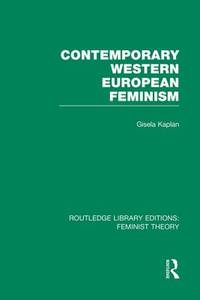
réf. SONG0805797572Twayne Publishers 1997-03-21. 1. hardcover. Used: Good. 6.20x0.80x9.20. Buy with confidence. Excellent Customer Service & Return policy. Twayne Publishers hardcover
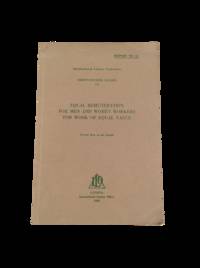
1951réf. 228591951. International Labour Conference. Equal Remuneration for Men and Women Workers for Work of Equal Value 1950 documents the formal development of international labor standards addressing gender-based wage inequality in the immediate postwar period. Issued in advance of the adoption of the Equal Remuneration Convention the report supports research into women's labor history international law and the institutional mechanisms through which gender equity policies were articulated and debated. The publication situates wage discrimination as a matter of economic justice and human rights presenting coordinated efforts by member states and labor delegates to establish enforceable standards for equal pay across national economies. International Labour Conference. Equal Remuneration for Men and Women Workers for Work of Equal Value Report VII 1; Thirty-fourth Session 1951. Geneva: International Labour Office 1950. First edition. Octavo. Original printed wrappers. The report opens with proceedings from the 33rd session of the International Labour Organization outlining debates over gendered wage structures and the economic implications of pay inequality. It includes excerpts from committee reports and plenary discussions alongside a comparative survey of member state legislation and labor practices concerning women's wages. The latter portion presents the full draft convention text proposed for adoption defining "equal remuneration" to include both wages and supplementary benefits as well as an alternative recommendation for countries not prepared to ratify binding measures. The document frames unequal pay as both structural discrimination and a violation of fundamental rights establishing terminology and policy frameworks that would shape subsequent international labor standards. 57 pages. Original printed wrappers. Octavo format. Mild toning to margins faint crease to lower front wrapper light wear at spine ends and small pencil notation at upper corner of title leaf; internally clean and secure; overall very good condition. Produced during a period of expanding international governance through organizations such as the International Labour Organization the report provides direct evidence of early multilateral efforts to codify gender equality in employment offering substantial value for the study of global labor policy and the historical foundations of equal pay legislation. unknown
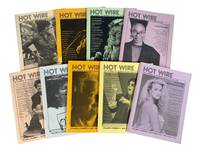
1988réf. 223381988. Armstrong Jr. Toni L. ed. Hot Wire: The Journal of Women's Music and Culture 1988-1994 documents lesbian feminist cultural production through coverage of music performance publishing and community organizing during the late twentieth century. Produced in Chicago the periodical established a platform for lesbian artists activists and writers at a time when independent feminist media sustained networks of communication outside mainstream publishing. The journal includes interviews essays and reports on women's music festivals lesbian performance and feminist enterprises supporting research into LGBTQ history women's liberation and the development of alternative media infrastructures. 1 Hot Wire:Volume 4 Number 2 March 1988. Featuring an interview with Robin Tyler one of the first openly lesbian comedians alongside Cheryl Miller's "Lesbians of Color: Celebrating Common Bonds and Differences." Includes coverage of the 1987 March on Washington "Transistor Sisters: The Girl Groups" by Jorjet Harper and a "Mothers & Daughters" feature. 2 Hot Wire:Volume 6 Number 2 May 1990. Highlights include interviews with Heather Bishop and the legendary keyboardist Laura Post. Barbara Smith and Kitchen Table Women of Color Press are profiled reflecting Hot Wire's ongoing commitment to women-of-color feminism. "Twenty Years of Making Music" by Helen Hooke and "White Courtesys Monogamy and Other Reflections" by Monica Grant offer critical insight into lesbian relationship politics and musical trajectories. 3 Hot Wire:Volume 6 Number 3 September 1990. Includes Holly Near's interview and excerpts from her performance alongside pieces on Michelle Shocked Yasmín Jiwani and Rosetta Reitz. The "I Was There" section captures first-person festival memories while Cathy Andrews reports on "Doing the Festivals." This issue gives special attention to Black lesbian performers and visual artists and reflects the multicultural reach of Hot Wire. 4 Hot Wire:Volume 7 Number 3 September 1991. A deeply insightful issue this volume features Karen Williams the Indigo Girls and Rhiannon & Phamie on performing in women's music spaces. Paula E. Languth's essay "Fade In - Fade Out" continues Hot Wire's tradition of integrating popular culture and feminist critique. Feminist cartoonist Alison Bechdel contributes work anchoring this issue's broader theme of lesbian humor and community satire. 5 Hot Wire:Volume 8 Number 1 January 1992. Lead features include interviews with Margie Adam and Lisa Dietrich alongside Judith Sloan's "Is She or Isn't She.An Outrageous Feminist" and performance reviews from Michigan Womyn's Music Festival. "All Women Radio" and "Singing for Our Lives" foreground the growing importance of radio and choral expression in the lesbian music movement. 6 Hot Wire:Volume 8 Number 2 May 1992. This issue focuses on "Women and Humor" spotlighting comedians Ronnie Gilbert and Dykes to Watch Out For's Alison Bechdel. Julia Willis's "Who Wears The Tux" unpacks gender norms in performance culture. The issue includes a crossword puzzle and a section on lesbian films underscoring the playful and subversive tone that Hot Wire helped cultivate. 7 Hot Wire:Volume 8 Number 3 September 1992. Covering Jamie Anderson and "Big Mamas" by Rosetta Reitz this issue features Cheryl Miller on Black lesbian filmmakers and Laura Post on lesbian guitarists. "Gulf Coast Women's Festival" and "OutWrite '92" offer field reports on lesbian literary and musical organizing. The inclusion of fitness sobriety and motherhood themes reflects a broadening scope of lesbian lifestyle concerns. 8 Hot Wire:Volume 9 Number 2 May 1993. Sherry Hicks discusses "The Queen of Coda Cool" while Laura Love and Seriah Carol offer pieces on mixed-race identity and folk music. "Washington Anthem Revisited" revisits a decade of protest music. Cathy Winter and Gayle Scott anchor a section on "New Artists & Old Favorites" showing the cyclical nature of talent within the lesbian music world. 9 Hot Wire:Volume 10 Number 3 September 1994. Final Issue. Suzanne Westenhoefer is interviewed and a ten-year retrospective looks at all 30 Hot Wire cover girls. Highlights include "Vampire Lovers by Moonlight" "Drumming Circle" by Naomi Pallas and "Women and Children" by Michal Brody. It documents the decline of women's cultural institutions due to funding and shifting community priorities. Published during a period when lesbian feminist media operated through independent print networks Hot Wire documented the growth and challenges of women's music and cultural institutions across the United States. The inclusion of performers writers and organizers reflects the interconnected nature of artistic production and activism while coverage of festivals and presses demonstrates the infrastructure supporting lesbian cultural expression. The final issue addresses the decline of some of these institutions in the 1990s marking a shift in funding and community organization. Minor edge wear and rubbing to covers with occasional sticker residue and light pencil marks; interiors clean and unmarked; overall very good to near fine condition. This archive provides sustained documentation of lesbian feminist publishing and the women's music movement in late twentieth century America. unknown
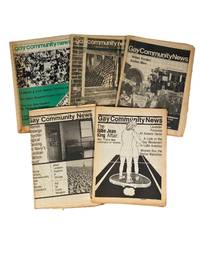
1978réf. 220741978. Gay Community News a major grassroots LGBTQ newspaper published in Boston between 1973 and 1992 documenting lesbian and gay political activism feminist organizing anti-racist solidarity movements and state surveillance during the post-Stonewall era. Produced collectively and distributed nationally through activist and community networks the publication served as one of the most influential independent queer newspapers in the United States during the late 1970s and early 1980s. The archive reflects LGBTQ political and cultural expression within the underground press illustrating how queer activists responded to institutional discrimination media hostility police violence and internal community debates through journalism photography and movement reporting. The issues preserve contemporary coverage of major developments including the White Night Riots anti-lesbian military investigations attacks on queer institutions and lesbian visibility in sports and public life providing important evidence of the political priorities and cultural language of LGBTQ activism before the AIDS crisis transformed queer organizing in the United States. Gay Community News. Boston Massachusetts 1978-1981. Five tabloid-format newspaper issues printed on newsprint each approximately 16-24 pages and illustrated throughout with black-and-white photography activist graphics and bold typographic layouts. 1 Gay Community News. Vol. 5 No. 48. Boston: June 17 1978. Includes a Lesbian & Gay Pride Calendar coverage of the expulsion of two gay seminarians from a Methodist institution reporting on tax-exempt status controversies affecting queer organizations and continuation of a fire safety project focused on LGBTQ households. Front cover features a pride march photograph prominently displaying a "Women Unite" banner. 2 Gay Community News. Vol. 6 No. 8. Boston: September 16 1978. Documents the fifth break-in and ransacking of the newspaper's offices that year alongside reporting on Anita Bryant's canceled Boston appearances and a feature discussing the poetry of Adrienne Rich. 3 Gay Community News. Vol. 6 No. 44. Boston: June 2 1979. Covers the White Night Riots in San Francisco following Dan White's manslaughter conviction in the killings of Harvey Milk and George Moscone accompanied by front-page protest photographs outside City Hall. Additional articles address the Thorpe trial and legal challenges to anti-gay legislation in Oklahoma. 4 Gay Community News. Vol. 7 No. 48. Boston: June 28 1980. Reports on anti-lesbian investigations within the U.S. Navy under the headline "Women Undergo Psychological Testing in Navy's Lesbian 'Witchhunt'" while also covering discrimination cases involving Black lesbians in Chicago and aid efforts supporting Cuban refugees. 5 Gay Community News. Vol. 8 No. 42. Boston: May 16 1981. Features extensive coverage of Billie Jean King's public outing and the media response under the headline "Yes There Are Lesbians in Tennis" alongside articles on Latin American gay activism antiwar protest movements and women participating in the Boston Marathon. The archive captures a critical period in LGBTQ history marked by expanding queer political visibility alongside escalating backlash from religious institutions employers law enforcement and government agencies. Gay Community News distinguished itself from commercial gay publications through its sustained emphasis on feminism anti-racism labor activism antiwar politics and coalition-building across social movements. Coverage of the White Night Riots military anti-lesbian purges attacks on queer institutions and lesbian representation in public culture demonstrates the newspaper's role as both activist platform and documentary record of late twentieth-century LGBTQ organizing. Edge wear creasing moderate toning and occasional closed tears consistent with the fragility of newsprint; interiors remain generally clean and legible throughout. Overall good to very good condition. An important archive of underground queer journalism documenting political struggle lesbian feminist activism and community self-representation during the post-Stonewall decade. unknown
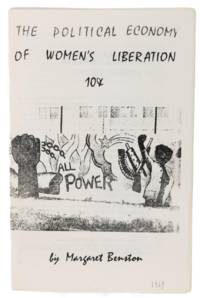
1969réf. 188471969. Benston Margaret. The Political Economy of Women's Liberation. Buffalo NY 1969. First edition pamphlet. 16 pages 9" x 5.5." Margaret Benston was a vocal Leftist Feminist and professor of chemistry computer science and gender studies at Simon Fraser University. This pamphlet contains a manifesto describing how women's labor is exploited by a capitalist framework. She writes that equal access to jobs outside the home is not enough to level the playing field because "as long as work in the home remains a matter of private production and is the responsibility of women they will simply carry a double workload." At the end Benston includes excerpts of Lenin's writing. Very good condition. unknown
1899réf. 179371899. 2 Issues of Englishwoman's Review. John Bale Sons and Danielsson Ltd: London July 15th 1899. January 15th 1902. Measures 8.5" x 5.5" inches. 224 pages. Soft covers. Both reviews open with an advertisement for the printer that reads "Office for the employment of women as compositors. Girls trained and employed for the last twenty years. Ladies and gentleman are invited to place their orders for printing where they will be executed by women in a style equal to the best. No slipshod work! No exorbitant prices!" The rest of both reviews is composed of articles news and reviews related to women's suffrage. Some titles include "Experiences Amongst Chinese Women" "The Political Position of Women in Canada." Together the two speak to the level of organization as well as the international focus of the movement as women collaborated across countries and continents reporting on successes and obstacles bolstering support for the cause by keeping readers well informed. Soft covers missing original covers. Clean front and back free endpapers instead. Texblocks tight and clean. Overall good condition. unknown
réf. 18017Three Addresses to Girls at School" J.M Wilson. Percival and Co: London 1890. 7" x 5" inches. 74 pages. Soft cover pamphlet. A series of speeches delivered by the vice president of the Clifton High School for Girls in Covent Garden 1890. The speeches were given on "Education" "High School Education for Girls" and "Religion" in 1887 1889 and 1890 respectively. In them Wilson the school's vice president and late head master addresses the female students on the value of their education"You are living in a great age when changes of many kinds are in progress in our political and social and religious ideas. There never was a greater need of trained intelligence clear heads and earnest hearts. And the part that women play is not a subordinate one." Whereas in 1840 60% of British women were illiterate that number dropped dramatically to 40% by 1860 and the momentum for female education picked up considerably through the end of the nineteenth century into the twentieth. Wilson's speeches delivered to high school girls give fascinating insight into both the vision and anxiety bound up in educational reform during the time. "We earnestly desire that women should be highly educated" he writes. "And yet is there not a type of educated woman which we do not wholly admire I am not going to caricature a bluestocking but to point out one or two real dangers. Education is good; but perfect sanity is better still. Sanity is the most excellent of all women's excellences.It is a small matter that you should protest against some small maladjustment or folly; but it is a great matter that you should be perfectly sane and well-balanced. Now education helps sanity." The addresses both promote women's education and caution against radically upending existing social structures. Wilson advises the girls throughout to be gentle humble and sane and celebrates the role educated women play in supporting men in positions of power. Front soft cover detached. Textblock is partially detached. Text block clean and bright. Overall good condition. unknown
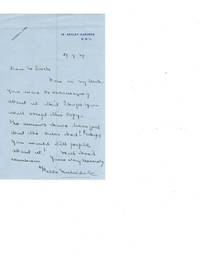
1939réf. 153491939. Feminism and Women's Rights Hilda Martindale. Autograph Letter Signed. Dated April 24 1939. 1 page. 7 x 4.5 in. Black ink on light blue paper. In her hand Martindale writes in thanks of a friend's encouragement and sends a copy of her recent work. In full: "Here is my book. You were so encouraging about it that I hope you will accept this copy. The review have been good but the sales bad! Perhaps you would tell people about it" Martindale was an important advocate for women's employment rights in her day; she made history as one of the first woman factory inspectors in Victorian England and rose to become the Deputy Chief of her department. In 1938 she published a book on the history of women civil servants likely the book she references in the letter and upon her death her estate established a foundation dedicated to assisting British women working in male-dominated fields. Very good. unknown
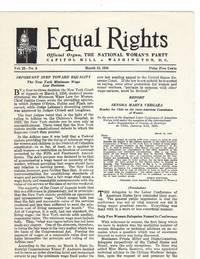
1936réf. 160251936. National Woman's Party. Equal Rights March 15 1936 documents the organization's campaign for legal equality at a time when women's workplace legislation divided American feminists over whether sex-specific protections advanced or restricted women workers. Founded in 1916 by Alice Paul and Lucy Burns during the suffrage campaign the National Woman's Party continued after ratification of the Nineteenth Amendment by advocating the Equal Rights Amendment then commonly associated with the Lucretia Mott Amendment and by opposing laws that imposed legal distinctions based solely on sex. This issue addresses the New York minimum wage controversy international equal-rights efforts and proposed workplace protections for women and children. National Woman's Party. Equal Rights. Vol. 22 No. 6. March 15 1936. 4 pages. 8 1/2 x 11 inches. Official organ of the National Woman's Party. The issue reports on the New York minimum wage case after the New York Court of Appeals struck down the state law regulating minimum wages for women; the United States Supreme Court subsequently affirmed that judgment in Morehead v. New York ex rel. Tipaldo on June 1 1936. It also discusses the Equal Rights Treaty signed at Montevideo by Cuba Ecuador Paraguay and Uruguay part of the National Woman's Party's effort to establish sex equality in international law. Another article addresses workplace hygiene and a resolution requiring employers to provide women with separate quarters for washing changing clothes and general use as well as seats for women and children when the work did not require them to remain standing. Published two years before enactment of the Fair Labor Standards Act of 1938 the issue records a central dispute in interwar women's rights politics: whether legislation written specifically for women offered necessary labor protection or created legal distinctions that could restrict women's employment and undermine demands for equal rights. The National Woman's Party pursued the latter argument while simultaneously campaigning internationally for legal equality between the sexes. The March 1936 issue therefore preserves contemporary evidence of the relationship among the Equal Rights Amendment campaign minimum wage litigation international treaty advocacy and debates over sex-specific workplace regulation. In excellent condition. unknown
1871réf. 147891871. Mott Lucretia. Autograph Quotation Signed 1871 a concise manuscript statement embodying the ethical and political philosophy that undergirded the nineteenth century women's rights and abolitionist movements. Written entirely in her hand Mott declares "Truth for authority not authority for truth" and signs "Lucretia Mott." The formulation distills a foundational principle of antebellum and Reconstruction era reform: the rejection of inherited legal ecclesiastical and political authority when divorced from moral truth and human equality. By 1871 more than two decades after the 1848 Seneca Falls Convention and the signing of the Declaration of Sentiments Mott stood as an elder stateswoman of American reform her Quaker convictions shaping a lifetime of advocacy for abolition women's legal equality and freedom of conscience. Mott Lucretia. Autograph Quotation Signed. 1871. One card approximately 4¼ x 3 inches. Composed during the post Civil War period when debates over Reconstruction citizenship and suffrage reshaped the constitutional landscape the statement reflects the continued insistence by early feminists that justice must supersede custom majority rule and patriarchal tradition. The maxim's structure directly challenges hierarchical authority aligning with arguments advanced by Mott and her contemporaries that law and governance derive legitimacy only when grounded in universal moral principles. As a signed and dated manuscript expression of this credo the card functions as a compact primary document articulating the intellectual core of American women's rights ideology. Paper clean with strong legibility and a bold well preserved signature and date. Overall condition: very good. unknown
1985réf. 83357Adelaide: Research Centre for Women's Studies University of Adelaide to Number 22; Carfax numbers 23-45; and Routledge numbers 46-51 1985. First Edition. Paperback. Very Good. Adelaide Research Centre for Women's Studies University of Adelaide to Number 22; Carfax numbers 23-45; and Routledge numbers 46-51 1985 to 2006. Octavo to Number 22 and large octavo the rest 49 issues in total Number 7/8 is a double issue. Original card covers; in excellent condition. At the time the journal was published bi- or triannually. 49 items. Research Centre for Women's Studies, University of Adelaide (to Number 22); Carfax (numbers 23-45); and Routledge (numbers 46-51 paperback
1983réf. SBBIH-FKGUJO42DOUMFeminism & Nonviolence Study Gro 1983. paperback. Good. Our good condition books are generally good for reading but not for gifting or collecting. They could have imperfections such as creasing fanning inscriptions margin notes yellowing staining on edge or cover or pages bumps scuffs etc etc sometimes multiple of these. It's a wide category that encompasses anything that isn't almost-new down to anything that is slightly better than poor. We would NOT recommend gifting Good books - these should be considered reading copies. Our books are dispatched from a Yorkshire former cotton mill. We list via barcode/ISBN so please note that the images are stock images and may not be the exact copy you receive furthermore the details about edition and year might not be accurate as many publishers reuse the same ISBN for multiple editions and as we simply scan a barcode or enter an ISBN we do not check the validity of the edition data when listing. If you're looking for an exact edition please don't order at least not without checking with us first although we don't always have time to check. We aim to dispatch prompty the service used will depend on order value and book size. We can ship to most countries see our shipping policies. Payment is via Abe only. Feminism & Nonviolence Study Gro paperback
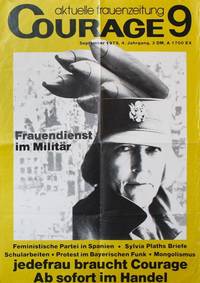
1979réf. 32004Berlin 1979. First Edition. Original photo-montaged advertisement poster 83.5x58.75cm. printed offset in black and yellow on glossy white stock; previous mail folds general wrinkling most heavily along right-hand edge else About Very Good and sound. Advertising poster for the German feminist magazine Courage the image presumably reproducing the cover of the current issue. Contents feature articles on women in the military the feminist movement in Spain and the letters of Sylvia Plath. At bottom of image: "Jedefrau Braucht Courage / Ab sofort im Handel" Every woman needs courage from now on in work. Quite a large poster presumably issued to be displayed at the newsagent. unknown
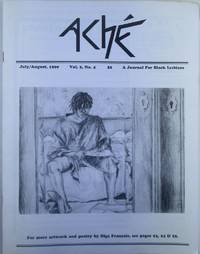
1990réf. 022873Albany CA: Lisbet Publisher 1990. Wraps. Good. Illustrated wraps. Saddle stapled. 8 ½ by 11 inched. 40 pp. including covers. A few illustrations throughout. Single issue of this magazine. Founded in 1989 by Pippa Fleming and Lisbet Tellefsen Ache was created "for and about Black lesbians in the San Francisco Bay Area." See Yale University Online Exhibition for previous and following information. The magazine grew into the Ache Project and was published for five years and provided Black queer women worldwide a venue to share resources get published and build community. This issue with poetry report on a conference on Lesbian and Gay media etc. GOOD condition. Some curling and creasing to the corners and along the spine. Lisbet, Publisher unknown
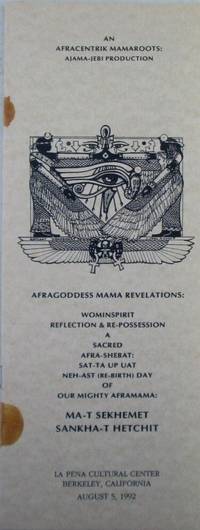
1992réf. 022872Berkeley: Asungi/Mamaroots Presumed Publisher 1992. Pamphlet. Good. Illustrated wraps. Tall narrow booklet 11 by 4 inches. 12 pp. including covers. A program for what appears to have been a one day event August 5 1992 held by AfraShe Asungi. Asungi founded MAMAROOTS: AJAMA-JEBITM an "AfraGoddess sistahoood dedicated to Afracentric spirituality and cultural awareness" quoting Asungi as quoted in Sacred Women of Africa and the African Diaspora: A Womanist Vision an essay by Arisika Razak. As Razak notes Asungi's work idealizes the form of dark-skinned woman removes it from a male gaze and counters "negative racially charged stereotypes of Black women." As an artist Asungi's work explores Black queer and goddess themes much of it recalling mythical themes from Africa. It seems this event explored and developed the aforementioned sistahood through reflection meditation and performance. This booklet includes some passages for recitation. GOOD condition. Two circular rust type stains at the upper and lower spine. Asungi/Mamaroots, Presumed Publisher unknown
1960réf. 82266London:: George G. Harrap and Co. 1960. Hardcover first edition -. Very near fine in a like dustjacket. First printing. A survey of the first century of women scholars at Oxford University. October 1959 marked the 80th anniversary of the establishment of women's colleges at Oxford - this is an account of the reforms that made this possible of early prejudices and of some of the notable women who passed through Oxford by an author who was herself one of those women. Illustrated with eight plates in half tone. Definition of terms used at Oxford. Several appendices bibliography index. 272 pp. George G. Harrap and Co., hardcover
1993réf. 81602Boston:: Beacon Press 1993. SIGNED hardcover first edition -. Fine in fine dust jacket. Uncommon in the first edition and especially so signed. First printing. A book which "concentrates on 17th- and 18th-century European developments in taxonomy and physical anthropology to show how the European male became the prototype of the human race; how women were reduced to a subset noted only for sexual differences; and how people of color were placed at inferior levels of the great chain of being on a par with apes. By celebrating sexuality in plants Erasmus Darwin and Linneaus did much to set the stage for thinking of females in terms of sexuality alone - leading Linneaus to choose the term 'mammals' to distinguish the order of warmblooded hairy animals - -but also to underscore women's role as nurturing caretakers. More shocking was the scholars' concern with female genitalia and sexual characteristics." Kirkus Winner of the 1994 Society for Social Studies of Science Ludwik Fleck Prize which noted that her "incisive book draws timely attention to the critical roles of language metaphor and ideology in the development of science." INSCRIBED by the author on the half title page to the late Oklahoma collector Larry Owens. Illustrated with reproductions of vintage drawings. Extensive notes bibliography index. viii 289 pp. Beacon Press, hardcover
réf. 21216995-nnew. unknown
réf. DADAX0230223966New unknown
réf. DADAX0230298567New unknown
réf. DADAX0190248033New unknown
réf. DADAX0252081137New unknown
réf. DADAX0252081889New unknown
réf. DADAX0367222523New unknown
réf. DADAX0295743166New unknown