705 996 résultats
1941réf. vita5513New York: Farrar & Rinehart Inc. 1941. Octavo gray cloth hardcover gilt letters map illus. endpapers xviii 941 pp. Very Good with darkened spine and edges light edgewear. Farrar & Rinehart, Inc., (1941). hardcover books
2007réf. 335531qmsCharleston SC: Arcadia Publishing 2007. Octavo softbound slick photo. illus. wrappers 127 pp. Fine. From lower cover: Tiny Amelia Island in the northeast corner of Florida was once among the most important ports in the western hemisphere. Before Florida was granted statehood the island served as an international gateway between Spanish Florida and the English colonies that would later become the United States. Where Spanish monks and pirates once roamed the island eventually developed into a significant seaport that exported the rich resources of Florida’s interior in the late 1800s. This ear was known as the Golden Age of Amelia Island and the town located on its north end Fernandina. The railroad that connected Amelia Island to the Gulf Coast was largely responsible for the Golden Age as it brought a burgeoning economy and many of the South’s most prominent and welathy figures. Today the island is best known as a resort community but retains the influence and charm of its remarkable past. Arcadia Publishing, (2007). paperback books
1940réf. vas773Philadelphia: The Church Historical Society 1940. Octavo blue cloth hardcover gilt letters x 295 pp. Very Good with darkened spine and light edgewear. From Preface: The author while collecting materials in Great Britain for The Anti-Slavery Movement in England A Study in English Humanitarianism covering the years from 1770 to 1833 became convinced that a further analysis of earlier sources of humanitarian opinion was clearly indicated. The development of the eighteenth century humanitarian mood was not in itself sufficient to explain great reservoirs of sentiment favorable to the protection of native peoples. Organized ameliorative activities even if originally at least partially a product of the new mood obviously in turn intensified humanitarian sentiments and made effective action possible. Outstanding among such humanitarian bodies were the older Anglican missionary socieities founded at the opening of the eighteenth century. The richness of the Society for the Propagation of the Gospel records for historical purposes British as well as American was first stressed by Professor Charles M. Andrews in the American HIstorical Review in an article entitled “Materials in British Archives for American Colonial History” which appeared in January 1905. And three years later the value of religious records for the study of “the broad story of American culture” and “a full understanding of American character and spriti” was ably stated by the late Dr. J. Franklin Jameson in a presidential address “The American Acta Sanctorium” which was published in the American Historical Review in January 1908. The Church Historical Society, 1940. hardcover books
2005réf. vas837Charleston SC: Arcadia Publishing 2005. Octavo softbound slick photo. illus. stiff wrappers 128 pp. Fine. Arcadia Publishing, 2005. paperback books
réf. 1246261971. Various publishers and places: 1971-1976. 9 groups of material in original format as issued and generally in very good condition. See below for details. § A fascinating collection of magazines and newsletters assembled for the advertisements and announcements which document the birth of Microsoft and the personal computer. The collection includes: 1 Scientific American Sept. 1971 first advertisement for a personal computer on p. 194. 2 QST March 1974 the first ad for the first minicomputer on p. 154. 3 Radio-Electronics July 1974 pp.29-33: Titus Build the Mark 8 Minicomputer. 4 Popular Electronics Jan. 1975 pp. 33-38 Roberts and Yates: Altair 8800 Minicomputer part 1 and 5 the same Feb. 1975 pp. 56-58 Altair 8800 Minicomputer part 2 These two issues feature a two-part article titled "Build a Minicomputer" by Ed Roberts and William Yates. This was the first time an affordable personal computer had ever been described in a magazine. The January edition provided detailed diagrams of the Altair 8800 and the February issue discusses programming possibilities. The news galvanized hobbyists around the country inspiring groups such as the Homebrew Computer club to form. Famously Bill Gates cited these articles as his inspiration for dropping out of Harvard and launching Microsoft. 6 Byte Magazine Sept. 1975--Jan. 1976. The revolution begins. 7 Computer Notes Altair Users Group Nov.- Dec. 1975. P. 19 Bill Gates on the status of BASIC originally on paper tape first revealed in March 1975 one month before Gates and Allen founded Microsoft. 8 Computer Notes Altair Users Group Jan. 1976 announces the first Altair Convention. P. 13 Gates on programming and p. 14 Gates on software. 9 Computer Notes Altair Users Group Feb. 1976. P. 3 Gates: An Open Letter to Hobbyists outlining the Microsoft business model and clarifying the distinction between proprietary and open-source software. Altair licensed Microsoft BASIC. Foundational documents heralding the birth of one of the most important scientific achievements of humankind. In July 1975 the first computer store opened in L.A. In March 1976 Albuquerque hosted the first World Altair Computer Conference see #8." John Doerr a Silicon Valley investor from the earliest days once opined that with Apple and Microsoft opening with months of each other "it was the greatest legal creation of wealth in the history of the planet unknown books

1949réf. 8554bdGettysburg Pennsylvania: The Bookmart 1949. Octavo softbound slick white stapled b & w photo. illus. wrappers 58 pp. Fine; bright white clean. The Bookmart, (1949). paperback books
1909réf. 3160Bangor NY 1909. Manuscript ledger containing seventeen years of financial information for the women's philanthropic group. Comprised of 77 handwritten pages with 2 sheets 4 pages inserted at front. Bound in quarter cloth over marbled card measuring 6 x 7 inches. Cloth spine has largely perished; text block almost fully disbound but held together by remnants. Boards generally rubbed with loss of bottom front corner. Internally legible and detailed in a variety of hands. Founded in New York in 1886 The International Order of the King's Daughters was an interdenominational women's organization whose mission was to "represent faith hope and service to others" IOKD. Initially begun by ten women from Episcopal Methodist and Presbyterian churches the members hoped to cross boundaries in their small communities in order to improve life for all. Their official motto reflected this: "Look up and not down Look forward and not back Look out and not in And lend a hand" IOKD. Member branches were encouraged to choose their own community missions serving where they saw the most need locally. Within a year the organization had spread across the east coast with hundreds of chapters and over 50000 members; it remained a predominantly women's group although some branches granted membership to men beginning in 1891. The present branch was located in Bangor New York near the Canadian border. In a town that had been founded not even a century before in 1806 the women of the Kings Daughters of Bangor had an opportunity to help meet key needs for their municipality. In the almost two decades' worth of notes in this ledger researchers can traces how dues and fundraising helped the entirely-women group contributed books and funds to the creation of a public library; assisted in providing clothes for the needy; and ran two key projects which were the maintenance of the local cemetery and the "old ladies home" a housing space for widowed single and other in-need women as they aged without families. A research-rich ledger with opportunities to study in fields including but not limited to rural women's social history the role of women's organizations in the founding of towns interdenominational religious organizations women's religious groups historical fundraising the formation of local libraries and educational programs women in business and philanthropy genealogy and paleography. unknown books
1971réf. 5793fdWashington DC: Department of the Navy United States of America 1971. Six parts in one volume. Octavo navy blue faux leather gilt letters and decoration to spine pictorial endpapers xxvii 42 118 170 152 134 477 pp. Very Good with light rubing to endpapers slight toning age darkening to interior. Department of the Navy, United States of America, 1971. hardcover books
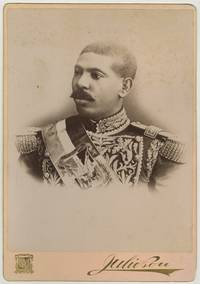
1898réf. BK0089Santiago Dominican Republic: Julio Pou Primet 1898. Large photographic portrait of Dominican president Ulises Heureaux shown in elaborate military dress with embroidered tunic epaulettes sash and decorations. Photograph measuring 8 1â„2 × 7 inches mounted to a larger photographer's card with Pou's printed monogram and facsimile signature at lower margin. Scattered light foxing and spotting with minor wear to mount; image generally very good. A contemporary portrait of Ulises Heureaux 1845-1899 the Black Dominican military and political leader who dominated the government of the Dominican Republic during the final two decades of the nineteenth century. Known popularly as "Lilís" Heureaux rose to prominence during the struggle against Spanish annexation and became a principal lieutenant of Gregorio Luperón before serving repeatedly as president beginning in 1882 maintaining effective control of the country from 1887 until his assassination in 1899. The photographer Julio Pou Primet 1862-ca. 1930 was among the important early Dominican photographers and painters. After operating a studio in Santo Domingo and serving as Dominican consul in Havana Pou returned to the capital and in 1891 was appointed official photographer to Heureaux1 making this portrait not merely a commercial likeness but an image produced within the visual culture of the presidential regime itself. Centro León preserves another example of this portrait cataloged to 1898 and attributed to Pou.2 The date places the portrait at the very end of Heureaux's rule amid the financial crisis that would help precipitate his downfall. His government had transferred substantial control over Dominican customs revenues to the American-controlled San Domingo Improvement Company while mounting foreign debt and the collapse of his paper currency destabilized the country. Heureaux was assassinated at Moca on July 26 1899; the financial arrangements developed under his administration became an important antecedent to the expanding American involvement in Dominican finances and the U.S. customs receivership established several years later.3 1 "Julio POU PRIMET 1862-1930" el grimh July 29 2023 accessed September 18 2026 https://grimh.org/index.phpItemid=1028&id=1150&lang=es&layout=edit&option=com_content&view=article. 2 "Ulysses Heureaux NS" Centro Leon eMuseum accessed September 18 2026 https://emuseum.centroleon.org.do/objects/3103/ulises-heureaux-lilis. 3 John B. Moore "Message from the President of the United States transmitting a protocol of an agreement between the United States and the Dominican Republic providing for the collection and disbursement by the United States of the customs revenues of the Dominican Republic signed on February 7 1905" accessed from the Office of the Historian September 18 2026 https://history.state.gov/historicaldocuments/frus1905/d325. . Julio Pou Primet unknown books
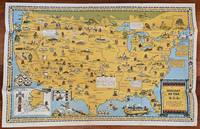
1944réf. BK0102New York: The Friendship Press 1944. Pictorial map measuring 21 x 33 ¼ inches. Some creasing from folds; bright colors; very good plus. Louise Jefferson was an artist and author who helped found the Harlem Artist's Guild in the 1930s after moving to New York City to attend Hunter College. She worked for the Friendship Press in New York during the following years for which she drew this map a pictorial representation of the American Indian tribes in the United States. She became the art director of the press perhaps the first African American woman to hold such a post at a major publishing house. She continued to do freelance work and eventually published a major nonfiction work on African art in 1973 entitled The Decorative Arts of Africa. This is a nice example of Jefferson's most well-known map which shows the United States borders mapped out by ancestral tribal lands. She would publish another map entitled "Uprooted People of the U.S.A." a year later in 1945. The Friendship Press unknown books
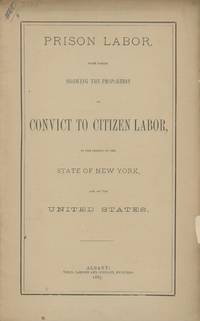
1885réf. BK0176Albany: Weed Parsons and Company 1885. 54 pp. 8vo. Original printed gray wrappers. Very good with minor soiling and small tears to wrappers and an early notation at the upper corner of the front wrapper. A defense of contract prison labor by John Sherwood Perry a New York manufacturer who operated an enormous stove-making business employing prisoners at Sing Sing. Perry began contracting for labor at the prison in the 1870s and by the early 1880s employed more than 1300 inmates in his manufacturing operations. His use of prison labor brought him into direct conflict with organized labor particularly iron molders who objected to competition from cheaply produced prison goods. The pamphlet was published during a period of growing opposition to the contract labor system which allowed private manufacturers to employ prisoners at a fraction of the cost of free labor. Perry argues that prison industries represented too small a proportion of American manufacturing to constitute a serious threat to ordinary workers supporting his position with extensive statistical tables comparing convict and civilian employment in New York and other states. An interesting contemporary defense of prison labor by one of its principal beneficiaries whose operations at Sing Sing were central to the controversy over the use of incarcerated workers in American manufacturing during the 1880s. . Weed, Parsons and Company unknown books
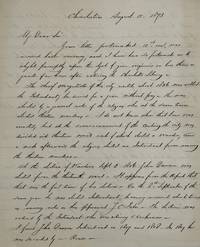
réf. 699284to. Two pages approximately 300 words in part: "The chief magistrate of this city until about 1836 was called the Intendant . in 1806 John Dawson was elected warden from the thirteenth ward . the same year he was elected Intendant serving until 1809 . In 1811 he became cashier of the State Bank long passage about the oddities of banks in Charleston . Dawson succeeded Felix Manly as cashier and I suspect was himself succeeded by Samuel Wragg. . I may well be wedded to the college. It is now about my only life. I am showing that I am not too old for the place having within a few years succeeded in introducing French and Spanish into my course and I trust it will not be long before I shall introduce the Italian." Old fold lines but very good. unknown books
1924réf. 010342Jerusalem : Supreme Moslem Council 1924. Book. Near Fine. Printed Wrappers. 1st Edition. 32mo - over 4 - 5" tall. The 1924 First Edition printed by Moslem Orphan Printing Press the 1925 2nd ed. printed by the Franciscan Printing Press as stated on rear wrappers. No other textual differences although the 1924 is approx. 1/4" taller and perhaps 1/8" narrower than the 1925and the wrappers a shade different in color. Both 16 pages with 7 photo illustrations each. Each with top corner rear wrappers torn along perforation and with docket stamp as needed for admission. Each Near Fine small corner creases and shallow edge chips. RARE in the First Edition and in lovely condition. . Supreme Moslem Council Paperback books
1830réf. 21128New York: Ludwig & Tolefree 1830. First Edition. Hardcover. Good. 8.5 x 5.25 inches 151 pp with engraved frontispiece and four additional illustrations. In original boards with what appears to be later but not recent cloth over the original cloth spine. Boards worn front board only just attached some losses to spine cloth; good. Early ownership signature Joshua Hodsdon Yarmouth on front free endpaper printed label on rear pastedown admonishing the reader to "Never wet your thumb or finger to turn over a leaf in this or any other book." Little is known about John Skillman but he evidently frequented the regular morning court hearings in Lower Manhattan for people who had been arrested the previous day for relatively minor crimes such as drunkenness lewd behavior vagrancy petty theft and prostitution. His reports on these crimes which were probably modeled on those that had recently begun appearing regularly in London newspapers take the form of brief pun-filled comic vignettes or dialogues between the accused and the magistrate. For example "James G----- was sent by his employer with 10 shillings to buy screws---bought 5 shillings worth and expended the rest of the money in his own way. Is put in poetical language under the screws" and "Mary Stevenson entertains the opinion that 'time is money;' and having no instrument or machine whereby she might keep proper 'note of time' thought proper to obtain one at all hazards. She is now in close confinement for a time." Beneath the humor however are characterizations of male and female defendants of different races classes ethnic backgrounds -- some flattering some not. Scholar Brian Baaki has argued that by placing "an overwhelming volley of black malefactors" at the beginning of the text Skillman "tries to manufacture an association between African-Americans and crime." There may be room for a more nuanced reading but without doubt the book is of interest in the broader context of the social and cultural history of early nineteenth century New York. Sabin 81589 American Imprints 3498. Ludwig & Tolefree hardcover books
1972réf. S11345Mexico City:: Sociedad Mexicana de Historia de la Ciencia y de la Tecnologia 1972-79. 1972. 3 volumes nos. 3 4 & 5; Vols. 4-5 stated one of 1000 copies. 8vo. iv 352; iv 348; iv 147 pp. Original printed wrappers; lightly smudged and rubbed rear cover Vol. 4 with small closed hole. Burndy Library bookplates. Very good. Featuring an entire volume dedicated to the memory of Izquierdo a prolific Mexican doctor and historian of science who specialized in physiology. Sociedad Mexicana de Historia de la Ciencia y de la Tecnologia, 1972-79. unknown books
1933réf. S9171London:: British Museum 1933 1936. 1933. Second edition. Two volumes. 4to. xi 245 68; 59 pp. Frontis. index. Gilt-stamped olive cloth. Fine. appendix: Printed wrappers; edges slightly torn corner fold on back cover. Very good. British Museum, 1933, 1936. hardcover books
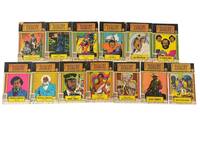
1983réf. 237451983. Bertram Fitzgerald's Golden Legacy 1983 reprint of the 1966-1976 first printing near complete in thirteen of sixteen issues documenting an effort to create an illustrated Black history curriculum for young readers during and after the civil rights movement. Fitzgerald born in Harlem and trained as an accountant developed the series in response to the omission and distortion of Black achievement in conventional school histories and in the illustrated literature he had encountered as a child. Its stated purpose was explicit: "The intention of our publication is to implant pride and self-esteem in black youth while dispelling myths in others." Fitzgerald consequently built a historical sequence extending from ancient African kingdoms and the Haitian Revolution through slavery abolition Reconstruction civil rights leadership exploration literature and invention using the visual vocabulary of the comic book to place Black historical actors at the center of the narrative. Coca-Cola purchased issues in quantity beginning early in the run and distributed copies through schools libraries churches and organizations including the NAACP and National Urban League; approximately nine million copies of the sixteen volume series were ultimately published. Golden Legacy. Vols. 1 through 12 and 15. New York City: Fitzgerald Publishing Co. 1983. Near complete 13 issues of the illustrated Black history magazine. Illustrated wrappers 4to approximately 32 pages each extensively illustrated in full color by a changing group of writers and artists many of them Black. 1 Golden Legacy. Vol. 1 1966. The Saga of Toussaint L'Ouverture and the Birth of Haiti establishing the series with the Haitian Revolution and the leadership of Toussaint L'Ouverture. 2 Golden Legacy. Vol. 2 1967. The Saga of Harriet Tubman "The Moses of her People" presenting Tubman through enslavement escape and her work guiding others to freedom. 3 Golden Legacy. Vol. 3 1967. Crispus Attucks and the Minutemen placing Attucks within the revolutionary generation and the struggle for American independence. 4 Golden Legacy. Vol. 4 1968. The Life of Benjamin Banneker recounting the career of the Black mathematician astronomer surveyor and almanac maker. 5 Golden Legacy. Vol. 5 1969. The Life of Matthew Henson devoted to the Arctic explorer and his role in expeditions toward the North Pole. 6 Golden Legacy. Vol. 6 1969. Alexander Dumas and Family extending the series beyond the United States through the history of the Dumas family and the Black ancestry of the French novelist. 7 Golden Legacy. Vol. 7 1969. Frederick Douglass Part One. 8 Golden Legacy. Vol. 8 1970. Frederick Douglass Part Two. The paired issues give Douglass the most extended individual treatment in the series following his passage from enslavement to abolitionist authorship and political leadership. 9 Golden Legacy. Vol. 9 1970. The Life of Robert Smalls recounting the life of the formerly enslaved Civil War mariner who later served in Congress. 10 Golden Legacy. Vol. 10 1970. Joseph Cinque and The Amistad Mutiny treating the 1839 revolt aboard La Amistad and the legal struggle that followed. 11 Golden Legacy. Vol. 11 1970. Men of Action White Wilkins & Marshall bringing the chronology into twentieth century civil rights history through Walter White Roy Wilkins and Thurgood Marshall. 12 Golden Legacy. Vol. 12 1972. Black Cowboys recovering Black participation in the history and mythology of the American West. 13 Golden Legacy. Vol. 15 1972. Ancient African Kingdoms moving beyond biography to present African civilization before the Atlantic slave trade. Fitzgerald began Golden Legacy at a moment when Black parents educators publishers and civil rights organizations were challenging school curricula that marginalized African American history. The series answered that problem through popular print rather than a conventional textbook: historical protagonists appear heroically in full color action sequences while the subjects themselves move across national and chronological boundaries from Haiti Africa and Russia to slavery abolition western expansion Reconstruction the modern civil rights movement and twentieth century invention. Fitzgerald initially encountered difficulty financing and distributing the project; corporate support from Coca-Cola beginning with the early volumes enabled bulk distribution and access to improved printing while later volumes attracted additional commercial sponsorship. The NAACP National Urban League and New York City Board of Education were among the institutions associated with or endorsing the series placing Golden Legacy within the broader effort to make Black history available to children outside the limits of existing textbooks. Some loss to covers some staining internally sound and mostly clean. Overall good to very good condition. A near complete archive of the illustrated curriculum through which a Black independent publisher recast African and African American history for a generation of young readers from the height of the civil rights movement through the American Bicentennial. unknown books
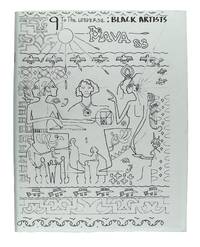
1983réf. 50199Philadelphia: Black History Museum UMUM Publishers 1983. Near Fine. Philadelphia: Black History Museum UMUM Publishers 1983. First Edition. Quarto 27.5cm; illustrated wraps featuring cover design by Isaac Foy; 89pp.; black and white photographs and illustrations. A touch of rubbing to covers with partially-removed museum store sticker to rear. A group festschrift to support and celebrate Black artists divided into three panels the first celebrating Selma Burke Roy DeCarava and Tom Feelings the second dedicated to Art Institutions Collections Patrons and Galleries and concluding with "New Voices in the Tradition - Historians Critics.". Black History Museum UMUM Publishers unknown books
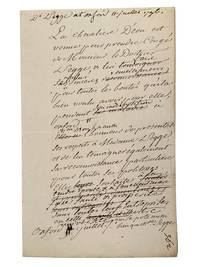
1796réf. 231691796. Transgender and Cross-DressingLGBTQ D'Eon de Beaumont Charlotte Geneviève. Autograph Letter Signed 11 July 1796 written and signed by one of the earliest recorded transgender women in Europe in her feminine title offering direct manuscript evidence of her self-identification as a woman with the female title and pronouns "La chevaliere d'Eon" and "Mlle d'Eon". The letter dates to D'Eon's time in England after her diplomatic career military service and public gender transition made her one of the most documented transgender individuals of the eighteenth century. Though some accounts claim D'Eon's gender transition was a hoax or political ruse this quiet and courteous social note confirm D'Eon's personal identity as a woman. D'Eon de Beaumont Charlotte Geneviève. 11 July 1796. 2 manuscript pages on one sheet. 4.5 x 7.5 inches. In French. Autograph letter written from Oxford and addressed to "Dr. Legge at Oxford 11/juillet 1796" thanking Dr. Legge for "toutes les bontés" all the kindnesses shown during d'Eon's stay and extending respects to "Madame Legge." D'Eon refers to herself in the third person with explicitly feminine language opening with "La chevaliere d'Eon est venue prendre congé" later stating "Mlle d'Eon a aussi l'honneur de présenter ses respects." The letter praises Legge for his moral and medical goodstanding describing his "savoir" "bienveillance" and "douceur" toward his patients and calling him in effect a physician to humanity. The letter reads in full: "Dr. Legge at Oxford 11 July 1796 The Chevalier d'Eon has come to take her leave of Dr. Legge and to offer him her most sincere thanks for all the kindnesses he was good enough to show her during her stay in Oxford. Mlle d'Eon also has the honor of presenting her respects to Mrs. Legge and of expressing to her as well her particular gratitude for all her courtesies. She wishes the devoted wife and her husband health and prosperity in all their endeavors at this illustrious university which honors her just as much as Mr. Legge does. Oxford July May Fortune-after the storms of her past life-enable her one day to demonstrate her gratitude to him; this gratitude will always remain as fervent as her attachment to Dr. Legge who-through his knowledge his benevolence of heart and his zeal and gentleness toward his patients-truly deserves to be called the Physician of the Human Race in the moral as well as the physical sense." Health and financial difficulties plagued the Chevalier after she relocated permanently to England in 1785. She was often confined to her bed by illness and old injuries including a broken leg suffered during her years as a spy. With her pension abolished her dueling career ended by poor health and many of her old acquaintances in France lost to exile or execution D'Eon turned to her community in England and her faith to keep her spirits high. Her friends and acquaintances provided her with both solace and financial support when she was unable to pay her debts. Correspondence from this point in her life indicates that D'Eon had a deep belief in the manifestation of God as one's community and expressed profound gratitude in her letters to those keeping her from destitution. By 1796 d'Eon had lived publicly as a woman for decades following the international scandal that surrounded her gender in the 1770s. This letter reflects her identity in personal social correspondence worlds away from the scandal and political intrigue surrounding her initial transition. The manuscript offers insight into a transgender woman's feminine identity and pronouns in her own hand while her gender was publicly subject to rumor debate and trial. Faint soiling and tanning to edges; legible throughout; intact and well preserved. An unusual firsthand document of an early transgender pioneer identifying herself with feminine pronouns in eighteenth century Europe. unknown books
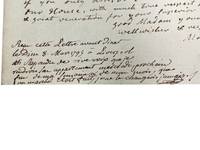
1795réf. 231141795. Transgender and Cross-DressingLGBTQ D'Eon de Beaumont Charlotte Geneviève. Autograph Note Signed 8 March 1795 written and signed by one of the earliest recorded transgender women in Europe. The letter dates to D'Eon's time in England after her diplomatic career military service and public gender transition made her one of the most documented transgender individuals of the eighteenth century. D'Eon de Beaumont Charlotte Geneviève and Mary Watterison. 8 March 1795. 1 manuscript pages on one sheet bifolded. Approx. 8 x 12.5 inches. In English and French. Manuscript letter written from Mary Watterison to Madam D'Eon with a note in D'Eon's hand below signed "D". Watterison writes to D'Eon explaining that she can no longer afford to continue renting her a room at the agreed upon price and that D'Eon will have to vacate the room by the following Wednesday or pay more for her rent. D'Eon writes a note below stating that she responded in person and will leave the apartment rather than changing their deal. The letter reads in part: "1795 My good madam / I am sure your considerate liberality of heart will not only pardon but applaud what nesesety only could compel me to inform you. Which is that the great loss I find from letting the lodgings at the prise I first agreed too is such as I realy cannot afford. for indeed the prise is not equel even to the trouble of our servants without reconing a farthing for the rooms.And now my dr Madam as I never wish to gain anything by you therefore hope you are too good to wish me to lose by you you must pardon me if I say I realy consider myself as a cleer looser of 10/6 per week for the past time you have been here if you give me no more then first proposed therefore must beg you to have other lodgings by next Wednesday or else promise to pay me after the rate of a guinea per week besides five.with much true respect for you person great veneration for you superior talants. I am good Madam your most sincere wellwisher respectful humble servt. / Mary Watterison." Below in Chevalier D'Eon's hand in French translated "Received this letter before dinner on Sunday March 8 1795 in Liverpool. Responded in person that I would return her apartment next Wednesday at the end of my week of my month that I never change a done deal / D." Financial difficulties plagued the Chevalier after she relocated permanently to England in 1785. With her pension abolished her dueling career ended by poor health and many of her old acquaintances in France lost to exile or execution D'Eon turned to her community in England for survival. Her friends and acquaintances provided her with both solace and financial support when she was unable to pay her debts though she always remained dignified proud and unwilling to be taken advantage of as evidenced by her statement at the end of the letter: "I never change a done deal." In correspondence from this point in her life D'Eon expresses both grave financial anxiety and profound gratitude to those keeping her from destitution as well as a deep belief in the manifestation of God as one's community. By 1795 D'Eon had lived publicly as a woman for decades following the international scandal that surrounded her gender in the 1770s. The manuscript offers insight into D'Eon's life and financial difficulties in England while her gender was publicly subject to rumor debate and trial. Notably though expressing frustration and displeasure with D'Eon Mary Watterison always uses the feminine title "Madam" indicating a consistent respect for her gender identity. Soiling and tanning to edges particularly at upper right margin; legible throughout; intact and well preserved. An unusual firsthand document of an early transgender pioneer identifying herself with feminine pronouns in eighteenth century Europe. unknown books
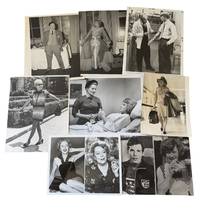
1968réf. 235351968. Transgender public identity and Christine Jorgensen press photo archive depicting the first widely publicized trans woman in American mass media from staged publicity and television retrospectives to dramatized scenes from The Christine Jorgensen Story. Jorgensen became internationally known after the New York Daily News reported her transition on December 1 1952 following hormone treatment and surgery in Denmark under Dr. Christian Hamburger. Her celebrity developed through nightclub work interviews autobiography campus speaking and television appearances giving mid-century American audiences a named public figure through whom they first encountered medical transition gender identity and the social consequences of legal recognition. The Christine Jorgensen Story released in 1970 by United Artists and based on her 1967 autobiography moved that life into commercial cinema at a time when trans identity was still usually treated by the press as spectacle rather than self-definition. Photo archive of 8 silver gelatin press photographs each approximately 8" x 10" United States and London circa 1968-1977. Christine Jorgensen appears in formal and public settings including a London arrival or press appearance with hat coat gloves handbag and fur and an ABC publicity sheet for the program "2nd Edition of Whatever Became Of" identifying her as having "went into show business after making front-page headlines with a sex change." Verso captions identify a September 10 1970 London appearance connected to the Loews premiere of The Christine Jorgensen Story while two film stills show John Hansen as George Jorgensen receiving a locket from Aunt Thora and a clinical scene with a doctor examining the young Jorgensen's arm. Additional portraits and press subjects broaden the group beyond Jorgensen alone including a photo of Erika Schineggar a former top Austrian skier who later identified as "Erik" and an individual in both masc and femme attire expanding this archive to the greater trans identity during the 1960s and 1970s. Jorgensen's visibility came decades before most American jurisdictions allowed straightforward amendment of sex markers and her rejected 1959 marriage license application in New York became one of the best-publicized examples of how state records could deny recognition to a trans woman's adult life. The group anchors institutional collecting in the concrete media channels that made trans identity public to broad audiences: wire-service captions television publicity staged film biography and celebrity portraiture. Light handling wear creasing stamps caption sheets pasted press captions and editorial markings; overall in good condition. The Jorgensen sequence especially the 1970 London premiere material and the ABC "Whatever Became Of" publicity places her after the first wave of sensational coverage and inside the later television culture that revisited celebrity lives. unknown books
1900réf. 223161900. Early twentieth century Mexico documented in photographs and real photo postcards depicting rural life Indigenous labor archaeological sites and urban landscapes during the decades surrounding the Mexican Revolution. The images record scenes of everyday activity alongside monumental remains of ancient Mesoamerican civilizations illustrating the cultural landscape of Mexico during a period when tourism archaeology and national identity formation increasingly emphasized the country's Indigenous heritage. Photographs of markets domestic work agricultural labor and village life provide visual evidence of social conditions and cultural practices within rural communities during the early twentieth century. Archive of thirty nine black and white real photo postcards and photographs dating from approximately the 1900s through the 1920s. Many images contain captions printed in the negative in English or Spanish identifying locations and subjects. Several photographs depict well known archaeological sites including views of the Pyramid of the Sun at Teotihuacan and detailed images of the carved serpent heads of the Temple of Quetzalcoatl. Other photographs document rural environments and community life including images labeled "Xochimilco Mex." showing canal traffic and canoe riders navigating the waterways near Mexico City. One real photo postcard captioned "Haciendo tortillas" depicts Indigenous women preparing tortillas over open fires surrounded by cooking vessels and firewood. Additional photographs show thatched roof dwellings agricultural labor including men harvesting agave plants and scenes of local marketplaces. A group portrait depicting Mexican soldiers alongside women and children suggests the presence of military or political activity during the revolutionary era. The photographs reflect a period when Mexico's archaeological monuments and Indigenous communities were increasingly photographed by travelers ethnographers and publishers producing visual material for both domestic and international audiences. After the Mexican Revolution of 1910-1920 intellectual and political movements promoting indigenismo emphasized Indigenous heritage as a central component of Mexican national culture while archaeological research at sites such as Teotihuacan gained international attention. Real photo postcards circulated widely during this period and served both as souvenirs and as documentary images of landscapes monuments and local communities. Photographs and postcards generally measure approximately 3 x 5 inches and remain preserved as loose prints. Minor edge wear and surface toning visible with occasional curling at the corners; most images retain strong contrast and clarity. Overall very good condition. The archive provides a varied photographic record of Mexican cultural life Indigenous communities and archaeological sites in the early twentieth century. unknown books
1968réf. 224131968. African American Education Chernow Fred and Carol. Reading Exercises in Negro History. Elizabethtown PA: The Continental Press Inc. 1968. Educational programs designed to support mid-20th century classroom instruction in African American history and literacy comprising of 3 programs; Reading Exercises in Negro History Volumes 1 and 2 along with the rare companion Teacher's Guide. This series is explicitly designed for elementary-level readers with content written at a fourth-grade level and focused on biographical narratives of Black achievement across fields such as science government literature education and civil rights. Each volume includes illustrated reading selections followed by multiple-choice comprehension questions and vocabulary drills intended to foster critical thinking and independent learning. Each measure 8.25" x 11" and have 12-63 pages. Volume 1 profiles figures such as Robert Sengstacke Abbott Marian Anderson W.E.B. Du Bois Katherine Dunham Langston Hughes Thurgood Marshall Gordon Parks and Carter G. Woodson. The volume opens with a structured guide "To the Teacher" noting that "Reading Exercises in Negro History presents short biographical sketches of famous American Negroes" and is intended both to train students for standardized reading tests and to "point up the success of individuals in overcoming obstacles and the contributions Negroes have made to American and world culture." The accompanying Teacher's Guide provides teaching strategies suggested discussion questions answer keys vocabulary aids and interdisciplinary correlations to maximize classroom effectiveness. Notably it explains that the reading series helps students struggling with written formats common to testing emphasizing the importance of understanding word meaning in context. The volumes were co-authored by Fred B. Chernow then Assistant Principal for the Board of Education City of New York and Carol Chernow both of whom were active in educational publishing and curriculum development. The inclusion of this history-based literacy tool in 1968 a year marked by the assassination of Martin Luther King Jr. and the expansion of Black Studies programs reflects broader shifts in educational philosophy and curriculum reform following the Civil Rights Movement. An important pedagogical artifact from the integration era this archive offers insight into how Black history was being introduced to primary classrooms in the late 1960s. Some dog eared corners and minor wear to covers and original library stamps. Teacher's Guide has fragile binding. Text and pages clean. Overall very good condition. A leading elementary educational guide in Black studies during the Civil Rights era. unknown books
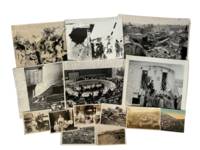
1930réf. 205761930. Archive of fourteen photographs documenting the Palestinian experience across two critical historical periods: pre-state Palestine in the 1930s and the internationalization of the Palestinian question in the 1970s. The collection combines early regional views and later press photography to present a sustained visual record of displacement conflict and diplomatic engagement. The archive's later component consists of six large-format press photographs approximately 7" x 9" to 8.25" x 11" each with typed captions on recto or verso. These images document key moments in the 1970s including Palestinian guerrilla presence amid bombed urban environments the aftermath of attacks on refugee camps such as Ein Helweh in Lebanon and scenes of civilians navigating destroyed housing and infrastructure. Several photographs capture the material conditions of displacement including makeshift shelters rubble-filled streets and densely damaged residential quarters. A central group of images documents the Palestinian presence at the United Nations in 1974 situating the conflict within an international diplomatic framework. One photograph shows the General Assembly chamber during the vote recognizing Palestinian representation recording the outcome 89 in favor 8 against with 37 abstentions. Another depicts the United Nations Security Council in session as it debates and condemns Israeli military actions in Lebanon following retaliatory strikes. Additional images show the arrival of the Palestinian delegation in New York marking a key moment in the formal political recognition of Palestinian claims on the global stage. Complementing these are eight earlier photographs from 1930s Palestine and surrounding regions including city views such as Nazareth and Nablus as well as refugee encampments and vernacular urban environments prior to the establishment of the State of Israel. These earlier images present densely built hillside cities traditional architectural forms and early patterns of settlement and displacement providing historical context for the later press material. Taken together the archive offers a rare longitudinal visual record linking pre-1948 Palestine with the later period of armed conflict refugee crisis and international diplomacy. The juxtaposition of early regional views with later press documentation underscores both continuity and transformation in the Palestinian experience across the 20th century. This material holds strong research value for Middle Eastern history refugee studies conflict and war photography and the history of international organizations. It is particularly valuable for examining how the Palestinian question was documented visually across both local and global contexts from lived environments to diplomatic representation at the United Nations. unknown books
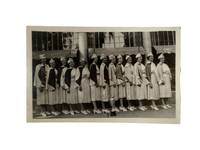
1930réf. 204911930. A vintage Silver gelatin photograph of thirteen nurses posing with trophy. Circa 1930s. Photograph measures approx. 4.75" by 5.75". Photographer stamp "R412" and" La Brea Larja" paper insignia printed on verso. Image shows thirteen female nurses of varying ages posed in a line facing right with faces toward camera and smiling with a double handled trophy on sidewalk in foreground. Nurses are dressed in their work long sleeved white satin uniforms and white shoes with white satin capes and caps. Capes are folded back to show inner lining which vary in color from person to person. Overall very good condition. 1930s nurses in satin uniforms pose proudly with their trophy. unknown books