Regiment, West MiddlesexBiblio.com
1.469 Ergebnisse
Best.-Nr. 1019446293.Ghardcover. Good. Access codes and supplements are not guaranteed with used items. May be an ex-library book. hardcover
Best.-Nr. A9781783316557Hardback. New. hardcover
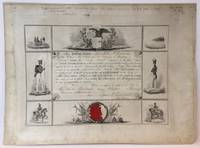
Best.-Nr. 58705A collection of 11 items from the first organizational years of the National Guard unit which protected New York City in the early 19th century. The group consists of three brass cylinders each containing rolled manuscript documents related to the regiment; an oval metal box containing a pair of epaulettes from the 7th; a wallet style polished black leather military bag with a gilt emblem of the 7th National Guards on the front flap; and a partially printed document completed in manuscript acknowledging the service of a member of the regiment. New York 1816-1847. What became known as New York's Seventh Regiment was originally organized in April 1806 as a response to the threats from the British search and seizure policies in New York harbor. The regiment consisted of four companies comprising many of the merchants and tradesmen in the city. During the War of 1812 the unit by then designated the 2nd Battalion 11th Artillery manned the guns of the forts guarding New York harbor. After the war a military-weary New York saw a fall-off of interest in drilling and training by militias. The appointment in 1820 of Col. James Benedict to lead the Eleventh brought a renewed interest in organized training discipline and field exercises attention to uniforms and equipment and regular attendance at meetings. His order regarding the wearing of pantaloons over boots is reflected in one of the documents present here. By 1824 the Eleventh had been renamed "The National Guards" in honor of the Marquis de Lafayette and by 1826 it was redesignated "The Twenty-Seventh Regiment of the New York State Artillery." In addition to official parades and escorting of dignitaries the national Guards were used to maintain order in the city during public executions in the 1820s and were called out to help quell riots in the 1830s. A reorganization of all the militia units resulted in its new official designation as the Seventh Regiment in 1847. All of the material is in very good condition aside from some scuffing to the metal box. Each of the brass cylinders has an engraved label and the end of each one unscrews to reveal the rolled document inside. The metal box has a faint blind-stamp on the lid identifying it as having been produced by J.H. McLenney & Co. 141 Grand St. New York. The leather wallet is stamped in blind on the back "Ridabock & Co. New York." McKenney & Co. and its successor Ridabock & Co. were manufacturers and dealers in military goods. #6445. Itemized list of the collection: a The first cylinder engraved label reading "Roll of Honorary Members 1st Co. 7th Regt." The document inside dated June 23 1816 206 x 25 cm. consisting of 6 pages tipped together end-to-end records the "Bye laws for the Regulation of Capt. James Benedict's Company in the Eleventh Regiment NY State Artillery" including the establishment of a monthly meeting time regulations regarding attendance new members arms & equipment etc. It is signed by the three members of the Committee of Revisal Gilbert Hopkins Irad Hawley and Richard E. Purdy as well as approximately 77 members of the company. Damage to the lower corner of the document has resulted in the loss of several signatures; some chipping along the right margin of the scroll occasionally affecting a word or two. b The second cylinder engraved label reading "Roll of Company. 7th Regt. N.G.S.N.Y." Rolled inside are two separate documents. The first dated May 18 1821 90 x 20 cm. consisting of 3 pages tipped together end-to-end is a document signed by the members of the company commanded by Capt. Gilbert Hopkins 11th Regt 1st Brigade pledging to abide by a decision regarding the wearing of pantaloons over instead of under Boots on Parade signed by 67 members of the company. The second document is undated 22 x 20 cm. a single leaf approves an alteration to the by-laws regarding dunning members for non-attendance signed by 20 members. c The third cylinder engraved label reading "Roll of the first Company National Guards New York State Artillery" ownership name partially rubbed out but research shows it reads "Captain J.S. Cocks". The manuscript document records another revision of the by-laws this one from October 1826. Printed in block letters at the head of the document 184 x 23 cm. consisting of 5 pages tipped together end-to-end is the title "TWENTY-SEVENTH REGIMENT / NEW YORK STATE ARTILLERY / PRO PATRIA ET GLORIA / NATIONAL GUARDS." The text includes several modifications to various articles of the by-laws and is signed by the members of the Committee of Revisal Smith Spelman Thos. Jaycox and Thos. H. Locke along with 48 other members of the regiment. Some chipping to the margins of the document not affecting text; one long tear carefully repaired on verso touching some letters but all still legible. The ink from the block lettering has burned through the paper in spots. John Samuel Cocks 1813-1868 whose name is etched on the cylinder was elected captain of the First Company of the 7th Regiment in 1838 and resigned in 1845. During the Civil War he served as a Colonel with the 40th New York Infantry Mozart Regiment. A Successful New York businessman and member of the New York state legislature he died in Brooklyn in 1868. d The black metal box containing the epaulettes is moderately scuffed. There is a small metal handle on the lid and a clasp. The epaulettes rest on an oval post mounted inside the box. Each is braided and has a brass crescent on the shoulder dulled and a round emblem of red cloth with a contrasting black & gray striped cloth "7" affixed to it a gold button embossed with an eagle and two bars. The epaulettes show some wear particularly on the undersides where a metal plate denotes left and right shoulder pad with modest fraying to the edges. e The leather wallet has high polish; the ornamental lettering "NG7" on the front flap is bright the small leather loop clasp is worn but intact. f A partially printed document image size 21 x 31 cm. on a larger sheet 30 x 40 cm. completed in manuscript and dated October 14 1846. The text is surrounded by eight vignette illustrations six of men in uniform on horseback in ranks one of an eagle perched on a shield and the last of swords and cannons with a red wax seal over the middle partially chipped away. The document acknowledges the seven years service of John A. Hadden in Company 6 National Guard 27th Regiment and declares him to be exempt for the rest of his life from both jury service and further military service. Signed by two members of the regiment Andrew H. Brenner and Cyrus H. Loutrel. A few creases in the surface of the document which is a little soiled and has some later ink notes by Hadden in the upper margin. unknown
Best.-Nr. 4822072-nnew. unknown
Best.-Nr. 7179733-nnew. unknown
Best.-Nr. 41646158-nnew. unknown
2010Best.-Nr. DADAX1165870789Kessinger Publishing 2010-09-10. hardcover. New. 6.00x1.31x9.00. Buy with confidence. Excellent Customer Service & Return policy. Kessinger Publishing hardcover
2010Best.-Nr. DADAX1165258676Kessinger Publishing 2010-09-10. paperback. New. 6.00x0.20x9.00. Buy with confidence. Excellent Customer Service & Return policy. Kessinger Publishing paperback
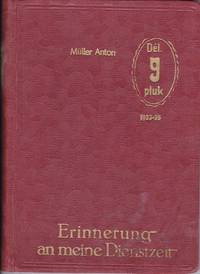
1933Best.-Nr. 9101C1933. Tschechoslowakei. 1933-35. ca. 205 x 15 cm. ca. 80 S. Original-Leinen mit goldgeprägtem Deckeltitel. Einband leicht berieben Deckel etwas gebogen. Innen zahlreiche private ganzseitige Einträge und Illustrationen. Altersentsprechend guter Zustand. Das Album zur Dienstzeit eines Soldaten besteht aus deutschsprachigen Einträgen von Kameraden zum Zwecke der Erinnerung an die gemeinsame Dienstzeit und aus Einträgen des Albumeigners selbst. Diese Einträge sind teils tagebuchartig teils sind es eher Verse zur Selbsterbauung. Die Einträge sind datiert und stammen meist aus 1934-1935. Die Soldaten waren scheinbar in ihrem Wehrdienst und wurden geschult die Naivität der Einträge scheint keine Berührung mit irgendeinem Kampfeinsatz zu kennen. Genannt sind Orte wie Nitra Zilina und Malazky welche allesamt in der heutigen Slowakei liegen und damals der Tschechoslowakei in den Jahren zwischen 1918 und 1938 zugehörten. Die Einträge sind alle in deutscher Sprache verfasst oft auch eher etwas holprig. Es scheint sich um das Album eines Deutschböhmers und Sudetendeutschen zu handeln der im Rahmen seiner tschechoslowakischen Soldatenzeit an diese Orte versetzt wurde. In mehreren Einträgen werden auch die Sehnsucht nach der Heimat und das Deutschsein zum Ausdruck gebracht. Ein längerer Eintrag des Albumbesitzers etwa zur Mitte des Albums trägt den Titel "Ein Deutscher Spruch!". Der mehrstrophige Text lautet: "Wenn alles reist wenn alles bricht du Deutsches Herz versage nicht. Versage nicht du Deutsches Land vergiss nicht unsere Bruderhand. / Versage nicht du Deutsches Herz versage nicht in Leid u. Schmerz. Denn einmal kommt die Zeit wo mann uns Deutschen doch befreit. / Halte Deiner Heimat heiligerscholle Deutsch soll sie bleiben komme was wolle komme was wolle Freud oder Leid Deutsch soll sie bleiben in Ewigkeit!" Es sieht so aus als hätte dieser Soldat das Jahr 1938 und den Einmarsch der Wehrmacht am 1.10.1938 kaum erwarten können. Interessante historische Archivalie privater Hand aus der Tschechoslowakei vor 1938! =================== LIEBE KUNDEN ICH MACHE MEINE DIESJÄHRIGE HERBSTAKTION MIT 30% AUF DEN GESAMTEN BESTAND. DIE AKTION LÄUFT BIS EINSCHLIESSLICH SONNTAG 25. OKTOBER. WICHTIG: DER 30%-RABATT WIRD ERST NACH IHRER BESTELLUNG ABGEZOGEN SIE ERHALTEN EINE EMAIL MIT DEN AKTUALISIERTEN ZAHLUNGSINFOS VON MIR. ICH FREUE MICH WIE IMMER AUF IHR INTERESSE AN MEINEN SELTENEN BÜCHERN ARCHIVALIEN UND UNIKATEN. ==================== unknown
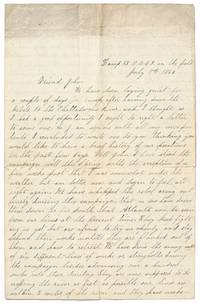
1864Best.-Nr. 438776Atlanta Georgia 1864. Very Good. Autograph Letter Signed. Folio. 4pp. Partial splitting at the edges of one vertical and two horizontal folds about very good. A detailed and historically important long letter written in the field by Union soldier Harvey Rodgers just two weeks before he was killed at the Battle of Atlanta on July 22 1864. Rodgers was mustered into service in 1861 as a Corporal in the 54th Regiment Ohio Volunteer Infantry Zouaves Company A commanded by 1st Lt. Judson McCoy referred to as "Jud" in the letter. In the letter written to his "Friend John" on four easily legible folio pages Rodgers describes Confederate and Union Army maneuvers and skirmishes immediately after the Battle of Kennesaw Mountain fought from June 19 - July 2 1864 during the lead-up to the Battle of Atlanta which began on July 21st: ". Well John I have stood the campaign well this Spring . We have whipped the rebel army out finely . that is we have drove them so far South that Atlanta can be seen from our lines . I suppose you have heard about our making a charge on the 27th June . I do not wish to be in anymore such places . we lay in camp until the 2nd of July when our Division moved . very near due south of the Kennesaw mountain. That night Jud with our Company was on picket. We heard the cars very plain but did not think they the rebel army were evacuating the mountain and falling back . Next morning . We did not move forward until two o'clock when we advanced our lines two miles finding a small force of Cavalry in our front which we routed by charging them. The Regt. lost 1 killed 14 wounded ." He describes a second skirmish on July 4th at which his Company fought in support of the Union army's 16th Corps to advance Union lines and continues: ". On the 5th we were moved back again and brought further around on the right where we now lay. Our front lines are two miles further on. The rebels have a line of works between them and the Chattahoochee river . I expect we will have a pretty hard time before we get there and a hard time to cross the river ." The Battle of Atlanta commenced on July 21 1864. Both Harvey Rodgers and Union Maj. Gen. James B. McPherson were killed during the battle on July 22nd. Rodgers' letter thus ends poignantly: "Well John my time is fast rolling around now and I begin to think I will soon get home again. Only two months and 8 days more . Still in that short time there are many dangers to undergo. I may be called on to go into several more charges. Perhaps of some one not to come out alive . There has not more than half a dozen days passed since the 10th of May but what we have been under the sound of artillery. The troops appear to be pretty well worn out and wish for the campaign to close yet they all want to get into Atlanta first ." A compelling and ultimately heartbreaking eye witness account of General Sherman's Atlanta campaign during the summer of 1864. Longer quoted extracts from the letter are available. unknown
2007Best.-Nr. DADAX0548276463Kessinger Publishing 2007-07-25. hardcover. New. 6.00x0.63x9.00. Buy with confidence. Excellent Customer Service & Return policy. Kessinger Publishing hardcover
Best.-Nr. 64610730The Naval & Military Press . Papeback. New. pp. 378 The Naval & Military Press unknown
2007Best.-Nr. DADAX1783316322Naval & Military Press 2020-07-10. paperback. New. 6.00x0.84x9.00. Buy with confidence. Excellent Customer Service & Return policy. Naval & Military Press paperback
2007Best.-Nr. DADAX1783316551Naval & Military Press 2020-07-10. hardcover. New. 6.00x1.00x9.00. Buy with confidence. Excellent Customer Service & Return policy. Naval & Military Press hardcover
1946Best.-Nr. 837P9Not Stated: Not Stated 1946. Cloth. Good. 8.5" by 6". Not Stated. An illustrated history of the 23rd Hussars a regiment raised during the Second World War illustrated with many folding maps. A detailed account of the 23rd Hussars written by those in the regiment.This cavalry regiment was raised by the British Army during the Second World War and it existed from 1940 to 1946.Notable members of the regiment were the film music composer John Addison the barrister John de Cunha and the MP Sir Alan Glyn.Illustrated with eleven folding maps and forty-nine plates.Prior owner's ink inscription to the verso of the front endpaper H. T. King who was a member of the 23rd Hussars.Lacking the dust wrapper. In the original publisher's cloth binding. Externally boards are bowed. Light bumping to the extremities. A few minor marks to the boards and spine. Prior owner's ink inscription to the verso of the front endpaper. Internally binding is a little strained. Pages are bright and clean with a couple of spots. Good Not Stated hardcover
Best.-Nr. 224600C E & D J Finkemeyer Melbourne 1998. 291 pp illustrated end-papers b&w illustrations maps fine copy in like pictorial d/j. Inscribed and signed by the editor/ publisher on front end-paper: "Both our best wishes Colin Finkemeyer 4/1/99" with original sketch head of Japanese Guard with signature of Don Moore - the illustrator. C E & D J Finkemeyer, Melbourne, 1998 unknown
2006Best.-Nr. DADAX1847343910Naval & Military Press 2006-06-20. hardcover. New. 5.50x0.56x8.50. Buy with confidence. Excellent Customer Service & Return policy. Naval & Military Press hardcover
1862Best.-Nr. 72838np: np 1862. Civil War letter archive comprising 78 chronologically arranged letters the majority from Corporal Christopher C. Mead of the 12th New Jersey Regiment to his wife Hannah dated November 12 1862 to May 29 1864. Two letters comprise correspondence between Christopher and Hannah in March and April 1864; Hannah authored two additional letters in May 1864. Three letters are incomplete. Most bear penciled numbers on the front apparently added by a previous handler. The correspondence is generally legible though some letters have faded more than others; overall the paper is in good condition. The archive also includes three undated and unsigned letter fragments; an unsigned letter dated June 18 1863; a September 16 1862 letter addressed to "Uncle Christopher" concerning family matters accompanied by a note reading "Mrs. Hannah Mead Woodstown Salem Co. New Jersey Please forward"; and a four-page indenture dated 1811 and signed by James Mead. The most striking letters are Corporal Mead's fist hand account at the Battle at Gettysburg with vivid description of Picket's charge written on July 6th. Shortly after Pickett's Charge at Gettysburg Mead. an active participant in the battle. writes his wife Hannah: ".The next day was the severest of the fighting. Skirmishing was kept up until about noon when the rebels opened with about 80 pieces of artillery upon us which was kept up for about 3 hours when they succeeded in silencing one of our batteries; the artillery fight which was about a half mile apart ours being on a hill theirs masked in the woods the ground between us was lower than either of the artillery positions. After they had succeeded in silencing in silencing the battery they began to pour out of the woods in 3 lines of battle and a line of skirmishers in advance of them. In all 18 reg's strong approaching our front they made a splendid approach with their colors flying in the breeze. I was about the center of our line at the point of which they were approaching and had a fair view of them although they had silenced our battery. Thanks be to God of our Nation we had more in reserve for them. Well charged with great and canister shot which was opened upon them with terrible effect. But as their ranks were terribly thinned by the artillery fire yet they closed up quickly their ranks and marched on like brave determined men to accomplish their purposes. On they came driving our skirmishing line before them like so many frightened sheep. Although they fought well until they saw there was no chance then they fell back quickly as they possibly could; and as soon as the rebs came in range of our guns of our line of battle which laid behind piles of rails and stones four deep we opened on them and they fell like grain before the reaper which nearly annihilated them and all that came as far as our line of battle came as prisoners and of the 18 stand of colors they so nobly brought out only one seen to go back." Letter from Gettysburg recounts the Battle of Pickett's Charge. During Pickets Charge Mead writes "But as their ranks were terribly thinned by the artillery fire yet they closed up quickly their ranks and marched on like brave determined men to accomplish their purposes. On they came driving our skirmishing line before them like so many frightened sheep. Although they fought well until they saw there was no chance then they fell back quickly as they possibly could; and as soon as the rebs came in range of our guns of our line of battle which laid behind piles of rails and stones four deep we opened on them and they fell like grain before the reaper which nearly annihilated them and all that came as far as our line of battle came as prisoners and of the 18 stand of colors they so nobly brought out only one seen to go back." From Longacre page 135 "Several minutes under the storm of Federal bullets reduced Lowrances and Lane's brigades to bloody fragments. A handful managed to reach the wall before they went down riddled with balls. Their comrades at last convinced of the futility of it all began to flee. Many fell dead the moment they turned their backs to the enemy. Others hugged the ground in the hope of surviving the hail of lead long enough to surrender." Pickett's Charge July 3 1863 also known as the Pickett-Pettigrew-Trimble Assault was a major Confederate infantry attack against Union positions under Major General George G. Meade on the final day of the Battle of Gettysburg. Ordered by General Robert E. Lee and directed by Lieutenant General James Longstreet approximately 12500 Confederate soldiers advanced nearly three-quarters of a mile across open ground toward the center of the Union line on Cemetery Ridge. Preceded by a heavy artillery bombardment the assault was met by intense Union artillery and rifle fire and was repulsed with more than 50 percent Confederate casualties. The failed attack effectively ended Lee's invasion of Pennsylvania and forced the Confederate Army's retreat to Virginia. Popularly named for Major General George Pickett whose division formed the center of the assault the charge is often regarded as a major turning point of the Civil War and is associated with the "high-water mark of the Confederacy" referring to the farthest point reached by Confederate forces. Mead writes from Hanover County Virginia late May 1864. Soon after he fought in the Battle of Cold Harbor May 31 - June 12 1864 where Mead was killed. Battle of Cold Harbor May 31-June 12 1864 was a major engagement of the Union Army's Overland Campaign against Richmond. At the crossroads of Cold Harbor roughly ten miles northeast of Richmond General Ulysses S. Grant's Army of the Potomac launched repeated assaults against entrenched Confederate forces under General Robert E. Lee culminating in a devastating attack on June 3. The Union assaults failed to break the Confederate defenses and resulted in more than 17000 casualties. Grant subsequently disengaged crossed the James River and moved toward Petersburg a vital railroad and manufacturing center that guarded the approaches to Richmond. Although Cold Harbor was a costly Union defeat Grant's continued advance ultimately placed Confederate forces under sustained pressure around Richmond and Petersburg. np unknown
2010Best.-Nr. DADAX1163577170Kessinger Publishing 2010-09-10. hardcover. New. 6.00x0.63x9.00. Buy with confidence. Excellent Customer Service & Return policy. Kessinger Publishing hardcover
Best.-Nr. DADAX1476669090McFarland 2018-06-25. Illustrated. paperback. New. 7.00x1.06x10.00. Buy with confidence. Excellent Customer Service & Return policy. McFarland paperback
2007Best.-Nr. DADAX0548500622Kessinger Publishing 2007-09-12. paperback. New. 6.00x1.63x9.00. Buy with confidence. Excellent Customer Service & Return policy. Kessinger Publishing paperback
2007Best.-Nr. DADAX0548597561Kessinger Publishing 2007-10-02. paperback. New. 6.00x1.16x9.00. Buy with confidence. Excellent Customer Service & Return policy. Kessinger Publishing paperback
1936Best.-Nr. 36076Madrid 1936.- Una enorme hoja de papel couchet en Gran folio Imperial 62 x 104 cm. con el texto bilingüe español-francés profusamente ilustrada por ambas caras con fotografías en negro y que muestran los diversos daños causados a la población civil por los ataques de aviones enemigos sobre el barrio de Tetuán de las Victorias.- Buen estado en general algo debilitada por la parte de las dobleces. GUERRA CIVIL 1936-1939 Y EXILIO Libro en español Sin editorial paperback
1936Best.-Nr. 36075Madrid 1936.- 1 hoja en papel couché de Gran Folio Imperial apaisado 325 x 73 cm. con texto trilingüe español-francés-inglés profusamente ilustrada en sus dos caras con fotografías de Museo del Prado en las que se aprecia toda la destrucción que causaron los ataques llevados a cabo sobre Madrid el 16 de Noviembre entre 7 y 8 de la tarde.- Lleva noticia del entonces subdirector del Museo F. S. Sánchez Cantón y artículo del poeta Antonio Machado. Está en buenas condiciones aunque se han restaurado rajitas de las dobleces. GUERRA CIVIL 1936-1939 Y EXILIO Libro en español Sin editorial paperback
Best.-Nr. A9781163803899Paperback / softback. New. paperback